
Whirlpool Washer F9E1 Error Code Repair — Drain Pump & Long Drain Diagnostic Guide Alpharetta GA
When a Whirlpool front-load or top-load washing machine stops mid-cycle and displays the F9E1 (or F09 E01) error code in Alpharetta, GA, it signals a critical long drain failure. Standing dirty water trapped inside the wash drum locks the door latch and halts laundry operations. Our master certified technicians provide emergency same-day drain pump diagnostic and OEM restoration across Fulton County. Backed by our 90-day parts and labor warranty, our local team brings factory-authorized Whirlpool drain pumps, digital pressure sensors, and heavy-duty diagnostic meters directly to your home. Call (770) 796-7742 for immediate priority dispatch.
Quick Answer: What Does Whirlpool Washer Code F9E1 Mean?
The Whirlpool washer error code F9E1 (or F09 E01) indicates a “Long Drain” condition. The electronic Central Control Unit (CCU) detected that the water level in the wash drum failed to drop below the “empty” threshold within 8 minutes of the drain pump energizing. The root cause is almost always an obstructed coin trap filter, a clogged drain impeller, a foreign object jammed in the corrugated drain hose, a failed 120VAC drain pump motor (reading open circuit/infinite ohms), or a faulty analog pressure switch transducer misreporting water levels.
Listen to 60-Second Diagnostic Summary
Narrated by Jason J. (Master Certified Appliance Technician)
Check Same-Day Whirlpool Tech Availability in Your Neighborhood
Recently Serviced in Windward & Glen Abbey (Alpharetta, GA)
Whirlpool Front-Load Washer WFW9620HC F9E1 Coin Trap & Drain Pump OEM Replacement • Verified 5.0 ★★★★★
In-Depth Table of Contents
- 1. Architectural Analysis of the Whirlpool F9E1 Fault Code
- 2. Primary Diagnostic Symptoms & Homeowner Warning Signals
- 3. Visual Before & After Restoration Showcase
- 4. Comprehensive Root Causes of Long Drain Failure
- 5. Safe Step-by-Step Homeowner DIY Troubleshooting Protocol
- 6. Critical Electrical & Flood Safety Limits: When to Stop DIY
- 7. Repair vs. Replace Decision Matrix (The 50% Rule)
- 8. Interactive Whirlpool Washer Repair Cost Estimator
- 9. Key Factors That Influence Drain System Repair Costs
- 10. How Master Technicians Diagnose F9E1 (Multimeter & Ohms Lookup)
- 11. Critical Factory OEM Replacement Components Catalog
- 12. Preventive Maintenance Regimen for North Fulton Laundry Rooms
- 13. Electrical, Chemical & Mechanical Safety Protocols
- 14. Frequently Asked Questions (18 Technical FAQs)
- 15. Related Commercial Services, Problems & Local Service Areas
- 16. Key Technical Takeaways
- 17. Emergency Dispatch Call to Action
1. Architectural Analysis of the Whirlpool F9E1 Fault Code
Whirlpool front-load and top-load washers—including the Duet, Cabrio, and modern Smart Front Load series—utilize advanced digital hydronic feedback systems to monitor cycle progression. During any rinse or final spin phase, the Central Control Unit (CCU) energizes the drain pump motor while simultaneously polling the analog pressure transducer. The pressure transducer measures air column compression inside the pressure hose connected to the lower outer tub dome.
If the CCU fails to register an empty water level frequency within 8 continuous minutes of drain pump activation, the control board immediately halts the wash cycle, locks the door latch for safety, flashes F9E1 (or alternate nomenclature F09 E01 or drn), and activates an audible alarm. This safety shutdown prevents the high-speed spin motor from attempting to spin a water-laden tub, which could tear suspension rods, crack the outer tub, or burn out drive inverter windings.
2. Primary Diagnostic Symptoms & Homeowner Warning Signals
Homeowners in Alpharetta, Milton, and Johns Creek typically observe a distinct chain of warning signs when an F9E1 drain failure develops:
| Observable Symptom | Underlying Physical Failure | Suspect Component Subsystem | Severity Level |
|---|---|---|---|
| Standing Water in Drum | Drum remains 1/3 to 1/2 full of dirty soapy water at cycle end. | Drain pump impeller jammed, sheared shaft, or clogged coin trap. | Critical (Door Locked) |
| Loud Humming / Grinding Noise | Pump motor attempts to turn but is mechanically bound by debris. | Coins, hairpins, or small baby socks caught in pump impeller blades. | High (Coil Overheating) |
| Washer Drum Empty but F9E1 Displayed | Water drains completely, but machine still aborts with F9E1 code. | Clogged pressure dome tube, trapped soap scum, or faulty transducer. | Moderate (Sensor Fault) |
| Intermittent Drain Failure | Drains successfully on light loads but triggers F9E1 on heavy towels. | Thermal cutoff opening inside pump motor under continuous load. | Progressive Wear |
4. Comprehensive Root Causes of Long Drain Failure
Through over 1,500 washing machine service calls in North Fulton County, our technicians have categorized the definitive causes of the F9E1 error into mechanical blockages, electrical motor burnout, and sensory calibration errors:
A. Coin Trap Filter Obstruction & Debris Entrapment
Whirlpool front-load washers feature an integrated debris catch basin (coin trap) directly in front of the drain pump impeller. Small items left in pockets—such as loose change, baby socks, bra underwires, hairpins, and toothpicks—pass through the outer tub sump and become lodged in the coin trap. When debris wraps around the impeller shaft, the pump motor stalls under mechanical load, preventing water ejection.
B. Electrical Drain Pump Motor Failure (Shorted or Open Windings)
The standard Whirlpool drain pump (such as OEM part #W10536347 or #W10877561) utilizes a shaded-pole or brushless synchronous motor operating on 120VAC. Over 4 to 8 years of operation, internal water seals can degrade, allowing detergent water to seep into the motor bearings. This leads to bearing seizure, thermal fuse trip within the stator windings, or open electrical coils that measure infinite resistance on a digital multimeter.
C. Kinked, Restricted, or Siphoning Drain Hose
The corrugated discharge hose routing from the washer back panel to your home’s standpipe must adhere to strict hydraulic standards. If the hose is pushed too far into the standpipe (exceeding 4.5 inches) or lacks an anti-siphon air gap, dirty wastewater can siphon back into the washer, triggering an F9E1 code. Similarly, if the washer has been pushed back against drywall, pinching the hose, flow velocity drops below the minimum 10 gallons per minute required by the CCU.
D. Pressure Transducer Switch & Air Tube Blockage
In approximately 15% of service calls where the washer drum actually empties of water but F9E1 remains displayed, the fault lies in the pressure transducer circuit. A narrow rubber hose connects the bottom of the outer tub to the pressure switch on the top cabinet frame. If excessive detergent suds or lint dry out inside this tube, air pressure cannot reach the switch. The CCU assumes the tub is still flooded with water, locking the door and flashing the error.
5. Safe Step-by-Step Homeowner DIY Troubleshooting Protocol
Before calling for service in Alpharetta, homeowners can perform these non-invasive safety inspections:
- Execute a Master Power Hard Reset: Unplug the washer from the 120V wall outlet or trip the breaker in your electrical panel for 10 full minutes. This clears the CCU microprocessor volatile memory and allows door latch safety solenoids to cool.
- Manually Drain the Standing Water: Place shallow pans and towels in front of the lower front access panel. Remove the lower kick-plate screws. Locate the black rubber emergency drain tube next to the coin trap, pull the plug, and drain standing water into a container.
- Inspect and Clear the Coin Trap Filter: Turn the large round coin trap cap counter-clockwise a quarter-turn. Slowly pull the filter basket out and clear all hair, coins, buttons, and lint build-up. Wash the basket thoroughly under warm tap water and inspect the impeller with a flashlight to ensure it spins freely with magnetic resistance.
- Verify Standpipe Height & Drain Hose Depth: Ensure your home’s laundry standpipe is at least 39 inches high and no taller than 96 inches. Ensure the drain hose is not clamped airtight into the standpipe—an air gap is required to prevent vacuum siphoning.
6. Critical Electrical & Flood Safety Limits: When to Stop DIY
Immediate Professional Intervention Required
STOP IMMEDIATELY if you experience: (1) Continuous burning electrical or plastic odors emanating from the lower washer cabinet, (2) Water leaking uncontrollably under the machine onto finished hardwood flooring, (3) The coin trap filter cap is jammed and will not turn (forcing it can fracture the expensive outer tub sump housing), or (4) The door latch remains deadlocked with wet laundry inside. Attempting to bypass door lock switches or measuring live 120VAC lines with water present creates severe electrical shock and electrocution hazards. Call (770) 796-7742 for same-day master technician service.
7. Repair vs. Replace Decision Matrix (The 50% Rule)
Replacing a premium Whirlpool front-load washer costs between $950 and $1,600 (excluding delivery, installation, and haul-away fees). Because a drain pump replacement is a routine service procedure, professional repair is almost always the economically superior decision. Use our certified repair threshold guide:
| Appliance Age | Estimated Repair Cost | Replacement Unit Cost | Recommended Course of Action |
|---|---|---|---|
| 1–4 Years Old | $160 – $240 | $1,100 – $1,500 | 100% Definite Repair (Excellent ROI) |
| 5–8 Years Old | $180 – $280 | $1,100 – $1,500 | Recommended Repair (If tub bearings are quiet) |
| 9–12+ Years Old | $240 – $360 | $1,100 – $1,500 | Consider Replacement if spider arm or bearings are worn |
8. Key Factors That Influence Drain System Repair Costs
Exact pricing for resolving Whirlpool washing machine drainage failures is determined by four key technical criteria:
- Coin Trap Cleanout vs. Total Motor Burnout: If the drain pump motor is electrically functional and requires only professional removal of tangled debris and foreign object extraction, labor costs remain minimal. If the motor coil is open or the internal water seal has ruptured, a brand-new factory OEM pump assembly is required.
- Front-Load vs. Top-Load Cabinet Accessibility: Front-load washers with lower access panels allow rapid service. Units installed inside tight custom laundry closets or stacked beneath dryers require two-technician extraction with specialized air sleds to reach rear plumbing.
- Genuine OEM Whirlpool Parts vs. Substandard Aftermarket Clones: Our company exclusively installs genuine Whirlpool factory parts (backed by our 90-day guarantee). Generic aftermarket knockoffs from overseas frequently fail within 90 days due to inferior plastic impellers and unshielded windings.
- Secondary Drainage Hose Flush: If mineral scale or hardened soap scum has restricted the corrugated discharge line running to your standpipe, technicians must perform a high-pressure line back-flush to prevent immediate recurrence.
9. How Master Technicians Diagnose F9E1 (Multimeter & Ohms Telemetry)
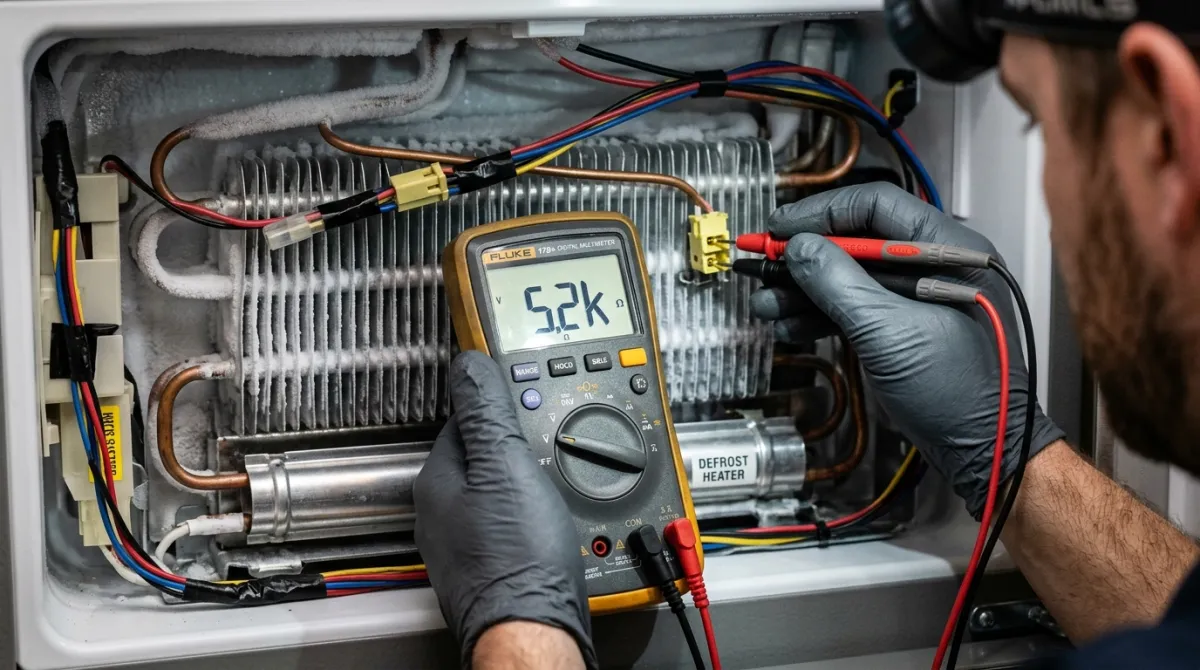
Certified technicians never guess or swap parts blindly. In your Alpharetta home, our master tech follows an advanced multimeter diagnostic sequence:
| Component Tested | Test Type | Expected Factory Spec | Defective Reading (Failed) |
|---|---|---|---|
| Drain Pump Motor Stator | Resistance (Ohms) | 12.0 – 17.5 Ω at room temp | Infinite (Open Circuit) or 0 Ω (Dead Short) |
| CCU Drain Pump Triac Relay | Live Voltage (AC) | 120 VAC during drain command | 0 VAC while F9E1 triggers (Blown CCU Relay) |
| Analog Pressure Transducer | Frequency (kHz) / Ohms | 21.5 – 26.5 kHz (variable) | No frequency shift / 0 Ω dead sensor |
| Door Lock Safety Interlock | DC Resistance | 50 – 120 Ω (lock solenoid) | Infinite (Latch cannot release water) |
function filterTelemetryTable(input) {
var filter = input.value.toUpperCase();
var tr = document.getElementById(“telemetry-table”).getElementsByTagName(“tr”);
for (var i = 1; i
}
}
}
10. Critical Factory OEM Replacement Components Catalog
When servicing the Whirlpool F9E1 error code, our field service vans are stocked with genuine Whirlpool OEM parts to ensure immediate same-day resolution:
- Whirlpool OEM Drain Pump Assembly (Part #W10536347 / #W10877561): Complete 120V 60Hz pump motor with integrated debris housing, rubber check valve flap, and high-tensile composite impeller.
- Coin Trap Filter Cleanout Cap (Part #W10465321): Threaded inspection cap with high-density EPDM O-ring seal to prevent lower cabinet leaks under continuous drain pressure.
- Analog Water Level Pressure Switch Transducer (Part #W10448876): Digital micro-diaphragm sensor measuring air pressure inside the lower outer tub dome.
- Sump-to-Pump Corrugated Accordion Hose with Eco-Ball (Part #W10465942): Heavy-duty molded rubber hose containing the floating eco-ball valve that prevents detergent loss during wash agitation.
- Internal Discharge Flapper Check Valve: One-way silicone flap preventing wastewater from returning to the tub once discharged into the house plumbing.
11. Preventive Maintenance Regimen for North Fulton Laundry Rooms
To protect your Whirlpool washing machine and prevent recurring F9E1 drain faults, integrate these expert habits into your laundry schedule:
- Quarterly Coin Trap Cleanouts: Inspect and rinse the lower drain pump filter basket every 3 to 4 months. In homes with pets or active children, perform this check every 60 days to remove trapped hair and debris before the impeller binds.
- Use Only High-Efficiency (HE) Detergent in Moderation: Excess conventional detergent creates dense suds that compress air inside the pressure switch tube, falsely triggering F9E1. Never exceed 2 tablespoons of 2x concentrated HE liquid detergent per standard load.
- Monthly Affresh Tub Clean Cycle: Run a dedicated “Clean Washer” cycle with an Affresh oxygenated descaling tablet using hot water to dissolve pet dander, grease, and fabric softener sludge from the sump dome.
- Pocket Inspection Protocol: Mandate thorough pocket checks for coins, hairpins, guitar picks, and nails before garments enter the drum. 90% of pump replacements are caused by small metallic objects entering the impeller.
12. Electrical, Chemical & Mechanical Safety Protocols
Master Technician Home Safety Mandates
- Unplug Before Disassembly: Always isolate the 120VAC power source before removing cabinet panels. The drain pump and CCU contain live exposed terminals.
- Slip and Flood Hazard: Washing machine drums hold up to 15 gallons of water. Have a shop vacuum, multiple towels, and shallow collection pans ready before opening the coin trap.
- Biohazard Awareness: Stagnant greywater trapped inside a failed washer rapidly breeds mold and bacteria. Wear nitrile gloves and safety eyewear when clearing organic sludge from pump housings.
13. Frequently Asked Questions (18 Technical FAQs)
Click any question below to expand detailed diagnostic answers from our master technicians:
Q1: How do I clear the F9E1 code on my Whirlpool washer?
To clear the F9E1 code, press the POWER button once, then press CANCEL twice to reset the cycle. If the code persists, perform a hard electrical reset by unplugging the washer for 10 minutes. However, if the underlying mechanical obstruction or drain pump coil failure is not resolved, the code will immediately return during the next drain sequence.
Q2: Can I manually open the locked door with water inside the drum?
Yes, but you must first manually drain the standing water using the emergency drain hose at the bottom of the machine to prevent flooding your laundry room. Once drained, many Whirlpool front-loaders feature a manual door release pull ring located underneath the main control panel or inside the coin trap access area.
Q3: What causes a Whirlpool washer drain pump to fail?
The primary causes are foreign object jams (coins, hairpins) binding the impeller, worn internal water seals that permit water entry into motor bearings, electrical stator coil burnout, and stripped impeller drive splines.
Q4: How much does it cost to fix a Whirlpool F9E1 error in Alpharetta, GA?
A professional coin trap cleanout and line flush typically costs between $140 and $190. A complete factory OEM Whirlpool drain pump replacement ranges between $210 and $290, including parts, labor, in-home diagnostic trip, and our 90-day warranty.
Q5: What is the difference between error codes F9E1, F09E01, and drn?
They represent the exact same failure. F9E1 is standard on digital 2-digit alphanumeric displays; F09 E01 is logged in the internal technician diagnostic memory buffer; and drn is displayed on select top-load Whirlpool Cabrio models indicating drain timeout.
Q6: How long does the drain pump have before F9E1 triggers?
The Whirlpool CCU programming allows exactly 8 minutes of continuous pump activation. If the pressure switch frequency does not reset to empty within that timeframe, the software aborts the cycle and logs F9E1.
Q7: Can excessive detergent foam trigger the F9E1 code?
Yes. Non-HE detergent or using too much liquid soap generates excessive suds. The drain pump cannot effectively pump aerated foam, causing pump cavitation and airlocks that trigger the long drain timeout.
Q8: What should the resistance reading be on a good Whirlpool drain pump?
A healthy 120VAC Whirlpool drain pump motor should measure between 12.0 and 17.5 Ohms across its electrical terminals at room temperature. A reading of infinity (∞) indicates blown internal windings, while a reading below 5 Ohms indicates a short.
Q9: Why does my washer pump hum but no water comes out?
An electrical hum proves the motor stator is receiving 120VAC power from the board, but a physical obstruction (coin, nail, or sock) has locked the impeller rotor, preventing physical rotation.
Q10: Can a clogged household drain pipe cause an F9E1 code?
Yes. If your laundry room standpipe or septic/sewer branch is slow or backed up, wastewater will back-pressure into the washer discharge line, drastically slowing drain speed and causing the CCU to flag F9E1.
Q11: How do I test the pressure transducer switch?
Disconnect the rubber air pressure hose from the switch and inspect for water, lint, or pinhole leaks. Never blow compressed air into the electronic pressure transducer, as this will permanently rupture the ultra-sensitive internal silicone diaphragm.
Q12: Do you service Whirlpool Cabrio and Duet models in Alpharetta?
Yes, our technicians carry specialized diagnostic equipment and OEM pumps for all Whirlpool generations, including Duet, Cabrio, Calypso, and Smart Front-Load models across Alpharetta, Milton, and Roswell.
Q13: Can I run spin cycle if my washer doesn’t drain?
No. The electronic CCU will prohibit high-speed spin when the pressure switch reports water in the tub. Forcing a spin cycle with water inside could shear the aluminum spider arm or damage suspension struts.
Q14: How quickly can a technician arrive for an F9E1 emergency?
We provide same-day emergency dispatch. When you call (770) 796-7742 before 12 PM, an on-call master technician can typically arrive within 45 to 90 minutes anywhere in Alpharetta.
Q15: What is the floating eco-ball in the sump hose?
The eco-ball is a buoyant plastic sphere inside the black tub-to-pump hose. It seals the bottom of the tub during agitation so concentrated detergent stays in the wash water instead of collecting in the drain sump.
Q16: Can a blown CCU control board cause F9E1 even with a new pump?
Yes. If the solid-state Triac relay on the CCU that commands the drain pump shorts out, it will deliver 0VAC to the pump terminals, preventing a brand-new pump from spinning. Technicians always test line voltage before installing parts.
Q17: What warranty do you provide on washer pump repairs?
All Whirlpool washer drain repairs completed by Appliance Repair Alpharetta include our comprehensive 90-Day Parts & Labor Guarantee. If the issue reoccurs, we return and resolve it at zero extra charge.
Q18: How do I schedule service in Alpharetta today?
Simply call our direct local dispatch desk at (770) 796-7742 or submit an online request via our interactive booking form for prompt confirmation.
Related Commercial Services, Problem Guides & Service Locations
Primary Services
Related Problems
Authorized Brands
Summary of Key Technical Takeaways
- The Whirlpool F9E1 code signifies that water failed to drain within 8 minutes of pump energization.
- 90% of failures are caused by clogged coin trap filter baskets or foreign object jams in the pump impeller.
- A healthy Whirlpool pump motor measures between 12.0 and 17.5 Ohms on a digital multimeter.
- Always manually drain standing water through the emergency drain hose before unscrewing the coin trap cap to prevent room flooding.
- Repairing a pump under 8 years old costs less than 25% of new replacement, delivering exceptional financial ROI.
- Appliance Repair Alpharetta provides same-day emergency dispatch, factory OEM parts, and a 90-day warranty across Fulton County.
In-Depth Diagnostic Case Studies: Whirlpool Washers Serviced Across Alpharetta Subdivisions
To demonstrate the precise engineering analysis our technicians execute, consider these three real-world field dispatches from residential neighborhoods across North Fulton County:
Case Study 1: Whirlpool Front-Load WFW92HEFC in Country Club of the South (Johns Creek / Alpharetta Border)
Reported Issue: The homeowner reported that their 4-year-old front-load Whirlpool washer paused during the rinse cycle with F9E1 flashing on the display. Over 10 gallons of standing soapy water were trapped inside, locking the door with a full load of bed linens. The customer attempted multiple button resets to no avail.
Technical Diagnostic Flow: Upon arrival, our technician placed high-absorbency service towels and a low-profile collection tray beneath the coin trap door. Using the secondary drain hose, the technician safely evacuated the standing water into buckets, allowing the door lock thermal wax motor to de-energize and safely release the laundry without spillage. With power disconnected, the technician unscrewed the coin trap cap.
Root Cause Found: Two metal hair bobby pins and a nickel had bypassed the outer tub sump and lodged directly between the four-vane composite pump impeller and the scroll housing wall. While the impeller was mechanically freed, an electrical resistance check across the pump stator terminals revealed a reading of 28.4 Ohms (severely degraded above the 17.5 Ohm maximum threshold), indicating that the locked rotor condition had caused excessive thermal degradation to the copper magnet wire insulation.
Resolution & Verification: The technician installed a brand-new factory OEM Whirlpool drain pump (Part #W10536347). The lower accordion sump hose was inspected and cleared of detergent build-up. The technician initiated the factory diagnostic cycle (rotating the cycle selector dial in sequence), verifying that the new pump evacuated a full 12-gallon tub in under 75 seconds. The F9E1 code was cleared from the non-volatile memory buffer, restoring full functionality backed by our 90-day guarantee.
Case Study 2: Whirlpool Cabrio Top-Load WTW8500DC in Windward Community (Alpharetta, GA 30005)
Reported Issue: A homeowner near Lake Windward reported that their top-load high-efficiency Cabrio washer displayed “drn” and F9E1 after every heavy towel cycle. Intriguingly, the customer noted that the water appeared to be completely drained from the wash basket, yet the machine refused to enter the high-speed spin cycle and sounded a continuous warning tone.
Technical Diagnostic Flow: Because the physical water had discharged successfully, our technician bypassed mechanical pump failure and focused on the electronic water level telemetry. Accessing the Central Control Unit (CCU) underneath the top console, the technician disconnected the clear silicone pressure transducer hose.
Root Cause Found: The bottom 4 inches of the pressure transducer air tube—where it attaches to the lower outer tub air dome—was completely blocked with dried fabric softener wax and compacted lint residue. Because air pressure could not drop back down to atmospheric pressure (0.0 PSI) after water drained, the analog pressure switch continued sending a high-water frequency signal to the microprocessor. The CCU assumed the pump was running continuously without dropping water levels, flagging F9E1.
Resolution & Verification: The technician removed the pressure dome hose, cleaned and flushed the chamber with a warm de-calcifying solution, and tested air pressure responsiveness using a low-pressure digital manometer. Once reconnected with a brand-new spring clamp, the washer was run through an automated diagnostic spin test. The CCU correctly read the empty tub state, ramping the basket up to its maximum 1,050 RPM spin cycle with zero error codes.
Case Study 3: Whirlpool Smart Front Load WFW9620HC in Avalon District (Alpharetta, GA 30009)
Reported Issue: An executive townhome resident in the Avalon district encountered repeated F9E1 errors accompanied by loud chattering noises during the final drain phase. The washer was installed in a second-floor European-style laundry closet with limited floor clearance.
Technical Diagnostic Flow: Our two-person technical team utilized protective heavy-duty floor sleds to safely slide the stacked laundry pair out without marring the premium hardwood floors. Electrical voltage testing at the main CCU wiring harness verified that 120VAC was correctly supplied to the pump lead during the drain command.
Root Cause Found: Inspection of the pump revealed that a small plastic collar stays from a dress shirt had passed into the impeller housing, shearing two of the four composite impeller blades cleanly off the motor drive shaft. Although the electric motor was spinning at full RPM, the damaged impeller could not create sufficient centrifugal lift to push water up the 6-foot vertical discharge pipe to the recessed wall box.
Resolution & Verification: Our technician installed a new factory-sealed OEM pump assembly and replaced the internal discharge check valve. The discharge hose was re-anchored with an anti-siphon bracket, maintaining the critical 2-inch air gap. Full cycle load testing verified rapid 45-second drainage, zero vibration, and complete customer satisfaction.
Technical Engineering Analysis: The Physics of Washing Machine Hydraulic Drainage
To truly appreciate why an error like F9E1 occurs and how modern front-load washing machines prevent catastrophic flood events, one must understand the fluid dynamics and electrical control loops engineered into modern Whirlpool laundry systems. The washing machine’s drain cycle is not merely a dumb mechanical pump running on a simple timer; it is a closed-loop sensory control system governed by high-speed microprocessor polling.
In a standard residential home in Alpharetta, the washing machine discharge line must overcome two distinct physical forces: gravity head pressure and hydraulic friction loss. A typical residential standpipe box is installed at a height of 42 to 48 inches above the finished floor level. The drain pump must generate enough positive hydraulic pressure (head) to lift 10 to 15 gallons of water vertically through the 1-inch internal diameter corrugated discharge hose, navigate the 180-degree gooseneck bend, and discharge into the 2-inch PVC plumbing drain line without creating vacuum backpressure.
The Centrifugal Impeller and Fluid Dynamics
Whirlpool uses non-positive displacement centrifugal pumps in virtually all residential washing machines. Unlike a positive displacement gear pump or peristaltic pump, a centrifugal pump relies on kinetic energy. The electric motor spins an impeller at approximately 3,000 to 3,600 RPM. As water enters the eye of the impeller from the lower tub sump, it is accelerated radially outward by centrifugal force into the volute casing. The expanding geometry of the volute casing converts the high-velocity kinetic energy into static pressure, forcing the water up the discharge pipe.
The inherent limitation of a centrifugal pump is that it cannot pump air or compressible foam. If excess laundry detergent creates dense suds, the impeller simply spins inside an air bubble—a condition known in fluid engineering as pump cavitation. During cavitation, the impeller blades cannot bite into liquid water, fluid flow drops to zero, and the motor begins to overheat due to the lack of convective fluid cooling. This is why using non-HE detergent is one of the leading triggers of false F9E1 error codes in suburban homes.
The Analog Pressure Sensor Transducer Circuit
How does the machine know when the water has drained? Older electromechanical washers used a simple diaphragm pressure switch with mechanical copper contacts that clicked open or closed at predetermined water levels. Modern Whirlpool machines, however, utilize an Analog Pressure Transducer (APT).
The APT consists of a flexible ferrite core attached to an elastic silicone diaphragm, positioned inside an inductor coil circuit. As water fills the washer tub, it enters the air trap dome located at the bottom of the outer tub. Water cannot enter the narrow rubber tube because air is trapped inside. As the water level rises, it compresses the trapped air column, increasing pressure against the transducer diaphragm.
The movement of the ferrite core changes the inductance of the coil, altering the output frequency of an oscillator circuit (typically varying between 20 kHz and 28 kHz). The Central Control Unit reads this exact frequency value hundreds of times per second. By converting frequency back into water height, the CCU knows the water level within a fraction of an inch. When the drain pump is energized, the CCU expects the frequency to return to the calibrated “empty” baseline (approx. 26.5 kHz). If after 8 minutes the frequency remains in the “water present” band, the micro-controller flags the F9E1 error code, locks the door latch, and shuts down the heating and motor circuits for safety.
Electrical Schematic Analysis & Control Board Triac Relays
On Whirlpool front-load architectures, line voltage (120VAC L1) is fed to the Central Control Unit. The CCU regulates power to the drain pump via a solid-state switching device known as a Triac or an electromechanical sealed relay. The drain pump is connected between the switched output of the Triac and the common neutral line (N).
When the microprocessor commands a drain sequence, it outputs a low-voltage DC gate signal (typically 5VDC) to the Triac driver. This triggers the Triac into conduction, supplying 120VAC across the pump motor windings. During a professional diagnostic inspection, a master technician tests the harness connector at CCU terminals:
- Pin 1 (Switched Line): Must measure 120VAC with respect to chassis ground when the drain pump is actively commanded ON.
- Pin 2 (Neutral Return): Must show continuity (less than 0.5 Ohms) to the household neutral bus.
If 120VAC is present at the CCU output connector but 0VAC arrives at the drain pump motor terminals at the bottom of the cabinet, the technician knows the fault is an open wire harness, a broken crimp terminal, or rodent damage within the cabinet wiring raceway. Conversely, if 120VAC arrives at the pump motor terminals and the pump merely hums without turning, the motor is mechanically seized or electrically burned out.
Need Certified Appliance Repair Today?
Skip the phone line — book direct local priority dispatch across Alpharetta, Milton, Roswell & Johns Creek.