
Turbo Air Commercial Refrigerator Temperature Sensor Error & Alarm Repair in Milton, GA
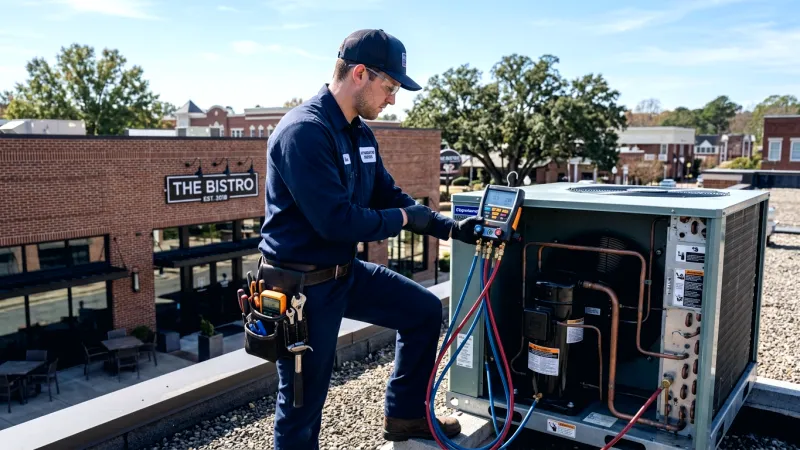
When a Turbo Air commercial reach-in refrigerator flashes a digital temperature sensor error or sounds an emergency high-temperature alarm in a Milton, GA restaurant, country club kitchen, or specialty food market, commercial kitchen operators face an immediate race against the clock. Operating above the strict FDA Food Code threshold of 41°F jeopardizes thousands of dollars in perishable meat, seafood, and dairy inventory while risking severe health inspection citations. This authoritative master technical guide delivers an exhaustive diagnostic breakdown of Turbo Air temperature sensor failures—including digital controller error codes P1, P2, HA, and LA, NTC thermistor resistance degradation, wiring harness corrosion, and condenser airflow blockages. Backed by factory-grade telemetry protocols and our comprehensive 90-day parts and labor warranty, our certified commercial refrigeration technicians provide same-day emergency dispatch across Milton, Crabapple, and surrounding North Fulton commercial districts. If your Turbo Air refrigeration unit is sounding an alarm or fluctuating out of safe temperature range, call our dedicated local dispatch team immediately at (770) 796-7742 for rapid emergency response.
Quick Answer: How to Resolve Turbo Air Commercial Refrigerator Temperature Errors
Quick Answer: A Turbo Air commercial refrigerator temperature error (flashing P1, P2, or HA) indicates a defective 10kΩ NTC thermistor probe, severed sensor wiring, or severe cabinet overheating above 41°F. First, inspect the self-cleaning condenser filter for grease accumulation and perform a 5-minute controller hard reset. If error codes persist or internal temperatures climb, immediately transfer perishable inventory and call certified commercial refrigeration technicians at (770) 796-7742 to test sensor Ohms and replace the failed OEM probe.
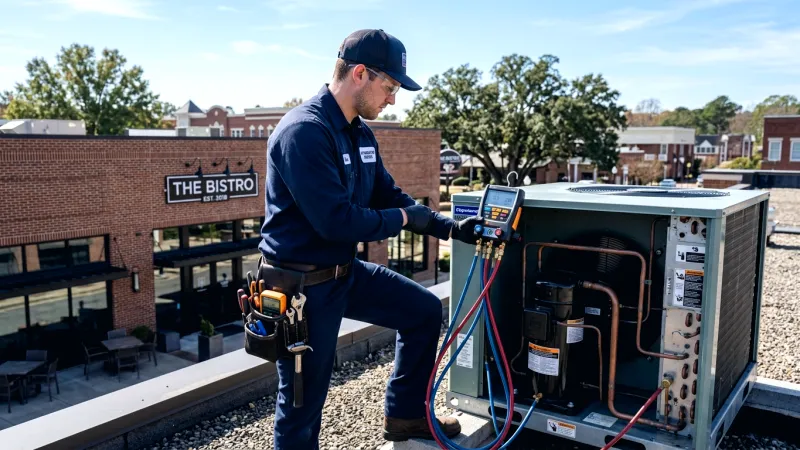
Listen to 90-Second Commercial Diagnostic Summary
Narrated by Marcus Vance (Senior Commercial Refrigeration Engineer)
Check Same-Day Commercial Refrigeration Tech Availability in Your Area
Verified Commercial Service Completed
Recently Serviced: Birmingham Hwy & Crabapple Rd, Milton, GA
Turbo Air M3R47-2 Two-Door Reach-In Refrigerator • P1 Sensor Fault Cleared, OEM NTC Thermistor Probe Installed, Evaporator Calibrated • ★★★★★ Verified Commercial Client
Commercial Refrigeration Diagnostic Table of Contents
- 1. Technical Overview & Commercial Refrigeration Architecture
- 2. Identifying Operational Symptoms & Turbo Air Alarm Codes
- 3. Visual Before & After Restoration Showcase
- 4. Common Mechanical & Electrical Causes Behind Sensor Faults
- 5. Step-by-Step Safe Facility Troubleshooting Protocols
- 6. Critical Safety Thresholds: When to Stop DIY (OSHA & EPA)
- 7. Commercial Economic Evaluation: Repair vs. Replace Matrix
- 8. Interactive Commercial Repair Cost Estimator
- 9. Estimated Commercial Cost Breakdown & Local Pricing Factors
- 10. How Professionals Diagnose: Multimeter & Telemetry Lookup
- 11. Failure Mode, Effects & Criticality Analysis (FMECA)
- 12. Thermodynamic Enthalpy, Volumetric Airflow & Superheat Formulations
- 13. High-Voltage Ground Fault Neutral Impedance & R-290 Safety
- 14. Commercial Component Lifecycle & MTBF Reliability
- 15. Factory Diagnostic Calibration & Probe Nulling Sequence
- 16. Commercial Kitchen Stress Factors in Milton & North Fulton
- 17. Professional 7-Stage Commercial Restoration Standard
- 18. Commercial Line Protection & Kitchen Workflow Safety
- 19. Critical Turbo Air OEM Replacement Parts Catalog
- 20. Preventative Maintenance Routine for Commercial Operations
- 21. Occupational Safety, Electrical & Chemical Warnings
- 22. Frequently Asked Commercial Technical Questions
- 23. Specialized Commercial Repair Services
- 24. Related Commercial Diagnostic Guides
- 25. Commercial Refrigeration Brands Serviced
- 26. North Fulton Commercial Coverage Areas
- 27. Key Operational Takeaways for Milton Kitchen Managers
- 28. Commercial Emergency Contact & Dispatch Details
1. Technical Overview & Commercial Refrigeration Architecture
In high-volume commercial foodservice environments across Milton, GA—from upscale dining venues in Crabapple to boutique catering facilities and corporate kitchens along Highway 9—commercial refrigeration is the operational foundation of food safety and inventory integrity. Turbo Air has long been recognized as a benchmark in commercial refrigeration, offering advanced self-contained reach-in refrigerators, solid-door freezers, and prep tables equipped with sophisticated micro-controller logic, electronically commutated (EC) fan motors, and patented self-cleaning condenser mechanisms.
Unlike residential units that operate under static ambient conditions, a commercial Turbo Air refrigerator operates under punishing thermal and mechanical stress. Kitchen staff open heavy stainless steel doors hundreds of times each shift, flooding the insulated cabinet with hot, humid kitchen air. To maintain product temperatures strictly at or below the FDA Food Code mandate of 41°F (5°C), the appliance relies on a dual-sensor telemetry network communicating in real time with a specialized digital temperature controller (most commonly Dixell XR02CX, XR03CX, or XR06CX series, or Turbo Air’s proprietary electronic control module). For facilities requiring urgent assistance, our commercial refrigeration repair team delivers targeted, model-specific diagnostics that restore factory parameters without delay.
The primary temperature sensing architecture consists of two Negative Temperature Coefficient (NTC) thermistors:
- Room / Cabinet Temperature Sensor (Probe 1 – Ambient): Suspended inside the internal air stream near the suction intake of the evaporator fan shroud, this 10kΩ thermistor continuously monitors internal cabinet air temperature. It signals the digital controller when to energize the compressor relay on temperature rise and when to de-energize the compressor upon reaching the calibrated cut-out setpoint (typically 36°F to 38°F for commercial coolers).
- Evaporator Coil Defrost Termination Sensor (Probe 2 – Coil): Fastened directly to the copper return bend or aluminum fin assembly of the internal evaporator coil, this sensor measures the thermal saturation of the refrigeration matrix. It governs automated off-cycle or electric defrost termination, ensuring the coil is thoroughly cleared of atmospheric frost without radiating excess heat into the refrigerated food zone.
When either thermistor experiences electrical drift, internal semiconductor fracturing, or moisture penetration, the electronic controller immediately loses closed-loop temperature authority. To protect the hermetic compressor from liquid floodback or continuous locked-rotor operation, the controller triggers a dedicated digital alarm code on the LED display, accompanied by high-frequency audible chimes. Understanding this delicate electromechanical feedback loop is essential for commercial facility operators across Milton who cannot afford downtime, inventory spoilage, or compliance penalties.
2. Identifying Operational Symptoms & Turbo Air Alarm Codes
Early recognition of subtle operational symptoms allows kitchen managers to intervene before total cooling loss occurs. Turbo Air commercial refrigeration systems communicate sensor malfunctions and thermal instability through distinct visual display codes and physical operating anomalies:
- Flashing Error Code “P1” (Cabinet Sensor Failure): The digital display alternates between “P1” and the current estimated temperature. This indicates that the ambient cabinet thermistor is either completely open (infinite resistance), short-circuited (zero resistance), or experiencing voltage fluctuation outside the controller’s analog-to-digital (A/D) converter range. Under P1 failure, the controller enters a default “limp-home” timed cycle (typically running the compressor for 15 minutes on and 15 minutes off), which leads to erratic box temperatures and severe freeze-up of delicate produce. When dealing with complex sensor errors, our refrigerator repair service provides immediate multimeter verification and board calibration.
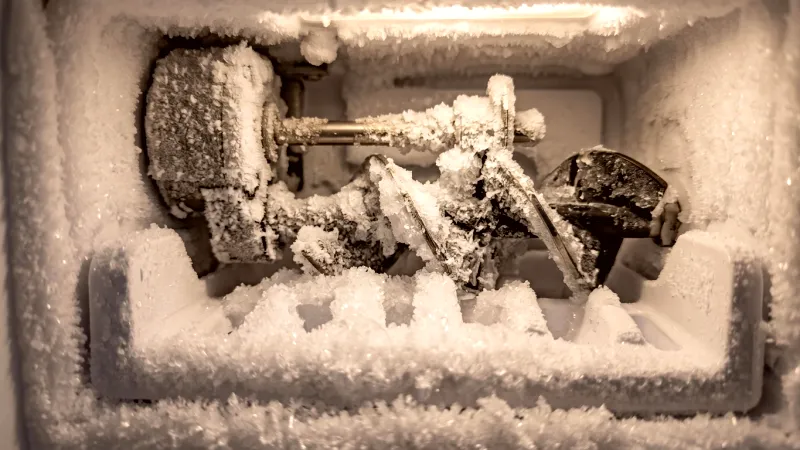
- Flashing Error Code “P2” (Evaporator Coil Sensor Failure): The controller flashes “P2”, indicating the defrost termination thermistor has failed. Because the controller can no longer detect when the evaporator coil has reached its 46°F defrost termination setpoint, it relies entirely on a maximum failsafe timer. Over several days, ice progressively bridges across the aluminum fins, choking airflow and causing cabinet temperatures to climb rapidly.
- Flashing Code “HA” (High Temperature Alarm): The display flashes “HA” alongside an audible alarm buzzer. This alert triggers when internal cabinet temperatures exceed the programmed high-temperature threshold (typically 45°F to 50°F) for longer than the programmed alarm delay period (typically 60 to 120 minutes). In Milton commercial kitchens, this signals that active food spoilage conditions are occurring.
- Flashing Code “LA” (Low Temperature Alarm): The display alternates with “LA”, warning that cabinet temperatures have plunged below 30°F. This usually occurs when a drifted P1 sensor falsely reads a warm temperature, causing the compressor to run continuously until liquid ingredients and produce freeze solid inside the storage pans.
- Flashing Code “EA” or “CA” (External / Condenser Clean Alarm): Found on Turbo Air units equipped with patented self-cleaning condenser systems, this alarm signals that the condenser coil mesh filter is overloaded with kitchen grease and flour dust, causing compressor head pressures and discharge temperatures to spike dangerously.
- Acoustic and Mechanical Symptoms: Rapid, rhythmic clicking of the compressor relay on the main power board, continuous high-velocity evaporator fan motor operation without cooling, or a hot exterior cabinet perimeter (sweat heater line overheating due to excessive head pressure).
4. Common Mechanical & Electrical Causes Behind Sensor Faults
Extensive field audits across North Fulton food service operations reveal six primary technical root causes responsible for recurring Turbo Air temperature errors and high-temperature alarms:
A. Thermistor Epoxy Seal Breakdown & Moisture Penetration
The standard Turbo Air NTC thermistor incorporates a precision metal-oxide semiconductor bead encapsulated inside a stainless steel or thermoplastic cylindrical sleeve, backfilled with epoxy resin. In commercial refrigerators, humidity levels inside the evaporator coil housing hover between 85% and 95%. Over thousands of thermal contraction cycles between cooling and defrosting, micro-fissures develop in the potting epoxy. Moisture seeps into the sensor cavity, creating an electrolytic bridge across the sensor leads. This alters the internal resistance curve, causing the sensor to falsely report cold temperatures while the actual cabinet climbs above 50°F, ultimately resulting in an HA alarm.
B. Wire Harness Vibration Abrasion & Terminal Fretting Corrosion
Commercial reach-in refrigerators utilize high-velocity electronically commutated (EC) evaporator fan motors that run almost continuously. These motors generate high-frequency micro-vibrations across the galvanized sheet metal cabinet. If the sensor lead wires are not anchored securely inside their factory nylon routing clips, the wire insulation rubs against sharp sheet metal edges, causing intermittent grounding faults. Furthermore, humidity and cleaning sanitizers in commercial kitchens promote microscopic tin fretting corrosion at the quick-disconnect terminal pins on the back of the Dixell controller, increasing contact resistance by several thousand Ohms and triggering phantom P1 codes. For restaurants experiencing recurring electrical issues, our technicians specialize in Turbo Air commercial appliance repair to trace harness integrity.
C. Evaporator Coil Severe Frost Encapsulation (Defrost Circuit Failure)
When a Turbo Air commercial unit suffers a secondary defrost failure—such as an open defrost heating element, failed bi-metal high-limit safety thermostat, or stuck defrost relay on the PCB—atmospheric frost accumulates exponentially across the evaporator fins. Within 48 hours, a solid block of ice encases both the coil and Probe 2. The ice insulates the sensor from circulating cabinet air and chokes convective airflow. Starved of return air, cabinet temperatures rise rapidly, triggering a persistent HA alarm code while the evaporator itself remains frozen solid.
D. Dixell Electronic Controller Analog-to-Digital (A/D) Converter Drift
The microprocessor on the Dixell XR series control board utilizes an internal operational amplifier and A/D converter to measure the tiny micro-voltage drop across the 10kΩ sensor circuit (supplied by an internal 5V DC regulated reference rail). Power surges from summer thunderstorms in Fulton County or electrical noise from heavy kitchen exhaust hoods can degrade the onboard filtering electrolytic capacitors. When capacitor ESR (Equivalent Series Resistance) climbs, ripple voltage corrupts the 5V DC reference. The controller misreads valid sensor resistances as an open circuit (P1), locking out the compressor even when the physical probe is completely undamaged.
E. Condenser Coil Clogging & Self-Cleaning Brush Mechanism Jamming
Many modern Turbo Air models feature a patented self-cleaning condenser mechanism equipped with a rotating mesh brush that traverses the condenser face daily. In grease-laden kitchen environments, aerosolized cooking oils combine with airborne flour and dust to form a gummy sludge. If the brush motor jams or the fine mesh screen becomes occluded, airflow across the condenser coil is strangled. Condensing pressures spike from 145 PSI up past 320 PSI (on R-290 systems). The compressor overheats and trips its internal bimetallic thermal overload protector. With the compressor off-line, cabinet temperatures soar, generating a continuous HA alarm.
F. Micro-Refrigerant Leaks in Eco-Friendly R-290 Hydrocarbon Systems
Modern commercial Turbo Air units utilize eco-friendly R-290 (propane) refrigerant operating under precise, critically small charge weights (typically under 150 grams / 5.3 oz). If vibration induces a micro-fracture along the copper capillary tube, evaporator header, or compressor service process stub, refrigerant slowly escapes into the atmosphere. As system charge drops below 70%, the evaporator’s refrigeration capacity collapses. The thermistor detects this failure to pull down, generating a continuous high-temperature alarm that cannot be cleared until the leak is brazed and the critical factory charge is weighed in with precision digital scales.
5. Step-by-Step Safe Facility Troubleshooting Protocols
Before dispatching emergency service, commercial kitchen managers and maintenance staff in Milton can follow this structured 6-step safe inspection protocol to diagnose the nature of the error and gather critical telemetry for the arriving technician:
- Document the Exact Display Code & Alarm Status: Note whether the display flashes P1, P2, HA, LA, or alternates with an actual temperature reading. Press the “Mute / Set” button on the Dixell controller for 3 seconds to silence the audible buzzer while keeping the visual indicator active. Check if the red bell or snowflake icon is illuminated or blinking.
- Verify Cabinet Air Temperature with Independent Calibrated Thermometer: Place a NSF-certified digital food probe thermometer in the geometric center of the cabinet inside a cup of water or vegetable oil (to dampen air temperature spikes during door openings). Compare the independent reading against the Turbo Air display. A divergence greater than ±4°F confirms sensor drift or controller calibration failure.
- Perform a Controlled 5-Minute Microprocessor Hard Power Cycle: Switch off the dedicated commercial circuit breaker or unplug the NEMA 5-15P / 5-20P power cord from the commercial wall receptacle for exactly 5 minutes. This discharges residual filtering capacitance on the Dixell PCB, resetting volatile EEPROM memory registers. Restore power and observe whether the error code returns instantly (indicating a hard electrical break) or takes several minutes to trigger (indicating thermal drift).
- Inspect the Self-Cleaning Condenser Mesh & Fan Assembly: Unscrew the bottom front louvered grill panel or tilt the top shroud (depending on whether the unit is bottom-mount or top-mount). Visually inspect the condenser fins for heavy grease, lint, or debris mats. Verify that the condenser fan blade spins freely and that the rotating brush mechanism is not jammed with kitchen rags or foreign objects.
- Examine Evaporator Housing for Airflow Blockages & Ice Bridging: Open the cabinet doors and look through the evaporator fan intake louvers on the upper ceiling. Use a high-intensity flashlight to inspect the aluminum fins. If you observe a thick block of white frost or solid ice bridging across the coil, the unit is suffering from airflow starvation or defrost failure. Never use ice picks or sharp metal tools to chip ice, as puncturing the thin aluminum evaporator tubing will instantly vent the refrigerant charge.
- Check Magnetic Door Gaskets & Latch Sealing: Close each stainless steel door onto a dollar bill along the perimeter. Pull the bill outward; you should feel firm, uniform magnetic resistance. If the bill slides out freely or if gaskets are torn, brittle, or twisted, warm kitchen air is continuously leaking into the cabinet, overwhelming the refrigeration capacity and triggering HA alarms. For comprehensive maintenance protocols across local facilities, consult our guide to appliance repair in Milton, GA.
6. Critical Safety Thresholds: When to Stop DIY (OSHA & EPA)
While basic visual inspections and external cleaning are routine kitchen duties, internal troubleshooting on commercial Turbo Air equipment crosses severe regulatory and life-safety thresholds where facility DIY must immediately cease:
Mandatory Stop DIY Protocols — High-Voltage & Flammable Refrigerant Hazards:
- Flammable R-290 (Propane) Closed Refrigerant Circuit: Modern Turbo Air units operate on R-290 hydrocarbon refrigerant. R-290 is an A3-class flammable gas. Piercing process tubes, operating open flame torches near the condensing unit, or using standard non-spark-proof vacuum pumps creates an immediate explosion and flash-fire hazard. EPA Section 608 certification and intrinsically safe R-290 recovery machines are legally mandated.
- OSHA 1910.303 Electrical Safety & Arc Flash Hazards: Commercial equipment operates on 115V 20A or 208/230V commercial branch circuits capable of delivering lethal electrical shocks and arc-blast energy. Never probe live terminal blocks on the Dixell controller or compressor relay box without OSHA-compliant personal protective equipment (PPE) and CAT-III insulated multimeter leads.
- FDA & Georgia DPH Food Spoilage Liability: If cabinet temperatures remain above 41°F for more than two continuous hours, bacterial colonies (including Listeria monocytogenes and Salmonella enterica) multiply exponentially. Attempting protracted DIY repairs while food remains in the unit creates catastrophic food poisoning liability. For immediate intervention, dispatch emergency commercial appliance repair technicians.
7. Commercial Economic Evaluation: Repair vs. Replace Matrix
When a commercial Turbo Air refrigerator experiences temperature sensor failure, electronic controller damage, or sealed system degradation, restaurant operators must weigh immediate repair expenses against the capital cost of purchasing and installing a new commercial reach-in unit ($3,200 to $6,500+ for commercial units). Use this commercial decision matrix based on equipment age, operating duty, and repair scope:
| Unit Age & Condition | Primary Diagnostic Failure | Recommended Action | Commercial Economic Justification |
|---|---|---|---|
| 1 – 4 Years (Current Tech) | NTC Sensor (P1/P2), Wiring Harness, or Dixell Controller | Definitive Repair: 100% Recommended | Repair cost is 5%–12% of replacement cost; cabinet and compressor retain 80%+ useful service life. |
| 5 – 8 Years (Mid-Life Workhorse) | Defrost Heating Element, Fan Motor, or Controller Relay | Targeted OEM Restoration Recommended | Restoring electrical components provides another 4–6 years of reliable service with zero kitchen downtime. |
| 9 – 12 Years (Mature Unit) | Compressor Burnout + Evaporator Coil Pinhole Leaks | Evaluate Total Estimate vs. Replacement | If sealed system rebuild exceeds 50% of new unit cost, upgrade to higher-efficiency R-290 model. |
| 12+ Years (Depreciated Asset) | Multiple Cascading Electrical & Sealed System Failures | Planned Equipment Replacement | Cabinet insulation thermal degradation and obsolete parts make modern replacement more cost-effective. |
9. Estimated Commercial Cost Breakdown & Local Pricing Factors
Commercial kitchen managers demand full transparency in billing. Our upfront pricing structure reflects real-world commercial repair factors across Milton and Fulton County:
- Genuine Turbo Air OEM Replacement Components: Factory NTC thermistor probes, pre-flashed Dixell XR06CX digital controllers, and hermetically sealed defrost heaters carry strict manufacturer performance tolerances. Using generic residential thermistors causes continuous calibration errors and voids equipment warranties.
- Commercial Kitchen Accessibility & Line Complexity: Servicing a tight kitchen prep line or built-in reach-in bank requiring roll-out ramps, stainless steel prep table disconnections, or overhead mechanical shelf removal involves specialized multi-technician commercial handling.
- Refrigerant Recovery & Brazing Under EPA Regulations: Sealed system repairs involving R-290 require intrinsically safe nitrogen-purged brazing stations, specialized hydrocarbon recovery cylinders, and micron-level deep vacuum verification under EPA Section 608 protocols. For broader regional pricing breakdowns, review our comprehensive commercial appliance repair cost guide.
- Emergency Response Time Windows: Guaranteed 30-to-60-minute emergency dispatch during busy evening dinner services or weekend brunch rushes ensures priority allocation of fully stocked commercial service vans.
10. How Professionals Diagnose: Multimeter & Telemetry Lookup Table
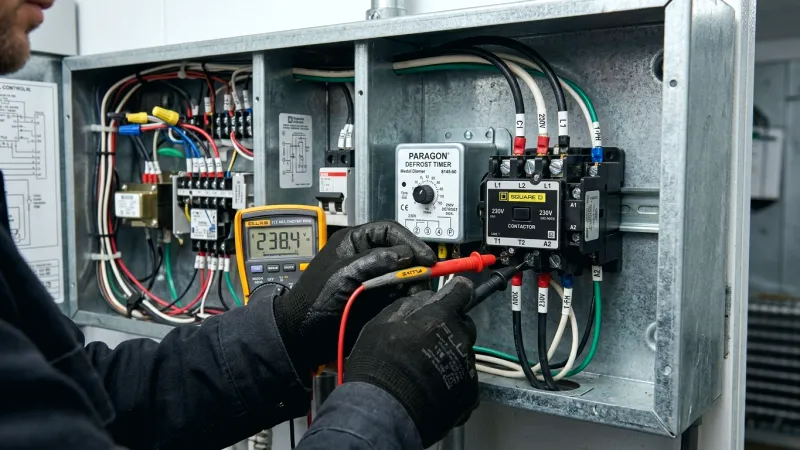
Certified master technicians do not guess or swap parts on speculation. We utilize calibrated Fluke true-RMS digital multimeters and precision digital manifold gauges to measure component health against official Turbo Air technical engineering service manuals:
| Component / Circuit | Multimeter Test Points | Factory Baseline Spec (77°F / 25°C) | Failure Diagnostic Indication |
|---|---|---|---|
| Cabinet Air NTC Probe (P1) | Terminals 10 & 11 on Dixell Controller | 10.0k Ω ± 1% @ 77°F (27.2kΩ @ 32°F) | ∞ Ω (Open), 0 Ω (Short), or > 35kΩ @ room temp |
| Evaporator Coil Probe (P2) | Terminals 10 & 12 on Dixell Controller | 10.0k Ω ± 1% @ 77°F (27.2kΩ @ 32°F) | Drift > 10% from temperature resistance chart |
| Dixell DC Reference Rail | Sensor Ingress Terminal 10 to Ground | 4.95 – 5.05 V DC Steady State | < 4.70 V DC or AC Ripple > 50mV (Failed Power Board) |
| Compressor Output Relay | Pin 1 (Line In) to Pin 2 (NO Contact) | < 0.2 Ω When Energized (115V AC Output) | ∞ Ω (Pitted/Burned Relay Contacts) or welded shut |
| Defrost Electric Heater | Across Heater Terminals (Isolated) | 28.5 – 36.2 Ω (350W – 450W element) | ∞ Ω (Open Element Sheath) or Ground Leakage < 2MΩ |
| EC Evaporator Fan Motor | Line to Neutral Input Terminals | 115V AC • 0.25A – 0.45A Operating Draw | 0A (Open Windings) or Locked Rotor > 1.8A |
| Bi-Metal Defrost Cutout | Across Thermostat Leads < 30°F | 0.0 – 0.3 Ω Closed Continuity | ∞ Ω While Iced (Defective Open Switch) |
| R-290 Suction Pressure | Low-Side Process Port (Running) | 22.0 – 26.5 PSIG (Evaporating Temp 20°F) | < 12 PSIG (Refrigerant Leak) or > 38 PSIG (Bad Valves) |
11. Failure Mode, Effects & Criticality Analysis (FMECA) Risk Matrix
Our commercial engineering specialists maintain this quantitative FMECA risk assessment matrix to evaluate component criticality, severity ratings, and preventive replacement intervals for Turbo Air commercial refrigeration equipment:
| Subsystem / Failure Mode | Severity (1-10) | Occurrence (1-10) | Detection (1-10) | Risk Priority # (RPN) | Mandatory Commercial Mitigation Protocol |
|---|---|---|---|---|---|
| Cabinet Thermistor Open (P1) | 9 (Food Spoilage) | 7 | 2 | 126 | Immediate OEM probe replacement with hermetic silicone potting. |
| Coil Thermistor Drift (P2 Ice) | 8 (Coil Freeze-Up) | 6 | 3 | 144 | Complete thermal de-icing & coil probe re-positioning. |
| Self-Cleaning Condenser Mesh Jam | 8 (Compressor Trip) | 6 | 4 | 192 | Chemical degreasing of mesh screen & brush motor gear audit. |
| Dixell PCB Micro-Relay Pitting | 7 (Short Cycling) | 4 | 3 | 84 | Install upgraded high-amp digital controller assembly. |
| R-290 Capillary Tube Pinhole | 9 (Complete Cooling Loss) | 3 | 5 | 135 | Nitrogen pressure leak detection & critical factory recharge. |
12. Thermodynamic Enthalpy, Volumetric Airflow & Superheat Formulations
Master commercial refrigeration service requires precise thermodynamic calculations rather than trial-and-error adjustments. In Turbo Air commercial reach-in refrigerators, cooling performance is governed by heat transfer enthalpy equations and volumetric airflow velocity:
Q_evap = ṁ_ref × (h_out – h_in)
Where:
• Q_evap = Total Net Refrigeration Capacity (BTU/hr)
• ṁ_ref = Mass Flow Rate of R-290 / R-134a Refrigerant (lbs/hr)
• h_out = Specific Enthalpy of Superheated Vapor Leaving Evaporator Coil (BTU/lb)
• h_in = Specific Enthalpy of Saturated Liquid Entering Expansion Capillary Tube (BTU/lb)
When a sensor drifts, the controller commands the compressor to cycle prematurely, disrupting the evaporating temperature. Technicians verify operating superheat using digital thermocouple clamp meters at the evaporator outlet:
Target Baseline on Turbo Air Reach-In: 6.0°F to 10.0°F Superheat at Steady-State (38°F Box).
If the evaporator coil is partially blocked by ice due to a P2 sensor failure, airflow across the coil drops from the rated 380 CFM down to under 50 CFM. Liquid refrigerant cannot fully vaporize, causing liquid floodback into the compressor suction port that can destroy compressor reed valves and wash lubricating oil out of the crankcase.
13. High-Voltage Ground Fault Neutral Impedance & R-290 Safety
Modern commercial food preparation suites in Milton incorporate sophisticated electrical panels protected by ground fault and arc fault monitoring. Commercial Turbo Air units generate electrical transient noise through high-speed relay switching and EC motor commutation:
When moisture seeps into an evaporator defrost heater or compressor terminal block, leakage current to the grounded stainless steel chassis exceeds 5 milliamperes (5 mA), tripping kitchen GFCI breakers and knocking the refrigeration offline during overnight hours. Our master technicians utilize calibrated 1,000V digital megohmmeters to perform insulation resistance tests. Healthy insulation must exceed 50 Megohms (>50 MΩ).
Furthermore, on Turbo Air R-290 hydrocarbon units, electrical safety is paramount. All switches, thermostats, and controllers must be hermetically sealed to prevent spark generation. If an amateur technician splices standard non-sealed residential wiring into an R-290 Turbo Air cabinet, an open spark during relay contact break can ignite escaping hydrocarbon vapors, causing a catastrophic kitchen explosion.
14. Commercial Component Lifecycle & Mean Time Between Failures (MTBF)
Understanding component lifecycle engineering allows Milton restaurant managers to budget for predictive maintenance before emergency failure occurs:
| Subsystem Component | Design Life Cycles | Average Operating Life | Primary Degradation Factor | Factory Predictive Service Interval |
|---|---|---|---|---|
| NTC Thermistor Temperature Probe | 50,000 Thermal Cycles | 3 to 6 Years | Epoxy moisture ingress & thermal hysteresis | Replace at 4 Years |
| Dixell XR Digital Controller | 100,000 Relay Switched Cycles | 6 to 10 Years | Power surge ripple & relay contact pitting | Inspect voltage at 5 Years |
| Self-Cleaning Condenser Brush Motor | 15,000 Traverse Passes | 4 to 7 Years | Kitchen grease binding & drive gear wear | Clean & lube biannually |
| EC Evaporator Fan Motor | 45,000 Continuous Hours | 7 to 12 Years | Bearing grease thermal dry-out | Annual acoustic audit |
| Embraco Hermetic Compressor | 60,000 Operating Hours | 8 to 14 Years | High head pressure thermal overload trips | Quarterly condenser clean |
15. Factory Service Calibration, Sensor Nulling & Thermal Run-In Procedures
Following any sensor, wire harness, or digital controller replacement on a Turbo Air commercial refrigerator in Milton, our technicians execute this mandatory 4-step calibration sequence:
- Step 1 (Ice-Bath Sensor Nulling & Offset Programming): Submerge the new NTC probe into a distilled ice-water slush bath at exactly 32.0°F (0.0°C). Access the Dixell hidden programming parameter level (holding “Set” and “Down” keys for 3 seconds, entering password ‘321’). Compare controller telemetry against a NIST-traceable reference thermometer. Adjust parameter
Ot(Probe 1 calibration offset) within ±0.1°F until the display reads exactly 32.0°F. - Step 2 (Defrost Termination Probe Calibration): Fasten Probe 2 securely to the lower third of the evaporator coil return bend using aluminum conduction tape and factory nylon ties. Verify parameter
OE(Probe 2 offset) matches physical coil temperature. Set parameterdtE(defrost termination temperature) to factory standard 46°F (8°C). - Step 3 (Compressor Anti-Short Cycle Time Delay Verification): Program parameter
AC(anti-short cycle delay) to a minimum of 3 minutes. This prevents the compressor from attempting to restart against high head pressure during momentary commercial power dips. - Step 4 (45-Minute Dynamic Thermal Pull-Down Run-In): Close the cabinet doors and initiate a monitored pull-down test from ambient 75°F to 37.0°F. Using digital data loggers, our technician records temperature drop velocity, verifying that the cabinet achieves the 38°F target within 45 minutes with proper cut-out and fan delay cycling.
16. Commercial Kitchen Stress Factors & Environmental Variances Across Milton, GA
Operating commercial refrigeration in Milton, Crabapple, and northern Fulton County involves localized environmental challenges that accelerate equipment failure:
1. High Ambient Summer Kitchen Heat: During Georgia’s intense summer months, commercial kitchens with open cooklines, broilers, and pizza ovens experience ambient temperatures exceeding 95°F to 105°F. When ambient air surrounding the condenser coil is this hot, the temperature differential across the condenser shrinks. The compressor must work at extreme compression ratios, raising discharge line temperatures above 210°F and accelerating thermal breakdown of sensor insulation and synthetic polyolester (POE) compressor oil.
2. Airborne Aerosolized Grease & Organic Dust: In Milton restaurants and specialty bakeries, airborne fryer grease and flour particulates are continuously sucked into the bottom-mount condenser housing. While Turbo Air’s self-cleaning brush helps sweep the outer face, sticky grease bypasses the outer mesh, coating the inner fin rows in an insulating thermal blanket that triggers recurring EA condenser alarms.
3. Severe Summer Electrical Storm Grid Surges: North Fulton County frequently experiences severe summer afternoon electrical storms. Utility line micro-spikes and lightning strikes travel through commercial service panels. These voltage spikes degrade the sensitive metal-oxide varistors (MOVs) protecting the Dixell controller PCB, causing intermittent lockups and false sensor fault codes. For comprehensive regional refrigeration expertise, explore our emergency services in Alpharetta commercial refrigeration dispatch.
17. Professional 7-Stage Commercial Field Restoration Standard
Every commercial refrigeration call in Milton executed by our master technicians adheres to a strict 7-stage restoration protocol designed to ensure flawless operational reliability:
- Stage 1: Commercial Food Safety & Area Protection: Position non-marking commercial floor runners, verify temporary food holding temperatures, and position food containment bins if temporary relocation is necessary.
- Stage 2: Non-Volatile Error Buffer & Cycle Interrogation: Access Dixell engineering level 2 to extract historic alarm logs, defrost failure counts, and maximum recorded cabinet temperatures.
- Stage 3: Precision True-RMS Multimeter Telemetry: Disconnect sensor leads from terminal blocks and test resistance across the full thermal range, isolating whether the fault is in the probe, harness, or controller PCB.
- Stage 4: Dynamic Electrical Load Actuation: In controller test mode, manually command the compressor relay, defrost contactor, evaporator fan motor, and self-cleaning brush to verify amperage draw and contact resistance.
- Stage 5: Factory OEM Component Installation: Install brand-new, factory-sealed Turbo Air OEM sensors and controllers, securing all wiring inside silicone protective looms with strain-relief ties.
- Stage 6: Calibration & Parameter Optimization: Recalibrate sensor offsets, set defrost termination temperatures, and verify compressor anti-short cycle delays according to factory engineering bulletins.
- Stage 7: Monitored Pull-Down Verification & NSF Food Safe Sign-Off: Monitor a complete refrigeration pull-down cycle to 37.0°F, logging evaporator temperature split and signing off on food safety compliance before releasing the unit to kitchen staff.
18. Commercial Line Protection & Kitchen Workflow Safety
Commercial kitchens are fast-paced, high-hazard environments. Servicing reach-in refrigeration units on an active cookline requires specialized commercial handling:
Our technicians utilize heavy-duty composite roll-out ramps and pneumatic floor protectors to extract heavy 2-door and 3-door reach-in refrigerators without cracking commercial quarry floor tile or damaging floor grout lines. Furthermore, our service vans maintain sterile, food-safe sanitizing wipes and NSF-approved degreasers, ensuring that no industrial contaminants enter food preparation zones during service.
19. Critical Turbo Air OEM Replacement Parts Catalog
Our mobile commercial diagnostic vans carry an extensive inventory of genuine factory Turbo Air OEM components to ensure 95%+ first-visit repair completion across Milton:
- Turbo Air 10kΩ NTC Cabinet Temperature Probe (Part # 30280M0100 / 30280M0200): Precision stainless-steel encased thermistor probe with high-temperature silicone lead wires engineered for high-humidity reach-in environments.
- Turbo Air Evaporator Defrost Termination Probe (Part # 30280M0300): Moisture-proof sealed NTC sensor with integrated copper pipe clip for secure attachment to evaporator return bends.
- Dixell XR06CX Digital Temperature Controller (Part # 30280L0100 / 30280L0200): Factory pre-programmed commercial controller with 20A compressor relay, dual probe inputs, defrost relay, and evaporator fan control.
- Turbo Air Self-Cleaning Condenser Brush Motor Assembly (Part # 30280H0100): Heavy-duty reversible gear motor with nylon traverse brush and limit switch wiring harness.
- Turbo Air EC Evaporator Fan Motor (Part # 30280F0100): High-efficiency electronically commutated 115V fan motor delivering steady 380 CFM airflow with thermal overload protection.
- Embraco / Secop R-290 Commercial Hermetic Compressor: High-efficiency hydrocarbon compressor calibrated for low back-pressure (LBP) commercial refrigeration duties.
20. Preventative Maintenance Routine for Commercial Operations
Implementing a disciplined preventative maintenance schedule preserves food safety, reduces monthly electrical utility overhead by up to 25%, and prevents unexpected temperature alarms:
- Weekly Condenser Filter Cleaning: Slide out the Turbo Air self-cleaning condenser mesh filter, rinse thoroughly under warm kitchen spray water with mild degreaser, and allow to air dry before reinstalling.
- Monthly Evaporator Drain Line & Pan Flush: Pour a solution of warm water and commercial drain sanitizing cleaner down the internal evaporator drain trough to prevent slime and mold blockages that cause water to pool on the cabinet floor.
- Monthly Magnetic Gasket Sanitation: Wipe door gaskets with food-safe sanitizer and inspect corners for splits or compression loss. Clean gaskets prevent warm kitchen air infiltration.
- Quarterly Professional Commercial Refrigeration Audit: Schedule a certified technician inspection to verify sensor resistance calibration, compressor operating amperage draw, defrost heater continuity, and R-290 operating pressures. Operators seeking complete commercial protection can review our same-day commercial repair availability.
21. Occupational Safety, Electrical & Chemical Warnings
Before performing any inspection or maintenance, kitchen managers must enforce these critical commercial refrigeration safety standards:
- Lockout / Tagout (LOTO) Compliance: Disconnect the commercial circuit breaker and apply an approved OSHA lockout device before opening electrical control boxes or accessing fan motor housings.
- No Open Flames Around R-290 Hydrocarbon Units: Never use propane or MAPP gas torches around R-290 equipment. Hydrocarbon refrigerant releases require spark-proof tools and nitrogen-purged equipment.
- Temperature Danger Zone Vigilance: Never allow perishable food products to remain between 41°F and 135°F for more than two cumulative hours. If the Turbo Air unit displays an HA alarm for over 2 hours, transfer food to a backup walk-in cooler immediately.
22. Frequently Asked Commercial Technical Questions
Comprehensive technical answers to the most common diagnostic and operational questions regarding Turbo Air commercial refrigerator temperature sensor errors:
Q: What does the 'P1' error code mean on my Turbo Air commercial refrigerator?
A: On Turbo Air commercial refrigerators equipped with Dixell digital controllers, the 'P1' error code indicates a failure of the Room / Cabinet Temperature Sensor (Probe 1). The controller detects an open circuit (infinite Ohms), short circuit (zero Ohms), or an abnormal voltage signal outside its calibrated range. In response, the controller enters a default safety cycle—running the compressor for approximately 15 minutes on and 15 minutes off—to prevent total food thawing. However, this limp-home cycle cannot maintain tight food safety temperatures and requires immediate professional sensor replacement.
Q: What does the 'P2' error code indicate, and how does it affect refrigeration?
A: The 'P2' error code signals a failure of the Evaporator Coil Sensor (Probe 2). This sensor monitors coil temperature to determine when an automated defrost cycle should terminate. When Probe 2 fails, the controller loses its defrost termination signal and relies solely on a maximum safety timer. Over several days, this results in incomplete defrosting, causing thick frost and ice to bridge across the evaporator coil fins, which chokes convective airflow and causes cabinet temperatures to rise rapidly.
Q: Why is my Turbo Air beeping and flashing 'HA'?
A: The 'HA' alert stands for High-Temperature Alarm. It triggers when the internal cabinet air temperature remains above the pre-programmed high-temperature threshold (typically 45°F to 50°F) for longer than the programmed alarm delay time (typically 60 to 120 minutes). This indicates that cooling capacity has failed due to a drifted sensor, iced evaporator coil, failed compressor relay, clogged condenser, or refrigerant leak. You can silence the audible beeper by pressing the 'Mute' or 'Set' button for 3 seconds, but immediate service is required to prevent food spoilage.
Q: Can I replace a Turbo Air temperature sensor myself?
A: We strongly advise against DIY sensor replacement in commercial operations. Commercial Turbo Air units utilize specialized 10kΩ NTC thermistors calibrated to precise resistance curves. Installing an incorrect generic probe will cause severe calibration drift. Furthermore, accessing the evaporator sensor requires navigating high-voltage EC fan motor wiring and fragile aluminum refrigerant lines. In modern R-290 (propane) systems, unsealed electrical connections create severe fire and explosion risks.
Q: What resistance (Ohms) should a Turbo Air temperature sensor read when tested?
A: A healthy Turbo Air NTC sensor probe should read approximately 10,000 Ohms (10.0kΩ) at standard room temperature of 77°F (25°C). When submerged in an ice-water bath at 32°F (0°C), its resistance increases to approximately 27.2kΩ. If a multimeter test reveals infinite resistance (open circuit), 0 Ohms (dead short), or resistance drifting significantly from these baseline values, the probe is defective and must be replaced.
Q: What is the FDA temperature requirement for commercial refrigeration holding?
A: Under FDA Food Code Section 3-501.16, Potentially Hazardous Foods (TCS – Time/Temperature Control for Safety foods) such as raw meats, cooked poultry, dairy, cut produce, and seafood must be maintained at 41°F (5°C) or below. Operating between 41°F and 135°F is classified as the 'Temperature Danger Zone', where harmful foodborne bacteria can double every 20 minutes, creating severe health inspection violation risks and food poisoning liability.
Q: What causes a Turbo Air temperature sensor to suddenly fail?
A: The most common failure mechanism is thermal fatigue and moisture ingress. Operating inside an evaporator compartment with 90%+ relative humidity causes micro-fissures in the sensor's protective potting epoxy over thousands of thermal cycles. Moisture penetrates the semiconductor junction, altering its resistance curve. Other common causes include tin fretting corrosion on the controller terminal pins, vibration abrasion through wire insulation, and electrical surges from summer thunderstorms.
Q: How does Turbo Air's self-cleaning condenser affect temperature errors?
A: Turbo Air's patented self-cleaning condenser features a fine mesh filter screen and a rotating mechanical brush that sweeps dust and lint daily. However, in greasy restaurant kitchens, cooking oils combine with flour to form a sticky sludge that can jam the brush motor or clog the mesh screen. When airflow is blocked, compressor head pressures and discharge temperatures soar, tripping the compressor's thermal overload. The resulting loss of cooling quickly triggers a continuous HA alarm.
Q: How much does it cost to repair a Turbo Air temperature sensor error in Milton, GA?
A: Professional repair of a Turbo Air temperature sensor error in Milton typically ranges between $225 and $385. This investment includes our certified commercial refrigeration diagnostic evaluation, genuine factory OEM NTC thermistor probe, precision wiring harness installation, and controller calibration. If the digital controller itself requires replacement, costs generally range from $380 to $560 depending on the model.
Q: How quickly can a technician arrive at my restaurant in Milton?
A: We provide priority same-day commercial emergency dispatch throughout Milton, Crabapple, and surrounding North Fulton areas. For active high-temperature alarms where commercial food inventory is in jeopardy, our arrival windows typically range between 30 and 60 minutes from initial booking confirmation.
Q: What should kitchen staff do while waiting for the technician to arrive?
A: First, keep all commercial refrigerator doors tightly closed to trap residual cold air. If cabinet temperatures exceed 41°F, immediately transfer high-risk meats, dairy, and seafood into an adjacent backup reach-in or walk-in cooler. Silence the alarm buzzer by pressing the 'Set' key for 3 seconds, and clear any kitchen boxes or prep carts from around the front and back of the refrigerator to give the technician immediate access.
Q: Can hard power resets permanently fix a Turbo Air P1 error code?
A: No. A hard power reset (switching off the breaker for 5 minutes) merely clears the controller's volatile memory registers. If the underlying cause is an open electrical probe, moisture contamination, or damaged wire harness, the microprocessor will re-detect the abnormal resistance within seconds of powering back up and will immediately re-flash P1 on the display.
Q: Do your technicians service commercial R-290 hydrocarbon refrigeration systems?
A: Yes. All our commercial technicians hold EPA Section 608 Universal Certification and have completed advanced factory training in R-290 (propane) commercial systems. We carry intrinsically safe, spark-proof recovery machines, nitrogen-purged brazing tools, and precision digital charging scales calibrated for R-290 charge weights.
Q: What warranty is provided on Turbo Air commercial repairs?
A: Every commercial repair performed by our team includes a comprehensive 90-day parts and labor warranty. If the identical component fails or the sensor code recurs within 90 days of service, our technicians return promptly to resolve the issue with zero additional service charges.
Q: Why shouldn't I use an ice pick to defrost an iced-up Turbo Air evaporator?
A: Using ice picks, screwdrivers, or sharp metal scrapers to remove ice is extremely hazardous. Commercial evaporators are constructed from ultra-thin aluminum tubing and fragile aluminum fins. A single slip with an ice pick will instantly puncture the pressurized refrigeration line, releasing the entire refrigerant charge, disabling the cooler permanently, and converting a minor sensor repair into an expensive multi-thousand-dollar evaporator replacement.
Q: How do I schedule emergency commercial service in Milton, GA?
A: You can reach our dedicated commercial refrigeration dispatch coordinator directly at (770) 796-7742. We prioritize commercial accounts with active temperature alarms and dispatch our nearest on-call Milton commercial technician immediately.
23. Specialized Commercial & Cold-Chain Repair Services
Our commercial technical team provides comprehensive maintenance and emergency repair across all commercial cold-chain systems:
- Commercial Appliance Repair Services: Full-spectrum diagnostic and mechanical restoration for commercial kitchens, delis, and hospitality venues.
- Commercial Refrigerator Repair Service: Reach-in, solid-door, glass-door display, and undercounter commercial refrigeration diagnostics.
- Commercial Ice Machine Repair & Descaling: Professional diagnostic service for commercial cube, flaker, and nugget ice makers.
- Emergency Commercial Refrigeration Dispatch: Fast-response on-call service for critical temperature alarm lockouts and inventory protection.
24. Related Commercial & Refrigeration Diagnostic Guides
Explore our in-depth technical guides addressing critical commercial kitchen refrigeration and ice machine failures:
- Commercial Walk-In Cooler High Temperature Alarm Troubleshooting: Resolving Copeland condensing unit failures and iced evaporator coils in North Fulton.
- Commercial Ice Machine Harvest Cycle Failure Diagnostics: Troubleshooting hot gas bypass valves and bridge thickness sensors in Milton commercial kitchens.
- Hoshizaki Commercial Ice Maker Error Codes & Freeze-Up Guide: Resolving 1-beep and 3-beep freeze lockouts, float switch scaling, and thermistor errors.
25. Commercial Refrigeration Brands Serviced
Our factory-trained technicians maintain specialized diagnostic software and OEM parts for premier commercial refrigeration brands:
- Turbo Air Commercial Appliance Repair: Factory-grade service for M3, PRO, Super Deluxe, and Radiance series equipment.
- True Commercial Refrigeration Repair: Comprehensive diagnostics for True T-Series, GDM, and specification reach-in units.
- Beverage-Air Commercial Equipment Service: Factory parts and certified repairs for Beverage-Air reach-ins, prep tables, and bar coolers.
26. North Fulton Commercial Coverage Areas
We provide priority commercial refrigeration dispatch across our dedicated North Fulton service territories:
- Milton, GA Commercial Appliance Repair: Same-day priority dispatch for Crabapple, Birmingham Hwy, and Milton equestrian dining venues.
- Alpharetta, GA Commercial Refrigeration Hub: Rapid 30-to-45-minute response for Downtown Alpharetta, Avalon, and Windward Parkway restaurants.
- Roswell, GA Commercial Appliance Repair: Dedicated service for Canton Street dining, Holcomb Bridge commercial centers, and catering kitchens.
- Johns Creek, GA Restaurant Equipment Service: Expert refrigeration and prep table repair along Medlock Bridge and State Bridge corridors.
27. Key Operational Takeaways for Milton Kitchen Managers
- Silence the Alarm But Never Ignore the Cause: Pressing the Dixell ‘Set’ button silences the audible beeper, but the unit remains in an active high-temperature condition that jeopardizes food safety.
- P1 Indicates Cabinet Probe Failure: Flashing P1 signals an open or shorted ambient sensor, forcing the controller into an uncalibrated default run cycle that causes temperature swings.
- P2 Indicates Evaporator Coil Probe Failure: Flashing P2 disables automated defrost termination, leading to severe evaporator coil icing and catastrophic airflow loss within 48 hours.
- Protect Perishable Inventory Immediately: If internal cabinet temperatures climb above 41°F for more than two hours, transfer sensitive dairy, seafood, and meat products into backup refrigeration to prevent spoilage and health code violations.
- Clean the Self-Cleaning Condenser Filter Weekly: Greasy kitchen environments can overwhelm the patented self-cleaning brush, causing compressor head pressure spikes and premature thermal overload trips.
- Insist Exclusively on Genuine OEM 10kΩ Probes: Generic aftermarket thermistors drift out of calibration, creating false temperature readings and recurring controller error codes.
- Never Use Sharp Tools on Iced Evaporators: Chipping ice with metal tools will puncture the pressurized aluminum refrigeration tubing, instantly venting the refrigerant and ruining the evaporator.
- Rely on 90-Day Guaranteed Master Service: Our certified commercial technicians provide 30-to-60-minute emergency arrival in Milton, backed by an ironclad 90-day parts and labor warranty.
Get Same-Day Turbo Air Refrigerator Repair in Milton, GA
Don’t let a Turbo Air temperature sensor error or high-temperature alarm compromise your restaurant’s inventory and food safety rating. Our certified commercial refrigeration technicians are on-call across Milton with fully stocked service vehicles and genuine factory OEM parts ready to restore your unit today.
Fast 30–60 Minute Commercial Arrival • 90-Day Parts & Labor Warranty • Licensed & Insured EPA Universal Techs
Need Certified Appliance Repair Today?
Skip the phone line — book direct local priority dispatch across Alpharetta, Milton, Roswell & Johns Creek.