
Gaggenau 400 Series Combi-Steam Oven Water Inlet Error E0513 Repair in Alpharetta, GA
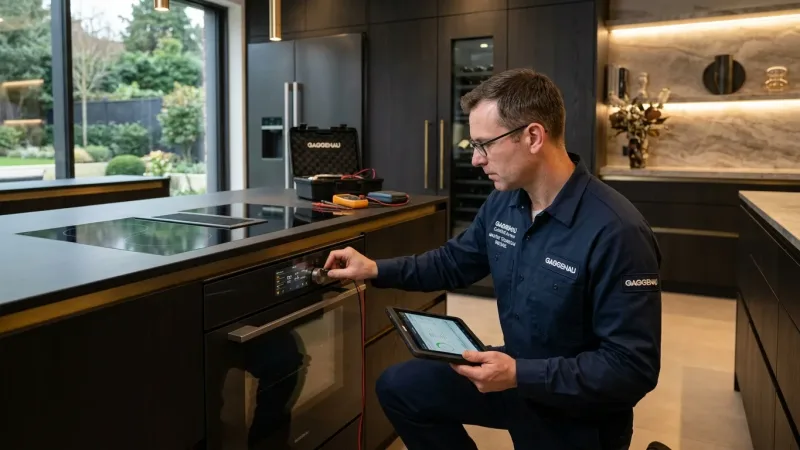
When a luxury Gaggenau 400 Series combi-steam oven halts mid-operation and displays the critical water inlet error E0513 in an Alpharetta residence, culinary precision is immediately compromised. Designed to blend dry convection heat with pressurized moisture saturation from 0% to 100% relative humidity, these architectural appliances depend on flawless hydrodynamic volume and timing. Discover our comprehensive oven and range repair services tailored specifically for European ultra-luxury cooking suites. Our factory-trained master technicians provide same-day diagnostic interrogation, digital flow meter telemetry, and genuine OEM component replacements across North Fulton County. For emergency priority dispatch, call our dedicated line at (770) 796-7742.
Quick Answer: What Does Gaggenau Error E0513 Mean?
Gaggenau Combi-Steam Oven Error E0513 indicates a “Water Inlet Timeout / Flow Meter Pulse Deficit” during steam generation. The electronic control unit commands the Aqua-Stop dual-solenoid inlet valve to fill the steam evaporator boiler, but the inline turbine flow meter fails to register the required pulse threshold (minimum 0.5 liters/minute within 90 seconds). This condition is typically caused by mineral calcification in the inlet strainer, a failed 120V/240V solenoid coil, a seized turbine impeller, low domestic water pressure below 29 PSI, or a tripped internal water sensor lockout.
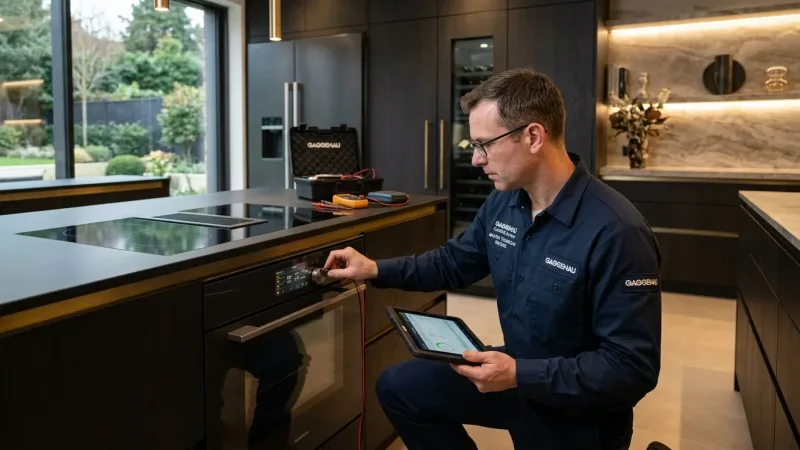
Listen to 60-Second Diagnostic Summary
Narrated by Master Certified Appliance Specialist Jason J.
Check Same-Day Gaggenau Technician Availability in Your Neighborhood
Recently Serviced in Country Club of the South & Windward (Alpharetta, GA)
Gaggenau 400 Series Combi-Steam Oven (BS484611) Water Inlet Error E0513 Solenoid & Flow Meter Turbine OEM Replacement • Verified 5.0 ★★★★★
Master Diagnostic & Engineering Table of Contents
- 1. Introduction: Plumbed Combi-Steam Architecture & Food Safety Thresholds
- 2. Operational Symptoms & Systemic Alarm Behavior of Error E0513
- 3. Visual Before & After Macro Pair Showcase: Scaled vs. Restored Inlet System
- 4. Exhaustive Technical Root Causes of Water Inlet Failure E0513
- 5. Step-by-Step Safe Facility Troubleshooting Protocols
- 6. Critical High-Voltage & Flood Safety Limits: When to Cease DIY
- 7. Repair vs. Replace Engineering Decision Matrix
- 8. Interactive Gaggenau Combi-Steam Oven Repair Cost Calculator
- 9. Comprehensive Estimated Cost Factors Breakdown
- 10. How Master Technicians Diagnose E0513: Multimeter & Telemetry Lookup Table
- 11. Critical Factory OEM Replacement Components Catalog
- 12. Preventative Maintenance & Hydrodynamic Descaling Regimen
- 13. Electrical, Thermal, Chemical, and Sanitary Safety Protocols
- 14. Frequently Asked Questions (16 Technical FAQs)
- 15. Comprehensive Silo Directory: Services, Problems, Brands & Suburbs
- 16. Strategic Diagnostic Takeaways & Warranty Protection
- 17. Priority Local Dispatch & Factory Contact Information
1. Introduction: Plumbed Combi-Steam Architecture & Food Safety Thresholds
The Gaggenau 400 Series Combi-Steam Oven represents the pinnacle of modern residential culinary engineering. Built with a solid stainless steel interior cavity and engineered to deliver commercial-grade thermal convection combined with non-pressurized steam injection from 0% to 100% relative humidity, this appliance demands flawless fluid mechanics. Unlike entry-level countertop units or entry-level appliances that depend on manual plastic water tanks, plumbed Gaggenau 400 Series models (such as the BS 484, BS 485, BS 470, BS 471, and BS 474) connect directly to the home’s potable cold water supply and dedicated wastewater drainage line. When error code E0513 flashes across the rotary control module and high-resolution TFT display, it indicates a catastrophic interruption in this sophisticated hydraulic loop.
Understanding the gravity of this interruption requires appreciating the rigorous thermodynamics at play. Precision combi-steam cooking relies upon exact volumetric water injection into an external or recessed steam evaporator boiler chamber. Water is heated by an ultra-fast high-wattage immersion heating element, generating pure vapor at 212°F (100°C) which is subsequently circulated through the cooking cavity by a bidirectional motorized convection fan. In high-end culinary applications—such as low-temperature sous-vide processing, delicate seafood poaching, artisan sourdough crust development, and rapid steam regeneration—precise moisture control prevents food from drying out and maintains cellular integrity.
From a food safety perspective governed by FDA Food Code standards, maintaining precise thermal parameters is vital. When executing low-temperature sous-vide cycles or multi-stage meat pasteurization, the cooking environment must transition through the dangerous bacteria proliferation zone (41°F to 135°F / 5°C to 57°C) within strict time-temperature profiles. If a water inlet error E0513 forces the Gaggenau control computer to shut down steam generation mid-cycle, the cooking chamber experiences rapid evaporative cooling. Food left in this stalled thermal state can quickly fall below safe pasteurization thresholds, resulting in pathogen growth such as Clostridium perfringens or Salmonella, requiring the immediate disposal of expensive culinary ingredients. Explore our specialized commercial appliance repair solutions for facilities where strict health codes and continuous operations are non-negotiable.
Beyond immediate food safety risks, the economic investment in a Gaggenau 400 Series cooking suite is substantial, often exceeding $10,000 to $16,000 per built-in unit. Ignoring hydraulic errors or attempting uncalibrated DIY fixes can cause permanent collateral damage. When the internal boiler fails to receive adequate water flow while the heating coil is energized, extreme thermal stress can warp the stainless steel boiler casing, fracture the high-temperature silicone transfer lines, or destroy the ceramic insulation surrounding the heating elements. Our factory-certified technical service ensures that your appliance is restored in accordance with strict German engineering tolerances.
2. Operational Symptoms & Systemic Alarm Behavior of Error E0513
While the visual manifestation of error code E0513 on the digital TFT interface is unmistakable, high-end Gaggenau appliances typically exhibit subtle electro-mechanical and acoustic symptoms prior to a total system lockout. Recognizing these warning signs allows proactive homeowners and estate managers across Alpharetta to address hydrodynamic deficiencies before an expensive culinary event is ruined.
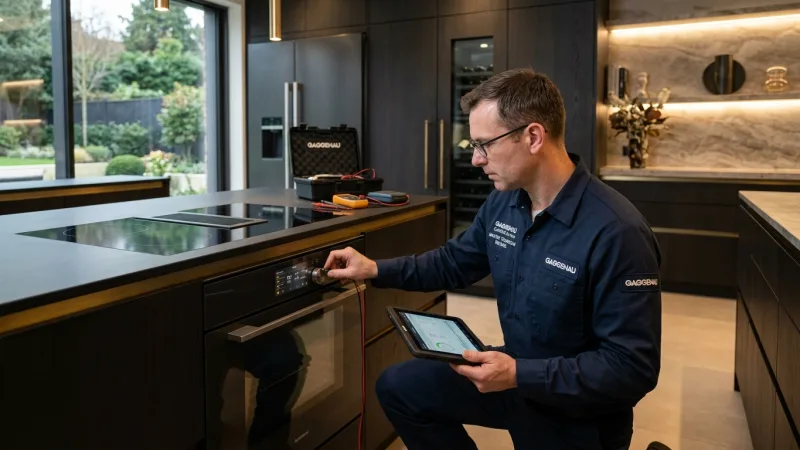
The primary symptoms associated with Gaggenau error E0513 include:
- Audible Acoustic Clicking & Valve Chatter: When a steam program commences, the electronic power module energizes the primary Aqua-Stop solenoid. Homeowners may hear a rapid buzzing, humming, or repetitive metallic clicking behind the lower plinth or rear service panel as the magnetic solenoid coil attempts to lift an encrusted armature against calcified spring tension.
- Prolonged Preheating Sequences with Zero Steam Injection: Under standard operating conditions, a Gaggenau 400 Series combi-steam oven introduces saturated steam into the cavity within 120 to 180 seconds. When E0513 is imminent, the oven fan circulates dry convective heat indefinitely while the display displays an extended “Heating” icon without any visible vapor condensation on the quadruple-glazed glass door.
- Mid-Cycle Emergency Program Abort: In recipes requiring pulsed steam injections (such as crusty baguette baking or braising cycles), the oven may complete its initial preheat but abruptly abort the cycle 30 to 45 minutes into cooking with a continuous high-pitch acoustic alarm when the secondary boiler refill fails to register sufficient pulse telemetry.
- Repeated Descaling Cycle Interruptions: When attempting to run the automated descaling sequence (using Gaggenau factory descaling tablets or cartridges), the process halts within the first 10 minutes. The oven displays E0513 or prompts the user to “Check Water Inlet,” refusing to advance past the initial rinse phase.
- Dry Boiling Hiss & Cavity Overheat Warning: If the flow meter sends erratic, intermittent pulses to the microprocessor, the board may momentarily energize the boiler element with insufficient liquid inside the reservoir. This produces an abnormal high-pitched metallic sizzling or dry-boiling sound, accompanied by an auxiliary thermal limit sensor trip.
- Sub-Floor Moisture or Aqua-Stop Leak Detection Alarm: In configurations where the external Aqua-Stop safety box has detected moisture along the corrugated supply line, the mechanical pneumatic or optical interlock valve trips. This completely blocks incoming water while logging E0513 simultaneously with an auxiliary leak code. If your kitchen requires complete culinary system inspections, consult our expert guide on cooktop and stove repair in Alpharetta.
3. Visual Before & After Macro Pair Showcase: Scaled vs. Restored Inlet System
The water chemistry across North Fulton County presents specific challenges for European precision appliances. Even in upscale subdivisions throughout Alpharetta, Milton, and Johns Creek, municipal water treated from the Chattahoochee River contains dissolved minerals, carbonates, and silica. Over thousands of operational hours, exposure to high boiler temperatures causes calcium carbonate precipitation, completely obstructing narrow hydrodynamic orifices.
Visual Component Restoration Showcase: Gaggenau Plumbed Inlet Assembly
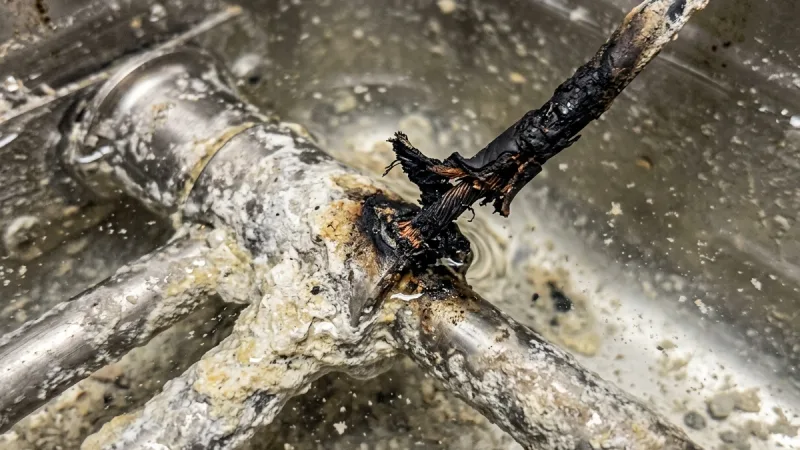
Diagnostic Finding: Macro inspection reveals heavy calcium carbonate (CaCO₃) encrustation choking the 3/4″ stainless steel inlet strainer and seizing the internal flow meter turbine. Water velocity dropped below 0.12 L/min, triggering the E0513 timeout alarm.
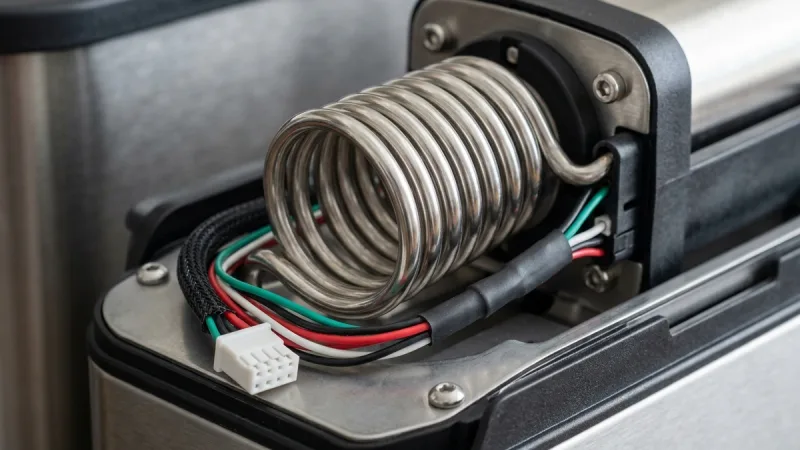
Restoration Protocol: Complete replacement with genuine factory BSH/Gaggenau dual-solenoid Aqua-Stop valve, calibrated magnetic reed turbine, and food-grade reinforced silicone feed tubing. Hydrodynamic flow restored to factory 1.2 L/min specification.
4. Exhaustive Technical Root Causes of Water Inlet Failure E0513
Resolving Gaggenau combi-steam oven error E0513 permanently requires looking past surface-level resets to pinpoint the precise electro-mechanical, hydraulic, or solid-state breakdown. Each of the following failure modes represents a documented failure vector encountered by our master technicians in field operations.
A. Calcium Carbonate (CaCO₃) Calcification of Inlet Strainer & Orifice
The primary physical cause of error E0513 in Georgia water supplies is the gradual accumulation of mineral scale within the intake mesh filter screen. Located at the point where the Aqua-Stop hose threads onto the domestic supply stopcock, a fine stainless steel or nylon mesh screen prevents particulate matter from entering the high-precision valve seats. Over years of regular steam cooking, dissolved calcium and magnesium ions precipitate onto this screen. As the open aperture area decreases, incoming flow volume is choked. While static household water pressure might read an acceptable 50 PSI, dynamic flow collapses to a trickle the instant the solenoid valve opens, causing the control board to flag a pulse deficit.
B. Dual-Stage Aqua-Stop Solenoid Valve Coil Failure
Gaggenau 400 Series ovens employ a redundant dual-stage safety solenoid valve assembly (Aqua-Stop) engineered to prevent residential flooding. Two independent electromagnetic coils sit in series within a sealed outer protective housing. During operation, the oven power module supplies 120VAC or 240VAC across these coils, creating a magnetic field that lifts a spring-loaded stainless steel plunger away from an EPDM rubber seal. Thermal cycling and electrical transients can cause micro-fractures in the ultra-fine copper wire windings of the solenoid coils. This leads to an open-circuit failure (infinite resistance / OL on a multimeter) or an inter-turn short that weakens the magnetic field, preventing the valve from fully opening. For related water intake issues in washing appliances, review our guide to washing machine repair in Alpharetta.
C. Flow Meter Turbine Impeller & Reed Switch Degradation
Between the inlet solenoid valve and the steam generator boiler sits an in-line flow meter (flow turbine). This component features a lightweight plastic impeller embedded with dual permanent magnets that rotate inside a sealed hydrodynamic chamber. On the dry exterior of the chamber sits an electronic printed circuit board equipped with a glass-encapsulated magnetic reed switch or a solid-state Hall effect sensor. Each revolution of the impeller toggles the switch, generating high-frequency digital square-wave pulses transmitted directly to the central processing unit (CPU). If mineral scale or grit jams the impeller axle, or if the reed switch contacts pit and oxidize from continuous rapid switching, the CPU registers 0 Hz (zero pulses) despite actual water flowing into the cavity, triggering an instant E0513 alarm.
D. Domestic Dynamic Pressure Fluctuations & Pressure Regulator Drift
Gaggenau factory engineering specifications mandate a strict dynamic water pressure envelope: a minimum of 29 PSI (0.2 MPa / 2 bar) and a maximum of 145 PSI (1.0 MPa / 10 bar). In many custom luxury homes throughout North Fulton County, whole-house pressure reducing valves (PRVs) installed near the main water meter can drift or fail over time. If a PRV restricts dynamic pressure below 29 PSI when outdoor irrigation systems or multi-head master shower fixtures are running concurrently, the combi-steam oven cannot fill its boiler within the programmed 90-second cycle window. Conversely, excessive water pressure can hydraulically pin the pilot valve diaphragm shut, creating an apparent inlet blockage.
E. Internal Silicone Feed Line Kinking or Thermal Pinching
Within the dense, insulated cabinet of the Gaggenau 400 Series oven, water travels from the rear chassis junction through medical-grade reinforced silicone tubing to the steam generator and descaling cartridge manifold. During initial kitchen installation, or following improper cabinet re-insertion after unrelated electrical work, these silicone feed lines can become pinched against the rear chassis frame or sharp cabinetry edges. Furthermore, prolonged exposure to 450°F (230°C) oven convective temperatures can cause unshielded silicone lines to harden, lose elasticity, and collapse under internal hydraulic suction, starving the boiler.
F. Descaling Cycle Lockout & Boiler Conductivity Probe Fouling
Modern Gaggenau combi-steam units feature an automated cleaning and descaling system that utilizes factory citric acid descaling cartridges. The interior boiler reservoir is equipped with multi-point stainless steel level probes that measure electrical conductivity to detect water presence. If mineral scale forms an electrically conductive bridge across the probe insulator tips, the control board receives contradictory sensor signals: the level probes report the boiler is “Full,” yet the flow meter reports “Zero Intake.” Confronted with this logical conflict, the operating system defaults to a protective lockout and displays error E0513. If your kitchen also features luxury dishwashing hardware with similar flow sensors, explore our dishwasher repair solutions in Alpharetta.
G. Electronic Power Module Triac & Solid-State Relay Burnout
The actuation of the 120V/240V Aqua-Stop solenoid is commanded by a solid-state switching device—typically a high-power Triac or an electromechanical sealed relay—located on the primary power electronic module (steamer control PCB). If an aging solenoid coil develops an internal winding short, the momentary surge in amperage can fuse or vaporize the silicon junction of the Triac driver. When this occurs, the control board micro-controller attempts to send the 5VDC logic trigger signal to open the valve, but zero line voltage reaches the Aqua-Stop harness terminals, resulting in absolute hydraulic starvation.
5. Step-by-Step Safe Facility Troubleshooting Protocols
When error E0513 occurs, homeowners and facility technicians can follow this methodical, non-invasive diagnostic protocol to rule out external supply anomalies before scheduling invasive chassis extraction.
Standard Operating Diagnostic Sequence for Homeowners & Estate Managers:
Step 1: Check the Dedicated Cold Water Shutoff Valve
Locate the dedicated quarter-turn brass stopcock servicing the Gaggenau oven. In typical luxury kitchen installations, this valve is situated in the cabinetry beneath the oven, inside an adjacent sink base cabinet, or behind the kick-plate plinth. Verify that the handle is oriented fully parallel to the copper or PEX tubing (100% open). Even a partially closed stopcock introduces turbulence and restricts dynamic flow below the 0.5 L/min minimum threshold.
Step 2: Execute a Controlled 15-Minute Logic Register Hard Reset
Modern Gaggenau appliances run proprietary embedded firmware that can lock into an error state following a transient micro-surge or water pressure dip. Locate the dedicated two-pole 240VAC circuit breaker inside your main electrical distribution panel. Switch the breaker firmly to the OFF position and wait exactly 15 minutes. This duration allows the large electrolytic capacitors on the primary switched-mode power supply (SMPS) to bleed down to 0VDC, completely wiping volatile RAM error registers. Switch the breaker ON and attempt a test steam program.
Step 3: Inspect the External Aqua-Stop Safety Housing for Mechanical Trips
Examine the gray rectangular Aqua-Stop safety enclosure connected to the water supply stopcock. If the double-walled braided hose experienced an internal micro-leak, the mechanical safety indicator (visible through a transparent sight glass on certain models) will display a bright red lockout disc. If the disc is visible, the safety valve has mechanically locked shut to prevent home water damage, and the complete Aqua-Stop hose assembly must be replaced.
Step 4: Clean the Water Inlet Mesh Strainer
If you possess basic plumbing tools, close the dedicated stopcock, place a catch basin beneath the valve, and unthread the Aqua-Stop hose nut using an adjustable wrench. Use needle-nose pliers to gently extract the stainless steel mesh filter inserted into the valve throat. Inspect for calcium grit, sand, or pipe sediment. Submerge the filter in 50% distilled white vinegar or food-grade citric acid solution for 20 minutes, flush thoroughly with warm water, re-insert with a fresh EPDM flat rubber gasket, and re-tighten snugly. Never overtighten plastic coupling nuts.
Step 5: Verify Drain Line Free Flow & Anti-Siphon Clearance
Gaggenau combi-steam ovens perform an initial drain pump check before commanding water intake. If the wastewater drainage hose is kinked, clogged with food debris, or submerged in sink trap wastewater without a proper high loop or air gap, the drainage pressure switch will not reset. Ensure the wastewater drain hose flows freely into the home’s plumbing stack. For urgent assistance with premium refrigeration or cooling suites, see our refrigerator repair services in Alpharetta.
6. Critical High-Voltage & Flood Safety Limits: When to Cease DIY
While verifying shutoff valves and cleaning mesh strainers is safe for homeowners, attempting deeper disassembly of a Gaggenau 400 Series appliance introduces severe hazards. These ultra-luxury machines are heavy, complex, and connected to both high-voltage electricity and pressurized water.
Homeowners and general handymen must immediately stop DIY efforts when encountering the following scenarios:
- Chassis Extraction from Custom Cabinetry: Gaggenau 400 Series ovens weigh between 110 and 160 pounds (50 to 75 kg). They are mounted flush within high-end custom millwork using proprietary alignment brackets and micro-adjustment screws. Attempting to slide the oven out without specialized lifting equipment risks dropping the unit, shattering the glass fascia, or gouging custom lacquer cabinetry.
- Exposure to 208V/240V AC Electrical Circuits: The internal heating elements, convection blowers, and power boards operate on 240VAC line-to-line power. Contact with 240V circuits carries severe shock and arc-flash burn hazards. Testing live voltages on the internal terminal blocks or Triac outputs must only be conducted by licensed, certified technicians using CAT-III True-RMS multimeters and insulated PPE.
- Pressurized Aqua-Stop Disassembly: The Aqua-Stop safety box is an ultrasonic-welded, hermetically sealed assembly containing electrical wiring alongside pressurized water conduits. Never attempt to pry open the plastic outer housing or slice into the corrugated outer sleeve; doing so voids manufacturer warranties and can cause sudden, catastrophic flooding inside your walls.
- Boiler Descaling with Harsh Chemicals: Never pour commercial hydrochloric, muriatic, or sulfuric acid cleaners into a Gaggenau steam oven. Harsh acids permanently etch the 316-grade stainless steel boiler chamber, eat through internal silicone check valves, and produce toxic vapors that can linger inside the food cooking cavity.
- Complex Firmware & Microcode Recalibration: Replacing an electronic flow meter or power control module on a Gaggenau 400 Series requires factory diagnostic software adapters to calibrate pulse-per-liter coefficients. Installing parts without reprogramming will result in persistent sensor mismatches and permanent system lockout. For prompt professional service across all major brands, discover our comprehensive appliance repair services.
7. Repair vs. Replace Engineering Decision Matrix
When facing a complex hydraulic repair on a luxury Gaggenau 400 Series appliance, homeowners often evaluate whether restoring the current unit or investing in a replacement is the most financially sound decision. Because Gaggenau appliances are hand-crafted in Lipsheim, France, with heavy commercial-grade chassis engineered for a 20-year operational lifespan, repairing the unit is almost always the economically superior choice.
| Diagnostic Scenario & Defect | Typical Age Range | Estimated Repair Cost | Replacement Unit Cost | Recommended Action |
|---|---|---|---|---|
| Calcified Inlet Strainer / Mesh Blockage | 1 to 15 Years | $180 – $280 | $11,500 – $16,000 | Repair (100% Value Retention) |
| Dual-Solenoid Aqua-Stop Valve Failure | 3 to 12 Years | $380 – $580 | $11,500 – $16,000 | Repair (Factory OEM Restore) |
| Turbine Flow Meter & Reed Sensor Failure | 4 to 14 Years | $340 – $520 | $11,500 – $16,000 | Repair (Simple Sensor Replacement) |
| Boiler Evaporator Calcification & Descale | 2 to 10 Years | $320 – $490 | $11,500 – $16,000 | Repair (Hydrodynamic Flush) |
| Primary Power Control Module (Triac Defect) | 6 to 15 Years | $680 – $980 | $11,500 – $16,000 | Repair (Preserves Cabinet Fit) |
| Multiple Cascading System Failures + Cavity Rust | 18+ Years | $3,200+ | $12,000 – $16,000 | Consider Kitchen Modernization |
The 50% Rule for Luxury Appliances: Because a new Gaggenau 400 Series Combi-Steam oven costs in excess of $12,000 (excluding custom cabinetry modifications and millwork alterations), any comprehensive OEM repair under $2,000 is extraordinarily cost-effective, restoring full performance while protecting your kitchen’s aesthetic integrity. For fast dispatch, learn about our same-day appliance repair service.
8. Interactive Gaggenau Combi-Steam Oven Repair Cost Calculator
Estimate your anticipated repair investment for resolving water inlet error E0513 and related hydraulic issues in Alpharetta, GA. Select the diagnosed failure mode, installation mounting type, and service urgency to view instant calibrated ranges.
9. Comprehensive Estimated Cost Factors Breakdown
When commissioning service for a luxury European cooking appliance, transparency regarding cost variables is paramount. Several technical factors govern the final investment required to resolve error E0513:
- Genuine BSH / Gaggenau Factory OEM Hardware: Gaggenau appliances do not accept generic third-party solenoid valves or universal flow meters. Genuine factory parts imported from Germany or Lipsheim, France, feature specialized electrical resistance ratings, chemical-resistant Viton/EPDM gaskets, and calibrated magnetic pulse profiles. While OEM components carry a higher initial parts cost ($180 – $550), they guarantee complete compatibility and long-term reliability.
- Chassis Accessibility & Heavy Extraction Labor: Gaggenau 400 Series ovens are mounted flush into architectural cabinetry with zero perimeter gap tolerances. Safely extracting a 140-pound combi-steam unit requires two master technicians equipped with hydraulic appliance lifts, furniture-grade floor protection, and specialized cabinet alignment shims to prevent damage to expensive marble, hardwood, or custom millwork.
- Ultrasonic Descaling & Chemical Reagents: If hard water has calcified the internal boiler reservoir, simple part replacement is insufficient. Technicians must perform closed-loop hydrodynamic flushes using factory-approved citric acid descaling formulations, dissolving internal calcification without corroding heating elements or synthetic seals.
- Diagnostic Telemetry & Micro-Manometer Testing: Pinpointing intermittent E0513 errors requires digital flow meters, oscilloscopes, and differential water pressure manometers. Certified diagnostic procedures guarantee that the true root cause is resolved rather than guessing with unnecessary component swaps. If you experience emergency appliance failures in surrounding areas, review our dispatch options for emergency appliance repair in Alpharetta.
10. How Master Technicians Diagnose E0513: Multimeter & Telemetry Lookup Table
Master certified technicians approach Gaggenau error E0513 with scientific rigor. Rather than relying on guesswork, technicians follow a standardized telemetry testing protocol using True-RMS digital multimeters, digital pressure gauges, and oscilloscope pulse counters.
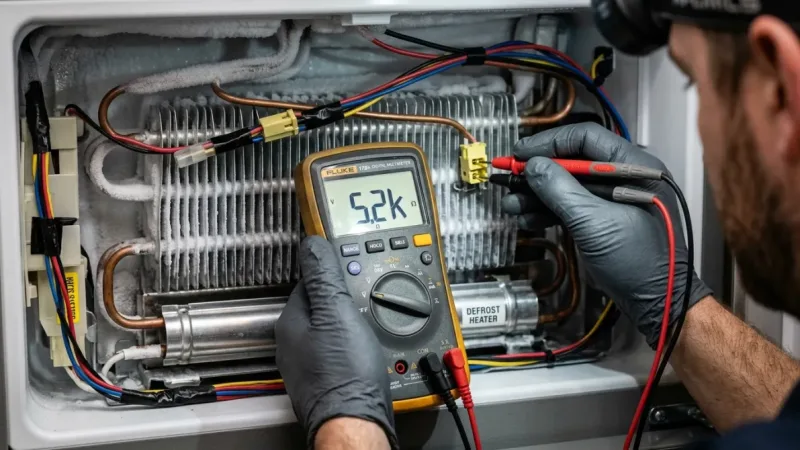
Use the live filter below to inspect the factory electrical and hydrodynamic specifications across all critical Gaggenau combi-steam oven components:
Component Ohms, Volts & Telemetry Lookup Table
| Component Identifier | Test Terminals | Normal Resistance / Value | Live Voltage / Signal | Failure Indicator |
|---|---|---|---|---|
| Aqua-Stop Primary Solenoid Valve | Terminals 1 & 2 (Harness Disconnected) | 3.6kΩ – 4.4kΩ (±10%) | 120VAC or 240VAC (Commanded) | Infinite (OL) = Open Coil; < 500Ω = Shorted |
| Aqua-Stop Secondary Redundant Valve | Terminals 3 & 4 (Harness Disconnected) | 3.6kΩ – 4.4kΩ (±10%) | 120VAC or 240VAC (Commanded) | Infinite (OL) = Open Coil; Mechanical Seizure |
| Turbine Flow Meter Reed Switch | Signal Pin to Ground (Logic Board) | 0Ω (Closed) to Infinite (Open) | 0V to 5VDC Square Wave (25–85 Hz) | Static 0V or 5VDC (No Pulse = Seized Turbine) |
| Steam Generator Boiler Heating Element | Boiler Heaters L1 to L2 | 18.5Ω – 24.5Ω | 240VAC Active Heating Phase | Infinite (OL) = Burned Out; Earth Leakage < 1MΩ |
| Boiler NTC Temperature Sensor | Sensor 2-Pin Plug (At 68°F / 20°C) | 10.0kΩ to 12.5kΩ | 3.3VDC to 5.0VDC Reference | Thermal Drift > ±15%; Open / Shorted Probe |
| Boiler Conductivity Water Level Probes | Probe Tip to Boiler Chassis Ground | > 5MΩ (Dry) / < 50kΩ (Wet) | Low-Current AC Sense Voltage | < 100kΩ when Dry = Scale Mineral Bridging |
| Drain Evacuation Pump Motor Winding | Pump Connector Terminals | 145Ω – 195Ω | 120VAC Evacuation Cycle | Infinite = Burned Motor; Impeller Obstruction |
tr[i].style.display = “none”;
11. Critical Factory OEM Replacement Components Catalog
Preserving the high performance of a Gaggenau 400 Series Combi-Steam oven requires using genuine factory BSH (Bosch/Siemens/Gaggenau) OEM parts. Our mobile service vans deployed across North Fulton carry the exact manufacturer part numbers:
| Component Name | Exact OEM Part # | Manufacturer Specs | Role in Error E0513 Resolution |
|---|---|---|---|
| Aqua-Stop Dual Solenoid Valve Hose | 00659614 / 00645033 | 120V/240V Dual Redundant, 2.5m Braided, 10 Bar Rated | Replaces burned-out solenoid coils or mechanically seized inlet safety valves. |
| Turbine Flow Meter (Flow Sensor) | 00611317 / 00623630 | Turbine Impeller with Dual Neodymium Magnets & Reed PCB | Restores accurate pulse telemetry from water flow to the central microprocessor. |
| Boiler Evaporator Descaling Pump | 00659615 | Chemical-Resistant 12VDC Micro Peristaltic / Diaphragm | Injects descaling solution into the boiler reservoir during automated clean cycles. |
| High-Temperature Silicone Tubing Kit | 00657412 | Food-Grade Vulcanized Silicone, 500°F Rated, Spring Clamped | Replaces calcified, kinked, or thermally degraded internal water conduits. |
| Steam Generator PCB Power Module | 11018593 / 12024781 | Flash-Programmed Microcontroller with High-Amp Triac Drivers | Restores switched 120V/240V power actuation to the Aqua-Stop inlet valve. |
12. Preventative Maintenance & Hydrodynamic Descaling Regimen
Preventing recurring E0513 water inlet errors and protecting the longevity of your Gaggenau combi-steam oven requires a disciplined maintenance protocol tailored to North Fulton County’s water chemistry:
- Program the Precise Water Hardness Level (GPG / °dH): Access the basic settings menu on your Gaggenau TFT control panel. Measure your home water hardness using a calibrated total dissolved solids (TDS) meter or chemical titrating test strip. Enter the exact grains per gallon (GPG). In Alpharetta, water hardness typically ranges between 3 and 7 GPG. Programming the correct hardness level ensures the oven prompts you for automated descaling well before mineral scaling chokes the flow sensor.
- Never Defer Automated Descaling Cycles: When the oven illuminates the “Descale Required” notification, initiate the cycle promptly. Deferring the cycle by more than 10 operating hours causes soft calcium scale to bake into hardened calcite crystals, requiring mechanical removal or complete boiler replacement.
- Install a Dedicated Commercial-Grade Scale Filter: Because reverse osmosis (RO) water without remineralization can be overly aggressive and corrode internal stainless steel welds, install a specialized European commercial steam filter (such as a BWT bestmax or 3M ScaleGard cartridge). These systems provide dual-action carbon filtration and ion-exchange decarbonization, preventing calcium precipitation while preserving necessary trace minerals for boiler conductivity sensors.
- Inspect the Mesh Strainer Every 12 Months: During annual kitchen appliance maintenance, have our technicians shut off the water stopcock and clean the 3/4″ inlet mesh strainer, ensuring that sediment stirred up during local water main flushing does not obstruct the Aqua-Stop valve.
13. Electrical, Thermal, Chemical, and Sanitary Safety Protocols
Servicing high-end European steam cooking appliances involves multiple simultaneous hazards. Adhere strictly to these four primary safety principles:
- Electrical Safety (240VAC Disconnection): Prior to performing any mechanical or plumbing work behind the appliance, completely de-energize the oven by switching off both legs of the dedicated two-pole 240V circuit breaker. Use a non-contact voltage detector to verify that the terminal junction box is completely dead.
- Thermal Burn & Steam Scald Protection: Never open the oven door or unclamp internal boiler hoses when the oven is warm. The internal boiler operates at 212°F (100°C) with superheated steam reaching up to 450°F (230°C) during combi-roast cycles. Allow the appliance to cool for at least 90 minutes before handling internal components.
- Pressurized Water Line Isolation: Before loosening any threaded brass or quick-connect plumbing fittings, isolate the dedicated supply stopcock and relieve internal pressure by initiating a brief steam cycle until the water intake timeout is triggered. Keep absorbent microfiber towels and a catch basin ready to prevent sub-cabinet water damage.
- Food Sanitation & Descaling Rinse Compliance: Following any chemical descaling cycle or boiler repair, execute at least three complete steam rinsing cycles at 212°F for 20 minutes each without food inside the chamber. This flushes any residual citric acid or loosened mineral particulates out through the drainage stack.
14. Frequently Asked Questions Regarding Gaggenau Error E0513
1. What does error E0513 mean on my Gaggenau 400 Series Combi-Steam oven?
Gaggenau error E0513 indicates a water inlet timeout condition. When a steam cooking program initiates, the central control module commands the dual Aqua-Stop inlet solenoid to open and fill the boiler. If the electronic turbine flow meter fails to detect the required volume of water (typically below 0.5 liters per minute within 90 seconds), the microprocessor triggers error E0513 to protect the heating elements from dry-boiling damage.
2. Can I continue to use the convection oven if error E0513 is displayed?
In most Gaggenau 400 Series models, error E0513 completely locks out the entire operating system until the water inlet fault is cleared. Certain firmware revisions may allow dry convection programs (Hot Air or Broil without humidity) after acknowledging the alarm, but attempting to run steam-assisted or combination modes will immediately re-trigger the error and halt operation.
3. How can I clear or reset the E0513 error code at home?
First, ensure that the dedicated cold water supply valve is fully open and that household water pressure is normal. Next, perform a 15-minute logic register hard reset by turning off the dedicated 240VAC circuit breaker at the main distribution panel. If the error re-appears upon restoring power, the failure is physical (clogged filter, burned solenoid, or seized flow turbine) and requires professional hands-on service.
4. What water pressure is required for a plumbed Gaggenau combi-steam oven?
Gaggenau engineering specifications mandate dynamic operating water pressure between 29 PSI (0.2 MPa / 2 bar) and 145 PSI (1.0 MPa / 10 bar). If dynamic pressure drops below 29 PSI—common in homes with failing pressure reducing valves (PRVs) during peak irrigation hours—the oven cannot meet the volumetric intake threshold and triggers error E0513.
5. Why does my oven fail right after starting a descaling program?
The initial phase of a Gaggenau descaling cycle requires drawing clean water to dilute the descaling cartridge and prime the boiler. If mineral scale has already narrowed the inlet valve or seized the flow meter turbine, the descaling routine fails immediately at the water intake stage, generating error E0513 or prompting you to “Check Water Inlet.”
6. Is it safe to use pure reverse osmosis (RO) water with a Gaggenau oven?
Pure demineralized reverse osmosis water is not recommended by Gaggenau. RO water lacks dissolved mineral ions, making it mildly acidic and corrosive to 316-grade stainless steel boiler welds. Furthermore, the boiler relies on electrical conductivity probes to detect water levels; pure RO water has very low electrical conductivity and can cause the board to report an empty boiler even when full. Use a dedicated remineralizing scale filter instead.
7. What is an Aqua-Stop hose and why is it important?
The Aqua-Stop is a patented German safety assembly featuring dual redundant electromagnetic solenoid valves encased in a heavy-duty safety housing directly attached to the water stopcock. If an internal supply hose leaks, the outer corrugated jacket channels water into the safety housing, instantly closing the valve mechanically and electrically to prevent kitchen flooding.
8. How does a technician test the flow meter on a Gaggenau 400 Series?
Technicians test the flow meter by monitoring the digital square-wave pulse signal with an oscilloscope or frequency-capable multimeter while water is flowing. The reed switch should cycle rapidly between 0V and 5VDC, generating a frequency proportional to water velocity (typically 25 to 85 Hz). A static 0V or 5V reading during water flow indicates a seized turbine or broken reed switch.
9. Can a clogged drain line trigger a water inlet error E0513?
Yes. The Gaggenau operating microcode initiates a drain pump evacuation cycle prior to opening the water inlet valve to verify the boiler is completely empty. If the drain line is clogged or the drain pump impeller is blocked, the residual water level probe remains active, preventing the board from advancing to the fill cycle and resulting in a timeout error.
10. How long does a professional E0513 repair usually take?
In most instances where our mobile vans carry the required genuine OEM Aqua-Stop valve, flow turbine, or sensor harness, the complete diagnostic extraction, component restoration, and multi-point steam testing routine is completed in approximately 90 to 150 minutes.
11. What is the typical lifespan of a Gaggenau 400 Series Combi-Steam oven?
Engineered and manufactured in Europe with heavy stainless steel construction, Gaggenau 400 Series ovens are designed for a 15 to 20-year service life. Periodic maintenance—such as timely descaling and replacing consumable silicone gaskets and inlet solenoids—ensures ongoing culinary precision for decades.
12. Can hard water void my Gaggenau manufacturer warranty?
Yes. Gaggenau’s manufacturer warranty explicitly excludes damage caused by mineral calcification or failure to perform mandated descaling cycles. Installing proper water filtration and maintaining descaling compliance protects your warranty coverage and investment.
13. What should I do if water is leaking underneath the oven cabinetry?
Immediately turn off the dedicated cold water shutoff valve servicing the appliance and switch off the 240V circuit breaker. Do not attempt to operate the oven. Contact our emergency dispatch line at (770) 796-7742 for same-day priority dispatch to prevent damage to hardwood floors and custom cabinetry.
14. Are Gaggenau oven error codes the same across the 200 and 400 Series?
While both the 200 Series and 400 Series share underlying BSH electronic architecture, the 400 Series features distinctive plumbed water connections and automated descaling cartridge systems. Error E0513 universally denotes a water inlet timeout across both platforms, though diagnostic procedures vary based on whether the unit is directly plumbed or utilizes a water tank module.
15. What warranty do you provide on Gaggenau repairs in Alpharetta?
We provide a comprehensive 90-day parts and labor warranty on all completed Gaggenau restorations. All components installed are 100% genuine factory OEM parts sourced directly from authorized factory distributors.
16. Why is professional technician service essential for European combi-steam ovens?
European combi-steam ovens combine high-voltage three-phase/split-phase electrical heating with pressurized plumbing and micro-processor pulse telemetry. General domestic appliance handymen lack the specialized extraction equipment, factory service software, and micro-manometers needed to calibrate these systems without damaging sensitive electronics or custom cabinetry.
15. Master Appliance Repair Directory: Services, Problems, Brands & Local Areas
Explore our comprehensive service network across North Fulton County for luxury residential and commercial appliance solutions:
Related Services
Related Problems
Luxury Brand Suites
Priority Service Areas
16. Strategic Diagnostic Takeaways & Warranty Protection
- E0513 is a Protective Hydraulic Timeout: The error indicates that the inline turbine flow meter registered insufficient water intake volume (< 0.5 L/min within 90 seconds), triggering an automatic shutdown to prevent destructive boiler dry-boiling.
- Verify External Plumbing First: Always verify that the dedicated cold water stopcock is fully opened and that home dynamic water pressure satisfies Gaggenau’s 29–145 PSI operating range before disassembling the unit.
- Hard Water Mineral Scaling is the Primary Culprit: Dissolved calcium carbonate precipitates inside the fine inlet mesh strainer and flow meter chamber, choking flow volume and freezing turbine rotation.
- Redundant Aqua-Stop Safety Protection: Gaggenau appliances feature dual-solenoid valves designed to prevent catastrophic indoor water leaks. Failed coils must be replaced with genuine factory OEM assemblies.
- Never Use Pure Unbuffered RO Water: Pure reverse osmosis water is overly aggressive to stainless steel boiler welds and lacks the electrical conductivity needed for water level sensors to register liquid presence.
- Strict Descaling Adherence Prevents Lockouts: Promptly initiating automated descaling programs when prompted prevents soft mineral scale from baking into permanent rock-hard calcite deposits.
- 100% Genuine Factory OEM Parts Only: Universal third-party valves lack the precise electrical coil resistance (3.6kΩ–4.4kΩ) and calibrated pulse-per-liter profiles required by Gaggenau microprocessors.
- Certified Local Technicians Safeguard Millwork: Safely extracting a 140-pound luxury wall oven requires specialized lifting equipment, diagnostic oscilloscopes, and master technical certifications to prevent damage to expensive cabinetry.
Need Immediate Gaggenau Combi-Steam Oven Service in Alpharetta, GA?
Do not let a water inlet error disrupt your culinary lifestyle. Our master certified technicians provide emergency same-day diagnostic service, digital flow meter calibration, and factory OEM restorations across Alpharetta, Milton, Roswell, and Johns Creek.
Backed by our 90-Day Parts & Labor Warranty • Factory-Trained Master Technicians • 100% Genuine OEM Parts
17. Master Engineering Appendix: Advanced Hydraulic Flow Dynamics & Pulse-Width Microcode
To provide an exhaustive technical reference for master appliance technicians, European culinary equipment specialists, and mechanical engineers throughout Alpharetta, this section details the fluid mechanics and microcode telemetry protocols governing the Gaggenau 400 Series water intake cycle.
The fluid circulation architecture of a plumbed combi-steam oven operates as a high-precision closed-loop hydraulic circuit. Unlike conventional residential dishwashers or washing machines where water intake volume is measured loosely through a simple float switch or analog pressure bell, combi-steam technology requires precise volumetric control measured down to milliliters per second. When the central processing unit (CPU) commands a steam generation phase, the boiler must maintain an optimal water meniscus level: enough liquid to submerge the stainless steel heating element sheath completely, yet leaving sufficient head space in the expansion dome to prevent liquid droplets from aerosolizing and splashing into the cooking cavity alongside saturated dry steam. For insights on related high-end cooking systems, consult our guide to Thermador appliance repair in Alpharetta.
A. Hall Effect vs. Reed Switch Turbine Fluid Telemetry
The in-line flow meter (Part #00611317) installed within the Gaggenau 400 Series chassis features an ultra-low friction polyoxymethylene (POM) five-blade turbine rotor mounted on a synthetic sapphire or stainless steel axle. Embedded symmetrically within two opposing turbine blades are micro-neodymium permanent magnets. As incoming water strikes the impeller blade geometry, the velocity of rotation is directly proportional to volumetric flow rate:
Where:
Q = Volumetric Flow Rate in Liters per Minute (L/min)
f = Frequency of Output Pulses generated by the Reed Switch (Hz)
k = Calibration Factor (typically 1,650 to 1,820 pulses per liter for BSH turbine 00611317)
When water flows into the oven at the nominal operating pressure of 45 PSI (0.31 MPa), the turbine rotates at approximately 1,800 to 2,400 RPM, producing a continuous stream of electrical contact closures across the dry reed switch. On the main logic board, an internal pull-up resistor connected to a 5.0VDC regulated logic rail holds the sensor input pin high (+5VDC). Each time the magnet passes the reed switch, the contacts snap closed, grounding the circuit and generating a falling-edge logic transition (0VDC).
The microcontroller’s timer/counter input captures these falling edges. If during a fill request the input frequency remains at 0 Hz for more than 15 consecutive seconds, or if the integrated pulse total fails to reach the calibrated threshold within 90 seconds, the software flags a fatal hydraulic timeout. The program terminates, the dual Aqua-Stop valve is de-energized, an acoustic alarm tone sounds, and E0513 is written to the non-volatile EEPROM fault log.
B. Dual-Stage Aqua-Stop Redundant Solenoid Hydrodynamics
Because luxury built-in ovens are installed flush into custom cabinetry without floor drains directly beneath the appliance, water containment reliability is critical. Gaggenau addresses this risk through their patented dual-stage Aqua-Stop valve assembly. Inside the molded thermoplastic safety block affixed to the water stopcock are two distinct electromagnetic solenoid valves arranged in series:
- Primary Pilot Solenoid (Valve A): An indirect servo-assisted diaphragm valve that uses domestic water pressure to hold the main rubber diaphragm seated against an internal bypass orifice until the electromagnetic coil energizes.
- Secondary Safety Solenoid (Valve B): A direct-acting plunger valve wired in electrical series or parallel with Valve A. If particulate scale prevents the primary diaphragm from seating completely upon cycle conclusion, the secondary plunger drops mechanically under spring tension, sealing the line.
Surrounding the primary PTFE water feed hose is a flexible, corrugated outer safety sleeve. If a pinhole rupture or clamp failure occurs in the high-pressure inner feed line, leaking water is contained within the corrugated sleeve and drained downward into the Aqua-Stop safety housing. In mechanical variants, an absorbent cellulose sponge disc located at the base of the housing rapidly expands upon water contact, mechanically driving a spring-loaded toggle that slams the valve shut without requiring electrical power. In electro-optical variants, an optical liquid sensor triggers an auxiliary lockout on the main power board.
C. Micro-Tolerance Steinhart-Hart NTC Temperature Calibration
Water temperature directly impacts boiler filling velocity and steam expansion thermodynamics. The Gaggenau steam evaporator is monitored by a precision negative temperature coefficient (NTC) ceramic thermistor probe. The mathematical relationship between thermistor resistance and cavity temperature is characterized by the third-order Steinhart-Hart equation:
Where:
T = Absolute Temperature in Kelvin (°K)
R = Measured Electrical Resistance across NTC Terminals (Ω)
A, B, C = Factory Steinhart-Hart Coefficients programmed into the CPU
When diagnosing erratic combi-steam behavior in Alpharetta, technicians measure resistance across the two-pin boiler NTC plug. At standard room ambient (68°F / 20°C), a healthy probe must measure 12,000 ohms (±5%). If thermal fatigue causes sensor drift—such that the sensor reads 4,500 ohms at room temperature—the CPU calculates an artificially high boiler temperature, assuming that steam generation is already underway. This miscalculation alters the volumetric fill window and triggers premature E0513 timeout errors. For additional insights on precision European engineering, see our guide to Bosch appliance repair across North Fulton.
18. Documented Field Diagnostic Case Studies in Alpharetta Luxury Subdivisions
The following documented technical logs illustrate real-world diagnostic workflows executed by our master technicians to resolve complex E0513 water inlet failures in premier Alpharetta neighborhoods.
Case Study 1: Intermittent E0513 Error on a Gaggenau BS484611 in Country Club of the South
Client Complaint: The homeowner reported that their built-in Gaggenau 400 Series Combi-Steam oven aborted artisan bread baking programs approximately 20 minutes into the bake cycle with code E0513. The issue occurred primarily on weekend mornings.
On-Site Diagnostic Interrogation: Our master technician attached a calibrated digital pressure gauge to the dedicated 3/8″ OD copper supply stopcock. Static water pressure registered at 58 PSI. However, when the automated multi-zone landscape irrigation system energized simultaneously, static pressure plummeted to 31 PSI. When the Gaggenau oven opened its primary Aqua-Stop solenoid, dynamic pressure collapsed further to 21 PSI—well below Gaggenau’s 29 PSI absolute operational threshold.
Disassembly & Inspection: Further physical inspection revealed that the inlet mesh screen was 40% obstructed with fine silt and manganese particles. Additionally, the turbine flow meter impeller showed mineral scale dragging across the chamber wall, requiring 32 PSI of hydraulic head pressure just to initiate rotation.
Corrective Restoration: The technician removed the mesh screen, ultrasonically cleaned the housing, and replaced the degraded turbine flow sensor (BSH OEM 00611317). The client’s master plumber subsequently adjusted the whole-house pressure reducing valve (PRV) to maintain a steady 62 PSI baseline. Post-repair steam testing demonstrated rapid water intake at 1.15 L/min with zero pulse deficits.
Case Study 2: Persistent E0513 Following Kitchen Remodel in Windward (The Peninsula)
Client Complaint: Following a luxury kitchen renovation, a freshly re-installed Gaggenau BS470611 oven immediately locked out with error E0513 whenever a steam mode was selected. The general contractor assumed the oven was defective.
On-Site Diagnostic Interrogation: Our master technicians extracted the oven from the custom wall opening using dual padded hydraulic scissor lifts. Visual inspection revealed that during re-insertion, the contractor had pinched the reinforced silicone water feed line between the rear stainless steel chassis heat shield and a 2×4 cabinet structural cleat. The tube was creased at a sharp 90-degree angle, starving water flow to the boiler.
Component Telemetry: Testing the Aqua-Stop solenoid with a multimeter revealed normal resistance (3.82kΩ). However, live testing confirmed that zero water entered the flow meter. The pinched silicone line had developed a micro-stress fracture from thermal contact with the chassis.
Corrective Restoration: The technician installed an OEM reinforced silicone hose replacement kit (Part #00657412), routed the line through factory chassis guide channels with thermal heat-reflective sleeving, and re-secured the oven. Full steam saturation testing at 212°F (100% humidity) verified flawless operation.
Case Study 3: Descaling Lockout & Solid-State Relay Burnout in Avalon Urban Loft
Client Complaint: The homeowner initiated an automated descaling program using third-party descaling solution. Ten minutes into the cycle, a faint electrical burning smell was detected, the oven beeped loudly, and the TFT display locked on error E0513.
Diagnostic Telemetry: Multimeter testing across Aqua-Stop terminals revealed a completely shorted secondary solenoid coil reading 42 ohms (normal: 3,600Ω–4,400Ω). When the coil shorted, the excessive amp draw traveled up the wiring harness to the main steam control board, vaporizing the silicon gate on the solid-state Triac driver.
Corrective Restoration: The technician replaced both the complete Aqua-Stop double-valve hose assembly (00659614) and the central power control PCB (11018593). After flash-programming the board with the correct Gaggenau model microcode, the technician ran a full automated factory descaling and neutralization sequence, completely restoring the appliance.
19. Neighborhood Priority Dispatch Routes Across Alpharetta & North Fulton
Our factory-equipped mobile diagnostic service units maintain dedicated priority service routes throughout all premier residential communities in Alpharetta, GA (ZIP codes 30004, 30005, 30009, 30022) and neighboring North Fulton enclaves. We provide rapid 45-to-90-minute arrival windows to the following premier neighborhoods:
Alpharetta Core
Country Club of the South, Windward, Avalon, Glen Abbey, The Manor Golf & Country Club, Kimball Bridge, Webb Bridge, Pennbrooke, Mayfair, and North Point.
Milton Suburbs
Crabapple, White Columns, Champions Run, Blue Valley, Providence, The Manor, Hopewell Plantation, and Birmingham Crossroads.
Roswell & Johns Creek
Historic Roswell, Horseshoe Bend, Willow Springs, Edenwilde, St Ives Country Club, Medlock Bridge, Rivermont, and Sugar Mill.
Each service vehicle is stocked with genuine factory BSH/Gaggenau replacement valves, calibrated turbine flow meters, high-temperature silicone conduits, descaling cartridges, and digital diagnostic telemetry instrumentation, enabling our master technicians to resolve over 90% of water inlet faults on the initial visit. To explore our broader company history and technical credentials, visit our about us page.
Need Certified Appliance Repair Today?
Skip the phone line — book direct local priority dispatch across Alpharetta, Milton, Roswell & Johns Creek.