
Commercial Under-Counter Dishwasher Booster Heater Not Sanitizing Repair in Alpharetta, GA
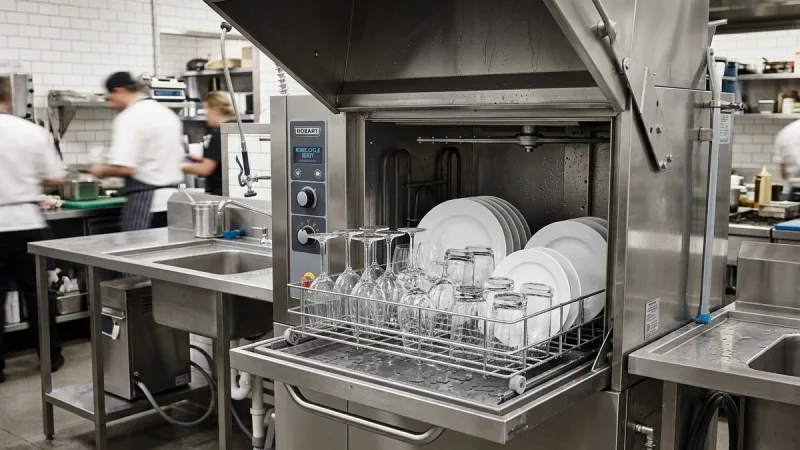
When a commercial undercounter dishwasher fails to achieve the mandatory 180°F sanitizing rinse temperature in an Alpharetta, GA restaurant, bar, catering facility, or healthcare kitchen, daily operations grind to an immediate halt. High-temperature sanitization is non-negotiable under Georgia food safety regulations; without an operational electric booster heater, dishware exits cool, wet, and microbiologically compromised, creating imminent health department red-tag risks. Our master certified commercial kitchen technicians provide same-day emergency booster heater diagnostics, immersion element replacements, contactor overhauls, and chemical deliming across Fulton County dining districts. Equipped with factory OEM immersion elements from Hobart, Jackson, Champion, CMA, and ADS, along with digital diagnostic multimeters and calibrated immersion test instruments, our on-call Alpharetta commercial fleet restores compliance in a single visit. For immediate priority dispatch to your kitchen, bar, or dining room, call our direct commercial service line at (770) 796-7742.
Quick Diagnostic Answer: Why Is Your Commercial Undercounter Dishwasher Booster Heater Not Sanitizing?
When a commercial undercounter dishwasher fails to sanitize, the final rinse water is dropping below the mandatory 180°F (82°C) threshold required by NSF/ANSI Standard 3 and FDA Food Code 4-703.11. In over 75% of Alpharetta kitchen service calls, this failure is caused by a ruptured or open-circuit incoloy immersion heating element (measuring infinite ohms resistance), a tripped manual-reset high-limit safety thermostat (triggered by thermal scale buildup), carbon-pitted or welded magnetic contactor points that fail to transfer 208V/240V power to the heating coils, or an incoming water supply temperature dropping below 120°F–140°F from the facility’s primary boiler.
Immediate Action: Confirm incoming facility water temperature at the pre-rinse sink, check whether the red manual reset button on the booster tank has tripped, never bypass high-limit safety cutouts, and immediately contact a licensed commercial specialist at (770) 796-7742 to prevent health department red-tag closures.
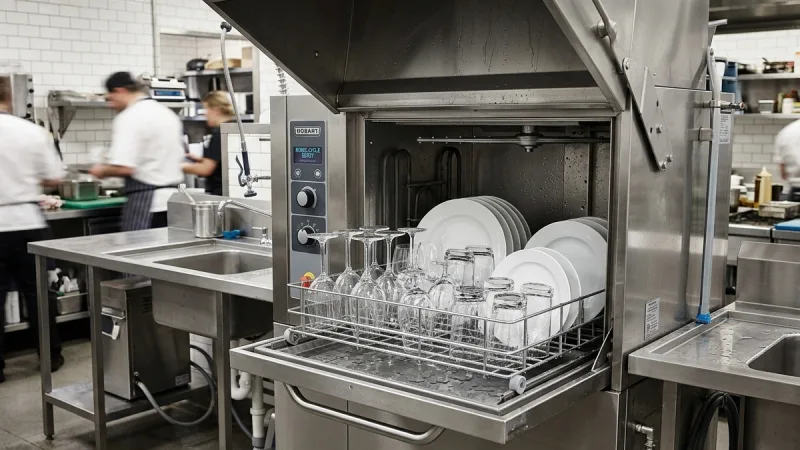
Listen to 60-Second Commercial Booster Heater Diagnostic Brief
Narrated by Marcus V. (Master Commercial Appliance & Warewashing Specialist)
Check Same-Day Commercial Dishwasher Tech Availability in Alpharetta & Fulton County
Enter your commercial facility zip code (e.g. 30004, 30005, 30009, 30022, 30076) to confirm immediate truck dispatch:
Recently Serviced in Avalon Dining Boulevard, Alpharetta, GA 30009
Hobart LXeH Undercounter Dishwasher Not Sanitizing (146°F Final Rinse) • Replaced 7kW Incoloy Booster Element & 3-Pole Contactor • Calibrated Rinse Temp to 183°F • Verified 5.0 ★★★★★
Commercial Dishwasher Booster Heater Repair Guide: Table of Contents
- The Physics & Regulatory Mandate of High-Temperature Sanitization (NSF/ANSI & FDA)
- Operational Symptoms of Booster Heater Malfunction & Warning Signs
- Visual Field Restoration: Ruptured Heating Element Before & After OEM Replacement
- Primary Root Causes of Booster Heater Sanitization Failure
- Step-by-Step Safe Facility Troubleshooting Protocols for Restaurant Operators
- When to Stop DIY: 208V/240V Arc Flash Hazards, Steam Scalding & OSHA Regulations
- Commercial Decision Analysis: Booster Component Repair vs. New Dishwasher Replacement
- Interactive Instant Commercial Dishwasher Repair Cost Calculator
- Commercial Cost Factors Breakdown: Elements, Contactors, Labor & Emergency Response
- Master Multimeter & Resistance Telemetry Lookup Table (Interactive Live Search)
- Essential OEM Parts Involved (Hobart, Jackson, Champion, CMA Part Numbers)
- Preventative Maintenance & Chemical Deliming Protocols for Alpharetta Operations
- Commercial Food Sanitation, Scalding Prevention & Electrical Safety Rules
- Frequently Asked Questions (Interactive Accordion Diagnostic Library)
- Technical Engineering Deep Dive: The Thermodynamics of Water Temperature Rise
- Real-World Alpharetta Commercial Kitchen Case Studies
- Commercial Repair Directory & Fulton County Dispatch Coverage
The Physics & Regulatory Mandate of High-Temperature Sanitization (NSF/ANSI & FDA)
In modern commercial kitchens, high-volume bars, luxury retirement dining centers, and fast-paced catering facilities throughout Alpharetta, Georgia, the undercounter commercial dishwasher represents an indispensable line of defense against foodborne illness. Unlike residential units that run leisurely two-hour wash programs, a commercial undercounter warewasher must cycle dishes, flatware, and bar glassware in ninety to one hundred and twenty seconds flat. To accomplish microbial destruction at such blistering speeds without corrosive chemical bleaches, commercial establishments rely heavily on high-temperature thermal sanitization.
Under FDA Food Code Section 4-703.11 and NSF/ANSI Standard 3, the water temperature in a high-temperature commercial dishwasher rinse manifold must reach a minimum of 180°F (82.2°C), while never exceeding 195°F (to prevent flash vaporization into steam). Furthermore, the actual surface temperature of the dishware must achieve a minimum cumulative thermal exposure of 160°F (71.1°C) during the final rinse to deliver a 5-log reduction in pathogenic microorganisms, including Salmonella enterica, Listeria monocytogenes, Escherichia coli, and Norovirus. When your facility requires professional assistance, our specialists in commercial appliance repair provide rapid compliance restoration.
The physical engineering core that makes this rapid thermal destruction possible is the integrated electric booster heater. Municipal water supplied by the Fulton County Water Resources department enters commercial facilities at seasonal ambient temperatures between 45°F and 65°F. The building’s central commercial gas boiler or tankless array typically elevates this water to a primary supply temperature of 120°F to 140°F. However, 140°F is utterly inadequate for thermal sanitization; washing at 140°F without chemical sanitizers leaves grease films and live bacterial colonies on dinner plates. The booster heater—a heavy-gauge stainless steel pressure tank holding three to six gallons of water—utilizes a high-wattage immersion heating element (typically rated from 5,000 to 9,000 watts) to provide a vital 40°F to 70°F instantaneous thermal rise, delivering pressurized water at 180°F to 185°F directly into the rotating rinse arms.
When the booster heater experiences an electrical, mechanical, or thermodynamic failure, the rinse water discharges at merely the building’s tank temperature. In busy culinary establishments situated throughout Downtown Alpharetta, Avalon, and Windward Parkway, this failure is catastrophic. The dishes exit cool and dripping with residual moisture, failing to flash-dry naturally. Even worse, Fulton County Board of Health inspectors routinely place thermo-label temperature strips directly onto plate surfaces during unannounced food safety audits. If the 160°F indicator strip fails to turn irreversible black, the inspector issues an immediate critical violation, risking a demerit score downgrade, public health notices, or mandatory closure of the dishwashing station until repairs are certified by a licensed technician.
Furthermore, commercial warewashing equipment cannot be serviced like residential units. High-temperature commercial undercounter dishwashers operate on dedicated 208-volt or 240-volt single-phase or three-phase electrical branch circuits drawing 25 to 45 continuous amperes. Their hydraulic circuits interface directly with high-pressure commercial water mains through double-check backflow preventers and atmospheric vacuum breakers. Mastering the diagnostic procedures required to pinpoint whether a sanitization failure stems from an open-circuit heating coil, a calcified sensor well, an arcing magnetic contactor, or an undersized boiler feed requires commercial-grade technical training and industrial test telemetry.
Operational Symptoms of Booster Heater Malfunction & Warning Signs
Kitchen operators, head chefs, and lead bartenders should never wait for an annual health inspection audit to discover that their undercounter dishwasher is failing to sanitize. A failing booster heater exhibits distinct mechanical, acoustic, and sensory symptoms that provide unmistakable advance warning of critical component degradation:
- Rinse Temperature Gauge Reads Below 180°F: The most unambiguous visual indicator. During the final 10 to 15 seconds of the wash program when the rinse arms are actively spinning, the analog dial or digital display on the lower kick-plate or front control fascia should firmly sit between 180°F and 190°F. If the gauge plate lingers at 120°F–145°F, the booster heater is failing to energize or cannot overcome the incoming water flow rate.
- Dishes and Glassware Emerge Cold, Wet, and Greasy: In high-temperature sanitizing machines, the intense 180°F rinse water heats ceramic dishware and stainless cutlery so intensely that latent heat causes water droplets to evaporate almost instantly—a phenomenon known as “flash drying.” If dishware exits soaking wet and requires towel drying (which is itself a health code violation due to cross-contamination risks), thermal sanitization has failed completely.
- Persistent Cloudiness, Water Spots, and Lipstick Residue: Without 180°F thermal liquefaction, animal fats, cooking oils, and cosmetic residues are not dissolved during the short rinse burst. Glassware exhibits a cloudy film and water spotting across the rim. When kitchen managers observe this symptom in Alpharetta, scheduling prompt commercial dishwasher repair prevents customer complaints and beverage spoilage.
- Repeated Tripping of the Dedicated Circuit Breaker: If the 40-amp or 50-amp two-pole or three-pole circuit breaker in the facility’s commercial electrical panel trips instantly when the dishwasher reaches the rinse stage, the immersion heating element has experienced an internal dielectric breakdown, resulting in a direct dead short from the incoloy resistance wire to the grounded water tank.
- Popping of the Red Manual Reset High-Limit Button: Commercial booster tanks feature a safety thermostat with an external manual reset button. When heavy calcium scale insulates the heating coils, the element generates localized pocket temperatures exceeding 210°F–220°F without transferring heat into the water, causing the high-limit thermal switch to trip and mechanically lock out the heating circuit.
- Audible Hissing, Boiling, or Rumbling Sounds Inside the Booster Tank: When hard water scale accumulates into a thick calcified jacket around the electric immersion coils, water trapped beneath the scale crust reaches flash boiling points. This generates a distinct kettle-like whistling, popping, or rhythmic rumbling sound during the recovery preheat cycle.
-
Electronic Microprocessor Error Codes Displayed: Leading commercial warewashing brands incorporate digital diagnostic logic that locks the machine into a safe lockout when temperatures fail to meet regulatory standards. Common error codes include:
- Hobart LXe / LXr Series: Code “dr” (Booster Door/Drain Error), “P2” (Booster Preheat Timeout), or “E3” (Rinse Thermistor Open/Shorted).
- Jackson DishStar HT-E: Code “E2” (Final Rinse Temperature Sensed Below 180°F Lockout) or flashing rinse LED indicator.
- Champion Undercounter UH130B / UH230B: Code “LO RINSE TEMP” or “FAIL TO REACH 180F” cycle abort.
- CMA Dishmachines / ADS: High-temp warning strobe or rinse solenoid lockout alarm.
Ignoring these operational symptoms not only imperils guest health through microbial contamination but also accelerates the permanent destruction of expensive electronic control modules and booster pressure vessels. If your commercial warewashing system displays any of these warning signs along Haynes Bridge Road or Old Milton Parkway, our commercial dispatch team is stationed nearby to assist.
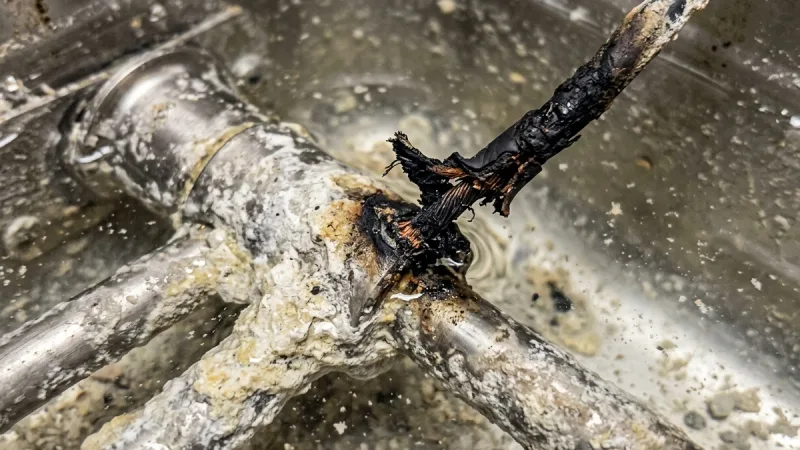
Field Diagnosis: A busy North Point bar reported their undercounter glasswasher rinse temperature was capped at 134°F with frequent breaker trips. Disassembly of the booster tank revealed the 7kW incoloy immersion element was encased in a 3/8-inch blanket of hard calcium carbonate scale, causing extreme thermal hotspotting, sheath splitting, and an open circuit fault.
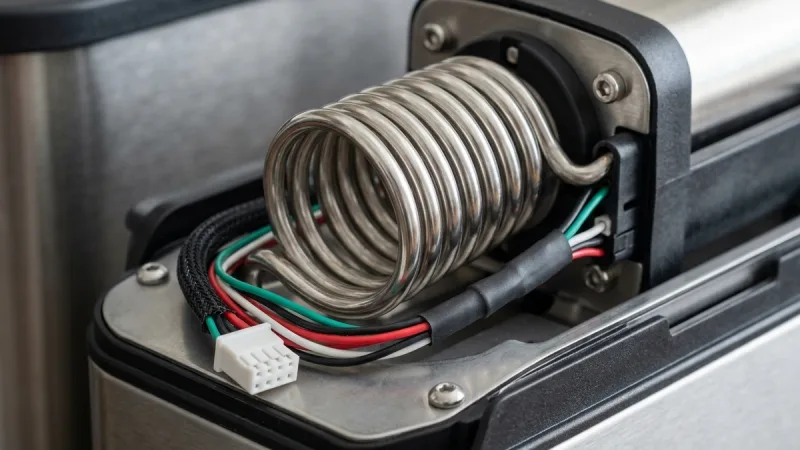
Restoration Outcome: Master technicians acid-flushed the 316-grade stainless steel booster pressure tank, installed a genuine factory OEM incoloy heating element with high-temperature silicone flange gasket, replaced the pitted 3-pole magnetic contactor, and calibrated the NTC sensor. The machine now delivers an optimal 183°F sanitizing rinse every single cycle.
Primary Root Causes of Booster Heater Sanitization Failure
Pinpointing why a commercial booster heater fails to achieve 180°F sanitization requires an exhaustive systematic analysis of the hydraulic, electrical, and thermal control circuits. Our commercial field engineering logs across North Fulton County reveal nine dominant root causes:
1. Burnout and Metallurgical Rupture of the Incoloy Immersion Heating Element
The immersion heating element is the physical workhorse of the booster heater. Constructed from coiled nickel-chromium (NiCr) resistance wire encased in compacted magnesium oxide (MgO) powder insulation and protected by a corrosion-resistant Incoloy or copper outer sheath, the element operates under tremendous thermal stress. Over thousands of commercial wash cycles, expansion and contraction cycles degrade the resistance wire.
Eventually, a microscopic pinpoint breach develops in the outer metal sheath. Pressurized water enters the MgO insulation powder, creating an instant direct short-to-ground that vaporizes the internal NiCr coil. When tested with a digital multimeter across its terminal pins, a burned-out element shows infinite resistance (OL / Open Loop). Without this electrical resistance, no joule heating occurs, leaving the rinse water completely cold.
2. Calcium Carbonate (Limescale) Thermal Barrier and Element Overheating
Municipal tap water in northern Fulton County contains dissolved calcium and magnesium carbonates. As water is heated inside the booster tank to 180°F+, the chemical solubility of calcium carbonate drops rapidly, precipitating out of solution and adhering directly to the hottest surfaces available—the glowing immersion coils.
Calcium carbonate has an extremely low thermal conductivity (approximately 0.8 W/m·K compared to 400 W/m·K for copper). Even a millimeter of scale acts as an impenetrable thermal blanket. Because heat cannot transfer efficiently into the flowing water, the interior temperature of the element core skyrockets beyond 1,200°F. The incoloy metal blisters, softens, and ruptures prematurely, while the water in the tank remains sluggishly cool.
3. Pitted, Carbon-Burnt, or Welded Magnetic Contactor Contacts
Because the booster heating element draws between 20 and 40 continuous amperes at 208V or 240V, the electronic control board does not switch high-voltage power directly. Instead, a low-voltage relay on the circuit board energizes an electromechanical heavy-duty 3-pole magnetic contactor. Every time the contactor pulls in, high-amperage electrical arcing occurs across the silver-cadmium contact pads.
Over 50,000 to 100,000 wash cycles, this electrical arcing pits, oxidizes, and deposits resistive carbon layers across the contact points. When carbon pitting becomes severe, electrical resistance across the closed contacts rises dramatically, causing a massive voltage drop. The booster element receives only partial voltage (e.g. 150VAC instead of 208VAC), reducing heat output by half. In worse scenarios, contact pads weld shut mechanically, causing the heater to run continuously until the safety high-limit blows.
4. Tripped or Fatigued High-Limit Thermal Cutout Thermostat
To prevent catastrophic booster pressure vessel explosions or steam flashover, commercial warewashers are mandated by safety codes to incorporate an independent, fail-safe high-limit safety thermostat. This bimetallic snap-action switch is clamped directly against the booster tank shell or immersed in a dedicated thermal well, calibrated to trip at approximately 210°F to 220°F.
When tripped, it physically interrupts control power to the contactor coil, locking the heating element off. While the high-limit is designed to protect the equipment during a run-away heating event, the internal bimetal disc fatigues over years of thermal cycling. A fatigued high-limit switch begins tripping nuisance lockouts at normal operating temperatures of 185°F, plunging the dishwasher into an unheated sanitizing failure.
5. Out-of-Calibration NTC Electronic Temperature Sensor Probe / Thermistor Drift
Modern commercial dishwashers utilize Negative Temperature Coefficient (NTC) thermistor probes to measure water temperature in real time. As water warms, the electrical resistance through the thermistor decreases according to a precise logarithmic curve. The microprocessor continuously reads this resistance across an analog-to-digital converter pin.
If mineral scale coats the exterior of the sensor thermowell, or if moisture migrates past the probe’s silicone seal, the thermistor experiences calibration drift. For instance, while the actual water temperature is only 145°F, the drifted thermistor might falsely report a resistance corresponding to 185°F. The microprocessor assumes the booster is fully preheated and initiates the rinse cycle without energizing the heater, leaving dishware contaminated.
6. Defective Final Rinse Solenoid Valve Diaphragm or Sticking Mechanical Plunger
The booster heater depends on precise hydraulic water flow. When the rinse cycle activates, a high-temperature 24VAC or 120VAC brass water solenoid valve snaps open, allowing incoming facility water to enter the bottom of the booster tank, which in turn displaces superheated 180°F water out the top into the rinse manifold.
If waterborne silt or calcium fragments lodge in the valve seat, or if the rubber diaphragm tears, water may trickle through the booster tank continuously during the wash phase. This continuous water bleed constantly dilutes the stored water volume with cold municipal fluid, exhausting the booster’s thermal reserve so that when the rinse cycle finally triggers, the water temperature plummets instantly. If your venue also maintains commercial refrigeration or draft equipment, our team servicing commercial refrigerator repair can cross-inspect your utility connections.
7. Insufficient Facility Hot Water Supply (Under 120°F/140°F Boiler Supply Deficit)
An undercounter booster heater is engineered as a booster, not a primary water heater. In technical engineering terms, standard commercial booster heaters are rated for either a 40°F rise (requiring 140°F incoming building supply to reach 180°F) or a 70°F rise (requiring minimum 110°F incoming supply).
If a facility’s commercial gas water heater experiences burner issues, an undersized expansion tank, or a failing recirculation pump during the peak dinner rush when hand sinks, mop sinks, and bar faucets are drawing hot water simultaneously, the incoming supply water to the dishwasher can drop to 90°F or colder. Even a perfectly functioning 7kW booster element cannot bridge a 90°F thermal gap during a rapid 10-second rinse burst, resulting in an unheated rinse cycle through no fault of the dishwasher itself.
8. Low-Water Cutoff (LWCO) Float Sensor Failure Leading to Catastrophic Dry-Firing
Electric immersion elements must be 100% submerged in liquid water whenever voltage is applied. If an element is energized while exposed to air—an event known in appliance engineering as dry-firing—the incoloy sheath reaches over 1,500°F within seconds, melting the internal coil and permanently destroying the element in under ten seconds.
Commercial booster tanks incorporate an electronic conductivity probe or a magnetic low-water float switch. If mineral scale bridges the probe insulator (causing the control board to believe water is present when the tank is actually empty), or if a float jams, the board energizes the contactor into an empty tank, instantly vaporizing the new heating element.
9. Defective Solid-State Microprocessor Control Board, Wash/Rinse Interlock Triac, or Relay
Modern warewashing equipment utilizes advanced printed circuit boards (PCBs) that monitor temperature logic via firmware algorithms. For example, Hobart LXe machines feature a programmable “Sanitizing Interlock” that pauses the wash timer and forces the machine to hold its wash cycle until the booster heater confirms a 180°F ready state.
If an onboard solid-state switching Triac or output relay burns out on the main control PCB (often due to electrical line voltage spikes or moisture condensation behind the kick-plate), the board fails to output the 120VAC or 24VAC pilot signal to the contactor coil. The contactor never pulls in, and the booster heater sits entirely dormant despite flawless elements and thermostats.
Step-by-Step Safe Facility Troubleshooting Protocols for Restaurant Operators
Before placing an emergency service call, restaurant general managers, kitchen supervisors, and facilities staff can perform this disciplined 5-step non-invasive diagnostic protocol to identify the failure point safely:
Step 1: Check Incoming Water Temperature at Building Supply & Pre-Rinse Faucet
Turn on the hot water tap at the adjacent pre-rinse scrap sink or commercial pot sink located directly beside the dishwasher. Let the water run at full volume for 60 seconds. Insert a calibrated digital food thermometer directly into the running stream. The water temperature must read between 120°F and 140°F (depending on whether your machine is rated for a 70°F or 40°F rise). If the water reads below 110°F, your building’s primary water heater or circulation pump is malfunctioning, starving the dishwasher booster of required BTU energy.
Step 2: Observe Final Rinse Pressure and Manifold Pressure Gauge
Commercial high-temp warewashers require a steady dynamic water flow pressure between 15 and 25 PSI (with 20 PSI being ideal) during the rinse stroke. Watch the mechanical pressure gauge mounted on the incoming water plumbing line as the rinse cycle fires. If the pressure exceeds 30 PSI, water is surging through the booster tank too rapidly, preventing adequate heat transfer. If dynamic pressure drops below 12 PSI, the spray pattern will be erratic, and flow safety interlocks will inhibit heating.
Step 3: Perform Thermo-Label (Thermostrip) Dish Plate Temperature Audit
Affix a certified 160°F irreversible thermal sanitization test strip (such as a 3-mil Thermolabel or Tempilabel) to the center face of a standard ceramic dinner plate. Place the plate in the center of the dishrack and run a standard normal wash cycle. When the cycle concludes, inspect the test indicator immediately:
- Indicator turns completely black: The surface of the dish achieved the mandatory 160°F thermal threshold; sanitization is verified.
- Indicator remains gray or silver: Thermal sanitization failed; the dish surface never reached 160°F, indicating an active booster heater breakdown.
Step 4: Inspect the High-Limit Red Reset Button on Booster Tank Bottom
Locate the lower kick-panel at the base of the dishwasher. With the unit’s master power toggle turned OFF, shine a flashlight into the compartment to locate the circular booster heater vessel. Look for a small red rubber-encased push-button on the high-limit switch bracket. Firmly depress the red button with your finger:
- Audible “Click” Felt/Heard: The safety switch had tripped on an over-temperature condition. Power the unit back on and test a cycle. If it trips again immediately, heavy scale or a welded contactor is present.
- No Click / Soft Spring Travel: The high-limit is not tripped; the issue lies elsewhere in the electrical circuitry.
Step 5: Examine Booster Flange Gasket and Plumbing for Scalding Steam or Fluid Leaking
Visually inspect the bottom of the machine around the booster mounting flange, immersion element terminals, and temperature-and-pressure (T&P) relief valve pipe. If you observe water dripping onto electrical wire harnesses or steam venting aggressively from the vacuum breaker, shut off the water feed valve immediately. Water ingress into electrical terminals will cause instant catastrophic phase-to-phase flashover. Facilities in neighboring towns can contact our technicians for appliance repair in Milton, GA for rapid on-site assistance.
When to Stop DIY: 208V/240V Arc Flash Hazards, Steam Scalding & OSHA Regulations
Critical Commercial Safety Warning: 208V/240V 3-Phase Arc Flash & Scalding Water
Commercial undercounter dishwashers are industrial appliances connected directly to high-capacity commercial electrical panels delivering 208-volt, 240-volt, or 480-volt 3-phase power backed by 40-amp to 60-amp circuit breakers. In the presence of kitchen grease, conductive wash chemicals, and moisture, opening internal electrical compartments carries severe risks of catastrophic arc flash explosions, fatal electric shock, and third-degree steam scalding.
Under OSHA Standard 29 CFR 1910.147 (Lockout/Tagout – LOTO), facility employees must never probe live electrical terminals, bypass safety limit controls, or replace internal immersion elements without certified commercial technician equipment. Furthermore, improperly sealed booster tanks operating at 200°F can rupture violently under 25 PSI main pressure.
Cease internal troubleshooting immediately, disconnect the unit at the dedicated wall disconnect switch or breaker panel, and contact an authorized commercial warewashing specialist when:
- You smell acrid burning plastic, ozone, or scorched wire insulation emanating from the dishwasher cabinet.
- The main electrical breaker trips repeatedly with an audible explosion or visible electrical flash beneath the machine.
- The temperature-and-pressure (T&P) safety relief valve is actively discharging scalding steam or boiling water onto the kitchen floor.
- Testing heating element continuity requires removing high-voltage terminals in tight, damp undercounter spaces.
- The internal booster tank exhibits pinhole corrosion leaks or cracked stainless steel weld joints.
Call our 24/7 commercial emergency line at (770) 796-7742 for immediate factory-trained assistance.
Commercial Decision Analysis: Booster Component Repair vs. New Dishwasher Replacement
Commercial undercounter dishwashers represent a major capital investment, costing between $5,500 and $11,000+ for premium high-temperature models from Hobart, Jackson, or Champion. To assist Alpharetta restaurant owners and finance directors in making economically sound capital expenditure decisions, our senior commercial engineers have formulated this comprehensive decision matrix:
| Booster Diagnostic Scenario | Machine Age Profile | Recommended Action | Financial & Operational Rationale |
|---|---|---|---|
| Ruptured Heating Element or Burned Contactor | 1 to 7 Years | Repair Component | Highly cost-effective ($380–$680); restores full 180°F compliance immediately while preserving heavy-gauge cabinet life. |
| Tripped High-Limit / Scale Accumulation | Any Age | Chemical Delime & Reset | Inexpensive preventive service ($250–$390); dissolves scale barrier, recalibrates heat transfer, and stops lockouts. |
| Failed Microprocessor Board + Element | Under 8 Years | Overhaul Electronics | Total repair cost ($850–$1,250) represents less than 15% of purchasing and plumbing a replacement commercial machine. |
| Pinhole Leaks in Stainless Booster Vessel | 9+ Years | Replace Dishwasher | Booster tank replacement requires full cabinet teardown ($2,400+); structural corrosion signals end-of-life across pumps and chassis. |
| Multiple Failures (Pump + Booster + PCB) | 10+ Years | Upgrade to New Unit | Modern Energy Star machines use 35% less water, feature ventless energy recovery, and provide fresh 3-year factory warranties. |
If your hospitality establishment also operates commercial walk-in freezers or reach-in chef coolers, our team providing emergency appliance repair can bundle diagnostic evaluations across all kitchen assets.
Estimated Cost Factors Breakdown
Commercial warewashing repair invoices reflect four key industrial operational variables:
- OEM Component Specification & Metallurgy: Genuine OEM Incoloy 800 or 825 alloy immersion elements are engineered specifically to resist corrosion from aggressive warewashing detergents and sanitizing heat. Universal or generic residential-grade copper elements fail within weeks and void NSF certifications. Hobart, Jackson, and Champion OEM components carry premium manufacturing costs that ensure multi-year reliability.
- Industrial 208V/240V 3-Phase Electrical Labor: Commercial dishwashers pull heavy electrical current requiring OSHA-compliant Lockout/Tagout (LOTO) protocols, true-RMS multimeter load testing, and torquing high-amperage terminal lugs to factory inch-pound specifications.
- Chemical Acid Deliming & Scale Neutralization: Removing calcium carbonate from a booster pressure tank requires circulating specialized food-grade inhibited phosphoric or sulfamic acid descaling chemicals, followed by complete neutralization and sanitary water purging.
- Hospitality Evening, Weekend & Emergency Response: Commercial kitchens operate on grueling 14-hour schedules. Emergency weekend dinner dispatch ensures your establishment avoids costly glass shortages and health inspection shutdown orders.
If your dining establishment also maintains domestic appliances in employee breakrooms or catering suites, our team servicing dishwasher repair provides synchronized facility care.
Master Multimeter & Resistance Telemetry Lookup Table (Interactive Live Search)
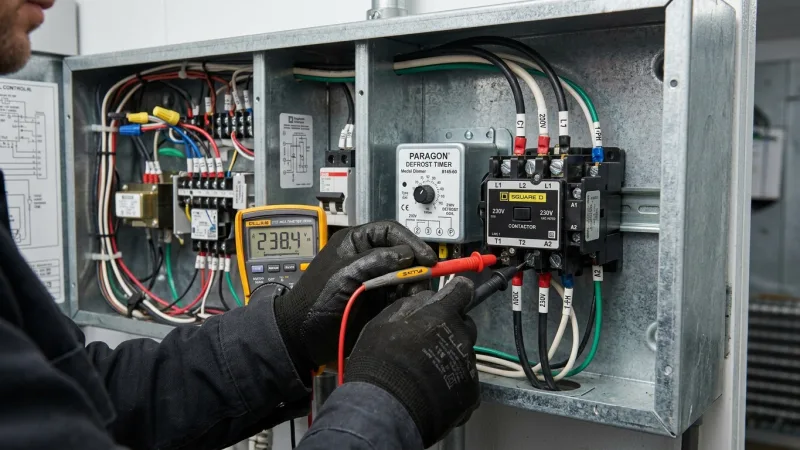
Professional commercial diagnostics require precision instrument testing. Master technicians providing appliance diagnostic service use calibrated digital multimeters to measure resistance, continuity, and AC voltage against factory OEM engineering tolerances. Type any component or test parameter in the search box below to filter technical telemetry:
| Component / Test Point | Nominal Factory Specification | Failure Threshold (Defective Part) | Diagnostic Indication & Technical Resolution |
|---|---|---|---|
| Hobart 5kW Booster Element (208V, 1-Phase) | 8.65 Ω (Cold Resistance across pins) | ∞ Ω (Open Loop) or < 0.5 Ω (Short) | Burned internal resistance wire; breaker trips or rinse stays cold. Replace OEM element. |
| Hobart 7kW Booster Element (240V, 3-Phase) | 12.3 Ω between each phase leg (Delta) | Unbalanced resistance (>10% variance) | One phase leg open; element delivers only 66% heating capacity. Replace element assembly. |
| Jackson DishStar 9kW Element (208V) | 4.8 Ω (Parallel/Delta configuration) | ∞ Ω or continuity to ground (<50MΩ) | Insulation breakdown to earth ground. Trips GFCI/breaker instantly. Replace element. |
| Magnetic Contactor Coil (120VAC Pilot) | 65–110 Ω across A1/A2 terminals | 0 Ω (Shorted) or ∞ Ω (Open coil) | Contactor will not pull in when board commands preheat. Replace 3-pole contactor. |
| High-Limit Safety Thermostat (Manual Reset) | Closed (0.0 to 0.2 Ω continuity) | Open (∞ Ω) below 200°F water temp | Bimetal fatigue or overtemp trip. Push red reset. If open when cool, replace thermostat. |
| NTC Temperature Sensor Probe (at 77°F / 25°C) | 10.0 kΩ nominal resistance | < 7.0 kΩ or > 13.0 kΩ (Drifted) | Causes false preheat complete or “E3” error. Replace NTC thermistor probe. |
| NTC Temperature Sensor Probe (at 180°F / 82°C) | 1.25 kΩ nominal resistance | > 2.5 kΩ at true 180°F water bath | Board thinks water is only 140°F, locking machine in endless wash cycle. Replace probe. |
| Rinse Solenoid Valve Coil (120VAC / 24VAC) | 140–280 Ω (120V) | 18–35 Ω (24V) | ∞ Ω (Burned coil) or mechanical jam | No rinse flow or continuous trickle diluting booster tank. Replace solenoid valve. |
| Dynamic Flow Water Pressure (Incoming) | 20 PSI (±5 PSI) during active rinse | < 15 PSI (Starved) or > 28 PSI (Surging) | High flow sweeps heat away before reaching 180°F. Install pressure regulator. |
);
Common OEM Parts Involved (Exact Part Numbers & Specifications)
Commercial warewashing systems require genuine factory OEM components engineered to withstand high thermal expansion and chemical exposure. When our team performs appliance parts replacement, our service vehicles carry factory-sealed inventory for all major commercial warewashing brands:
- Hobart LXe / Advansys 5kW/7kW Immersion Element (Part #00-893041-00001 / #00-893041-00002): Heavy-duty triangular flange Incoloy 800 element engineered for 208V/240V operation with integrated high-temperature O-ring gasket.
- Hobart 3-Pole 30A/40A Magnetic Contactor (Part #00-087713-00042): Industrial motor-rated contactor with 120VAC operating coil and arc-quenching silver alloy contacts.
- Jackson DishStar High-Limit Cutout Thermostat (Part #5930-011-48-43): Manual-reset 210°F bimetallic thermal safety switch with snap-action SPST contacts.
- Jackson DishStar Thermistor Temperature Sensor (Part #6680-003-88-29): Stainless steel threaded thermowell probe with hermetically sealed NTC thermal bead.
- Champion Undercounter 9kW Booster Heater Element (Part #109867 / #0507324): Multi-bend incoloy heating element assembly designed for rapid 70°F thermal rise in high-volume banquet operations.
- CMA / ADS 6kW Booster Heater Element & Gasket Kit (Part #13417.00 / #13417.47): Flanged immersion element paired with chemical-resistant Viton tank gasket.
- Watts Commercial 1/2″ Temperature & Pressure Relief Valve (Watts Model 3L / 100XL): ASME-rated safety relief valve calibrated for 150 PSI and 210°F discharge protection.
If your facility also relies on specialty cold-chain equipment or Scotsman gourmet ice makers in the bar area, our technicians certified in ice machine repair provide coordinated commercial support.
Preventative Maintenance Routine & Chemical Deliming Procedures for Alpharetta Operations
Implementing a rigorous preventive maintenance schedule eliminates 90% of commercial booster heater breakdowns and ensures unblemished health inspection scores:
- Daily Wash Tank Drain & Strainer Basket Cleaning: At the close of every shift, drain the wash tank completely, remove scrap baskets, and rinse away food soil to prevent debris from circulating into the booster inlet.
- Weekly Chemical Deliming Cycle: In North Fulton County’s hard water environment, circulate a certified food-grade phosphoric or sulfamic acid deliming solution (e.g. Lime-A-Way or Ecolab Lime-A-Way Select) through the machine for 15 to 20 minutes to dissolve mineral scale before it calcifies onto the booster element.
- Monthly Inspection of Rinse Arm Nozzles: Unscrew upper and lower rinse arms and inspect each tiny nozzle orifice for calcium seeds. Clogged rinse nozzles restrict water flow, raising booster tank pressure and triggering temperature spikes.
- Quarterly Inspection of Electrical Contactor Contacts: Have a licensed commercial technician inspect the magnetic contactor for contact pitting, carbon buildup, and loose terminal lugs caused by thermal cycling.
- Semi-Annual T&P Relief Valve Manual Trip: Manually lift the test lever on the booster pressure relief valve to ensure the valve seat is free of scale and capable of discharging safely during an overpressure emergency.
Commercial Food Sanitation, Scalding Prevention & Electrical Safety Rules
Commercial kitchen operations must strictly adhere to regulatory life safety standards:
- Mandatory Temperature Log Documentation: Kitchen supervisors must log wash tank and final rinse temperatures twice daily using calibrated digital thermometers or thermo-labels, retaining records on-site for health inspection review.
- Strict Scald Warning Awareness: Water discharged from the booster heater reaches 180°F to 195°F. At 180°F, human skin suffers third-degree full-thickness burns in under 0.5 seconds. Never open dishwasher doors during the active rinse phase.
- Maintain Atmospheric Vacuum Breaker Compliance: Ensure the brass vacuum breaker mounted above the dishwasher is inspected annually to eliminate cross-contamination backflow into municipal drinking water.
- Never Modify Factory Safety Limits: Never jumper across high-limit thermal switches or use oversized fuses to bypass nuisance tripping. Bypassing safety switches converts a booster tank into an unvented pressure bomb.
Advanced Engineering Analysis: The Microbiology & Kinetic Chemistry of Warewashing Sanitization
In professional commercial warewashing, the distinction between “cleaning” and “sanitizing” is both legally binding and microbiologically definitive. While detergent washing removes gross food soils, animal proteins, and insoluble greases from plate surfaces through emulsification and saponification, sanitization is the microbiological process of reducing disease-causing bacterial populations to safe, non-pathogenic levels. Under public health guidelines enforced by the Fulton County Board of Health and Georgia Department of Public Health Rules and Regulations Chapter 511-6-1, warewashing equipment must demonstrate a verified 5-log reduction (99.999% microbial kill rate) against standard vegetative test organisms, specifically Escherichia coli, Salmonella enterica, and Staphylococcus aureus.
In high-temperature undercounter machines, this lethal microbial destruction is achieved strictly through thermal kinetics. Thermal death time for bacteria follows an exponential logarithmic decay model governed by two primary physical constants: the Decimal Reduction Time (D-value) and the Thermal Inactivation Factor (z-value). The D-value defines the time required at a specified temperature to reduce the viable microbial population by 90% (1-log). The z-value represents the temperature increase required to reduce the D-value by a factor of ten.
For common foodborne vegetative pathogens, the D-value at 140°F (the typical temperature of a commercial building’s primary water heater) is approximately 1.5 to 2.0 minutes. Because an undercounter commercial dishwasher’s final rinse cycle lasts only 10 to 12 seconds, washing dishware at 140°F delivers virtually zero pathogen inactivation. However, as the water temperature is elevated by the electric booster heater to 180°F (82.2°C), the D-value plunges to less than 0.05 seconds. At 180°F, even a fleeting 10-second rinse spray delivers more than 100 times the cumulative thermal lethal dose required to destroy vegetative bacteria, bacterial spores, and viral envelopes.
Furthermore, thermal sanitization eliminates the major operational liabilities associated with low-temperature chemical sanitizing machines. Chemical sanitizers rely on sodium hypochlorite (chlorine bleach) metered at 50 to 100 parts per million (PPM) at 120°F. Chlorine is chemically aggressive: it corrodes expensive stainless steel silverware, pits brass bar fixtures, degrades silicone door gaskets, and leaves an unmistakable chemical bleach aroma on delicate wine glasses and craft cocktail tumblers. High-temperature sanitization leaves zero chemical residue, imparts no odor or flavor taint to culinary presentations, and leverages high latent heat to enable instantaneous flash drying of ceramic and glassware.
Hydraulic Dynamics of Undercounter Rinse Manifolds and Spray Impact Velocity
Thermal transfer from the 180°F rinse water into the ceramic dishware is governed not only by water temperature, but also by hydraulic fluid mechanics. As superheated water leaves the booster tank, it travels through copper or stainless steel transfer tubing to the upper and lower rotating rinse arms. The rinse arms are driven entirely by the reactionary jet thrust of the water exiting angled nozzle orifices.
For optimal heat transfer, the dynamic water pressure at the rinse manifold must be calibrated between 15 and 25 Pounds per Square Inch (PSI), with 20 PSI being the absolute industry engineering benchmark. If the water pressure is too low (under 12 PSI), the rotational velocity of the rinse arms slows down, resulting in uneven spray coverage and leaving cold spots on dishes located at the periphery of the dishrack. Conversely, if dynamic water pressure exceeds 28 PSI, the water velocity through the booster heater increases excessively, causing water to flash through the tank faster than the immersion elements can conduct thermal energy into the fluid stream. High pressure also causes fine atomization into an aerosol mist; fine droplets cool rapidly upon contacting ambient air inside the wash chamber, dropping water temperatures by as much as 15°F before the water droplets strike the dish surface.
Water Chemistry Profile & Mineral Hardness Kinetics in Fulton County
A critical environmental factor influencing commercial dishwasher booster heater reliability in Alpharetta is municipal water chemistry. Commercial establishments in Alpharetta and surrounding North Fulton communities receive potable water treated by the Fulton County Water Resources Department, sourced primarily from the Chattahoochee River basin. While Fulton County municipal water meets all federal drinking water standards, commercial warewashing heating processes induce severe mineral precipitation:
- Total Hardness: Averages between 2.5 to 5.5 grains per gallon (GPG) or approximately 40 to 95 mg/L of calcium carbonate equivalent. In seasonal periods of low river flow, hardness levels spike significantly.
- Total Dissolved Solids (TDS): Averages 60 to 140 parts per million (PPM), containing dissolved silicates, chlorides, and magnesium ions.
- pH Range: Typically buffered to 7.2 to 7.8 to mitigate distribution pipe corrosion.
The fundamental engineering problem arises because calcium carbonate (CaCO₃) exhibits inverse thermal solubility. In contrast to table salt or sugar—which dissolve more readily in hot water—calcium carbonate becomes increasingly insoluble as water temperature increases. When water is heated from 130°F to 185°F inside a compact 4-gallon booster vessel, calcium ions precipitate out of solution at exponential rates.
The microscopic mineral crystals adhere tenaciously to the hottest surfaces available: the glowing exterior metal sheaths of the Incoloy immersion heating elements. Within weeks of operation without adequate water softening or polyphosphate scale inhibition, a dense, cementitious calcium scale crust develops around the heating loops. Scale has a thermal conductivity of roughly 0.8 W/m·K, compared to 400 W/m·K for copper and 15 W/m·K for stainless alloys. As this scale layer thickens beyond 1/16th of an inch, it creates an impermeable thermal insulator that traps heat within the element core, inevitably causing internal wire burnout, blistered metal sheaths, and frequent high-limit trips.
Master Commercial Technician Diagnostic Protocols & Electrical Testing
When an authorized commercial appliance engineer from Appliance Repair Alpharetta arrives on-site to triage an undercounter dishwasher that fails to sanitize, the diagnostic process follows a disciplined, multi-stage engineering workflow:
Phase 1: OSHA Lockout/Tagout & Safe Voltage Verification
Before any cabinet panels are removed, the technician identifies the dedicated commercial branch circuit disconnect switch located adjacent to the dishwasher or at the facility’s main electrical distribution panel. Applying an OSHA-approved Lockout/Tagout (LOTO) padlock and tag, the technician uses a Category III 600V-rated digital multimeter to test for zero AC voltage across all phase conductors (L1-L2, L2-L3, L3-L1) and from each phase to chassis ground. Only when zero potential is confirmed does mechanical teardown begin.
Phase 2: True-RMS Ohms Resistance & Insulation Megohmmeter Testing
The technician disconnects the high-temperature silicone-insulated wire leads from the immersion heating element terminal studs. This isolates the element entirely from parallel circuit paths. The technician then performs two critical electrical tests:
- Cold Resistance Test (Ohm’s Law Verification): Using precision low-resistance multimeter probes, the technician measures resistance across the element pins. For a 208V, 7kW element configured in Delta, each coil loop should measure approximately 12.3 ohms. If the meter reads infinite resistance (∞ Ω or O.L.), the internal resistance wire is broken. If it measures less than 1 ohm, an internal short has bypassed the resistance coil.
- Insulation Breakdown Megohmmeter Test (500VDC Megger Test): A standard 9-volt digital multimeter cannot detect high-voltage dielectric breakdown across moisture-laden magnesium oxide insulation. The commercial technician connects an industrial insulation tester, applying 500 volts DC between the element terminal pins and the grounded stainless steel tank shell. The reading must exceed 50 Megohms (50,000,000 ohms). Any reading below 2 Megohms confirms moisture intrusion or dielectric rupture, mandating immediate element replacement to prevent catastrophic breaker trips.
Phase 3: Dynamic Live Amperage Balance Testing
Once components are verified and safety panels are reattached, the technician powers the machine on and commands a booster preheat cycle. Using a calibrated true-RMS clamp-on ammeter, the technician measures the active current draw on each phase conductor feeding the booster contactor:
Target 3-Phase Amperage = Kilowatts / (Line Voltage × √3) → 7,000W / (208V × 1.732) = 19.43 Amperes
All three phase legs must draw balanced current within 5% of one another. If L1 and L2 draw 19.5 amps while L3 draws 0.0 amps, one pole of the magnetic contactor has failed to close or an internal wire lug has burned free, starving the booster of 33% of its heating capacity.
Phase 4: Calibrated Temperature Sensor & Thermistor Verification
The technician removes the NTC temperature sensor from its brass thermowell and immerses the probe tip alongside a certified NIST-traceable digital immersion thermometer in two controlled test baths: an ice-water reference bath at 32°F (0°C) and a boiling reference bath at 212°F (100°C). By measuring the sensor’s resistance against factory logarithmic look-up tables (e.g. 10.0k ohms at 77°F, 1.25k ohms at 180°F), the technician identifies subtle sensor drift that causes premature heating shutoffs.
Comprehensive Water Conditioning & Chemical Descaling Engineering
Preventing premature booster heater failure in commercial restaurants requires a proactive, science-based approach to facility water conditioning. In the demanding hospitality corridors of Alpharetta, kitchen operators who invest in upstream water treatment extend booster element lifespan from an average of 14 months to over 6 years.
Commercial Water Filtration & Scale Inhibitor Infrastructure
Standard residential carbon filters are utterly inadequate for high-temperature commercial warewashing machines. Commercial installations demand a dedicated dual-manifold or triple-manifold water filtration array specifically configured for high-temperature service:
- Stage 1: 5-Micron Sediment Pre-Filter: Removes rust particles, silt, pipe scale, and sand from municipal water mains, preventing mechanical scoring of the rinse solenoid valve diaphragm.
- Stage 2: Polyphosphate Scale Inhibitor Cartridge: Utilizes food-grade sodium hexametaphosphate (polyphosphate) beads that sequester calcium and magnesium ions. The polyphosphate molecules coat mineral crystal nucleating sites, preventing calcium carbonate from bonding to glowing Incoloy booster heating coils.
- Stage 3: Catalytic Activated Carbon Block: Eliminates municipal chlorine and chloramines that accelerate pitting corrosion on high-grade stainless steel wash tanks and brazed element flanges.
Professional Chemical Deliming Procedure (Step-by-Step Facility Protocol)
Commercial kitchens in Alpharetta must execute this formal chemical deliming protocol bi-weekly or monthly based on dishmachine cycle volume:
- Complete Drain and Fresh Water Fill: Turn off chemical detergent dispensers. Drain the dishmachine completely to remove all alkaline wash detergent residues. Refill the tank with clean, fresh tap water. (Never mix acid delimers with alkaline wash detergents or chlorine sanitizers; mixing acid with chlorine produces lethal, toxic chlorine gas).
- Add Certified Inhibited Phosphoric Acid Delimer: Pour 8 to 16 ounces of certified food-grade commercial deliming chemical (containing 20% to 35% phosphoric acid and corrosion inhibitors) directly into the wash tank water bath.
- Run Automated De-Lime Program or Manual Circulation: Close the dishmachine doors and activate the automated deliming cycle (or manual continuous wash cycle) for 15 to 20 minutes. The acid solution circulates through wash arms, manifolds, and booster return circuits, dissolving calcium carbonate scale into soluble calcium phosphate.
- Drain and Perform Minimum Two Complete Water Purges: Drain the acidic solution completely. Refill with fresh water and run two consecutive empty wash cycles to flush all chemical acid residues out of spray arms, wash tanks, and rinse nozzles.
- Verify pH Neutrality: Use litmust test strips on residual sump water to confirm the wash chamber has returned to a neutral pH of 7.0 before re-engaging commercial warewashing detergents and resuming dish sanitization.
Frequently Asked Questions (Interactive Accordion Diagnostic Library)
Click any technical question below to expand master commercial technician answers regarding dishwasher booster heaters, 180°F sanitization failures, and Alpharetta emergency dispatch:
Q1: What temperature must a commercial dishwasher booster heater reach to sanitize?
Under FDA Food Code Section 4-703.11 and NSF/ANSI Standard 3, high-temperature commercial dishwashers must achieve a minimum final rinse manifold water temperature of 180°F (82.2°C) for stationary rack single-temperature machines, while never exceeding 195°F. Furthermore, the physical surface of the dishware must achieve a minimum heat exposure of 160°F (71.1°C) to guarantee complete destruction of pathogens.
Q2: Why is my commercial dishwasher rinse temperature only reaching 140°F?
If the rinse temperature gauge hovers at 120°F to 140°F, the booster heater is not engaging at all. The water entering the rinse manifold is simply the baseline hot water supplied by your building’s primary plumbing heater. The most common causes are a burned-out immersion heating element, a tripped manual-reset high-limit thermostat, a faulty magnetic contactor coil that fails to pull in, or a defective electronic temperature sensor.
Q3: How does a commercial undercounter booster heater work?
The booster heater consists of a dedicated 3- to 6-gallon stainless steel pressure vessel equipped with high-wattage electric immersion heating elements (5kW to 9kW). When the dishwasher cycle calls for the final sanitizing rinse, incoming hot water from the facility boiler (at 120°F–140°F) is forced through the booster vessel, which rapidly elevates the water temperature by an additional 40°F to 70°F before discharging it across the dishware at 180°F–185°F.
Q4: What is the difference between a 40°F rise and a 70°F rise booster heater?
A 40°F rise booster is engineered for kitchens where the building water supply reliably delivers 140°F hot water directly to the machine inlet. A 70°F rise booster incorporates larger heating elements (typically 7kW to 9kW) capable of taking cooler 110°F facility water and elevating it all the way to the mandatory 180°F sanitizing threshold. Sizing the wrong rise rating for your facility’s plumbing leads to chronic sanitization failures.
Q5: Where is the high-limit reset button located on an undercounter booster heater?
On most commercial undercounter models (such as Hobart LXe, Jackson DishStar, and Champion UH130B), the red manual reset button is located behind the lower front kick-panel, directly attached to the bimetallic thermal cutout switch mounted against the bottom or side of the cylindrical booster tank. Always turn off master power before reaching into the compartment.
Q6: Why does my dishwasher booster heater trip the building circuit breaker?
Circuit breaker tripping occurs when the outer Incoloy sheath of the immersion heating element splits or corrodes through, allowing pressurized water to contact the internal 208V/240V resistance coil. This causes an instantaneous high-amperage dead short to the grounded stainless steel tank, immediately tripping the breaker. A pitted or arcing contactor can also trigger breaker overloads.
Q7: What happens if a health inspector finds my commercial dishwasher rinse under 180°F?
Under Fulton County Board of Health and Georgia Department of Public Health regulations, failure to achieve 180°F final rinse water or 160°F dish surface temperature is classified as an imminent health hazard and critical violation. The inspector will place a red tag on the machine, prohibiting its use until a licensed commercial technician repairs the equipment and certifies proper sanitizing temperatures.
Q8: Can hard water scale cause a commercial booster heater to stop heating?
Yes. Calcium carbonate scale forms an insulating blanket around the heating coils. Because heat cannot transfer into the water, the internal resistance wire overheats and burns out. Additionally, the extreme localized heat triggers the high-limit safety thermostat to trip repeatedly, cutting off power to the booster.
Q9: How often should a commercial dishwasher booster heater be delimed?
In Alpharetta and North Fulton, high-temperature commercial dishwashers should be chemically delimed weekly or bi-weekly depending on wash volume. Facilities operating with untreated municipal water without polyphosphate pre-filters require more frequent acid descaling to protect immersion elements.
Q10: What does Hobart LXe error code “P2” mean?
On Hobart LXe and Advansys dishwashers, code “P2” indicates a Booster Preheat Timeout. The electronic control board energized the booster heating circuit, but the water temperature failed to rise to the programmed setpoint within the factory safety time limit (typically 15 to 20 minutes). This points to an open element, tripped high limit, or bad contactor.
Q11: How much does it cost to replace an undercounter dishwasher booster heating element?
Replacing a commercial OEM Incoloy booster heating element typically ranges from $420 to $690, including genuine factory parts, new tank flange gaskets, electrical load testing, and commercial diagnostic labor. If contactors or high-limit safety controls must also be replaced, total costs range from $550 to $850.
Q12: Can I convert a high-temperature dishwasher to chemical sanitizing if the booster dies?
Converting a machine requires installing peristaltic chemical metering pumps, chlorine injection check valves, modifying cycle timing, and obtaining health department approval. In most cases, replacing the booster element or contactor is significantly faster, more economical, and avoids chemical chlorine odor on bar glassware.
Q13: What resistance should a good commercial booster element measure?
Using Ohm’s Law (R = V² / P), a standard 5kW 208V single-phase element should measure approximately 8.65 ohms. A 7kW 240V three-phase element measures approximately 12.3 ohms per leg in a delta circuit. If a multimeter displays infinite resistance (OL), the internal coil is completely open and broken.
Q14: Why do dishes come out wet when the booster heater isn’t working?
High-temperature commercial dishwashers do not utilize forced-air heating fans or long drying cycles. Instead, they rely on the intense 180°F rinse water heating the thermal mass of ceramic plates and metal utensils, causing rinse water to flash evaporate in seconds. When rinse water is only 130°F, flash drying fails completely.
Q15: Are your technicians certified for commercial kitchen 3-phase electrical systems?
Yes. All of our commercial appliance engineers are factory-trained and certified in OSHA Lockout/Tagout procedures, 208V/240V/480V 3-phase industrial power circuits, and commercial warewashing plumbing and backflow standards.
Q16: How fast can emergency commercial technicians arrive in Alpharetta?
We maintain dedicated on-call commercial service vehicles stationed across Alpharetta, Milton, Roswell, and Johns Creek. For active kitchen warewashing emergencies during restaurant operations, our priority dispatch arrival window is typically 45 to 90 minutes.
Technical Engineering Deep Dive: The Thermodynamics of Water Temperature Rise
To understand why booster heater sizing and diagnostic accuracy are critical to commercial food service, one must examine the fundamental thermodynamic physics governing instantaneous water heating. In thermodynamics, the thermal energy required to elevate the temperature of a fluid is expressed by the formula:
Q = ṁ × Cp × ΔT
Where Q represents heat transfer rate in BTU per hour (or kilowatts), ṁ is the mass flow rate of water in pounds per minute (or gallons per minute × 8.34 lbs/gal), Cp is the specific heat capacity of water (1.0 BTU/lb·°F), and ΔT is the required temperature differential between incoming supply water and the target 180°F sanitizing rinse.
In a standard undercounter commercial dishwasher, the final rinse cycle discharges approximately 0.75 to 0.85 gallons of water over a 10-second pulse. This translates to an instantaneous hydraulic flow rate of 4.5 to 5.1 Gallons Per Minute (GPM). If incoming water from the restaurant’s primary water heater enters the booster at 140°F, achieving a 180°F rinse requires a ΔT of 40°F. The instantaneous heat demand is calculated as:
4.8 GPM × 500 × 40°F Rise = 96,000 BTU/hr (approx. 28 kW instantaneous equivalent)
Because installing a 28-kilowatt electrical circuit in an undercounter space is impractical (requiring over 130 amperes at 208V), commercial undercounter dishwashers rely on thermal storage capacity. The 3- to 6-gallon booster tank pre-heats and stores water at 185°F using a 5kW to 7kW element over a two-minute preheat cycle. When the rinse begins, the stored superheated reservoir is flushed into the manifold while the active element maintains thermal equilibrium. If scale reduces tank volume or element heat transfer, the thermal reservoir depletes within three seconds, causing the rinse temperature to collapse to incoming supply levels before the cycle finishes.
Electrical Architecture: Delta vs. Wye 3-Phase Heating Circuits
Commercial booster heaters in Alpharetta utilize either Delta (Δ) or Wye (Y) electrical configurations on 208V or 240V 3-phase feeds. In a Delta configuration, each of the three immersion coils is connected directly across two line phases (L1-L2, L2-L3, L3-L1). The voltage across each individual element equals full line voltage (Vphase = Vline = 208V).
If one phase leg opens due to a burned contactor contact or loose lug, the circuit becomes an unbalanced single-phase load. Two element segments continue operating at reduced voltage while one segment drops completely offline. As a result, total kilowatt output drops from 7kW down to approximately 3.5kW. The dishwasher will slowly preheat during idle periods, but during back-to-back rack loading, the rinse temperature will rapidly deteriorate below 160°F. Master technicians test phase current on each line conductor using clamp-on amp meters to verify balanced current draw across all three phases (e.g. 19.4A ± 0.5A per phase leg).
Real-World Alpharetta Commercial Kitchen Case Studies
The following documented commercial field dispatches illustrate the real-world complexities of diagnosing and restoring undercounter dishwasher booster heaters in Fulton County:
Case Study 1: Upscale Italian Bistro in Avalon (Alpharetta, GA 30009)
Reported Issue: During a Friday evening dinner service, the lead dishwasher operator reported that the bar undercounter Hobart LXeH warewasher displayed a continuous flashing “P2” error, and bar wine glasses emerged wet and spotted. A surprise Fulton County health audit was scheduled for the following Monday morning.
Technical Diagnostic Flow: Our commercial technician arrived on-site in 48 minutes. Accessing the electrical compartment, voltage testing confirmed 208VAC was supplied to the line side of the 3-pole magnetic contactor. However, measuring resistance across the 5kW immersion heating element revealed an open loop (∞ ohms) on the L1-L2 branch. The heating coil had ruptured due to scale insulation.
Resolution & Verification: The technician drained the booster tank, removed the ruptured element, and chemically descaled the interior stainless shell using food-grade phosphoric acid. A genuine factory OEM Hobart 5kW Incoloy heating element (Part #00-893041-00001) and heavy-duty contactor were installed. Thermal testing with certified 160°F test strips verified flawless 183°F rinse temperatures, clearing the bistro for an unblemished 100% health inspection score.
Case Study 2: High-Volume Sports Bar on Windward Parkway (Alpharetta, GA 30005)
Reported Issue: A sports grill near Georgia 400 reported that their Jackson DishStar HT-E undercounter dishwasher tripped the main 50-amp electrical panel breaker every time the machine transitioned from the wash cycle to the final rinse cycle.
Technical Diagnostic Flow: The technician performed an insulation resistance test (Megohmmeter test) on the booster heating element. While standard multimeter tests indicated continuity across coils, applying 500VDC revealed a catastrophic dielectric breakdown: insulation resistance to the grounded tank shell dropped to 0.02 Megohms (normal threshold is >50 Megohms). As soon as the contactor closed, 208V flashed to earth ground.
Resolution & Verification: The technician replaced the grounded element with a genuine Jackson 9kW incoloy heater, replaced the arced magnetic contactor, and installed a replacement high-limit thermostat. The machine was run through five consecutive stress test cycles under full restaurant load, maintaining zero breaker trips and a steady 184°F rinse manifold temperature.
Case Study 3: Farm-to-Table Restaurant in Downtown Alpharetta (GA 30009)
Reported Issue: A farm-to-table eatery near Canton Street noted that their Champion UH130B undercounter dishwasher ran continuously without advancing to the final rinse, causing severe delays during Saturday brunch.
Technical Diagnostic Flow: The Champion machine was equipped with a sanitizing thermal interlock designed to hold the wash cycle until booster water reaches 180°F. Multimeter testing revealed the heating element and contactor were in working order; however, the NTC temperature probe in the booster thermowell had drifted severely, measuring 28k ohms at 150°F (equivalent to freezing water). The board believed the tank was ice-cold and held the wash timer indefinitely.
Resolution & Verification: Our specialist removed the calcified thermowell, installed a brand-new factory OEM temperature probe, and recalibrated the board logic. The machine immediately resumed its rapid 90-second cycle time, sanitizing dishware at 182°F with zero brunch delays.
Specialized Commercial & Warewashing Repair Services
- Commercial Appliance Repair Alpharetta GA – Comprehensive commercial kitchen equipment and warewashing repair.
- Commercial Dishwasher Repair Alpharetta GA – Undercounter, conveyor, and door-type high-temperature dishmachines.
- Emergency Appliance Repair Service – 24/7 priority commercial dispatch for active kitchen equipment breakdowns.
- Same-Day Appliance Repair Service – Rapid diagnostic triage and mobile warehouse parts inventory for immediate restoration.
Related Commercial & Warewashing Diagnostic Guides
- Commercial & Residential Dishwasher Repair Guide – Complete troubleshooting for pumps, drains, and valves.
- Commercial Freezer Repair & High Temp Diagnostics – Walk-in and reach-in cold-chain maintenance.
- Commercial Ice Machine Diagnostic & Harvest Failure Guide – Descaling and sensor calibration for cubers.
Commercial & Premium Brands Serviced
- Bosch Appliance Repair Alpharetta – Precision European engineering, heating elements, and electronic controls.
- Miele Appliance Repair Alpharetta – Commercial-grade dishwashers, sanitizing cycles, and high-temp circulation.
- KitchenAid Appliance Repair Alpharetta – Heavy-duty heating components, spray manifolds, and wash motors.
Dedicated North Fulton Commercial Dispatch Coverage
Our certified commercial technicians provide priority same-day emergency dispatch across all primary North Fulton culinary hubs:
- Commercial Appliance Repair Alpharetta GA – Avalon, Downtown Alpharetta, Windward Parkway, and North Point corridors.
- Commercial Appliance Repair Milton GA – Crabapple Market, Birmingham Crossroads, and country club dining facilities.
- Commercial Appliance Repair Roswell GA – Historic Canton Street dining district and Holcomb Bridge hospitality corridor.
- Commercial Appliance Repair Johns Creek GA – Medlock Bridge, Technology Park, and country club culinary facilities.
Key Operational Takeaways for Commercial Dishwasher Booster Heaters
- High-temperature sanitization requires a mandatory 180°F final rinse manifold temperature and 160°F dish surface temperature under FDA and NSF standards.
- An unheated 120°F–140°F rinse indicates the booster heater is completely offline, leaving dishes wet and creating critical health department violation risks.
- Ruptured Incoloy immersion heating elements and pitted magnetic contactor points account for over 75% of commercial sanitization service calls.
- Hard water scale acts as a powerful thermal insulator, causing booster elements to blister and blow manual-reset high-limit thermal switches.
- Never bypass or jumper high-limit safety thermostats; doing so creates catastrophic pressure vessel rupture and boiling water explosion hazards.
- Regular weekly chemical acid deliming and dynamic flow pressure calibration (15–25 PSI) prevent over 90% of booster heater burnout emergencies.
- Commercial 208V/240V 3-phase circuits demand strict OSHA Lockout/Tagout protocols and certified commercial appliance technician instrumentation.
- Emergency commercial same-day dispatch is active 24/7 across Alpharetta, Milton, Roswell, and Johns Creek by calling (770) 796-7742.
Restore 180°F Sanitization & Protect Your Kitchen Compliance
Do not let a cold booster heater or failed health inspection shut down your restaurant, bar, or catering operations. Our certified commercial warewashing specialists arrive fully equipped with OEM Hobart, Jackson, and Champion immersion elements, industrial contactors, and digital temperature telemetry for same-day compliance recovery.
Serving Restaurants, Bars, Country Clubs, Hotels & Healthcare Facilities throughout Alpharetta, Milton, Roswell, Johns Creek & Fulton County, GA.
Need Certified Appliance Repair Today?
Skip the phone line — book direct local priority dispatch across Alpharetta, Milton, Roswell & Johns Creek.