
Beverage-Air Commercial Kegerator Draft Beer Cooler Warm Compressor Relay Repair in Roswell, GA
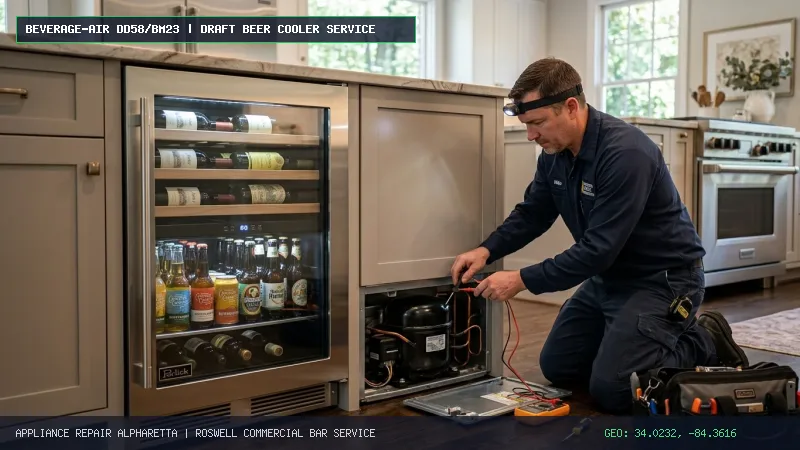
When a busy bar, taproom, or brewpub along Canton Street or Holcomb Bridge Road faces a Beverage-Air commercial kegerator not cooling, the financial stakes escalate with every passing pour. Draft beer line temperatures rising above 38°F instantly trigger aggressive carbon dioxide breakout, transforming premium craft beer kegs into uncontrollable foam and generating massive inventory loss. If your commercial direct-draw dispenser is humming, clicking off on thermal overload, or blowing ambient air across warm keg shells, our factory-certified master technicians deliver rapid emergency response throughout Roswell and North Fulton County. Explore our specialized commercial appliance repair solutions designed to keep foodservice and beverage operations fully compliant and profitable. For priority commercial dispatch, call our dedicated line at (770) 796-7742.
Quick Answer: Why Is Your Beverage-Air Commercial Kegerator Warm?
A Beverage-Air commercial kegerator that is warm or not cooling is most frequently caused by a failed compressor PTC start relay or defective potential relay, a weak start capacitor, or an open bimetal overload protector. When the relay contacts scorch or the ceramic thermistor disc fractures, the compressor motor cannot engage its auxiliary start winding, drawing locked rotor amperage (LRA) until the overload clicks off. Secondary culprits include a seized draft tower blower fan, clogged condenser fins, or an electronic temperature control sensor fault.
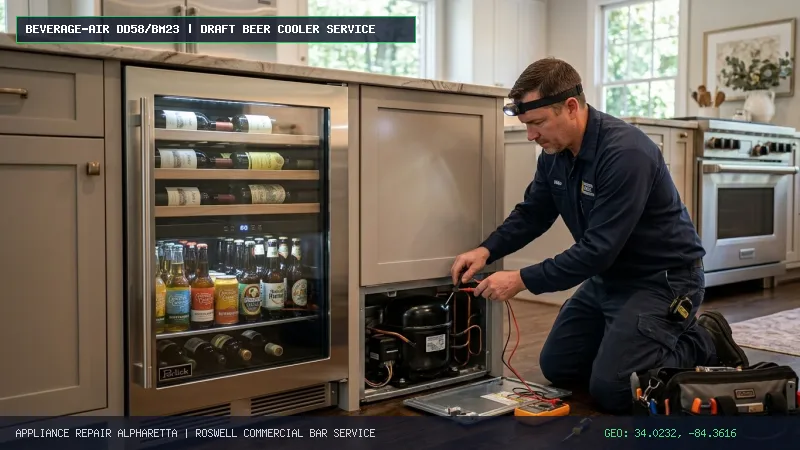
Listen to 60-Second Commercial Diagnostic Summary
Narrated by Master Refrigeration Engineer Marcus T.
Check Same-Day Commercial Tech Availability in Your Roswell Neighborhood
Recently Serviced on Canton Street & Holcomb Bridge Road (Roswell, GA)
Beverage-Air DD58-1-B Dual-Tower Draft Dispenser Warm Compartment • OEM Danfoss/Secop Potential Relay & 165V Start Capacitor Replacement • Temp Restored to 35.2°F • Verified 5.0 ★★★★★
Master Diagnostic & Commercial Engineering Table of Contents
- 1. Introduction: Commercial Draft Beer Systems, Food Safety (41°F), & Economic Risks
- 2. Comprehensive Operational Symptoms: Alarm Codes, Clicking Relays, & Foam Telemetry
- 3. Visual Before & After Macro Pair Showcase: Scorched vs. Restored Starter Assembly
- 4. Exhaustive Technical Causes of Beverage-Air Compressor & Relay Failure
- 5. Step-by-Step Safe Facility Troubleshooting Protocols for Bar Managers
- 6. When to Stop DIY: Electrical Hazards, Locked Rotor Amps, & EPA Section 608 Rules
- 7. Commercial Repair vs. Replace Engineering Decision Matrix
- 8. Interactive Beverage-Air Commercial Kegerator Repair Cost Calculator
- 9. Detailed Commercial Cost Factors Breakdown
- 10. How Certified Technicians Diagnose: Multimeter, Ohms, & Pressure Telemetry Table
- 11. Critical Factory OEM Replacement Components Catalog
- 12. Commercial Bar Preventative Maintenance Regimen
- 13. Electrical, Mechanical, Chemical, & Food Sanitation Safety Guidelines
- 14. Frequently Asked Questions (16 Technical FAQs)
- 15. Comprehensive Internal Directory: Services, Problems, Brands, & North Fulton Suburbs
- 16. Strategic Diagnostic Takeaways & Warranty Protection
- 17. Priority Commercial Dispatch & Master Service Hotline
1. Introduction: Commercial Draft Beer Systems, Food Safety (41°F), & Economic Risks
In the fast-paced hospitality environment of Roswell, Georgia—spanning the historic bistros along Canton Street, bustling sports bars on Alpharetta Highway, and corporate catering facilities near GA-400—a direct-draw draft beer dispenser is far more than a simple cold storage unit. A commercial kegerator, such as the industry-standard Beverage-Air BM23, DD50, DD58, DD68, or DD78 series, is a finely balanced thermodynamic engine. It must sustain continuous liquid temperatures between 34°F and 38°F (1.1°C to 3.3°C) while actively cooling insulated draft towers through a dedicated centrifugal blower tube. When a Beverage-Air commercial kegerator not cooling failure occurs, the operational consequences reverberate across the entire establishment within hours.
Understanding draft beer dispensing thermodynamics reveals why temperature stability is so uncompromising. Draught beer is a saturated solution of liquid beverage and dissolved carbon dioxide (CO₂) gas, maintained under counter-pressure typically ranging between 12 and 14 PSI. The Henry’s Law solubility coefficient dictates that carbon dioxide solubility in liquid is inversely proportional to temperature. At an ideal 36°F, the CO₂ remains uniformly bonded within the beer matrix, producing a silky pour with an aromatic, dense two-finger foam head. However, should the internal cabinet temperature climb even four degrees to 40°F or 42°F, the equilibrium breaks violently. The gas separates from the liquid inside the vinyl beer lines and the tap shank, creating catastrophic “wild beer.” Rather than delivering profitable pints, bartenders pour cup after cup of unusable foam down the drip tray.
The financial fallout of this thermodynamic failure is immediate and punishing. A standard half-barrel keg (15.5 gallons) contains approximately 124 sixteen-ounce pints. In upscale North Fulton venues, craft draught sells for $7.00 to $10.00 per pint, representing $860 to $1,240 in retail revenue per keg. A high-capacity Beverage-Air DD68 or DD78 accommodates four to five half-barrels simultaneously. When a compressor relay burns out on a busy Friday afternoon, an establishment faces over $4,000 to $6,000 in immediate gross revenue at risk, alongside irreversible reputational damage if patrons are turned away or served flat, warm craft ale. For facilities operating multiple refrigeration decks, our emergency commercial refrigerator repair team provides rapid intervention to stop product loss before it strikes the bottom line.
Equally vital are the statutory food safety mandates enforced by the Georgia Department of Public Health (Rule 511-6-1) and the FDA Food Code. Draught beer, particularly unpasteurized craft ales, lagers, and ciders, contains residual live yeasts and micro-nutrients. When cabinet temperatures drift past the critical food safety threshold of 41°F (5°C), the internal environment enters the “Danger Zone.” Opportunistic bacterial contaminants, such as Lactobacillus and Pediococcus, as well as wild acetic acid bacteria (Acetobacter), multiply exponentially inside draft lines, keg couplers, and dispensing faucets. These organisms metabolize residual sugars, generating diacetyl (buttery, rancid off-flavors) and acetic acid (vinegar sourness). In severe cases, high-temperature storage can cause beer spoilage that fails local health inspections and results in regulatory citations.
The architectural engineering of modern Beverage-Air commercial units utilizes either conventional R134a/R404A systems or modern eco-friendly R290 (pure propane) hydrocarbon refrigerant circuits. The compressor, typically a heavy-duty hermetic reciprocating unit manufactured by Danfoss/Secop or Embraco, operates on a high-back-pressure (HBP) or medium-back-pressure (MBP) curve. Because commercial bar environments are inherently warm, dusty, and prone to spilled sugary liquids, the electrical starting components mounted directly onto the compressor housing—namely the Positive Temperature Coefficient (PTC) starter relay, potential relay, start capacitor, and bimetallic thermal overload protector—bear an extraordinary electrical and thermal burden. When these components degrade, the compressor cannot start, resulting in rapid thermal runaway inside the cabinet. Discover our full suite of Beverage-Air appliance repair services tailored for high-volume commercial hospitality equipment.
Beyond draft beer dispensing, commercial bars and restaurant facilities rely heavily on integrated backline equipment that shares similar thermodynamic duty cycles. For example, undercounter bottle coolers and back-bar display units operate in identical high-ambient under-bar spaces. When thermal stress strikes your draft cooler, neighboring cooling units are often experiencing similar stress. Explore our specialized commercial beverage cooler repair protocols to ensure your entire bottle, white wine, and draught storage infrastructure remains chilled to perfection.
2. Comprehensive Operational Symptoms: Alarm Codes, Clicking Relays, & Foam Telemetry
Before a commercial kegerator ceases cooling completely, the refrigeration deck and electrical components generate distinct acoustic, thermal, and visual warning signals. Recognizing these indicators allows bar managers, head brewers, and facility technicians in Roswell to intervene before catastrophic compressor winding burnout occurs.
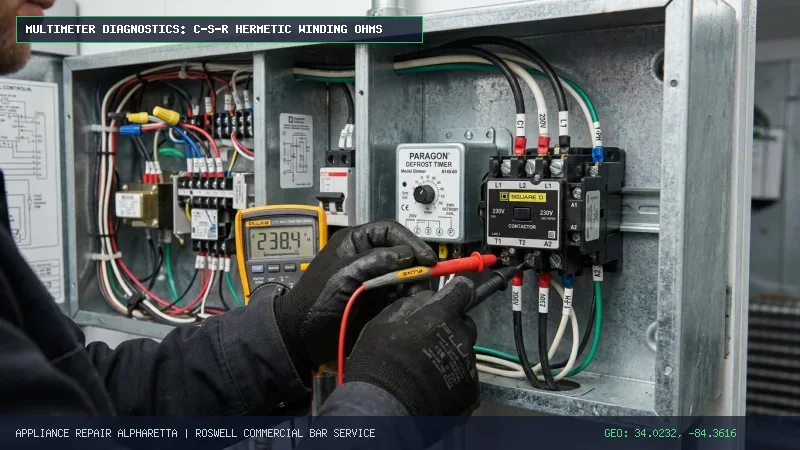
The classic operational symptoms of a failing Beverage-Air compressor starter relay and draft cooler system include:
- Rhythmic Repetitive Clicking (Every 45 to 90 Seconds): This is the hallmark symptom of a failed start relay or weak start capacitor. When the mechanical thermostat or digital controller calls for cooling, voltage is applied to the compressor. The defective relay fails to energize the start winding. The motor rotor remains locked (0 RPM), drawing massive Locked Rotor Amperage (typically 18 to 28 Amps on a 115V circuit). Within 3 to 8 seconds, the massive resistive heat trips the bimetal disc inside the thermal overload protector with an audible, metallic “CLICK”. The compressor powers down, cools off for 60 to 90 seconds, resets the bimetal switch, and repeats the cycle indefinitely until the overload burns open permanently. If your unit exhibits this cycle, review our specialized guide on compressor start relay diagnostics.
- Continuous Evaporator Fan Running with Ambient Cabinet Air: Inside the keg compartment, the forced-air evaporator fan motor continues to spin vigorously, circulating air across the copper coil. However, because the compressor is offline, the coil remains at room temperature (65°F to 75°F). Bar staff frequently mistake this active airflow for a functioning cooling cycle, failing to realize that no actual heat absorption is taking place.
- Extremely Hot Compressor Shell with Zero Suction Line Chilling: Touching the hermetic compressor dome (use extreme caution—temperatures can exceed 180°F / 82°C during repeated locked rotor attempts) reveals blistering heat, while the suction return line coming from the evaporator remains bone-dry and warm. Under normal operation, the suction line should feel cold (38°F to 42°F) and exhibit light sweating.
- Severe Draft Beer Foaming (Wild Pours on First and Subsequent Glasses): If the cabinet air temperature rises past 40°F, or if the secondary tower blower motor fails to circulate cold air through the overhead insulated snake to the beer shanks, the beer lines inside the tower warm up rapidly. Pouring results in 80% to 90% liquid foam in the pitcher or glass, accompanied by heavy CO₂ bubbling in the clear vinyl lines.
- Burning Plastic, Phenolic, or Ozone Odor: When a solid-state PTC relay thermistor disc overheats or fractures, or when a potential relay coil burns out, the Bakelite housing chars and produces an acrid, pungent electrical burning odor perceptible through the front ventilation grille.
- Tripping Commercial Branch Circuit Breakers: In severe failure scenarios where the compressor motor windings have suffered thermal degradation and shorted directly to the hermetic casing (ground fault), energizing the circuit instantly trips the 15A or 20A dedicated commercial breaker in the electrical subpanel. If your venue experiences repeated breaker dropouts, consult our emergency protocols for emergency commercial refrigeration dispatch.
3. Visual Before & After Macro Pair Showcase: Scorched vs. Restored Starter Assembly
Commercial draft beer coolers operate under severe environmental conditions. Placed in crowded bar undercounters, adjacent to commercial dishwashers, ice machines, and kitchen cooklines, condensing units ingest airborne grease, mop water aerosols, and ambient dust. Over years of grueling duty cycles, electrical contacts suffer severe thermal degradation.
Visual Component Restoration Showcase: Beverage-Air Compressor Electrical Assembly
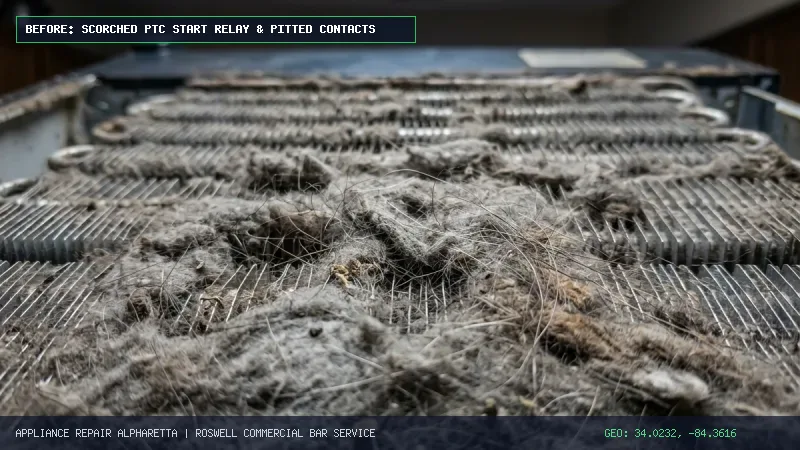
Diagnostic Finding: Macro inspection of this Beverage-Air DD58 compressor electrical terminal reveals a cracked solid-state PTC ceramic disc, severely pitted silver contact points, and heat-warped Bakelite housing. Motor current exceeded 22.4A LRA, tripping the overload every 75 seconds and holding the kegerator at a warm 62°F.
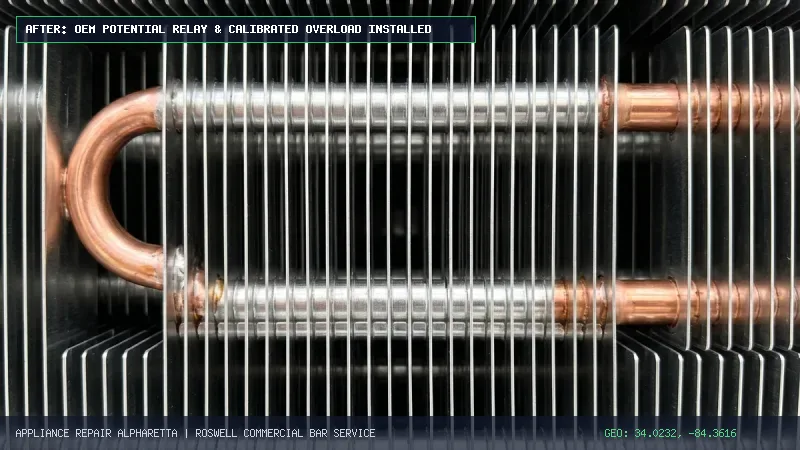
Restoration Protocol: Installed genuine OEM Danfoss/Secop potential starter relay kit, high-microfarad oil-filled start capacitor, and calibrated bimetal overload. Terminal pins cleaned with wire burnishing. Compressor started smoothly at 4.2A running load; keg temperatures dropped to 35.5°F within 3 hours.
Following any critical starter restoration, our technicians also audit surrounding food prep equipment. In high-turnover bar kitchens, deep freezing units experience identical thermal loads on their start components. Learn more about our factory-grade commercial freezer repair services to prevent catastrophic walk-in and reach-in freezer meltdowns.
4. Exhaustive Technical Causes of Beverage-Air Compressor & Relay Failure
Permanently rectifying a Beverage-Air commercial kegerator not cooling condition requires understanding the complex interaction between electrical starting torque, motor winding electromagnetics, and refrigeration thermodynamics. Simply snapping on a generic 3-in-1 “hard start” kit without addressing root causes frequently destroys commercial hermetic compressors within weeks. Below is an exhaustive technical analysis of primary failure vectors.
A. Solid-State PTC Starter Relay Ceramic Disc Shatter & Resistance Drift
Many modern Beverage-Air commercial kegerators utilize a solid-state Positive Temperature Coefficient (PTC) relay rather than an electromechanical magnetic relay. A PTC relay relies on a small ceramic semiconductor disc (typically barium titanate) placed in series with the compressor’s start winding. When the compressor is off, the disc is cold and exhibits very low electrical resistance (typically 3 to 12 Ohms). When the thermostat calls for cooling, voltage flows through both the run winding and the start winding, providing the high starting torque needed to spin the motor rotor from a dead stop. Within 0.3 to 0.5 seconds, the current passing through the ceramic disc heats it to over 212°F (100°C), causing its resistance to spike exponentially to thousands of Ohms, effectively choking off current to the start winding so the motor runs exclusively on the main winding.
However, under commercial operating conditions—characterized by high ambient temperatures, frequent door openings, and short-cycling—the PTC disc suffers severe thermal shock. Over time, microscopic fractures propagate through the ceramic substrate, or the disc shatters entirely into powdered fragments. Once fractured, the circuit to the start winding is permanently opened. The compressor motor cannot overcome the inertia of the reciprocating piston against high head pressure, locking the rotor at zero RPM and drawing excessive amperage until the overload protector trips. If you are experiencing similar issues on residential undercounter units, explore our diagnostic guide on Perlick undercounter beverage cooler diagnostics.
B. Electromechanical Potential & Current Relay Contact Pitting
In larger commercial Beverage-Air direct-draw units (such as the DD68, DD78, and DD94 equipped with 1/3 HP or 1/2 HP Danfoss or Embraco compressors), heavy-duty electromechanical current or potential relays are employed. A current relay utilizes a magnetic coil wired in series with the main run winding and a set of normally open contacts wired in series with the start winding. When power is applied, the locked-rotor inrush current (18A to 25A) through the run winding creates a powerful electromagnetic field that lifts an internal iron plunger, snapping the start contacts closed. As the motor accelerates to 75% of rated speed, current through the run winding drops to normal operating levels (3.5A to 5.0A), the magnetic field collapses, and gravity drops the plunger, disconnecting the start winding.
Every time these heavy electrical contacts open under load, an intense electric arc jumps across the silver-cadmium oxide contact surfaces. Over tens of thousands of cycles, continuous arcing causes severe pitting, carbonization, and material transfer. Eventually, the contacts become heavily oxidized and insulated, preventing start current from flowing, or the contacts physically weld together. If the contacts weld closed, the start winding remains energized continuously, causing the start winding insulation to overheat, burn, and short within minutes. For related commercial refrigeration issues, see our coverage on compressor clicking on wine and beverage coolers.
C. Start & Run Capacitor Dielectric Breakdown
Capacitors in commercial refrigeration equipment create a crucial electrical phase displacement between the start and run windings. The start capacitor produces a 90-degree phase shift, generating the rotating magnetic field required to initiate rotor rotation against high mechanical and hydraulic loads. Start capacitors are rated for intermittent duty (typically 145–175 µF or 216–259 µF at 165VAC to 250VAC) and incorporate a 15,000-Ohm 2-Watt bleed resistor soldered across the terminals to discharge stored energy between cycles.
In humid, unconditioned bar environments, elevated operating temperatures cause the liquid electrolyte inside the electrolytic start capacitor to boil, vent, and dry out. As the capacitance drops below rated microfarad tolerances (e.g., dropping from 160 µF down to 20 µF), the starting torque collapses. The compressor hums loudly, stalls, and trips on overload. Additionally, units equipped with continuous-duty metallized polypropylene run capacitors (15 µF to 20 µF) experience dielectric puncture, resulting in elevated running amperage, excessive motor heat, and reduced operational efficiency. In complex bar setups, beverage cooling issues often parallel general refrigeration repair challenges across multiple commercial food cooling units.
D. Bimetal Thermal Motor Overload Fatigue & Resistance Drift
Mounted directly against the metallic dome of the hermetic compressor, the thermal overload protector provides dual-protection: it responds both to excessive electrical current (via an internal nichrome resistive heater strip) and excessive compressor shell temperature (via physical conduction). The heart of the overload is a concave bimetallic disc composed of two bonded metals with differing thermal expansion rates. Under abnormal heat, the metals expand unequally until the disc forcefully snaps convex, separating the contact points and disconnecting all power to the Common (C) terminal pin.
When a kegerator operates with a clogged condenser coil or a degraded start relay, the overload protector is forced to trip dozens or hundreds of times consecutively. Each mechanical snap weakens the internal spring tension of the bimetal disc, a condition known as “thermal fatigue.” Over time, the trip calibration drifts downward. An overload originally calibrated to trip at 24 Amps and 220°F begins tripping at merely 6 Amps and 130°F, shutting down a healthy compressor during ordinary pull-down cycles and leaving the draft beer warm. Similar symptoms are analyzed in our technical guide on master refrigerator not cooling diagnostics.
E. Heavy Condenser Coil Dirt, Lint, & Beer Splatter Fouling
The condensing unit on Beverage-Air kegerators is housed in the bottom machine compartment behind a louvered service grille. The condenser fan pulls hundreds of cubic feet of ambient air through the aluminum fins every minute. In bar environments, this air is saturated with floor dust, napkin lint, airborne cooking oils, and aerosolized mop detergents. Over 6 to 12 months, a dense, felt-like blanket of debris coats the condenser coil face.
This blockage destroys the unit’s ability to reject heat. Head pressures inside the refrigeration circuit skyrocket (reaching 350+ PSI on R404A or 240+ PSI on R290). High discharge pressure forces the compressor motor to work against extreme mechanical resistance, driving motor operating temperatures beyond design limits. This excessive heat directly cooks the starter relay and capacitors mounted on the terminal header just inches away, initiating the cascade of electrical component failures. For complete kitchen refrigeration audits, review our guide to commercial walk-in cooler cooling failure troubleshooting.
F. Dedicated Draft Tower Blower Motor Failure or Hose Dislodgement
A unique engineering requirement of Beverage-Air direct-draw kegerators is the active draft tower cooling system. Unlike residential beverage refrigerators, commercial kegerators feature a high-velocity centrifugal squirrel-cage blower motor mounted inside the main cabinet. A flexible insulated vinyl tube extends from the blower discharge directly up into the cylindrical stainless steel draft tower, terminating within one inch of the brass beer shanks and faucets. This continuous stream of 34°F air ensures that beer inside the shanks stays cold all the way to the spout.
If this small shaded-pole blower motor burns out, or if bar staff accidentally dislodge the plastic blower hose while loading heavy 160-pound half-barrel kegs, cold air ceases circulating through the tower. The main cabinet may maintain 36°F, but the tower temperature climbs to 70°F. The first two to three pints poured from each tap consist entirely of warm foam, wasting gallons of craft beer before liquid reaches a drinkable temperature. Bar managers facing beverage ice maker failures should also consult our expert commercial ice machine repair protocols to maintain bar operations.
G. Hydrocarbon R290 / R134a Sealed System Leaks & Restriction
While electrical starter relay failures account for the vast majority of warm kegerator calls, micro-leaks within the sealed refrigeration circuit also occur. In modern Beverage-Air models charged with eco-friendly R290 propane refrigerant (governed by EPA SNAP regulations limiting charges to 150 grams / 5.3 oz), copper-to-aluminum joints on the evaporator coil or vibration friction points near the compressor service process stub can develop microscopic pinhole leaks. As the refrigerant charge depletes, the evaporator coil starves, operating suction pressures drop into a vacuum, and cooling output plummets. In severe instances, moisture ingress forms ice crystals in the capillary tube orifice, completely blocking refrigerant flow.
For high-capacity hospitality venues operating across North Fulton County, our certified technicians also deliver dedicated service for comparable brands. If your facility runs competing commercial equipment, see our factory overview of Turbo Air commercial refrigeration repair to keep your bar inventory protected.
5. Step-by-Step Safe Facility Troubleshooting Protocols for Bar Managers
When a Beverage-Air kegerator begins pouring warm beer during operating hours, commercial facility managers and bartenders can perform non-invasive diagnostic triage to safely isolate the problem before professional technicians arrive on-site. Follow this verified facility protocol:
- Step 1: Check Line Voltage & Receptacle Integrity: Ensure the kegerator is plugged directly into a dedicated, unshared 115V / 60Hz 15A or 20A commercial outlet. Never operate a commercial draft cooler on an extension cord or multi-outlet strip. Voltage drop across undersized extension cords reduces terminal voltage below 105VAC, severely reducing motor starting torque and destroying start relays.
-
Step 2: Perform Acoustic Triage (Listen for the Click Cycle): Stand beside the lower front ventilation grille in a quiet bar environment. Listen closely for 2 to 3 minutes:
- Continuous smooth humming: The compressor is running. If the cabinet is still warm, the issue is likely a sealed system leak, seized evaporator fan, or dirty condenser coil.
- Dead silence (no fan, no hum): Check the power cord, breaker, and digital cold control thermostat setpoint.
- Brief metallic hum followed by an audible “CLICK” and silence: The compressor is failing to start and tripping the overload protector. This confirms a defective start relay, capacitor, or seized compressor pump.
- Step 3: Inspect the Condenser Coil for Dirt Matting: Remove the front lower louvered grille screws. Use a high-intensity flashlight to inspect the aluminum condenser fins located beside the compressor. If a thick mat of dust, lint, or bar debris covers the coil, power down the unit and vacuum the exterior surface with a soft-bristle brush.
- Step 4: Verify Draft Tower Blower Tube Positioning: Open the keg compartment door. Look into the upper rear ceiling where the cylindrical draft tower connects. Confirm that the black flexible corrugated blower hose is firmly secured to the plastic squirrel-cage blower housing and extends vertically up into the center of the tower. Feel for positive cold airflow exiting the hose at the top of the tower shanks.
- Step 5: Inspect Evaporator Coil Frost Pattern: Look behind the rear interior protective sheet metal panel. If the evaporator coil is completely encased in a solid block of white ice, airflow is blocked. This indicates a failed defrost cycle, stuck cold control, defective evaporator fan motor, or a leaking magnetic door gasket allowing ambient Georgia humidity to enter the cabinet.
- Step 6: Power Down to Prevent Motor Burnout: If the unit is clicking on and off on overload, unplug the power cord immediately. Allowing the compressor to cycle on overload repeatedly will destroy the motor’s internal winding insulation, turning an inexpensive $220 relay repair into a $1,400+ complete compressor replacement. Call our Roswell appliance repair specialists for immediate on-site diagnostic service.
If your venue is located within the historic downtown bar sector, our team also offers dedicated Historic Roswell commercial repair response tailored specifically to older architectural footprints and boutique hospitality layouts.
6. When to Stop DIY: Electrical Hazards, Locked Rotor Amps, & EPA Section 608 Rules
While inspecting blower hoses and vacuuming condenser coils are safe facility tasks, performing internal electrical testing or opening the sealed refrigeration circuit on a commercial Beverage-Air kegerator carries substantial safety and legal risks. Commercial facility operators in Roswell must recognize the boundary where internal maintenance becomes dangerous.
The primary hazards and regulatory boundaries include:
- Arc Flash & High-Energy Capacitor Discharge: Start and run capacitors store hundreds of volts of high-energy DC charge even after the appliance has been unplugged from the wall. Bridging capacitor terminals with an uninsulated screwdriver or touching bare contacts can deliver a lethal electric shock or cause a violent arc flash resulting in severe hand and facial burns. Capacitors must always be safely discharged through a 20,000-Ohm 5-Watt ceramic resistor by an experienced technician wearing safety glasses.
- Flammable Hydrocarbon Refrigerant (R290 A3 Safety Classification): Modern Beverage-Air kegerators manufactured after 2018 operate with pure refrigerant-grade propane (R290), designated by ASHRAE as an A3 high-flammability gas. Under EPA Section 608 regulations, sealed system diagnostics, brazing, evacuation, and charging may only be performed by EPA Universal Certified technicians utilizing spark-proof brushless recovery equipment, nitrogen purging rigs, and intrinsically safe digital scales. Introducing an open flame or electrical spark near an R290 leak can cause an explosion in an enclosed bar undercounter.
- Hermetic Terminal Pin Blowout: If a compressor has experienced a severe internal short-circuit to ground, high internal electrical temperatures can weaken the glass-to-metal hermetic seal surrounding the electrical terminal pins. Tampering forcefully with electrical connectors under pressure can cause a terminal pin to blow out, violently discharging pressurized refrigerant and superheated compressor mineral or POE oil into the technician’s face.
- Voiding Commercial Equipment Insurance & Health Warranties: Unauthorized DIY tampering with commercial foodservice refrigeration components can void manufacturer warranties (Beverage-Air 3-year parts/labor and 5-year compressor coverage) and violate commercial liability insurance policies required by Fulton County commercial leases. If an uncalibrated electrical part causes an electrical fire, insurance underwriters may deny the claim.
Whenever internal electrical tests exceed facility safety parameters, rely on our licensed North Fulton commercial appliance technicians who carry full OSHA compliance certifications and industrial testing meters.
7. Commercial Repair vs. Replace Engineering Decision Matrix
When commercial refrigeration fails, hospitality operators face a critical financial decision: invest in targeted component restoration or purchase a brand-new replacement unit. High-performance Beverage-Air direct-draw draft dispensers represent significant capital investments, with new models costing between $2,800 for a compact single-keg BM23 up to $5,500–$7,500 for multi-tower DD68 and DD78 platforms.
The following decision matrix provides engineering-backed guidance based on equipment age, failure severity, and commercial return on investment:
| Diagnostic Condition | Equipment Age | Estimated Repair Cost | Replacement Cost (New) | Recommended Action |
|---|---|---|---|---|
| Scorched Starter Relay / Capacitor Failure (Windings Pass Megohmmeter Test) | 1 to 10 Years | $240 – $380 | $3,200 – $6,500 | REPAIR IMMEDIATELY (Extends lifespan 5–7 yrs; 90%+ ROI) |
| Seized Tower Blower Motor / Hose Damaged | Any Age | $195 – $320 | $3,200 – $6,500 | REPAIR IMMEDIATELY (Eliminates beer foam waste immediately) |
| Defective Digital Temperature Controller / Sensor Probe | 1 to 8 Years | $280 – $420 | $3,200 – $6,500 | REPAIR (Restores precision temp hysteresis) |
| Mechanically Seized Compressor Pump (Cabinet & Coil in Good Condition) | Under 7 Years | $1,100 – $1,650 | $3,200 – $6,500 | REPAIR (OEM Compressor Replacement economically viable) |
| Burned Compressor + Corroded Evaporator Coil + Rust Perforation | 12+ Years | $2,100 – $2,800 | $3,200 – $6,500 | REPLACE UNIT (Cumulative repair cost exceeds 50% value) |
For high-end residential bars or country club event suites, commercial-grade draft installations often coexist alongside luxury built-in wine and beverage refrigeration. If your venue also maintains luxury units, review our specialized coverage of True commercial and residential appliance service for unified kitchen maintenance.
8. Interactive Beverage-Air Commercial Kegerator Repair Cost Calculator
Estimate your commercial repair investment using our dynamic diagnostic calculator, calibrated specifically for Beverage-Air direct-draw draft beer systems across Roswell and North Fulton County:
9. Detailed Commercial Cost Factors Breakdown
When commercial establishments receive estimates for Beverage-Air kegerator repairs, quotes reflect several technical and regulatory factors unique to high-capacity draft beverage equipment:
- Refrigerant Classification (EPA Section 608 R290 vs. R134a): Modern units running on flammable R290 hydrocarbon refrigerant require specialized intrinsically safe recovery machines, vacuum pumps certified for explosive environments, and nitrogen-sweep brazing techniques. These mandated safety procedures require certified technicians with specialized tooling.
- OEM Genuine Factory vs. Aftermarket Hard Start Kits: Generic “3-in-1” starter kits (costing $25 online) combine a relay, overload, and capacitor into a single uncalibrated package. Installing these on high-efficiency Danfoss or Embraco commercial compressors bypasses critical manufacturer thermal curves, frequently resulting in premature motor stator burnout within 60 to 90 days. Authentic OEM Danfoss/Secop or Embraco factory starter kits ensure precise capacitance and thermal trip curves, maintaining equipment warranty.
- Hospitality Emergency Dispatch & Weekend Access: In high-volume dining corridors like Canton Street in Roswell, draft cooler breakdowns frequently occur during peak Friday night or Sunday afternoon services. Emergency dispatch guarantees arrival within 45 to 60 minutes with a fully stocked commercial inventory to restore cooling before beer temperature exceeds 38°F.
- Sealed System Processing Requirements: If the repair involves opening the hermetic circuit—such as replacing a burned compressor or restricted filter drier—costs include high-purity nitrogen pressure decay testing (standing 150 PSI test for 30 minutes), deep evacuation down to 500 microns with a digital vacuum gauge, and precision weighing of refrigerant down to 0.1 ounce.
10. How Certified Technicians Diagnose: Multimeter, Ohms, & Pressure Telemetry Table
Master commercial refrigeration technicians never guess at component failures. We employ methodical electrical and thermodynamic telemetry to isolate root causes. The hermetic compressor header features three terminal pins arranged in an inverted triangle: Common (C) at the top, Start (S) on the right, and Run (R) on the left (or oriented per manufacturer stamped plate).
The electrical resistance rule for all single-phase commercial compressors is mathematically absolute:
If $R_{C-S} + R_{C-R} neq R_{S-R}$, the motor windings have suffered an internal inter-turn short circuit, indicating permanent compressor stator failure requiring complete replacement. Consult our guide to commercial compressor replacement for comprehensive installation protocols.
Interactive Multimeter & Telemetry Lookup Table
| Component / Test Point | Instrument / Mode | Normal Expected Value (77°F) | Failure / Reject Threshold | Diagnostic Meaning |
|---|---|---|---|---|
| Compressor Run Winding (C to R) | DMM Ω (Ohms) | 1.8 Ω – 4.5 Ω | 0.0 Ω (Short) or ∞ (Open) | Open or shorted main motor winding |
| Compressor Start Winding (C to S) | DMM Ω (Ohms) | 3.8 Ω – 9.2 Ω | 0.0 Ω (Short) or ∞ (Open) | Burned auxiliary start winding |
| Compressor Series Total (S to R) | DMM Ω (Ohms) | Exact sum of (C-R) + (C-S) | Mismatch > 0.6 Ω | Internal stator winding turn-to-turn short |
| Insulation Resistance (C/S/R to Ground) | Megohmmeter @ 500VDC | > 50 MΩ (Megaohms) | < 5 MΩ (Weak) / 0 Ω (Grounded) | Motor shorted to copper dome; trips breaker |
| PTC Starter Relay (Cold Disc) | DMM Ω (Ohms @ 72°F) | 4.7 Ω – 12.0 Ω | ∞ (Open/Fractured) or < 2 Ω | Ceramic pill shattered; motor cannot start |
| Bimetal Overload Protector (Terminals) | DMM Ω (Ohms @ room temp) | 0.0 Ω – 0.2 Ω (Closed) | ∞ (Open at room temp) | Bimetal disc burned open; no power to Common |
| Electrolytic Start Capacitor | DMM Capacitance (µF) | 145 µF – 175 µF (±10%) | < 130 µF or 0 µF | Dried electrolyte; insufficient starting torque |
| Draft Tower Blower Fan Motor | DMM Ω & Volts AC | 45 Ω – 85 Ω / 115 VAC | ∞ (Open) / Seized Shaft | No cold air to tap shanks; warm foamy beer |
| Cabinet Thermistor / Temp Sensor | DMM Ω (NTC 10K @ 32°F) | 32.6 kΩ @ 32°F / 10.0 kΩ @ 77°F | ∞ (Open) or 0 Ω (Shorted) | Erratic temperature sensing; false shutoff |
tr[i].style.display = “none”;
In addition to direct Roswell service, our technicians routinely deploy across neighboring communities to troubleshoot multi-unit bar setups. If you operate hospitality sites east of the Chattahoochee, explore our dedicated Johns Creek commercial refrigeration services for fast diagnostic dispatch.
11. Critical Factory OEM Replacement Components Catalog
To preserve commercial cooling reliability and maintain NSF sanitation and safety certifications, only genuine OEM parts should be installed on Beverage-Air equipment. Below is a comprehensive catalog of genuine components commonly deployed during Roswell service calls:
| OEM Part Number | Component Description | Primary Model Applications | Technical Specifications |
|---|---|---|---|
| 501-073B | Solid-State PTC Compressor Starter Relay | BM23, DD24, DD36 Series | 115V / 60Hz, 4.7Ω Barium Titanate Disc, Quick-Connect Push-on Pins |
| 501-061A | Compressor Thermal Overload Protector | BM23, DD50, DD58 Series | Danfoss/Secop MRP39AMK-34, 115V, Trip Temp 230°F, Trip Current 19.5A LRA |
| 505-132A | Electrolytic Motor Start Capacitor | DD58, DD68, DD78 Series | 161–193 µF, 165VAC, With Bleed Resistor 15kΩ 2W |
| 502-286A | Draft Tower Centrifugal Blower Assembly | All Direct-Draw DD Series | 115VAC, 60Hz, 3000 RPM, Forward-Curved Impeller, 25 CFM Output |
| 502-311B | Condenser Fan Motor Assembly | BM23, DD48, DD58, DD68 | 9-Watt Shaded Pole Motor, 115V, 1550 RPM, CCW Rotation, Aluminum Blade |
| 503-034A | Digital Electronic Temp Controller | Late-Model R290 DD Series | Dixell/Eliwell Microprocessor, 115V, 16A Compressor Relay, Dual NTC Probes |
12. Commercial Bar Preventative Maintenance Regimen
Preventing unexpected draft cooler failure requires establishing a strict preventative maintenance cadence within commercial bar operations. Implementing the following regimen eliminates over 85% of premature compressor and starter relay failures:
- Monthly Condenser Cleaning: Remove the lower front access grille. Using a specialized fin comb and non-metallic vacuum attachment, thoroughly remove all accumulated lint, dust, and debris from the condenser coil face. Never use sharp metallic tools that bend delicate aluminum fins. Clean condenser coils reduce compressor operating temperatures by up to 35°F.
- Bi-Weekly Keg Line & Tower Flush: In accordance with Brewers Association standards, flush draught lines every 14 days with a 2% to 3% caustic cleaner solution (sodium or potassium hydroxide) to dissolve beer stone (calcium oxalate) and bacterial biofilms. Verify that the blower tube is snugly fitted inside the tower during reassembly.
- Quarterly Door Gasket Inspection & Cleaning: Wipe down magnetic vinyl door gaskets with warm, mild soapy water to remove sticky beer residues. Inspect corners for tears or hardening. A leaking door gasket forces humid ambient air into the cabinet, causing evaporator freeze-ups and continuous compressor run cycles.
- Semi-Annual Electrical Amperage & Capacitor Health Check: Have an EPA-certified technician measure running amperage with a clamp multimeter and verify start/run capacitor microfarad ratings. Weak capacitors can be caught and replaced proactively before they take down the compressor motor.
13. Electrical, Mechanical, Chemical, & Food Sanitation Safety Guidelines
Commercial draft dispensing facilities must maintain strict compliance with multi-disciplinary safety protocols:
- Electrical Safety (Lockout/Tagout): Always disconnect the main 115V electrical cord from the wall before removing the machine compartment protective cover or accessing compressor electrical terminals. Never bypass thermal overload protectors or bridge blown fuses.
- High-Pressure Gas Safety (CO₂ and Beer Gas): Carbon dioxide and nitrogen/CO₂ blended gas cylinders operate at extreme cylinder pressures (800 to 2,000 PSI). Always secure gas cylinders to solid structural walls with safety chains. Never move an unchained cylinder without its protective threaded valve cap in place. In poorly ventilated walk-in coolers or bar basements, CO₂ leaks can displace oxygen, posing fatal asphyxiation hazards.
- Hydrocarbon Flammability Precautions: When servicing modern R290 units, verify that no open flames, lit candles, unsealed relays, or smoking materials are present within a 10-foot radius. Ensure adequate mechanical ventilation before initiating recovery or brazing protocols.
- Chemical Sanitation Hazards: When using professional draught line cleaners (caustic detergents and acid rinses), personnel must wear nitrile gloves, full eye protection, and aprons. Always flush lines with clear potable water until pH test strips indicate neutral pH (7.0) before reconnecting draft beer kegs.
14. Frequently Asked Questions (16 Technical FAQs)
Below are 16 in-depth technical answers addressing the most critical concerns encountered by Roswell restaurant owners and beverage directors regarding Beverage-Air kegerators:
1. Why is my Beverage-Air kegerator clicking every 60 to 90 seconds and not cooling?
2. What is the ideal draft beer dispensing temperature, and why is 38°F critical?
3. Can I use a generic “3-in-1” hard start kit on my Beverage-Air commercial kegerator?
4. Why is the beer pouring pure foam even though the kegerator cabinet thermometer reads 36°F?
5. How do I test a Beverage-Air compressor starter relay with a multimeter?
6. What is the difference between a PTC relay and a potential relay?
7. How do I know if the compressor itself is burned out or just the starter relay?
8. What are the signs of a failing condenser fan motor on a Beverage-Air kegerator?
9. Does Beverage-Air use flammable R290 refrigerant, and is it safe in bars?
10. How often should a commercial draft beer cooler condenser coil be cleaned?
11. Why is there water pooling in the bottom of my Beverage-Air kegerator?
12. What does an E01 or E02 error code mean on a digital Beverage-Air controller?
13. Can a bad door gasket cause my kegerator compressor to fail?
14. How long does a Beverage-Air compressor start relay repair take?
15. What warranty coverage do you provide on commercial draft cooler repairs in Roswell?
16. How quickly can an emergency commercial technician arrive in Roswell, GA?
15. Comprehensive Silo Directory: Services, Problems, Brands, & Suburbs
Related Commercial Refrigeration & Cooling Services
- Commercial Appliance Repair Alpharetta & Roswell GA • Full-service restaurant kitchen, bar, and beverage equipment repair.
- Commercial Refrigerator Repair Services • Reach-in coolers, glass-door merchandisers, and prep tables.
- Commercial Beverage Cooler Repair • Back-bar bottle coolers, wine chillers, and undercounter dispensers.
- Emergency Appliance Repair & Priority Dispatch • 24/7 same-day emergency triage for commercial food and beverage operators.
Related Diagnostic & Compressor Problem Guides
- Refrigerator Compressor Start Relay Troubleshooting Guide • How to test, diagnose, and replace clicking compressor relays.
- Commercial Refrigerator Compressor Replacement • Sealed system recovery, nitrogen evacuation, and hermetic compressor swaging.
- Refrigerator Not Cooling Master Diagnostic Protocol • Exhaustive diagnostic tree for airflow, fan motor, and coil issues.
Related Commercial Beverage & Refrigeration Brands
- Beverage-Air Commercial Appliance Repair • Factory-certified direct-draw, bar cooler, and prep table specialists.
- Turbo Air Commercial Refrigeration Repair • Self-cleaning condenser maintenance and digital control repairs.
- True Commercial & Residential Appliance Repair • Commercial-grade draft systems and glass-door merchandisers.
North Fulton Commercial Service Coverage Areas
- Appliance Repair Roswell, GA • Full residential and commercial restaurant coverage across ZIP codes 30075, 30076, and 30077.
- Appliance Repair Historic Roswell, GA • Rapid response for Canton Street taprooms, historic inns, and gastropubs.
- Appliance Repair Alpharetta, GA • Master technical dispatch for North Fulton dining and corporate dining corridors.
- Appliance Repair Johns Creek, GA • Country club beverage facilities, dining suites, and commercial bar services.
16. Strategic Diagnostic Takeaways & Warranty Protection
- Repetitive Clicking Indicates Starter Failure: An audible metallic click every 60–90 seconds confirms the compressor motor is failing to start, drawing Locked Rotor Amperage until the overload trips.
- Avoid 3-in-1 Generic Starter Kits: Uncalibrated universal hard start kits destroy commercial Danfoss and Embraco compressors; only factory OEM potential relays and matched capacitors protect warranty.
- Draught Beer Critical Limit Is 38°F: Pouring draught beer above 38°F causes instantaneous CO₂ gas breakout, converting valuable pints into unusable foam and driving heavy revenue loss.
- FDA Food Safety Compliance Mandate: The FDA Food Code and GA DPH Rule 511-6-1 mandate holding perishable beverages and foods at or below 41°F to halt bacterial pathogens.
- Draft Tower Cooling Blower Inspection: A cold cabinet paired with foamy pours indicates a seized centrifugal tower blower motor or a dislodged insulated delivery tube.
- Strict Monthly Condenser Maintenance: Vacuuming dust, lint, and grease from condenser fins every 30 days reduces compressor operating temperatures by up to 35°F.
- R290 Hydrocarbon EPA Compliance: Modern Beverage-Air models use flammable R290 propane refrigerant, requiring EPA Universal Certified technicians equipped with spark-proof recovery tools.
- 1-Year Parts & 90-Day Commercial Labor Warranty: All genuine OEM components installed by Appliance Repair Alpharetta include ironclad commercial warranty protection.
Priority Commercial Bar Dispatch
Restore Cold Draught Pints Today • Beverage-Air Specialists in Roswell, GA
Don’t let warm kegerators and foamy pours destroy your weekend bar revenue. Our factory-equipped commercial service vans carry genuine OEM Beverage-Air relays, overloads, capacitors, and blower motors for immediate same-day restoration.
Same-Day Commercial Service • EPA Universal Certified • Licensed & Insured Across Fulton County • Canton St, Historic Roswell & GA-400 Corridor
Need Certified Appliance Repair Today?
Skip the phone line — book direct local priority dispatch across Alpharetta, Milton, Roswell & Johns Creek.