
Dacor Discovery Wall Oven Error Code F8 Cooling Blower Fan Repair in Johns Creek, GA
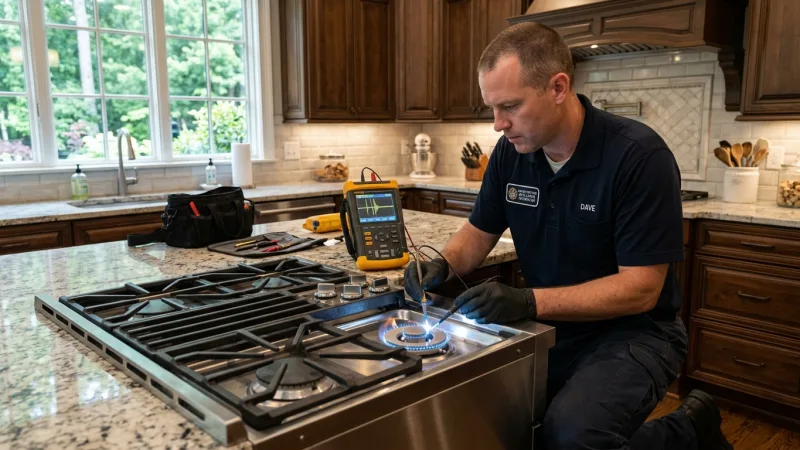
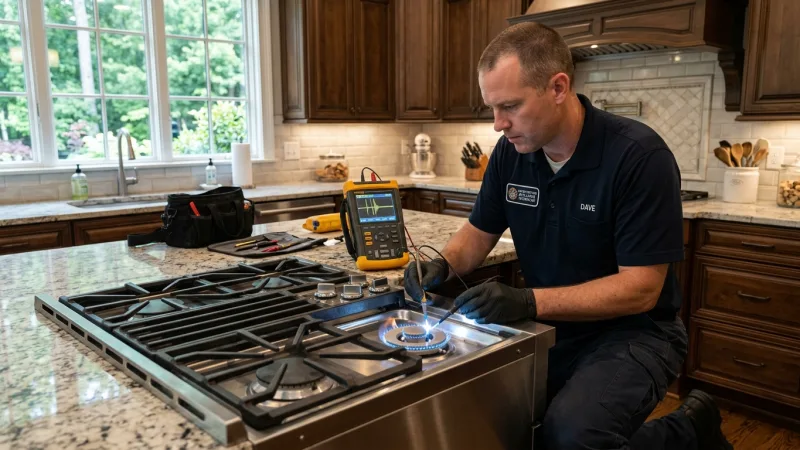
When your luxury Dacor Discovery built-in wall oven interrupts your baking cycle and flashes the urgent F8 error code in Johns Creek, GA, immediate diagnostic evaluation is essential to safeguard the oven’s sensitive computerized control assemblies, prevent thermal fuse trips, and protect surrounding custom cabinetry from convective heat accumulation. In modern culinary homes across Johns Creek—from St Ives Country Club and The Country Club of the South to Rivermont and Medlock Bridge—Dacor Discovery single and double wall ovens (including DTO, EO, MOV, and Discovery iQ series) rely on a dedicated upper tangential cooling blower to evacuate intense chassis heat. Our certified technicians specialize in oven and range repair, delivering rapid component diagnostics, digital multimeter telemetry, and same-day factory restoration throughout North Fulton County. Call (770) 796-7742 for immediate emergency dispatch.
Quick Answer: What Causes Dacor Oven Error Code F8 in Johns Creek, GA?
Quick Answer: The dacor oven error code f8 signifies a critical cooling fan failure where the electronic oven controller (OVC) fails to detect the required rotational speed (RPM) from the upper or lower tangential cooling blower fan during a heating or self-clean cycle. This fault is triggered by a seized blower motor bearing, an open 120V motor winding (normal: 18–32 Ω), a defective Hall-effect tachometer sensor circuit, a dislodged wiring harness, or failing cooling fan triac/relays on the relay power board. To clear a transient logic glitch, switch off the dual-pole 240V circuit breaker for 10 minutes. If the F8 code reappears upon initiating a bake or broil cycle, call certified specialists at (770) 796-7742 to test blower voltage, tachometer pulse signals, and relay board continuity.
Listen to 60-Second Technical Overview
Narrated by Jason J. (Master Certified Appliance Diagnostic Specialist)
Check Same-Day Dacor Wall Oven Service Availability in Johns Creek & North Fulton
Verified Local Service
Recently Serviced in Johns Creek, GA
Dacor Discovery DTO230 Double Wall Oven • Tangential Cooling Blower & Relay Board Restoration • Country Club of the South, Johns Creek, GA • ★★★★★ 5.0 Star Verified Service
Comprehensive Diagnostic Directory
- 1. Dacor Discovery Wall Oven Systems Architecture
- 2. Identifying Operational Symptoms & Error Signals
- 3. Visual Before & After Restoration Showcase
- 4. Common Mechanical & Electrical Causes of F8
- 5. Step-by-Step Safe Facility Troubleshooting Protocols
- 6. Critical Safety Thresholds: When to Stop DIY
- 7. Economic Evaluation: Repair vs. Replace Matrix
- 8. Interactive Instant Repair Cost Calculator
- 9. Estimated Cost Breakdown & Local Pricing Factors
- 10. How Professionals Diagnose: Multimeter Telemetry Lookup
- 11. Failure Mode & Criticality Analysis (FMECA)
- 12. Aerodynamic Flow & Heat Dissipation Formulations
- 13. Hall Effect Tachometer Pulse Train Diagnostics
- 14. Relay Board Triac Switching & Solder Joint Integrity
- 15. Architectural Cabinetry & Air Sled Extraction
- 16. Johns Creek Grid Power Spikes & Environmental Factors
- 17. Professional 7-Stage Restoration Standard
- 18. High-Limit Thermal Cutout (TCO) Safety Interlocks
- 19. Critical OEM Replacement Parts Catalog
- 20. Preventative Maintenance Routine
- 21. Electrical & Mechanical Safety Warnings
- 22. Frequently Asked Technical Questions (16 FAQs)
- 23. Local Service Silos & Support Networks
- 24. Key Takeaways for Johns Creek Homeowners
1. Dacor Discovery Wall Oven Systems Architecture & Cooling Airflow Dynamics
Built-in luxury wall ovens engineered by Dacor—such as the Discovery DTO and EO series, the Renaissance line, and the modern Discovery iQ smart wall ovens—represent the pinnacle of residential cooking technology. To achieve rapid preheating, precise convection baking, and intensive 900°F pyrolytic self-cleaning cycles within enclosed cabinetry recesses, Dacor engineering isolates the thermal cavity from the surrounding millwork using a sophisticated dual-path convective cooling envelope. For homeowners seeking dedicated service for luxury cooking suites, our technicians specialize in Dacor range and oven repair throughout North Fulton.
Unlike conventional freestanding ranges that dissipate waste heat through rear chassis gaps into open room air, a built-in wall oven is completely encased within custom kitchen cabinetry. In premier estates throughout Johns Creek, GA, custom wood panels, exotic veneers, and delicate stone countertops surround the oven cavity. Without an active mechanical forced-air ventilation system, the intense radiant heat generated during baking would quickly exceed 200°F on external metal surfaces, melting wire harness insulation, incinerating microprocessors on the electronic control board (ERC), and scorching high-end architectural cabinetry.
To prevent thermal destruction, Dacor Discovery wall ovens incorporate a heavy-duty, high-CFM tangential cross-flow cooling blower fan positioned on top of the upper oven chassis deck. When you command a cooking function—such as Pure Convection, Convection Bake, Standard Bake, Broil, or Self-Clean—the main Electronic Oven Controller (OVC) commands the cooling blower motor to spin. Ambient room air is drawn in through precision intake louvers located beneath the lower door, channeled upward through double-walled chassis air channels surrounding the insulation wrap, swept over the heat sinks of the relay board and digital display microcomputer, and finally exhausted out through horizontal discharge louvers positioned directly below the control console.
For safety and regulatory compliance (UL and ANSI commercial cooking standards), the microprocessor cannot simply assume the cooling fan is spinning based on a relay closure command. The blower motor assembly incorporates an integrated Hall-effect tachometer sensor or optical encoder that monitors physical shaft rotation. If the microprocessor commands the cooling blower to engage but fails to detect a continuous train of digital speed pulses within 20 to 30 seconds, it interprets this condition as a catastrophic loss of cooling. The controller instantly initiates an emergency thermal abort, sounds a high-frequency acoustic warning buzzer, terminates power to all heating element relays, and locks the user interface with the persistent F8 error code.
In high-demand culinary households and residential catering settings across North Fulton County, encountering an F8 fault completely disables oven operation. Understanding the electromechanical feedback loop between the cooling blower assembly, the relay control board, and the digital sensor harness is the foundational key to achieving a lasting, safe repair. If your oven refuses to heat or shuts down mid-recipe, our master technicians deliver certified emergency appliance repair to diagnose the exact electronic breakdown quickly.
2. Identifying Operational Symptoms & Error Signals
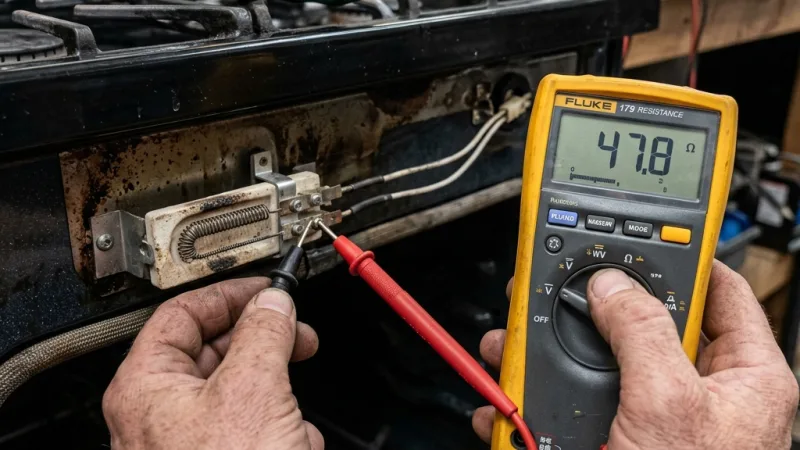
Homeowners in Johns Creek frequently report a distinct sequence of auditory, visual, and operational symptoms before the Dacor Discovery wall oven locks into its F8 safety shutdown mode. Recognizing these early warning indicators allows you to turn off the appliance before extreme heat damages sensitive secondary electronic assemblies:
- Audible Acoustic Failure Signatures: Prior to complete motor seizure, the tangential blower’s sleeve bearings or ball bearings dry out from thermal grease degradation. The oven emits a noticeable metallic squeal, high-pitched chattering, rhythmic vibration, or deep humming drone from the upper vent area above the door when heating begins.
- Absence of Airflow from Exhaust Louver: Under normal operation, a steady, perceptible curtain of warm air gently blows outward from the bottom horizontal exhaust vent louvers beneath the control panel. When the blower fails, this exhaust airflow drops to absolute zero, even though heating elements are energized.
- Immediate Heating Abort & Beeping Alarm: The user selects a bake or roast temperature (e.g., 350°F). The oven clicks as heating element contactors engage, but within 15 to 45 seconds, the oven emits three rapid beeps, completely shuts off the heating cycle, and displays “F8” or “F8 Cooling Fan Error” on the vacuum fluorescent or OLED display.
- Excessive Exterior Control Panel Heating: If the blower fails intermittently mid-cycle, the touch glass panel, rotary knobs, and upper trim become uncomfortably hot to the touch (exceeding 145°F), posing burn hazards and causing capacitive touch buttons to become erratic or unresponsive.
- Mid-Self-Clean Cycle Lockout: Dacor ovens place maximum electrical and thermal stress on the cooling blower during the 850°F self-clean process. If the blower drops below high-speed RPM during self-clean, the oven immediately aborts the cycle, locks the motorized door latch mechanism, and refuses to open until cavity temperatures drop below 400°F.
- Persistent Display Lockout Following Breaker Reset: When an internal motor winding has burned open or the Hall sensor signal line is shorted, cycling power at the circuit breaker does not clear the error; the moment bake mode is reselected, the F8 fault immediately reappears.
If you experience any of these symptoms alongside an unresponsive touch panel, reference our guide on double wall oven touch panel errors and cooling fan interlocks to understand how control modules react to systemic thermal hazards.
4. Common Mechanical & Electrical Causes of Error Code F8
Thorough diagnostic field analysis across hundreds of high-end Dacor Discovery installations in Johns Creek, Milton, and Alpharetta reveals five primary root causes responsible for generating the F8 error code:
A. Mechanical Bearing Seizure & High-Temperature Lubricant Breakdown
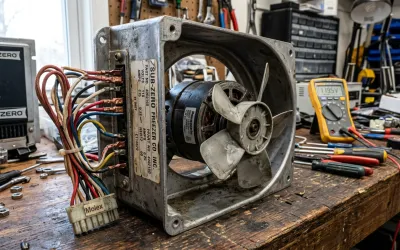
The tangential cross-flow cooling fan incorporates sintered bronze sleeve bearings or miniature sealed ball bearings on both ends of the extended aluminum squirrel-cage impeller wheel. Over years of exposure to convective heat pulses (reaching 180°F to 220°F directly above the oven cavity), the synthetic high-temperature lubricant inside the bearing porous matrix dries out, oxidizes, and polymerizes into a sticky, gummy varnish. Without lubrication, rotor friction increases exponentially. The shaded-pole motor’s starting torque is insufficient to overcome this mechanical drag, causing the motor to hum softly without spinning. When the tachometer sensor detects 0 RPM, the controller registers F8.
B. Burned or Open 120V AC Motor Stator Windings
When the cooling blower motor becomes mechanically bound or impeded by debris, the rotor enters a locked-rotor stall condition. In a locked-rotor state, inductive counter-electromotive force (back-EMF) drops to zero, and the motor draws continuous stall current (typically 1.8A to 2.4A instead of its normal running current of 0.55A). Because shaded-pole motors lack thermal reset switches in some older revisions, the magnetic wire enamel insulation breaks down under ohmic heating ($I^2R$). The copper windings short internally, melting the ultra-fine wire and creating a complete open circuit (infinite resistance, $infty Omega$). If you are diagnosing modern heating element failures or bake relay issues on other Dacor series, consult our guide for Dacor Modernist wall oven heating repair.
C. Hall Effect Tachometer Sensor Transducer & Magnet Failure
Even if the cooling blower motor spins smoothly at full velocity, the oven will still trip the F8 fault if the speed feedback telemetry loop is interrupted. Dacor blowers mount a small neodymium ring magnet onto the rotating motor shaft directly adjacent to a solid-state Hall-effect sensor IC board. The Hall sensor requires a regulated 5V DC supply from the relay board and generates a square-wave pulse signal (2 to 4 pulses per shaft revolution). Thermal fatigue, vibration, or voltage spikes can destroy the internal semiconductor transistor of the Hall sensor. Without these pulses reaching Pin 2 of the logic harness, the microprocessor assumes a stalled blower and executes an emergency shutdown.
D. Relay Board Triac Driver & Cooling Fan Relay Contact Pitting
The Dacor Discovery power relay board (mounted on the upper chassis deck behind the control panel) manages line voltage delivery to the blower motor through electromechanical relays (typically labeled K3 for Low Speed and K4 for High Speed) or a solid-state triac motor speed circuit. Over hundreds of baking cycles, inductive voltage spikes from motor de-energization cause electrical arcing across the relay contacts. This arcing pits and carbonizes the silver-alloy contact pads, driving contact resistance above 50 Ohms or welding the contacts open. Alternatively, the solder joints connecting the relay pins to the printed circuit board traces can crack due to thermal cycling fatigue, preventing 120V AC from reaching the blower motor connector.
E. Exhaust Louver Blockage & Cabinetry Ventilation Deficiencies
In custom luxury kitchen cabinetry, improper installer clearances can severely restrict airflow circulation. Dacor installation specifications mandate a minimum of 200 square inches of unobstructed airflow in the cabinetry cutout. If foreign objects, decorative trim, or misaligned custom false-drawer panels obstruct the intake or exhaust louvers, static backpressure spikes dramatically. The blower impeller struggles against extreme aerodynamic resistance, causing motor winding temperatures to surge and triggering the high-limit thermal cutout switch (TCO) mounted directly to the fan housing.
Similar cooling fan sensor and airflow dynamics occur across other luxury brands; review our diagnostic overview of the GE Profile cooling fan error F350 to compare cross-flow blower telemetry and micro-controller watchdog logic.
5. Step-by-Step Safe Facility Troubleshooting Protocols
Before scheduling an on-site master diagnostic inspection, Johns Creek facility managers and homeowners can execute these four non-invasive preliminary checks to verify whether a minor external condition or transient software anomaly is triggering the F8 error code:
Perform a Complete Double-Pole 240V Breaker Hard Reset
Locate your home’s main electrical service distribution panel. Identify the dedicated double-pole 30A, 40A, or 50A circuit breaker supplying your Dacor wall oven. Switch the breaker completely to the “OFF” position. Leave the breaker off for a minimum of 15 full minutes. This duration ensures that high-voltage electrolytic capacitors on the Dacor relay board and display controller fully bleed off residual charge through internal bleeder resistors, resetting volatile microprocessor EEPROM registers and clearing temporary tachometer communication timeouts. If your facility incorporates commercial-grade cooking or refrigeration suites, explore our specialized standards for commercial appliance repair across North Fulton.
Inspect Intake & Discharge Air Louvers for Mechanical Obstructions
Examine the horizontal metal louver slots situated beneath the oven control console and along the bottom perimeter of the oven door. Use a bright LED flashlight to inspect for dust accumulation, compacted kitchen grease lint, or foreign objects accidentally jammed into the vent slots. If grease-laden dust has formed a felt-like mat across the grille, gently vacuum the surface with a soft-bristle brush attachment. Never insert metal knives, screwdrivers, or wires into the louvers, as this risks contacting energized internal wiring or bending aluminum blower fan blades.
Verify Door Latch Microswitch Alignment & Gasket Seal
Open and firmly close the oven door, checking that the motorized door latch hook moves freely and that the silicone perimeter door seal compresses evenly against the porcelain cavity face. A sagging door hinge allows extreme convective heat (up to 450°F) to escape directly past the front seal, bathing the cooling fan intake grille in superheated air and triggering the high-limit thermal cutout switch. If you notice sagging hinges or door latch issues, compare with our troubleshooting protocols for oven motorized door latch errors.
Perform a Low-Temperature Test Cycle with Acoustic Observation
After restoring circuit breaker power, set the oven to a gentle Bake cycle at 200°F. Place your hand approximately 2 inches in front of the horizontal exhaust louver beneath the control panel. Listen intently: you should hear the quiet whirr of the cooling fan motor spooling up within 5 seconds, followed immediately by a gentle breeze of air blowing outward. If you hear no motor sound, hear a strained electrical hum, or if the F8 alarm sounds within 30 seconds, immediately cancel the cycle and shut off the breaker.
6. Critical Safety Thresholds: When to Stop DIY & Call a Master Certified Specialist
Built-in wall ovens are heavy, high-voltage appliances that present severe electrical arc flash, structural drop, and fire hazards if disassembled without commercial-grade training and proper extraction equipment. Homeowners must stop DIY efforts immediately upon encountering any of the following safety thresholds:
Mandatory Stop-Work Conditions — Cease DIY Immediately:
- Lethal 240V/208V AC Line Voltage: Wall ovens are connected to high-amperage 240V branch circuits capable of delivering catastrophic electrical shocks and severe arc blast injuries. Never open metal junction boxes or access panels while connected to power.
- Wall Oven Extraction Hazards: The cooling blower fan and relay boards are located on the top exterior deck of the oven chassis. Accessing them requires extracting the 180 to 280-pound oven forward out of its cabinetry recess. Attempting this without pneumatic air sleds risks dropping the unit, tearing hardwood floors, or collapsing cabinetry partitions.
- Electrical Burning Odor or Visible Scorching: Any smell of acrid electrical smoke, melting PVC wire insulation, or blackened scorch marks on the upper exhaust louver indicates an active thermal overload that requires certified inspection.
- Repeated Circuit Breaker Tripping: If the 240V dual-pole breaker snaps off the moment the oven is energized, a catastrophic phase-to-ground dead short has developed across a heating element or motor winding.
- Intermittent High-Limit Thermal Cutout Trips: If the oven completely loses all display power when heated, the 300°F manual-reset thermal fuse has opened due to dangerous cavity heat retention.
For safety protocols concerning other high-voltage cooking appliances, review our guide on what to do when a wall oven fails to heat up safely across North Fulton homes. If your home experiences wider multi-appliance electrical disruptions, our central Alpharetta appliance repair headquarters coordinates rapid regional response teams.
7. Economic Evaluation: Repair vs. Replace Decision Matrix (The 50% Rule)
A premium Dacor Discovery single wall oven currently retails between $4,200 and $6,500, while a double wall oven or Discovery iQ combination unit ranges from $7,800 to $11,500, excluding custom cabinetry retrofitting, trim alterations, and electrical permits in Johns Creek. Homeowners in neighboring communities can also schedule certified evaluations through our Milton appliance repair dispatch team. Applying the professional 50% Rule: if the repair estimate is less than half the cost of a replacement unit and the appliance has completed less than half its expected 15- to 20-year operational life, component restoration is by far the most economical and sustainable choice:
| Appliance Age | Typical Failure Scope | Recommended Action | Financial & Architectural Rationale |
|---|---|---|---|
| 1 – 5 Years | Cooling Blower Motor or Hall Sensor Failure | Highly Recommended: OEM Repair | Appliance has 80%+ remaining service life; factory blower replacement restores 100% factory reliability. |
| 6 – 10 Years | Blower Motor + Relay Board Contact Wear | Recommended: Precision Rebuild | Repair cost ($320–$550) is under 7% of new replacement price; avoids costly custom cabinetry modifications. |
| 11 – 15 Years | Blower, Relay Board, & Convection Element | Conditional: Evaluate Cavity Condition | If porcelain cavity enamel and glass doors are pristine, component renewal extends luxury operation another 6–8 years. |
| 16+ Years | Multiple System Failures & Porcelain Rust-Through | Consult Master Tech Assessment | Compare total multi-component rebuild cost against new energy-efficient smart wall oven models. |
9. Estimated Cost Breakdown & Local Pricing Factors in Johns Creek
Transparent, upfront pricing ensures Johns Creek homeowners understand the exact cost factors before any physical work begins on their Dacor wall oven:
- Genuine OEM Component Specificity: Dacor utilizes heavy-duty shaded-pole and BLDC tangential blowers manufactured to strict balance tolerances. Utilizing genuine OEM blowers (Part # 105658, 701441, 101487) ensures exact CFM airflow and tachometer pulse calibration. For detailed pricing context across major appliances, consult our comprehensive appliance repair cost guide.
- Cabinetry Architecture & Pneumatic Extraction: Built-in double wall ovens weighing up to 280 lbs installed within flush inset custom cabinetry require specialized multi-technician extraction with pneumatic air sleds to protect finished hardwood and marble tile.
- Secondary Circuit Verification: If a seized blower motor operates under stall conditions for extended periods, it frequently degrades the driving relay contacts or triac switches on the main power relay board, requiring trace-level board diagnostics.
- 90-Day Parts & Labor Guarantee: All Dacor repairs performed by our certified technicians include an ironclad 90-day parts and labor warranty, providing complete peace of mind.
10. Master Tech Diagnostic Protocol: Telemetry & Multimeter Ohms Lookup Table
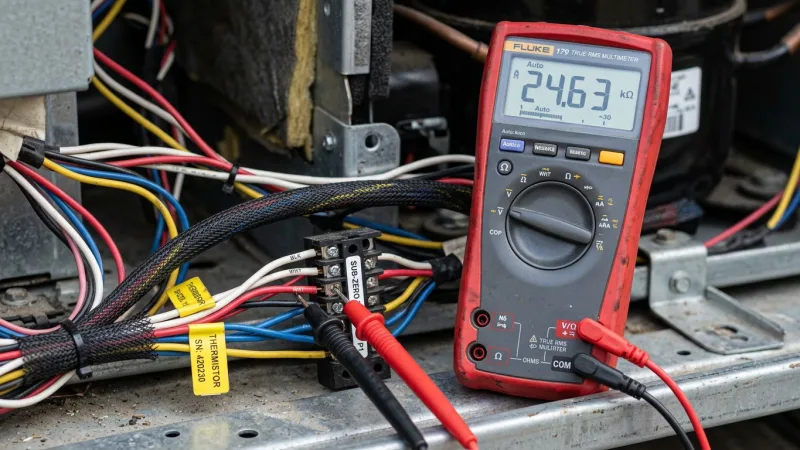
Our certified technicians utilize true-RMS digital multimeters, oscilloscope frequency loggers, and factory schematic wiring diagrams to test Dacor Discovery electrical sub-assemblies against OEM engineering specifications:
| Dacor Component | Test Points & Pinout | Expected Factory Spec | Failure Indication & F8 Root Cause |
|---|---|---|---|
| Cooling Blower Motor (Main Winding) | Terminals L to N (Unplugged) | 18.5 – 32.0 Ohms (at 70°F) | ∞ Ohms (Open Coil) or < 5 Ohms (Shorted) |
| Hall Effect Tachometer Power Supply | Harness Pin 1 (+) to Pin 3 (GND) | 4.8 – 5.2 Volts DC Regulated | 0 VDC (Failed Relay Board 5V Regulator) |
| Hall Effect Tachometer Pulse Signal | Pin 2 (Signal) to Pin 3 (GND) | 0V to 5V Square Wave (Manual Spin) | Constant 0V or 5V (Defective Sensor IC) |
| Cooling Fan Relay Contacts (K3 / K4) | Relay Common to NO Contact | < 0.2 Ohms (Energized State) | > 5.0 Ohms (Carbonized / Pitted Contacts) |
| High-Limit Thermal Cutout Switch (TCO) | Across TCO Terminals @ 70°F | < 0.3 Ohms (Closed Continuity) | ∞ Ohms (Tripped at > 300°F Over-temp) |
| Cavity Platinum RTD Temp Sensor | Sensor Leads @ 77°F | 1,080 – 1,090 Ohms (±2%) | Drifted > 1,250 Ohms (Causes Overheating) |
| Convection Element Ring | Terminal to Terminal | 22.0 – 26.5 Ohms (2,500W @ 240V) | ∞ Ohms (Burned Element Coil) |
11. Failure Mode, Effects & Criticality Analysis (FMECA) Component Risk Matrix
Our technical engineering team maintains this quantitative FMECA risk matrix to assess component criticality, failure probability, and preventive replacement intervals for Dacor Discovery cooking appliances:
| Subsystem / Component | Severity (1-10) | Occurrence (1-10) | Detection (1-10) | Risk Priority # (RPN) | Mandatory Field Mitigation Protocol |
|---|---|---|---|---|---|
| Upper Tangential Blower Assembly | 9 (Thermal Abort) | 7 | 2 | 126 | Replace with OEM high-temp assembly; inspect squirrel cage clearance. |
| Hall-Effect Speed Sensor Board | 8 (F8 Lockout) | 6 | 3 | 144 | Verify 5V DC rail & signal square wave; renew sensor sub-assembly. |
| Main Relay Board K3/K4 Relays | 8 (No Blower Power) | 5 | 3 | 120 | Inspect solder pads for thermal fracture; replace complete relay PCB. |
| High-Limit Thermal Cutout Switch | 7 (Total Power Loss) | 4 | 2 | 56 | Perform continuity test; identify airflow restriction before reset. |
| Motorized Door Latch Assembly | 6 (Door Lock Error) | 4 | 3 | 72 | Clean cam microswitches; lubricate worm gear mechanism. |
12. Aerodynamic Volumetric Airflow, Heat Dissipation & Convective Enthalpy Formulations
Master certified technical service on luxury Dacor cooking appliances requires calculating precise thermodynamic heat dissipation rates. In a high-temperature built-in cavity, heat transfer from the outer steel wrapper to the cooling airflow stream is governed by fundamental convective energy equations:
Q = ṁ × Cp × ΔT = ρ × V̇ × Cp × (T_exhaust – T_intake)
Where:
• Q = Heat Rejection Rate (BTU/hr)
• ρ = Density of Air (approx. 0.075 lbs/ft³ at standard room temperature)
• V̇ = Volumetric Flow Rate of Cooling Blower (CFM, ft³/min × 60 min/hr)
• Cp = Specific Heat Capacity of Air (0.24 BTU/lb·°F)
• ΔT = Temperature Rise Across Chassis Air Jacket (°F)
During a 500°F convection roasting cycle, the dual heating elements and convection fan generate over 17,000 BTU/hr of thermal energy. While high-density fiberglass and ceramic blanket insulation retain approximately 88% of this heat within the cavity, over 2,000 BTU/hr conducts through the inner oven chassis walls into the outer air jacket. To keep external chassis skin temperatures below the 160°F maximum threshold established by UL 858 safety standards, the Dacor tangential cooling blower must maintain a continuous volumetric flow rate of at least 115 CFM on low speed and 165 CFM on high speed.
If bearing friction or lint accumulation reduces blower speed from 2,200 RPM to 1,400 RPM (a 36% velocity drop), volumetric airflow collapses to less than 70 CFM. As airflow drops, the temperature of air flowing across the control board compartment surges from 110°F to over 195°F. At these temperatures, the silicon junctions inside the microprocessor undergo thermal leakage, and the solder traces on the relay board experience severe thermal expansion fatigue. This thermodynamic reality underscores why Dacor firmware aggressively triggers the F8 error code: running the oven without adequate convective cooling would cause thousands of dollars in ruined electronics. If you suspect broader heating element issues, see our detailed guide on why an oven fails to heat correctly in Johns Creek.
13. Hall Effect Tachometer Pulse Train Diagnostics & Microprocessor Speed Feedback
The feedback mechanism that governs error code F8 is a precision closed-loop frequency-detection circuit. The Hall-effect sensor utilizes an integrated bipolar semiconductor switch activated by alternating North-South magnetic poles on the rotor shaft ring magnet.
As the motor rotates at 2,200 RPM, a 4-pole magnet generates 4 state transitions per revolution, yielding an output frequency:
This 146.6 Hz square wave is transmitted back to the timer/counter interrupt pin of the microprocessor on the relay board. The firmware calculates the time period between consecutive rising edges. If the period exceeds a predefined threshold (corresponding to < 1,000 RPM) for longer than 20 consecutive seconds during an active bake cycle, the microprocessor branches into its fault-handling interrupt routine, locks the heating relays open, and writes the F8 byte into EEPROM memory.
14. Relay Board Triac Switching, Inductive Snubbers & Solder Joint Integrity
On Dacor Discovery wall ovens, the cooling blower is controlled via either electromechanical relays (K3 and K4) or a phase-controlled silicon bilateral AC switch (triac). Switching an inductive motor load generates severe back-electromotive force (counter-EMF) spikes when voltage is interrupted:
Because the motor winding has significant inductance ($L approx 120text{ mH}$), rapid current interruption can generate voltage spikes exceeding 600V. Factory relay boards incorporate metal-oxide varistors (MOVs) and resistor-capacitor (RC) snubber networks across the relay contacts to clamp these spikes. Over years of thermal stress, snubber capacitors can dry out or develop high equivalent series resistance (ESR). When snubbers degrade, high-voltage arcing pits the relay contacts and induces noise pulses across the adjacent 5V DC low-voltage sensor traces, corrupting tachometer readings and producing intermittent F8 error codes. Our technicians inspect relay contact resistance with 4-wire Kelvin probes and reflow cracked solder joints using silver-bearing electrical solder.
15. Architectural Cabinetry Nuances & Zero-Damage Air Sled Extraction in Johns Creek
Built-in wall ovens in premier Johns Creek estates—such as those in Rivermont, St Ives, and The Country Club of the South—are integrated into custom millwork with flush overlay reveals, delicate face frames, and adjoining marble or quartz countertops. Extracting a 280-pound Dacor Discovery double wall oven to access the upper cooling fan presents severe risks to finished cabinetry and flooring if handled improperly.
Our certified master technicians execute a specialized extraction standard:
- Pneumatic Air Sled Deployment: High-pressure pneumatic air sleds slide beneath the appliance platform, hovering the multi-hundred-pound oven on a friction-free cushion of air. This prevents gouging delicate site-finished oak, hickory, or travertine floors.
- Cabinet Face-Frame Cladding: Protective rigid edge-guards clamp along the interior vertical stiles of the cabinetry cutout to prevent scuffing fine paint and lacquer finishes.
- Telescoping Chassis Support Racks: Aluminum staging tables support the oven immediately in front of the cabinet opening, allowing our technician to access top-mounted cooling fan assemblies and relay boards without disconnecting main conduit feeds or straining factory wiring harnesses.
16. Johns Creek Grid Power Spikes, Summer Thunderstorms & Environmental Factors
Operating high-end cooking appliances in Johns Creek and North Fulton County presents environmental challenges that directly accelerate cooling fan and control board failures:
1. Severe Thunderstorm Voltage Spikes: North Georgia experiences frequent summer afternoon electrical storms. Lightning strikes miles away induce high-frequency inductive voltage transients into residential utility service drops. While main electrical panel breakers protect against heavy sustained overcurrent, microsecond voltage spikes pass directly into sensitive appliance control electronics. These surges puncture the thin gate-oxide layers of speed sensor transistors and degrade relay board MOVs, resulting in erratic tachometer behavior.
2. High Ambient Humidity & Kitchen Grease Varnish: The humid subtropical climate across Fulton County accelerates airborne dust agglomeration. Cooking grease aerosols combine with humid intake air, forming a sticky varnish across blower squirrel-cage blades and sleeve bearings. Over time, this buildup unbalances the impeller wheel, causes bearing wobble, increases rotational drag, and leads to motor seizure.
17. Professional Field Diagnostic Methodology: The 7-Stage Restoration Standard
When our master certified technicians arrive at your Johns Creek residence, every Dacor wall oven service call follows our rigorous 7-stage diagnostic and restoration standard:
- Stage 1: Electrical Isolation & Floor Protection: Technicians de-energize the 240V double-pole circuit breaker, verify zero energy with non-contact voltage detectors, and lay down neoprene floor runners.
- Stage 2: Non-Destructive Oven Extraction: Utilizing pneumatic air sleds, the wall oven is smoothly eased forward onto padded telescoping support jacks.
- Stage 3: Microprocessor Error Buffer Interrogation: Accessing Dacor’s diagnostic test mode, technicians review historical fault logs, cycle counts, and recorded fan speed telemetry.
- Stage 4: True-RMS Telemetry & Winding Analysis: Technicians measure stator resistance (Ohms), verify 120V line supply under simulated load, and test Hall sensor DC voltage and pulse output.
- Stage 5: Factory OEM Component Installation: Defective cooling blower motors, speed sensor assemblies, or relay power boards are replaced with brand-new, factory-sealed Dacor OEM parts.
- Stage 6: Harness Dressing & Cabinet Reinstallation: High-temperature fiberglass sleeving protects wire harnesses, and the oven is reinserted into the cabinetry recess with exact 1/8-inch reveal alignments.
- Stage 7: Full Dynamic Thermal Run-In Test: The oven undergoes a 30-minute high-heat test cycle while our technician monitors live exhaust airflow velocity, motor current draw, and surface temperature.
For other luxury oven brands exhibiting similar heating disruptions, review our guide on Viking oven F3 error code repair to understand comparative luxury diagnostic protocols.
18. High-Limit Thermal Cutout (TCO) Safety Interlocks & Cabinetry Protection
As a fail-safe backup to the cooling fan tachometer circuit, Dacor Discovery wall ovens incorporate one or more bimetallic High-Limit Thermal Cutout Switches (TCOs) mounted directly onto the blower scroll housing or the upper chassis exhaust manifold. These TCOs are calibrated to snap open at approximately 275°F to 315°F.
If a blower motor seizes and the software fail-safe fails to disengage the heating elements due to a welded relay contact, convective heat builds up rapidly in the upper chassis deck. When the TCO reaches its trip point, it mechanically breaks the line voltage supply to the entire oven control system. The display goes completely dark, preventing electrical fire hazards and protecting surrounding cabinetry from heat discoloration. During service, our technicians test TCO continuity and inspect mounting brackets to ensure proper thermal coupling.
Thermal safety controls protect not only your oven but also adjacent built-in appliances and kitchen utility lines; if your home requires comprehensive maintenance across luxury dishwashers and cooking equipment, consult our certified guide to dishwasher repair and drainage solutions.
19. Critical OEM Replacement Parts Catalog for Dacor Wall Ovens
Our mobile diagnostic service trucks serving Johns Creek carry a complete inventory of genuine factory OEM replacement parts for Dacor Discovery wall ovens:
- Upper Tangential Cooling Blower Assembly: Dacor OEM Part # 105658 / 701441 / DE81-08442A (120V, 60Hz, high-temperature bearings, integrated Hall tachometer speed sensor).
- Hall-Effect Tachometer Speed Sensor Sub-Assembly: Dacor OEM Part # 101487 / 82991 (includes 3-pin wiring lead and precision magnetic sensor board).
- Main Power Relay Board (OVC / Relay PCB): Dacor OEM Part # 102377 / 92028 / 702005 (heavy-duty relays for bake, broil, convection, and cooling fan low/high speeds).
- High-Limit Thermal Cutout Switch (TCO): Dacor OEM Part # 62734 / 102223 / 72723 (manual-reset or auto-reset 300°F ceramic safety limit switch).
- Cavity Platinum RTD Temperature Sensor: Dacor OEM Part # 82733 / 72022 (1,080 Ω at 70°F, high-accuracy thermal feedback probe).
- Dual Convection Blower Motor Assembly: Dacor OEM Part # 82823 / 101511 (rear cavity air circulation motor with reverse-pitch impeller).
20. Preventative Maintenance Routine for Johns Creek Homeowners
Adhering to this structured preventative maintenance routine keeps your Dacor Discovery wall oven operating smoothly and prevents unexpected cooling fan failures:
- Quarterly Louver Vacuuming: Use a soft-bristle vacuum nozzle to clear dust and pet dander from the upper exhaust louvers and lower door intake slots. Never allow grease films to bridge the vent gaps.
- Door Seal Integrity Audit: Periodically close the oven door on a crisp dollar bill at four points around the perimeter. If the bill slides out with zero resistance, the silicone gasket has compressed or hinges have sagged, requiring adjustment to prevent heat leakage.
- Self-Clean Pre-Cleaning Protocol: Before initiating a high-heat self-clean cycle, manually wipe heavy grease pools from the cavity floor. Heavy smoke deposits coat the upper cooling blower blades, increasing motor drag and triggering F8 errors.
- Post-Cooking Fan Run Time Observation: After turning off the oven, leave the door closed and allow the cooling blower to run until it shuts off automatically. The blower continues circulating air until cavity temperatures drop below 200°F; never cut power to the oven while the fan is cooling down.
- Annual Master Technician Diagnostic Service: Schedule an annual preventative diagnostic tune-up to measure motor operating current, calibrate RTD sensor resistance, and check relay board solder joints. Also explore our guides for refrigerator repair and dishwasher repair to maintain whole-kitchen appliance reliability.
21. Electrical, Mechanical & High-Temperature Safety Protocols
Always observe these critical safety rules before inspecting or servicing any residential cooking appliance:
- Always disconnect main electrical power at the household breaker panel and verify zero voltage before removing any trim panels.
- Never bypass or shunt cooling fan relay contacts or high-limit thermal switches; running heating elements without forced cooling creates immediate fire hazards.
- Ensure the appliance grounding conductor is securely bonded to the main chassis frame to prevent stray voltage shock risks.
- Allow the oven cavity to cool for a minimum of 3 hours after heating before touching internal components or access covers.
22. Frequently Asked Technical Questions Regarding Dacor Error Code F8
Detailed answers to the most common questions asked by homeowners and facility managers in Johns Creek:
Q1: What does error code F8 mean on a Dacor Discovery wall oven?
Error code F8 indicates a cooling fan speed failure. The electronic oven controller (OVC) commands the upper tangential cooling blower to run during heating or self-clean cycles, but the Hall-effect tachometer sensor fails to detect the required rotational RPM within 20 to 30 seconds. To protect control boards and cabinetry from intense convective heat, the oven immediately halts heating and sounds an alarm.
Q2: Can I continue using my oven if the F8 error code clears after a breaker reset?
No, continued use is strongly discouraged. Even if cycling the breaker temporarily clears the display, an underlying mechanical bearing drag or intermittent tachometer signal will cause the blower to fail again mid-cycle. Running the oven without reliable cooling risks melting the control board, blowing thermal fuses, and scorching surrounding kitchen cabinetry.
Q3: How does the Dacor oven monitor cooling fan speed?
The cooling blower motor shaft features a ring magnet that rotates past a solid-state Hall-effect sensor board. As the magnet spins, the sensor generates a 0V to 5V square-wave pulse train. The microprocessor on the relay board monitors this frequency; if pulses stop or drop below threshold, the controller registers F8.
Q4: Is the cooling blower fan the same as the convection fan inside the oven cavity?
No. The convection fan is located inside the rear cavity wall and circulates hot air over cooking food. The cooling blower fan is an external tangential cross-flow blower located on the top exterior chassis deck that pulls cool room air through internal chassis channels to protect electronics and cabinetry.
Q5: How much does it cost to repair Dacor error code F8 in Johns Creek, GA?
Professional repairs typically range from $285 to $460 for single wall ovens and $340 to $560 for double wall ovens, depending on whether the issue requires replacing the blower motor assembly, the tachometer sensor, or the power relay board. We provide upfront flat-rate quotes before any work begins.
Q6: How long does a certified technician take to diagnose and fix this fault?
A complete diagnostic inspection and component replacement typically takes 60 to 90 minutes. Because our mobile service vans stock genuine factory OEM Dacor blowers, speed sensors, and relay boards, most repairs are completed on the initial visit.
Q7: Can a power surge during a North Fulton thunderstorm cause error code F8?
Yes. High-voltage lightning transients traveling through residential utility lines can damage the delicate 5V DC speed sensor circuit or puncture the triac switching components on the relay board, causing the controller to misread fan speed and lock into F8 fault mode.
Q8: Are generic aftermarket cooling blowers safe to use on Dacor ovens?
No. Generic aftermarket blowers often have incorrect volumetric airflow (CFM), inferior sleeve bearings that fail under high heat, and incompatible tachometer pulse frequencies that trigger persistent false F8 alarms. We install exclusively genuine factory-sealed Dacor OEM parts.
Q9: Why does my oven make a loud grinding noise before the F8 code appears?
A loud grinding, squealing, or rattling noise indicates that the cooling fan bearings have dried out and metal-on-metal wear is occurring, or that the squirrel-cage impeller has shifted and is rubbing against the aluminum scroll housing.
Q10: Does your Dacor wall oven repair in Johns Creek include a warranty?
Yes, every repair performed by our master certified technicians includes an ironclad 90-day parts and labor warranty. If the identical issue recurs within 90 days, our technician returns and resolves it with zero additional service fees.
Q11: Can a failed cooling fan cause the oven door to lock permanently?
If the cooling fan fails during a high-temperature self-cleaning cycle, the motorized door lock latch remains engaged until cavity temperatures safely fall. If heat has warped the latch assembly or blown the thermal cutout, manual extraction and latch release by a certified technician is required.
Q12: How do your technicians protect custom cabinetry when servicing wall ovens?
We utilize pneumatic air sled equipment that hovers heavy double wall ovens on a friction-free air cushion, protecting hardwood and stone flooring. We also install padded face-frame guards to prevent scratching adjacent custom cabinet trim.
Q13: What should I check if my oven display went completely dark after an F8 error?
A completely blank display indicates that the 300°F high-limit thermal cutout switch (TCO) has tripped due to excessive heat accumulation. The TCO must be tested for continuity and reset or replaced alongside the cooling blower motor.
Q14: Can a dirty exhaust grille cause error code F8 on a Dacor oven?
Yes. Heavy grease and dust accumulation across the intake or exhaust louvers creates high static backpressure, forcing the blower motor to work harder, overheat its windings, and drop below minimum speed thresholds.
Q15: How can I look up other error codes on my luxury kitchen appliances?
You can reference our comprehensive master error codes directory to diagnose diagnostic alarms across all luxury brands including Dacor, Wolf, Viking, Thermador, and Sub-Zero.
Q16: How quickly can a technician arrive at my home in Johns Creek?
We offer priority same-day dispatch across Johns Creek, Milton, Alpharetta, and Roswell. Technicians typically arrive within 45 to 75 minutes of your service call. Call (770) 796-7742 to reserve an arrival slot.
23. Local Service Silos & Support Networks
Explore our specialized repair directories, luxury brand certified services, and North Fulton regional dispatch centers:
Core Repair Services
Related Diagnostic Problems
Luxury Cooking Brands
North Fulton Dispatch Centers
24. Key Takeaways for Johns Creek Homeowners
- F8 Is a Critical Thermal Safety Lockout: Error code F8 indicates a cooling blower failure; forcing the oven to operate or repeatedly resetting the breaker risks destroying control boards and scorching cabinetry.
- Closed-Loop Tachometer Feedback: The Dacor controller requires a continuous 146 Hz square wave from the Hall-effect speed sensor; a failed sensor triggers F8 even if the blower motor spins.
- 120V Shaded-Pole Motor Winding Specs: Healthy Dacor blower motor stators measure 18.5 to 32.0 Ohms; reading infinite Ohms confirms a burned, open winding requiring assembly replacement.
- Protect High-End Cabinetry: Accessing top-mounted blower assemblies requires specialized pneumatic air sled extraction to prevent gouging hardwood floors or damaging custom kitchen millwork.
- Relay Board Triac & Contact Diagnostics: Worn K3/K4 relay contacts or cracked PCB solder joints fail to deliver line voltage to the blower motor, simulating a motor failure.
- Summer Grid Spikes in North Fulton: Power fluctuations from Georgia thunderstorms frequently damage delicate low-voltage speed sensor boards and relay varistors.
- Insist on Genuine Factory OEM Components: Generic aftermarket blowers lack balanced impellers and produce incorrect tachometer pulse signals that trigger chronic false alarms.
- Comprehensive 90-Day Guarantee: Every Dacor wall oven repair performed by our master certified technicians includes full 90-day parts and labor warranty protection.
Restore Your Dacor Discovery Wall Oven Today
Don’t let an F8 cooling fan fault compromise your culinary routine or endanger your custom cabinetry. Our certified master technicians are on-call across Johns Creek with fully stocked service trucks ready to diagnose and repair your Dacor Discovery oven today.
Need Certified Appliance Repair Today?
Skip the phone line — book direct local priority dispatch across Alpharetta, Milton, Roswell & Johns Creek.