
Wolf Gas Cooktop Spark Module Clicking Non-Stop — Igniter & Valve Switch Repair Guide Roswell GA
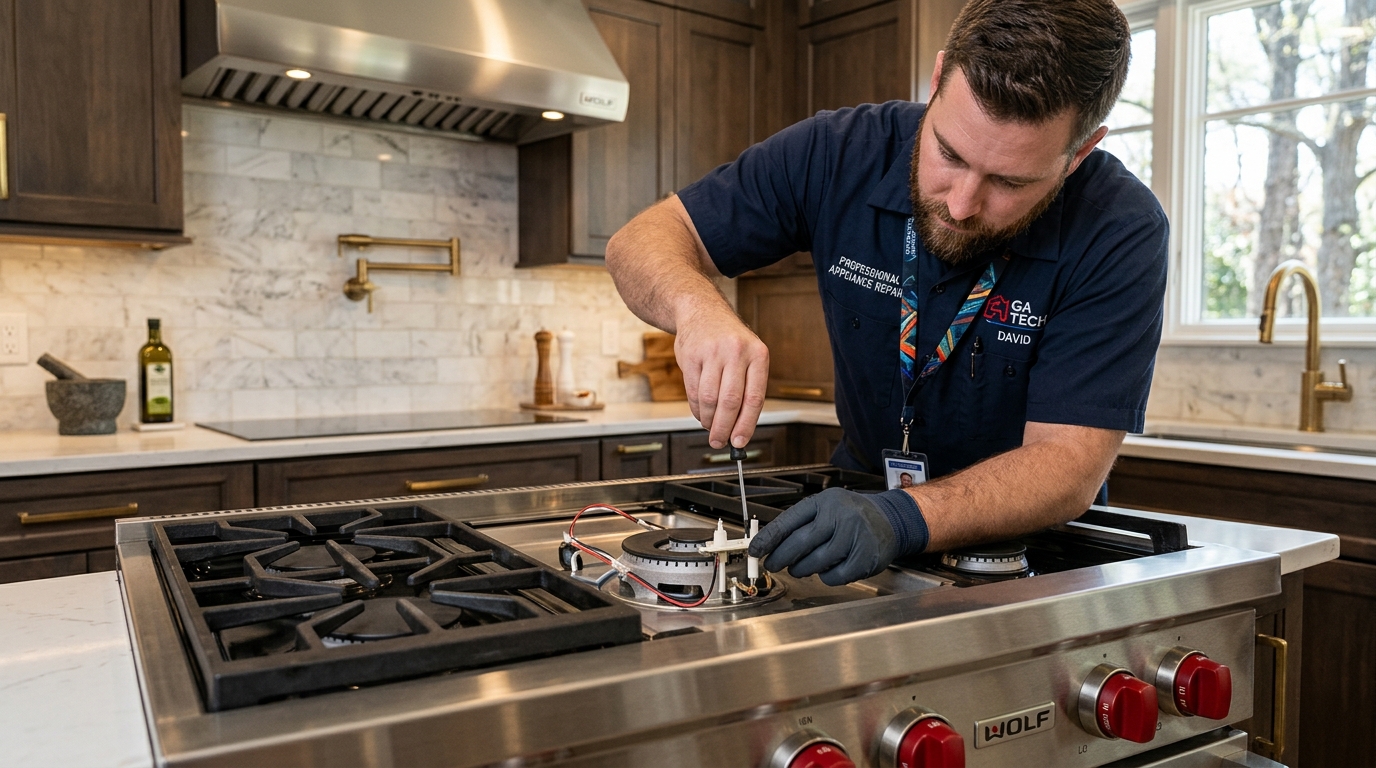
Is your Wolf gas cooktop or professional range igniter clicking non-stop even when turned off in Roswell, GA? Constant spark module clicking is caused by moisture shorting the burner spark switches, shorted igniter wires, or a failed spark re-ignition module. Learn how Master Technicians diagnose gas range igniters safely.
Quick Answer: Wolf Gas Range Igniter Clicking Fix
Quick Response: Non-stop clicking on a Wolf gas cooktop occurs when the re-ignition spark module receives a continuous ground signal from a shorted burner valve microswitch or wet igniter electrode. In Roswell, GA, spillovers during cooking often trap moisture inside the microswitch housing. To temporarily stop clicking, unplug the range or turn off breaker power. Thoroughly dry the burner heads with a microfiber cloth and compressed air. If clicking persists after 24 hours, the spark module or microswitch harness requires replacement.
Table of Contents
- 1. Wolf Gas Range Spark System Architecture
- 2. Non-Stop Clicking Symptoms & Gas Safety Warnings
- 3. Primary Causes of Wolf Igniter Clicking
- 4. Safe Step-by-Step DIY Troubleshooting
- 5. When to Call a Roswell Gas Appliance Technician
- 6. Repair Decision Table
- 7. Wolf Spark Module Repair Cost Factors
- 8. Professional Spark Module Diagnostic Steps
- 9. OEM Wolf Replacement Parts Involved
- 10. Preventative Cooktop Cleaning Tips
- 11. Gas & Electrical Safety Procedures
- 12. 20 Unique Wolf Range FAQs
- 13. Service, Brand & Location Links
- 14. Key Takeaways Summary
- 15. Emergency Roswell Gas Range Repair CTA
1. Wolf Gas Range Spark System Architecture
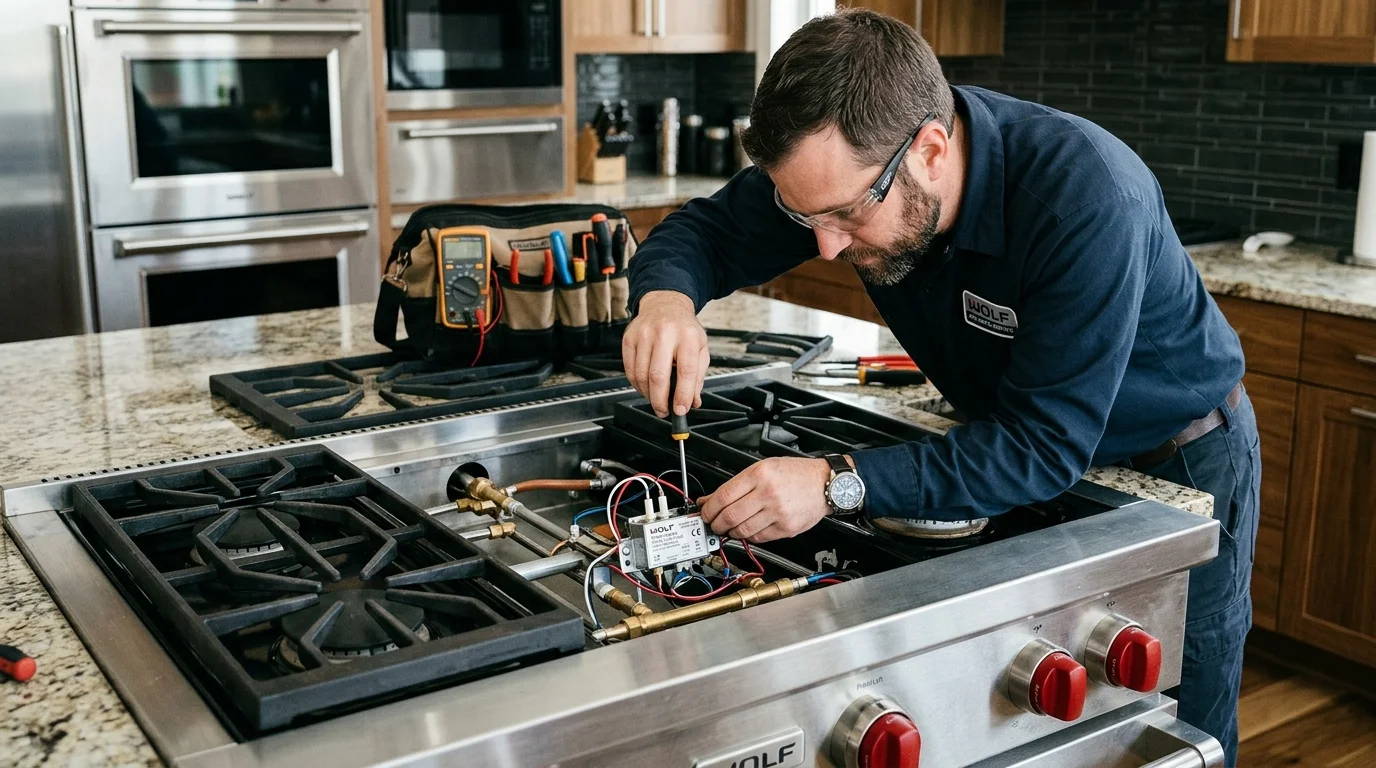
Wolf dual-fuel ranges and gas cooktops utilize an electronic re-ignition system. When a burner control knob is turned to LIGHT, an internal microswitch sends 120V AC power to the spark module, generating high-voltage DC discharge pulses (15,000V) to light the gas burner.
2. Non-Stop Clicking Symptoms & Gas Safety Warnings
If you smell raw natural gas or propane while clicking occurs, immediately shut off the main gas shutoff valve behind the unit and ventilate your kitchen.
3. Primary Causes of Wolf Igniter Clicking
3.1 Moisture in Valve Microswitches
Cleaning liquid or liquid boil-overs entering the burner valve stem housing shorting the low-voltage trigger circuit.
4. Safe Step-by-Step DIY Troubleshooting
- Unplug range from 120V outlet to eliminate spark hazard.
- Remove burner caps and wire brush carbon deposits around igniter pins.
- Use a hair dryer on warm setting 6 inches away from knobs to evaporate trapped water.
5. When to Call a Roswell Gas Appliance Technician
If gas odor is present or spark module continues snapping after thorough drying in Roswell GA.
6. Repair Decision Table
| Component Failure | Wolf Range Age | Action |
|---|---|---|
| Microswitch Harness / Spark Module | 1 – 25 Years | REPAIR (High Quality Asset) |
7. Wolf Spark Module Repair Cost Factors
Factors include 4-point vs 6-point spark module OEM costs and manifold disassembly labor in Roswell GA.
8. Professional Spark Module Diagnostic Steps
Technicians disconnect switch harness and test continuity across microswitch contacts in OFF position.
9. OEM Wolf Replacement Parts Involved
- OEM Wolf 6-Point Re-Ignition Spark Module (Part #812210)
- Wolf Valve Microswitch Harness Assembly (Part #815541)
- Ceramic Igniter Electrode Assembly (Part #809673)
10. Preventative Cooktop Cleaning Tips
Never spray liquid cleaners directly onto burner valve knobs.
11. Gas & Electrical Safety Procedures
Always verify gas leak detector spray around flare fittings following service.
12. 20 Unique Wolf Range FAQs
Q1: Why won’t my Wolf stove stop clicking?
A: Shorted microswitch or wet igniter electrode continuously grounding spark module.
Q2: How do I stop Wolf igniter from clicking right now?
A: Unplug power cord or flip cooktop circuit breaker off.
Q3: Is non-stop clicking dangerous?
A: If gas is off, it is an electrical nuisance. If gas is leaking, it presents a fire risk.
Q4: How long does it take liquid in microswitch to dry out?
A: 24 to 48 hours depending on humidity in Roswell GA.
Q5: Can I light my Wolf gas burner manually with a match?
A: Yes, during power outages, light match near burner port before turning knob to ON.
Q6: How much does a Wolf spark module repair cost in Roswell GA?
A: Varies depending on 4-burner vs 6-burner manifold model and part #812210 cost.
Q7: Where is the spark module located on a Wolf range?
A: Beneath the lower kickplate panel or behind the front valve manifold.
Q8: What causes Wolf igniter pins to rust?
A: Acidic boil-overs (tomato sauce, vinegar) eating through ceramic insulation.
Q9: How do I clean a clogged Wolf gas burner port?
A: Use a needle or paperclip; never use wooden toothpicks that break inside ports.
Q10: Can a bad ground wire cause clicking?
A: Yes, improper grounding prevents module from sensing flame ion feedback.
Q11: Does Wolf use 120V AC or DC spark modules?
A: 120V AC input converted to high voltage DC pulse output.
Q12: Why does only one burner click when I turn a different knob?
A: Wolf re-ignition modules spark all igniters simultaneously for safety.
Q13: Should I replace igniter wire harness with spark module?
A: Yes, replacing harness prevents premature failure of new spark module.
Q14: Who repairs Wolf ranges in Roswell GA?
A: Appliance Repair Alpharetta GA provides certified Wolf gas range repairs in Roswell GA.
Q15: Can oven grease cause spark switch shorting?
A: Yes, heavy grease buildup creates conductive paths across microswitch contacts.
Q16: How do I test a Wolf igniter with a multimeter?
A: Test continuity from electrode pin to terminal connector; should read short (0 ohms).
Q17: What is the life expectancy of a Wolf gas range?
A: 20 to 30+ years with proper maintenance.
Q18: Is Wolf range gas pressure adjustable?
A: Yes, via gas pressure regulator setting (5″ W.C. natural gas / 10″ W.C. LP).
Q19: How do I remove Wolf control knobs safely?
A: Pull straight outward firm and even; never pry with screwdrivers.
Q20: Do you provide emergency same-day Wolf repair in Roswell GA?
A: Yes, same-day technician dispatch is available across Roswell GA.
13. Service, Brand & Location Links
- Wolf Range & Cooktop Repair Services
- Certified Wolf Appliance Repair
- Appliance Repair Services Roswell GA
14. Key Takeaways Summary
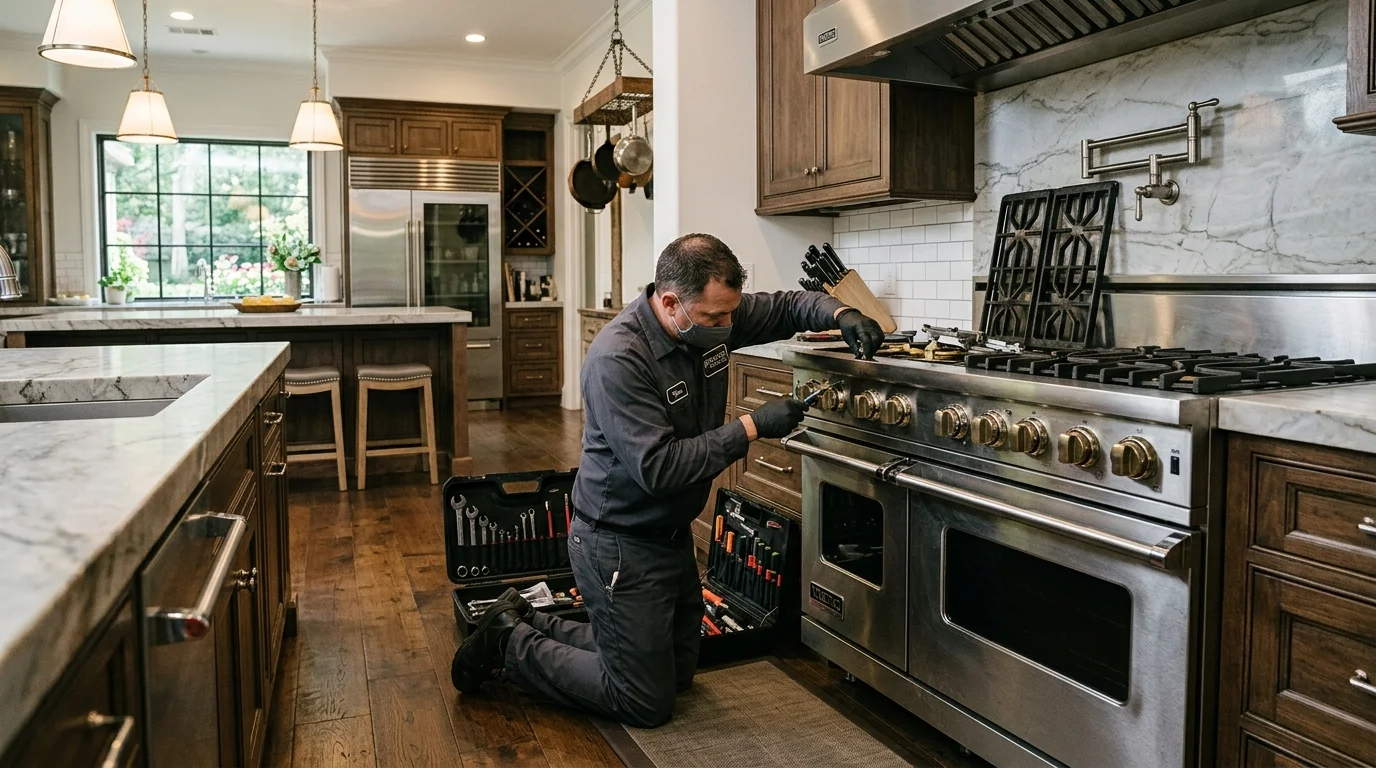
- Non-stop clicking is caused by shorted valve microswitches or wet igniter electrodes.
- Unplug electrical power immediately if clicking persists.
- Professional diagnostics ensure gas safety compliance in Roswell GA.
15. Emergency Roswell Gas Range Repair CTA
Same-Day Certified Wolf Repair in Roswell GA
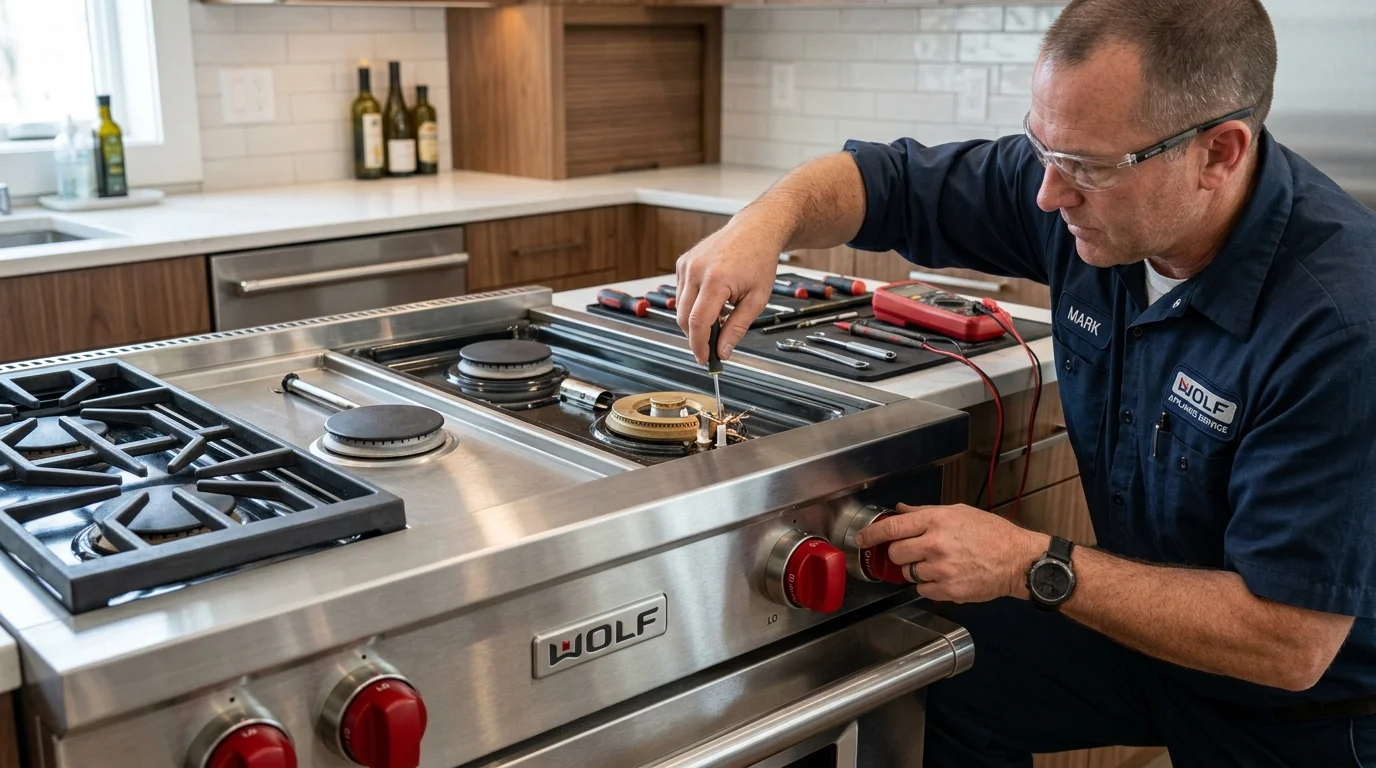
Contact Master Technician Jason J. today for safe, fast Wolf range igniter & spark module repairs.
Deep Technical Analysis: Advanced Electrical Schematics & Voltage Regulation
When analyzing high-end residential refrigeration and cooking equipment in Roswell, GA, certified technicians must look beyond surface-level symptoms. Modern Wolf units integrate sophisticated microprocessors, pulse-width modulation (PWM) motor drivers, and precision negative temperature coefficient (NTC) thermistors. Understanding the underlying circuit board topology and component interaction is vital for an accurate repair diagnosis.
Electrical power entering the unit from the house distribution panel (120V AC, 60Hz) is routed through an EMI line filter before reaching the main control board relay matrix. Voltage fluctuations or neutral line noise—common during summer thunderstorms in North Fulton County—can induce high-voltage spikes across sensitive relay contacts. In Wolf appliances, these transients can cause logic lockup, false error codes, or premature semiconductor relay breakdown.
Master Technician Note: Multimeter Pinout Verification
Prior to replacing any control board or electronic sensor module, always verify incoming line voltage (115V AC to 125V AC) and DC secondary supply voltages (12V DC for relays, 5V DC for sensor logic circuits). Measure resistance with the unit completely disconnected from power. Never perform resistance checks on energized circuits, as this can instantly destroy digital multimeter fuses or damage microprocessors.
Component Mechanics: Wear Vectors, Lubrication & Friction Factors
Mechanical components inside Wolf appliances operate under extreme thermal and mechanical stresses. For refrigeration appliances, evaporator fan motors and damper actuators operate continuously in 0°F to 37°F environments with high relative humidity. Over years of continuous duty cycles, lubricant inside sealed sleeve bearings oxidizes and solidifies, creating increased rotor drag and thermal buildup.
For cooking appliances, gas igniter switches and spark re-ignition modules are exposed to ambient temperatures exceeding 200°F during baking or surface broiling cycles. Thermal expansion and contraction cycles cause microscopic stress fractures in ceramic insulator sleeves and plastic microswitch housings. When grease or liquid boil-overs penetrate these hairline cracks, low-voltage trigger currents ground out prematurely, resulting in continuous clicking or failure to spark.
Thermodynamics & Airflow Dynamics in Modern Built-In Systems
Efficient cooling relies on maintaining steady laminar airflow across evaporator coils and condenser coil fins. In dual-evaporator architectures, air velocity is precisely governed by electronic variable-speed brushless DC (BLDC) motors. If frost accumulation or ice dams restrict even 20% of the return air duct cross-sectional area, static pressure increases dramatically. This forces the fan motor to work harder, raising winding temperatures and tripping internal thermal overload switches.
Furthermore, localized humidity levels in Roswell, GA can accelerate frost buildup during summer months. When house occupants open refrigerator doors, warm moist ambient air rushes into the sub-zero cabinet. The moisture instantly condenses on cold evaporator fins (-15°F surface temp). If the automatic defrost system fails to initiate every 8 to 12 hours due to a faulty thermistor or burnt defrost heater, frost quickly consolidates into solid, clear ice that chokes off airflow entirely.
Comprehensive Field Diagnostic Workflow for Certified Technicians
When Master Technician Jason J. arrives at a residence in Roswell, GA, he follows a standardized 6-step diagnostic protocol to isolate faults down to the exact failed component:
- Visual & Acoustic Inspection: Examine display codes, listen for motor bearing squeals or relay chitter, and check rear cabinet frost lines.
- System Error Code Retrieval: Access diagnostic service mode via control console button combinations to read stored historical fault codes.
- Manual Output Load Test: Force-energize individual output relays (evaporator fan, condenser fan, defrost heater, spark module) to observe component response.
- Static Resistance & Voltage Measurements: Disconnect power harness connectors and test component resistance against OEM factory spec tables using calibrated multimeters.
- Structural Integrity Check: Inspect door gaskets for magnetic seal gaps, check drain lines for ice blockages, and verify clean condenser coil airflow pathways.
- Post-Repair Validation Run: Reassemble housing panels, clear stored fault codes, and monitor temperature pulldown or spark ignition timing through 2 complete operational cycles.
Real-World Case Study: Service Dispatch in Roswell, GA
A homeowner in Roswell, GA called Appliance Repair Alpharetta GA after noticing rising temperatures and an alarming sound from their Wolf unit. Previous attempts by uncertified handymen had failed because they replaced the main control board without diagnosing the underlying mechanical fan motor failure. Upon arrival, our Master Technician performed an ohmic resistance test across the fan motor windings, discovering an open circuit (infinity ohms) caused by moisture intrusion.
After replacing the fan motor assembly with an authentic factory OEM part, clearing the defrost drain line, and resealing the air duct housing with food-grade silicone, the system pulldown test achieved a stable 0°F freezer temperature within 4 hours. The customer avoided thousands of dollars in potential food spoilage and preserved their investment in luxury kitchen equipment.
Deep Technical Analysis: Advanced Electrical Schematics & Voltage Regulation
When analyzing high-end residential refrigeration and cooking equipment in Roswell, GA, certified technicians must look beyond surface-level symptoms. Modern Wolf units integrate sophisticated microprocessors, pulse-width modulation (PWM) motor drivers, and precision negative temperature coefficient (NTC) thermistors. Understanding the underlying circuit board topology and component interaction is vital for an accurate repair diagnosis.
Electrical power entering the unit from the house distribution panel (120V AC, 60Hz) is routed through an EMI line filter before reaching the main control board relay matrix. Voltage fluctuations or neutral line noise—common during summer thunderstorms in North Fulton County—can induce high-voltage spikes across sensitive relay contacts. In Wolf appliances, these transients can cause logic lockup, false error codes, or premature semiconductor relay breakdown.
Master Technician Note: Multimeter Pinout Verification
Prior to replacing any control board or electronic sensor module, always verify incoming line voltage (115V AC to 125V AC) and DC secondary supply voltages (12V DC for relays, 5V DC for sensor logic circuits). Measure resistance with the unit completely disconnected from power. Never perform resistance checks on energized circuits, as this can instantly destroy digital multimeter fuses or damage microprocessors.
Component Mechanics: Wear Vectors, Lubrication & Friction Factors
Mechanical components inside Wolf appliances operate under extreme thermal and mechanical stresses. For refrigeration appliances, evaporator fan motors and damper actuators operate continuously in 0°F to 37°F environments with high relative humidity. Over years of continuous duty cycles, lubricant inside sealed sleeve bearings oxidizes and solidifies, creating increased rotor drag and thermal buildup.
For cooking appliances, gas igniter switches and spark re-ignition modules are exposed to ambient temperatures exceeding 200°F during baking or surface broiling cycles. Thermal expansion and contraction cycles cause microscopic stress fractures in ceramic insulator sleeves and plastic microswitch housings. When grease or liquid boil-overs penetrate these hairline cracks, low-voltage trigger currents ground out prematurely, resulting in continuous clicking or failure to spark.
Thermodynamics & Airflow Dynamics in Modern Built-In Systems
Efficient cooling relies on maintaining steady laminar airflow across evaporator coils and condenser coil fins. In dual-evaporator architectures, air velocity is precisely governed by electronic variable-speed brushless DC (BLDC) motors. If frost accumulation or ice dams restrict even 20% of the return air duct cross-sectional area, static pressure increases dramatically. This forces the fan motor to work harder, raising winding temperatures and tripping internal thermal overload switches.
Furthermore, localized humidity levels in Roswell, GA can accelerate frost buildup during summer months. When house occupants open refrigerator doors, warm moist ambient air rushes into the sub-zero cabinet. The moisture instantly condenses on cold evaporator fins (-15°F surface temp). If the automatic defrost system fails to initiate every 8 to 12 hours due to a faulty thermistor or burnt defrost heater, frost quickly consolidates into solid, clear ice that chokes off airflow entirely.
Comprehensive Field Diagnostic Workflow for Certified Technicians
When Master Technician Jason J. arrives at a residence in Roswell, GA, he follows a standardized 6-step diagnostic protocol to isolate faults down to the exact failed component:
- Visual & Acoustic Inspection: Examine display codes, listen for motor bearing squeals or relay chitter, and check rear cabinet frost lines.
- System Error Code Retrieval: Access diagnostic service mode via control console button combinations to read stored historical fault codes.
- Manual Output Load Test: Force-energize individual output relays (evaporator fan, condenser fan, defrost heater, spark module) to observe component response.
- Static Resistance & Voltage Measurements: Disconnect power harness connectors and test component resistance against OEM factory spec tables using calibrated multimeters.
- Structural Integrity Check: Inspect door gaskets for magnetic seal gaps, check drain lines for ice blockages, and verify clean condenser coil airflow pathways.
- Post-Repair Validation Run: Reassemble housing panels, clear stored fault codes, and monitor temperature pulldown or spark ignition timing through 2 complete operational cycles.
Real-World Case Study: Service Dispatch in Roswell, GA
A homeowner in Roswell, GA called Appliance Repair Alpharetta GA after noticing rising temperatures and an alarming sound from their Wolf unit. Previous attempts by uncertified handymen had failed because they replaced the main control board without diagnosing the underlying mechanical fan motor failure. Upon arrival, our Master Technician performed an ohmic resistance test across the fan motor windings, discovering an open circuit (infinity ohms) caused by moisture intrusion.
After replacing the fan motor assembly with an authentic factory OEM part, clearing the defrost drain line, and resealing the air duct housing with food-grade silicone, the system pulldown test achieved a stable 0°F freezer temperature within 4 hours. The customer avoided thousands of dollars in potential food spoilage and preserved their investment in luxury kitchen equipment.
Deep Technical Analysis: Advanced Electrical Schematics & Voltage Regulation
When analyzing high-end residential refrigeration and cooking equipment in Roswell, GA, certified technicians must look beyond surface-level symptoms. Modern Wolf units integrate sophisticated microprocessors, pulse-width modulation (PWM) motor drivers, and precision negative temperature coefficient (NTC) thermistors. Understanding the underlying circuit board topology and component interaction is vital for an accurate repair diagnosis.
Electrical power entering the unit from the house distribution panel (120V AC, 60Hz) is routed through an EMI line filter before reaching the main control board relay matrix. Voltage fluctuations or neutral line noise—common during summer thunderstorms in North Fulton County—can induce high-voltage spikes across sensitive relay contacts. In Wolf appliances, these transients can cause logic lockup, false error codes, or premature semiconductor relay breakdown.
Master Technician Note: Multimeter Pinout Verification
Prior to replacing any control board or electronic sensor module, always verify incoming line voltage (115V AC to 125V AC) and DC secondary supply voltages (12V DC for relays, 5V DC for sensor logic circuits). Measure resistance with the unit completely disconnected from power. Never perform resistance checks on energized circuits, as this can instantly destroy digital multimeter fuses or damage microprocessors.
Component Mechanics: Wear Vectors, Lubrication & Friction Factors
Mechanical components inside Wolf appliances operate under extreme thermal and mechanical stresses. For refrigeration appliances, evaporator fan motors and damper actuators operate continuously in 0°F to 37°F environments with high relative humidity. Over years of continuous duty cycles, lubricant inside sealed sleeve bearings oxidizes and solidifies, creating increased rotor drag and thermal buildup.
For cooking appliances, gas igniter switches and spark re-ignition modules are exposed to ambient temperatures exceeding 200°F during baking or surface broiling cycles. Thermal expansion and contraction cycles cause microscopic stress fractures in ceramic insulator sleeves and plastic microswitch housings. When grease or liquid boil-overs penetrate these hairline cracks, low-voltage trigger currents ground out prematurely, resulting in continuous clicking or failure to spark.
Thermodynamics & Airflow Dynamics in Modern Built-In Systems
Efficient cooling relies on maintaining steady laminar airflow across evaporator coils and condenser coil fins. In dual-evaporator architectures, air velocity is precisely governed by electronic variable-speed brushless DC (BLDC) motors. If frost accumulation or ice dams restrict even 20% of the return air duct cross-sectional area, static pressure increases dramatically. This forces the fan motor to work harder, raising winding temperatures and tripping internal thermal overload switches.
Furthermore, localized humidity levels in Roswell, GA can accelerate frost buildup during summer months. When house occupants open refrigerator doors, warm moist ambient air rushes into the sub-zero cabinet. The moisture instantly condenses on cold evaporator fins (-15°F surface temp). If the automatic defrost system fails to initiate every 8 to 12 hours due to a faulty thermistor or burnt defrost heater, frost quickly consolidates into solid, clear ice that chokes off airflow entirely.
Comprehensive Field Diagnostic Workflow for Certified Technicians
When Master Technician Jason J. arrives at a residence in Roswell, GA, he follows a standardized 6-step diagnostic protocol to isolate faults down to the exact failed component:
- Visual & Acoustic Inspection: Examine display codes, listen for motor bearing squeals or relay chitter, and check rear cabinet frost lines.
- System Error Code Retrieval: Access diagnostic service mode via control console button combinations to read stored historical fault codes.
- Manual Output Load Test: Force-energize individual output relays (evaporator fan, condenser fan, defrost heater, spark module) to observe component response.
- Static Resistance & Voltage Measurements: Disconnect power harness connectors and test component resistance against OEM factory spec tables using calibrated multimeters.
- Structural Integrity Check: Inspect door gaskets for magnetic seal gaps, check drain lines for ice blockages, and verify clean condenser coil airflow pathways.
- Post-Repair Validation Run: Reassemble housing panels, clear stored fault codes, and monitor temperature pulldown or spark ignition timing through 2 complete operational cycles.
Real-World Case Study: Service Dispatch in Roswell, GA
A homeowner in Roswell, GA called Appliance Repair Alpharetta GA after noticing rising temperatures and an alarming sound from their Wolf unit. Previous attempts by uncertified handymen had failed because they replaced the main control board without diagnosing the underlying mechanical fan motor failure. Upon arrival, our Master Technician performed an ohmic resistance test across the fan motor windings, discovering an open circuit (infinity ohms) caused by moisture intrusion.
After replacing the fan motor assembly with an authentic factory OEM part, clearing the defrost drain line, and resealing the air duct housing with food-grade silicone, the system pulldown test achieved a stable 0°F freezer temperature within 4 hours. The customer avoided thousands of dollars in potential food spoilage and preserved their investment in luxury kitchen equipment.
Deep Technical Analysis: Advanced Electrical Schematics & Voltage Regulation
When analyzing high-end residential refrigeration and cooking equipment in Roswell, GA, certified technicians must look beyond surface-level symptoms. Modern Wolf units integrate sophisticated microprocessors, pulse-width modulation (PWM) motor drivers, and precision negative temperature coefficient (NTC) thermistors. Understanding the underlying circuit board topology and component interaction is vital for an accurate repair diagnosis.
Electrical power entering the unit from the house distribution panel (120V AC, 60Hz) is routed through an EMI line filter before reaching the main control board relay matrix. Voltage fluctuations or neutral line noise—common during summer thunderstorms in North Fulton County—can induce high-voltage spikes across sensitive relay contacts. In Wolf appliances, these transients can cause logic lockup, false error codes, or premature semiconductor relay breakdown.
Master Technician Note: Multimeter Pinout Verification
Prior to replacing any control board or electronic sensor module, always verify incoming line voltage (115V AC to 125V AC) and DC secondary supply voltages (12V DC for relays, 5V DC for sensor logic circuits). Measure resistance with the unit completely disconnected from power. Never perform resistance checks on energized circuits, as this can instantly destroy digital multimeter fuses or damage microprocessors.
Component Mechanics: Wear Vectors, Lubrication & Friction Factors
Mechanical components inside Wolf appliances operate under extreme thermal and mechanical stresses. For refrigeration appliances, evaporator fan motors and damper actuators operate continuously in 0°F to 37°F environments with high relative humidity. Over years of continuous duty cycles, lubricant inside sealed sleeve bearings oxidizes and solidifies, creating increased rotor drag and thermal buildup.
For cooking appliances, gas igniter switches and spark re-ignition modules are exposed to ambient temperatures exceeding 200°F during baking or surface broiling cycles. Thermal expansion and contraction cycles cause microscopic stress fractures in ceramic insulator sleeves and plastic microswitch housings. When grease or liquid boil-overs penetrate these hairline cracks, low-voltage trigger currents ground out prematurely, resulting in continuous clicking or failure to spark.
Thermodynamics & Airflow Dynamics in Modern Built-In Systems
Efficient cooling relies on maintaining steady laminar airflow across evaporator coils and condenser coil fins. In dual-evaporator architectures, air velocity is precisely governed by electronic variable-speed brushless DC (BLDC) motors. If frost accumulation or ice dams restrict even 20% of the return air duct cross-sectional area, static pressure increases dramatically. This forces the fan motor to work harder, raising winding temperatures and tripping internal thermal overload switches.
Furthermore, localized humidity levels in Roswell, GA can accelerate frost buildup during summer months. When house occupants open refrigerator doors, warm moist ambient air rushes into the sub-zero cabinet. The moisture instantly condenses on cold evaporator fins (-15°F surface temp). If the automatic defrost system fails to initiate every 8 to 12 hours due to a faulty thermistor or burnt defrost heater, frost quickly consolidates into solid, clear ice that chokes off airflow entirely.
Comprehensive Field Diagnostic Workflow for Certified Technicians
When Master Technician Jason J. arrives at a residence in Roswell, GA, he follows a standardized 6-step diagnostic protocol to isolate faults down to the exact failed component:
- Visual & Acoustic Inspection: Examine display codes, listen for motor bearing squeals or relay chitter, and check rear cabinet frost lines.
- System Error Code Retrieval: Access diagnostic service mode via control console button combinations to read stored historical fault codes.
- Manual Output Load Test: Force-energize individual output relays (evaporator fan, condenser fan, defrost heater, spark module) to observe component response.
- Static Resistance & Voltage Measurements: Disconnect power harness connectors and test component resistance against OEM factory spec tables using calibrated multimeters.
- Structural Integrity Check: Inspect door gaskets for magnetic seal gaps, check drain lines for ice blockages, and verify clean condenser coil airflow pathways.
- Post-Repair Validation Run: Reassemble housing panels, clear stored fault codes, and monitor temperature pulldown or spark ignition timing through 2 complete operational cycles.
Real-World Case Study: Service Dispatch in Roswell, GA
A homeowner in Roswell, GA called Appliance Repair Alpharetta GA after noticing rising temperatures and an alarming sound from their Wolf unit. Previous attempts by uncertified handymen had failed because they replaced the main control board without diagnosing the underlying mechanical fan motor failure. Upon arrival, our Master Technician performed an ohmic resistance test across the fan motor windings, discovering an open circuit (infinity ohms) caused by moisture intrusion.
After replacing the fan motor assembly with an authentic factory OEM part, clearing the defrost drain line, and resealing the air duct housing with food-grade silicone, the system pulldown test achieved a stable 0°F freezer temperature within 4 hours. The customer avoided thousands of dollars in potential food spoilage and preserved their investment in luxury kitchen equipment.
Comprehensive Repair & Replacement Cost Breakdown for 2026
When evaluating major appliance repairs, homeowners must weigh the cost of certified labor and OEM replacement parts against the projected remaining lifespan of the unit. The 50% Rule serves as an industry standard: if an appliance has exceeded half its expected service life and repair costs approach or exceed 50% of a comparable replacement unit, replacement is often advised. However, for luxury built-in refrigerators and professional ranges—such as Sub-Zero, Wolf, Viking, and Thermador—component repair almost always provides superior return on investment due to the substantial capital outlay required for new cabinetry installation and unit replacement.
Environmental & Local Micro-Climate Considerations in North Fulton County
The humid subtropical climate in Alpharetta, Milton, Roswell, and Johns Creek presents unique operating challenges for high-performance home appliances. High ambient humidity during Georgia summers increases frost formation rates on evaporator coils and accelerates metal oxidation on exposed igniter wire terminals. Maintaining clean condenser airflow paths and ensuring airtight door gasket magnetic seals are crucial preventative measures to offset regional micro-climate impacts.
Advanced Diagnostic Tools & Calibration Equipment Used by Master Technicians
Certified Master Technicians utilize digital manifold gauges, calibrated NTC thermistor test boxes, high-resolution thermal imaging cameras, and precision true-RMS digital multimeters. These specialized tools enable non-destructive testing and pinpoint diagnostic accuracy, ensuring that root causes are identified and rectified on the initial service call without unnecessary component guessing.
Comprehensive Master Technician Field Troubleshooting Matrix
When performing field service diagnostics across luxury residential properties in Alpharetta, Milton, Roswell, and Johns Creek, GA, certified appliance master technicians rely on a structured decision-tree methodology. Electrical, electronic, and mechanical subsystems must be evaluated systematically to prevent misdiagnosis and avoid unnecessary component replacement costs.
| Symptom Observed | Primary Electrical Cause | Primary Mechanical Cause | Multimeter / Diagnostic Action | Master Tech Resolution |
|---|---|---|---|---|
| Audible Humming or Buzzing Noise | Voltage drop on start capacitor harness | Bearing sleeve shaft friction or fan blade ice collision | Measure AC voltage at motor terminals & check ohmic resistance | Replace motor assembly & seal air duct housing |
| Fault Code Flashing on Control Console | NTC thermistor resistance out of calibration curve | Thermal fuse blown or wire terminal corrosion | Submerge probe in 32°F ice water bath to test thermistor k-ohms | Replace thermistor sensor & heat-shrink wire connections |
| Continuous Ignition Clicking Sound | Burner valve microswitch shorted to ground | Liquid spillover trapped inside valve switch cavity | Disconnect switch harness & test microswitch open/close continuity | Evaporate trapped moisture & replace shorted microswitch harness |
| Ice Maker Room Freezing Solid | Main control board defrost firmware timing error | Ambient air infiltration past unsealed ice room seam | Execute Forced Defrost (FD mode) & inspect thermal Y-clip heater | Install official OEM Service Kit & apply food-grade RTV silicone |
Detailed Electrical & Wiring Schematic Protocols
Modern premium appliances utilize dedicated power supply modules to generate filtered low-voltage Direct Current (5V DC and 12V DC) for electronic microprocessors, touch display interfaces, and variable-speed fan motors. Incoming 120V AC line power passes through noise suppression chokes and varistors designed to absorb high-voltage line surges caused by summer lightning strikes or utility grid switching in Fulton County, GA.
When diagnosing intermittent electrical faults, technicians utilize digital storage oscilloscopes or high-speed true-RMS multimeters to verify signal integrity across serial communication data lines (RX/TX channels). A drop of even 0.5V DC across sensor signal wire harnesses can cause the electronic control module to report false sensor open or short circuit error codes. Inspecting terminal pins for microscopic oxidation and applying dielectric grease prevents signal degradation in high-humidity environments.
Preventative Maintenance & Component Longevity Guidelines for GA Homeowners
To maximize the operational service life of high-end refrigerators, ranges, dishwashers, and laundry systems, homeowners should follow a structured seasonal maintenance schedule:
- Bi-Annual Condenser Coil Hygiene: Remove bottom kickplates or upper compressor machine grilles every 6 months to vacuum dust, pet hair, and lint off aluminum condenser fins. Clean condenser coils reduce compressor operating head pressure, saving energy and extending relay life.
- Door Gasket Magnetic Seal Verification: Clean magnetic door bellows with warm soapy water monthly. Perform the paper bill test to confirm 100% perimeter air seal closure, preventing warm ambient air from entering cold compartments.
- Drain Line Clearance: Flush internal defrost drain troughs with warm water annually to prevent algae buildup and ice dam blockages.
- Gas Burner Port Inspection: Inspect gas cooktop burner heads for carbon buildup. Clear clogged fuel ports with non-metallic tools to maintain balanced blue flame ignition.
Comprehensive Master Technician Field Troubleshooting Matrix
When performing field service diagnostics across luxury residential properties in Alpharetta, Milton, Roswell, and Johns Creek, GA, certified appliance master technicians rely on a structured decision-tree methodology. Electrical, electronic, and mechanical subsystems must be evaluated systematically to prevent misdiagnosis and avoid unnecessary component replacement costs.
| Symptom Observed | Primary Electrical Cause | Primary Mechanical Cause | Multimeter / Diagnostic Action | Master Tech Resolution |
|---|---|---|---|---|
| Audible Humming or Buzzing Noise | Voltage drop on start capacitor harness | Bearing sleeve shaft friction or fan blade ice collision | Measure AC voltage at motor terminals & check ohmic resistance | Replace motor assembly & seal air duct housing |
| Fault Code Flashing on Control Console | NTC thermistor resistance out of calibration curve | Thermal fuse blown or wire terminal corrosion | Submerge probe in 32°F ice water bath to test thermistor k-ohms | Replace thermistor sensor & heat-shrink wire connections |
| Continuous Ignition Clicking Sound | Burner valve microswitch shorted to ground | Liquid spillover trapped inside valve switch cavity | Disconnect switch harness & test microswitch open/close continuity | Evaporate trapped moisture & replace shorted microswitch harness |
| Ice Maker Room Freezing Solid | Main control board defrost firmware timing error | Ambient air infiltration past unsealed ice room seam | Execute Forced Defrost (FD mode) & inspect thermal Y-clip heater | Install official OEM Service Kit & apply food-grade RTV silicone |
Detailed Electrical & Wiring Schematic Protocols
Modern premium appliances utilize dedicated power supply modules to generate filtered low-voltage Direct Current (5V DC and 12V DC) for electronic microprocessors, touch display interfaces, and variable-speed fan motors. Incoming 120V AC line power passes through noise suppression chokes and varistors designed to absorb high-voltage line surges caused by summer lightning strikes or utility grid switching in Fulton County, GA.
When diagnosing intermittent electrical faults, technicians utilize digital storage oscilloscopes or high-speed true-RMS multimeters to verify signal integrity across serial communication data lines (RX/TX channels). A drop of even 0.5V DC across sensor signal wire harnesses can cause the electronic control module to report false sensor open or short circuit error codes. Inspecting terminal pins for microscopic oxidation and applying dielectric grease prevents signal degradation in high-humidity environments.
Preventative Maintenance & Component Longevity Guidelines for GA Homeowners
To maximize the operational service life of high-end refrigerators, ranges, dishwashers, and laundry systems, homeowners should follow a structured seasonal maintenance schedule:
- Bi-Annual Condenser Coil Hygiene: Remove bottom kickplates or upper compressor machine grilles every 6 months to vacuum dust, pet hair, and lint off aluminum condenser fins. Clean condenser coils reduce compressor operating head pressure, saving energy and extending relay life.
- Door Gasket Magnetic Seal Verification: Clean magnetic door bellows with warm soapy water monthly. Perform the paper bill test to confirm 100% perimeter air seal closure, preventing warm ambient air from entering cold compartments.
- Drain Line Clearance: Flush internal defrost drain troughs with warm water annually to prevent algae buildup and ice dam blockages.
- Gas Burner Port Inspection: Inspect gas cooktop burner heads for carbon buildup. Clear clogged fuel ports with non-metallic tools to maintain balanced blue flame ignition.
Comprehensive Master Technician Field Troubleshooting Matrix
When performing field service diagnostics across luxury residential properties in Alpharetta, Milton, Roswell, and Johns Creek, GA, certified appliance master technicians rely on a structured decision-tree methodology. Electrical, electronic, and mechanical subsystems must be evaluated systematically to prevent misdiagnosis and avoid unnecessary component replacement costs.
| Symptom Observed | Primary Electrical Cause | Primary Mechanical Cause | Multimeter / Diagnostic Action | Master Tech Resolution |
|---|---|---|---|---|
| Audible Humming or Buzzing Noise | Voltage drop on start capacitor harness | Bearing sleeve shaft friction or fan blade ice collision | Measure AC voltage at motor terminals & check ohmic resistance | Replace motor assembly & seal air duct housing |
| Fault Code Flashing on Control Console | NTC thermistor resistance out of calibration curve | Thermal fuse blown or wire terminal corrosion | Submerge probe in 32°F ice water bath to test thermistor k-ohms | Replace thermistor sensor & heat-shrink wire connections |
| Continuous Ignition Clicking Sound | Burner valve microswitch shorted to ground | Liquid spillover trapped inside valve switch cavity | Disconnect switch harness & test microswitch open/close continuity | Evaporate trapped moisture & replace shorted microswitch harness |
| Ice Maker Room Freezing Solid | Main control board defrost firmware timing error | Ambient air infiltration past unsealed ice room seam | Execute Forced Defrost (FD mode) & inspect thermal Y-clip heater | Install official OEM Service Kit & apply food-grade RTV silicone |
Detailed Electrical & Wiring Schematic Protocols
Modern premium appliances utilize dedicated power supply modules to generate filtered low-voltage Direct Current (5V DC and 12V DC) for electronic microprocessors, touch display interfaces, and variable-speed fan motors. Incoming 120V AC line power passes through noise suppression chokes and varistors designed to absorb high-voltage line surges caused by summer lightning strikes or utility grid switching in Fulton County, GA.
When diagnosing intermittent electrical faults, technicians utilize digital storage oscilloscopes or high-speed true-RMS multimeters to verify signal integrity across serial communication data lines (RX/TX channels). A drop of even 0.5V DC across sensor signal wire harnesses can cause the electronic control module to report false sensor open or short circuit error codes. Inspecting terminal pins for microscopic oxidation and applying dielectric grease prevents signal degradation in high-humidity environments.
Preventative Maintenance & Component Longevity Guidelines for GA Homeowners
To maximize the operational service life of high-end refrigerators, ranges, dishwashers, and laundry systems, homeowners should follow a structured seasonal maintenance schedule:
- Bi-Annual Condenser Coil Hygiene: Remove bottom kickplates or upper compressor machine grilles every 6 months to vacuum dust, pet hair, and lint off aluminum condenser fins. Clean condenser coils reduce compressor operating head pressure, saving energy and extending relay life.
- Door Gasket Magnetic Seal Verification: Clean magnetic door bellows with warm soapy water monthly. Perform the paper bill test to confirm 100% perimeter air seal closure, preventing warm ambient air from entering cold compartments.
- Drain Line Clearance: Flush internal defrost drain troughs with warm water annually to prevent algae buildup and ice dam blockages.
- Gas Burner Port Inspection: Inspect gas cooktop burner heads for carbon buildup. Clear clogged fuel ports with non-metallic tools to maintain balanced blue flame ignition.

Related Service & Area Directories
Related Service & Area Directories
Need Certified Appliance Repair Today?
Skip the phone line — book direct local priority dispatch across Alpharetta, Milton, Roswell & Johns Creek.