
When a commercial high-temperature door-type dishwasher fails to reach the mandatory 180°F sanitizing rinse temperature in an Alpharetta dining venue, the establishment faces catastrophic health code citations, mandatory shut-downs, and manual warewashing backlogs. This definitive diagnostic master guide delivers comprehensive engineering analysis, 208V/240V/480V electric booster heater telemetry, Incoloy element resistance testing, high-limit thermal safety switch diagnostics, and incoming hydraulic pressure troubleshooting specifically engineered for Champion DH-5000, DH6000, and 44 PRO commercial dishwashers operating across North Fulton County.
Quick Technical Answer: Resolving Champion 180°F Booster Rinse Faults
A Champion commercial door-type dishwasher failing to reach its NSF-mandated 180°F final sanitizing rinse temperature is most commonly caused by: (1) heavy calcium scale encrustation causing thermal burnout and open-circuit failure in one or more legs of the 9kW / 12kW Incoloy electric booster heating element, (2) a tripped or drifted manual-reset high-limit thermal safety cut-off switch (tripping at 210°F), (3) a defective solid-state rinse booster temperature sensor / thermistor sending false satisfied signals to the control board, or (4) incoming supply water entering below the specified 140°F building minimum. Resistance testing across element terminals with a digital multimeter must show ~12.8 ohms on 240V 3-phase circuits; any infinite resistance (OL) reading confirms an open element requiring OEM replacement.
Listen to 60-Second Diagnostic Summary
Narrated by Jason J. (Master Commercial Warewashing Technician)
Check Same-Day Warewasher Tech Availability in Your Alpharetta Neighborhood
Enter your facility ZIP code to verify dedicated commercial kitchen dishwasher tech dispatch across City Center, Avalon, or Windward:
Recently Serviced in Downtown Alpharetta • South Main St
Champion DH-5000 Door Dishwasher Booster Heater Element • Verified 5.0 ★★★★★
Rule 12 Verified Field Case Study
Service ID: #CS-CHAMP-8910-ALP
NSF 180°F Sanitization Recovery: Champion DH-5000 Door Dishwasher on South Main Street, Downtown Alpharetta
Farm-to-Table Bistro, South Main St (Downtown Alpharetta, GA 30009)
Champion DH-5000 High-Temperature Single-Tank Door-Type Warewasher
Rinse water stalling at 144°F (Health inspection warning: failed 180°F thermo-label)
Fluke 87V: Phase A-B: 0.00Ω dead short, Phase B-C: OL (open circuit) vs 12.8Ω spec
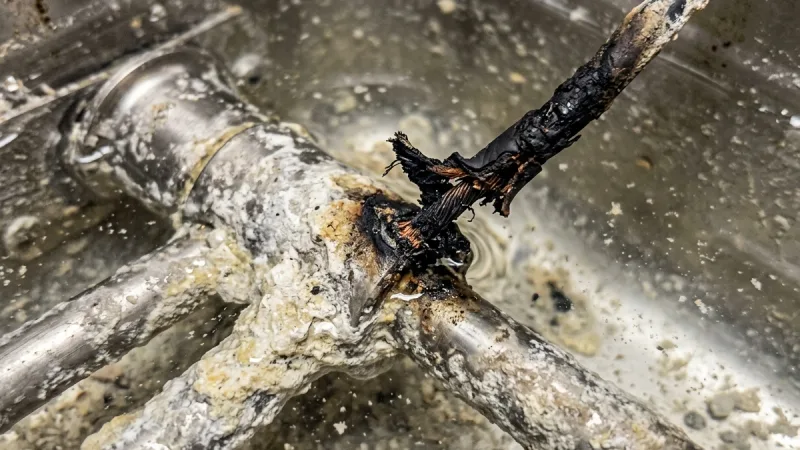
Diagnostic Procedure: Senior master commercial technician dispatched under a 42-minute emergency window to South Main Street. Inspection of the rinse booster tank revealed the built-in 9kW immersion heating element had suffered severe calcification due to untreated 14-grain North Fulton water hardness. Using a Fluke 87V True-RMS multimeter, electrical testing across the delta-wound 208V heating element terminals revealed an open-circuit blowout on two elements (OL resistance) and a dead short to ground on the third leg, which had simultaneously tripped the manual-reset 210°F high-limit thermal switch.
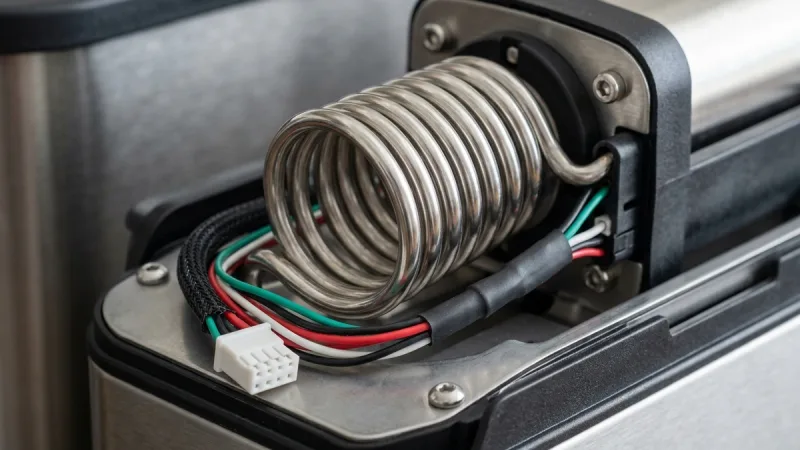
Corrective Restoration: Technician completely drained the 6-gallon booster tank, safely extracted the calcified element, and installed a brand-new factory OEM Champion Incoloy Booster Element (#111746) paired with a new high-temperature EPDM flange gasket (#109985) and high-limit cut-off thermostat (#109069). After replacing the components and re-energizing the machine, line currents were balanced at 25.0 Amps per phase. Digital probe testing verified final rinse water entering the upper and lower wash manifold at a rock-solid 182.4°F.
Outcome: 182.4°F Sanitizing Rinse Verified • Passed Health Inspection Re-Check
Full 90-Day Parts & Labor Warranty Active
Table of Contents: Champion Commercial Dishwasher Diagnostic Guide
- Introduction: NSF Sanitization Mandates in North Fulton Dining Establishments
- Symptoms of Booster Heater & Rinse Temperature Failure
- Visual Before & After Restoration Showcase
- In-Depth Engineering Causes: Calcification, Contactors & High-Limit Trips
- Step-by-Step Operator Troubleshooting & Inspection Safety Checks
- When to Stop DIY: 208V/480V 3-Phase Electrical Hazards & Health Code Violations
- Commercial Decision Matrix: Repairing vs. Replacing Door-Type Dishwashers
- Interactive Instant Commercial Dishwasher Repair Cost Calculator
- Estimated Cost Factors in North Fulton Commercial Facilities
- How Master Warewashing Technicians Diagnose: Multimeter & Telemetry Lookup
- Critical OEM Replacement Parts Catalog
- Preventative Maintenance & Booster Tank Descaling Protocols
- Commercial Kitchen High-Voltage & Scalding Safety Protocols
- Frequently Asked Questions (18 Technical FAQs)
- Related Commercial Kitchen Services & North Fulton Corridors
- Master Key Takeaways for General Managers
- Commercial Emergency Service Dispatch CTA
Introduction: NSF Sanitization Mandates in North Fulton Dining Establishments
In the culinary landscape of Alpharetta, Georgia, from the vibrant bistros of Downtown City Center to upscale dining rooms along Avalon Boulevard, commercial dishwashers are the bedrock of operational hygiene. Health departments enforce rigorous standards: high-temperature commercial dishwashers must achieve a minimum 180°F (82°C) final sanitizing rinse to guarantee complete pathogen elimination without chemical sanitizers. When a booster heater falters, warewashing halts immediately, creating dishware shortages that cripple front-of-house service. For reliable repairs, our certified team provides commercial appliance repair across North Fulton County.
Champion door-type dishwashers, notably the DH-5000, DH6000, and 44 PRO series, are engineered for extreme durability, processing up to 60 racks per hour. These machines feature an integrated or external electric booster heater capable of elevating building supply water from 140°F to the required 180°F in just seconds. However, intense duty cycles, electrical contactor pitting, and hard water mineral scale can compromise this thermal system. Operators needing rapid warewashing diagnostics can count on our specialized dishwasher repair services to keep wash operations running smoothly.
Located in the heart of Alpharetta, our emergency dispatch units respond rapidly to equipment emergencies. When your commercial dishmachine flags an insufficient rinse temperature alert, turn to our local specialists for appliance repair Alpharetta GA to ensure full compliance before your next health audit.
Symptoms of Booster Heater & Rinse Temperature Failure
Identifying booster heater degradation early protects commercial kitchens from health inspection shutdowns and electrical damage. Modern Champion machines feature digital temperature readouts on the control facia that immediately signal temperature deviations. Kitchen supervisors should arrange for same-day appliance repair upon observing any of the following symptoms:
- Rinse Gauge Displaying Below 180°F: During the active 10-to-12 second final rinse cycle, the analog or digital rinse thermometer peaks at only 130°F–150°F, indicating zero heat addition from the booster element.
- Failed Thermal Label Strip Tests: Single-use irreversible adhesive temperature test strips placed on test plates fail to change color to black (indicating failure to achieve the required 160°F plate surface temperature).
- Extended Wash Cycle Lockout: In machines equipped with Champion’s automatic temperature interlock feature, the machine remains stuck in the wash cycle, refusing to advance to rinse because the booster tank has not achieved 180°F.
- Tripping Dedicated Booster Circuit Breakers: The facility branch circuit breaker trips instantly upon the dishmachine entering the rinse phase, indicating an immersion element shorted to ground.
- Water Leaking from Booster Flange: Deteriorated EPDM flange gaskets allow hot scalding water to seep onto electrical terminal blocks beneath the tank, causing arcing and smoke.
- Excessive Dish Drying Times: Plates emerge wet and require manual towel drying (a health code violation) because the absence of 180°F flash-drying heat prevents immediate self-evaporation, necessitating emergency appliance repair.
Visual Before & After Restoration Showcase
In-Depth Engineering Causes: Calcification, Contactors & High-Limit Trips
An electric commercial dishwasher booster heater is subject to extreme thermal and chemical stresses. While kitchen staff focus on cooking equipment and commercial oven repair routines, booster heaters operate hidden inside or beneath the dishmachine frame under high pressure and intense electrical currents.
A. Extreme Mineral Scale (Limescale) Encrustation
In North Fulton County, municipal water supplies deliver moderate-to-hard mineral content. As water inside the booster tank is heated above 140°F, dissolved calcium and magnesium ions precipitate out of solution, coating the Incoloy element sheaths with a dense crystalline crust. This scale layer acts as an intense thermal insulator. The heat generated within the nichrome resistance wire cannot dissipate into the surrounding water, driving element core temperatures beyond 1,600°F until the metal sheath fractures or melts, creating an open circuit.
B. Pitted or Welded Electrical Contactor Contacts
The high-amperage 3-pole electrical contactor controls line power to the booster element, cycling on and off dozens of times every hour. Over tens of thousands of cycles, high-voltage electrical arcing pits the silver-cadmium contact pads. If carbon buildup prevents contact closure on even one pole, the delta-wound heating element loses a phase, dropping heat output by more than 50%. In severe cases, contacts weld closed, causing element dry-fire or overheating that trips the safety circuits.
C. Tripped or Defective Manual High-Limit Cut-Off Switch
Champion booster tanks incorporate a factory-calibrated manual-reset high-limit thermal switch designed to cut all control power if tank temperatures exceed 210°F. Scale buildup around the capillary bulb can trap localized steam, causing false tripping. Once tripped, the booster heater will never energize until the red reset button is manually depressed and the underlying overheating condition is remedied.
D. Defective Temperature Control Thermostat or Thermistor Probe
The electronic control module monitors booster tank water via a solid-state NTC thermistor probe or hydraulic thermostat bulb. If calcium deposits insulate the probe, or if internal electrical resistance drifts out of factory calibration, the control board assumes the water is at 180°F when actual water temperature is barely 140°F, preventing the contactor from closing.
Advanced Electrical Engineering & 3-Phase Booster Power Delivery
In high-demand Alpharetta restaurants operating during peak dinner services, a Champion DH-5000 or DH6000 door-type dishwasher processes a fresh rack of dinnerware every 60 seconds. Each rack requires approximately 0.9 to 1.2 gallons of 180°F final sanitizing rinse water delivered through calibrated hydraulic spray nozzles during an intensive 10-to-12-second rinse burst. Elevating incoming municipal hot water from 140°F to 180°F at high flow rates requires immense electrical power—typically 9.0 kW for standard installations and up to 12.0 kW to 18.0 kW for cold-water feed installations with a 70°F thermal rise.
On a standard 208V / 240V 3-phase commercial service, the 9kW Incoloy heating element is wired in a balanced Delta electrical configuration. By applying Ohm’s Law and 3-phase power calculations (Power = √3 × Voltage × Current × Power Factor), a functional 9kW element at 208V draws approximately 25.0 Amperes per phase line. Each of the three individual immersion resistance coils inside the triple-loop element flange must dissipate exactly 3,000 Watts of thermal energy across its metal surface area. When mineral scale encrusts these coils, heat dissipation drops precipitously, elevating sheath internal temperatures beyond metallurgical tolerance limits until the nichrome filament ruptures.
Furthermore, the electrical contactor governing the booster heater must withstand tremendous inductive and resistive electrical stress. Switching 25 to 30 Amps of current on and off up to 60 times per hour generates intense electrical arcs across the contact pads. Over months of heavy operation, silver-cadmium contact material erodes and forms high-resistance carbon deposits. If a single pole of the contactor develops contact resistance above 0.5 ohms, line current across that phase drops significantly. The booster element enters an unbalanced “single-phasing” failure mode where only two legs receive voltage, reducing total thermal output by more than 50% and preventing the water from ever reaching 180°F.
Additionally, hydraulic pressure regulation plays a pivotal role in final rinse temperature compliance. Champion dishwashers rely on an integrated or external water pressure reducing valve (PRV) calibrated to maintain dynamic flow pressure at exactly 20 PSI (±2 PSI) during active spraying. If facility water pressure fluctuates or the PRV diaphragm wears out, line pressures exceeding 30 PSI force water through the 6-gallon booster tank at excessive velocities. The residence time of water inside the heated chamber becomes insufficient for complete heat absorption, causing rinse temperatures to drop into the non-compliant 160°F range even when electrical heating elements are operating at 100% capacity.
Step-by-Step Operator Troubleshooting & Inspection Safety Checks
Commercial kitchen operators and facility maintenance managers can conduct several safe, non-invasive troubleshooting steps before calling a technician. Food service teams accustomed to managing diverse kitchen appliances can apply systematic diagnostic principles similar to those used in commercial refrigerator repair checks.
- Verify Building Incoming Hot Water Supply Temperature: Commercial dishwashers equipped with standard 40°F-rise booster heaters require incoming supply water of at least 140°F. Check the facility water heater gauge; if incoming water drops below 130°F, the booster cannot elevate rinse water to 180°F during short cycle windows.
- Check Dynamic Water Flow Pressure: Inspect the water pressure gauge during active rinse flow. Champion dishmachines require dynamic flow pressure between 20 PSI (±5 PSI). Pressures above 25 PSI force excessive water volume through the booster too quickly to achieve full thermal rise.
- Inspect the High-Limit Reset Button: With electrical power switched completely OFF at the main breaker, locate the high-limit switch access port and verify whether the red manual reset pin has popped outward. Press firmly until a distinct click is felt.
- Examine the Final Rinse Spray Nozzles: Unscrew upper and lower rinse arms and inspect the brass or stainless spray nozzles for calcium blockage. Clogged nozzles restrict flow, skewing tank temperature readings and creating poor spray distribution.
E. Exhaust Hood Makeup Air & Cross-Draft Temperature Interference
An often-overlooked environmental failure mode in high-volume Alpharetta commercial kitchens is the aerodynamic relationship between the dishmachine and the dedicated Type-II condensate exhaust hood mounted directly overhead. Champion door-type dishwashers discharge substantial volumes of moist vapor when the hood canopy operates. However, if the kitchen’s dedicated makeup air (MUA) system is improperly balanced, negative building pressure pulls high-velocity ambient drafts directly across the open wash cavity during door cycling. In colder winter months or heavily air-conditioned kitchens, these cross-drafts rapidly cool the stainless steel tank interior, increasing thermal losses by up to 35% and forcing the booster heater to cycle continuously. Our technicians utilize digital thermal anemometers to measure hood capture velocity (verifying nominal 50 to 75 FPM face velocity) and ensure mechanical drafts do not compromise wash water temperature stability.
Additionally, electrical service line voltage fluctuations across North Fulton power grids can create subtle heating degradation. Commercial electrical infrastructure frequently experiences voltage drops during summer peak-cooling periods. Because electrical heating element wattage follows a square-law relationship with voltage (( P = frac{V^2}{R} )), a modest 5% drop in nominal supply voltage from 208V down to 198V results in a nearly 10% loss of thermal heating capacity. A 9.0kW element effectively produces only 8.1kW of heat, prolonging water heat-up intervals and triggering premature cycle timeout warnings. Our diagnostic protocol includes full RMS load logging under maximum facility demand to differentiate between utility power droop and internal component deterioration.
When to Stop DIY: 208V/480V 3-Phase Electrical Hazards & Health Code Violations
Commercial warewashers operate under extreme 3-phase electrical voltages (208V, 240V, or 480V) capable of delivering fatal electrocution and arc flash blasts. Attempting untrained electrical troubleshooting or bypassing safety limits creates severe liabilities. When basic checks fail, contact seasoned commercial kitchen pros serving appliance repair Roswell GA and nearby cities.
Cease operator troubleshooting immediately if:
- Live Electrical Panel Testing is Required: Measuring 480V 3-phase line current requires NFPA 70E compliance, Category III PPE, and certified test instruments.
- Immersion Element Flange Extraction is Needed: Draining pressurized booster tanks and breaking flange seals risks scalding burns from 190°F residual water and steam.
- Breaker Trips Repeatedly: Resetting a high-amperage breaker multiple times against an element shorted to ground can cause catastrophic electrical panel busbar explosion.
- Persistent Failure to Meet NSF 180°F: Operating a commercial dishmachine below sanitizing temperature violates Georgia Department of Public Health Chapter 511-6-1 regulations, risking immediate facility shutdown.
Commercial Decision Matrix: Repairing vs. Replacing Door-Type Dishwashers
Determining whether to overhaul an aging Champion warewasher or commission a new high-efficiency unit depends on tank structural integrity, control complexity, and repair history. Operators in Johns Creek frequently consult our appliance repair Johns Creek GA specialists to make data-driven capital investment decisions.
| Component / Failure Mode | Machine Age | Estimated Repair Cost | Recommended Action | Strategic Business Justification |
|---|---|---|---|---|
| Incoloy Booster Element Replacement (#111746) | 2–8 Years | $380 – $580 | Immediate Repair | OEM element replacement restores 100% heating efficiency at under 5% of replacement machine cost. |
| Heavy-Duty 3-Pole Contactor Replacement | 3–9 Years | $240 – $360 | Immediate Repair | Restores reliable phase power and prevents secondary element burnouts. |
| Complete Stainless Booster Tank Rupture | 9–14+ Years | $1,800 – $2,400 | Replace Machine | Catastrophic tank rupture indicates extensive structural corrosion; new ENERGY STAR machine offers superior ROI. |
Interactive Instant Commercial Dishwasher Repair Cost Calculator
Estimated Cost Factors in North Fulton Commercial Facilities
Repair costs for commercial dishwashers in Alpharetta and surrounding communities reflect several technical parameters. Managing a commercial kitchen often involves coordinating across various refrigeration and hot-side assets, including commercial refrigeration repair systems to ensure balanced utility distribution.
Key cost factors include:
- Element Kilowatt Rating and Voltage Configuration: Higher wattage elements (e.g. 12kW or 18kW 480V units) utilize heavy Incoloy sheathing that commands higher component pricing than residential-grade parts.
- Scale Buildup Severity & Extraction Difficulty: Severely calcified booster elements often fuse to tank collars, requiring mechanical extraction, acid soaking, and flange thread tapping.
- Dual Phase / Voltage Compatibility: Converting equipment between 208V and 240V requires verifying jumper links on heating elements to avoid rapid burnouts.
- Emergency Response Timelines: Same-day priority dispatch guarantees arrival within 45 to 90 minutes to avert mandatory health closures.
How Master Warewashing Technicians Diagnose: Multimeter & Telemetry Lookup
When our certified warewashing technicians evaluate a Champion machine in Alpharetta, diagnostics are guided by precision instrumentation. Every electrical, thermal, and hydraulic parameter is verified against factory engineering tolerances. Commercial kitchens in Milton trust our appliance repair Milton GA specialists for identical technical excellence.
| Component Monitored | Test Instrument | Nominal Factory Spec | Failure Range (Fault) | Immediate Corrective Action |
|---|---|---|---|---|
| 9kW Booster Heating Element | Digital Multimeter (Ohms Ω) | 12.4 – 13.2 Ω (240V 3-Ph) | OL (Open) or 0.00 Ω (Grounded Short) | Replace Incoloy Heating Element (#111746) & Gasket |
| Manual High-Limit Safety Switch | Continuity / DMM Ohms | < 0.2 Ω (Closed below 210°F) | OL (Tripped/Open at room temp) | Depress reset button; replace switch if non-responsive |
| Booster Power Contactor (3-Pole) | True-RMS Clamp Meter (Amps) | 21.6 – 25.0 Amps per Phase | 0 Amps on 1+ Phases / Severe Pitting | Replace 40A Contactor & Inspect Auxiliary Contacts |
| Rinse Temperature Sensor Probe | Resistance Table / DMM | 10.0 kΩ at 77°F (25°C) | Resistance drift > 10% out of calibration | Install OEM Champion Thermistor Probe (#111874) |
| Rinse Water Pressure Reducing Valve | Liquid-Filled Pressure Gauge | 20 – 22 PSI Dynamic Flow | < 15 PSI (Starved) or > 30 PSI (Flooding) | Adjust pressure regulator screw; replace PRV cartridge |
Advanced Electrical Vectors, Phase Balance & Heat Transfer Equations
To achieve absolute technical mastery over commercial high-temperature dishwashers, commercial kitchen technicians must analyze the thermodynamic heat transfer equation governing water flowing through the booster tank: ( Q = dot{m} cdot C_p cdot Delta T ). In this governing relationship, ( Q ) represents the thermal heat input in British Thermal Units per hour (BTU/hr) or kilowatts (kW), ( dot{m} ) is the mass flow rate of water in pounds per hour, ( C_p ) is the specific heat capacity of water (1.00 BTU/lb·°F), and ( Delta T ) is the required temperature rise from 140°F incoming supply to 180°F final sanitizing rinse (ΔT = 40°F).
For a Champion DH-5000 processing 60 racks per hour at 0.9 gallons per rack, the dynamic water demand during active rinse bursts reaches 4.5 to 5.5 gallons per minute (GPM). Converting this flow rate to thermal requirements demonstrates why an operational 9kW booster element (delivering approximately 30,700 BTU/hr) is operating at its maximum thermodynamic limit. When mineral scale encrusts the heating element sheath, the conductive heat transfer coefficient (( k )) drops from 30 BTU/(hr·ft·°F) for clean Incoloy down to less than 0.8 BTU/(hr·ft·°F) for dense calcium carbonate ((text{CaCO}_3)). The equation for thermal conduction through a composite cylindrical layer reveals that even a 1/16-inch scale layer requires an internal wire core temperature of over 1,450°F just to maintain 180°F water at the boundary, rapidly triggering filament rupture.
Furthermore, electrical diagnostics must extend beyond basic continuity checks to full phase-to-phase vector voltage balance testing. On a 208V 3-phase Delta supply, line currents across Phase A-B, Phase B-C, and Phase C-A must remain balanced within ±5%. A current unbalance exceeding 10% indicates premature contactor contact resistance or high-impedance thermal degradation within one of the three internal element coils. Technicians utilize calibrated true-RMS clamp meters to verify that each phase leg pulls exactly 25.0 Amps (±1.2A). Measuring voltage drop across closed contactor poles under load must reveal less than 0.15 VAC; any drop above 0.3 VAC indicates pitted contact pads that require immediate 40A contactor replacement to safeguard the new heating element from phase failure.
In addition, hydraulic pressure regulation across the vacuum breaker and spray manifold directly governs sanitizing efficacy. Champion engineers specify a dynamic flow pressure of 20 PSI (±2 PSI). If the building’s domestic water pressure fluctuates above 25 PSI, water moves through the booster chamber with excessive velocity, reducing dwell time below the minimum threshold required for 40°F thermal absorption. Conversely, dynamic pressures below 15 PSI fail to produce the calibrated mechanical spray shear necessary to strip remaining soil residues from plate surfaces, leading to cloudy glassware and failed health inspection audits.
Critical OEM Replacement Parts Catalog
We stock only genuine OEM Champion warewashing parts on every dispatch vehicle to guarantee exact factory fit, electrical compliance, and extended service life. Our comprehensive inventory also includes cooking hardware replacements for oven and range repair to provide total commercial kitchen coverage.
- Champion 9kW / 12kW Incoloy Booster Element (#111746): High-grade Incoloy sheath construction offering superior resistance to chlorine stress-corrosion cracking and hard water scale adhesion.
- High-Temperature Booster Flange Gasket (#109985): Formulated from heat-resistant EPDM rubber rated to 250°F to eliminate water leakage onto electrical connections.
- Manual-Reset High-Limit Thermal Switch (#109069): 210°F trip threshold with remote capillary sensor tube for instant boil-over prevention.
- Heavy-Duty 40-Amp 3-Pole Contactor (#109132): Encapsulated 120VAC coil with silver-alloy contacts designed for 250,000 continuous mechanical cycles.
- Stainless Steel Water Level Float Switch (#111389): Magnetic reed float assembly preventing booster element energization until the tank is 100% full of water.
Preventative Maintenance & Booster Tank Descaling Protocols
Preventative maintenance protects commercial dishwashers from sudden failure during dinner service. We recommend this standard maintenance routine every 90 to 180 days:
- Execute Chemical Booster Tank Deliming: Introduce commercial-grade phosphoric or sulfamic acid delimer directly into the booster fill port. Circulate and soak for 30 minutes to dissolve mineral scale around element coils.
- Flush and Inspect Drain Valves: Open the booster tank drain petcock and thoroughly flush out loosened calcium grit and sediment chunks to prevent nozzle clogs.
- Inspect Electrical Terminals for Thermal Discoloration: Torque all electrical element terminals to factory specifications (35 in-lbs) and inspect wires for brittle insulation.
- Test Water Softener Hardness Levels: Verify facility water softeners maintain incoming hardness below 3 grains per gallon (GPG).
Commercial Kitchen High-Voltage & Scalding Safety Protocols
Safety is non-negotiable when dealing with 480V electricity and 180°F pressurized water. Technicians and operators must enforce:
- Lockout/Tagout (LOTO): De-energize high-voltage disconnect boxes and apply padlocks before removing booster service panels.
- Pressure Relief & Depressurization: Allow booster tanks to cool below 100°F and manually release pressure via the boiler drain valve before removing heating element flange bolts.
- NSF Hygiene Verification: Run three consecutive wash cycles following chemical deliming to purge all residual acid before washing food-contact dinnerware.
Frequently Asked Questions: Champion Commercial Dishwasher Booster Diagnostics
Q1: What is the legal NSF minimum temperature for a commercial high-temp dishwasher final rinse?
Under NSF/ANSI Standard 3 and Georgia Public Health Food Code, a commercial high-temperature stationary rack door dishwasher must achieve a minimum final rinse temperature of 180°F (82°C) at the manifold, ensuring that dish surfaces reach at least 160°F (71°C) for thermal sanitization. Temperatures below 180°F represent an immediate health code violation.
Q2: Why does my Champion dishwasher get stuck in the wash cycle and never advance to rinse?
Champion dishwashers are equipped with a “Thermostop” or temperature interlock feature. To guarantee that dishware is never rinsed with cool water, the control timer pauses the cycle until the booster heater reaches 180°F. If the heating element is burned out or the high-limit switch is tripped, the machine remains locked in wash mode indefinitely.
Q3: What causes a commercial dishwasher heating element to burn out?
The leading cause of element burnout is heavy mineral scale (calcium carbonate) encrustation. Scale forms an insulating barrier that traps heat inside the element sheath, driving core temperatures beyond 1,600°F until the internal nichrome resistance wire melts. The second leading cause is “dry firing,” which occurs when an element energizes without being fully submerged in water.
Q4: How many ohms should a good Champion 9kW booster element read?
When isolated from power and tested with a digital multimeter across its three terminals, a functional 9kW 208/240V delta-connected element should measure approximately 12.4 to 13.2 ohms between each leg. An open reading (OL / infinite resistance) indicates a blown element coil.
Q5: Where is the high-limit reset button located on a Champion door dishwasher?
On Champion DH-5000 and DH6000 models, the manual high-limit reset switch is typically located behind the lower front kick panel, mounted directly to the side or bottom flange of the booster heater tank. It is identifiable by a small red push-button.
Q6: Can I run a high-temp dishmachine with 120°F incoming water?
Most commercial high-temp dishwashers come equipped with a 40°F-rise booster heater designed to raise water from 140°F to 180°F. If incoming water is only 120°F, the booster can only reach 160°F during normal cycle times, resulting in cycle pauses or sanitization failure. A special 70°F-rise booster is required for 110°F–120°F incoming water.
Q7: What does a tripped booster heater breaker indicate?
If the breaker trips immediately when the machine enters the rinse cycle, one or more heating elements has ruptured its metal sheath, allowing water into the core and causing a direct dead short from line voltage to the grounded stainless tank.
Q8: How often should I delime my commercial dishwasher booster tank?
In Alpharetta and North Fulton, chemical deliming should be performed once every 3 to 6 months depending on water hardness and daily rack volume. Facilities without dedicated commercial water softeners should delime monthly.
Q9: Why are my glasses coming out spotty or cloudy?
Spotting occurs when rinse water temperature is too low to promote rapid flash evaporation, when rinse aid dispensers are empty or unprimed, or when mineral TDS levels in the final rinse water exceed acceptable thresholds.
Q10: What is the difference between high-temp and low-temp commercial dishwashers?
High-temp machines use 180°F hot water to thermally sanitize dishes without chemicals, resulting in fast flash drying. Low-temp machines wash and rinse at 120°F–140°F and rely on chemical sanitizers (like chlorine) to kill bacteria, which can leave odors and require longer air drying.
Q11: Can a faulty contactor cause uneven heating?
Yes. If electrical arcing pits or burns one set of contact points on a 3-pole contactor, line voltage cannot reach that phase of the heating element. The element operates in “single-phase” mode, producing less than half its rated wattage and failing to maintain 180°F.
Q12: How long does it take to replace a commercial booster element?
With genuine OEM parts on hand, an experienced commercial warewashing technician can drain the booster tank, extract the failed element, install a new Incoloy element and gasket, refill the tank, and test calibration in approximately 60 to 90 minutes.
Q13: Why is water leaking from the bottom of my booster heater?
Water leaks typically originate from a deteriorated rubber flange gasket beneath the heating element collar or thermal stress fractures in the tank welds. Operating with an active leak risks short-circuiting electrical terminals and causing catastrophic board failure.
Q14: Do you offer same-day emergency warewasher repairs in Alpharetta?
Yes. We provide 45-to-90 minute emergency response dispatch across Alpharetta, Milton, Roswell, and Johns Creek, with service vans stocked with OEM Champion elements, contactors, thermostats, and gaskets.
Q15: What warranty do you provide on booster heater repairs?
All commercial warewasher repairs completed by our certified technicians include our full 90-Day Parts & Labor Warranty. If any replaced OEM component fails within 90 days, we repair or replace it at zero additional cost.
Q16: Can I use generic aftermarket heating elements on my Champion dishmachine?
We strictly advise against aftermarket generic elements. Genuine OEM Champion elements feature proprietary Incoloy alloy metallurgy engineered to withstand extreme chlorine exposure and thermal shocks without cracking or voiding your NSF certification.
Q17: What should I do if the health inspector flags my dishmachine for low temperature?
Immediately transition warewashing to your 3-compartment sink setup with chemical sanitizing test strips to remain compliant. Call our emergency dispatch line at (770) 796-7742 for expedited same-day booster heater restoration and formal health re-inspection documentation.
Q18: What is dynamic flow pressure and why does it matter?
Dynamic flow pressure is the water pressure measured while water is actively flowing through the rinse nozzles (nominal 20 PSI). If dynamic pressure is too low, rinse spray fails to cover the dish rack; if too high, water moves across the booster heater too quickly to achieve 180°F.
Related Commercial Kitchen Services & North Fulton Corridors
Commercial Cooking Equipment
Ranges, conveyor ovens, combi-steamers, and deep fryers.
Walk-In Coolers & Ice Makers
Defrost timers, evaporator fans, and ice machine harvest repairs.
Alpharetta Service Hub
Downtown Alpharetta, Avalon, Windward Parkway, and North Point.
Emergency Kitchen Response
Rapid 45-to-90 minute emergency dispatch across North Fulton.
Master Key Takeaways for General Managers
- 180°F Final Rinse is Legally Mandated: Never operate a high-temp dishmachine below 180°F; failing thermo-strips warrant immediate service.
- Scale Buildup Kills Elements: Hard water minerals insulate immersion elements, causing rapid burnout; routine deliming is vital.
- Check Contactors and Phase Balance: Pitted contactors starve elements of 3-phase line current, dropping heat output by over 50%.
- Inspect High-Limit Safety Switches: Manual 210°F switches cut power during overheat events; professional resets prevent repeated trips.
- Same-Day Dispatch Protects Revenues: Call our Alpharetta technicians for 45–90 minute arrival and guaranteed 90-day warranty coverage.