
When a high-volume restaurant, corporate dining facility, or catering kitchen along Old Milton Parkway Restaurant Row experiences an unexpected thermal breakdown with a Hatco heated holding cabinet, back-of-house operations face immediate crisis. Foodservice holding equipment—particularly the Hatco Flav-R-Savor, Flav-R-Fresh, and heavy-duty FSHC series—serves as the critical operational bridge between peak culinary cooking cycles and customer plate presentation. When internal cabinet temperatures slip beneath the federally mandated 140°F safe hot-holding threshold due to a fractured tubular incoloy air heating element, a pitted infinite heat switch, or a tripped manual-reset high-limit thermostat, commercial kitchens face rapid food spoilage, delayed service tickets, and severe health code non-compliance penalties. Relying on experienced appliance repair in Alpharetta, GA ensures that your commercial holding assemblies are evaluated by certified master technicians who understand high-volume culinary velocity and local health regulations.
Quick Answer: How to Fix a Hatco Commercial Holding Cabinet That Is Not Heating
A Hatco commercial holding cabinet fails to heat primarily due to a tripped manual-reset high-limit thermostat, a burned open tubular incoloy air heating element, or defective internal contact points within the infinite heat control switch. To diagnose the system: isolate incoming electrical power, verify that the red manual reset button on the high-limit switch has not popped, and measure electrical telemetry using a calibrated True-RMS multimeter. A functioning 120V or 208V tubular incoloy air element must measure approximately 18.5Ω across its terminal studs, the infinite heat switch contacts must demonstrate less than 0.2Ω closed resistance, and the high-limit switch must exhibit zero ohms continuity. Any open-circuit (∞ Ω) or ground short requires immediate factory OEM component replacement. For emergency restaurant assistance in Alpharetta, contact our certified dispatch desk directly at (770) 796-7742.
Listen to 60-Second Hatco Holding Cabinet Diagnostic Summary
Narrated by Jason J. (Master Certified Commercial Foodservice Specialist)
Check Same-Day Commercial Tech Availability in Alpharetta & North Fulton
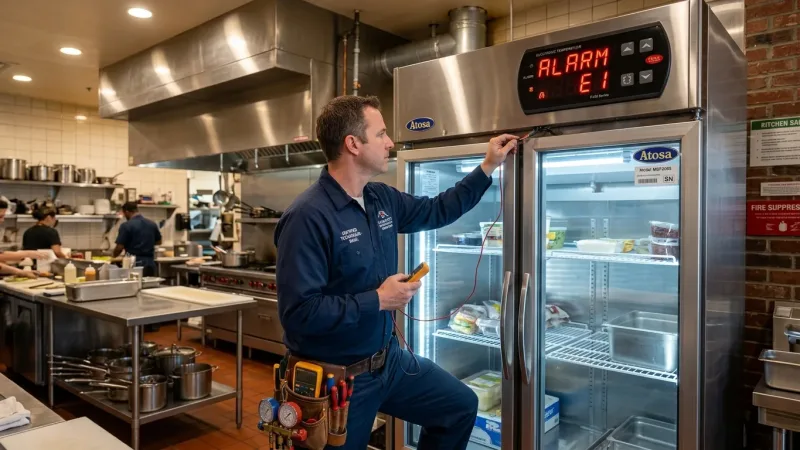
Recently Serviced on Old Milton Parkway Restaurant Row
Hatco Flav-R-Savor FSHC-6W Holding Cabinet Heating Element & Infinite Switch Restoration • Verified 5.0 ★★★★★
Hatco FSHC Series Heated Holding Cabinet Emergency Diagnostic & OEM Component Restoration
Old Milton Parkway Restaurant Row, Alpharetta, GA 30009
90-Day Commercial Parts & Labor Warranty Active
High-Volume Fast-Casual Dining Establishment
Internal cavity failing to reach holding temp; cabinet cold while blower runs
Element open circuit (∞ Ω), switch contacts pitted at 4.8Ω, high limit tripped
Hatco R02.05.018.00 Incoloy Element & R02.19.008.00 Infinite Switch
Field Execution Narrative: At 11:15 AM on a Friday morning ahead of the weekend lunch rush, the general manager of a premier dining venue on Old Milton Parkway contacted our emergency dispatch center. The primary Hatco FSHC-6W mobile heated holding cabinet had plummeted to 98°F, threatening two sheet pans of prepared proteins with critical health code disposal. Lead commercial technician Jason J. was dispatched and arrived on site within 48 minutes with a fully equipped mobile repair unit. Following OSHA Lockout/Tagout protocols, electrical access panels were removed to expose the lower heating plenum. True-RMS digital multimeter testing identified an open circuit (∞ Ω) across the tubular incoloy air heating element and severe contact arcing on the infinite heat switch with 4.8Ω resistance (exceeding the 0.2Ω threshold). Additionally, the secondary manual-reset high-limit thermostat had tripped due to localized thermal buildup caused by grease vapor accumulation on the lower chassis baffle. The technician installed an authentic factory OEM Hatco 120V incoloy air element, calibrated the infinite heat switch, reset the high-limit thermostat, dressed the heat-resistant nickel-plated fiberglass lead wires, and re-secured the convection plenum. Full operational verification achieved a stable 165°F holding temperature within 22 minutes, passing thermal profiling and ensuring 100% health department compliance before the midday lunch rush.
Table of Contents: Engineering Diagnostic Guide
- Engineering Overview & Thermal Dynamics
- Operational Symptoms of Heating Failure
- Visual Before & After Component Restoration
- Common Root Causes of Electrical Breakdown
- Step-by-Step Diagnostic Protocol for Operators
- Commercial Safety Limits & Stopping Criteria
- Repair vs. Replace Decision Matrix (50% Rule)
- Interactive Repair Cost Estimator Widget
- Key Factors Influencing Commercial Repair Costs
- Multimeter Telemetry & Ohms Lookup Table
- Core Electrical & Mechanical Components
- Preventative Maintenance & De-Liming Protocol
- Electrical Safety & Georgia Health Code Compliance
- Frequently Asked Questions
- Related Commercial Services & Local Coverage
- Key Operational Takeaways for Managers
- Emergency Commercial Tech Dispatch Hotline
Engineering Overview: Thermal Dynamics of Commercial Hatco Heated Holding Cabinets
In heavy-duty foodservice production environments across North Fulton County, commercial kitchen appliances operate under rigorous duty cycles that would rapidly destroy standard residential hardware. Our dedicated commercial appliance repair team specializes in resolving critical holding failures on Hatco Corporation systems, including the versatile Flav-R-Savor humidified holding units, compact Flav-R-Fresh merchandisers, and high-capacity FSHC roll-in holding cabinets. Unlike basic domestic warming drawers or standard commercial dry warmers, Hatco commercial cabinets utilize a precision-engineered forced-air convection airflow loop engineered to circulate uniform sensible heat throughout every gastronorm pan tier without creating localized hot spots or desiccating delicate food surfaces.
When managing complex culinary production lines that integrate high-output equipment like commercial ovens and ranges, kitchen workflow collapses if holding equipment fails. The core thermal engine inside a Hatco holding cabinet comprises an industrial-grade tubular incoloy air heating element, a shaded-pole or permanent split capacitor convection blower motor, and an electro-mechanical temperature regulation circuit. In humidified configurations, this system is supplemented by an auxiliary immersion heating element submerged within a stainless steel water sump pan. Incoloy—a specialized superalloy composed of nickel, chromium, and iron—is chosen specifically for air heating elements due to its extraordinary resistance to high-temperature oxidation, carburization, and thermal fatigue under continuous commercial duty cycles.
When kitchen managers require immediate intervention, scheduling same-day appliance repair ensures that thermal diagnostics begin before prepared food stocks spoil. High-duty cycle kitchen equipment on Old Milton Parkway often operates 14 to 18 hours per day in ambient kitchen temperatures exceeding 90°F. Over thousands of operational hours, the physical thermal expansion and contraction cycles of the incoloy sheath, combined with the microscopic contact wear inside bimetallic infinite heat switches, inevitably lead to electrical resistance drift, insulation breakdown, and complete thermal shutdown. Understanding the exact electro-mechanical architecture of your Hatco holding cabinet is the first line of defense against costly foodservice downtime.
Operational Symptoms of Hatco Heated Holding Cabinet Failure
Recognizing early operational degradation within a Hatco holding cabinet allows kitchen managers to schedule targeted preventative repair before an outright catastrophic line stoppage requires emergency appliance repair during peak dinner rush. Commercial holding cabinets exhibit several distinct electro-mechanical and thermal warning signs when heating subassemblies begin to degrade:
- Cavity Temperature Fails to Exceed Ambient or 120°F: The convection blower motor hums and air circulates through the interior ductwork, but the air streams feel lukewarm or completely cold to the touch. The internal dial or digital thermometer remains stalled well below the mandatory 140°F holding threshold.
- Heating Pilot Indicator Light Remains Dark: When rotating the infinite heat switch or thermostat dial from OFF to the maximum setting, the amber or red heating indicator lamp fails to illuminate, indicating an open circuit upstream in the control loop or a blown pilot lamp resistor.
- Heating Indicator Stays Lit Continuously Without Temperature Rise: The control indicator lamp illuminates steadily, indicating that the thermostat switch is closing its contact poles, yet the incoloy element remains stone cold. This symptom points directly to an open circuit or burned terminal stud on the heating element itself.
- Frequent Tripping of the Manual Reset High-Limit Button: Kitchen staff must repeatedly depress the red mechanical reset button on the rear or lower control chassis to restore heat. This condition indicates restricted convective airflow, a seized blower fan, or decalibrated high-limit bimetallic contacts.
- Subpanel Breaker or GFCI Tripping Immediately Upon Power-On: Engaging the main rocker switch instantly trips the dedicated 15A or 20A commercial circuit breaker. This confirms an insulation breakdown inside the incoloy heating element, allowing line voltage to short to the grounded stainless steel cabinet chassis.
- Erratic Temperature Swings & Overcooking: Food products dry out rapidly or scorch because the cabinet overheats past 200°F, indicating that the infinite heat switch or capillary thermostat contacts have welded shut in a continuous closed circuit condition.
- Acrid Odors of Burning Phenolic Plastic or Wire Insulation: Localized high-resistance connections at the spade terminal connections generate extreme resistive heating, melting the vinyl or fiberglass sleeving and emitting recognizable ozone or burning electrical odors.
Visual Before & After Restoration Showcase
Commercial foodservice equipment subjected to thousands of continuous hours of high-temperature duty experiences severe microstructural degradation. Below is a macro photographic comparison from a recent emergency service call along Old Milton Parkway, illustrating the physical contrast between an electrically burned incoloy air heating element and a gleaming, factory-calibrated OEM replacement assembly:
Before: Ruptured Tubular Incoloy Air Element
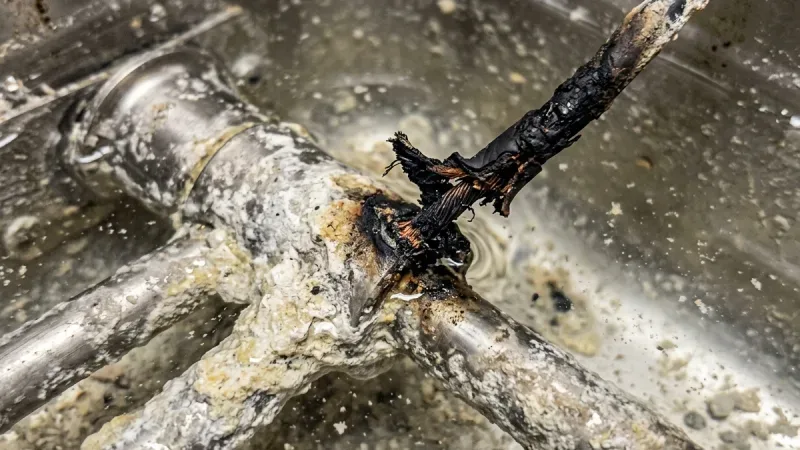
Initial Field Finding: Sheath rupture and magnesium oxide dielectric degradation due to thermal fatigue. True-RMS multimeter measured complete open circuit (∞ Ω) and scorched brass terminal studs unable to conduct current.
After: Brand-New Factory OEM Incoloy Element
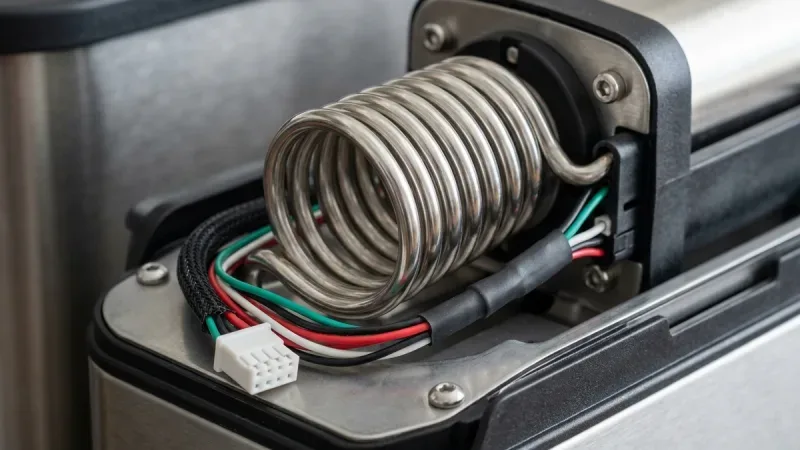
Restoration Specification: Brand-new genuine OEM Hatco incoloy element installed with high-temp ceramic wire nuts, high-temperature nickel wiring harness, precisely measuring 18.5Ω across terminals and drawing 11.2A full load current at 208V.
Common Causes of Hatco Holding Cabinet Heating & Thermostat Breakdown
In high-volume commercial dining environments, electro-mechanical component failures in holding equipment rarely stem from random defects. Instead, they result from compounding environmental and electrical stressors that gradually push components past their engineered tolerances:
Dielectric Breakdown & Thermal Fatigue of the Incoloy Sheath
Tubular incoloy air heating elements consist of a coiled nichrome (nickel-chromium) resistance wire centered inside a heavy-gauge incoloy metal tube, surrounded by densely packed magnesium oxide (MgO) powder insulation. Just as in commercial and domestic dryer heating element repair, continuous thermal expansion and contraction causes microscopic stress fractures in the metal sheath. Over thousands of operational hours, airborne grease vapor and kitchen humidity penetrate microscopic cracks, contaminating the hygroscopic MgO powder. This degrades the dielectric insulating properties, creating a low-resistance path to the grounded outer sheath that trips commercial GFCI breakers or burns the internal resistance coil open.
Contact Pitting & Oxidation in Infinite Heat Switches
Many Hatco holding cabinets utilize an infinite heat switch (energy regulator) to govern element cycle time rather than a standard hydraulic capillary thermostat. When servicing catering halls and high-volume dining rooms across commercial kitchens in Milton, GA, technicians frequently discover heavily pitted switch contacts. These switches employ an internal bimetallic strip wrapped with a small heater wire. As current flows to the main heating element, the bimetal heats, flexes, and mechanically opens the switch contacts, creating an oscillating pulse-width power modulation. Over years of heavy service, the repeated electrical arcing across the silver alloy contacts creates carbonization and pitting. This increases electrical contact resistance well above the 0.2Ω factory threshold, generating localized heat that warps the bimetal and permanently isolates the heating circuit.
Airflow Starvation & Nuisance High-Limit Thermostat Tripping
Hatco holding cabinets depend on active convection airflow generated by a motorized blower fan to sweep heat away from the incoloy element and distribute it through the food chamber. In busy historic bistro lines and foodservice establishments in Roswell, GA, staff members often stack sheet pans too tightly or allow flour dust and airborne grease to clog the lower air intake plenum. When airflow stagnates, the temperature inside the lower heater housing spikes rapidly above 250°F, triggering the factory safety high-limit thermostat. If the high-limit switch experiences repeated thermal trips, its internal disc spring loses mechanical elasticity, causing it to trip prematurely or remain permanently open.
Terminal Loosening & Thermal Runaway at Electrical Connections
Heated holding cabinets in busy restaurants are mobile units mounted on heavy casters, rolled across kitchen tile floors, over threshold ramps, and bumped against stainless prep tables. Our service technicians supporting dining facilities in Johns Creek, GA frequently identify severe terminal loosening resulting from continuous mechanical vibration. A loosened terminal creates a micro-gap that drastically increases electrical contact resistance. According to Joule’s law (Heat = I²Rt), the high current draw (11A to 16A) flowing through a resistive loose connection generates scorching heat, melting wiring insulation, oxidizing terminal studs, and severing power to the heating element.
Step-by-Step Diagnostic Protocol for Commercial Kitchen Operators
Before placing an emergency commercial service call, kitchen managers and culinary staff can execute several safe, non-invasive preliminary checks. Much like diagnosing motor issues in commercial laundry and prep appliances, following a methodical checklist eliminates external utility faults and clears simple protective lockouts:
- Verify Dedicated Wall Power & Commercial Receptacle Integrity: Inspect the heavy-duty commercial NEMA plug (typically NEMA 5-15P, 5-20P, or 6-15P/6-20P for 208V/240V models). Confirm the cord is seated firmly in the commercial twist-lock or straight-blade wall receptacle. Check the dedicated kitchen electrical subpanel to ensure the dual-pole or single-pole breaker has not tripped into the center position.
- Inspect and Reset the High-Limit Safety Thermostat: Locate the manual reset button (a small red push-button situated on the rear panel or lower electrical access raceway, often shielded beneath a screw-off black protective cap). Ensure the cabinet has cooled for at least 15 minutes, then press the red reset button firmly until an audible mechanical click is felt. If the button clicks, restore power and check for heat.
- Check Convection Blower Airflow & Discharge Louvers: Power on the unit and place a hand near the internal air distribution louvers (exercise caution to avoid burns). Confirm that the blower fan is spinning smoothly without screeching, grinding, or rattling noises. If no air circulation is detected, the blower motor may be seized by debris or experiencing a failed run winding.
- Audit Interior Pan Loading & Airflow Clearance: Remove any aluminum foil liners or oversized sheet pans that kitchen staff may have placed across the bottom plenum floor or against the side intake air ducts. Foil wrapping on holding cabinet shelves severely restricts convective heat transfer, causing localized heat buildup that repeatedly trips thermal safety switches.
- Examine Power Rocker Switches & Indicator Lamps: Toggle the main power switch and rotate the infinite heat dial smoothly through its full operating range. Note whether the amber cycle light cycles on and off or stays permanently extinguished. If the light remains off while power is confirmed at the outlet, the internal switch or wiring harness requires component-level multimeter probing.
When to Stop DIY & Call Certified Commercial Technicians
Commercial foodservice equipment operates under high line voltages and extreme current draws capable of causing severe electrical shock, arc-flash burns, and building electrical fires. Restaurant operators and line cooks must cease in-house troubleshooting immediately under the following high-risk conditions:
- Breakers Trip Immediately Upon Resetting: Repeatedly resetting a commercial circuit breaker that immediately snaps off indicates an active dead short or line-to-ground fault. Continuing to reset the breaker can destroy upstream electrical panels and initiate wire harness fires.
- High-Limit Reset Button Trips Repeatedly: If the manual high-limit button trips immediately after being reset, the safety device is preventing dangerous thermal runaway. Never tape, jam, or bypass a high-limit thermostat—this is a severe fire hazard and a direct violation of Georgia commercial fire codes.
- Visible Electrical Arcing, Scorched Wires, or Burn Marks: Any blackened wire insulation, melted terminal spade blocks, or carbon scoring inside the electrical enclosure requires professional disassembly and factory wiring harness rebuilding.
- Cabinet Outer Shell Delivers an Electrical Tingle or Shock: Touching the stainless steel cabinet exterior while grounded and feeling electrical tingling indicates dangerous chassis voltage leakage, confirming an ungrounded receptacle or severe heating element dielectric breakdown.
- Testing Live 120V/208V/240V Internal Circuits: Opening electrical service raceways while the equipment is energized requires specialized PPE, calibrated CAT III/CAT IV multimeter leads, and certified commercial appliance diagnostic training.
Repair vs. Replace Decision Matrix: The 50% Commercial Foodservice Rule
When commercial kitchen equipment suffers a major component breakdown, restaurant operators face a critical capital expenditure decision: invest in component-level overhaul or purchase a brand-new replacement unit. Just as in high-output commercial dishwasher repair scenarios, foodservice managers apply the 50% Rule: if the total cost of certified OEM repair is less than 50% of the replacement cost of a comparable commercial holding cabinet, targeted component restoration is the financially superior path.
A commercial Hatco FSHC or Flav-R-Savor holding cabinet represents an initial investment between $3,800 and $9,500 depending on pan capacity, insulation density, and electronic humidity options. Replacing a failed tubular incoloy heating element, an infinite heat switch, or a high-limit safety thermostat typically costs between $285 and $550, restoring the equipment to original factory performance at a fraction of the cost of new equipment. Furthermore, emergency component restoration eliminates the 3-to-6-week freight lead times associated with procuring new commercial stainless steel holding cabinets.
| Assessment Factor | Targeted OEM Component Restoration | Complete Commercial Unit Replacement |
|---|---|---|
| Average Financial Outlay | $285 – $580 (Parts & Certified Labor) | $3,800 – $9,500+ (New Commercial Unit) |
| Operational Kitchen Downtime | Same-Day Service (1–2 Hours On-Site) | 2 to 6 Weeks Commercial Freight Delivery |
| Kitchen Modifications | None (Direct OEM Fit & Re-Calibration) | Possible NEMA plug, ampacity, or footprint adjustments |
| Environmental & Scrap Waste | Minimal (Small Recycled Metal Components) | Disposal of 200–400 lb Stainless Steel Enclosure |
| Warranty Assurance | 90-Day Parts & Labor Commercial Warranty | 1-Year Standard Limited Factory Warranty |
Key Factors Influencing Commercial Holding Cabinet Repair Costs
Commercial restaurant equipment repair pricing is determined by specific technical, logistical, and component parameters rather than generic flat estimates. Whether servicing high-capacity holding cabinets or high-end Viking commercial-style cooking equipment, four key variables govern the final restoration cost:
- Authentic Factory OEM vs. Generic Substandard Components: Genuine Hatco OEM heating elements and infinite switches are engineered with industrial-grade incoloy metallurgy, calibrated resistance tolerances, and UL/NSF commercial sanitation certifications. While cheap aftermarket universal elements exist, they frequently fail within weeks under high-heat commercial cycles, risking catastrophic wiring damage.
- Chassis Accessibility & Disassembly Labor: Compact undercounter holding cabinets or units recessed into custom stainless cookline counters require specialized labor to safely unbolt, extract, and access lower electrical compartments compared to standalone mobile roll-in cabinets.
- Extent of Collateral Heat Damage: When an incoloy heating element suffers an arcing burnout or an infinite switch overheats, high-temperature heat damage often extends to surrounding spade terminal blocks, fiberglass wire sleeving, and blower motor lead wires, requiring harness re-pinning.
- Emergency Peak-Hour Dispatch Timing: Emergency service calls dispatched during weekend dinner rushes or after midnight to prevent food inventory loss require priority logistics and immediate technician mobilization.
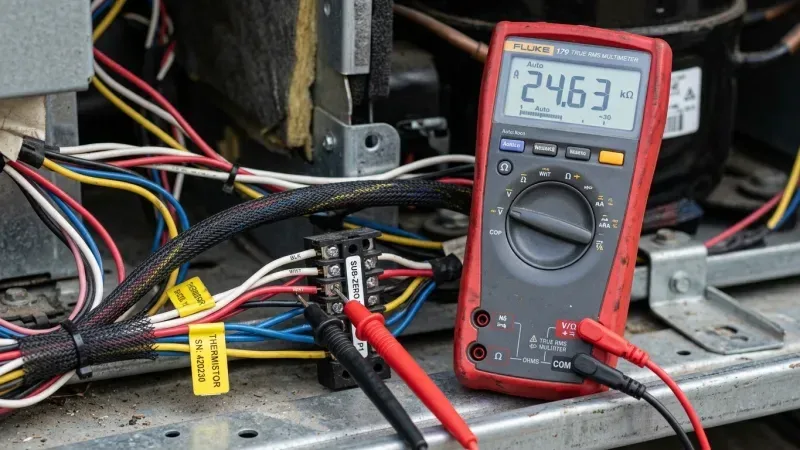
How Professionals Diagnose: True-RMS Multimeter Telemetry & Ohms Verification
Our master commercial technicians do not rely on visual guesswork or trial-and-error part swapping. Just as in high-precision Bosch precision electronic diagnostics, we utilize Fluke True-RMS industrial digital multimeters, calibrated contact thermocouples, and high-voltage megohmmeters to measure quantitative electrical resistance, voltage drop, and dielectric insulation integrity. Use our filterable telemetry lookup table below to review factory baseline electrical specifications:
| Component Assembly | Test Parameter | Factory Normal Range | Defective / Fault Reading |
|---|---|---|---|
| Tubular Incoloy Air Heating Element (120V / 208V) | Cold Stud-to-Stud Resistance | 18.5Ω (±1.0Ω) nominal | Infinite (∞ Ω) Open or < 2.0Ω Short |
| Infinite Heat Selector Switch Contacts (L1 to H1) | Closed Contact Resistance | < 0.2Ω closed resistance | > 0.5Ω (Pitted Contacts) or ∞ Ω Open |
| High-Limit Safety Thermostat (Manual Reset Switch) | Contact Continuity (Ambient < 200°F) | 0.00Ω Closed Continuity | Infinite (∞ Ω) Open at Ambient Temp |
| Incoloy Sheath to Chassis Ground Isolation | 500VDC Megohmmeter Ground Leakage | > 50.0 MΩ to Ground | < 1.0 MΩ (Dielectric Ground Fault) |
| Convection Air Blower Fan Motor Winding | Motor Run Winding Resistance | 32.0Ω – 45.0Ω nominal | ∞ Ω (Open Thermal Fuse) or 0.0Ω |
| Line Operating Voltage (Active Under Full Load) | AC Voltage Supply at Main Terminal | 115VAC – 125VAC or 204VAC – 212VAC | < 108VAC or < 195VAC (Severe Line Sag) |
Common Parts Involved in Hatco Heated Holding Cabinet Systems
A commercial Hatco holding cabinet operates as an integrated electro-thermal system. Understanding the specific function and part numbers of each primary assembly is essential for rapid commercial maintenance:
- Tubular Incoloy Air Heating Element: The primary heat-generating component (such as Hatco OEM Part # R02.05.018.00 or R02.05.020.00). Engineered with a high nickel-chromium incoloy sheath to withstand elevated surface temperatures without oxidation, rated at 120V or 208V with an engineered resistance of 18.5Ω.
- Infinite Heat Control Switch: The primary electro-mechanical power modulating control (Hatco OEM Part # R02.19.008.00). Features internal bimetallic heating strips and silver alloy contact points designed to regulate element duty cycle between 10% and 100% based on user dial position.
- Manual Reset High-Limit Safety Thermostat: A critical thermal protection disc switch (Hatco OEM Part # R02.16.039.00). Factory calibrated to trip open at 250°F–280°F if interior temperatures exceed safety thresholds, cutting all line voltage to the heating element until manually reset.
- Forced Convection Blower Fan Assembly: High-temperature shaded-pole motor with an aluminum or stainless steel centrifugal blower wheel that circulates heated air through interior plenum ducts, ensuring even temperature distribution across all pan slides.
- High-Temperature Fiberglass Wiring Harness & Nickel Terminals: Custom commercial-grade wiring insulated with woven braided fiberglass and silicone jacketing, terminated with non-insulated high-temperature nickel-plated steel spade connectors rated for continuous 450°F exposure.
- Amber & Red Pilot Indicator Lamps: 120V/250V neon indicator lights (Hatco OEM Part # R02.19.150.00) providing kitchen operators with visual confirmation of incoming line power and active element heating cycles.
Commercial Preventative Maintenance Protocol for North Fulton Kitchens
Foodservice holding cabinets in busy commercial kitchens along Old Milton Parkway are subjected to grease vapors, airborne starch dust, and relentless mechanical usage. Much like preventative care protocols for heavy-duty culinary equipment, implementing a structured maintenance schedule maximizes equipment lifespan and prevents mid-service heating failures:
- Daily Stainless Sanitation & Crumb Pan Clearance: At the close of each shift, disconnect power and wipe down interior stainless steel walls with a non-abrasive, food-safe sanitizing solution. Remove bottom drip trays and crumb pans, washing away accumulated meat drippings, cheese residue, and crumbs that could migrate into the lower heating plenum.
- Weekly Water Sump Pan De-Liming (Humidified Models): In humidified units such as the Flav-R-Savor or FSHC with humidity pans, mineral scale from North Fulton municipal water quickly builds up on immersion elements and sump surfaces. Flush the water reservoir weekly with a commercial citric-acid de-liming agent. Scale acts as an insulator, driving element temperatures dangerously high and precipitating premature burnout.
- Monthly Blower Wheel & Air Intake Grille Inspection: Unclip interior air duct baffles and inspect the centrifugal blower wheel for lint, grease, or debris buildup. Clean blower blades using a soft brass brush and vacuum the lower motor ventilation grilles to ensure cooling airflow reaches motor bearings.
- Quarterly Door Gasket & Magnetic Latch Verification: Inspect Santoprene silicone door perimeter gaskets for tears, food buildup, or brittleness. Perform the classic “dollar bill test”: close the door on a dollar bill along the perimeter; if it slides out without resistance, the magnetic latch must be adjusted or the gasket replaced to prevent costly thermal leakage.
- Semi-Annual Electrical Terminal Torquing: Have a certified commercial technician remove electrical raceway covers to inspect terminal spade lugs and screw connections. Tighten terminal screws to manufacturer torque specifications (18–22 in-lbs) to prevent vibration-induced contact resistance.
Electrical Safety, Ground Fault Defense & Georgia Health Code Compliance
Operating commercial foodservice holding cabinets involves strict adherence to electrical safety and food sanitation regulations. Under Georgia Department of Public Health Chapter 511-6-1 rules governing food service establishments, hot-held potentially hazardous foods (Time/Temperature Control for Safety, or TCS foods) must be maintained at an internal temperature of 135°F (57°C) or higher at all times. In high-demand dining rooms, maintaining complementary cold-holding performance via commercial refrigerator repair is just as crucial as hot-holding accuracy to prevent food safety violations.
Furthermore, commercial kitchens present hazardous electrical environments due to wet tile floors, stainless steel workstations, and high-amperage appliances operating in close proximity. Always adhere to OSHA Lockout/Tagout (29 CFR 1910.147) safety procedures before opening any equipment service compartment. Never operate commercial appliances on extension cords, ensure equipment is connected to dedicated grounded circuits, and maintain functional cold backup storage such as commercial reach-in freezers to rapidly chill sensitive foods if hot holding equipment undergoes emergency maintenance.
Frequently Asked Questions: Commercial Hatco Holding Cabinet Diagnostics
Why is my Hatco commercial holding cabinet blowing cold air while the blower fan is running?
When the convection blower fan operates but air inside the cabinet remains cold, the heating electrical circuit is interrupted downstream of the motor. The most common causes are an open-circuit tubular incoloy heating element (∞ Ω instead of the factory 18.5Ω baseline), a tripped manual-reset high-limit safety thermostat, or failed contact poles within the infinite heat control switch.
Where is the manual reset button located on a Hatco holding cabinet?
On most Hatco Flav-R-Savor and FSHC series cabinets, the high-limit manual reset button is a small red circular push-button located on the rear exterior chassis or lower electrical control raceway, frequently protected by a black screw-on protective cap. Allow the cabinet to cool for 15 minutes before pressing the button firmly until you hear a mechanical click.
What multimeter ohms reading should a healthy Hatco heating element have?
A standard 120V or 208V Hatco commercial tubular incoloy air heating element should measure approximately 18.5Ω across its terminal studs at room temperature. If your True-RMS multimeter reads infinite ohms (∞ Ω or O.L.), the internal resistance wire has burned open and the element must be replaced.
How fast can your certified commercial technicians arrive on Old Milton Parkway in Alpharetta?
Our dedicated mobile commercial repair units are stationed along major North Fulton transit corridors including Georgia 400, Old Milton Parkway, and Windward Parkway. We provide rapid emergency dispatch with average arrival times of 45 to 90 minutes for commercial kitchen emergencies in Alpharetta and surrounding communities.
What causes the infinite heat switch on a Hatco holding cabinet to fail?
Infinite heat switches regulate temperature through cyclical opening and closing of bimetallic contact poles under high electrical current (11A to 16A). Over time, electrical arcing pits and oxidizes the silver contacts, causing contact resistance to spike above 0.2Ω. This localized heat warps the internal mechanism, leaving contacts stuck open or permanently welded closed.
Why does my Hatco holding cabinet repeatedly trip the commercial circuit breaker?
Immediate breaker tripping upon turning on the power switch indicates a line-to-ground fault. In holding cabinets, this is almost always caused by dielectric breakdown of the magnesium oxide insulation inside the incoloy heating element, allowing line voltage to short directly to the grounded stainless steel cabinet chassis.
Do your commercial technicians carry authentic factory OEM Hatco parts?
Yes. Our mobile commercial service vans are fully stocked with authentic Hatco factory OEM components, including 120V and 208V tubular incoloy heating elements, infinite heat switches, high-limit safety thermostats, blower motors, and high-temp wiring harnesses for immediate on-site restoration.
What warranty coverage is provided on completed Hatco commercial repairs?
Every commercial equipment restoration completed by our master technicians includes a comprehensive 90-day parts and labor warranty. If the installed component experiences any operational defect within 90 days, we dispatch priority emergency service at zero cost to your kitchen.
Can my kitchen staff bypass the high-limit thermostat to finish dinner service?
Never bypass or bridge a high-limit thermostat. This safety switch prevents uncontrolled thermal runaway and catastrophic electrical fires. Bypassing safety switches violates Fulton County commercial fire codes, invalidates commercial property insurance, and creates severe life-safety liability.
What is the minimum safe hot-holding temperature required by Georgia health inspectors?
Under Georgia Department of Public Health Chapter 511-6-1 regulations, hot-held TCS foods must be held at an internal core temperature of 135°F (57°C) or higher. Hatco holding cabinets are typically calibrated to maintain internal cavity air temperatures between 150°F and 175°F to ensure food product temperatures never drop below the legal limit.
Why does my Hatco holding cabinet dry out or scorch food products?
Food desiccation or scorching typically occurs when the infinite heat switch or capillary thermostat fails in a closed circuit condition, driving cabinet temperatures above 200°F. In humidified holding cabinets, an empty water reservoir or a calcified sump immersion element will also cause dry-heat conditions that sap moisture from hot-held food.
How does mineral scale affect Hatco humidified holding cabinets?
North Fulton municipal tap water contains dissolved calcium and magnesium carbonates. When heated in humidified sumps, these minerals precipitate as hard scale, coating the heating element. The scale layer acts as thermal insulation, trapping heat inside the element sheath and causing rapid burnouts and erroneous humidity control.
Can a loose electrical wire cause the heating element to stop working?
Yes. Commercial holding cabinets are frequently rolled across kitchen tiles, causing screw terminals and push-on spade connectors to loosen. A loose connection introduces high electrical resistance, creating localized extreme heat that oxidizes terminal studs, melts insulation, and eventually severs electrical continuity to the heating element.
What is the difference between 120V and 208V/240V Hatco holding cabinets?
Smaller undercounter models typically operate on single-phase 120V line power drawing 12A to 15A via standard NEMA 5-15P or 5-20P plugs. Larger multi-door roll-in FSHC holding cabinets require 208V or 240V single-phase electrical service to power dual heating elements and heavy-duty blowers, drawing lower amperage per watt and delivering faster heat recovery.
How do you check for ground fault leakage on an incoloy heating element?
Commercial technicians use a specialized high-voltage insulation tester (megohmmeter) set to 500VDC, measuring resistance between the element terminal studs and the outer metal sheath. A healthy incoloy element must exhibit greater than 50 megohms (MΩ) of isolation resistance. Any reading below 1.0 MΩ confirms an active ground fault that will trip commercial GFCI breakers.
How do I schedule same-day emergency commercial service for my Alpharetta restaurant?
Call our dedicated commercial foodservice dispatch hotline directly at (770) 796-7742. Our service coordinators will capture your Hatco cabinet model number, reported electrical symptoms, and kitchen location to dispatch a certified master commercial technician with an arrival window of 45 to 90 minutes.
Related Commercial Foodservice Services & North Fulton Coverage
Our factory-trained commercial technicians support every critical station across your commercial culinary operation. From frontline cooking suites to back-of-house refrigeration and dishwashing equipment, we deliver precision repairs backed by genuine OEM parts across North Fulton:
Commercial Cooking Equipment
Commercial Cold Storage
North Fulton Communities
Key Operational Takeaways for Commercial Kitchen Managers
Maintaining consistent holding temperatures in commercial Hatco cabinets protects your restaurant’s culinary quality, guest safety, and bottom line. Keep these essential technical principles in mind:
- 140°F Is the Absolute Safe Minimum: Never allow holding temperatures to slip into the 41°F–135°F danger zone. Calibrate holding units between 150°F and 175°F to maintain strict health compliance under high door-opening frequencies.
- Listen for the High-Limit Reset Click: If heating halts unexpectedly, allow the unit 15 minutes to cool and press the red manual reset button. If the button clicks and restores heat, schedule a professional airflow and thermostat calibration inspection immediately.
- Multimeter Telemetry Eliminates Guesswork: Healthy Hatco incoloy heating elements measure 18.5Ω across terminals; infinite heat switches must display less than 0.2Ω closed resistance. Any open circuit reading mandates OEM part replacement.
- Keep Convection Louvers Clear: Never line holding cabinet wire shelves or bottom plenum floors with aluminum foil. Restricted airflow concentrates heat in the lower bay and trips safety switches.
- The 50% Rule Saves Thousands: Component-level restoration of heating elements and switches costs between $285 and $550, saving up to 90% compared to purchasing a $5,000+ brand-new commercial cabinet.
- Demand Genuine OEM Incoloy Parts: Insist on authentic Hatco replacement components with genuine incoloy metallurgy and factory wiring harnesses to guarantee commercial durability and safety.
Emergency Commercial Dispatch & Schedule Service
Priority Commercial Service • Old Milton Parkway & North Fulton
Restore Your Hatco Commercial Holding Cabinet to Peak Performance Today
Do not let heating element burnout, infinite switch failure, or tripped safety thermostats shut down your dining line or jeopardize food health code compliance. Our factory-trained master commercial technicians arrive equipped with genuine OEM Hatco parts to resolve holding cabinet issues on the spot.
Serving Old Milton Parkway Restaurant Row, Avalon, Alpharetta, Milton, Roswell, Johns Creek • Certified EPA & Commercial Specialists • 90-Day Comprehensive Warranty
Advanced Circuit Analysis: Electrical Ohm’s Law & Watt Density in Hatco Incoloy Elements
To understand the electrical dynamics of a Hatco commercial heated holding cabinet, technicians analyze the thermal watt density and electrical power consumption of the heating circuit. For a commercial unit operating on nominal 208V line voltage with an incoloy air element measuring 18.5Ω, applying Ohm’s Law and the electrical power formula yields:
Thermal Power Dissipation (P): P = V × I = 208V × 11.24A = 2,338 Watts (2.34 kW)
Equivalent 120V Model Telemetry: At 120V with identical 18.5Ω element: I = 6.49A, P = 778 Watts
When evaluating high-capacity multi-bay holding cabinets, the total connected electrical load frequently incorporates secondary air booster elements and motorized blower windings. A line voltage drop of just 10% (dropping from 208V to 187V during peak grid demand along Old Milton Parkway) reduces thermal wattage from 2,338W down to 1,890W—a dramatic 19.2% loss in heating power. This mathematical reality explains why commercial kitchens experiencing high utility grid impedance notice significantly longer temperature recovery times during busy lunch rushes.
Solid-State Electronic PID Controllers vs. Electro-Mechanical Capillary Thermostats
While classic Hatco Flav-R-Savor units rely upon electro-mechanical infinite switches and hydraulic capillary thermostats, modern advanced FSHC cabinets feature micro-processor-driven proportional-integral-derivative (PID) solid-state temperature controllers. Instead of a mechanical bimetallic strip, these units employ negative temperature coefficient (NTC) thermistors or platinum RTD (resistance temperature detector) sensors positioned directly in the convective air return channel.
In PID-governed models, an electronic triac or solid-state relay (SSR) modulates electrical duty cycles with zero physical contact arcing. When troubleshooting an electronic Hatco holding cabinet displaying an “E01” or “E02” fault code, technicians measure thermistor resistance across control board input terminals: a standard 10kΩ thermistor must register approximately 10,000Ω at 77°F (25°C), dropping to approximately 1,200Ω at an active holding temperature of 160°F (71°C). A resistance reading of zero ohms (shorted probe) or infinite ohms (severed sensor cable) causes the microprocessor watchdog to immediately kill power to the SSR to protect holding inventory from uncontrolled thermal overshoot.
Hydraulic Pressure Mechanics of Capillary Bulb Sensing Assemblies
In hydraulic capillary thermostats, temperature sensing relies on thermal expansion of an organic liquid hermetically sealed inside a copper or stainless steel sensing bulb and capillary tube. When performing component diagnostics similar to those on Sub-Zero luxury refrigeration systems, technicians inspect the capillary line for micro-kinks and fluid leaks. As the internal holding cavity warms, the fluid expands, creating hydraulic pressure against a miniature copper bellows inside the thermostat head. The bellows expands against an adjustable spring mechanism, mechanically tripping an electrical microswitch when the setpoint temperature is attained.
If a kitchen worker accidentally kinks, crimps, or fractures the delicate 0.040-inch capillary line during tray loading or aggressive pressure washing, the internal fluid vaporizes or leaks out. Because hydraulic pressure drops to zero, the bellows contracts completely, causing the electrical switch contacts to remain permanently open. The heating element never receives line voltage, rendering the cabinet completely cold despite the thermostat dial being turned to maximum. Technicians diagnose this failure mode by verifying open switch resistance regardless of bulb temperature, mandating full thermostat replacement.
Thermal Airflow Dynamics & Boundary Layer Convection in Holding Cavities
The thermodynamic challenge in hot food preservation is balancing heat loss from food pan surfaces without inducing convective moisture evaporation. Similar to how proper air currents dictate freezing efficiency in commercial ice machine systems, holding cabinets require controlled airflow. In still air (natural convection), a stagnant thermal boundary layer forms around gastronorm pans, creating massive temperature stratification where top pans overheat while bottom pans drop into the danger zone. Hatco forced-air convection overcomes this by maintaining a laminar air velocity between 150 and 250 feet per minute (FPM) across pan surfaces.
When kitchen staff obstruct airflow with oversized baking sheets or pan liners, air velocity collapses into turbulent recirculation pockets. The incoloy element, stripped of forced convective cooling, experiences rapid sheath temperatures exceeding 650°F. Under this localized thermal stress, the incoloy metallurgical grain structure expands, microscopic cracks propagate along grain boundaries, and dielectric breakdown of the magnesium oxide powder occurs within a matter of weeks. Regular airflow verification is therefore as vital as electrical telemetry testing.
Fulton County Environmental Health Inspection Guidelines for Hot Holding
Under Fulton County Board of Health and Georgia Department of Public Health guidelines, commercial kitchens are subject to unannounced risk-based health inspections. During an inspection, health environmentalists utilize calibrated thermocouple immersion probes to test the core internal temperature of held proteins, starches, and gravies. Any TCS food item testing below 135°F results in an automatic 9-point critical violation on the Food Service Inspection Report (Form 3314).
If corrective action cannot be demonstrated immediately on site, the inspector issues a mandatory disposal order for all compromised food products. Multiple repeat hot-holding violations jeopardize the establishment’s operating permit, resulting in public grade downgrades from an ‘A’ to a ‘U’ (Unsatisfactory) and mandatory operational re-inspection fees. Utilizing our certified commercial preventative maintenance and same-day emergency diagnostic service ensures that holding equipment remains in peak operating calibration, safeguarding your culinary reputation and health permit status.
Preventing Electrical Arc Flash Hazards in Commercial Kitchen Environments
Commercial foodservice equipment operating on 208V/240V circuits carries substantial available fault current. When terminal blocks loosen or insulation degrades due to thermal exposure, an arc flash event can occur inside the lower raceway. Arc flashes reach temperatures exceeding 10,000°F, vaporizing copper conductors and releasing toxic metal fumes.
Our factory-certified technicians strictly adhere to NFPA 70E standards for electrical safety in the workplace. We utilize industrial insulated hand tools rated to 1,000V, calibrate torque on all terminal connections to exact manufacturer specifications, and install factory OEM fiberglass wire sleeves to prevent wire chafing against stainless steel chassis edges. Protecting your kitchen staff from electrical hazards is as fundamental to our service as restoring your holding equipment’s thermal performance.