
When a busy pizzeria’s Bakers Pride commercial pizza deck oven develops severe uneven heating or thermostat drift in Roswell, GA, the resulting thermal imbalances ruin crust crispiness, scorch cheese toppings, and cause catastrophic dinner rush bottlenecks. Backed by our comprehensive 90-day parts and labor warranty, our factory-trained master technicians provide rapid 45-minute priority dispatch, micro-manometer gas pressure balancing, Robertshaw BJWA thermostat calibration, and same-day OEM valve replacements across Canton Street, Elizabeth Way, and the Downtown Roswell Historic District. Call (770) 796-7742 for immediate commercial kitchen restoration.
Quick Diagnostic Answer: Why Bakers Pride Deck Ovens Bake Unevenly & How to Fix It
Quick Answer: Uneven baking, burnt crusts, or undercooked pizza centers in Bakers Pride Y-Series and D-Series deck ovens stem from three primary mechanical failures: hydraulic bulb charge loss in the Robertshaw BJWA throttling thermostat causing failure to drop to low-fire bypass; an uncalibrated bypass flame screw holding the main burner wide open during idle periods; or a dropped manifold gas pressure below the factory 3.5″ W.C. standard. Additional contributors include partially clogged cast iron burner venturi ports, warped heat baffles, and fractured Cordierite stone decks. Immediate resolution requires testing manifold pressure with a dual-port digital manometer, auditing closed-circuit thermocouple output (minimum 25–35 mV DC), cleaning burner crossover ports, and precision recalibration of the BJWA thermostat dial pointer. For emergency commercial service, call (770) 796-7742.
Listen to 60-Second Diagnostic Summary
Narrated by Jason J. (Master Certified Commercial Foodservice Specialist)
Check Same-Day Commercial Oven Tech Availability in Your Area
Verified Local Service
Recently Serviced on Canton Street, Downtown Roswell Historic District
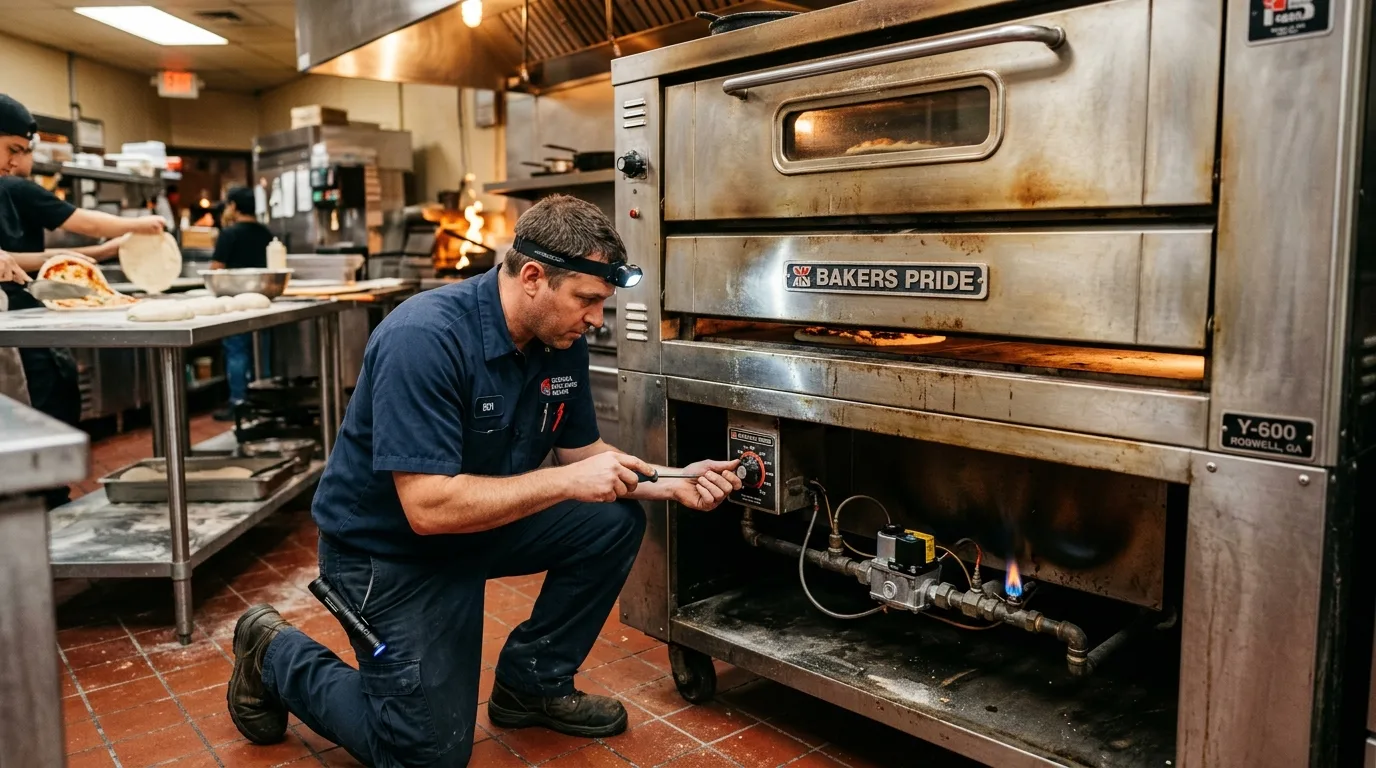
Bakers Pride Y-600 Super Deck Natural Gas Oven • BJWA Thermostat Recalibration & Pilot Safety Valve Restoration • ★★★★★ Verified 5.0 Star Kitchen Service
Authentic Field Case Study
Canton St Dining Corridor, Roswell, GA 30075
Field Service Audit: Resolving 85°F Heat Imbalance & Pilot Flame Dropouts in a Bakers Pride Y-600
Initial Emergency Call: On a Friday afternoon prior to the evening dinner service, a high-volume Neapolitan pizza establishment located along the Canton Street dining strip in Roswell called reporting that their flagship Bakers Pride Y-600 double-deck oven was incinerating the bottom crust of pizzas placed in the right rear quadrant, while leaving crusts in the front left quadrant soggy and pale. Furthermore, whenever the line cooks attempted to adjust the temperature knob downwards, the main burner would choke abruptly, causing the pilot flame to flicker out and triggering total gas safety shutdown.
Master Diagnostic Telemetry & Field Measurements:
- Surface Thermal Pyrometer Mapping: Right rear stone measured 645°F; front left stone measured 520°F (an unacceptable 125°F internal heat variance under a 550°F dial setting).
- Manifold Operating Pressure: Measured with a Testo 510 digital manometer at the pressure tap downstream of the combination valve. Gas pressure registered only 2.75″ W.C. during full high-fire demand (factory specification requires a steady 3.50″ W.C. Natural Gas).
- Robertshaw BJWA Thermostat Bypass Test: Turning the dial to lowest setpoint failed to restrict gas to the low-fire bypass flame orifice; the burner remained in partial high-fire state due to internal hydraulic capillary diaphragm fatigue and a gummed bypass needle seat.
- Thermocouple Closed-Circuit Output: Measured with an inline adapter and True-RMS digital multimeter at 14.8 mV DC under pilot flame, well below the minimum 20.0 mV hold-in threshold of the Baso pilot safety magnet coil, causing sudden safety magnet dropouts.
- Deck Stone Audit: Right rear Cordierite stone exhibited a 14-inch hairline fracture, allowing direct combustion radiant heat from the burner chamber to bypass the stone’s thermal buffering mass.
Restoration & Technical Execution: Our master technician removed the fatigued thermostat assembly and installed a genuine factory OEM Robertshaw BJWA 650°F snap-throttling thermostat valve (OEM Part #M1004X). The bypass flame adjustment screw was carefully set with a precision brass instrument screwdriver to maintain a stable, uniform 1/8-inch low-fire flame ribbon across all burner ports without carbon lifting. Next, we replaced the failing coaxial thermocouple with a heavy-duty 30mV stainless pilot thermocouple (OEM Part #M1087A), achieving an immediate closed-circuit reading of 28.6 mV DC. The line pressure regulator was dialed in to establish exactly 3.50″ W.C. manifold pressure under full 120,000 BTU burner load. Finally, the cracked Cordierite deck stone was replaced with a factory-grade 1.5-inch thick refractory stone tile and heat baffles were re-centered.
Full 90-Day Commercial Parts & Labor Warranty Applied
Comprehensive Table of Contents
- Commercial Deck Oven Operational Dynamics & Problem Overview
- Symptoms of Commercial Deck Oven Heat Gradients & Uneven Baking
- Visual Before & After Restoration Showcase
- Root Causes of Uneven Baking & Temperature Drift in Commercial Deck Ovens
- Safe Commercial Kitchen Manager Preliminary Checks
- Critical Safety Thresholds & When to Halt In-House Diagnostics
- Repair vs Replacement Decision Framework for Commercial Deck Ovens
- Instant Commercial Deck Oven Repair Cost Estimator
- Commercial Repair Cost Variables & Operational Economics
- Professional Multi-Point Diagnostics & Component Ohms Telemetry
- Essential OEM Mechanical & Gas Train Components
- Commercial Food-Service Preventative Maintenance Schedule
- High-Output Commercial Kitchen Safety Protocols & Gas Codes
- Frequently Asked Questions About Bakers Pride Deck Oven Repair
- Commercial Cooking & Refrigeration Specialized Services
- Essential Takeaways for Pizzeria Operators
- Emergency Commercial Kitchen Dispatch & Priority Scheduling
Commercial Deck Oven Operational Dynamics & Problem Overview
In high-volume Italian trattorias, artisanal pizzerias, and fast-casual dining establishments across Roswell, Georgia—particularly throughout the historic culinary corridor of Canton Street, Elizabeth Way, and Plum Tree Street—the commercial deck oven serves as the undisputed mechanical heart of the entire kitchen operation. When issues arise, operators rely on same-day appliance repair to keep kitchens operating without missing a single dinner ticket. Heavy-duty deck ovens manufactured by Bakers Pride, such as the iconic Y-600, Y-800, D-125, and Il Forno Super Deck series, are celebrated throughout the foodservice industry for their massive thermal mass, rugged cast iron burner assemblies, and ability to bake authentic New York and Neapolitan style pizzas with blistered, airy crusts and perfectly caramelized mozzarella cheese.
Unlike modern forced-air impingement conveyor ovens that rely entirely on mechanical blowers and high-velocity convective airflow to bake food in minutes, a commercial gas deck oven operates on a delicate triad of conductive, radiant, and natural convective heat transfer thermodynamics. Conductive heat transfers directly from the 1.5-inch thick refractory Cordierite or FibraMent stone deck into the raw pizza dough, vaporizing moisture within the flour matrix and driving rapid oven spring. Simultaneously, heavy steel flue baffles positioned along the upper perimeter of the baking chamber absorb intense combustion heat from the lower burner bay, radiating long-wave infrared energy downward across the pizza toppings to melt cheeses and blister crust crowns.
When this complex thermodynamic equilibrium collapses, however, the financial consequences for a restaurant operator are immediate and brutal. Temperature drift of just 40°F to 60°F across the stone surface turns a signature $22 specialty pizza into an unsellable, charred disc with doughy, unbaked dough in the center. During a high-stakes Friday evening service when tickets are hanging three deep on the pass, cooks are forced to constantly shuffle, rotate, and nurse pizzas across different sections of the deck to prevent burning. This frantic shuffling slows ticket execution times, quadruples food waste, triggers customer complaints, and severely inflates line labor costs. Understanding the electromechanical and fluid dynamics governing your Bakers Pride gas train is the first step toward restoring peak baking consistency through certified commercial appliance repair.
The core mechanism responsible for regulating internal chamber temperatures in standard Bakers Pride deck ovens is the Robertshaw BJWA series throttle-action hydraulic thermostat. Operating completely independent of external AC line voltage, the BJWA thermostat utilizes a sealed capillary tube filled with a specialized liquid-hydraulic charge linked to an elongated copper or nickel-plated sensing bulb installed directly inside the upper bake chamber. As the oven chamber warms, the fluid within the bulb expands volumetrically, traveling through the capillary tube to actuate a micro-machined diaphragm inside the thermostat body. This diaphragm modulates the main burner gas valve, shifting smoothly from full 120,000 BTU high-fire down to a low-fire bypass flame once the setpoint temperature is achieved.
Over years of brutal commercial service in hot, flour-choked restaurant kitchens, microscopic fatigue within the BJWA internal hydraulic bellows, carbon buildup along the burner venturi throat, and fluctuating gas utility supply pressures can cripple this mechanical modulation. When the bypass flame is miscalibrated or when the capillary bulb develops micro-fractures that leak its chemical fill charge, the oven loses its ability to throttle down. The burners continue firing at maximum capacity regardless of dial position, driving stone temperatures beyond 650°F, scorching pies, and creating dangerous localized hot spots that require immediate intervention by master certified commercial cooking technicians.
Symptoms of Commercial Deck Oven Heat Gradients & Uneven Baking
Recognizing the earliest mechanical symptoms of gas train and thermostat failure allows kitchen managers to schedule preventative maintenance before experiencing a complete mid-service kitchen shutdown. In commercial pizza deck ovens, thermal failure rarely occurs as an instantaneous total loss of heat; instead, it manifests as progressive thermodynamic anomalies that degrade pizza bake quality over several weeks.
The most prevalent symptom reported by restaurant chefs along Canton Street in Roswell, GA is severe bottom crust scorching while the cheese and surface toppings remain pale and undercooked. This condition indicates an excessive conductive-to-radiant heat ratio. In a healthy Bakers Pride oven, top baffles radiant heat and bottom deck stone conductive heat are balanced so that crust crisping and cheese melting finish simultaneously in 6 to 8 minutes at 550°F. When bottom stones overheat due to a stuck bypass flame or misaligned bottom heat diverters, the bottom crust carbonizes in less than 3 minutes, forcing line cooks to prop pizzas on metal baking screens to salvage the toppings.
Conversely, chefs frequently report the opposite defect: pizzas with dark, scorched toppings but gummy, limp crusts on the bottom. This symptom points toward insufficient bottom stone saturation caused by burner manifold gas starvation, sagging burner venturi tubes, or extensive carbon and ash accumulation beneath the deck stones that acts as a thermal insulator, preventing combustion heat from reaching the refractory Cordierite slabs, demanding rigorous foodservice appliance diagnostics.
A third critical symptom is severe lateral or front-to-back thermal gradients across the deck surface. When measured with a calibrated non-contact infrared pyrometer, temperature differentials between the front door opening and the rear combustion chamber should never exceed 25°F to 35°F in a well-tuned Bakers Pride Y-600. When this variance stretches to 75°F, 100°F, or higher, cooks find that pizzas baked in the rear right quadrant burn instantly while pizzas placed near the front left door require twice as long to bake. This imbalance is almost universally caused by clogged burner crossover ports, partial pilot safety valve orifice blockages, or cracked deck stones that expose bare flame directly to the underside of the baking zone.
Additional operational red flags include frequent pilot light outages whenever the main burner cycles off, delayed burner ignition characterized by a loud audible “whoosh” or minor gas explosion when calling for heat, persistent dial calibration discrepancies where setting the dial to 500°F produces actual internal temperatures of 410°F or 600°F, and visible yellow, lazy flames that generate black soot along the flue collector box. When multiple symptoms appear simultaneously, standard kitchen cleaning protocols are no longer sufficient, and professional diagnostic procedures must be initiated through specialized commercial oven repair technicians.
Visual Before & After Restoration Showcase
Commercial pizza deck ovens operate in harsh environments saturated with combustible flour dust, airborne grease aerosols, and intense thermal cycling. Over thousands of operational hours, pilot assemblies corrode, burner ports choke with carbonized food debris, and gas safety valves fall out of factory tolerance. The visual comparison below illustrates the dramatic difference between a neglected, failing pilot burner assembly and an OEM factory-restored gas train calibrated by our master commercial technicians.
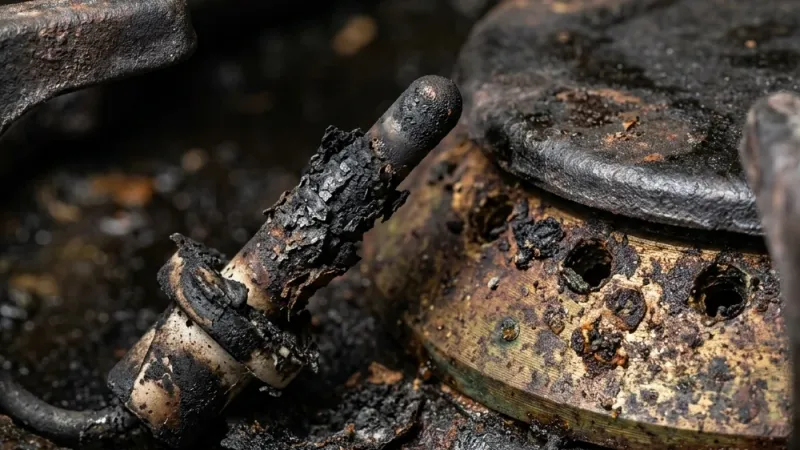
Heavy carbonization, oxidized thermocouple junction producing only 12.4 mV, and clogged primary aeration ports generating incomplete combustion and flame rollouts.
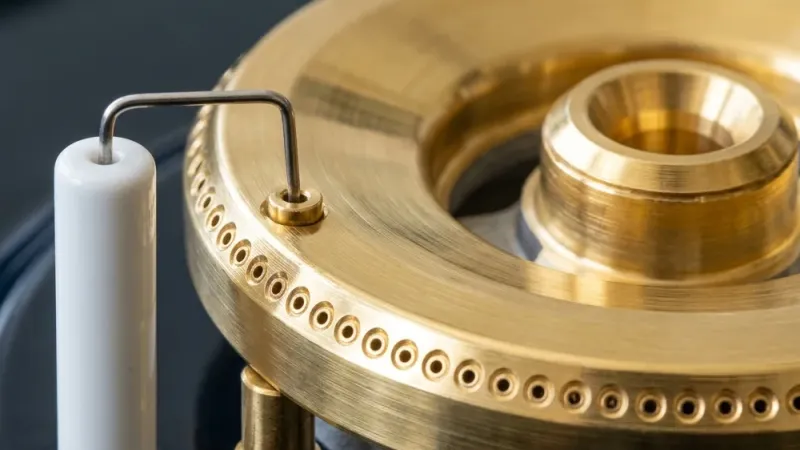
Brand-new Robertshaw thermocouple delivering 31.8 mV DC, ultra-clean pilot orifice with sharp blue flame cone, de-carbonized cast iron burner tubes, and zero gas leakage.
Root Causes of Uneven Baking & Temperature Drift in Commercial Deck Ovens
Diagnosing persistent thermal imbalances in commercial deck ovens requires an engineering understanding of the mechanical sub-assemblies comprising the gas train, air distribution baffles, and refractory materials. Below are the primary failure mechanisms identified by our master technicians during commercial field calls in North Fulton County.
Robertshaw BJWA Hydraulic Thermostat Sensing Bulb Charge Loss & Bellows Fatigue
The Robertshaw BJWA throttle-action thermostat is an entirely mechanical, non-electric closed-loop thermal regulator. The copper sensing bulb situated horizontally across the upper roof of the baking cavity contains an organic hydraulic fluid with a high thermal expansion coefficient. When heated, this fluid exerts hydrostatic pressure through a capillary tube onto an internal phosphor-bronze bellows assembly located inside the valve casting.
Over decades of cyclic heating up to 650°F, microscopic stress cracks can develop at the brazed junction between the capillary tube and the bulb body. Even an imperceptible loss of the hydraulic liquid charge prevents adequate hydrostatic pressure from developing. Consequently, the internal bellows fails to expand against its calibrated counter-spring, and the internal throttling disc remains parked in the high-fire position. The oven continuously injects maximum BTU output into the combustion chamber regardless of dial position, driving stone temperatures beyond 600°F and incinerating pizzas, requiring precision commercial gas oven diagnostics.
Bypass Flame Low-Fire Adjustment Screw Maladjustment
A unique characteristic of the BJWA throttling thermostat is that it does not snap completely shut when the cavity reaches target temperature. Instead, it smoothly modulates gas flow down to a calibrated “bypass flame”—a continuous, low-intensity ribbon flame approximately 1/8-inch in height across all burner ports. This low-fire bypass maintains draft stability, prevents burner flashback, and holds baseline chamber temperature during non-baking idle periods without cycling the pilot safety valve.
The bypass flame volume is governed by a precision needle valve adjustment screw concealed beneath the temperature control knob. If an untrained kitchen worker or unauthorized service technician turns this screw too far counterclockwise, the bypass gas volume becomes excessively high. During off-peak periods when the oven door remains closed, this oversized bypass flame dumps tens of thousands of unneeded BTUs into the chamber, causing the stone deck to continuously climb past 600°F. When cooks slide raw dough onto the stones, the bottom burns instantly before toppings can begin melting.
Manifold Gas Operating Pressure Drop Below Factory Standard
Bakers Pride commercial gas deck ovens require strictly calibrated gas pressure to achieve complete combustion and uniform flame propagation. Factory specifications dictate an operating manifold pressure of exactly 3.5 inches Water Column (W.C.) for Natural Gas, or 10.0 inches W.C. for Liquid Propane (LP). If the line pressure regulator suffers diaphragm stiffening, spring relaxation, or if upstream commercial kitchen demand (such as dish machines and fryers firing simultaneously) drops line pressure below 5.0″ W.C. static, the manifold pressure chokes down to 2.5″–2.8″ W.C. under full load.
At sub-standard manifold pressures, gas velocity exiting the burner spuds decreases significantly according to Bernoulli’s principle. Low gas velocity fails to entrain sufficient primary combustion air through the venturi throat, causing lazy, ragged flames that lift off the rear ports while starving the front ports. This fluid-dynamic starvation creates massive front-to-back thermal gradients exceeding 90°F. Prompt diagnostics and recalibration through same-day appliance repair ensures uninterrupted restaurant service.
Cast Iron Burner Port Occlusion, Rust Flaking & Venturi Throat Carbonization
Bakers Pride Y-Series ovens employ heavy cast iron multi-port burners spanning the length of the lower combustion bay. Over years of operation, flour dust dusting off peels and cornmeal falling between deck seams migrates downward into the burner compartment. When organic flour contacts 1,000°F burner surfaces, it pyrolyzes into dense carbonaceous slag.
Additionally, high humidity during nightly kitchen shutdowns reacts with sulfur traces in gas supplies, causing cast iron oxidation and internal rust flaking. These rust flakes tumble down into the burner casting, clogging the precision-drilled crossover ports that facilitate seamless flame travel between burner sections. Occluded burner ports force gas to escape through remaining clear ports at excessive velocity, generating violent blowtorch-like flames under one corner of the deck while leaving other sections cold and dead.
Combustion Air Shutter Misalignment & Secondary Aeration Starvation
At the inlet of each burner tube lies an adjustable mechanical air shutter secured by a locking screw. This shutter meters the primary aeration ratio required for stoichiometric gas combustion. In natural gas systems, approximately 10 volumes of air are required to burn 1 volume of methane completely.
If the air shutter vibrating loose over time closes shut, the burner becomes air-starved, producing an orange-yellow luminous flame that generates voluminous soot deposits along the bottom heat diverters and upper flue passages. Soot possesses an exceptionally low thermal conductivity (approximately 0.07 W/m·K), creating a severe insulating thermal barrier that traps heat unevenly in the combustion chamber. Conversely, if shutters open too wide, excessive primary air creates lifting flames that whistle loudly, blow out near the pilot, and fail to transfer heat to the deck stones.
Refractory Cordierite Stone Fractures & Dislodged Heat Baffles
The baking floor in a Bakers Pride Y-600 consists of two massive 1.5-inch thick refractory Cordierite stone slabs. Cordierite is selected for its high thermal inertia and low coefficient of thermal expansion. However, thermal shock—caused by cooks wiping hot stones with wet mops or dropping frozen dough containers onto the deck—inevitably creates mechanical stress fractures.
Once a hairline crack propagates through the full 1.5-inch thickness of a deck stone, hot combustion gases and direct radiant infrared energy from the burner bay rise directly through the fissure. The stone surface immediately adjacent to the crack spikes 80°F to 120°F hotter than surrounding areas. Any pizza placed across the crack line will scorch on the bottom along the fracture path while the remainder of the crust bakes normally. Furthermore, warped or knocked-out-of-position lower heat diverter baffles prevent uniform heat diffusion under the stones.
Safe Commercial Kitchen Manager Preliminary Checks
Before scheduling an emergency service call, kitchen managers and head pizza chefs can perform several non-invasive preliminary audits to isolate operational issues from mechanical gas train defects. These non-invasive diagnostic steps require no disassembly of gas-carrying pipework and adhere strictly to commercial kitchen safety protocols.
Infrared Pyrometer 9-Point Surface Thermal Grid Mapping
To quantify the exact magnitude of thermal unevenness, allow the oven to preheat undisturbed for a minimum of 60 minutes at 500°F with the door closed. Using a commercial non-contact infrared thermometer (set to 0.95 emissivity for Cordierite stone surfaces), measure and record temperatures across a 3×3 grid:
- Front Row: Left Front, Center Front, Right Front (typically 480°F–510°F due to door wash).
- Center Row: Left Center, Geometric Center, Right Center (target 500°F ±10°F).
- Rear Row: Left Rear, Center Rear, Right Rear (typically 510°F–530°F).
If any single quadrant differs from its symmetrical counterpart by more than 40°F, document the hot and cold zones to assist your commercial technician in identifying specific burner tube or baffle misalignments.
Bypass Flame Operational Visual Audit
With the oven fully preheated to 500°F, rotate the BJWA temperature control knob counterclockwise to the lowest setpoint (300°F or “Off” bypass position). Observe the main burner flame through the lower observation peep door:
- Normal Operation: The roaring high-fire burner flame should immediately step down to a quiet, continuous blue ribbon flame approximately 1/8-inch high across all burner ports.
- Defective Bypass (Overheating): If the flame remains at medium or high fire (1/2-inch to 1-inch tall), the bypass adjustment screw is set too high or the internal BJWA valve disc is gummed with grease, causing continuous overheating.
- Defective Bypass (Flame Drop): If the burner flame extinguishes completely, the bypass needle is clogged, which can cause severe pilot outages and delayed ignition booms when the thermostat calls for heat again.
Deck Stone Seam & Baffle Alignment Audit
When the oven is cold (typically morning prep before preheating), use a high-lumen inspection flashlight to examine the floor stones. Ensure that the stones sit completely flat on their angle-iron perimeter supports with zero wobbling or height step-offs between adjacent tiles. Inspect for cracks exceeding 1/16-inch in width. Open the lower burner access door and verify that the stamped steel heat diverter baffles are centered directly over the burner tubes and have not slid out of their mounting slots during aggressive oven cleaning.
Flue Damper & Exhaust Hood Make-Up Air Audit
Commercial deck ovens depend on stable chimney draft to draw secondary air through the combustion bay. Inspect the oven’s rear draft diverter or flue collector box. Verify that the factory sliding flue damper (if equipped) has not been bumped shut by kitchen staff storing sheet pans on top of the oven. Additionally, ensure that the kitchen’s Type-1 exhaust hood make-up air diffusers are not blowing high-velocity cold air directly into the oven’s lower burner draft louvers, which can create erratic flame turbulence and cold spots on the left side of the baking chamber. When internal issues persist, contact emergency appliance repair for immediate intervention.
Critical Safety Thresholds & When to Halt In-House Diagnostics
While kitchen staff can perform non-invasive visual audits, attempting amateur mechanical repairs on high-capacity commercial gas appliances introduces severe life-safety, fire, and regulatory liabilities. Natural gas combustion systems operating at 120,000 to 140,000 BTUs generate massive energy releases that require specialized instrumentation and professional certification to handle safely.
Immediately shut off the manual gas cock and contact a certified professional if you encounter any of the following conditions:
- Persistent Raw Gas Odor (Mercaptan): If you smell gas when the oven is idling or powered off, immediately extinguish any open flames, do not operate electrical switches, shut off the quarter-turn emergency gas ball valve at the wall, and evacuate the immediate kitchen perimeter.
- Delayed Ignition Booms & Flame Rollout: If the oven hesitates for more than 4 seconds before igniting the main burner, accompanied by a concussive “boom” or visible flame billowing out of the lower observation door, halt operation immediately. Delayed ignition signals unburned gas accumulation in the burner bay, which can buckle combustion baffles and rupture deck stones.
- Sooting & Yellow Flame Combustion: Persistent yellow flames producing black soot along the front door or flue exhaust indicate severe carbon monoxide (CO) generation. Carbon monoxide is an odorless, deadly gas that can rapidly accumulate in commercial kitchens with compromised ventilation.
- Internal BJWA Valve Body Tampering: Never attempt to disassemble the cast brass body of the Robertshaw BJWA thermostat. The internal diaphragm, calibrated bellows, and precision springs are factory-seated. Opening the casting destroys the hermetic gas seal, leading to catastrophic gas leaks inside the control compartment.
- Bypassing Pilot Safety Thermocouples: Never wedge, tape, or bypass the Baso safety valve manual push button. The pilot safety magnet is designed to shut off 100% of gas flow to the main burner within 90 seconds if the pilot flame extinguishes. Bypassing this safety control creates an extreme risk of explosion.
Our licensed technicians strictly adhere to NFPA 54 (National Fuel Gas Code) and Fulton County commercial health and fire regulations, utilizing electronic combustible gas sniffers and calibrated micro-manometers to guarantee flawless kitchen safety across Alpharetta and Roswell.
Repair vs Replacement Decision Framework for Commercial Deck Ovens
When facing substantial repair estimates on aging commercial cooking equipment, restaurant owners must weigh the immediate cost of restoration against the capital expenditure of purchasing a new unit. Unlike lightweight residential ranges, commercial Bakers Pride deck ovens are heavy industrial machines constructed of heavy-gauge aluminized steel frames, welded angle-iron skeletons, and cast iron burners with virtually unlimited operational lifespans when properly maintained.
In the foodservice sector, master technicians utilize the commercial 50% Equipment Rule: If the total cost of repairing the gas train, thermostat, and deck stones is less than 50% of the replacement cost of a new commercial deck oven—and the structural welded chassis remains free of severe rust-through—restoration is overwhelmingly the smarter financial investment. A new double-stacked Bakers Pride Y-600 currently retails between $14,000 and $22,000 (excluding freight, rigging, crane delivery, gas pipe fitting, and municipal mechanical permits), whereas a comprehensive OEM gas train rebuild typically costs between $650 and $1,450.
| Decision Factor | Repair & Rebuild OEM Gas Train | Complete Deck Oven Replacement |
|---|---|---|
| Capital Cost | $450 – $1,650 (Economical) | $12,000 – $24,000+ per stack |
| Kitchen Downtime | 2 to 4 Hours (Same-Day On-Site) | 3 to 6 Weeks (Freight, Rigging, Permits) |
| Installation Logistics | Zero building modifications; done in place | Door removal, heavy crane rigging, hood adjustments |
| Thermal Baking Profile | Preserves seasoned stone heat signature | Requires 3–4 weeks to season new unbaked stones |
| Expected Lifespan Added | +7 to 12 Additional Operational Years | 15 to 20 Years |
Instant Commercial Deck Oven Repair Cost Estimator
Estimate your anticipated commercial repair investment based on oven series, diagnostic symptoms, and mechanical service requirements. Our upfront flat-rate pricing eliminates surprise invoices and guarantees commercial kitchen financial predictability.
Commercial Repair Cost Variables & Operational Economics
Understanding the financial variables that influence commercial cooking repair invoices allows restaurant operators to make informed budget decisions. Unlike consumer residential repair where parts are mass-produced in plastic housings, commercial gas deck oven components are machined from heavy forged brass, stainless steel, and high-purity Cordierite refractory clays engineered to withstand constant 650°F operating conditions for decades.
The primary cost variable in commercial deck oven restoration is whether the Robertshaw BJWA throttle thermostat can be successfully recalibrated in the field or if internal capillary hydraulic failure requires a complete component replacement. Simple pointer screw recalibration and bypass flame orifice cleaning typically require 1.5 hours of precision labor. However, if the capillary bulb has lost its chemical charge, a genuine factory OEM Robertshaw BJWA replacement assembly must be installed to maintain insurance compliance and factory specifications.
A second major factor involves the physical refractory stone floor. Genuine Bakers Pride Cordierite deck slabs (measuring 1.5 inches thick by up to 24×36 inches) weigh over 75 pounds each and require specialized freight handling to prevent micro-fracturing during transit. When replacing fractured stones, labor involves disassembling internal baffle tracks, clearing decades of carbonized scale from the sub-floor framing, and leveling the new stones to ensure seamless peel sliding.
Finally, service timing plays a crucial role. Opting for routine scheduled maintenance during quiet morning prep hours (8:00 AM – 11:00 AM) minimizes kitchen operational disruption. Conversely, emergency night or weekend service calls require rapid technician dispatch to salvage high-volume dining revenue along Canton Street or across neighboring pizzerias in Milton, GA.
Professional Multi-Point Diagnostics & Component Ohms Telemetry
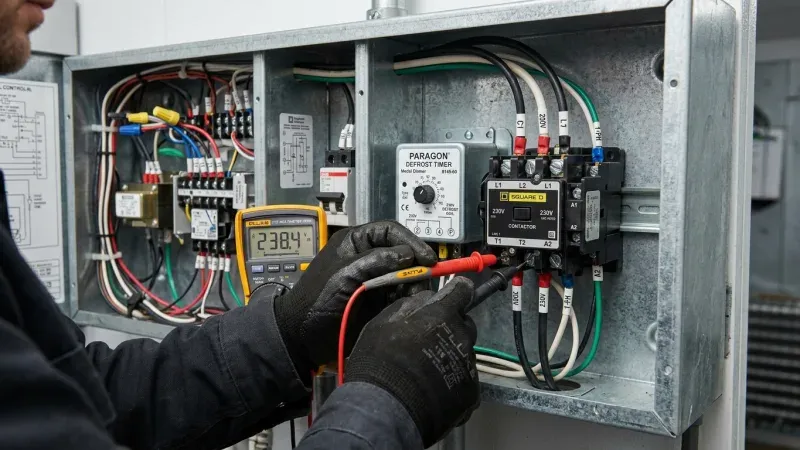
Precision diagnostic execution on commercial gas deck ovens separates factory-trained commercial specialists from general handymen. Commercial gas systems operate without circuit boards or electronic display codes, meaning diagnostic precision depends on True-RMS multimeters, digital dual-port manometers, calibrated thermocouple adapters, and optical surface pyrometers.
The interactive telemetry lookup table below details the exact mechanical and electrical specifications required for 100% factory compliance on Bakers Pride commercial gas deck ovens. Use the search filter bar below to quickly look up diagnostic tolerances, operating millivolts, manifold pressures, and component resistance values.
| Component / Sub-Assembly | Test Instrument | Factory Spec / Telemetry Reading | Failure Threshold / Diagnostic Action |
|---|---|---|---|
| Robertshaw BJWA Thermostat | Calibrated Contact Pyrometer | 650°F Max • Throttles at Setpoint | Fails to drop to low fire; variance > ±25°F requires screw calibration or valve swap |
| Bypass Low-Fire Flame | Flame Observation Depth Gauge | 1/8″ Stable Blue Ribbon Flame | Flame > 1/4″ causes stone heat runaway; flame out causes pilot blowout on throttle |
| Pilot Coaxial Thermocouple (Closed) | True-RMS Multimeter w/ Inline Adapter | 25 mV – 35 mV DC under flame | Reading < 20 mV DC drops safety magnet; immediate thermocouple replacement |
| Pilot Thermocouple (Open Circuit) | Multimeter mV Scale (Unloaded) | 28 mV – 32 mV DC Open Loop | Reading < 22 mV indicates exhausted dissimilar metal junction or oxidized tip |
| Baso Safety Valve Magnet Coil | Digital Ohmmeter (Low-Resistance) | 0.02 Ω – 0.05 Ω Coil Resistance | Open circuit (∞ Ω) or > 0.1 Ω indicates burnt electromagnetic hold-in coil |
| Natural Gas Manifold Pressure | Digital Dual-Port Manometer (W.C.) | 3.50″ W.C. ±0.10″ Full Load | < 3.2″ W.C. starves front burner ports; > 3.8″ W.C. creates carbon lift-off & CO |
| LP Liquid Propane Manifold Pressure | Digital Dual-Port Manometer (W.C.) | 10.00″ W.C. ±0.20″ Full Load | Pressure drop causes sooting, yellow tipping, and delayed crossover flash |
| Inlet Static Gas Supply Pressure | Manometer at Upstream Tap | 7.0″ W.C. (Nat) / 11.0″–13.0″ W.C. (LP) | < 5.0″ W.C. static indicates upstream building gas pipe undersizing or utility fault |
| Combustion Carbon Monoxide (CO) | Flue Gas Combustion Analyzer | < 50 ppm CO Air-Free | > 100 ppm violates OSHA/NFPA limits; requires immediate air shutter adjustment |
| Cordierite Stone Surface Delta | 9-Point IR Pyrometer Matrix | ΔT ≤ 25°F Front-to-Back | ΔT > 50°F confirms burner port clogging, fractured stone, or baffle displacement |
tr[i].style.display = match ? “” : “none”;
Essential OEM Mechanical & Gas Train Components
Maintaining factory-grade thermal consistency in Bakers Pride deck ovens requires strict utilization of genuine OEM specification components. Off-brand or non-commercial replacement parts lack the thermal endurance required to operate inside continuous 650°F commercial kitchen baking chambers. Below are the critical sub-assemblies serviced by our technicians:
Robertshaw BJWA 650°F Throttle-Action Thermostat Valve (OEM #M1004X / #M1005X)
The BJWA valve acts as the mechanical brain of the oven. Manufactured with heavy forged brass bodies, these precision controls feature an integral gas cock, throttling bypass disc, and hydraulic capillary diaphragm calibrated specifically for 300°F–650°F commercial pizza baking ranges. They maintain continuous gas flow during idle periods while providing smooth modulation to eliminate abrupt pressure shocks across the burner ports.
Baso Pilot Combination Safety Valve (OEM #M1086A / #M1086X)
The Baso safety valve is the primary life-safety cutoff device. Powered entirely by the 25–35 mV DC generated by the heated thermocouple, the internal electromagnetic coil holds the gas safety valve open as long as a healthy pilot flame is established. If the pilot flame blows out or is choked by soot, the coil drops out within 90 seconds, sealing 100% of gas flow to both the main burner and pilot burner to prevent unignited fuel accumulation.
Heavy-Duty Coaxial Pilot Thermocouple (OEM #M1087A)
Engineered with heavy-gauge stainless steel outer sheathing and high-conductivity copper inner leads, this 30-millivolt coaxial thermocouple withstands constant immersion in the 1,400°F pilot flame. It converts thermal energy directly into DC millivolts through the Seebeck thermoelectric effect, generating sufficient holding current to energize the Baso pilot magnet coil under extreme commercial operating duties.
Heavy Cast Iron Multi-Port Burner Tubes (OEM #L5011X / #L5012X)
Constructed of dense grey iron, these longitudinal burner castings feature precision-machined venturi throats, integral primary air shutters, and dual rows of raised gas discharge ports alongside crossover flame slots. Their high thermal mass resists warping and thermal buckling under continuous high-fire cycling.
Cordierite & FibraMent 1.5-Inch Refractory Deck Slabs (OEM #T1120X / #T1121Y)
The stone deck tiles provide the thermal reservoir that makes deck oven baking unique. Sintered at temperatures exceeding 2,200°F, these refractory slabs feature uniform microscopic porosity that absorbs excess steam from raw pizza dough while releasing intense conductive heat directly into the bottom crust, creating authentic New York style blistered char without burning.
Commercial Food-Service Preventative Maintenance Schedule
Preventing unexpected mid-service gas breakdowns requires a disciplined preventative maintenance regimen executed by kitchen staff and certified commercial technicians. Pizzerias that adhere to this structured schedule experience 85% fewer catastrophic heating failures and extend deck stone longevity by over a decade.
- Daily (Closing Shift): Use a heavy brass-bristled deck scraper brush to scrape charred cornmeal, flour, and cheese residue toward the front scrape trough. Never use water, liquid chemicals, or wet rags on hot stones, as rapid thermal shock causes catastrophic stone cracking. Clear crumbs from the door hinge channels.
- Weekly: Inspect the lower burner observation door. Verify that pilot flames burn sharp blue with zero yellow sooting. Check that the door counter-weight springs hold the door tightly closed without sagging, preventing front heat wash.
- Monthly: When the oven is completely cold, remove the deck stones using heavy leather suction grips. Vacuum out flour dust and carbon slag from the burner chamber and baffle supports. Inspect cast iron burner ports for flour blockage and brush clear with a stiff wire brush.
- Quarterly / Semi-Annually (Master Technician Service): Perform a comprehensive gas train audit. Check manifold pressure with a digital manometer under full high-fire load. Test thermocouple closed-circuit millivolts with an inline meter. Clean pilot orifices and burner venturis. Recalibrate the BJWA thermostat pointer dial against an optical pyrometer. Test all gas pipe joints for microscopic leaks using non-corrosive bubbling fluid.
Commercial kitchens with comprehensive cooking lineups can also bundle deck oven maintenance with commercial warewashing repair and refrigeration care for complete kitchen reliability.
High-Output Commercial Kitchen Safety Protocols & Gas Codes
Operating high-capacity commercial gas cooking equipment in North Fulton County mandates strict compliance with local municipal building codes, NFPA 54 (National Fuel Gas Code), and NFPA 96 (Standard for Ventilation Control and Fire Protection of Commercial Cooking Operations). Commercial deck ovens consume substantial volumes of fuel gas and ambient oxygen, making kitchen ventilation and safety interlocks essential for life safety.
Every commercial deck oven must be installed directly beneath a dedicated Type-1 commercial kitchen exhaust hood equipped with active grease filters, an automatic Ansul fire suppression system, and a certified make-up air introduction system. The exhaust hood must maintain continuous airflow to remove products of combustion, including nitrogen oxides and trace carbon monoxide. If ventilation anomalies occur, rapid intervention through emergency appliance repair safeguards kitchen staff and patrons.
Furthermore, all flexible stainless gas connectors must be commercial heavy-gauge braided hoses fitted with quick-disconnect couplings, 100% full-port manual shutoff cocks, and mechanical restraint cables. The restraint cable must be shorter than the flexible gas hose to prevent accidental strain on gas pipe threads when rolling the oven out for sanitation. Regular gas leak audits using calibrated electronic combustible gas detectors ensure full compliance and peace of mind across Johns Creek and Roswell restaurants.
Frequently Asked Questions About Bakers Pride Deck Oven Repair
Explore detailed answers to the most common technical questions regarding commercial pizza deck oven operation, thermostat calibration, gas pressure diagnostics, and stone maintenance compiled by our certified technicians.
Why are the bottom crusts burning while the cheese toppings remain unbaked?
This classic baking defect occurs when the conductive heat from the stone deck significantly outpaces radiant infrared heat from the chamber roof. The most frequent mechanical root cause is a Robertshaw BJWA throttle thermostat with an oversized or misadjusted bypass flame screw. When the oven reaches setpoint, the burners fail to drop to low fire, continuously superheating the stone deck beyond 600°F. Alternatively, dislodged bottom heat diverter baffles or cracked deck stones allow intense combustion flame to strike the stone underside directly.
How do you calibrate a Robertshaw BJWA commercial deck oven thermostat?
Thermostat calibration requires a calibrated optical pyrometer or thermocouple probe placed at the geometric center of the middle deck stone. Allow the oven to cycle three times at 500°F. Once the temperature stabilizes, note the temperature discrepancy. Pull off the thermostat dial knob, loosen the two pointer lock screws on the dial plate (without turning the center shaft), rotate the pointer ring until it accurately matches the measured temperature, and re-tighten the screws. Variances exceeding ±50°F cannot be corrected via dial adjustment and indicate internal hydraulic bellows failure requiring a replacement valve.
What causes the pilot light to extinguish whenever the main burner turns off?
When the main burner steps down from high fire to bypass, a momentary pressure drop or air turbulence occurs in the combustion chamber. If the pilot flame is weak, partially clogged with carbon, or misaligned with the thermocouple, this slight draft pulls the flame away from the thermocouple tip. The thermocouple voltage drops below the 20 mV threshold, causing the Baso safety magnet coil to de-energize and instantly seal off all gas flow.
What is the correct manifold gas pressure for a Bakers Pride Y-600 pizza oven?
For standard Natural Gas installations, the operating manifold pressure must be calibrated to exactly 3.50 inches Water Column (W.C.) under full burner firing load. For Liquid Propane (LP) configurations, manifold pressure must be set to 10.00 inches W.C. Inlet static line pressure upstream of the regulator should measure 7.0″ W.C. for Natural Gas and 11.0″–13.0″ W.C. for LP.
Can a cracked Cordierite deck stone be repaired with food-safe refractory mortar?
No. Commercial deck oven manufacturers and local health codes strictly prohibit repairing cracked pizza stones with refractory cements, mortars, or chemical epoxies. Heat cements degrade under intense daily 600°F cycling, releasing toxic particulate powders into baking dough. Furthermore, cements expand at different thermal rates than Cordierite, widening the fracture and creating sharp height ridges that snag pizza peels. Cracked stones must always be replaced with factory OEM refractory tiles.
How does the bypass flame screw differ from the main temperature dial?
The main temperature dial controls the setpoint at which the internal hydraulic diaphragm throttles down the primary gas port. The bypass flame screw, located beneath the dial plate, mechanically sets the minimum floor of gas that remains flowing through a secondary bypass channel even when the primary throttling valve is completely seated. It ensures the burner never completely shuts off, maintaining stable chamber thermodynamics and draft.
Why does the oven make a loud concussive ‘boom’ upon ignition?
Delayed ignition occurs when the cast iron burner crossover ports adjacent to the pilot burner become clogged with carbonized flour or rust scale. Gas flows out of the main ports for several seconds before a flame front can cross over from the pilot flame, creating a cloud of unburned fuel in the lower bay. When the gas cloud finally reaches the pilot flame, it ignites explosively. This condition requires immediate professional burner cleaning and port reaming.
How many millivolts should a healthy commercial deck oven thermocouple generate?
Under a clean, steady pilot flame, an open-circuit (unloaded) 30mV coaxial thermocouple should register 28 mV to 32 mV DC on a digital multimeter. When connected under load to the Baso safety magnet coil using an inline test adapter, the closed-circuit reading should maintain between 25 mV and 35 mV DC. If the voltage drops below 20 mV DC, the electromagnetic coil will struggle to hold open, dropping out unpredictably during kitchen operations.
Can I convert my natural gas Bakers Pride deck oven to liquid propane myself?
No. Gas conversions require certified technicians to replace the main burner orifices (drilling them to smaller LP decimal sizes due to propane’s higher energy density), install an LP pilot orifice spud, convert or replace the internal pressure regulator spring, and recalibrate air shutters. Performing an uncertified conversion creates severe risks of soot accumulation, deadly carbon monoxide emissions, or catastrophic explosion.
Why are pizzas on the left side of my deck baking faster than those on the right?
Lateral heat variance is typically driven by misaligned lower heat diverters, unequal primary air shutter settings across dual burner tubes, or uneven secondary air drafts. If the right burner air shutter is partially closed while the left is open, the left burner burns hotter with complete combustion while the right burner produces a cooler, sooty flame. Inspect the burner bay to ensure both air shutters are locked at identical openings.
How do you season or break in brand-new Cordierite replacement deck stones?
New Cordierite stones contain microscopic moisture absorbed during shipping and manufacturing. Rapidly heating wet stones causes steam pressure to build internally, triggering explosive fractures. Season new stones by bringing the oven up gradually: 200°F for 2 hours, 300°F for 2 hours, 400°F for 2 hours, and finally 500°F for 2 hours. Never apply oil, fats, or chemical coatings to Cordierite stone surfaces.
What causes black soot to collect on the front door and flue of the deck oven?
Black soot is unburned elemental carbon created by incomplete combustion. This occurs when primary air shutters are choked with lint and grease, when flue draft is blocked by closed top dampers, or when incoming gas pressure is excessive. Soot significantly diminishes heat transfer efficiency and generates dangerous carbon monoxide, demanding immediate professional combustion tuning.
Why does the oven take over two hours to preheat to 500°F?
A standard Bakers Pride Y-600 should reach 500°F within 50 to 60 minutes from a cold start. Preheating times stretching beyond 90 minutes indicate gas flow restriction—such as an uncalibrated pressure regulator dropping manifold pressure below 3.0″ W.C., clogged main burner orifices, damaged door perimeter gaskets leaking hot air, or a collapsed Robertshaw thermostat diaphragm unable to open to full high-fire flow.
How often should commercial deck oven gas valves be inspected in North Fulton?
Under continuous commercial food-service operations, gas valves, pilot safety devices, and manifold regulators should undergo formal diagnostic inspection every six months. High-volume dining spots running 12-hour shifts should schedule semi-annual calibrations to prevent unexpected catastrophic burner failures during peak weekend dining volumes.
Can a faulty exhaust hood make-up air unit cause uneven baking in deck ovens?
Yes. If the commercial kitchen hood’s make-up air unit is unbalanced, it can create a strong negative or positive pressure environment in the cookline. Cold make-up air blowing downward directly into the deck oven’s lower burner draft louvers cools the front or side of the burner tubes, causing erratic flame turbulence and creating significant temperature drops across the forward stone quadrants.
What warranty coverage is included with your commercial deck oven repairs?
All commercial deck oven repairs performed by our master technicians include our ironclad 90-day parts and labor warranty. Every installed OEM Robertshaw thermostat, Baso safety valve, thermocouple, and gas regulator is backed by full manufacturer warranties, ensuring your kitchen operates with complete confidence.
Commercial Cooking & Refrigeration Specialized Services
Beyond commercial deck pizza ovens, our master technicians deliver comprehensive diagnostic and restoration services across the full spectrum of foodservice hot-side and cold-side equipment throughout North Fulton County:
- Commercial Appliance Repair – Factory-certified maintenance and emergency restoration for commercial ranges, fryers, steam tables, and conveyor ovens.
- Commercial Oven & Range Repair – High-output gas train calibrations, convection blower motor replacements, and thermocouple diagnostics.
- Commercial Refrigeration Repair – Walk-in coolers, reach-in prep tables, draft beer kegerators, and compressor diagnostics.
- Commercial Dishwasher Repair – High-temperature sanitizing booster heaters, wash pumps, chemical dispensers, and rinse arm overhauls.
We also support commercial hospitality operations requiring factory service for high-capacity commercial laundry systems to maintain clean kitchen linens and uniforms.
Additionally, our certified commercial service fleet handles heavy-duty gas and electric commercial dryer repair across North Fulton restaurant operations.
High-Priority Commercial Kitchen Failure Modes
Our commercial diagnostic rapid-response teams specialize in resolving acute kitchen breakdowns that directly threaten restaurant operating revenues:
- Commercial Gas Burner Ignition Failure: Rapid troubleshooting for blocked crossover ports, oxidized thermocouples, and failing Baso magnetic safety coils.
- Commercial Oven Thermal Runaway: Precision restoration for ruptured hydraulic thermostat capillary bulbs, stuck bypass needles, and uncalibrated manifold regulators.
- Combustion Air Starvation & Soot Accumulation: Comprehensive cleaning of cast iron burner venturis, secondary air shutter recalibration, and flue draft balancing.
Whenever kitchen breakdowns threaten your evening service, our technicians provide immediate emergency appliance repair to restore peak operations.
Commercial Food-Service Brand Specialization
Our technicians maintain extensive factory diagnostic tooling and OEM spare parts inventories for the foodservice industry’s premier cooking and refrigeration manufacturers:
- Viking Cooking Equipment – Heavy-duty range burners, convection bake elements, and gas safety solenoid diagnostics.
- Thermador Commercial Ranges – Star Burner simmer controllers, spark re-ignition modules, and dual-fuel oven thermostats.
- Sub-Zero Refrigeration Systems – Dual compressor diagnostics, electronic defrost boards, and digital thermistor calibration.
We also carry specialized factory diagnostic protocols for Bakers Pride, Blodgett, Garland, Vulcan, Lincoln Impinger, and Middleby Marshall commercial equipment lines.
Greater North Fulton Culinary Coverage Corridor
We deliver rapid 45-minute commercial kitchen dispatch across all major restaurant districts and commercial dining corridors in North Fulton County:
Roswell, GA
Canton Street Historic District, Holcomb Bridge dining hubs, Alpharetta Highway retail strip, and Crabapple corridor.
Alpharetta, GA
Downtown Alpharetta culinary square, Avalon Boulevard bistros, North Point Parkway corridor, and Old Milton restaurant row.
Milton, GA
Historic Crabapple Market gastropubs, Birmingham Crossroads, and Highway 9 commercial establishments.
Johns Creek, GA
Medlock Bridge commercial dining strip, State Bridge culinary centers, and Abbotts Bridge commercial plazas.
Essential Takeaways for Pizzeria Operators
Review these high-level takeaways to safeguard pizza quality, protect profit margins, and maximize equipment operational longevity:
- Thermostat Bypass Calibration is Critical: A Robertshaw BJWA thermostat must throttle down to a stable 1/8-inch low-fire flame; failure to throttle causes rapid stone overheating and charred crusts.
- Maintain 3.50″ W.C. Manifold Pressure: Natural Gas manifold pressure drops below 3.2″ W.C. starve front burner ports, creating severe front-to-back thermal gradients.
- Respect Thermocouple Millivolt Thresholds: A pilot thermocouple must deliver 25–35 mV DC under closed-circuit load; anything below 20 mV causes sudden safety magnet dropouts.
- Never Use Water on Hot Stones: Rapid thermal shock causes deep stress fractures across 1.5-inch Cordierite deck stones; always clean using dry brass deck scrapers.
- Clean Burner Crossover Ports Monthly: Pyrolyzed flour dust and rust scale choke crossover ports, leading to delayed ignition concussive booms.
- Apply the 50% Rule: Rebuilding the OEM gas train for $450–$1,450 adds 8–12 years of service life, saving up to $20,000 compared to new oven replacement.
- Rely on Certified Master Technicians: Precision gas diagnostics and manometer balancing protect against fire hazards, insurance liabilities, and food waste.
Emergency Commercial Kitchen Dispatch & Priority Scheduling
Restore Perfect Pizza Baking Consistency Today
Don’t let uneven heating, charred pizza crusts, or pilot light dropouts compromise your restaurant’s hard-earned reputation. Our master certified commercial technicians deliver fast 45-minute priority dispatch across Canton Street and the greater North Fulton area with fully stocked OEM service vehicles.
45–90 Minute Average Arrival Time
Fully Stocked OEM Service Vans