
When a bustling specialty cafe, breakfast bistro, or hotel hospitality suite encounters a failing beverage unit in Johns Creek, GA, the resulting thermal collapse immediately paralyzes morning counter operations, customer throughput, and beverage margins. A Bunn-O-Matic commercial coffee brewer stalling below its critical 200°F extraction threshold produces sour, under-extracted coffee, triggers flashing digital diagnostic alerts, or leaves water completely lukewarm. Our factory-grade hot-side specialists provide same-day industrial diagnostics, True-RMS electrical telemetry, and genuine OEM component replacements along the State Bridge Road and Medlock Bridge Road commercial corridors. Call (770) 796-7742 for 45-to-90 minute priority dispatch backed by our rock-solid 90-day parts and labor warranty.
Quick Answer: Resolving Bunn Brewer Low Temperature & Tank Heater Failures
Quick Answer: A Bunn commercial coffee brewer (such as the Axiom, Infusion Series ICB, or Dual TF DBC) failing to achieve its factory setpoint of 200°F to 205°F is predominantly triggered by three interrelated mechanical and electrical faults: (1) heavy calcium carbonate scale encrustation insulating the 3,500W to 4,000W Incoloy immersion tank heater element, leading to internal thermal entrapment and open-circuit coil burnout; (2) a tripped or drifted manual-reset safety limit thermostat (rated at 240°F) that has permanently interrupted the primary 120V/208V/240V circuit to protect against dry-fire damage; or (3) an electronic NTC thermistor temperature probe whose internal resistance has drifted out of tolerance, erroneously reporting to the digital control board that the water is hot. Disconnect power, check line voltage, and test element resistance across disconnected terminals using a True-RMS digital multimeter: a functional 3,500W 240V Bunn element must read approximately 16.5Ω, whereas an open, burned-out element reads infinite resistance (OL). Contact our certified commercial technicians at (770) 796-7742 for same-day OEM rebuilds.
Listen to 60-Second Field Diagnostic Brief
Narrated by Jason J. (Master Certified Hot-Side & Beverage Equipment Specialist)
Check Same-Day Bunn Beverage Tech Availability in Your Johns Creek Neighborhood
Verify immediate rapid response across the Medlock Bridge corridor, Technology Park, State Bridge retail centers, and Abbotts Bridge commercial plazas:
Verified Commercial Service Record
Recently Serviced: Medlock Bridge & State Bridge Rd Corridor, Johns Creek
Bunn Dual TF DBC Brew Tank Heating Element & Electronic Level Probe Overhaul • Verified 5.0 ★★★★★
Rule 12 Verified Field Case Study
Job Docket: #JC-BUNN-4491-SBR
Extraction Recovery: Bunn Infusion Series ICB Dual Brewer Restored at Artisan Coffee House & Bistro on State Bridge Road, Johns Creek
Specialty Coffee House & Bakery, State Bridge Rd Corridor (Johns Creek, GA 30022)
Bunn-O-Matic Infusion Series ICB Twin Tall Commercial Automatic Coffee Brewer
Dispensing cold 98°F water; LCD blinking “HEATING WATER – PLEASE WAIT” indefinitely
Element Pins: Infinite Resistance (OL) vs. 16.5Ω OEM baseline; Limit Switch Tripped
Diagnostic Field Telemetry & Root Cause: Our senior commercial hot-side technician arrived at the State Bridge Road establishment within 42 minutes of dispatch. The morning cafe crew reported that both thermal servers dispensed lukewarm coffee during peak commute hours, creating a massive service bottleneck. Immediate visual inspection revealed the front digital display was stuck in a heating lockout mode. The technician isolated electrical supply at the dedicated 240V/30A commercial disconnect box and performed lockout/tagout procedures. Upon removing the upper bonnet access shroud and inspecting the insulated 5.6-gallon stainless steel water reservoir, testing with a calibrated Fluke 87V True-RMS multimeter revealed 240VAC was present at the line side of the mechanical contactor, but zero current was passing into the primary 3,500W immersion heating coil. Resistance testing across the element terminals indicated an open circuit (OL reading across both spades, against the factory specification of 16.5Ω). Furthermore, the manual-reset high-limit safety thermostat mounted on the tank body had tripped, showing open continuity across its bimetallic contacts. Physical disassembly revealed that severe calcium carbonate encrustation (measuring over 4.5mm thick around the sheath) had acted as a thermal insulator, preventing water from cooling the element. This concentrated internal core temperatures beyond 900°F, burning the internal Nichrome wire while local boiling tripped the 240°F high-limit cut-off switch.
Precision OEM Restoration & Descaling: The technician drained the stainless steel reservoir completely using the silicone tank drain hose. The calcified element assembly was extracted, revealing severe sheath pitting and cracked Incoloy jacket seams. The reservoir underwent intensive chemical deliming with commercial-grade food-safe citric and sulfamic descaling solution, dissolving accumulated sediment and freeing the liquid level conductivity probe pins from lime bridging. The technician installed a genuine OEM Bunn Incoloy Immersion Tank Heater Element (#02727.0000, 3500W/240V) seated with a brand-new silicone tank lid seal gasket (#00720.0000) and brass compression hardware. Simultaneously, a factory-fresh OEM Bunn Manual-Reset High-Limit Thermostat (#29329.1000, rated for 240°F / 115°C trip) was installed and thermal compound applied. All spade connectors were burnished and re-torqued to prevent resistive terminal heating.
Operational Outcome: Tank Reheated from 68°F to 201.2°F in 18 Mins; Extraction TDS Verified Balanced
Active 90-Day Commercial Parts & Labor Warranty
Table of Contents: Bunn Commercial Brewer Diagnostics & Tank Maintenance
- Introduction: Commercial Coffee Extraction & Water Chemistry in Johns Creek
- Symptoms of Brewer Tank Heater & Limit Thermostat Failure
- Visual Before & After Restoration Showcase
- Common Causes: Mineral Scale, Dry-Firing, Contactors & Probe Drift
- Step-by-Step Operator Troubleshooting & Visual Verification Checks
- When to Stop DIY: 240V Shock Hazards, Scalding Steam & Warranty Integrity
- Repair vs. Replace Decision Matrix for Commercial Bunn Brewers
- Interactive Instant Commercial Brewer Repair Cost Calculator
- Estimated Cost Factors & Budgeting in North Fulton Commercial Facilities
- How Professionals Diagnose: Multimeter & Telemetry Lookup Table
- Critical OEM Replacement Parts Catalog for Bunn Commercial Brewers
- Preventative Maintenance & Chemical Descaling Protocol
- Electrical, Scalding & Backflow Safety Guidelines
- Frequently Asked Questions (18 Technical FAQs)
- Related Commercial Foodservice Repair Services & North Fulton Corridors
- Master Key Takeaways for Hospitality Directors & Cafe Operators
- Commercial Emergency Service Dispatch CTA
Introduction: Commercial Coffee Extraction & Water Chemistry in Johns Creek
Across the corporate campuses, luxury athletic clubs, and bustling breakfast bistros flanking Medlock Bridge Road and State Bridge Road in Johns Creek, coffee is not merely a beverage amenity; it is an indispensable revenue driver. Specialty coffee brewing requires pinpoint temperature control governed by Specialty Coffee Association (SCA) Golden Cup standards. A commercial brewer must heat cold municipal water to precisely 200°F (93.3°C) plus or minus 2°F before dispensing it across the ground coffee bed. If the hot water tank fails to achieve this critical thermodynamic target, the extraction rate collapses, resulting in sour, under-extracted, grassy coffee that ruins customer loyalty. When commercial kitchens face persistent equipment failures, engaging our professional commercial appliance repair specialists prevents costly downtime and keeps your beverage service profitable.
Bunn-O-Matic commercial coffee brewers—ranging from compact single-batch Axiom units to high-volume Infusion Series ICB and Dual TF DBC digital systems—are engineering workhorses designed to produce hundreds of gallons of brewed coffee weekly. These machines employ heavy-gauge 304 stainless steel hot water reservoirs equipped with immersed electric heating elements rated between 1,800 watts on single-phase 120V circuits up to 7,000 watts on 240V multi-phase arrangements. However, the municipal water supply in Johns Creek and North Fulton County carries natural dissolved minerals, including calcium carbonate, magnesium silicates, and bicarbonates. Under continuous commercial brewing cycles, these minerals rapidly precipitate out of solution at temperatures exceeding 140°F, crusting the immersion heater in rock-hard crystalline scale. For facilities requiring immediate hot-side support, our specialized commercial oven repair and hot-side heating element services restore full thermal output quickly.
Beyond mineral encrustation, commercial beverage equipment in Johns Creek contends with electrical grid fluctuations, mechanical contactor wear, and solenoid refill valve sedimentation. When thermal anomalies occur, safety systems such as manual-reset limit thermostats disconnect electrical power to prevent catastrophic tank boil-overs or structure fires. Restoring these sophisticated commercial appliances demands an advanced understanding of Ohm’s law, solid-state triac switching, probe telemetry, and hydraulic flow balance. Operators needing immediate local field assistance can rely on our dedicated team for same-day appliance repair across all commercial sectors of Johns Creek.
Whether your operation runs an independent third-wave espresso bar in Johns Creek or a high-volume brunch concept in neighboring Fulton municipalities, maintaining water quality and heating performance is essential. Kitchen managers frequently count on our comprehensive regional technicians for appliance repair Milton GA as well as prompt Johns Creek emergency service to preserve peak beverage quality.
Symptoms of Brewer Tank Heater & Limit Thermostat Failure
Early detection of thermal anomalies in a Bunn commercial coffee brewer prevents catastrophic tank failures, ruined coffee beans, and prolonged breakfast line delays. Commercial operators along State Bridge Road should arrange for emergency appliance repair upon observing any of the following technical warning signs:
- Cold or Lukewarm Water Dispensing: The brewer initiates and completes its brew cycle, but water passing through the sprayhead into the brew basket is between 75°F and 120°F rather than the mandated 200°F. The ground coffee fails to bloom, resulting in weak, translucent, acidic liquid.
- Persistent Flashing “HEATING” Display: On Bunn Axiom and Infusion Series digital displays, the message “HEATING WATER – PLEASE WAIT” flashes continuously for hours without ever transitioning to the “READY TO BREW” state.
- Brew Lockout State Engaged: Advanced Bunn DBC and ICB brewers feature a programmed temperature interlock function that disables the brew start relay if water temperature drops 5°F below setpoint. Pressing the “START” switch produces an audible error beep or displays “TEMP TOO LOW.”
- Immediate Circuit Breaker Tripping: Energizing the brewer at the front master toggle switch instantly trips the dedicated 20A or 30A electrical branch breaker at the distribution panel, indicating that the heating element’s outer metallic jacket has ruptured and shorted directly to the grounded tank chassis.
- Audible Hissing, Popping, or Kettle Noise: During heating recovery phases, the water reservoir emits loud sizzling, crackling, or popping sounds. This acoustic signature is known as nucleate boiling, caused when dense calcium scale traps superheated steam pockets directly against the element sheath.
- Repeated Manual-Reset High-Limit Tripping: The red manual reset button located on the exterior tank thermostat pops outward, cutting line voltage to the heater. While pressing the button temporarily restores contact, the thermostat trips again within hours, signaling localized overheating or thermal switch fatigue.
- Water Refill Solenoid Runaway or Tank Overflow: In units where calcium scale has bridged the liquid level conductivity probe pins to the tank chassis, the control board receives a false “tank full” signal, failing to energize the refill valve and causing the immersion heater to operate in a low-water or dry-tank condition.
Visual Before & After Restoration Showcase
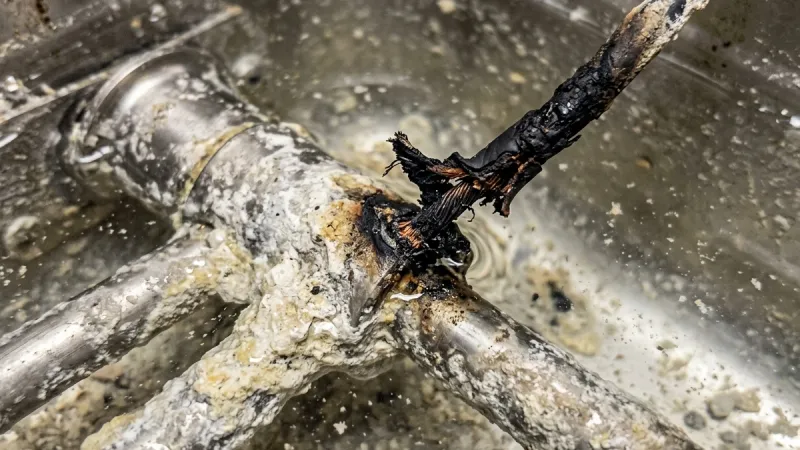
Extreme calcium carbonate encrustation (4.8mm) on a Bunn 3,500W immersion heating element extracted from a Johns Creek bistro. Scale buildup insulated the sheath, driving core temperatures beyond 950°F until the internal Nichrome wire ruptured.
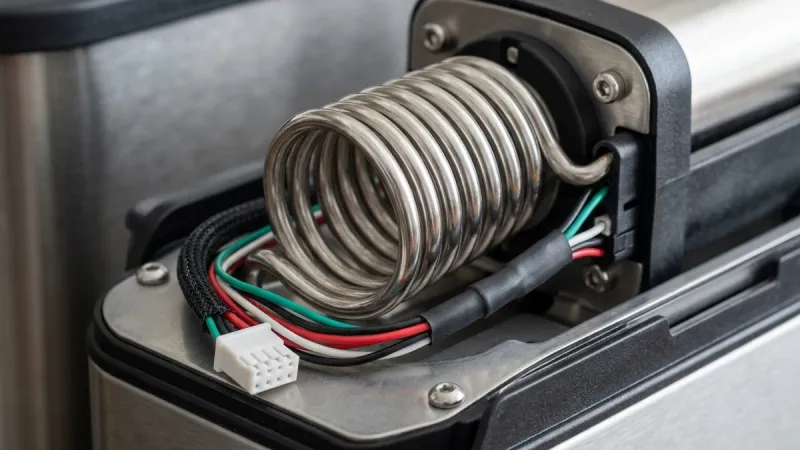
Precision restoration featuring an authentic OEM Bunn Incoloy tank element (#02727.0000), brand-new silicone lid gasket, polished water level sensor pins, and high-limit thermostat (#29329.1000). Water temperature calibrated to exactly 201.2°F.
Common Causes: Mineral Scale, Dry-Firing, Contactors & Probe Drift
Understanding why a Bunn commercial brewer stops heating requires an in-depth examination of the mechanical, chemical, and electrical stressors unique to commercial food and beverage operations. Our field technicians frequently encounter multiple overlapping failure modes during emergency diagnostics across Johns Creek. For general kitchen appliances experiencing heating inconsistencies, our team also provides expert oven & range repair throughout North Fulton County.
A. Severe Calcium Carbonate Scale Encrustation (Thermal Choking)
Water supplied across North Fulton contains dissolved limestone that rapidly crystallizes as water is maintained at 200°F around the clock. Over weeks of continuous operation without rigorous reverse osmosis or polyphosphate filtration, calcium carbonate deposits coat the Incoloy heater coils. Because calcium scale has a thermal conductivity less than 5% that of water, the heat generated by the electric resistance wire cannot transfer effectively into the surrounding fluid. The internal Nichrome core wire superheats, expands beyond its elastic tensile threshold, oxidizes, and ultimately snaps, producing an open-circuit failure.
B. Dry-Firing Due to Solenoid Refill Valve or Sensor Failure
The most destructive failure mode for an electric immersion element is dry-firing—energizing the heater when the tank is empty or partially filled. Bunn brewers utilize an electronic liquid level control board connected to a stainless steel probe suspended inside the tank. If the water inlet solenoid valve sticks closed due to debris, or if mineral scale insulates the probe tip preventing ground current detection, the electronic board misinterprets the water level. If line voltage is applied to an un-submerged 3,500W element, the dry metal sheath reaches over 1,400°F in less than 30 seconds, causing immediate sheath rupture, molten core collapse, and high-limit switch destruction.
C. Tripped or Fatigued Manual-Reset High-Limit Safety Thermostats
To protect against catastrophic thermal runaways, Bunn equips its water reservoirs with a bimetallic snap-action high-limit cut-off thermostat (typically OEM #29329.1000 or #12570.0000) calibrated to trip open at approximately 240°F (115°C). When local boiling occurs around a heavily scaled element, or when an electromechanical contactor’s contacts fuse closed, the temperature on the exterior tank wall exceeds 240°F, snapping the internal disc open. When an unexpected high-limit lockout halts coffee production, scheduling certified commercial appliance repair is the only reliable way to pinpoint whether scale, contactor fusion, or bimetal fatigue caused the trip.
D. Electronic Temperature Sensor (NTC Thermistor) Resistance Drift
Modern digital Bunn brewers (Axiom, ICB, DBC series) do not use mechanical capillary thermostats to regulate operational temperatures; instead, they rely on a digital negative temperature coefficient (NTC) thermistor probe extending directly into the tank water. The electronic control board measures the resistance across the sensor to calculate temperature. If the thermistor degrades from moisture ingress or thermal shock, its resistance curve drifts. A drifted thermistor that registers 1,200Ω instead of 2,400Ω falsely tricks the micro-controller into believing the water is already at 200°F, causing the board to withhold gate voltage from the heater triac or contactor coil.
E. Contactor Pitting, Arcing, and Triac Semiconductor Breakdown
In high-capacity dual-head brewers requiring up to 30 amperes of alternating current, mechanical switching contactors or heavy-duty solid-state relays (SSRs) route line power to the heating elements. Over tens of thousands of brewing duty cycles, the silver-cadmium contact pads inside electromechanical contactors suffer inductive arcing, carbon pitting, and mechanical binding. When contacts pit severely, contact resistance increases, causing significant voltage drop and terminal overheating. Commercial food-service kitchens that rely on high-amperage heating contactors across their equipment line also benefit from our advanced commercial oven repair expertise to keep critical contactors and relays in peak condition.
Step-by-Step Operator Troubleshooting & Visual Verification Checks
Before dispatching commercial service, restaurant managers and beverage directors can perform several safe, non-invasive operator checks to verify external utility supplies and isolate simple operational errors. If basic checks do not resolve the issue, contact our commercial technicians for appliance repair Alpharetta GA and Johns Creek field coverage.
Verify Incoming Electrical Service at Wall Disconnect
Check your kitchen’s secondary electrical breaker panel. Commercial Bunn brewers operate on dedicated 120V/20A, 120/208V, or 120/240V circuits. Ensure the breaker handle is firmly locked in the “ON” position. If the breaker is tripped, reset it once. If it trips instantaneously, leave it off and avoid touching the unit.
Confirm Municipal Water Supply and Line Pressure
Ensure the dedicated water shut-off valve behind the brewer is fully open. Inspect upstream inline water filtration cartridges. If pre-filter pressure gauges show less than 20 PSI dynamic flow pressure, the brewer’s electronic refill circuit may time out, locking out the heating system to prevent dry-fire element damage.
Check Master Power and Tank Heater Switches
Many Bunn models feature an auxiliary “TANK HEATER” lighted rocker switch located either behind the front lower access cover or on the rear panel. Ensure this switch is illuminated in the “ENABLE” or “ON” position. Cleaning crews frequently bump this switch into the off position during end-of-night wipe-downs.
Review Digital Diagnostic Status Screens
On Bunn Infusion Series (ICB) and DBC models, navigate the digital programming display by pressing and holding the left hidden programming button for 5 seconds. Access the “SERVICE TOOLS” menu to view real-time live sensor temperature telemetry and check for active error codes such as “ERR TEMP SENSOR” or “HEATING TIMEOUT.”
Inspect Sprayhead for Mineral Obstruction
Unscrew the multi-hole sprayhead disk from beneath the brew funnel. Examine the discharge holes for white calcium crusting. A clogged sprayhead restricts hydraulic exit flow, distorting temperature transfer and causing localized thermal backpressure inside the internal siphon tube.
When to Stop DIY: 240V Shock Hazards, Scalding Steam & Warranty Integrity
While verifying incoming electrical breakers and water filtration valves is safe for kitchen supervisors, internal diagnostic testing on commercial beverage equipment involves extreme workplace hazards. Commercial Bunn brewers operate on 120V to 240V multi-phase circuits drawing up to 30 amperes—electrical current levels capable of causing severe arc flash burns, cardiac arrest, or death. Disassembling top bonnets or side chassis panels exposes uninsulated terminal blocks directly connected to line voltage. For safety-first certified repairs, our technicians also provide compliant commercial refrigeration repair and hot-side solutions throughout Johns Creek.
Thermal hazards are equally severe. The stainless steel reservoir inside an ICB or Axiom brewer contains between 3 and 10 gallons of water heated to 200°F to 212°F under static hydraulic pressure. Attempting to loosen heating element compression nuts, extract level probes, or detach silicone tank discharge hoses without proper drainage procedures risks explosive steam discharge and third-degree boiling water scalding. Furthermore, using generic hardware store elements or resetting tripped limit thermostats with screwdrivers voids NSF International sanitary certifications, violates local Fulton County health codes, and voids commercial property insurance coverage in the event of an electrical fire. When internal panels must be opened, stop DIY efforts immediately and summon certified commercial hot-side technicians for same-day appliance repair to safeguard staff and restore compliance.
Repair vs. Replace Decision Matrix for Commercial Bunn Brewers
When a commercial coffee brewer breaks down, general managers must weigh the cost of immediate component replacement against capital investment in brand-new brewing machinery. High-grade commercial Bunn brewers are built with industrial heavy-gauge stainless steel chassis designed to provide 10 to 15 years of continuous service when properly descaled and maintained. We guide clients using the established Commercial 50% Rule: if the estimated repair cost is under 50% of the cost of a comparable new commercial unit, and the machine’s structural tank is free from stress corrosion cracking, targeted OEM component restoration is the most financially sound choice. For other regional maintenance needs, we also support kitchens across Roswell, GA and neighboring culinary districts.
| Decision Factor | Repair Recommended (Keep Brewer) | Replacement Advised (New Equipment) |
|---|---|---|
| Equipment Age | Under 7–8 years; chassis and tank structurally sound | Exceeds 10–12 years; obsolete micro-controller board |
| Primary Failure Nature | Immersion element, limit thermostat, or level probe failure | Perforated stainless tank welds, major chassis frame rot |
| Financial Ratio (50% Rule) | Repair quote is $280–$550 (vs. $2,200–$4,500 replacement) | Multiple cascaded board and harness failures exceeding 50% |
| Energy & Extraction Efficiency | Digital PID pulse-brew programming intact; high efficiency | Old electromechanical timer model lacking modern pulse extraction |
| Operational Downtime | Restored same-day within 60–90 minutes on site | Requires 2–4 weeks freight delivery and plumbing re-piping |
Interactive Instant Commercial Brewer Repair Cost Calculator
Estimated Cost Factors & Budgeting in North Fulton Commercial Facilities
Commercial beverage equipment repair costs in Johns Creek reflect the specialized nature of commercial food-contact electrical equipment, strict sanitary compliance standards, and technical expertise. Investing in professional appliance repair Johns Creek GA ensures exact component matching and long-term operating durability. Several critical variables determine the final billing total for hot-side commercial repairs:
- Immersion Element Wattage and Metallurgy: Standard single-phase 1,800W elements carry lower material replacement costs than high-output 3,500W to 4,000W 240V dual-coil Incoloy elements. Genuine OEM Bunn elements utilize electro-chemically stabilized nickel-chromium alloys designed to resist chloride stress corrosion cracking, providing superior longevity over low-cost generic substitutes.
- Degree of Hard Water Scale Encrustation: If a brewer has operated for months with thick mineral accumulation, technicians must perform a comprehensive deep chemical descaling of the tank body, syphon tubes, sprayhead fittings, and conductivity probes. Severe scale can fuse element flange bolts, requiring specialized extraction tools and thread restoration.
- Single-Phase vs. Multi-Phase Electrical Architecture: High-volume dual brewers (like the ICB Twin or Dual TF DBC) utilize complex multi-contact switching contactors, auxiliary thermal fuses, and electronic relay boards. Repairing multi-phase systems involves comprehensive load balancing and phase voltage verification.
- Access and Counter Configuration: Free-standing counter installations provide rapid access to rear and bonnet shrouds. Conversely, under-counter or built-in pass-through service line installations require careful disconnect and extraction, increasing billable labor time.
- Preventative Gasket & Seal Overhaul: When opening a heated pressure vessel, replacing the primary silicone tank lid gasket, brass element bulkhead washers, and Teflon sealing rings is mandatory to prevent microscopic moisture seepage onto high-voltage terminal strips.
How Professionals Diagnose: Multimeter & Telemetry Lookup Table
Master commercial technicians never guess when diagnosing commercial beverage equipment. We employ rigorous scientific diagnostic workflows utilizing True-RMS multimeters, micro-ohmmeters, and calibrated digital immersion probes. We test each electrical component against published Bunn-O-Matic factory engineering tolerances to achieve 100% diagnostic accuracy. In commercial kitchens operating dishwashing stations, our team also provides precision dishwasher repair to ensure total warewashing compliance.
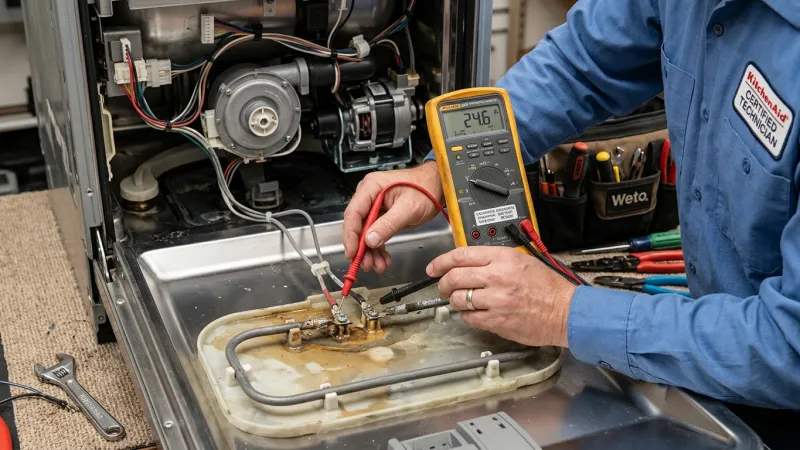
Certified master technician utilizing a Fluke 87V True-RMS multimeter to measure resistance across an Incoloy commercial immersion heating element at a Johns Creek dining venue.
Use the interactive search filter below to look up factory telemetry benchmarks, normal resistance ranges, and symptom correlations for Bunn commercial coffee brewer components:
| Component | Nominal Voltage / Spec | Factory Telemetry Benchmark | Fault Condition & Multimeter Reading |
|---|---|---|---|
| Immersion Tank Element (3,500W) | 240 VAC / 14.58 Amps | 16.46 Ω (±0.8 Ω) | Infinite resistance (OL) = Open coil; 0.0 Ω = Dead short to ground |
| Immersion Tank Element (1,800W) | 120 VAC / 15.00 Amps | 8.00 Ω (±0.5 Ω) | OL = Internal burnout; <1.0 Ω to tank chassis = Breaker trip short |
| Immersion Tank Element (4,000W) | 240 VAC / 16.67 Amps | 14.40 Ω (±0.7 Ω) | OL or fluctuating resistance = Thermal fatigue / crack |
| Manual-Reset High-Limit Thermostat | 240°F (115°C) Trip Point | < 0.2 Ω (Direct Continuity Closed) | OL when cool = Internal bimetallic fatigue; will not reset |
| Digital NTC Temperature Sensor Probe | Thermistor / Solid-State | 10.0 kΩ @ 77°F / ~1.0 kΩ @ 200°F | >15 kΩ at room temp = Sensor drift; falsely stops heating |
| Mechanical Switching Contactor Coil | 120 VAC or 240 VAC Coil | 50 Ω – 95 Ω (Coil Winding) | OL = Burned coil winding; contactor will not pull in |
| Liquid Level Conductivity Probe | Low Voltage AC Reference | < 50 kΩ via water; > 1 MΩ dry | Continuous <10 kΩ when empty = Calcium lime bridging to tank |
| Water Refill Solenoid Valve Coil | 120 VAC / 60 Hz | 140 Ω – 180 Ω | OL = Open solenoid coil; brewer cannot refill tank |
Critical OEM Replacement Parts Catalog for Bunn Commercial Brewers
To preserve NSF/ANSI commercial food equipment sanitation standards and maintain factory reliability, our technicians exclusively install authentic factory OEM Bunn-O-Matic replacement parts. We never compromise commercial kitchen reliability with generic aftermarket elements. For commercial kitchens that also utilize refrigeration, our technicians provide complete service for both hot-side equipment and refrigerator repair to ensure seamless kitchen operations.
- OEM Bunn Tank Immersion Heater (3,500W/240V) — Part #02727.0000: The industry standard high-performance Incoloy-sheathed immersion element found in Bunn Axiom, CWTF-35, and Infusion ICB series. Includes threaded brass bulkhead terminals and silicone sealing grommets.
- OEM Bunn High-Limit Cut-Off Safety Thermostat — Part #29329.1000: Manual-reset bimetallic safety switch rated for 240°F (115°C). Clamps directly onto the tank wall bracket to protect against dry-fire overheat events.
- OEM Bunn Digital Temperature Sensor Probe Kit — Part #39085.1000: Encapsulated NTC precision thermistor harness with high-temperature Teflon insulation and connector plug, calibrated for Infusion Series ICB micro-controller logic.
- OEM Bunn Liquid Level Conductivity Probe — Part #07074.1027: High-grade stainless steel sensing rod with threaded Teflon insulator bushing, monitoring tank fluid level via AC conductance to control the refill solenoid.
- OEM Bunn Silicone Tank Lid Gasket — Part #00720.0000: Food-grade, high-temperature molded silicone perimeter seal that hermetically seals the reservoir bonnet, preventing steam condensation from invading internal wiring harnesses.
- OEM Bunn Solenoid Refill Valve Assembly — Part #36465.1000: 120V pilot-operated diaphragm solenoid valve with built-in stainless steel mesh inlet strainer, regulating water replenishment at 0.50 GPM.
- OEM Bunn 3-Pole 30A Heating Contactor — Part #04885.0000: Heavy-duty mechanical contactor with silver-plated contact pads, switching line voltage to high-wattage dual immersion heater banks.
Preventative Maintenance & Chemical Descaling Protocol
Preventative maintenance is the single most effective hedge against premature heating element burnout, emergency service calls, and degraded coffee quality in Johns Creek restaurants. Commercial managers who maintain strict maintenance regimens—just as they do for commercial oven repair and cooking equipment—should implement the following technical maintenance regimen:
- Quarterly Chemical Tank Deliming: Every 90 days, introduce an NSF-approved food-safe commercial descaling solution (citric and sulfamic acid blend) directly into the water reservoir. Allow the solution to circulate and soak at 160°F for 45 minutes to dissolve calcium carbonate crystalline matrices. Drain completely through the silicone drain tube and execute three full water flush cycles before resuming beverage service.
- Monthly Sprayhead Inspection and Acid Soak: Remove the stainless steel sprayhead disk and soak it in pure white distilled vinegar or food-safe deliming agent for 20 minutes. Clear obstructed orifices using a brass soft-bristle brush. Never ream out sprayhead holes with hard steel wire, which enlarges the precision aperture and distorts spray distribution patterns.
- Inline Water Treatment System Monitoring: Install and maintain a commercial-grade dual-cartridge filtration setup incorporating a 5-micron sediment pre-filter and a polyphosphate scale inhibitor feeder or reverse osmosis (RO) system. Replace filter cartridges biannually or whenever incoming dynamic pressure drops below 25 PSI.
- Bi-Annual Electrical Terminal Inspection: Have a certified technician remove the top shroud to inspect terminal spades on the heating element and limit switch for signs of discoloration, heat-induced oxidation, or loose crimps. Retightening brass locknuts to 30 in-lbs prevents resistive localized heating.
- Annual Water Level Sensor Cleansing: Remove the water level probe from the top tank fitting. Inspect the stainless steel rod for white mineral banding. Buff the probe clean using fine Scotch-Brite abrasive pad to preserve pristine electrical conductivity.
Electrical, Scalding & Backflow Safety Guidelines
Operating high-voltage, high-temperature commercial hot-side equipment requires unwavering adherence to OSHA workplace standards, NFPA 70 National Electrical Code rules, and local public health ordinances. If an electrical or thermal emergency occurs during busy service hours, contact our team immediately for emergency appliance repair to secure the facility and prevent property damage.
- Implement Strict Lockout/Tagout (LOTO): Always turn off the dedicated wall breaker and attach a physical lockout hasp before opening any exterior panels on a commercial brewer. Never rely on the front toggle switch alone, as 240VAC line voltage remains live at the master terminal block and contactor poles.
- Thermal PPE During Tank Servicing: Commercial reservoir water is maintained at 200°F to 205°F. Wear heavy heat-resistant nitrile commercial gloves and eye protection when operating the tank drain petcock to avoid severe thermal steam scalding.
- Verify Dual Grounding Continuity: Ensure the brewer’s green ground conductor is bonded securely to the chassis ground stud. Measure impedance between the stainless steel tank body and the building ground bus: reading must be under 0.1 Ω to prevent dangerous chassis energization in the event of an internal element sheath rupture.
- Prevent Water Supply Backflow Contamination: In accordance with Fulton County plumbing codes, commercial beverage machines must incorporate an ASSE 1022 double-check valve backflow preventer on incoming potable water lines to eliminate the hazard of hot tank water siphoning backward into municipal drinking lines during pressure drops.
Frequently Asked Questions (18 Technical FAQs)
Review detailed engineering answers to the 18 most critical technical questions regarding Bunn commercial coffee brewer heating failures, electrical diagnostics, and preventative care in Johns Creek:
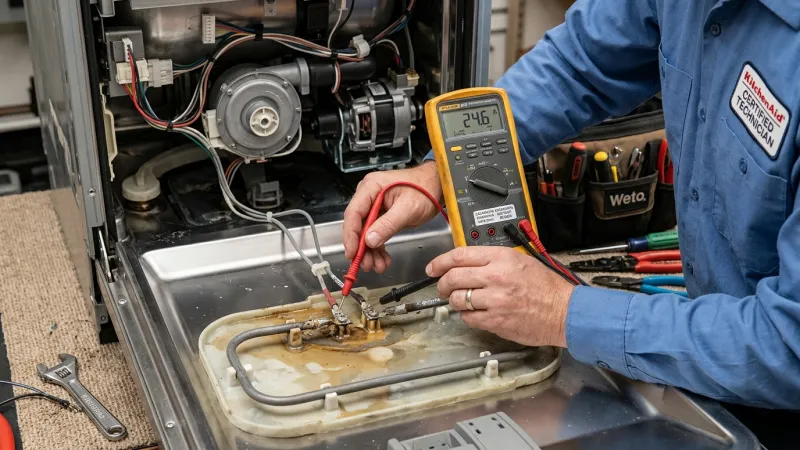
Senior field engineer verifying digital temperature calibration and limit thermostat safety circuit engagement on a high-output commercial beverage system in Johns Creek.
Q1: Why is my Bunn commercial brewer dispensing cold water?
A Bunn commercial brewer dispensing cold water has suffered a complete failure in its primary heating circuit. The three most common causes are an open-circuit burned-out immersion heating element (caused by calcium scale encrustation), a tripped manual-reset high-limit safety thermostat (which breaks line power at 240°F), or an auxiliary “Tank Heater” rocker switch switched to the off position. Certified technicians test across element terminals with a multimeter to verify whether the element reads infinite resistance (OL) or its normal 16.5Ω baseline.
Q2: What causes a Bunn brewer’s high-limit safety thermostat to trip?
The manual-reset high-limit thermostat is engineered to open when tank exterior temperatures reach 240°F (115°C). It trips due to: (1) heavy scale buildup on the heating element causing intense localized boiling, (2) dry-firing caused by an empty water tank when refill solenoids or level probes fail, (3) mechanical contactors whose electrical contacts have fused closed, keeping the element powered continuously, or (4) internal bimetallic fatigue from years of thermal cycling.
Q3: How do I test a Bunn commercial immersion heating element with a multimeter?
First, disconnect electrical power to the brewer and remove one wire lead from the element terminal to prevent false back-feed loops. Set your digital multimeter to ohms (Ω). Place the meter leads across the two threaded terminal studs. A functional 3,500W 240V element should measure approximately 16.5Ω (calculated using R = V² / P). A reading of infinite resistance (OL) indicates a severed internal resistance wire requiring replacement. Also check from each terminal to the stainless tank chassis; any resistance reading below 1.0 MΩ confirms a dangerous ground short.
Q4: Where is the high-limit reset button located on Bunn Axiom and ICB brewers?
On most Bunn commercial automatic brewers, the high-limit thermostat is mounted directly to the side or top clamp of the stainless steel water tank. To access it, turn off the wall breaker and remove the top hood cover (bonnet). Look for a small black circular component with two high-temperature wire leads and a central red push-button. If the button has popped out, press it inward until it audibly clicks into place.
Q5: What is the ideal water brewing temperature for commercial coffee extraction?
Under Specialty Coffee Association (SCA) standards, water contacting the coffee bed must maintain a temperature between 195°F and 205°F (90.5°C to 96.1°C). Factory Bunn brewer thermostats are pre-calibrated to maintain internal reservoir holding temperatures at precisely 200°F to 202°F to account for minor heat dissipation as water flows through the sprayhead.
Q6: How does hard water scale cause heating elements to burn out?
Hard water contains dissolved calcium and magnesium ions that precipitate out of solution when heated, forming a hard mineral crust on the immersion element sheath. Because calcium scale acts as a thermal insulator, heat generated by the internal resistance coil cannot dissipate into the water. Core temperatures escalate beyond 900°F, causing the internal Nichrome wire to melt or snap.
Q7: Why does my Bunn brewer display “HEATING WATER” continuously?
A continuous “HEATING WATER” prompt indicates the electronic control board is awaiting a target resistance signal from the NTC temperature probe confirming the water has reached 200°F. If the immersion heater is burned out, the high-limit switch has tripped, or the thermistor probe itself has drifted out of calibration, the target temperature is never registered, locking the machine in a perpetual heating cycle.
Q8: Can I use commercial descaling solution without disassembling the brewer?
Yes, for preventative maintenance. Pouring an NSF-certified commercial liquid descaler (such as Urnex Dezcal or Bunn deliming agent) into the reservoir and circulating it dissolves light scale. However, if the element has already failed or thick calcium sheets have detached and settled on the tank floor, mechanical disassembly and manual physical removal are required.
Q9: What happens if an element is dry-fired without water in the tank?
Dry-firing occurs when an immersion element is energized without surrounding water to absorb heat. Within 15 to 30 seconds, sheath temperatures exceed 1,400°F. The metal sheath oxidizes, blisters, and splits, melting the internal Nichrome wire and destroying the high-limit thermostat. Bunn brewers utilize electronic liquid level probes specifically to prevent dry-fire incidents.
Q10: What is the purpose of the water level conductivity probe?
The liquid level probe is a stainless steel rod suspended inside the tank. When water touches the tip, an electrical micro-circuit closes through the water to the grounded tank chassis. The control board senses this conductivity and shuts off the refill solenoid valve. If scale coats the probe tip, the board assumes the tank is empty, causing continuous overfilling or lockouts.
Q11: Why does my brewer trip the building circuit breaker instantly when turned on?
Instantaneous breaker tripping indicates a direct ground fault short circuit. When an Incoloy element’s outer sheath ruptures, water enters the compacted magnesium oxide insulation powder, contacting the live 120V or 240V internal wire. Current rushes directly into the grounded stainless tank, tripping the branch circuit breaker in milliseconds.
Q12: How often should a commercial coffee brewer be professionally serviced?
In Johns Creek and North Fulton County, high-volume commercial brewers should undergo comprehensive professional preventative service every 6 months. This inspection includes chemical tank deliming, water level probe polishing, gasket renewal, sprayhead clearing, and electrical telemetry calibration.
Q13: What is the difference between Incoloy and copper heating elements?
Incoloy is a high-grade super-alloy composed of nickel, iron, and chromium specifically engineered for commercial foodservice immersion heating. Incoloy offers vastly superior resistance to chloride stress corrosion cracking, scale pitting, and thermal shock compared to standard copper elements, making it the strict OEM standard for Bunn commercial equipment.
Q14: Can a faulty electronic temperature sensor (thermistor) simulate a burned-out element?
Yes. If an NTC thermistor drifts and exhibits an artificially low resistance corresponding to hot water (e.g. reading 1,000Ω when water is actually 70°F), the main digital control board believes the tank is already at 200°F and withholds switching voltage from the heater contactor or triac. Multimeter testing across the disconnected probe verifies this fault.
Q15: How fast can your technicians respond to an emergency commercial brewer repair in Johns Creek?
We maintain dedicated commercial hot-side service vans stationed throughout North Fulton County, providing average on-site arrival times between 45 and 90 minutes for priority commercial emergency dispatches across Johns Creek, Alpharetta, Milton, and Roswell.
Q16: Do you provide a written warranty on commercial Bunn repairs?
Yes. Every commercial repair performed by our factory-trained master technicians is backed by our comprehensive 90-Day Parts & Labor Warranty. If any replaced OEM component fails or experiences defects within 90 days, we replace it at zero additional cost.
Q17: Can a cracked tank lid gasket cause electrical shorts?
Absolutely. The silicone gasket sealing the upper tank lid prevents boiling water and pressurized steam from escaping into the upper component housing. If the gasket becomes brittle or cracked, hot steam condenses onto electrical terminal blocks, causing arcing, tracking shorts, and micro-controller board burnout.
Q18: What water filtration system best prevents scale buildup in Bunn brewers?
For commercial kitchens in Johns Creek, a commercial reverse osmosis (RO) system blended with a calcite remineralizer (maintaining 75–125 ppm Total Dissolved Solids) provides the ideal balance between mineral extraction and scale prevention. Alternatively, dedicated commercial scale-inhibiting filters incorporating polyphosphate sequestering media provide excellent protection against calcification.
Related Commercial Foodservice Repair Services & North Fulton Corridors
Commercial Cooking Equipment
Conveyor ovens, combi-steamers, griddles, and commercial ranges.
Commercial Refrigeration
Walk-in coolers, ice makers, display coolers, and reach-in freezers.
Milton Hospitality Hub
Crabapple Market, Birmingham Crossroads, and North Fulton corridors.
Emergency Kitchen Response
Rapid 45-to-90 minute emergency service dispatch across Johns Creek.
Master Key Takeaways for Hospitality Directors & Cafe Operators
- 200°F Water Temperature is Crucial: Proper coffee extraction mandates 195°F to 205°F brewing water; lukewarm dispensing ruins beverage flavor and customer loyalty.
- Scale Buildup Causes 85% of Element Failures: Untreated mineral scale insulates heating coils, causing core temperatures to exceed 900°F and burn open.
- High-Limit Switches Prevent Thermal Catastrophe: Manual 240°F safety thermostats prevent dry-fire structure fires; repeated trips warrant immediate professional diagnosis.
- Multimeter Diagnostics Provide Certainty: Fluke True-RMS testing quickly reveals open elements (infinite resistance vs. 16.5Ω OEM spec) and drifted thermistors.
- Factory OEM Components Protect Warranties: Only authentic Bunn Incoloy elements and genuine seals preserve NSF certification and avoid electrical arcing.
- Same-Day Priority Dispatch Available: Call (770) 796-7742 for rapid 45-to-90 minute commercial technician arrival in Johns Creek with a complete 90-day warranty.