
Commercial Walk-In Freezer Defrost Timer Failure & Evaporator Coil Freeze-Up Repair in Roswell, GA
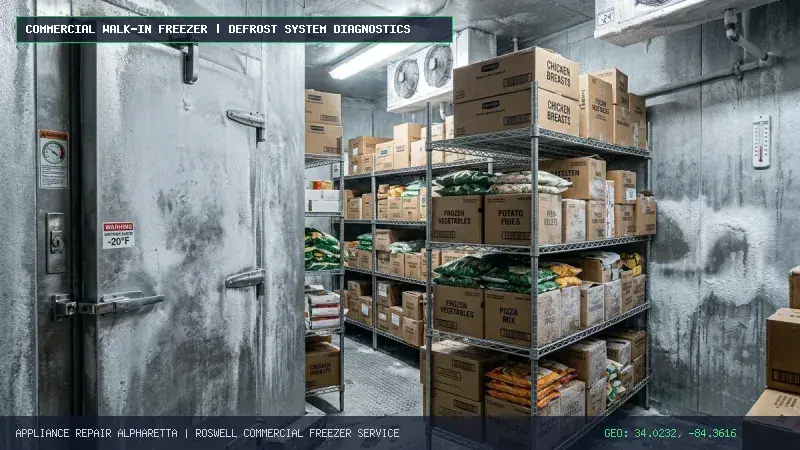
When a commercial restaurant, butcher shop, grocery supermarket, or wholesale food distributor in Roswell faces a sudden commercial walk-in freezer defrost timer failure, thousands of pounds of perishable meat, seafood, and frozen inventory face imminent thermal spoilage. In a commercial walk-in box operating at -10°F to 0°F, ambient humidity entering through door openings continuously condenses and freezes against the sub-zero aluminum fins of the evaporator coil. The electromechanical defrost timer—typically an industry-standard Paragon 8145-20, Paragon 8045, or Grasslin time control—serves as the critical pacemaker of the refrigeration cycle, initiating programmed electric or hot-gas defrost periods to melt this frost accumulation before airflow suffocates. When the timer clock motor seizes, contact points pit, or internal mechanical trippers break, the evaporator coil transforms into a solid block of impenetrable ice within 36 hours. Explore our dedicated commercial freezer repair solutions designed to safeguard commercial cold storage assets across North Fulton. For immediate priority emergency dispatch in Roswell, contact our master refrigeration dispatch desk at (770) 796-7742.
Quick Answer: How to Diagnose Walk-In Freezer Defrost Timer Failure?
A commercial walk-in freezer defrost timer failure occurs when the internal synchronous clock motor burns open or mechanical contact pins fail to toggle terminal 4 (refrigeration) to terminal 3 (defrost heaters). Symptoms include evaporator coils encased in solid ice while fans blow warm air, box temperatures climbing past +20°F, or heaters remaining stuck on continuously. Certified refrigeration technicians verify 208V/240V power to timer terminals 1 and 2, manually advance the timer wheel past the defrost pin to verify contact closure, and test Calrod heater continuity before replacing failed timer mechanisms.
Listen to 60-Second Commercial Refrigeration Diagnostic Summary
Narrated by Master Refrigeration Engineer Carlos D.
Check Same-Day Commercial Tech Availability in Your Roswell Neighborhood
Recently Serviced on Alpharetta Highway, Roswell
Paragon 8145 Defrost Clock Replacement & Evaporator Hydro-Steam De-Icing • $18,000 Inventory Saved • Verified 5.0 ★★★★★
Table of Contents: Walk-In Freezer Defrost Troubleshooting
- 1. Walk-In Freezer Defrost Thermodynamics & Sequence of Operation
- 2. Operational Symptoms of Defrost System Breakdown
- 3. Visual Before & After Restoration Showcase
- 4. Paragon vs. Grasslin vs. Digital Electronic Defrost Controllers
- 5. Root Causes of Evaporator Coil Ice Blockages
- 6. Safe Emergency Shift Checks for Restaurant Managers
- 7. When to Stop DIY: Pressurized Freon & 240V Electrical Dangers
- 8. Decision Matrix: Defrost Rebuild vs. Evaporator Coil Replacement
- 9. Interactive Commercial Freezer Cost Estimator
- 10. Factors Influencing Commercial Refrigeration Repair Pricing in Roswell
- 11. Technical Electrical & Telemetry Diagnostics: Multimeter Testing
- 12. OEM Commercial Refrigeration Components Catalog
- 13. Preventive Maintenance Regimen to Stop Future Freeze-Ups
- 14. Fulton County Health Codes & Critical Cold Chain Compliance
- 15. Frequently Asked Questions (Master Refrigeration Accordion)
- 16. Commercial Appliance Service Resources & Internal Links
- 17. Commercial Key Takeaways
- 18. Priority Commercial Dispatch Call to Action
1. Walk-In Freezer Defrost Thermodynamics & Sequence of Operation
A commercial walk-in freezer operating in the humid climate of North Georgia is an unforgiving thermodynamic system. Inside the freezer box, temperatures must remain between -10°F and 0°F to guarantee food preservation. At these temperatures, the aluminum fins and copper tubes of the ceiling-suspended evaporator coil drop to approximately -25°F to -20°F (evaporating temperature). Every time restaurant kitchen staff enter the freezer to retrieve poultry, beef, or ice cream, ambient kitchen air—often at 80°F with 60% relative humidity—rushes inside. The water vapor in that air instantly sublimates from gas directly into solid frost upon striking the frigid evaporator fins. Learn more about our comprehensive commercial appliance repair programs covering all back-of-house culinary assets.
Without automated periodic defrosting, this frost layer thickens exponentially. Because ice is an exceptional thermal insulator, it forms an insulating blanket that blocks airflow and prevents heat transfer from the box air into the boiling liquid refrigerant inside the coil. To prevent this choke-point, commercial refrigeration systems utilize an electric defrost sequence governed by an electromechanical defrost timer clock. Typically programmed for 3 to 4 defrost cycles per day (spaced every 6 to 8 hours), each cycle initiates a precise 4-step sequence:
- Step 1: Refrigeration Cut-Off & Pump Down: The defrost timer initiates at a scheduled tripper pin, de-energizing the liquid line solenoid valve (terminal 4 breaks). The condensing unit pumps remaining suction vapor out of the evaporator into the receiver tank until the low-pressure switch shuts off the compressor.
- Step 2: Evaporator Fan Lockout: Power to the ceiling evaporator fan motors is cut immediately. Leaving fans running during defrost would blast 80°F humid steam into the freezer box, causing ice fog, ceiling dripping, and iced product packaging.
- Step 3: Calrod Defrost Heater Energization: The timer closes contacts to terminal 3, energizing high-wattage incoloy electric sheath heaters interwoven directly into the coil fin pack and nested in the drain pan trough. The heaters rapidly warm the coil to 40°F–50°F, melting all frost into water that flows down the heated drain line.
- Step 4: Temperature Termination & Fan Delay: A bi-metal defrost termination switch (Klixon) clamped to the coil suction line senses when all ice has melted (typically reaching 55°F). It sends 208V/240V back to timer terminal X, energizing an internal solenoid that mechanically pops the timer out of defrost back into refrigeration. The compressor restarts, chills the wet coil below freezing, and only restarts the fans once the coil drops to 25°F to prevent blowing liquid droplets.
When this intricate electromechanical dance fails, the results are catastrophic. If you operate mixed refrigeration facilities, our commercial team also delivers complete diagnostic support for commercial refrigerator repair across Roswell, Alpharetta, and Milton.
2. Operational Symptoms of Defrost System Breakdown
A defrost failure does not happen instantaneously; it progresses over 24 to 72 hours. Recognizing these clear field symptoms allows kitchen managers to intervene before total product loss occurs:
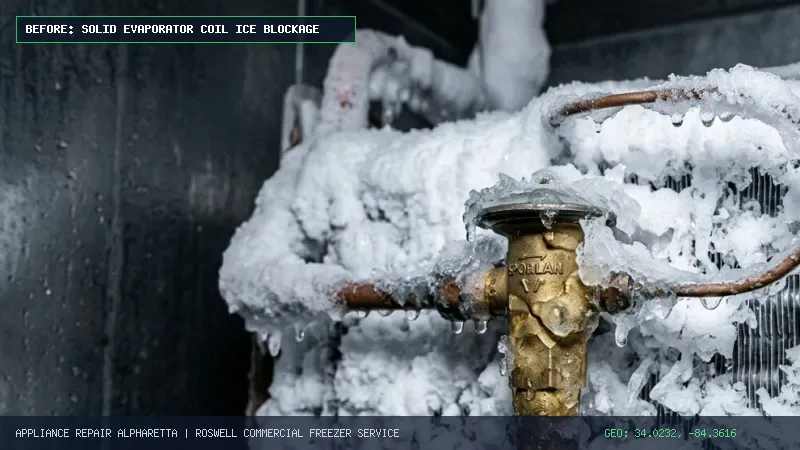
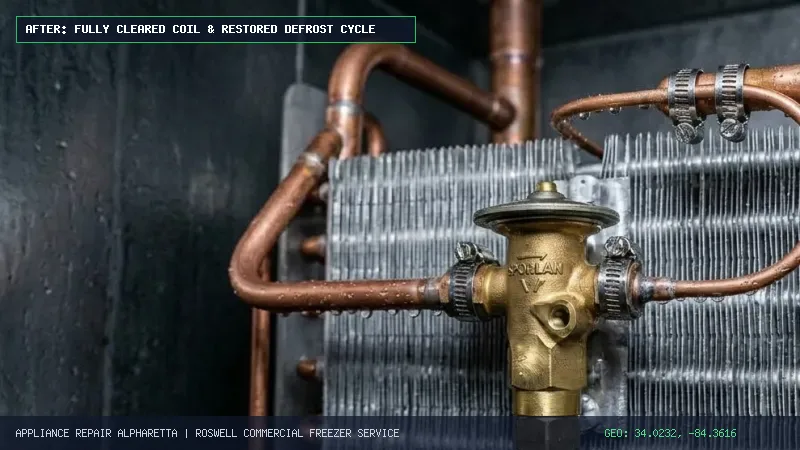
- Solid White Ice Bridging Across Evaporator Fins: Looking through the rear fan guards, the aluminum fins are completely invisible, obscured by a dense, solid glacier of ice that bridges between coils.
- Creeping Box Temperatures (+15°F to +35°F): While the condensing unit outside runs continuously, the freezer interior fails to achieve sub-zero holding, slowly climbing into the thawing zone.
- Evaporator Fans Blowing Weak or No Airflow: You can hear the evaporator fan motors humming, but placing a hand in front of the fan guard reveals almost zero velocity air being propelled into the room.
- Ice Accumulation on Freezer Floor Under Drain Pan: Ice stalagmites form on the floor beneath the coil housing, or the drain pan itself is overflowing with solid ice, indicating that the drain pan heater has failed.
- Compressor Short-Cycling on Low-Pressure Control: Because starved evaporator coils cannot boil refrigerant, suction pressure drops below the low-pressure switch cut-out (e.g. 5 PSI on R404A), causing the compressor outside to rapidly cycle on and off every two minutes.
- Freezer Box Turning Into a “Hot Box” (+50°F+): If the defrost timer motor seizes while contacts are closed to terminal 3 (heaters), the Calrod heaters will run continuously for hours, turning the freezer into an oven and melting all inventory.
When these severe cold chain crises arise, our field technicians provide rapid response through our specialized emergency appliance repair fleet.
4. Paragon vs. Grasslin vs. Digital Electronic Defrost Controllers
In commercial foodservice facilities throughout Fulton County, three primary generations of defrost control architecture govern walk-in freezers. Understanding their mechanical operation is vital for accurate fault isolation:
Paragon 8145 Series (Electromechanical Workhorse)
The Paragon 8145-20 (208V/240V) and 8145-00 (120V) are time-initiated, temperature- or pressure-terminated controls found in over 70% of commercial walk-ins. A synchronous timing motor continuously drives a 24-hour dial wheel. Brass tripper pins screwed into the wheel strike a mechanical actuator lever to initiate defrost. Inside, heavy silver-cadmium contacts toggle: terminal 4 (normally closed to refrigeration) opens, and terminal 3 (normally open to defrost heaters) snaps shut. A reset solenoid connected to terminal X pulls the contacts back to refrigeration when the evaporator termination switch closes. Common failure modes include stripped clock motor gear trains, loose tripper screws, or burned-out reset solenoids.
Grasslin DT-AV40 / DTMV Series (Modular Electronic & Mechanical)
Grasslin defrost timers utilize captive push-tab trippers arranged around a 24-hour or 7-day dial, eliminating lost tripper screws. The internal mechanism features a high-torque stepper motor or quartz movement with battery reserve. In Grasslin units, failure typically manifests as plastic gear teeth stripping due to kitchen grease contamination or high-voltage transient spikes burning out the internal power supply board.
Digital Microprocessor Controllers (Dixell, Carel, KE2 Therm)
Modern smart walk-in freezers utilize digital controllers that replace electromechanical timers with adaptive defrost algorithms. Utilizing dual NTC thermistor probes (one in the room air, one buried in the coil fin pack), the microcomputer analyzes coil temperature differentials and air pressure drop to initiate defrost only when frost is physically detected, rather than on a blind timer schedule. Failure on these digital platforms usually stems from sensor probe drift, lightening power surges corrupting EEPROM parameters, or failed on-board 16-amp heater relays.
5. Root Causes of Evaporator Coil Ice Blockages
While the defrost timer clock is the most frequent culprit, a frozen evaporator coil can also result from secondary electrical, mechanical, or airflow failures. Our technicians investigate five primary failure vectors:
1. Defrost Timer Clock Motor Open Circuit
The 208V/240V synchronous motor that powers the Paragon timer dial runs 24 hours a day, 365 days a year. Over 5 to 7 years of operation, the motor winding coil burns open, or grease within the sealed gear capsule dries into thick varnish. When the motor stops spinning, the dial stops rotating. The machine remains locked indefinitely in whatever state it was in—usually the refrigeration cycle—and never initiates another defrost cycle.
2. Burnt Open Calrod Defrost Heater Elements
Walk-in freezer evaporators utilize 3 to 6 incoloy sheath heating elements threaded through the coil fin pack, pulling between 1,500 and 4,000 watts. Repeated expansion and contraction cycles eventually cause micro-fractures in the magnesium oxide electrical insulation. Moisture enters the element sheath, causing an internal short circuit or an open resistance break. If one or two elements burn open, the timer initiates defrost, but the remaining heaters cannot generate sufficient BTUs to melt all the ice, leaving a bottom layer that grows with every cycle.
3. Defrost Termination Thermostat (Klixon) Stuck Closed
The termination thermostat is a sealed bi-metal disc switch clamped to the evaporator coil return bend. When functioning normally, it remains open at room temperature and snaps closed at 20°F. If the internal bi-metal disc becomes mechanically stuck in the closed position, it will continuously feed 240V to timer terminal X. The instant the timer initiates defrost, terminal X fires the reset solenoid and immediately aborts the defrost cycle back to refrigeration within 3 seconds, giving heaters zero time to melt ice.
4. Frozen Condensate Drain Line & Pan Heater Failure
As frost melts off the coil, the resulting water drips into an aluminum drain pan and flows through a copper drain pipe to the outside. In a -10°F room, this water will freeze solid before reaching the wall unless the drain line is wrapped with heated trace tape and the pan has an active drain pan heater. If the drain pan heater burns out, melted water refreezes inside the pan, filling the pan like an ice cube tray until it bridges up into the bottom coils.
5. Torn Door Gaskets & Excessive Infiltration
If a walk-in freezer door has a torn bottom sweep, split magnetic perimeter gasket, or missing PVC strip curtains, ambient kitchen moisture pours into the freezer 24 hours a day. The moisture influx exceeds the capacity of standard defrost cycles, causing rapid ice buildup even if the timer and heaters are working perfectly. For facility owners managing multiple food prep assets, our technicians also provide expert service for same-day appliance repair across North Fulton.
6. Safe Emergency Shift Checks for Restaurant Managers
When a manager discovers that a walk-in freezer is warming up and ice is visible on the ceiling unit, executing these immediate safe preliminary steps can protect valuable food inventory while awaiting certified technician arrival:
Step 1: Check the Timer Dial Wheel Movement
Locate the defrost timer enclosure (usually mounted near the condensing unit on the roof, in a mechanical room, or directly outside the freezer box door). Look through the clear plastic viewing window or unlatch the metal cover. Note the position of the 24-hour time-of-day dial. Mark the wheel with a pencil. Return 45 minutes later: if the dial has not advanced, the clock motor has burned out or lost its 208V power feed.
Step 2: Manually Force a Defrost Cycle (Triage Step)
On a Paragon timer, locate the center manual advance knob. Using your fingers or a flathead screwdriver, firmly rotate the knob counter-clockwise until you hear a sharp, loud mechanical “CLICK”. Inside the freezer, the evaporator fan motors should immediately shut off. Within 2 to 3 minutes, you should hear sizzling sounds as water drips onto hot Calrod heaters. If fans shut off and heat initiates, the heating circuit is intact, confirming that the automatic timer motor or trippers have failed.
Step 3: Inspect the Freezer Door Seal & Latch
Close the walk-in freezer door and perform the “dollar bill test”. Insert a bill between the magnetic gasket and the stainless jamb, close the door, and pull. There should be firm, continuous drag. Repeat this around the entire door perimeter, paying special attention to the bottom wiper sweep and top hinge corners. If daylight or drafts are visible, moisture infiltration is exacerbating your coil icing.
Step 4: NEVER Chip Ice with Screwdrivers or Knives
Under NO circumstances should kitchen staff use an ice pick, screwdriver, cleaver, or hammer to chip ice away from the aluminum evaporator coil fins. The copper refrigerant tubes embedded in the coil have a wall thickness of less than 0.020 inches. A single puncture releases the entire 15–30 lb charge of R404A or R448A refrigerant, costing upwards of $1,500 to repair and completely shutting down the refrigeration system.
7. When to Stop DIY: Pressurized Freon & 240V Electrical Dangers
Critical Commercial Safety Warnings for Facility Operators
Commercial refrigeration systems operate with lethal voltages and pressurized chemical refrigerants. Restaurant personnel must halt DIY troubleshooting and call certified refrigeration technicians immediately upon encountering:
- 208V / 230V Electrical Shock Hazards: Commercial defrost timers and Calrod heaters operate on high-amperage 208V/230V single-phase or 3-phase circuits. Touching exposed terminals inside a timer or junction box in a wet mechanical room carries severe electrocution hazards.
- Severe Frostbite & Freon Gas Inhalation: Liquid refrigerant inside evaporator tubes expands at -40°F upon exposure to atmospheric pressure. Skin contact causes instant tissue necrosis and severe frostbite burns.
- Thermal Scald Hazards from Defrost Steam: When high-pressure steam or pressurized hot water is used to de-ice an evaporator coil, temperatures inside the enclosed ceiling shroud exceed 180°F, creating extreme burn risks without proper PPE.
- Catastrophic Compressor Liquid Floodback: Forcing a walk-in freezer back into cooling while the coil remains heavily iced causes unevaporated liquid refrigerant to flood back directly into the compressor crankcase, causing catastrophic hydraulic slugging and shattering internal compressor reed valves.
8. Decision Matrix: Defrost Rebuild vs. Evaporator Coil Replacement
A complete commercial walk-in freezer evaporator assembly replacement (such as a Bohn, Trenton, or Heatcraft coil) typically costs between $3,500 and $7,500 installed, including refrigerant recovery, brazing, evacuation, and charging. Evaluating whether to repair the defrost electrical system or replace the entire coil assembly requires analyzing several key criteria:
| Evaluation Parameter | Recommend Defrost System Rebuild | Recommend Complete Coil Replacement |
|---|---|---|
| Evaporator Coil Age | Under 8–10 years old with clean copper tubes | Over 15+ years old with extensive fin corrosion |
| Refrigerant Circuit Integrity | Zero refrigerant leaks; holds static pressure | Multiple pinhole leaks in aluminum return bends |
| Root Defrost Failure | Timer clock motor, Klixon, or Calrod elements | Structural tube collapse due to severe ice expansion |
| Repair Cost Percentage | Total repair under 25% of new replacement cost | Cumulative repairs exceed 50% of new evaporator |
| Operational Downtime | 2 to 4 hours field turnaround; inventory preserved | 24 to 48 hours for crane, recovery & brazing |
;
range[0] += 95;
range[1] += 150;
10. Factors Influencing Commercial Refrigeration Repair Pricing in Roswell
Commercial walk-in freezer service requires specialized refrigeration diagnostic instruments, recovery equipment, and EPA-certified master technicians. Several key variables influence commercial repair investments:
- Severity of Evaporator Ice Encapsulation: Removing light surface frost requires 45 minutes of thermal treatment. In contrast, removing a 6-inch solid glacier wrapped completely around motor brackets and expansion valves demands 2 to 3 hours of meticulous steam melting to prevent fin damage.
- Number of Defrost Elements: A compact single-fan coil houses 2 Calrod heaters, whereas a 4-fan commercial evaporator houses 6 to 8 elements wired in balanced 3-phase delta or wye configurations, requiring higher parts and labor allocation.
- Refrigeration Voltage (120V vs. 208V/240V): Heavy commercial walk-ins operating on 208V/240V require high-voltage arc-rated safety procedures and industrial-grade contactors.
- Emergency Dispatch Timing: Fast daytime calls maintain standard commercial rates, whereas emergency midnight triage during peak dinner rushes or weekend holiday bans involves priority emergency premiums. If your facility also operates commercial cooking suites, explore our specialized commercial oven repair solutions.
11. Technical Electrical & Telemetry Diagnostics: Multimeter Testing
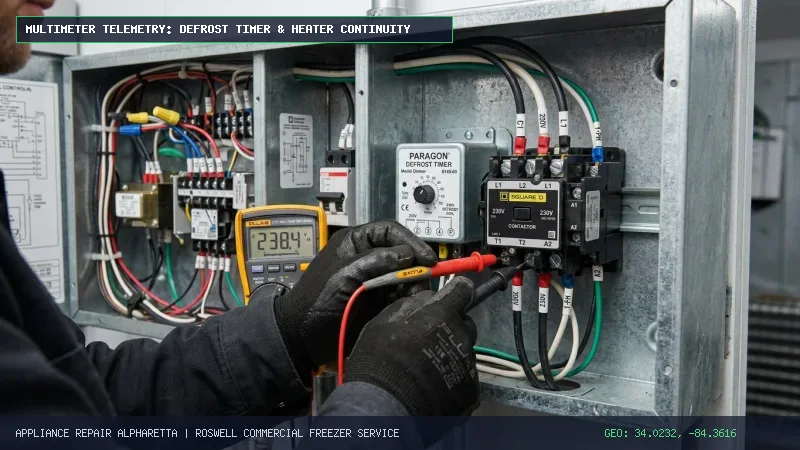
Professional commercial refrigeration diagnosis relies on accurate multimeter resistance, continuity, and voltage readings. Below is the official telemetry diagnostic testing protocol utilized by our master refrigeration technicians:
| Component Tested | Terminals / Wire Test Points | Normal Operating Resistance (Ohms) | Expected Line Voltage / Current | Diagnostic Failure Reading |
|---|---|---|---|---|
| Timer Clock Motor Winding | Paragon Terminals 1 to 2 | 1,800 Ω to 2,400 Ω (208V/240V motor) | 208V to 240V AC continuous | ∞ Infinite Ω (Open motor winding) • Clock dial stops rotating |
| Refrigeration Circuit Contacts | Paragon Terminals 1 to 4 | <0.3 Ω when in refrigeration mode | 208V/240V AC to liquid solenoid | High resistance (>5 Ω) or pitted contacts • Drops cooling circuit |
| Defrost Heater Circuit Contacts | Paragon Terminals 1 to 3 | <0.3 Ω when advanced to defrost | 208V/240V AC to Calrod heaters | ∞ Infinite Ω in defrost mode • Heaters never energize |
| Calrod Defrost Heaters (per element) | Evaporator Terminal Block H1 to H2 | 18 Ω to 32 Ω per individual element | 208V / 240V AC / 6.5A to 12A draw | ∞ Infinite Ω (Burnt heater coil) or reading to ground <10 MΩ |
| Defrost Termination Klixon | Klixon Leads (Brown to Red) | Cold (<20°F): <0.5 Ω / Warm (>55°F): Open | 208V/240V signal to Terminal X | Stuck closed when warm • Aborts defrost prematurely in 3 secs |
| Drain Pan Heater Element | Drain Pan Wire Leads | 85 Ω to 140 Ω | 208V / 240V AC / 1.5A to 2.8A | ∞ Infinite Ω • Causes solid ice block in drain trough |
12. OEM Commercial Refrigeration Components Catalog
We exclusively install genuine factory-engineered components from trusted commercial refrigeration manufacturers to ensure warranty compliance and long-term durability:
| Component Description | Manufacturer & Part Number | Operational Role & Engineering Function |
|---|---|---|
| 24-Hour Defrost Timer (208/240V) | Paragon #8145-20 / #8045-20 | Master electromechanical sequencer; initiates defrost 1–6x daily, terminates on temp |
| Electronic Universal Defrost Timer | Grasslin #DT-AV40 / #DTMV | Solid-state digital defrost clock with multi-voltage captive pins |
| Defrost Termination / Fan Delay Switch | Bohn / Heatcraft #43048 / Klixon | Bi-metal disc switch; terminates defrost at 55°F, restarts fans when coil chills to 25°F |
| Incoloy Coil Defrost Heater Element | Heatcraft #24752001 / Bohn #820-1002 | High-wattage electric sheath heater embedded in evaporator aluminum fins |
| Liquid Line Refrigerant Solenoid Valve | Sporlan #E3S130 / #A3S1 | Normally closed magnetic valve; shuts off liquid refrigerant during defrost pump down |
| Heavy-Duty Defrost Contactor (3-Pole) | Schneider / Square D 8910DP32V09 | Switches 30-amp heater loads; contacts pit over time, dropping one leg of heat |
13. Preventive Maintenance Regimen to Stop Future Freeze-Ups
A disciplined preventive maintenance schedule protects commercial freezer compressors from catastrophic liquid slugging and prevents inventory disasters:
Monthly Maintenance Checklist:
- Inspect the defrost timer dial to verify time-of-day accuracy (power blinks frequently reset clock position).
- Inspect magnetic door gaskets and floor sweep seals for splits or hardening; clean with mild detergent.
- Check that strip curtains hang flat with minimum 50% overlap across the entrance doorway.
- Visually examine the evaporator coil through the rear fan guard; fins should show light frost, never solid ice.
Quarterly Professional Inspections:
- Measure operating amp draw on all Calrod defrost heaters to identify failing elements before total freeze-up.
- Inspect contactor points on the defrost relay for pitting, arc erosion, or carbon tracking.
- Test the drain line heater cable continuity and flush the condensate drain line with hot water.
- Verify refrigerant superheat at the condensing unit compressor suction service valve. If your business also relies on commercial dishwashing sanitation, explore our specialized commercial dishwasher repair solutions.
14. Fulton County Health Codes & Critical Cold Chain Compliance
Fulton County Board of Health and FDA Food Code section 3-501.11 require that commercial frozen food be held frozen solid at 0°F (-18°C) or below. Any thermal excursion where internal product temperatures rise above 41°F enters the microbiological “Danger Zone”, where bacteria such as Salmonella, Listeria monocytogenes, and Clostridium perfringens multiply rapidly. If a defrost failure causes product warming above 41°F for more than four hours, health regulations mandate complete food disposal. Maintaining verified technician service records protects restaurants against health code penalties and liability.
15. Frequently Asked Questions (Master Refrigeration Accordion)
Below are answers to the most urgent technical questions posed by Roswell restaurant operators, grocery managers, and commercial kitchen executives regarding walk-in freezer defrost failures:
Q1: How do I know if my walk-in freezer defrost timer has failed?
The definitive test is observing dial wheel rotation. Locate your Paragon or Grasslin timer and mark the current time-of-day dial position with a pencil. Check back 1 hour later: if the dial has not moved, the internal synchronous clock motor has burned open or lost its 208V/240V power feed. Additionally, if the evaporator coil is frozen solid with ice while fans blow warm air, or if you can manually force defrost by turning the center knob but it never enters defrost automatically, the timer mechanism is defective and requires replacement.
Q2: Can I melt the ice off a walk-in freezer coil using a heat gun or torch?
NO! Never use a propane torch, high-output industrial heat gun, or open flame inside a walk-in freezer. Open flames will melt aluminum fin collars, scorch electrical wiring harnesses, crack plastic fan blades, and overheat copper tubing joints, causing catastrophic refrigerant leaks. Master technicians use controlled pressurized hot-water hydro-steam machines or specialized de-icing curtains that melt ice safely without subjecting copper tubing or thermal expansion valves to localized thermal shock.
Q3: How many times a day should a commercial walk-in freezer go into defrost?
In standard commercial restaurant kitchens in Georgia, walk-in freezers typically initiate 3 to 4 defrost cycles per 24-hour period, programmed at 6-hour or 8-hour intervals (for example, at 4:00 AM, 10:00 AM, 4:00 PM, and 10:00 PM, scheduled around delivery rushes). Each cycle is set for a maximum fail-safe duration of 40 to 45 minutes on the timer, but normal cycles terminate on temperature within 15 to 22 minutes via the defrost termination thermostat.
Q4: What is the role of the defrost termination thermostat (Klixon)?
The defrost termination thermostat is a temperature-sensing safety switch clamped to the evaporator coil tubing. Its primary purpose is to end the defrost cycle as soon as all frost has melted (typically when the coil hits 50°F to 55°F), rather than forcing heaters to run for the full 45 minutes on the clock dial. This saves substantial electrical energy and prevents overheating the freezer box. It also serves as a fan delay switch, preventing the evaporator fans from restarting until the coil has re-chilled to 25°F after refrigeration resumes.
Q5: Why is my walk-in freezer blowing air but not getting cold?
If the fans are turning but the box temperature is climbing past +20°F, the evaporator coil is almost certainly frozen into a solid block of ice behind the shroud. The ice blocks airflow across the coil fins, preventing heat exchange. Alternatively, the condensing unit compressor on the roof may be tripped on low-pressure cut-out, a liquid line solenoid valve may be stuck closed, or the system may have lost its refrigerant charge due to a vibration fracture.
Q6: What causes ice to form on the floor directly beneath the evaporator coil?
Ice buildup on the floor under the coil indicates that the condensate drain system has frozen. During defrost, melted water drops into the drain pan and exits through the copper drain pipe. If the drain pan heater element or the electric drain line heat-trace cable burns out, water refreezes inside the trough. The pan overflows with ice, spilling water over the front lip onto the floor where it freezes into dangerous slip-and-fall ice slicks.
Q7: How do I test if Calrod defrost heaters are working?
A certified technician isolates power at the disconnect switch, disconnects the heater leads at the evaporator terminal block, and measures resistance using an True-RMS multimeter set to ohms (Ω). A healthy commercial Calrod heater element typically measures between 18 and 32 ohms. A reading of infinity indicates an open internal heating filament. Technicians also test from each heater terminal to ground with a megohmmeter (Megger); any reading below 10 megohms indicates insulation breakdown that will trip circuit breakers.
Q8: What is the difference between air defrost and electric defrost?
Air defrost (off-cycle defrost) is only used in walk-in coolers operating above 35°F, where simply shutting off the compressor while leaving fans running allows 38°F room air to melt coil frost. In walk-in freezers operating below 32°F (typically -10°F to 0°F), air defrost is thermodynamically impossible because the room air is freezing. Freezers require active electric defrost (using electric Calrod elements) or hot-gas bypass defrost (redirecting hot discharge gas from the compressor through the evaporator).
Q9: Why does the freezer defrost timer reset solenoid burn out?
The reset solenoid coil on a Paragon timer (terminal X) is designed for intermittent duty—energized for only 1 to 2 seconds to mechanically trigger the contacts back into refrigeration. If the defrost termination thermostat on the evaporator coil welds closed or wire harnesses short, continuous 240V power is applied to the solenoid coil. Within 10 to 15 minutes of continuous power, the solenoid coil overheats, melts its plastic bobbin, and burns out completely.
Q10: Can a dirty condenser coil cause the walk-in freezer evaporator to freeze up?
Yes, indirectly. A heavily matted outdoor condensing coil causes head pressures to skyrocket, which causes the compressor to run hotter and experience extended run times. More critically, high head pressures cause thermal expansion valves (TXVs) to hunt erratically. If the system experiences low suction pressure and starving conditions, the evaporator coil operates at a much lower saturation temperature, causing dense frost accumulation that overpowers standard defrost cycles.
Q11: What type of refrigerant is used in modern commercial walk-in freezers?
Most existing commercial walk-in freezers in Roswell operate on R404A or R507. Newer installations and retrofits utilize lower-GWP refrigerants such as R448A (Solstice N40) or R449A (Opteon XP40). Master technicians verify refrigerant type from the condensing unit data plate before connecting digital manifold gauges, as pressure-temperature curves and superheat calculations differ significantly between refrigerants.
Q12: How long does it take for a commercial technician to de-ice a walk-in freezer?
Using professional pressurized hot-water de-icing rigs, a master technician can completely thaw, flush, and dry a heavily iced commercial evaporator coil in approximately 60 to 90 minutes. Attempting to de-ice a freezer by simply turning it off with doors open often takes 24 to 36 hours and creates massive water damage on the floor, while inventory continues to spoil.
Q13: Why are the evaporator fans delayed when cooling restarts after defrost?
The fan delay feature is a critical sanitary and thermodynamic safeguard. When defrost ends, the evaporator coil is wet with warm droplets (at ~50°F). If fans started immediately, they would blast this warm water mist into the -10°F room, creating ice fog, frost on ceilings, and ice crystals on food packaging. The fan delay switch keeps fans OFF until the coil drops to 25°F, freezing all residual moisture onto the metal fins before airflow resumes.
Q14: Can a faulty door heater cause ice buildup around the door frame?
Yes. Walk-in freezer door jambs contain continuous electric resistance heater wire embedded behind the stainless frame. This heater prevents condensation on the outer perimeter. If the frame heater burns out, condensation freezes into a solid ring of ice that welds the door shut. Forcing the door tears the magnetic gasket, allowing massive humid air infiltration that freezes the evaporator coil within days.
Q15: How fast can a commercial refrigeration technician respond to a walk-in freezer emergency in Roswell?
Because walk-in freezer failures risk thousands of dollars in food inventory, we prioritize commercial cold storage emergencies. Our EPA-certified commercial refrigeration trucks are stationed throughout North Fulton County, providing emergency on-site triage across Roswell, Alpharetta, Milton, and Johns Creek within 35 to 60 minutes with genuine Paragon timers, Klixons, and heaters on board.
Q16: What is the fail-safe backup setting on a mechanical defrost timer?
On a Paragon 8145 defrost timer, the mechanical dial includes a backup fail-safe termination setting (typically adjustable from 15 to 110 minutes, standardly set at 45 minutes). If the defrost termination thermostat on the coil fails to close or wires break, the mechanical timer wheel will physically trip the contacts back into refrigeration after 45 minutes, preventing the Calrod heaters from running endlessly and heating the box.
16. Commercial Appliance Service Resources & Internal Links
As Fulton County’s foremost commercial refrigeration and foodservice equipment repair service, we maintain comprehensive diagnostic capabilities for all restaurant, grocery, and institutional assets. Explore our core services:
Commercial Cold Storage
Emergency walk-in cooler, reach-in freezer, and draft beer cooler repair.
Commercial Warewashing
Door-type and conveyor warewasher wash pump, heater, and booster repair.
Commercial Cooking Suites
Precision service for commercial convection ovens, fryers, and ranges.
Local Service Areas
Same-day priority commercial technician dispatch across Roswell and North Fulton.
We also deliver localized commercial repair services across neighboring communities: explore our certified coverage in Alpharetta, GA, Milton, GA, and Johns Creek, GA.
17. Commercial Key Takeaways
- Commercial walk-in freezer defrost systems must initiate 3 to 4 times daily to melt frost before airflow suffocates across aluminum evaporator fins.
- Paragon 8145-20 and Grasslin timers fail when clock motors burn open, gear trains seize, or internal contact points pit.
- Evaporator coil freeze-ups cause box temperatures to climb past +20°F, putting perishable inventory at risk of total spoilage.
- Never chip ice off coil tubing with screwdrivers or torches; puncture releases pressurized Freon, destroying the refrigeration system.
- Defrost termination thermostats (Klixons) must be tested for proper 55°F open and 20°F close cycles to prevent aborting defrost prematurely.
- Calrod electric defrost heaters require resistance verification (18Ω–32Ω) and insulation megger testing to identify burnt elements.
- Emergency commercial refrigeration service in Roswell provides same-day response with OEM timers, heaters, and hydro-steam de-icing equipment on truck.
Need Certified Appliance Repair Today?
Skip the phone line — book direct local priority dispatch across Alpharetta, Milton, Roswell & Johns Creek.