
When a heavy-duty Dean commercial gas fryer suffers from a low millivolt thermopile drop and Honeywell VS820A combination gas valve lockout in the bustling culinary epicenters of the Roswell Historic Mill & Dining District, line operations face an immediate production halt. High-volume dining spots, southern bistros, craft brewpubs, and upscale taverns along Canton Street, Mill Street, and Sloan Street rely intensely on Dean Super Runner and SR series fryers to deliver crisp appetizers, fried chicken, and signature entrees during relentless service rushes. When the self-generating 750mV Powerpile thermopile weakens from carbonization, flame misalignment, or internal junction degradation, it fails to produce the threshold voltage needed to hold open the Honeywell VS820A main operator coil. The standing pilot remains illuminated, yet turning the operating thermostat to call for heat results in total silence—no main burner ignition, plunging oil temperatures, and compounding ticket delays. Our master technicians provide specialized commercial appliance repair across North Fulton County, deploying true-RMS multimeter telemetry, certified OEM Powerpile generators, and precision digital manometers for same-day kitchen restoration. For rapid emergency response to your commercial kitchen, call our priority dispatch desk at (770) 796-7742.
Quick Answer: Diagnosing Dean Fryer Thermopile Low Millivolt Gas Valve Lockout
Quick Answer: In a millivolt-powered Dean commercial fryer, the standing pilot heats a self-generating 750mV Powerpile thermopile that powers the Honeywell VS820A gas valve without external electricity. A main burner lockout with the pilot lit occurs when thermopile closed-circuit voltage drops below 325mV DC under load (factory nominal: 350–450mV DC closed circuit, 650–750mV DC open circuit). This millivolt drop is triggered by three primary root causes: heavy carbon fouling or oxidation insulating the thermopile tip, improper pilot flame immersion (must engulf the top 3/8 inch of the generator), or an open/shorted Honeywell VS820A main valve operator coil (normal resistance: 10.5–12.5 Ω). Technicians also inspect the hi-limit switch and operating thermostat circuit for resistive oxidation exceeding 0.3 Ω. If open-circuit voltage tests below 600mV DC despite a clean, properly positioned blue pilot flame, the thermopile has suffered internal thermal junction breakdown and must be replaced. For emergency same-day OEM restoration in Roswell, GA, call (770) 796-7742.
Listen to 60-Second Commercial Fryer Diagnostic Brief
Narrated by Jason J. (Master Certified Commercial Gas Appliance Specialist)
Check Same-Day Commercial Tech Availability in Roswell Corridors
Verified Local Service • Roswell GA
Dean SR42G Free-Standing Gas Fryer Thermopile & Pilot Overhaul
Location: Farm-to-Table Bistro on Canton St, Roswell Historic District • Restored 750mV Powerpile & Honeywell Gas Valve Loop • ★★★★★ Verified Commercial Account
Verified Field Case Study • Roswell Historic Mill & Dining District
Emergency Millivolt Gas Lockout Restoration on Dean SR42G Commercial Fryer
Commercial Venue: Artisan Smokehouse & Grill • 900 Block Canton Street, Roswell, GA 30075
Resolution: Completed in Single Visit
Diagnostic Telemetry & Field Findings:
- Kitchen Manager Complaint: During Friday lunch preparation, the primary 43-pound Dean gas fryer stopped heating. The standing pilot remained lit after being depressed and ignited, but turning the mechanical temperature dial from 200°F to 350°F failed to ignite the main burner tubes. Oil remained cold at 110°F, creating a severe bottleneck on ticket orders.
- Visual Flame & Component Inspection: Inspected the pilot burner bracket beneath the frypot front apron. Noticed heavy black carbon soot crusting over the tip of the thermopile. The pilot flame was weak, yellow-tipped, and lazy, failing to wrap around the thermopile sheath. Flame immersion measured barely 1/8 inch (3mm), far below the engineering standard of 3/8 inch (9.5mm).
- Thermopile Open-Circuit Telemetry: Disconnected the red and white thermopile spade leads from terminals TP and TP/TH on the Honeywell VS820A gas valve. Clipped Fluke 87V True-RMS multimeter test leads across the thermopile terminals in open-circuit mode. Multimeter registered a sluggish climb to only 284mV DC after 3 minutes of direct pilot heating—far below the mandatory 650–750mV DC open-circuit benchmark.
- Closed-Circuit Load Telemetry: Reconnected leads to the Honeywell valve and jumpered across the thermostat terminals to call for heat under load. Closed-circuit voltage collapsed instantaneously to 118mV DC. Because the Honeywell VS820A operator coil requires a minimum hold-in threshold of 325–350mV DC, the internal magnetic valve operator refused to pull open the main gas seat.
- Gas Valve Operator Coil Resistance: Tested the Honeywell VS820A valve operator coil between terminals TH and TP/TH with the circuit isolated. Measured 11.4 Ω resistance, confirming the valve coil was electrically intact and within the nominal 10.5–12.5 Ω factory specification. The lockout was completely driven by the degraded thermopile and clogged pilot orifice.
- Safety Loop Continuity Audit: Tested the high-limit safety thermostat switch and operating thermostat harness. Both safety devices registered less than 0.15 Ω series resistance, verifying that safety switches had not tripped and were not contributing to circuit voltage drop.
OEM Restoration Performed: Safely shut manual gas stop. Cleared pilot orifice and primary aerator with compressed nitrogen. Installed brand-new OEM Dean / Frymaster 750mV 2-wire Powerpile Thermopile (Part #810-1873 / Honeywell Q313A equivalent) with high-temperature glass-braided leads. Adjusted pilot flame regulator to achieve exact 3/8-inch thermopile immersion with a crisp, stable blue flame envelope.
Post-Service Telemetry Verification: New thermopile achieved 718mV DC open-circuit output within 90 seconds. Under thermostat load, closed-circuit voltage stabilized at 412mV DC (nominal: 350–450mV DC). Honeywell VS820A main operator snapped open instantly, firing all four burner tubes evenly at 3.5" W.C. natural gas manifold pressure. Frypot temperature recovered from 110°F to 350°F in 14 minutes. Full 90-day commercial parts and labor warranty applied.
Commercial Diagnostic Directory: Dean Commercial Fryer Thermopile & Gas Valve System
- Dean Commercial Fryer Engineering & Millivolt Generation Fundamentals
- Recognizing Millivolt Lockout Symptoms, Pilot Signatures & Warning Signals
- Visual Before & After Thermopile & Pilot Assembly Restoration
- Root Causes of Thermopile Low Millivolt Drop & Gas Valve Lockout
- Honeywell VS820A Valve Ladder Architecture & Circuit Sequence
- Roswell Historic Mill Commercial Kitchen Operating Realities
- HACCP, Food Safety & Georgia DPH Cooking Temperature Compliance
- Commercial Kitchen Safe Triage & Initial Inspection Sequence
- Commercial Gas Safety Thresholds & When to Call Master Technicians
- Commercial Fryer Repair vs. Replace Capital Decision Matrix
- Interactive Instant Dean Fryer Repair Cost Estimator
- Roswell Commercial Kitchen Repair Pricing Factors Breakdown
- Professional Multimeter Telemetry & Component Benchmarks Lookup
- Authentic OEM Dean & Honeywell Replacement Components
- Commercial Fryer Preventative Maintenance & Boil-Out Protocols
- Commercial Gas Safety, NFPA 96 & Fire Suppression Rules
- Frequently Asked Questions on Dean Fryer Millivolt Lockout
- Related Commercial Kitchen Services & North Fulton Coverage
- Key Operational Takeaways for Foodservice Operators
- Emergency Commercial Priority Dispatch & Service Contact
Dean Commercial Fryer Engineering & Millivolt Generation Fundamentals
In the demanding culinary landscape of the Roswell Historic Mill & Dining District, commercial gas fryers are true production workhorses. From bustling kitchens overlooking Vickery Creek to upscale bistros along Canton Street, food operations rely on fryers manufactured by Dean (a premier division of the Welbilt / Frymaster family) for their robust simplicity, rapid thermal recovery, and utility resilience. The defining engineering hallmark of classic Dean fryers—such as the ubiquitous Dean SR42G, SR52G, Super Runner series, and SM series—is their complete electrical autonomy. Unlike modern computer-controlled fryers that require an external 120VAC line cord and electronic ignition modules, millivolt Dean fryers generate their own operational electrical power through thermoelectric principles, allowing kitchens to fry continuously even during regional power interruptions.
This self-contained operation is powered by the Seebeck effect, embodied in a high-output 750-millivolt (mV) Powerpile thermopile (also known as a thermogenerator). A thermopile consists of dozens of miniature thermocouple junctions connected in electrical series and hermetically sealed inside an armored stainless steel sheath. When the tip of the thermopile is submerged in the intense thermal heat of the continuous standing pilot flame, a temperature differential is established between the hot active junctions and the cooler base junctions. This thermal gradient generates a minute direct current (DC) electrical potential, typically producing between 650mV and 750mV DC in an open circuit. This micro-power is directed to the terminals of a specialized millivolt gas control valve—most commonly the legendary Honeywell VS820A combination gas valve.
However, because a millivolt control circuit operates on fractions of a single volt (less than 0.75V DC), the system has zero tolerance for electrical resistance. A single poor wire crimp, oxidized brass terminal screw, soot-encrusted pilot tip, or slightly misaligned flame can easily drop circuit potential below the critical 325mV DC threshold required to actuate the Honeywell operator coil. When this happens, line cooks experience the classic culinary nightmare: the pilot flame burns bright, but turning the thermostat knob yields absolutely nothing. In this comprehensive diagnostic analysis, our master technicians explain the precise thermodynamic, electrical, and mechanical principles governing Dean commercial fryers, outlining exact telemetry benchmarks, diagnostic sequences, and OEM restoration standards for North Fulton restaurant operators.
Recognizing Millivolt Lockout Symptoms, Pilot Signatures & Warning Signals
Before a Dean commercial fryer experiences complete operational lockout, subtle precursor symptoms emerge within the combustion chamber and control loop. Line cooks and kitchen supervisors who recognize these early physical and electrical warnings can request certified same-day appliance repair before losing a critical piece of line equipment during dinner rush:
- Standing Pilot Holds Flame but Main Burners Never Fire: The most definitive symptom of a low millivolt lockout. The pilot safety magnet successfully holds the pilot gas passage open (which requires only 100–150mV DC), but when the chef rotates the temperature dial to 350°F, the main gas valve never opens. The fryer remains completely silent with cold oil.
- Intermittent Main Burner Dropouts During Heavy Cold-Drop Cycles: The main burners ignite initially when the fryer is idling, but when a heavy basket of frozen french fries or breaded chicken wings is dropped into the vat, the rapid temperature drawdown causes the burners to short-cycle or extinguish prematurely. As heat radiates through the chassis, increased resistance across aging terminals drops voltage below the holding threshold.
- Yellow, Wavering, or Lazy Pilot Flame Envelope: A healthy natural gas pilot flame is sharp, stable, and predominantly blue with a distinct inner cone. A yellow, dancing, or whispy pilot indicates carbon clogging within the pilot aerator orifice or inadequate gas delivery pressure, preventing complete thermal immersion of the thermopile.
- Audible Clicking or Faint Hum Without Gas Flow: When the thermostat contacts close, a faint magnetic click may be heard from the Honeywell VS820A valve, yet no gas flows to the burner orifices. This indicates that the thermopile generated barely enough voltage to attract the valve armature, but lacked sufficient current to overcome spring tension and pull the gas valve disc off its seat.
- Sluggish Oil Recovery & Saturated Fried Products: If the gas valve is intermittently starving the burner manifold, burner tubes fire at sub-nominal BTU capacity. Oil recovery times double or triple, causing fried food to absorb excessive grease, resulting in soggy, substandard culinary output that violates kitchen quality standards.
- Visible Heavy Carbon Sooting on Combustion Tubes & Baffles: Incomplete combustion from misaligned pilot flames or restricted air shutters causes velvety black carbon deposits to accumulate over the thermopile tip, frypot heat transfer tubes, and flue baffles, creating an insulating thermal barrier that exacerbates low millivolt generation.
Visual Before & After Thermopile & Pilot Assembly Restoration
Before: Degraded & Carbonized Thermopile
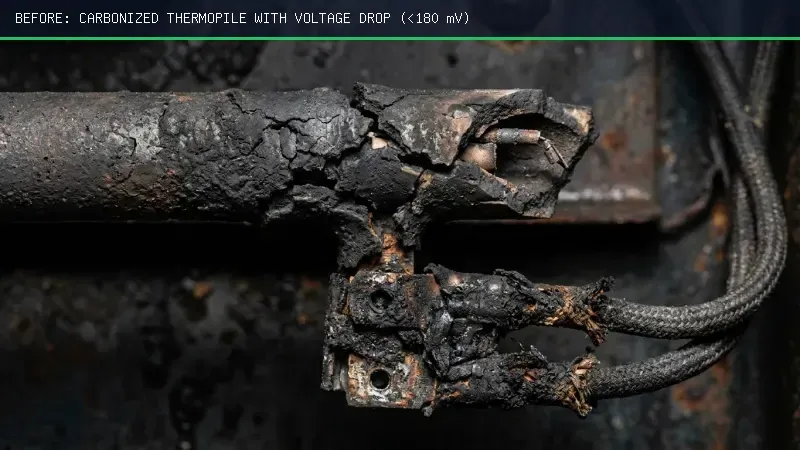
Initial Field Telemetry: Heavy carbon crusting, flame immersion only 1/8 inch, open-circuit voltage collapsed to 284mV DC, closed-circuit load dropped to 118mV DC. Gas valve operator coil locked out, rendering fryer inoperable.
After: Restored OEM 750mV Pilot Assembly
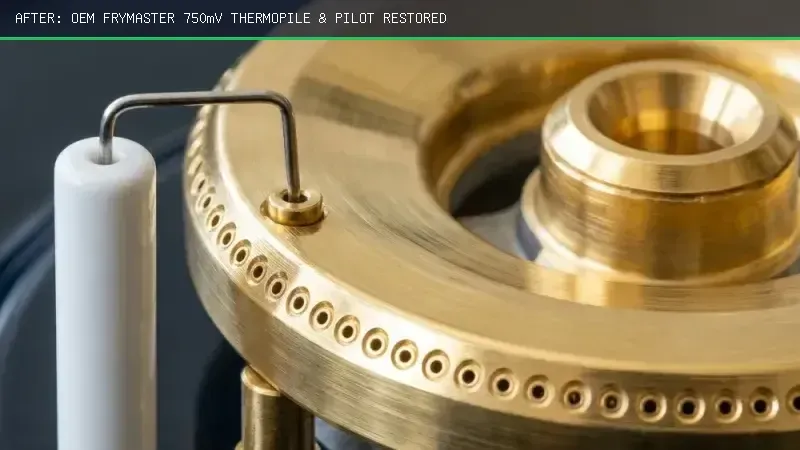
Post-Service Telemetry: Brand new OEM Dean/Honeywell 750mV Powerpile installed, pilot orifice cleared, flame immersion calibrated to exact 3/8 inch. Telemetry reads 718mV DC open circuit, 412mV DC closed circuit. Instant main burner ignition.
Root Causes of Thermopile Low Millivolt Drop & Gas Valve Lockout
A low millivolt condition on a Dean commercial fryer is rarely a random electrical anomaly; rather, it is the direct physical consequence of thermal degradation, environmental contamination, or mechanical wear acting upon the microscopic junctions of the combustion control loop:
Thermopile Internal Thermal Junction Degradation & Crystalline Breakdown
Inside the stainless steel armored jacket of a 750mV Powerpile thermopile, approximately 30 to 35 individual thermocouple pairs (typically dissimilar alloy wires of chromel and alumel or iron and constantan) are welded together in series. In a commercial fryer operating 12 to 16 hours daily, the tip of this generator is bathed in temperatures ranging from 1,200°F to 1,500°F. Over 18 to 36 months of continuous thermal punishment, the metallic crystalline structure of the internal welded junctions undergoes microscopic oxidation and metallurgical fatigue. This crystalline degradation dramatically increases the internal resistance of the generator. While the thermopile may still show 400mV to 500mV with no electrical load attached, the moment the Honeywell operator coil demands current, internal resistance causes the output voltage to immediately collapse below operational limits.
Insufficient Pilot Flame Immersion & Pilot Orifice Contamination
The physical geometry of the pilot flame is critical to thermoelectric generation. Factory engineering specifications from both Dean and Honeywell mandate that the pilot flame must directly envelop the top 3/8 inch (9.5mm to 12.7mm) of the thermopile sheath. The hottest portion of a Bunsen-style pilot flame is located just above the tip of the blue inner cone. If aerosolized cooking grease, flour dust, or mineral scale restricts the microscopic brass pilot orifice (typically sized at 0.018" to 0.021" for natural gas), the volume of fuel diminishes. The flame becomes small, cold, or pulls away from the generator body. Lacking adequate thermal energy across its hot junctions, the thermopile simply cannot generate the necessary millivolt potential.
Honeywell VS820A Combination Gas Valve Operator Coil Electrical Failure
The Honeywell VS820A combination gas valve contains two distinct electromagnetic solenoids: the pilot safety magnet (which holds open the manual pilot gas flow when depressed) and the main operator coil (which opens the main gas flow to the burner orifices when the thermostat calls for heat). The main operator coil is wound with heavy-gauge, low-resistance copper magnet wire designed to operate at 10.5 to 12.5 Ω. Under decades of radiant heat radiating from the adjacent frypot combustion tubes, the thin enamel varnish insulating the copper wire can bake and short internally, dropping coil resistance below 9 Ω and overloading the thermopile. Conversely, thermal cycling can cause the fine internal coil lead to snap or open, resulting in infinite ohms (OL) across terminals TH and TP/TH. In either case, the valve cannot actuate.
Excessive Circuit Contact Resistance in Thermostat & High-Limit Safety Loop
A millivolt circuit obeys Ohm’s Law strictly: Voltage = Current × Resistance (V = I × R). Because the available voltage is tiny (0.4V), circuit current is equally minute (approximately 30 to 40 milliamps). If high electrical resistance develops anywhere along the control path, the available voltage is consumed as voltage drop across the resistance rather than reaching the gas valve operator. The series safety loop on a Dean fryer passes through the Robertshaw mechanical operating thermostat and a manual-reset or automatic high-limit safety cutout switch. If silver electrical contacts within the thermostat pit, corrode from airborne sulfur/grease, or if spade terminal crimps loosen, the contact resistance can rise from 0.05 Ω to 1.5 Ω. An extra 1.0 Ω of contact resistance steals over 100mV DC from the circuit, causing the Honeywell valve to drop out even with a brand-new thermopile.
Thermopile Terminal Oxidation & Loose Screw Connections
The wiring harness connecting the Dean thermopile to the Honeywell valve utilizes brass spade lugs secured by screw terminals marked TP (Thermopile), TH (Thermostat), and TP/TH (Common). In hot, humid commercial kitchens, grease vapor mixes with cleaning chemical mists, causing copper and brass terminals to oxidize into non-conductive verdigris or tarnish. If terminal screws are loosened by equipment vibration or thermal expansion, high interfacial contact resistance develops. Even a microscopic layer of oxidation at the terminal screw is sufficient to starve the valve operator coil.
Honeywell VS820A Valve Ladder Architecture & Circuit Sequence
To troubleshoot a Dean commercial fryer like a master technician, one must understand the exact schematic ladder logic governing the self-powered combustion circuit. Commercial kitchen technicians who understand this sequence can systematically isolate defective components in less than ten minutes:
The electrical circuit forms two distinct parallel/series control paths anchored around the Honeywell VS820A three-terminal block:
- The Power Generation Leg (TP to TP/TH): The two leads from the 750mV thermopile connect directly across terminal TP (hot) and terminal TP/TH (common return). In open-circuit mode (with thermostat disconnected), the thermopile must establish 650mV to 750mV DC across these two points when heated by the pilot flame.
- The Switched Control Loop (TP to TH): The series control circuit departs from terminal TP, travels through the high-temperature wire harness to the normally closed high-limit safety switch, continues through the contacts of the mechanical operating thermostat (Robertshaw RX series), and returns to terminal TH on the valve.
- The Valve Operator Coil (TH to TP/TH): The internal electromagnetic operator coil of the Honeywell VS820A is permanently wired between terminal TH and terminal TP/TH inside the valve body. Its resistance measures 10.5 to 12.5 Ω.
The Exact Firing Sequence: When the standing pilot is lit and the operating thermostat dial is turned above the current oil temperature, the thermostat contacts snap closed. This completes the electrical loop between terminal TP and terminal TH. The DC millivoltage generated by the thermopile now flows through the safety loop and energizes the internal operator coil (terminals TH to TP/TH). Because electrical current is now flowing through the complete circuit, the voltage measured across the thermopile drops from its open-circuit level (650–750mV) down to its loaded closed-circuit level (350–450mV DC). If the voltage under load remains at or above 350mV DC, the electromagnetic field created by the operator coil overcomes internal return spring tension, snaps open the main valve diaphragm, and delivers natural gas at 3.5" W.C. manifold pressure to the burner orifices, igniting the main fire tubes with a smooth, resonant roar.
If at any point during operation the oil temperature exceeds 435°F to 450°F (indicating a runaway stuck thermostat), the bulb of the high-limit safety cutout expands rapidly, opening its microswitch contacts. This immediately interrupts the millivolt circuit between TP and TH. Devoid of current, the magnetic field in the operator coil collapses within 50 milliseconds, and the heavy internal stainless spring slams the gas valve disc shut, extinguishing the main burners instantly to prevent catastrophic fryer oil fires.
Roswell Historic Mill Commercial Kitchen Operating Realities
Commercial cooking equipment operating within the historic heart of Roswell faces unique operating stresses unlike standard suburban shopping centers. The Roswell Historic Mill & Dining District, flanked by Canton Street, Sloan Street, and Mill Street along the steep gorges of Vickery Creek, presents distinct infrastructural and environmental dynamics:
- Historic Building Mechanical Constraints & Makeup Air Turbulence: Many premier restaurants in Historic Roswell occupy adapted 19th-century brick cotton mill structures, converted heritage storefronts, and vintage homes. These buildings feature retrofitted commercial kitchen exhaust hoods where makeup air units (MAUs) and exhaust fans frequently create localized draft imbalances. Swirling downdrafts beneath the hood can flicker standing pilot flames away from the thermopile tip, causing intermittent millivolt dropouts during high-ventilation exhaust cycles.
- Natural Gas Delivery Fluctuations in Historic Utility Grids: Legacy natural gas distribution lines along older sections of GA-9 / Atlanta Street and Mimosa Boulevard experience dynamic supply pressure fluctuations during freezing Georgia winter evenings when neighborhood heating demand spikes. If incoming gas line pressure dips below the mandatory 5.0" to 7.0" W.C. inlet requirement, pilot flame BTU output drops, triggering thermopile lockouts.
- Relentless Weekend Dining Rush Intensities: Roswell’s Canton Street dining corridor is renowned across Metro Atlanta for extreme weekend foot traffic. On Friday and Saturday evenings, kitchen fryers operate under non-stop, maximum-capacity fry loading for 6 to 8 hours straight. Under this sustained thermal load, chassis temperatures beneath frypots soar, accelerating thermal fatigue across thermopile cables and electrical connections.
- Sub-Tropical Humidity & Airborne Lipid Aeration: Hot, humid summers along the Chattahoochee River basin saturate commercial kitchen makeup air with moisture. When high humidity combines with atomized cooking fats, sticky lipid aerosols coat the primary aeration ports of Bunsen pilot burners, starving the pilot flame of primary combustion air and producing sooty, low-temperature flames.
HACCP, Food Safety & Georgia DPH Cooking Temperature Compliance
Commercial deep fryers are not merely cooking appliances; they are critical bacteriological kill-step control points within a commercial foodservice facility’s Hazard Analysis Critical Control Point (HACCP) plan. In Fulton County, restaurant operations are governed by the Georgia Department of Public Health (DPH) Chapter 511-6-1 rules for food service sanitation, which enforce strict thermal cooking standards:
- Mandatory Internal Temperature Kill Steps: Under Georgia Food Code § 511-6-1-.04, raw animal proteins must reach verified minimum internal temperatures (165°F for poultry, 155°F for ground meats, 145°F for seafood). When a Dean fryer experiences low millivolt dropouts, oil temperature plunges from the required 350°F down to 260°F or lower during a rush. If line cooks pull fried chicken or pork cutlets based on standard timer durations rather than internal temperature probes, pathogen survival (such as Salmonella enterica or Campylobacter) becomes an immediate threat.
- Oil Degradation & Toxic Acrylamide Formation: When fryers suffer from erratic burner firing, oil experiences chronic temperature cycling. Frying in cold oil dramatically accelerates thermal hydrolysis and lipid oxidation, causing free fatty acids (FFAs) and polar compounds to skyrocket. This destroys food flavor, creates acrid smoke, and leads to health inspector citations during routine county food safety audits.
- High-Limit Safety Validation (NFPA 96 Mandate): A functioning high-limit safety thermostat is a non-negotiable fire safety requirement under NFPA 96 (Standard for Ventilation Control and Fire Protection of Commercial Cooking Operations). If an unqualified handyman bypasses the high-limit switch with a jumper wire to circumvent a millivolt lockout, the fryer is converted into a lethal bomb. Overheated oil can reach its auto-ignition temperature (typically 700°F–800°F), triggering catastrophic kitchen fires that void commercial property insurance coverage.
Commercial Kitchen Safe Triage & Initial Inspection Sequence
When a Dean commercial fryer locks out during kitchen prep, kitchen managers can perform several safe, non-invasive diagnostic triage steps to confirm whether the issue is a simple external constraint or demands professional commercial technician intervention:
Step 1: Upstream Gas Supply & Manual Quarter-Turn Shutoff Verification
Check the manual emergency quarter-turn gas shutoff valve located behind the fryer on the flexible stainless quick-disconnect line. Ensure the yellow valve handle is perfectly parallel to the gas pipe (fully open). Verify that the quick-disconnect sleeve has not popped partially loose from its locking collar during floor cleaning or mopping. Check other gas appliances on the same cookline (such as ranges or charbroilers) to confirm whole-line gas delivery is uninterrupted.
Step 2: Inspect Standing Pilot Flame Quality & Thermopile Immersion
Open the front cabinet door of the Dean fryer and look through the pilot view port located below the frypot apron. Observe the standing pilot flame. Is it crisp, quiet, and solid blue, or is it yellow, lifting, and roaring? Most importantly, verify that the pilot flame wraps completely around the upper 3/8 inch (approximately 10mm) of the cylindrical thermopile body. If the flame is barely touching the thermopile or blowing away due to drafts, the generator cannot reach thermal operating equilibrium.
Step 3: Check High-Limit Safety Cutout Reset Switch
Locate the manual high-limit safety reset button on the front or rear control panel (depending on the specific Dean model). Press the red button firmly with your finger. If you feel a distinct mechanical "click," the high-limit switch had tripped due to an over-temperature excursion or severe thermal surge. If it clicks and resets, attempt to fire the burners again. If the high-limit immediately trips again or refuses to reset, do not attempt to force it—shut off the gas valve and request emergency service.
Step 4: Inspect External Wire Terminals & Clean Visible Soot
With the fryer gas control knob turned to "PILOT" (or OFF), examine the terminal screws on the front face of the Honeywell VS820A gas valve. Look for loose wire spades, charred wire insulation, or heavy grease buildup. Inspect the tip of the thermopile inside the combustion chamber. If a thick layer of soft black carbon soot is visible on the thermopile, use a dry, soft brass wire brush to very gently brush the soot from the tip without bending or jarring the pilot bracket. Relight the pilot, allow it to heat for 3 full minutes, and test the thermostat.
Commercial Gas Safety Thresholds & When to Call Master Technicians
Commercial cooking hardware involves high combustion energy, pressurized gaseous fuels, and hundreds of pounds of boiling cooking oil. Kitchen staff must strictly recognize their safety boundaries and halt all internal troubleshooting immediately when encountering any of the following critical conditions:
- Persistent Odor of Natural Gas or Rotten Egg Mercaptan: If raw gas is smelled anywhere around the fryer cabinet or under the ventilation hood, immediately evacuate the cookline, shut the main gas valve behind the line, and call for emergency commercial assistance. Never attempt to ignite matches, cycle electrical switches, or use cellular devices near a gas pocket.
- Flashback or Explosive Delayed Ignition: If turning the thermostat causes a violent "boom" or puff of flame that blows out through the cabinet doors or flue opening, burner tubes or orifices are dangerously clogged or unaligned. Continued operation can blow out frypot baffles or rupture weld seams.
- Thermostat Fails to Regulate Temperature: If the main burners continue firing non-stop past 375°F and approach 400°F without shutting off, the operating thermostat bulb has lost its hydraulic charge or contacts have welded shut. Cease operation immediately before oil hits the auto-ignition limit.
- Gas Valve Replacement & Manometer Calibration: Replacing a Honeywell VS820A combination gas valve requires disconnecting rigid black iron pipe fittings, applying gas-rated thread sealants, performing calibrated electronic manometer pressure tests, and conducting soap-bubble leak audits under full dynamic flow. This work must exclusively be performed by factory-trained master technicians.
Commercial Fryer Repair vs. Replace Capital Decision Matrix
Commercial kitchen operators and food & beverage directors evaluate equipment investments using the standard Commercial 50% Rule: if the estimated repair cost exceeds 50% of the replacement value of a comparable brand-new commercial unit, and the equipment has completed more than 75% of its design lifespan, replacement is generally favored. Below is our master technician decision matrix for Dean commercial fryers:
| Evaluation Criteria | Recommended Action: Professional Repair | Recommended Action: Unit Capital Replacement |
|---|---|---|
| Equipment Age | Under 7–10 years old with sound structural stainless steel frypot | Over 12–15 years with metal fatigue, chassis rust, or obsolete parts |
| Frypot Integrity | Frypot weld seams are 100% leak-free, clean, and structurally intact | Frypot exhibits stress fractures, metal pitting, or oil seepage into combustion chamber |
| Component Failure Scope | Isolated thermopile, pilot assembly, hi-limit, or Honeywell valve failure | Multiple compounding failures (burned tubes, cracked heat exchanger, damaged frame) |
| Repair vs. New Cost Ratio | Repair investment is under 30%–40% of brand-new replacement cost | Repair quote exceeds 50% of new unit price plus freight and rigging |
| Kitchen Downtime Window | Same-day on-site restoration restores ticket production within 1 to 2 hours | Ordering new commercial fryer requires 2 to 4 weeks freight lead time |
Interactive Instant Dean Fryer Repair Cost Estimator
Roswell Commercial Kitchen Repair Pricing Factors Breakdown
Commercial cooking equipment repairs carry pricing structures governed by exact mechanical, electrical, and facility accessibility variables. When budgeting for Dean fryer repairs in Roswell, GA, four core factors influence final service invoicing:
- Authentic Factory OEM Components vs. Generic Substitutes: Genuine Dean / Frymaster factory thermopiles (Part #810-1873) and factory Honeywell VS820A combination gas valves feature heavy-duty commercial thermal armor, high-grade bismuth-telluride alloys, and calibrated magnetic operators rated for continuous commercial duty. While cheap generic aftermarket parts exist, they frequently fail within 60 days under commercial kitchen heat, costing far more in repeated downtime.
- Combustion System Scope (Single Component vs. Complete Assembly): A simple thermopile replacement requires approximately 45 to 60 minutes of technician labor. However, if the pilot orifice is heavily carbonized, pilot tubing kinked, or the Honeywell valve operator coil is shorted, replacing the entire integrated pilot and gas valve assembly with dynamic gas manifold pressure calibration represents a more comprehensive service.
- Cookline Physical Access & Line Extraction: In compact Historic Roswell kitchens, fryers are frequently wedged tightly between charbroilers and flat-top griddles under exhaust hood aprons. Safely disconnecting quick-disconnect gas lines, restraining cables, and pulling the equipment forward without damaging adjacent refrigeration or fire suppression nozzles requires experienced technical handling.
- Response Window & Emergency Dispatch Timing: Standard scheduled service during morning prep hours carries our standard commercial diagnostic rate. For immediate emergency dispatch during Friday or Saturday dinner rushes, priority response ensures a certified technician arrives on-site within 45 to 75 minutes, saving thousands of dollars in lost food sales.
Professional Multimeter Telemetry & Component Benchmarks Lookup
Our certified technicians utilize precision True-RMS Fluke 87V multimeters and calibrated digital manometers to eliminate guesswork from commercial gas diagnostics. Below is our definitive technical telemetry lookup table for the Dean Commercial Gas Fryer Millivolt System:
| Tested Component / Assembly | Test Terminals & State | Expected Telemetry Benchmark | Failure Criteria & Corrective Action |
|---|---|---|---|
| Powerpile 750mV Thermopile (Open Circuit) | TP to TP/TH (Thermostat Disconnected) | 650 – 750 mV DC Output | Reading < 600 mV DC -> Replace Thermopile |
| Powerpile 750mV Thermopile (Closed Circuit Under Load) | TP to TP/TH (Thermostat Calling for Heat) | 350 – 450 mV DC Output | Voltage < 325 mV DC -> Valve locks out, replace generator |
| Honeywell VS820A Operator Coil Resistance | TH to TP/TH (Harness Disconnected) | 10.5 – 12.5 Ω (Ohms) | Open (OL) or < 9.0 Ω -> Replace Gas Valve |
| Pilot Flame Thermopile Immersion | Physical Measurement at Pilot Burner | 3/8" (9.5mm to 12.7mm) Flame Wrap | Immersion < 1/4" -> Clear pilot orifice / adjust pressure |
| High-Limit Safety Cutout Switch Continuity | Across High-Limit Switch Terminals | 0.00 – 0.20 Ω (Direct Continuity) | Resistance > 0.30 Ω or Open -> Reset or replace switch |
| Mechanical Operating Thermostat Loop | Across RX Thermostat Terminals (Dial at 350°F) | 0.00 – 0.25 Ω Contact Resistance | Resistance > 0.50 Ω -> Burned contacts, replace thermostat |
| Natural Gas Manifold Delivery Pressure | Valve Outlet Pressure Tap (Burners Firing) | 3.5" W.C. (Inches Water Column) | Pressure < 3.2" or > 3.8" -> Calibrate valve regulator |
| LP / Propane Manifold Delivery Pressure | Valve Outlet Pressure Tap (Burners Firing) | 10.0" W.C. (Inches Water Column) | Pressure < 9.5" or > 10.5" -> Calibrate LP spring regulator |
Authentic OEM Dean & Honeywell Replacement Components
Our mobile commercial service units maintain a comprehensive inventory of authentic factory-certified OEM replacement components engineered specifically for Dean commercial gas fryers. We strictly reject generic aftermarket knock-offs because commercial foodservice equipment demands precise thermal tolerance and NSF/ANSI certifications:
- Genuine Dean / Frymaster 750mV Powerpile Thermopile (Part #810-1873): Features heavy-duty 36-inch glass-braided armored wiring leads, high-output thermocouple junctions, and precision screw spade lugs capable of withstanding 1,500°F combustion chamber temperatures.
- Honeywell VS820A High-Capacity Millivolt Combination Gas Valve: Factory calibrated with internal gas pressure regulator, manual pilot shutoff, standard 3/4" NPT inlet/outlet ports, and a precision 11.5 Ω magnetic operator coil designed for seamless pairing with 750mV generators.
- Robertshaw Commercial Mechanical Operating Thermostat (RX Series): Ultra-responsive hydraulic sensing bulb and capillary tube calibrated from 200°F to 400°F with heavy silver contact points engineered for zero-resistance millivolt circuit continuity.
- Robertshaw 450°F Manual-Reset High-Limit Safety Switch: Hermetically sealed safety cutout that snaps open with microsecond speed if vat temperatures exceed safe limits, preventing flash fires.
- OEM Dean Pilot Burner Assembly & Calibrated Orifice: Precision-cast pilot hood with dual flame wings engineered to direct 50% of flame heat across the thermopile while maintaining a stable pilot ignition tail aimed at the main burner tubes.
Commercial Fryer Preventative Maintenance & Boil-Out Protocols
Proactive preventative maintenance is the single most cost-effective measure a restaurant operator can implement to prevent sudden fryer lockouts, extend thermopile working life, and maintain peak culinary efficiency. Establishing a disciplined maintenance schedule keeps equipment running reliably across every service rush:
Weekly Boil-Out Protocol & Frypot Carbon De-Greasing
Over weeks of high-heat cooking, polymerized oil bakes onto the exterior of the frypot combustion tubes and pilot shield, creating an insulating crust. Perform a weekly boil-out using commercial fryer cleaner and water. Set the thermostat strictly below 200°F (never allow boil-out solution to boil violently over the apron). Use a long-handled stainless fryer brush to scrub carbon from heat tubes. Thoroughly neutralize the pot with a dilute vinegar rinse, drain completely, and wipe dry before re-filling with oil. Crucial note: ensure water never splashes into the pilot burner or gas valve enclosure.
Monthly Pilot Burner Aerator & Flue De-Liming Inspection
Inspect the air intake openings on the base of the pilot burner. Use a can of compressed air or dry nitrogen to blow dust, lint, and grease film out of the primary aeration ports. Clear any cobwebs or debris from the flue exhaust stack at the rear of the fryer. Free airflow ensures clean, soot-free combustion that protects thermopile junctions.
Semi-Annual Professional Electrical & Combustion Telemetry Audit
Engage our master commercial technicians every 6 months to perform a comprehensive commercial combustion audit. Our inspection checklist includes:
- Logging open-circuit and closed-circuit millivolt telemetry to identify degrading thermopiles before lockout.
- Checking Honeywell gas valve operator coil resistance and verifying drop-out magnet voltages.
- Testing dynamic natural gas manifold pressure under full firing load with a dual-port digital manometer.
- Calibrating the operating thermostat temperature against a NIST-traceable immersion thermometer.
- Executing high-limit safety trip point verification and soap-bubble testing all gas fittings.
Commercial Gas Safety, NFPA 96 & Fire Suppression Rules
Commercial deep fryers contain the single greatest concentration of combustible thermal energy in any restaurant facility. Strict adherence to National Fire Protection Association (NFPA) codes and industrial kitchen safety standards is mandatory:
- Restraining Cable & Caster Safety (NFPA 54 / ANSI Z21.69): Any commercial fryer mounted on wheels must be secured with a heavy-duty stainless steel restraining cable anchored to the masonry wall. The restraining cable must be noticeably shorter than the flexible gas connector line to prevent accidental mechanical strain or gas line shearing if the unit is rolled forward.
- Hood Fire Suppression Clearance (NFPA 96): The fryer frypot must be positioned squarely beneath the protective discharge zone of the wet chemical fire suppression system (such as Ansul R-102). Dedicated nozzles must point directly at the oil vat surface. Never shift cooking equipment under the hood without re-verifying nozzle alignment.
- Combustion Clearance & Flame Flashover: Maintain a minimum 6-inch clearance between the fryer flue and any adjacent combustible construction. Ensure a 16-inch stainless steel splash baffle is installed if the fryer sits immediately adjacent to an open-flame charbroiler or wok range.
- Class K Wet Chemical Extinguisher Staging: A certified, fully charged Class K fire extinguisher must be mounted within 30 feet of the fry station, inspected annually, and unobstructed by trash cans or prep carts.
Frequently Asked Questions on Dean Fryer Millivolt Lockout
What causes a Dean commercial fryer thermopile to experience low millivolt gas valve lockout?
A Dean commercial fryer millivolt lockout occurs when the 750mV Powerpile thermopile produces less than 325mV DC under load. The primary causes are metallurgical breakdown of internal thermocouple junctions from continuous high-heat duty, carbon soot crusting over the generator sheath, insufficient pilot flame immersion (failing to envelop the top 3/8 inch), oxidized terminal screw connections, or a shorted Honeywell VS820A operator coil (which should measure 10.5–12.5 Ω). Without sufficient millivolts, the valve cannot overcome internal spring tension to open the main gas seat.
Why does the pilot flame stay lit, but the main burners never ignite?
In a millivolt gas system, holding the pilot safety magnet open requires only 100 to 150mV DC. However, energizing the main gas valve operator coil and holding open the main fuel port requires a much higher threshold—between 350 and 450mV DC closed-circuit under load. When a thermopile weakens, it often produces 200–250mV DC: plenty of power to keep the pilot safety magnet engaged, but insufficient power to actuate the main burner valve. This leaves the pilot happily burning while the frypot remains cold.
What are the exact multimeter test specifications for a Dean fryer thermopile?
Using a True-RMS digital multimeter on DC millivolts: (1) Open-Circuit Test: With thermostat disconnected from terminals TP and TH, healthy thermopile output across TP and TP/TH must measure between 650mV and 750mV DC. (2) Closed-Circuit Load Test: With thermostat calling for heat, closed-circuit voltage must maintain between 350mV and 450mV DC. If closed-circuit voltage drops below 325mV DC, the system locks out and requires component replacement.
How much of the thermopile must be submerged in the pilot flame?
The pilot flame must fully engulf the top 3/8 inch (9.5mm to 12.7mm) of the thermopile sheath. The active hot thermocouple junctions are packed inside this upper section. If the flame is adjusted too low, covers only the very tip (1/8 inch), or impinges too far down the base, thermal differential between the hot and cold junctions decreases, severely reducing generated millivoltage.
What is the nominal resistance of the Honeywell VS820A gas valve operator coil?
The operator coil of the Honeywell VS820A combination gas valve should measure between 10.5 Ω and 12.5 Ω when measured across terminals TH and TP/TH with all external wiring removed. A reading below 9.0 Ω indicates internal turn-to-turn shorting, while infinite resistance (OL) indicates an open, burned-out coil wire. In either case, the entire gas valve must be replaced.
Can a faulty high-limit switch cause a low millivolt gas valve lockout?
Yes. The high-limit safety cutout is wired in direct series with the operating thermostat. In a 750mV circuit, total allowable loop resistance across all switches and wires is less than 0.30 Ω. If contacts inside an aging high-limit switch become pitted or oxidized, contact resistance can increase to 0.8–1.5 Ω. This creates a parasitic voltage drop that robs the Honeywell operator coil of needed voltage, preventing the valve from opening.
How quickly can your technicians respond to Historic Roswell restaurant emergencies?
Our commercial emergency service vehicles are stationed throughout North Fulton County with dedicated coverage along Canton Street, Mill Street, and the Historic Roswell corridor. Average response time for confirmed commercial kitchen emergencies is between 45 and 75 minutes. Call our direct line at (770) 796-7742 for priority dispatch.
Do you install genuine OEM parts for Dean commercial fryers?
Exclusively. We install genuine OEM Dean / Frymaster Powerpile thermopiles, factory Honeywell combination gas valves, and certified Robertshaw thermostats. We never use cheap generic universal parts on commercial equipment because they lack proper thermal insulation, void NSF listings, and fail prematurely under heavy restaurant usage.
Can a thermopile be cleaned to restore millivolt output, or must it be replaced?
If the thermopile is simply coated in a surface layer of soft carbon soot from a dirty pilot burner, gently brushing it with a soft brass wire brush can temporarily restore thermal transfer and millivolts. However, if open-circuit voltage remains below 600mV DC with a clean tip and proper flame immersion, the internal welded thermocouple junctions have suffered irreversible crystalline metallurgical breakdown and the generator must be replaced.
What gas manifold pressure should a Dean natural gas fryer maintain?
Factory specification for Dean natural gas commercial fryers requires an exact manifold pressure of 3.5" W.C. (Inches Water Column) while all main burners are actively firing. Inlet supply pressure should remain between 5.0" and 7.0" W.C. For liquid propane (LP) units, the manifold pressure benchmark is 10.0" W.C. with an inlet supply pressure between 11.0" and 13.0" W.C.
Why is jumping the high-limit safety switch illegal and dangerous?
Jumping or bypassing the high-limit switch removes the fryer’s primary catastrophic fire defense. If the operating thermostat bulb fails or welds closed, the burners will continue firing indefinitely until oil reaches its flash point (approximately 600°F–700°F). The oil will erupt into uncontrollable flames that overwhelm hood fire systems, violating NFPA 96 and OSHA fire codes and invalidating commercial insurance policies.
How often should commercial fryer boil-outs be performed?
In high-volume commercial kitchens, a complete boil-out using commercial cleaning solution should be conducted every 7 to 14 days during scheduled oil changes. This prevents carbonized grease from insulating heat transfer tubes and protects pilot burner assemblies from grease contamination that causes premature failure.
What warranty coverage do you provide on commercial fryer repairs?
All completed commercial repairs include a comprehensive 90-day parts and labor warranty. If the installed OEM component fails or drifts out of calibration within 90 days, our technicians return and resolve the issue with zero additional dispatch or labor charges.
Can kitchen downdrafts cause the thermopile to lose voltage?
Yes. In restaurants with unbalanced commercial hood ventilation systems, strong makeup air downdrafts can pull or flicker the pilot flame away from the thermopile sheath. Even a temporary disruption in thermal contact allows the hot junctions to cool within 15 to 20 seconds, dropping voltage below the holding threshold and causing the main burners to shut down during service.
What documentation do you provide for Fulton County health inspections?
Following every commercial service call, we generate an itemized digital work order detailing pre-repair telemetry, root failure diagnosis, OEM part numbers installed, post-repair calibration benchmarks (millivolts and manifold pressure), and thermostat temperature calibration logs for your HACCP compliance records and health department audits.
How can I schedule same-day commercial repair service in Roswell?
Simply call our dedicated commercial priority dispatch desk at (770) 796-7742. Provide our service coordinator with your restaurant address, equipment model number (e.g. Dean SR42G), and reported symptoms. We will dispatch a certified technician equipped with genuine OEM parts directly to your kitchen.
Related Commercial Kitchen Services & North Fulton Coverage
Our certified commercial technicians provide end-to-end hot side and cold side commercial equipment restoration throughout North Fulton County. Explore our specialized commercial service directories:
Commercial Hot-Side Lines
Commercial Appliance Repair •
Commercial Oven & Range Repair •
Same-Day Emergency Service •
24/7 Priority Dispatch
Commercial Cold-Side & Warewashing
Commercial Refrigerator Repair •
Walk-In Freezer Service •
Commercial Dishwasher Repair •
Commercial Ice Machine Care
North Fulton Municipal Coverage
Roswell GA Service Hub •
Alpharetta GA Local Service •
Milton GA Service Coverage •
Johns Creek GA Dispatch
Key Operational Takeaways for Foodservice Operators
- The 325mV DC Threshold Rule: In a self-generating millivolt system, pilot safety magnets hold at 100mV, but Honeywell VS820A main gas valves demand at least 325mV DC under load. If closed-circuit voltage collapses below 350mV, lockout is imminent.
- Verify Pilot Flame Immersion: Ensure the pilot flame immerses the top 3/8 inch (9.5mm to 12.7mm) of the thermopile in a stable blue flame envelope. Weak yellow flames trigger instant voltage starvation.
- Inspect Operator Coil Resistance: Measure Honeywell operator coil resistance across terminals TH and TP/TH (factory nominal: 10.5–12.5 Ω). Out-of-spec coils require complete valve replacement.
- Audit Series Loop Resistance: Operating thermostat and high-limit switches must maintain total contact resistance under 0.30 Ω. An extra 1 Ω of oxidation robs critical voltage.
- Never Bypass High-Limit Switches: Bypassing safety cutouts creates catastrophic flash-fire hazards, violates NFPA 96 codes, and voids insurance protection.
- Demand Authentic OEM Components: Only install genuine Dean 750mV thermopiles and factory Honeywell gas valves backed by a 90-day commercial warranty.
Emergency Commercial Priority Dispatch & Service Contact
Priority Commercial Gas Service • Roswell Historic Mill & Dining District
Restore Your Dean Commercial Gas Fryer to Peak Production Today
Do not allow cold fryer vats, soggy food, or unexpected gas lockouts to cripple your restaurant throughput during dinner rush. Our factory-trained master technicians arrive equipped with genuine OEM Dean thermopiles, Honeywell VS820A valves, and precision multimeters to restore full culinary capacity on the spot.
Serving Roswell, Alpharetta, Milton, Johns Creek • Certified Commercial Gas & Refrigeration Technicians • 90-Day Comprehensive Parts & Labor Warranty