
When high-volume bistro kitchens, premier sports lounges, boutique steakhouses, and artisan burger establishments along Avalon Boulevard and Alpharetta City Center launch into a bustling Friday evening dinner rush, a sudden commercial deep fryer failure brings ticket execution to an agonizing halt. Commercial gas fryers engineered by Frymaster—including the industry-standard FilterQuick, OCF30, and Master Jet series—rely on an automated direct spark ignition (DSI) control architecture that orchestrates precision gas valve timing, high-voltage trial sparks, and continuous microamp flame rectification. When kitchen staff encounter a persistent frymaster fryer error code ignition failure repair emergency, the fryer’s electronic controller locks out fuel flow after three failed ignition attempts to prevent combustible gas accumulation inside the combustion flue chamber. Explore our dedicated commercial cooking equipment repair services built to keep North Fulton restaurants fully operational. For urgent commercial technician dispatch directly to your kitchen line, reach our commercial service desk immediately at (770) 796-7742.
Quick Answer: Why Does a Frymaster Commercial Fryer Display Ignition Failure & Enter DSI Lockout?
A Frymaster commercial deep fryer displays an ignition failure error code and enters DSI lockout when the electronic control module fails to establish or verify a stable burner flame within the programmed 4-to-7 second trial ignition window. Primary root causes include carbon soot insulating the flame sensing probe, an open 24VAC Honeywell gas valve solenoid coil (measuring outside 18–24Ω), weak spark output under 15kV from a failing DSI ignition module, misaligned igniter gap spacing, or a tripped high-limit thermal cutoff switch.
Listen to 60-Second Diagnostic Summary
Narrated by Jason J. (Master Certified Commercial Gas Appliance Specialist)
Check Same-Day Commercial Fryer Tech Availability in Your Neighborhood
Verified Local Service
Recently Serviced on Avalon Boulevard Corridor
Frymaster FilterQuick OCF30 Gas Fryer Ignition Module Replacement • Restored to 2.8µA DC Flame Current • Verified 5.0 ★★★★★
Authentic Field Case Study #2608
Commercial Frymaster OCF30 Dual-Vat DSI Ignition Failure Restoration
Avalon Boulevard at Old Milton Parkway, Downtown Alpharetta, GA 30009
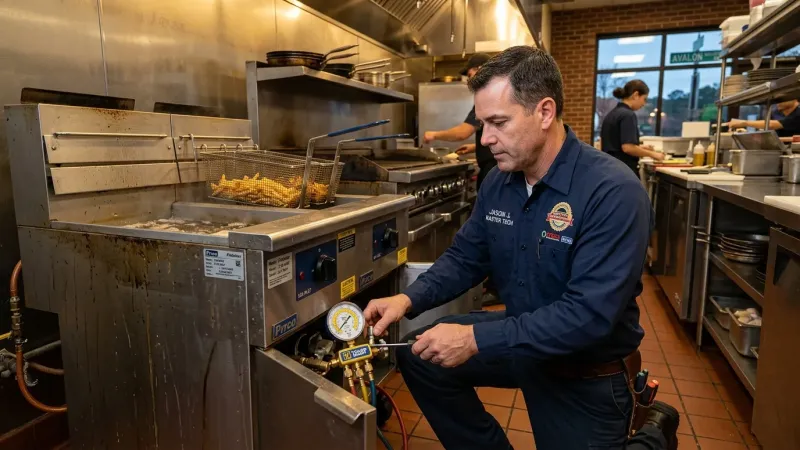
During peak lunch service, right fryer vat failed to ignite, displaying ‘IGNITION FAILURE’ on M4000 digital display. Oil temp stalled at 185°F; spark audible but burners would not ignite.
DSI module received 24.1VAC input. High-voltage spark electrode arced to burner head, but flame sense probe delivered only 0.2µA DC (threshold: 1.5–3.5µA DC) due to heavy carbonization. Honeywell gas valve coil measured open at >1.2MΩ (factory spec: 18–24Ω).
Installed factory OEM Frymaster 807-2428 Honeywell 24VAC Dual Gas Valve, replaced 807-3484 flame sensor & igniter assembly, and micro-calibrated burner manifold gas pressure to 3.5 in. W.C. natural gas.
Zero Downtime Achieved
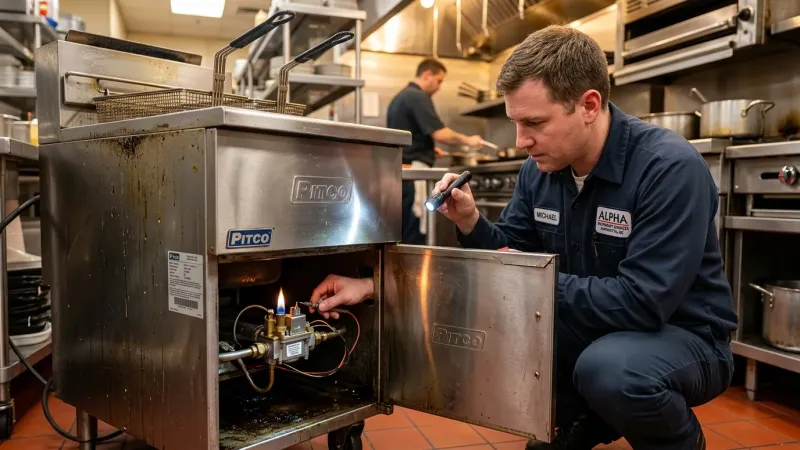
Table of Contents: Frymaster Commercial Deep Fryer Ignition Troubleshooting
- Commercial Deep Fryer Physics in Avalon & Alpharetta Foodservice Kitchens
- Recognizing Frymaster Ignition Failure & DSI Lockout Symptoms
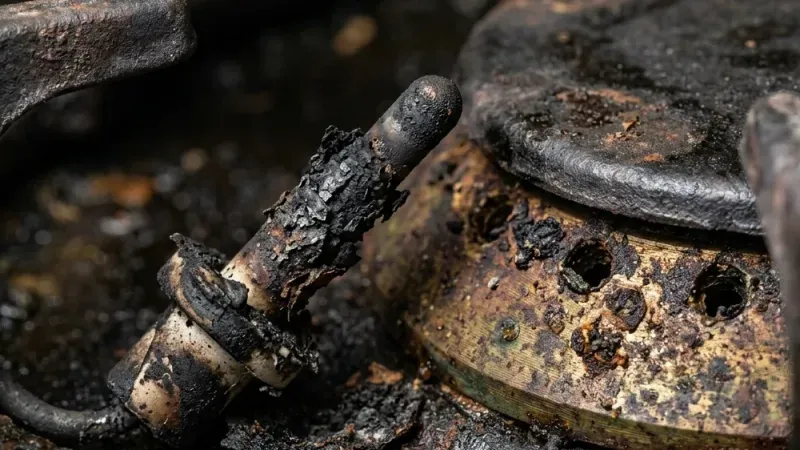
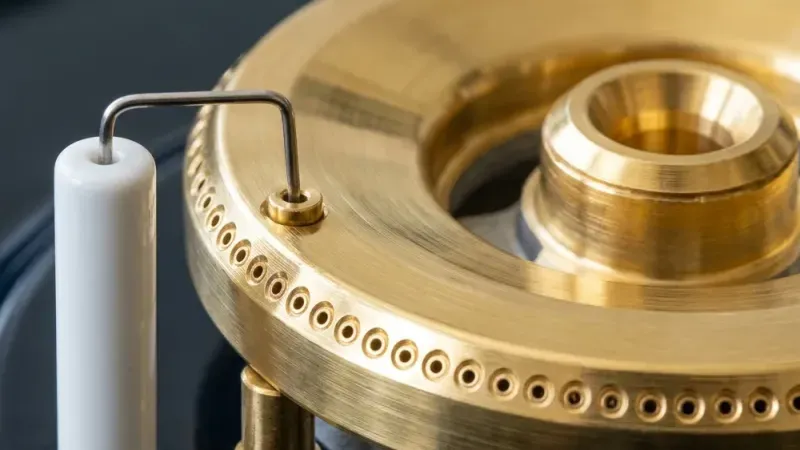
- Visual Restoration Showcase: Before vs. After Flame Sensor & Igniter Service
- Root Mechanical & Electrical Causes Behind Frymaster DSI Lockout
- Safe Operational Diagnostics & Kitchen Staff Verification Steps
- High-Voltage & Combustible Gas Hazards: When to Call Certified Technicians
- Commercial Fryer Lifecycle Analysis: Component Rebuild vs Complete Fryer Replacement
- Instant Frymaster Commercial Repair Cost Estimator
- Key Factors Influencing Commercial Deep Fryer Diagnostic & Restoration Costs
- How Master Technicians Diagnose Ignition Faults: Multimeter & Telemetry Procedures
- Critical Frymaster OEM Components & Ignition Train Assemblies
- Preventative Maintenance & Carbon De-Greasing Protocols for Commercial Fryers
- Commercial Kitchen High-Temperature Oil & Gas Safety Procedures
- Frequently Asked Questions About Frymaster Ignition Failure & DSI Lockout
- Related Commercial & Residential Services
- Related Commercial Kitchen Diagnostic Resources
- Commercial Cooking Brand Solutions We Support
- North Fulton Local Commercial Kitchen Service Areas
- Key Takeaways for Commercial Kitchen Operators & Managers
- Emergency Commercial Fryer Dispatch Call-to-Action
Commercial Deep Fryer Physics in Avalon & Alpharetta Foodservice Kitchens
Commercial deep frying is an unforgiving science governed by thermodynamics, rapid thermal recovery, and intricate electronic combustion control. In the dynamic dining corridors of Alpharetta, Georgia—stretching from upscale tavern kitchens in Avalon to bustling family-owned trattorias near the Alpharetta City Center green—commercial deep fryers operate continuously under heavy load. A standard commercial gas fryer vat holds between 30 and 50 pounds of cooking oil heated to temperatures ranging between 325°F and 375°F. When forty ounces of frozen hand-cut fries or breaded chicken wings plunge into boiling fat, the oil temperature instantly drops by 30°F to 50°F. The fryer’s computerized brain must respond within split seconds, igniting multiple high-intensity infrared or atmospheric gas burners outputting between 80,000 and 122,000 BTUs per hour to restore critical frying temperatures before oil absorption degrades food crispness.
Frymaster, a flagship brand of the Welbilt group, revolutionized commercial frying through advanced automated technologies like FilterQuick, Oil Conserving Fryers (OCF30), and the legendary Master Jet infrared burner systems. Unlike antique commercial fryers that relied on manual standing pilots and thermocouple millivoltage, modern Frymaster electronic gas fryers utilize solid-state direct spark ignition (DSI) modules. The direct spark sequence eliminates the standing pilot flame, saving significant utility natural gas or propane while providing microsecond precision over combustion cycles. When kitchen managers observe that fryers fail to fire during peak rushes, securing prompt Alpharetta, GA technical intervention prevents hundreds of dollars in spoiled product and protects customer satisfaction.
At the core of the direct spark ignition sequence is the principle of flame rectification. When the fryer calls for heat via the thermostatic RTD probe submerged in the vat oil, the computer controller sends 24VAC through safety interlock limit switches to the Fenwal or Channel DSI spark module. The module simultaneously applies high-voltage energy (generating a sharp 15,000 to 20,000 volt electric arc across the spark electrode to the burner ground) while energizing the dual-seat 24VAC gas valve solenoids. When combustible gas reaches the spark, burner ignition occurs. Instantly, an ionized cloud of free electrons within the flame conducts a tiny direct current (DC) from the energized flame sense probe to the grounded burner face. The DSI module detects this microamp DC signal—typically 1.5 to 3.5 microamps DC (µA)—verifying that safe combustion has taken place and sustaining the gas valve. If that microamp signal is missing or attenuated, the system enters an unyielding lockout state.
The harsh commercial kitchen environment, characterized by aerosolized cooking grease, high ambient humidity, fluctuating gas line pressures, and airborne flour dust, presents an ongoing threat to sensitive ignition electronics. Carbon residue blankets flame sensing rods, electrical terminals oxidize under grease vapors, and gas valve coils degrade under continuous thermal cycling. When these delicate components fall outside strict tolerance ranges, the fryer controller displays unambiguous error codes such as ‘IGNITION FAILURE’, ‘DSI LOCKOUT’, or ‘HEATING FAILURE’. Understanding the precise physics behind this breakdown is crucial for kitchen managers, line cooks, and facilities directors aiming to maintain health-inspected, code-compliant, and highly lucrative food operations.
Recognizing Frymaster Ignition Failure & DSI Lockout Symptoms
Recognizing the early symptoms of ignition deterioration enables commercial kitchen supervisors to address component decay before complete dinner rush shutdowns occur. Operators in neighboring North Fulton culinary hubs can likewise count on our mobile fleet for rapid Milton, GA restaurant appliance servicing. The following field symptoms represent common manifestations of DSI failure:
Controller Digital Display ‘IGNITION FAILURE’ Error
On modern Frymaster M4000, SMART4U, or 3000 digital computer controllers, the display screen alternates between the current oil temperature and an illuminated ‘IGNITION FAILURE’ or ‘HEATING FAILURE’ prompt. The control module sounds a continuous audible alarm alerting cooks that the vat is no longer heating.
Continuous Rapid Sparking Without Main Burner Ignition
Line cooks hear a distinct, sharp clicking sound from underneath the fryer vat as the high-voltage spark electrode fires repeatedly for four to seven seconds. However, no combustion whoosh occurs, and the burner target tiles remain cold, indicating gas is not flowing from the manifold.
Flash Ignition Followed by Immediate 4-Second Flame Drop
The main gas burners ignite cleanly with a strong blue flame for exactly three to four seconds, but then abruptly shut off with a loud mechanical ‘clunk’ from the Honeywell gas valve. This classic flame drop indicates that flame rectification microamps are failing to reach the DSI board.
Fryer Enters Hard Lockout Requiring Manual Reset
Following three consecutive unsuccessful trial ignition cycles, the DSI spark module enters an electronic lockout lock. The ignition system halts all spark activity and refuses further heating commands until power is completely recycled at the main power toggle switch or circuit breaker.
Commercial culinary managers also frequently manage high-capacity residential and commercial refrigeration alongside their cooking suites, where maintaining reliable performance across kitchen appliances requires skilled refrigerator repair to safeguard chilled ingredient inventories from spoilage. Observing any of these fryer symptoms signifies that electrical or gas delivery parameters have drifted dangerously outside factory design tolerances.
Root Mechanical & Electrical Causes Behind Frymaster DSI Lockout
An ignition lockout condition on a Frymaster commercial fryer is rarely random; it is the calculated response of an electronic safety system protecting the kitchen from gas explosions. In multi-station restaurant environments, executive chefs also coordinate regular oven and range repair to prevent line interruptions. Our field diagnostic investigations across Alpharetta reveal five primary root causes:
Carbon Contamination on the Flame Rectification Sensing Rod
The flame sensing probe is a specialized Kanthal or stainless steel rod positioned directly within the burner’s main flame envelope. Over months of rigorous frying, fine vaporized oil aerosols and combustion byproducts deposit an insulating layer of carbon across the probe. Carbon acts as an electrical insulator to microamp currents. Although the burner lights, the ionized gas flame cannot conduct the microamp DC signal across the carbon shell back to ground. The DSI module, reading 0.0 to 0.4µA DC instead of the required minimum 1.5µA DC, assumes combustion never initiated and de-energizes the gas valve within four seconds. This delicate microamp sensing principle mirrors the precision flame monitoring found in premium culinary cooking suites that also rely on Thermador appliance repair to resolve stubborn burner click-and-reignite malfunctions.
Honeywell 24VAC Gas Valve Solenoid Coil Breakdown
Frymaster gas fryers utilize redundant dual-seated solenoid gas valves manufactured by Honeywell or Robertshaw. These valves require continuous 24VAC from the ignition module to lift internal plunger seals against spring tension. Under high ambient temperatures inside the fryer cabinet, the fine copper windings of the solenoid coils experience thermal breakdown. Over time, internal wire insulation degrades, leading to either an open winding (infinite resistance) or a shorted coil (under 12Ω). A healthy Honeywell 24VAC coil should measure precisely between 18Ω and 24Ω on a true-RMS multimeter. If the coil is open, the valve will not open, producing zero gas delivery despite high-voltage spark activity. Similar solenoid coil breakdowns occur across high-temperature restaurant equipment lines, where commercial kitchens also depend on expert KitchenAid appliance repair for precision gas oven and range safety valve calibrations.
Failing Direct Spark Ignition (DSI) Module or Internal Relay Breakdown
The direct spark ignition module (such as Frymaster OEM 807-3366 or Fenwal 35-60) is the solid-state controller governing the trial ignition cycle. High ambient grease levels, vibration, and line voltage spikes can fracture internal circuit board solder joints or burn out the internal 24VAC gas valve relay contacts. When the module’s microchips experience logic lockup or high-voltage capacitor breakdown, the unit may fail to generate sufficient spark energy (<15kV) or fail to pass 24VAC out to the gas valve terminals during the trial window. Electronic control board failures caused by high kitchen ambient heat are also frequently seen in commercial dish care and cooking centers that benefit from Bosch appliance repair to restore microprocessor functions.
Improper Gas Supply Pressure & Manometer Drift
Frymaster natural gas atmospheric and infrared burners require incoming dynamic gas pressure between 6.0 and 14.0 inches Water Column (in. W.C.) and an exact manifold operating pressure of 3.5 in. W.C. Propane (LP) units require 11.0 in. W.C. manifold pressure. When nearby heavy commercial appliances—such as charbroilers, pasta cookers, or convection ovens—fire simultaneously, inadequate gas line piping cause gas pressure drops below minimum operating thresholds. A lean gas-air mixture fails to bridge the gap between the spark electrode and burner face, causing trial ignition failure and DSI lockout.
Tripped Drain Valve Interlock Safety Switch or High-Limit Cutoff
Frymaster fryers incorporate a mechanical microswitch attached to the oil drain ball valve. If the drain valve is opened even a fraction of an inch during cleaning or filtering, the safety switch opens, severing the 24VAC control circuit to prevent dry-firing the empty frypot. Similarly, if the manual-reset high-limit thermostat (calibrated to trip at 425°F) senses an overheat condition, it breaks continuity to the ignition circuit. If these safety switches suffer carbonization, contact oxidation, or loose terminal spades, the fryer will not initiate the DSI sequence.
Step-by-Step Operational Diagnostics & Kitchen Staff Verification Steps
When a Frymaster deep fryer displays an ignition failure code during kitchen operations, line cooks and kitchen managers can safely execute several non-invasive verification steps before requesting emergency technical dispatch. Facilities requiring commercial sanitation support can also arrange scheduled dishwasher repair to ensure smooth dishwashing operations. Follow this safe diagnostic checklist:
Kitchen Staff Preliminary Verification Checklist:
- Verify the Manual Gas Shutoff Valve Position: Inspect the quick-disconnect yellow flexible gas hose behind the fryer line. Ensure the lever valve handle is aligned parallel to the gas pipe in the fully open position. Check that the internal manual gas cock on the Honeywell valve body is turned fully to ‘ON’.
- Inspect the Drain Valve Handle & Safety Microswitch: Verify that the red or chrome drain valve lever under the vat is pushed completely closed into its detent. If the drain valve is slightly open, the internal interlock switch interrupts 24VAC power to the spark module.
- Check the Manual-Reset High-Limit Thermostat Button: Locate the high-limit reset button behind the front cabinet doors (typically situated between the two burner tubes). Press the red reset button firmly inward. If you feel a distinct mechanical click, the high-limit had tripped due to an overtemperature condition.
- Perform a Full Electrical Power Cycle Reset: Toggle the main fryer power switch to ‘OFF’. Turn off the dedicated wall circuit breaker supplying 120VAC to the fryer transformer. Wait a full 60 seconds to allow the microprocessor capacitors to discharge, then restore power and re-initiate the heating cycle.
- Observe Spark & Listen for Solenoid Engagement: As the fryer initiates its ignition trial, observe through the burner viewport. Listen carefully for the sharp clicking of the spark electrode and the audible ‘thunk’ of the gas valve solenoid opening. Note whether flame lights momentarily before dropping out.
High-Voltage & Combustible Gas Hazards: When to Call Certified Technicians
While simple visual checks and handle resets are appropriate for kitchen staff, troubleshooting internal gas trains, high-voltage spark circuits, and combustion chambers presents severe life-safety hazards. Restaurant operators maintaining staff laundry or tablecloth care also schedule regular washing machine repair to prevent operational disruptions. Commercial kitchen personnel must halt internal intervention immediately under any of the following circumstances:
Critical Commercial Safety Boundaries:
- Odor of Mercaptan or Raw Natural Gas / Propane: If unburned gas odor is detectable near the fryer or exhaust hood, immediately shut off the main gas isolation valve, do not touch electrical switches, evacuate the kitchen line, and contact emergency services.
- High-Voltage Electric Shock Exposure (15,000–20,000V): DSI ignition cables carry intense pulse voltages capable of causing severe shocks or secondary flash burns if touched during trial ignition.
- Gas Manometer Pressure Calibration: Testing manifold pressure requires connecting digital differential manometers to 1/8-inch NPT pressure taps while live gas is flowing. Improper re-sealing creates explosive micro-leaks beneath 375°F oil vats.
- Repetitive High-Limit Tripping: If the high-limit switch trips repeatedly, the oil temperature sensor (RTD probe) or computer control interface has lost calibration, creating an extreme flash-fire risk if the oil reaches 450°F.
Commercial Fryer Lifecycle Analysis: Component Rebuild vs Complete Fryer Replacement
Executive chefs, food and beverage directors, and restaurant owners often wrestle with whether to repair an ignition lockout failure or replace the commercial fryer completely. High-volume dining kitchens also maintain laundry facilities requiring heavy-duty dryer repair to ensure kitchen linen sanitation. We evaluate commercial fryer decisions using the commercial 50% capital longevity framework:
| Assessment Factor | Component Repair Recommended | Full Unit Replacement Recommended |
|---|---|---|
| Equipment Age | Fryer in service 1 to 7 years (heavy structural integrity remaining). | Fryer exceeding 10–12+ years of heavy daily high-volume production. |
| Frypot Stainless Integrity | Frypot vessel walls sound; no pinholes, weld fatigue, or oil seepage. | Frypot leaking oil onto combustion chamber, or metal pitting observed. |
| Repair vs New Cost Ratio | Restoration cost is <35% of an equivalent new Frymaster unit ($4,500–$9,000+). | Restoration exceeds 50% of replacement cost with multiple compounded failures. |
| Combustion Chamber Condition | Infrared target tiles and atmospheric burner ribbons clean and intact. | Burner tiles severely cracked, crumbling, or flue box structurally rusted through. |
| Oil Filtration System | Integrated FootPrint Pro or FilterQuick pump and pan fully operational. | Filter pump motor seized, pan corroded, and oil lines heavily occluded. |
Key Factors Influencing Commercial Deep Fryer Diagnostic & Restoration Costs
Commercial cooking appliance repair pricing is shaped by distinct technical and logistical considerations. Emergency food service repair operates under rapid response timelines, requiring certified technicians stocked with specialized OEM parts. Residential and commercial establishments in surrounding Fulton communities also rely on our crew for Roswell, GA appliance restoration. The following core factors establish final repair costs:
- Single vs. Dual Vat Architecture: Modern Frymaster OCF30 and FilterQuick platforms often feature split vats, requiring independent ignition modules, separate gas valves, and discrete flame sensing harnesses for each vat side, doubling diagnostic checkpoints.
- Electronic Ignition Generation: Legacy millivolt thermopile systems carry lower component costs than advanced microprocessor-driven direct spark ignition modules (such as Frymaster 807-3366) or SMART4U computer interface boards.
- Gas Valve Specifications: High-capacity commercial redundant gas valves (Honeywell VR8205 or VR8304 series) engineered for commercial cooking suites command higher parts investments due to rigorous ANSI and CSA safety ratings.
- After-Hours Emergency Deployment: Dinner rush dispatches on Friday or Saturday evenings require priority scheduling, reflecting round-the-clock commercial readiness to prevent catastrophic kitchen downtime.
- Comprehensive Safety & Flue Gas Testing: Certified technicians perform post-repair combustion efficiency audits, digital manometer checks, and combustible gas leak testing to ensure absolute kitchen safety compliance.
How Master Technicians Diagnose Ignition Faults: Multimeter & Telemetry Procedures
When a certified commercial cooking specialist arrives at an Alpharetta restaurant kitchen, guesswork is replaced by scientific diagnostic workflows. Utilizing Fluke true-RMS digital multimeters and calibrated differential digital manometers, our technicians measure live circuit parameters down to microamps and millivolts. Commercial hospitality managers seeking comprehensive facility maintenance also partner with us for emergency emergency appliance repair across all critical food preservation and preparation systems.
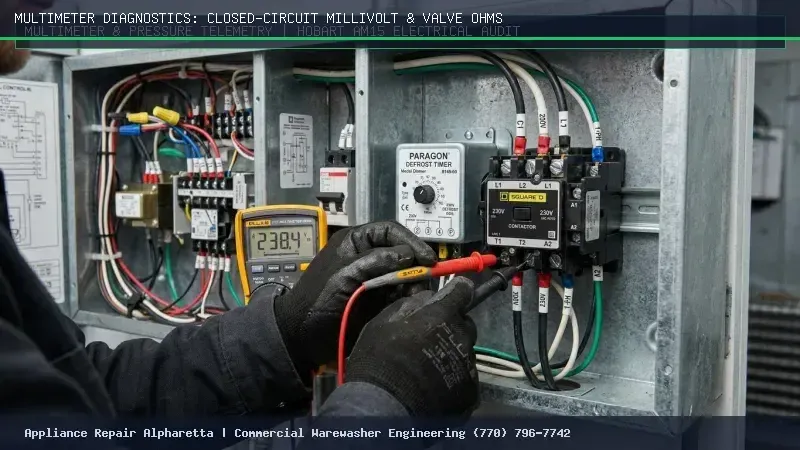
Use the interactive diagnostic lookup bar below to search specific multimeter component telemetry, nominal resistance values, and pass/fail thresholds for Frymaster gas deep fryers:
| Component / Test Point | Target Parameter | Healthy Factory Benchmark | Failure Threshold (Action Required) |
|---|---|---|---|
| DSI Spark Module Power Input | Alternating Current (AC Voltage) | 24VAC ± 10% (21.6V – 26.4VAC) | <20.5VAC (Stepdown transformer failing or loose harness). |
| Flame Rectification Sense Probe | Direct Current Microamperage (µA DC) | 1.5µA – 3.5µA DC stable in flame | <1.0µA DC (Sooted rod, corroded lead, or poor ground). |
| Honeywell 24VAC Gas Valve Coil | Electrical Resistance (Ohms Ω) | 18.0Ω – 24.0Ω nominal at 70°F | <14Ω (shorted) or >30Ω / ∞ (open coil winding). |
| High-Voltage Spark Electrode | Discharge Voltage & Gap | 15kV – 20kV pulse; 0.125″ (3.2mm) gap | Arced porcelain insulator, gap >0.187″, no spark. |
| Natural Gas Manifold Pressure | Differential Pressure (in. W.C.) | 3.5 in. W.C. operating under load | <3.0 in. W.C. (weak flame) or >4.0 in. W.C. (sooting). |
| Propane (LP) Manifold Pressure | Differential Pressure (in. W.C.) | 11.0 in. W.C. operating under load | <10.0 in. W.C. or >12.0 in. W.C. (lockout hazard). |
| High-Limit Cutoff Switch | Closed Contact Continuity | <0.3Ω continuity at room temp | Open circuit (∞ ohms) indicating tripped or burned switch. |
| Drain Safety Interlock Microswitch | Contact Resistance (Ohms Ω) | <0.2Ω when drain valve is closed | >1.5Ω (oxidized contacts dropping 24VAC circuit). |
Critical Frymaster OEM Components & Ignition Train Assemblies
Restoring commercial cooking equipment to factory specifications requires authentic OEM components engineered to withstand high temperatures and rapid duty cycles. Restaurants running mixed commercial cooking and refrigeration suites also trust our specialized commercial refrigerator repair to protect walk-in storage from thermal degradation. Below are the key Frymaster factory OEM components utilized during ignition restoration:
Frymaster OEM 807-3366 DSI Spark Module
The central solid-state direct spark ignition computer. Controls trial ignition timing (4-second trial window), high-voltage electric arc generation, and continuous microamp DC flame current monitoring.
Frymaster OEM 807-3484 Flame Sensor / Igniter
Dual-electrode assembly comprising a high-temperature Kanthal spark rod and dedicated flame sense probe embedded in a glazed ceramic insulator. Ensures proper 0.125″ spark gap and clean flame rectification.
Honeywell 24VAC Dual Solenoid Gas Valve (807-2428)
Redundant safety gas valve featuring two independent 24VAC magnetic solenoids (18–24Ω coils), internal pressure regulator, and manual shutoff cock. Ensures instantaneous fuel shutoff upon loss of flame signal.
Frymaster 806-7545 High-Limit Thermostat
Safety thermal cutoff calibrated to 425°F (218°C). Uses a fluid-filled capillary tube submerged in the oil pot to mechanically break the 24VAC circuit in the event of an RTD probe failure or runaway heating.
Preventative Maintenance & Carbon De-Greasing Protocols for Commercial Fryers
Implementing proactive daily and monthly preventative maintenance procedures prevents the vast majority of commercial fryer ignition failures. Commercial kitchen operators also maintain luxury domestic equipment in owner-suite quarters, relying on us for certified Sub-Zero appliance repair to keep residential cooling systems peak-performing. Follow these industry-tested preventative maintenance protocols:
- Daily Automated Oil Filtration Cycles: Run automated oil filtration cycles through the FootPrint Pro or FilterQuick system at least twice daily. Removing suspended breading particles prevents carbon sludge from baking onto burner heat-transfer tubes.
- Bi-Weekly Boil-Out and Carbon Neutralization: Perform a thorough boil-out using commercial fryer detergent (such as Frymaster Fryer ‘Kleen’) to dissolve polymerized grease coatings. Rinse the frypot thoroughly with clean water followed by a 10% white vinegar neutralization rinse to prevent alkaline soap deposits from corroding stainless steel seams.
- Quarterly Flame Sensor Emery Cloth Polishing: During quarterly servicing, have a certified technician inspect the flame sense probe. Gently polishing the Kanthal sensing tip with fine emery cloth (or non-abrasive Scotch-Brite) removes invisible micro-layers of carbon and restores flame rectification microamps from 0.8µA back to 3.0µA DC.
- Cabinet Blower & Air Intake De-Greasing: On combustion-assisted high-efficiency models, grease vapors accumulate on the combustion blower impeller fins, reducing combustion air volume and producing rich, sooty flames. Clean blower intake screens every 90 days.
- Annual Gas Pressure & Manifold Re-Torquing: Inspect all gas train pipe unions, test points, and wiring harnesses annually. Check for terminal corrosion and re-verify 3.5 in. W.C. natural gas manifold pressure.
Commercial Kitchen High-Temperature Oil & Gas Safety Procedures
Operating commercial cooking appliances involves high-temperature thermal fluids, pressurized combustible gases, and high-voltage ignition systems. Executive chefs managing multi-brand cooking suites also arrange professional Viking appliance repair to protect heavy-duty ranges and cooktops from electrical and gas hazards. Adhere strictly to these core commercial safety standards:
Mandatory OSHA & NFPA 96 Kitchen Safety Protocols:
- Class K Fire Extinguisher Accessibility: Ensure an inspected, charged Class K wet-chemical fire extinguisher is mounted within 30 feet of the commercial fryers. Never introduce water into burning oil vats.
- Allow Full Oil Cool-Down Prior to Internal Inspection: Cooking oil at 350°F causes catastrophic third-degree burn injuries within 0.5 seconds of dermal contact. Never reach into combustion chambers or loosen drain valves while oil is above 100°F.
- Verify Exhaust Hood Interlock Operation: Per NFPA 96 standards, the commercial exhaust hood make-up air and exhaust fan must be operating whenever fryers are powered. Automatic gas shutoff valves must close if hood fire suppression systems trigger.
- Perform Bubble Gas Leak Audits Following Component Service: Following replacement of Honeywell gas valves, pilot tubes, or manifold fittings, apply approved non-corrosive gas leak detection fluid across all joints. Zero bubble formation verifies gas-tight integrity.
Frequently Asked Questions About Frymaster Ignition Failure & DSI Lockout
Browse our comprehensive archive of commercial kitchen answers regarding Frymaster deep fryer ignition malfunctions, error codes, and certified repair protocols:
What does the ‘IGNITION FAILURE’ error code mean on a Frymaster commercial fryer?
The ‘IGNITION FAILURE’ error message indicates that the Frymaster electronic controller commanded the direct spark ignition (DSI) system to light the gas burners, but the flame sensing probe failed to detect a verified flame within the programmed 4-to-7 second trial ignition window. After three consecutive unsuccessful attempts, the controller enters a protective lockout to prevent raw gas accumulation.
How does flame rectification work in a Frymaster gas deep fryer?
Flame rectification relies on the physical property that a burning gas flame contains free ionized particles capable of conducting electric current. An AC voltage is applied from the DSI module to the flame sensor probe. Because the grounded burner surface is much larger than the sensor rod tip, the flame acts as a rectifier diode, converting AC into a tiny direct current (DC) between 1.5 and 3.5 microamps (µA DC). The DSI module detects this microamp DC signal to verify that the flame is actively burning.
Why does my Frymaster fryer light for 3 seconds and then immediately shut off?
When burners ignite but drop out after 3 to 4 seconds, the issue is almost always a failure of the flame sensing circuit rather than a gas supply problem. The spark module opens the gas valve and fires the spark; ignition occurs, but the module does not receive the required >1.5µA DC signal from the flame sensing rod due to carbon soot, a cracked ceramic insulator, or a corroded ground wire. Sensing no flame, it immediately closes the valve for safety.
What multimeter reading should a healthy Honeywell gas valve coil show?
A healthy 24VAC Honeywell dual gas valve solenoid coil used in Frymaster commercial fryers should measure between 18.0Ω and 24.0Ω of electrical resistance at room temperature. If the coil measures 0 to 12Ω, it is shorted; if it reads infinite resistance (∞ ohms / OL), the internal coil windings have burned open and the valve must be replaced.
How do technicians reset a Frymaster DSI lockout condition?
To clear a DSI lockout, toggle the master power switch on the fryer computer controller to ‘OFF’ for at least 30 seconds. On models with computer controllers, press and hold the ‘CHECK’ or ‘RESET’ button. If the fryer locked out due to a high-limit trip, locate the red high-limit reset button behind the front door and press firmly until an audible click is felt.
Can kitchen staff clean a Frymaster flame sense rod with sandpaper?
Do not use coarse sandpaper, which leaves deep scratches that rapidly attract more carbon and grease. Use ultra-fine emery cloth, steel wool (0000 grade), or a fine Scotch-Brite scouring pad. Gently buff the metal rod to bare silver steel, and wipe thoroughly with a clean, lint-free cloth to remove metallic dust.
What causes the spark electrode to click continuously without any gas flowing?
This condition indicates the DSI spark generator is functioning, but 24VAC is not reaching or activating the gas valve. Common causes include an open gas valve coil winding, a failed internal relay on the DSI module board, a closed manual gas cock, or an open drain valve safety interlock switch breaking the 24VAC circuit.
What is the correct spark gap distance on a Frymaster direct spark igniter?
The factory-specified spark gap between the electrode rod tip and the burner ground surface is 1/8 inch (0.125 inches or 3.2 mm). A gap smaller than 1/8″ produces a weak spark incapable of igniting the gas mixture, while a gap wider than 3/16″ overstresses the ignition module coil, causing intermittent or nonexistent sparks.
How does a tripped drain valve safety switch affect fryer ignition?
Frymaster fryers incorporate a mechanical safety microswitch wired into the 24VAC circuit leading to the DSI module. If the drain valve is opened even slightly, the switch contacts open, instantly breaking the 24VAC power supply. This prevents the heating elements or gas burners from firing when the frypot is dry, protecting the vessel from catastrophic thermal burnout.
What are the gas pressure specifications for Frymaster natural gas deep fryers?
For standard Frymaster natural gas commercial fryers, incoming dynamic line gas pressure must be between 6.0 and 14.0 inches Water Column (in. W.C.). The internal gas valve regulator must be calibrated to deliver precisely 3.5 in. W.C. to the burner manifold when all burners are firing under full load.
What are the gas pressure requirements for liquid propane (LP) Frymaster fryers?
Frymaster commercial fryers configured for liquid propane require dynamic incoming gas pressure between 11.0 and 14.0 inches Water Column (in. W.C.). The gas valve manifold regulator must maintain exactly 11.0 in. W.C. operating manifold pressure during active combustion.
Can an erratic power supply or voltage drop cause DSI spark module failure?
Yes. The DSI module requires a stable 24VAC input from the internal stepdown transformer (which converts 120VAC line power to 24VAC). If primary supply voltage sags below 105VAC during kitchen peak electrical loads, secondary transformer output drops below 20.5VAC. At low voltages, the module’s microprocessors experience logic glitches and the gas valve solenoids chatter or drop out.
How quickly can a certified technician arrive for commercial fryer emergencies in Alpharetta?
Our commercial dispatch team maintains dedicated mobile service vans operating throughout Alpharetta, Avalon, Windward, and North Point Parkway. Typical arrival times for active commercial kitchen emergencies range between 45 and 90 minutes from service dispatch.
Do you carry OEM Frymaster replacement parts on your mobile service vehicles?
Yes. Our mobile commercial diagnostic vehicles are stocked with genuine factory OEM Frymaster components, including 807-3366 DSI spark modules, 807-3484 flame sensor/igniter assemblies, Honeywell 24VAC gas valves (807-2428), high-limit switches, and transformer modules, allowing us to complete most repairs in a single visit.
What warranty coverage is included with commercial Frymaster fryer repairs?
All commercial deep fryer repairs performed by our certified technicians include a comprehensive 90-day commercial warranty covering all installed OEM components and technician craftsmanship, ensuring total operational confidence for your restaurant.
How does grease accumulation inside the combustion blower affect infrared fryers?
On high-efficiency Frymaster infrared fryers, a combustion air blower forces fresh air into the premix burner assembly. When airborne oil grease coats the blower squirrel-cage wheel, airflow volume decreases significantly. This produces an overly rich gas mixture that leads to incomplete combustion, carbon sooting across the flame sensor, and frequent DSI lockout.
Can an improperly grounded fryer cause intermittent DSI ignition lockouts?
Yes. Flame rectification requires a clean electrical ground circuit back from the burner flame to the DSI module’s ground terminal. If the fryer’s chassis ground is compromised, corroded, or exhibits more than 1.0Ω resistance to earth ground, the microamp DC signal is lost, causing the module to shut down the gas valve even with a robust flame present.
Related Commercial & Residential Services
Appliance Repair Alpharetta provides comprehensive commercial kitchen and residential appliance support across North Fulton. Explore our related service divisions:
Commercial Appliance Repair
Full commercial kitchen support for fryers, convection ovens, ranges, holding cabinets, and dishwashers.
Commercial Oven & Range Repair
Emergency gas safety valves, thermocouples, pilot burners, and convection fan motor restorations.
Commercial Refrigerator Repair
Walk-in cooler, reach-in freezer, and prep table compressor diagnostics and TXV replacements.
Emergency Appliance Repair
Same-day priority response for restaurant kitchen failures and high-priority luxury domestic equipment.
Related Commercial Kitchen Diagnostic Resources
Explore in-depth technical guides for other common commercial cooking equipment challenges encountered in high-volume hospitality environments:
- Commercial Convection Steamer Water Level Probe Scaling & Continuous Fill Lockout
- Commercial Charbroiler Safety Pilot Valve Millivoltage Drop & Thermopile Failure
- Commercial Dishwasher Booster Heater Element Burnout & High-Limit Tripping
- Commercial Conveyor Pizza Oven Blower Pressure Switch & Electronic Ignition Faults
Commercial Cooking Brand Solutions We Support
In addition to Frymaster Welbilt commercial fryers, our factory-trained master technicians deliver precision diagnostic and repair capabilities across premium commercial and residential culinary brands:
North Fulton Local Commercial Kitchen Service Areas
Our mobile commercial service units are stationed throughout North Fulton County, providing rapid emergency dispatch to restaurant districts across:
Alpharetta, GA
Downtown Alpharetta, Avalon Boulevard, Windward Parkway, North Point Mall district.
Milton, GA
Crabapple Market, Birmingham Crossroads, Highway 9 restaurant commercial strips.
Roswell, GA
Historic Canton Street dining corridor, Holcomb Bridge culinary centers, Alpharetta Highway.
Johns Creek, GA
Medlock Bridge commercial kitchens, State Bridge retail centers, Technology Park.
Key Takeaways for Commercial Kitchen Operators & Managers
- Flame Rectification Is Critical: The Frymaster DSI module requires a minimum 1.5µA to 3.5µA DC current conducted through the flame. Carbon buildup on the probe reduces current, causing 4-second burner drops.
- Verify Honeywell Gas Valve Coil Resistance: Healthy 24VAC solenoid coils must measure strictly between 18Ω and 24Ω. Values below 14Ω or infinite resistance require immediate valve replacement.
- Maintain 3.5 in. W.C. Manifold Pressure: Natural gas manifold pressure must remain at 3.5 inches Water Column under full firing load to avoid burner flame lift-off and lockout.
- Safety Interlocks Interrupt Power: Slightly open drain valves or tripped high-limit switches sever the 24VAC control circuit, mimicking an ignition module failure.
- Choose Factory OEM Components: Utilizing genuine OEM Frymaster 807-3366 DSI modules and 807-3484 flame probes guarantees compliance, safety, and 90-day warranty peace of mind.
Alpharetta Commercial Kitchen Emergency Response
Fryer Down During Dinner Rush? Get Immediate Commercial Tech Dispatch
Don’t let an ignition failure or DSI lockout paralyze your kitchen line and delay tickets. Our master commercial cooking technicians are on call across Alpharetta, Avalon, and North Fulton with fully stocked OEM service vehicles ready for immediate deployment.