
Frymaster Commercial Deep Fryer Pilot Flame Outage & Thermopile Lockout Repair in Milton, GA
When a bustling sports tavern, upscale farm-to-table bistro, country club dining facility, or fast-casual kitchen across Milton discovers that their Frymaster commercial fryer pilot light won’t stay lit during critical lunch or Friday evening dinner prep, commercial kitchen operations face immediate financial peril. Fried appetizers, crispy chicken tenders, pomme frites, calamari, and tempura account for more than 40% of kitchen revenue and order volume in modern American foodservice establishments. The Frymaster commercial deep fryer—celebrated throughout North Fulton commercial kitchens for its open-pot Master Jet burner geometry and rapid thermal recovery—relies upon an autonomous, self-generating millivolt electrical control circuit energized by a 750-millivolt (mV) coaxial thermopile generator. When fine airborne cooking flour, carbonized grease splatter, or baked-on sediment encrusts the pilot burner hood, or when internal thermocouple junctions degrade below the critical 325mV closed-circuit threshold under load, the combination gas safety valve immediately drops out, snapping off all fuel flow in a fail-safe mechanical lockout. Explore our comprehensive commercial appliance repair programs engineered to protect Milton restaurants from catastrophic kitchen downtime. For priority emergency technician dispatch directly to your Milton cookline, dial our commercial service line at (770) 796-7742.
Quick Answer: Why Does a Frymaster Commercial Fryer Pilot Go Out?
A Frymaster commercial deep fryer pilot goes out the moment the gas valve knob is released primarily due to a depleted 750mV thermopile generating less than 325 millivolts under load, an obstructed pilot orifice, or a tripped 425°F manual-reset high-limit thermostat. The pilot flame must generate sufficient thermoelectric voltage to energize the internal safety electromagnet inside the Robertshaw combination gas valve. If the flame is weak, yellow, misaligned, or the safety circuit is broken by high resistance, the gas valve instantly snaps closed.
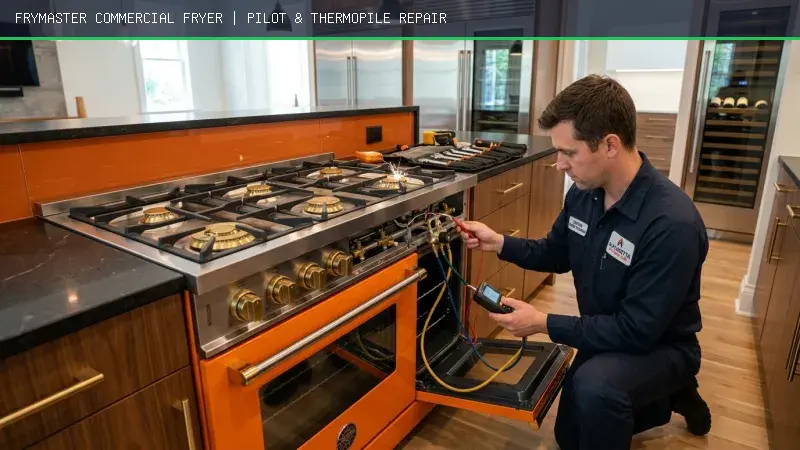
Listen to 60-Second Commercial Fryer Diagnostic Summary
Narrated by Master Gas Cooking Specialist Marcus V.
Check Same-Day Commercial Tech Availability in Your Milton Kitchen
Recently Serviced on Crabapple Road, Milton
Frymaster GF14 Dual-Pot Thermopile Replacement & Gas Pressure Manifold Calibration • 100% Friday Dinner Rush Saved ★★★★★
Table of Contents: Frymaster Commercial Fryer Diagnostic Manual
- 1. Millivolt Generation & Frymaster Gas Combustion Physics
- 2. Operational Symptoms of Commercial Fryer Pilot Failure
- 3. Visual Before & After Restoration Showcase
- 4. Common Causes: Why the Pilot Flame Fails to Stay Lit
- 5. Safe Commercial Kitchen Shift Troubleshooting Steps
- 6. When to Stop DIY: Gas Explosions, Flash Fires & Burn Hazards
- 7. Commercial Decision Matrix: Repairing vs. Replacing Commercial Fryers
- 8. Interactive Commercial Fryer Repair Cost Estimator
- 9. Factors Influencing Commercial Fryer Repair Invoices in Milton
- 10. Technical Multimeter Testing: Millivolts, High-Limits & Valve Ohms
- 11. Genuine OEM Frymaster Replacement Parts Catalog
- 12. Daily, Weekly & Monthly Commercial Fryer Preventive Maintenance
- 13. NFPA 96 Fire Safety, Boil-Out Protocols & Health Code Compliance
- 14. Advanced Gas Manifold, Orifice Physics & Flue Draft Dynamics
- 15. Step-by-Step Professional Thermopile Replacement Protocol
- 16. Frequently Asked Questions (Master Combustion Tech Accordion)
- 17. Commercial Kitchen Appliance Service Resources & Internal Links
- 18. Commercial Key Takeaways
- 19. Priority Commercial Dispatch Call to Action
1. Millivolt Generation & Frymaster Gas Combustion Physics
Understanding how standard commercial gas fryers operate is critical for kitchen staff troubleshooting flame outages. Unlike modern residential stoves that rely on 120-volt spark ignition modules, standard commercial millivolt fryers—such as the Frymaster GF14, Master Jet, and Dean Super Runner series—are completely autonomous electrical systems that require zero external wall power. They generate their own electricity directly from heat using a thermoelectric phenomenon known as the Seebeck effect. Discover our full suite of commercial cooking and refrigeration repair solutions for complete hot-line coverage across North Fulton commercial facilities.
The heart of this electrical generation is the 750-millivolt (mV) thermopile (also known as a powerpile generator). Constructed from dissimilar metals (typically chromel and constantan) joined at alternating hot and cold junctions inside a heavy copper or stainless steel coaxial sheath, the thermopile generates direct current (DC) voltage when heated by the pilot flame. When the pilot burns properly at 1,500°F to 1,800°F, heat differential across the junctions produces between 600mV and 800mV open-circuit. Review our specialized commercial cooktop and stove repair services for all facility cooking line diagnostics.
This modest voltage travels through a low-resistance wiring circuit connecting the operating thermostat, the manual-reset high-limit safety thermostat, and the combination gas control valve (typically a Robertshaw 7000 or Honeywell VR8200). Inside the gas valve, this millivoltage energizes two distinct electromagnetic coils: the pilot safety magnet (which requires a minimum of 180mV to hold the pilot valve open) and the main burner operator coil (which requires a minimum of 325mV under load to pull open the main gas valve when the thermostat calls for heat). If any component in this closed circuit introduces excessive electrical resistance—or if the pilot flame shrinks—the voltage plummets below the drop-out threshold, and internal springs instantly snap the gas valves closed. For broad commercial facility maintenance, explore our dedicated commercial built-in oven service team.
The open-pot architecture of Frymaster fryers eliminates the internal heat exchange tubes found in traditional tube-style fryers, creating a completely smooth, unobstructed frypot that is exceptionally easy to clean. However, because the burners fire against the exterior walls of the frypot, the pilot assembly is mounted in close proximity to the bottom cold zone. In commercial frying, crumbs, breading, and food sediment naturally settle into this cold zone, where oil temperatures remain around 200°F to prevent scorching. When kitchen stewards drain the frypot or perform vigorous cleaning without shielding the pilot assembly, breading crumbs fall directly into the pilot aerator mixer, creating severe primary air blockages that corrupt combustion stoichiometry.
In Milton commercial foodservice environments, restaurant kitchens experience significant fluctuations in ambient temperature and humidity between the summer patio season and winter chill. During peak summer service, kitchen air handling units struggle against heavy kitchen heat loads, causing cooks to run portable fans near the fry station. Air currents from these external fans frequently strike the open burner chamber beneath the frypot, disturbing the delicate primary air entrainment entering the pilot mixer tube. A pilot flame that is starved of primary air burns yellow and weak, failing to heat the upper third of the thermopile properly and causing intermittent dropouts that baffle line cooks.
Furthermore, commercial kitchen managers must realize that thermoelectric power generation is strictly proportional to the temperature differential ($Delta T$) between the hot junctions immersed in the flame and the cold junctions inside the lower body of the thermopile. If radiant heat from the main burners overheats the entire pilot bracket and lower thermopile housing—often due to missing burner heat shields or improper burner baffle alignment—the temperature differential collapses. Even with a large flame striking the probe, the thermopile cannot produce sufficient voltage to keep the gas valve open under heavy burner firing cycles.
2. Operational Symptoms of Commercial Fryer Pilot Failure
When a commercial deep fryer pilot circuit begins deteriorating, it produces distinct operational symptoms. Recognizing these early signs enables lead cooks and kitchen managers to schedule service before a total shutdown occurs in the middle of a rush:
- Pilot Flame Extinguishes the Instant the Knob Is Released: The pilot lights cleanly while holding down the gas valve knob, but extinguishes immediately upon releasing the knob, even after depressing it for 2 full minutes. This confirms open-circuit millivoltage below 180mV or an open high-limit switch.
- Pilot Shuts Off the Moment Main Burners Ignite: The pilot stays lit steadily during idle periods, but the instant the operating thermostat calls for heat and the main burner ignites, the pilot flame is either sucked away or drops out due to severe millivolt voltage sag under load below 325mV.
- Lazy, Yellow, Sooty Pilot Flame: Instead of a sharp, roaring blue torch flame that hugs the top 3/8-inch of the thermopile, the pilot burns with a soft, flickering yellow flame that deposits black carbon soot onto the sensor sheath, acting as a thermal insulator.
- Main Burners Refuse to Fire Despite an Active Pilot: The pilot flame burns continuously, but turning the oil temperature thermostat knob from 0°F to 350°F produces no click, no gas release, and zero burner ignition. This points to welded or oxidized thermostat contacts, a broken high-limit bulb, or a failed operator coil.
- Sudden High-Limit Thermostat Lockout: The pilot flame abruptly dies while cooking, and cannot be relit until the red manual high-limit reset button behind the front door is firmly pressed. If oil temperature actually exceeded 425°F, the operating thermostat has failed in a closed-circuit runaway condition.
- Delayed or Explosive Burner Ignition: When the thermostat calls for heat, gas pools in the combustion chamber for 3 to 5 seconds before igniting with a violent “WHOOSH” or bang that shakes the fryer chassis, indicating improper pilot flame positioning or clogged burner carryover ports.
- Frequent Pilot Outages During Hood Exhaust Startup: The pilot lights reliably in the morning, but as soon as the main kitchen hood exhaust system and make-up air fans are powered on, the pilot is immediately snuffed out by heavy draft imbalances across the kitchen line.
Foodservice operations experiencing simultaneous refrigeration and cooking failures can rely on our cross-trained commercial technicians for integrated commercial walk-in cooler high temp alarm diagnostics and hot-line equipment maintenance.
Another subtle but critical symptom is “thermal wandering.” The kitchen sets the dial to 350°F, but the oil temperature creeps past 390°F before the burners shut off, or fails to reignite until oil drops below 300°F. This indicates excessive hysteresis inside the mechanical thermostat bulb or a high-resistance contact block that starves the gas valve operator coil of holding current. Food cooked in wandering fryers either emerges soggy and oil-soaked (due to low fry temperatures) or charred on the outside while raw inside.
In severe cases of burner carryover blockage, line cooks will notice acrid, stinging fumes in the kitchen air whenever the fryer operates. This indicates incomplete combustion of natural gas or propane, leading to high concentrations of carbon monoxide and aldehydes. When incomplete combustion occurs beneath a commercial frypot, heavy soot accumulates on the exterior bottom surfaces of the tank. This soot layer acts as a stubborn thermal insulator, drastically reducing heat transfer into the oil, doubling heat-up times, and overheating the combustion chamber until the high-limit safety trips permanently.
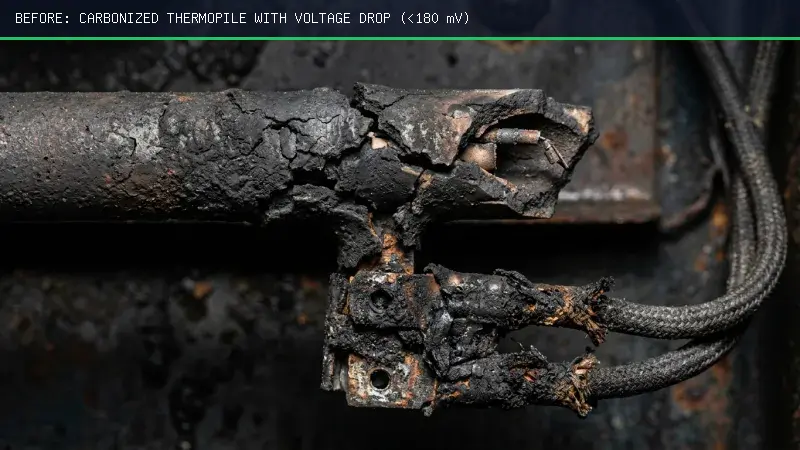
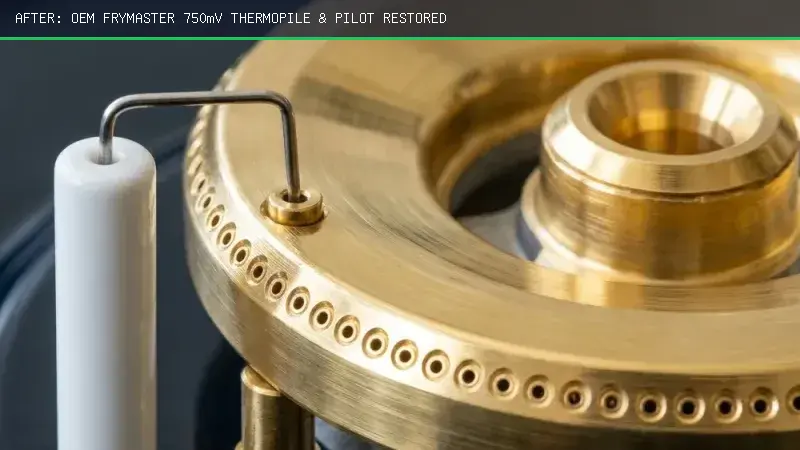
4. Common Causes: Why the Pilot Flame Fails to Stay Lit
A thorough diagnostic investigation reveals that commercial deep fryer pilot outages in Milton restaurants are driven by six specific mechanical and electrical failure modes:
1. Internal Junction Degradation of the 750mV Thermopile
Thermopiles operate in an exceptionally harsh environment, immersed directly in a 1,600°F pilot flame for years. Over time, repeated thermal shock degrades the internal welded junctions between the dissimilar metals. While a failing thermopile might generate 400mV to 500mV open circuit when tested with no electrical load, connecting the load of the gas valve operator coil causes the voltage to collapse below 250mV. The combination valve’s hold-in coil requires at least 325mV to keep the main valve operable; anything less results in pilot drop-out. For premium commercial ranges experiencing burner issues, consult our Vulcan commercial cooking appliance repair specialists.
The metallurgical degradation of the thermopile is exacerbated by sulfur compounds present in commercial fuel gas and trace chloride vapors from sanitizing chemicals used on kitchen floors. When sanitizers evaporate near the fryer base, halogenated vapors are drawn into the pilot burner’s primary air intake. At flame temperatures exceeding 1,500°F, these chlorides form acidic compounds that chemically attack the stainless steel coaxial probe, causing microscopic pitting and accelerating internal junction separation.
2. Clogged Pilot Burner Orifice & Primary Aerator Screen
The pilot burner uses a tiny brass or stainless steel orifice spud with an opening smaller than a sewing needle (typically 0.018″ to 0.024″ diameter). In commercial kitchens, fine airborne particles of breading flour, cornstarch, aerosolized fry grease, and dust drawn through the primary air intake ports gradually plug this orifice. The gas flow is choked, producing a soft, pencil-thin flame that fails to envelope the thermopile sheath. Without complete immersion, the cold junctions warm up while the hot junctions stay cool, destroying voltage generation.
Kitchen staff often make the mistake of attempting to clear this orifice using paper clips, sewing needles, or drill bits. This practice must never be permitted. Brass orifices are precision-machined to micro-inch tolerances; forcing steel needles into the opening wallows out the hole, distorting the gas jet angle and destroying the air-fuel ratio. A wallowed-out orifice creates an overly rich, roaring orange flame that rapidly deposits thick soot, blinding the thermopile within days.
3. Tripped or Defective High-Limit Safety Thermostat (425°F/450°F)
Every commercial deep fryer incorporates a non-adjustable, manual-reset high-limit thermostat wired in series with the thermopile circuit. Its capillary bulb is immersed directly in the frypot oil. If oil temperature reaches 425°F (450°F on some LP models), the high-limit switch snaps open to prevent the cooking oil from reaching its auto-ignition fire flashpoint (~475°F). An open high-limit creates an infinite resistance break in the circuit, completely blocking millivoltage from reaching the gas valve. If the high-limit has tripped, pressing its red reset button restores continuity; however, if the operating thermostat caused the overheat, the high-limit will trip again immediately. Check out our high-heat cooking solutions for Garland commercial cooking range maintenance.
Over years of severe commercial duty, high-limit thermostats experience mechanical fatigue within their internal snap-action disc. The hydraulic fluid sealed inside the copper capillary tube can leak out through microscopic stress cracks near the tank mounting ferrule. When hydraulic charge is lost, the internal microswitch defaults to an open position, permanently locking out the pilot flame even when the oil is completely cold. A multimeter continuity check across the high-limit terminals quickly identifies this open-circuit failure.
4. Pitted or Weak Combination Gas Valve Safety Magnet
Inside the Robertshaw 7000 or Honeywell combination valve, an electromagnetic power head holds the pilot safety valve open against spring tension. Over a decade of heavy restaurant service, the fine copper windings inside the magnet develop high resistance, or the metal contact armature develops a layer of oily film. A weakened magnet may require 400mV just to stay open. When tested, a good valve coil should read between 11.5 and 13.5 ohms of resistance. A reading of infinity indicates a burnt-out magnet that requires replacing the gas valve assembly.
5. Loose or Corroded Terminal Connections
Because the entire control circuit operates on fractions of a single volt (less than 0.75V DC), the circuit has zero tolerance for electrical resistance. A loose spade terminal, greasy screw terminal on the valve block (terminals TH, TP, and TH-TP), or corroded wire splice can easily introduce 2 to 4 ohms of parasitic resistance. In a millivolt circuit, just 3 ohms of resistance can drop voltage by 150mV, instantly killing the flame safety circuit. Restaurant managers in Crabapple can view our localized coverage on commercial appliance repair in Crabapple, GA.
6. Incorrect Gas Supply Pressure or Negative Kitchen Pressure
Commercial fryers require precise gas pressure: 3.5 inches Water Column (W.C.) for Natural Gas, or 10.0 inches W.C. for Propane (LP). If the building regulator fails or line pressure drops during heavy kitchen demand, the pilot flame starves. Furthermore, powerful commercial exhaust hoods (drawing 5,000+ CFM) without adequate makeup air create negative room pressure. This drafts air down the fryer flue, blowing out the pilot flame or pulling it away from the thermopile. Review our specialized residential and estate cooking services in BlueStar commercial-style range repair in Milton, GA.
5. Safe Commercial Kitchen Shift Troubleshooting Steps
Kitchen staff and shift managers can safely perform these initial checks to identify the source of a pilot outage before calling for emergency technical dispatch:
Step 1: Check the High-Limit Reset Button
Open the front fryer door. Locate the red manual-reset button on the high-limit thermostat box (typically located beneath the frypot on the left or center divider). Firmly press the red button. If you hear and feel a distinct mechanical “CLICK”, the high-limit had tripped due to an over-temperature condition. Allow the oil to cool below 300°F before attempting to relight the pilot. If the high-limit trips repeatedly, shut down the fryer immediately.
Step 2: Inspect Pilot Flame Color & Flame Geometry
Depress the gas valve knob in the PILOT position and ignite the flame using a long commercial lighter. Observe the flame while holding down the knob: Is the flame sharp, bright blue, and completely wrapping the upper 3/8-inch of the thermopile? If the flame is weak, fluttering yellow, or blowing away from the sensor, the pilot orifice is clogged with breading flour or grease soot.
Step 3: Hold the Pilot Knob for a Full 60 Seconds
Because a thermopile consists of numerous internal metal junctions, it has significant thermal mass and takes between 45 and 60 seconds to reach operating temperature from a cold start. Depress the knob fully, light the pilot, and maintain steady inward pressure for a full 60 seconds by the kitchen timer before slowly releasing the knob.
Step 4: Verify Main Manual Gas Supply Valve Position
Look behind the fryer at the flexible stainless steel gas connector hose. Verify that the yellow-handled commercial ball valve is turned completely parallel to the gas pipe (fully open). Ensure that the quick-disconnect fitting collar has fully snapped forward and locked into place, as a partially unseated quick-disconnect restricts gas flow.
Step 5: Inspect Terminal Block Wire Integrity
With the gas valve in the OFF position, inspect the three brass screw terminals on the top of the combination gas valve labeled TH, TP, and TH-TP. Check for loose screw clamps, grease-saturated wires, or burned spade terminals. Gently wiggle each lead to verify tight mechanical contact. Never yank on wiring when the fryer is hot.
6. When to Stop DIY: Gas Explosions, Flash Fires & Burn Hazards
Critical Commercial Gas Safety Directives for Restaurant Staff
Commercial gas deep fryers contain 40 to 80 pounds of flammable cooking oil heated to 350°F operating over high-output gas burners pulling 100,000 to 150,000 BTUs. Inexperienced tampering with gas controls introduces catastrophic fire and explosion risks. Kitchen staff must halt DIY troubleshooting immediately when encountering:
- Strong Rotten-Egg Sulfur Gas Odors: If raw natural gas or propane odors linger around the fryer, DO NOT attempt to light the pilot or flip electrical switches. Immediately evacuate the kitchen line, close the main emergency gas shutoff valve, and call the gas utility and certified technicians.
- NEVER Tape or Wedge the Pilot Knob in the Depressed Position: Bypassing the flame safety valve by jamming cardboard, tape, or wooden wedges behind the pilot knob allows raw unburned gas to pour continuously into the combustion chamber. The next ignition attempt will cause a violent explosion, blowing open the fryer doors and projecting fireball flames across the kitchen line.
- Thermal Oil Scalding & Flash Fire Hazards: Never remove high-limit bulbs, drain valves, or thermostat probes while the frypot contains hot cooking oil. Hot cooking oil at 350°F causes instant full-thickness third-degree burns.
- Carbon Monoxide (CO) Generation: Operating a commercial fryer with improper combustion air or misaligned burner orifices produces lethal, odorless carbon monoxide gas, threatening kitchen staff health and triggering emergency building evacuations.
- Hissing Gas Leaks at Flare Joints: If bubbling occurs when soapy water is applied to gas pipe connections, immediately close the gas valve and do not attempt to force-tighten pipe fittings under gas pressure.
7. Commercial Decision Matrix: Repairing vs. Replacing Commercial Fryers
A new commercial stainless steel deep fryer represents an investment ranging from $2,200 to $6,500+ per vat depending on brand, recovery rate, and automated oil filtration systems. Deciding whether to repair a pilot failure or replace the fryer requires evaluating frypot structural integrity and burner age:
| Assessment Factor | Repair Recommended (Maintain Unit) | Replace Unit (Retire & Upgrade) |
|---|---|---|
| Frypot Condition | Solid stainless steel, zero oil leaks, clean welds. | Pitted tank bottom, micro-cracks in weld seams, leaking oil onto burners. |
| Unit Age | Under 7 years old with regular boil-out maintenance. | Over 10–12 years old with heavily corroded cabinet framework. |
| Estimated Repair Cost | Less than 35% of a new commercial fryer replacement. | Exceeds 50% of replacement cost, especially if multiple vats have cracked pots. |
| Recovery Efficiency | Recovers to 350°F within 90 seconds after dropping cold baskets. | Struggles to recover oil temperature, resulting in greasy, soggy food. |
As a general rule across Milton commercial kitchens, if the stainless steel frypot is sound and structurally leak-free, replacing a thermopile, pilot assembly, or gas valve is highly cost-effective, restoring 100% factory performance at a fraction of capital replacement costs. For estate homeowners in Crooked Creek, explore our local service options in appliance repair in Crooked Creek, Milton, GA.
;
9. Factors Influencing Commercial Fryer Repair Invoices in Milton
Commercial foodservice repair pricing reflects the technical complexity of commercial gas systems and stringent safety mandates enforced by local fire marshals. Key pricing determinants include:
- Commercial Diagnostic & Travel Fee: Professional trip and thorough multi-point combustion testing, typically between $110 and $180, applied toward completed repairs.
- Component Specifics: A genuine OEM 750mV thermopile is an economical replacement ($85–$140 part cost), whereas a multi-function Robertshaw combination gas valve assembly represents a higher capital investment ($240–$420 part cost).
- Dual-Pot vs. Single-Pot Vat Layouts: Split-pot fryers (two independent narrow vats within a single 15-inch cabinet) feature crowded under-chassis piping that doubles labor disassembly time compared to wide single-pot units.
- Emergency Rush Timing: Emergency dispatches during peak Friday/Saturday dinner rushes or Sunday morning brunch shifts carry modest premium labor rates to mobilize master technicians immediately.
- Safety Re-Certification & Manometer Testing: Every reputable commercial repair includes static and dynamic gas pressure verification to certify zero gas leaks and code-compliant combustion.
Residents and business owners in The Manor can also explore our specialized localized services in appliance repair in The Manor, Milton, GA.
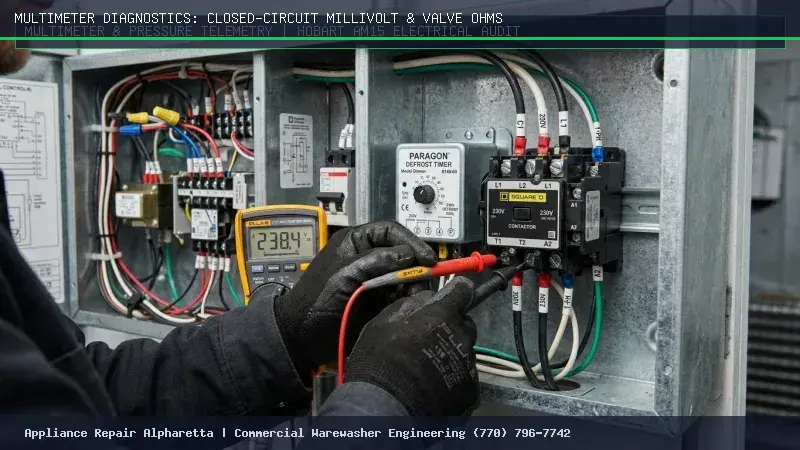
10. Technical Multimeter Testing: Millivolts, High-Limits & Valve Ohms
Master commercial technicians never guess when diagnosing commercial fryer pilot outages. We utilize high-precision digital multimeters (Fluke or Fieldpiece) to perform empirical electrical measurements. Use the interactive filter below to search component specifications:
| Component / Test | Test Mode | Factory Spec | Failure Threshold | Corrective Field Action |
|---|---|---|---|---|
| Thermopile Open-Circuit | DC Millivolts (Disconnected) | 550 mV – 750 mV | < 400 mV DC | Clean pilot orifice or replace thermopile #810-0155. |
| Thermopile Closed-Circuit | DC Millivolts (Under Load) | 350 mV – 500 mV | < 325 mV DC | Replace fatigued thermopile or clean circuit connections. |
| Gas Valve Pilot Magnet Coil | Resistance (Ohms) | 11.5 Ω – 13.5 Ω | ∞ (Open) or < 8.0 Ω | Replace combination gas valve assembly #807-1603. |
| Gas Valve Operator Coil | Resistance (Ohms) | 1.5 Ω – 2.5 Ω | > 5.0 Ω or Open | Replace combination valve powerhead. |
| High-Limit Thermostat | Continuity (Cold Oil) | 0.0 Ω – 0.2 Ω (Closed) | ∞ (Open Circuit) | Reset red button; if still open, replace #807-3516. |
| Operating Thermostat | Continuity (Calling for Heat) | 0.0 Ω – 0.3 Ω | > 1.0 Ω (High Resistance) | Replace thermostat assembly #807-1692. |
| Natural Gas Manifold Pressure | Digital Manometer (Firing) | 3.5″ W.C. | < 3.0″ or > 4.0″ W.C. | Calibrate internal regulator on gas valve. |
| Liquid Propane Manifold Pressure | Digital Manometer (Firing) | 10.0″ W.C. | < 9.0″ or > 11.5″ W.C. | Calibrate LP regulator spring or check tank supply. |
11. Genuine OEM Frymaster Replacement Parts Catalog
Installing cheap aftermarket generic pilot parts in commercial fryers frequently results in premature failure within weeks due to inferior metal alloys that cannot withstand 1,600°F continuous flame exposure. Our Milton commercial service trucks stock authentic OEM factory components:
750mV Coaxial Thermopile
OEM Part #: 810-0155 (Dean / Frymaster)
Heavy-duty dual-lead 36-inch coaxial thermopile engineered for standard millivolt gas valves. Generates 750mV open circuit.
Pilot Burner Assembly (Natural Gas)
OEM Part #: 810-0150 / 812-0447
Complete pilot burner bracket with pre-installed #0.024″ Nat Gas orifice, aerator screen, and mounting barrel.
Robertshaw 7000 Combination Gas Valve
OEM Part #: 807-1603 (Natural Gas)
Standard 1/2″ NPT millivolt commercial gas valve with manual safety shutoff, pilot regulator, and operator coil.
Manual-Reset High-Limit Thermostat
OEM Part #: 807-3516 (425°F Trip Point)
Critical life-safety emergency cutoff switch. Snaps open at 425°F to prevent commercial cooking oil auto-ignition.
Operating Frypot Thermostat
OEM Part #: 807-1692 (200°F–400°F Range)
Liquid-filled capillary thermostat bulb maintaining precise oil frying temperatures within ±5°F tolerance.
Liquid Propane (LP) Conversion Pilot Orifice
OEM Part #: 810-0152 (0.014″ Spud)
Precision-drilled brass spud calibrated for 10.0″ W.C. LP gas delivery to ensure stoichiometric blue pilot flame.
12. Daily, Weekly & Monthly Commercial Fryer Preventive Maintenance
Preventing unexpected pilot flame failures requires institutionalized cleaning and operational protocols on the kitchen line. Restaurant managers in Milton should mandate these standard maintenance operating procedures (SOPs):
Daily Shift Protocols:
- Crumb Zone Skimming: Skim floating crumbs every 2 hours during rush shifts. Excessive sediment sinking into the bottom cold zone insulates the lower frypot and alters heat dispersion.
- Pilot Shield Protection: When wiping down the fryer chassis at closing, verify that the stainless steel pilot deflector shield is positioned directly above the pilot burner to deflect oil drips.
- Gas Valve Knob Inspection: Ensure the gas valve dial is returned from PILOT to ON smoothly, without wiggling or binding.
Weekly Deep Cleaning (Boil-Out Procedures):
During weekly fryer boil-outs using commercial alkaline detergent compounds, kitchen staff must exercise extreme caution. Never allow boil-out solution to boil over the top rim of the frypot; alkaline water cascading down the front of the tank directly floods the pilot burner, thermopile terminal block, and combination gas valve, causing instant electrical shorts and severe corrosion of brass fittings. Always monitor the boil-out temperature closely, maintaining the water below 200°F (never a rolling violent boil).
Monthly Engineering Checks:
- Aerator Cleaning: Use compressed air or a soft nylon brush to remove lint and aerosolized grease from the pilot burner air mixing shutter.
- Flue Collector Inspection: Inspect the vertical stainless exhaust flue behind the frypot for grease accumulation or fallen kitchen tools that obstruct combustion drafting.
- High-Limit Capillary Check: Verify that the copper capillary tubes running to the high-limit and thermostat bulbs are clipped firmly to the tank walls and not rubbing against burner tubes.
13. NFPA 96 Fire Safety, Boil-Out Protocols & Health Code Compliance
Commercial deep fryers are the single most frequent point of origin for catastrophic commercial kitchen structure fires in the United States. Compliance with the National Fire Protection Association (NFPA 96) standard for commercial cooking operations is mandatory across Milton and Fulton County:
Mandatory Commercial Cooking Line Safety Standards
- Minimum 16-Inch Clearance or Steel Baffle: Commercial deep fryers must maintain a minimum 16-inch separation from adjacent open-flame cooking equipment (such as gas charbroilers or ranges) or be equipped with an 8-inch high stainless steel splash baffle to prevent oil splatter from entering open burner grates.
- ANSUL Fire Suppression Interlock: Commercial gas fryers must be interlocked with the kitchen hood fire suppression system via an automatic mechanical or solenoid gas shutoff valve. If the fire suppression system discharges, all gas flow to the fryer must terminate immediately.
- Class K Fire Extinguisher Proximity: A certified wet-chemical Class K fire extinguisher must be mounted within a 30-foot travel distance of the fry station, fully charged and inspected semi-annually.
- Automatic Gas Quick-Disconnect Restraining Cable: Fryers installed on casters must have a heavy-duty stainless steel restraining cable anchored to the wall structure that is shorter than the flexible gas connector hose to prevent line tension rupture.
14. Advanced Gas Manifold, Orifice Physics & Flue Draft Dynamics
To understand why commercial deep fryers fail under heavy kitchen line conditions in Milton, one must examine the hydrodynamic and thermal stress placed on the frypot heat exchanger. In open-pot fryers such as the Frymaster Master Jet, atmospheric burners fire directly against external stainless steel heat transfer fins or through immersion tube heat exchangers submerged inside the oil bath. During peak operational hours, these burners cycle hundreds of times per day, raising frypot metal temperatures to over 700°F while the cooking oil is maintained at 350°F. This thermal gradient causes continuous expansion and contraction of the stainless steel vessel.
This extreme thermal cycling places severe stress on the pilot burner assembly and thermopile mounting bracket. Positioned between the main burner tubes, the pilot assembly absorbs radiant heat from the primary flames while simultaneously enduring splashing drops of cooking oil, animal fats, and water droplets from frozen fries. Over months of service, aerosolized cooking oil hits the 1,600°F thermopile sheath and bakes into a vitrified carbon crust. This carbon layer is not merely cosmetic; it possesses an extremely low thermal conductivity rating, acting as a ceramic thermal barrier. As a result, heat from the pilot flame cannot penetrate through the outer stainless sheath into the internal chromel-constantan hot junctions. The millivoltage generated steadily drops from 750mV to under 300mV, ultimately tripping the safety magnet.
Furthermore, the flue draft dynamics of commercial fryers installed under high-velocity exhaust hoods in Milton country clubs and restaurants require delicate air balancing. Under NFPA 96 standards, commercial exhaust hoods must extract between 1,500 and 4,000 cubic feet of air per minute (CFM) depending on hood length and appliance fuel rating. When makeup air units (MAU) fail to supply 80% to 90% of this evacuated air volume, the kitchen operates under a severe negative pressure envelope. This vacuum pulls down through the fryer’s vertical exhaust flue. During burner idle periods, this reverse downdraft directs cool ambient air straight onto the pilot flame, physically blowing the small flame away from the thermopile tip. This causes intermittent, baffling flame drop-outs that only occur during busy dinner rushes when hood exhaust fans operate at maximum speed.
Master commercial cooking technicians utilize specialized dual-port digital manometers to measure draft pressure across the flue collector while simultaneously monitoring manifold gas pressure. Manifold pressure on natural gas Frymaster systems must hold dead-steady at 3.5 inches Water Column (W.C.) under full burner fire. If the gas pressure fluctuates or drops below 3.0″ W.C. when adjacent equipment—such as commercial ranges, charbroilers, or convection ovens—fires up, the pilot gas supply is starved, resulting in flame lift-off and thermopile drop-out.
Another critical failure mode involves the internal combination gas valve operator coil. In Robertshaw 7000 and Honeywell VR8200 commercial valves, the operator valve contains a secondary internal pilot gas channel governed by a spring-loaded diaphragm. If liquid oil or high-pressure cleaning water penetrates the valve casing during aggressive kitchen wash-downs, the internal diaphragm rubber hardens and loses elasticity. The valve fails to open smoothly, creating delayed ignition or requiring excessive millivolt pull-in current that fatigued thermopiles cannot provide.
In commercial facilities equipped with automated oil filtration pumps, such as the Frymaster FootPrint Pro or Filter Magic systems, additional interlock microswitches are wired into the millivolt control circuit. If the drain valve handle is bumped even 1/8-inch out of its fully closed position, an internal microswitch opens the thermopile circuit to prevent the burners from firing into an empty frypot. Kitchen staff frequently mistake this safety interlock lockout for a defective thermopile or broken gas valve. Certified technicians methodically verify drain safety switch continuity before disassembling gas piping.
15. Step-by-Step Professional Thermopile & Pilot Assembly Replacement Protocol
Replacing a commercial fryer thermopile and pilot assembly is a precision procedure that requires strict adherence to commercial gas fitting standards and National Fuel Gas Code (NFPA 54) protocols. Below is the comprehensive procedural breakdown executed by our certified technicians during Milton commercial service calls:
Phase 1: Safe Isolation & Gas Lockout
The technician first shuts off the manual gas ball valve located on the commercial gas drop line behind the fryer. The electrical power disconnect (if equipped with electronic ignition or filter pump) is locked out and tagged. Cooking oil is inspected: if hot oil is present, the technician allows the vat to cool below 120°F or drains the oil into a mobile stainless steel oil caddy to ensure complete technician safety during under-pot component extraction.
Phase 2: Pilot Tubing & Thermopile Extraction
Using precision flare nut wrenches, the technician disconnects the 1/4-inch aluminum pilot gas supply line from the gas valve pilot outlet. The two spade terminal leads from the thermopile are detached from the gas valve terminal block (terminals TP and TH-TP). The technician removes the two stainless steel mounting screws securing the pilot burner bracket to the front burner casting. The entire pilot assembly—including pilot hood, orifice spud, thermopile, and piezo igniter electrode—is carefully lowered out through the bottom access channel.
Phase 3: Component Inspection & Orifice Sizing
The pilot assembly is disassembled on a clean mobile workbench. The pilot orifice spud is removed and inspected under high-magnification optical loupe. If the orifice is carbonized, it is replaced with a factory-calibrated OEM orifice: #810-0150 (0.024″ for Natural Gas) or #810-0152 (0.014″ for Liquid Propane). The pilot burner aerator screen is cleaned using an ultrasonic solvent bath to remove lint and aerosolized oil particles that starve primary combustion air.
Phase 4: OEM Thermopile Installation & Height Alignment
A genuine OEM Frymaster 750mV coaxial thermopile (#810-0155) is inserted into the pilot bracket holder. Positioning is mathematically critical: the upper 3/8-inch (approximately 9.5 mm) of the thermopile probe must protrude directly into the primary pilot flame cone. If the probe is mounted too low, only the cold junctions are heated, cutting millivolt generation in half; if mounted too high, the flame impinges on the mounting ferrule, burning out the internal solder joints. The retaining push nut or threaded brass barrel is torqued securely to prevent vibration loosening during heavy meal rushes.
Phase 5: Gas Leak Electronic Sniffer Testing & Combustion Telemetry
The reassembled pilot bracket is remounted to the fryer chassis. The pilot gas tubing flare nut is threaded by hand and snugged 1/4-turn past hand-tight with a backup wrench. Gas is restored, and an electronic combustible gas detector sniffer verifies 0.0 PPM leakage around all flare connections. The technician lights the pilot, depresses the valve knob for 45 seconds, and releases it. A digital multimeter is connected across terminals TP and TH-TP to measure live closed-circuit millivolts under full burner load. The system is certified only when millivoltage holds rock-steady above 420mV DC while all burners fire at 350°F oil temperature.
16. Frequently Asked Questions (Master Combustion Tech Accordions)
Below are 16 detailed technical answers addressing the most critical operational and engineering questions encountered by Milton restaurant managers, lead fry cooks, and culinary operations directors:
1. Why does my Frymaster commercial deep fryer pilot light extinguish the moment I release the knob?
The pilot flame extinguishes immediately upon releasing the gas valve knob because the internal electromagnetic safety magnet inside the combination gas valve has dropped out. In standard commercial millivolt fryers, holding the knob down mechanically forces the pilot valve open, allowing gas to flow regardless of electrical voltage. When you release the knob, the valve relies entirely on electric current generated by the 750mV coaxial thermopile to hold the safety magnet open. If the thermopile is fatigued (generating under 180mV open-circuit), the pilot orifice is clogged with flour soot, or the manual-reset high-limit thermostat is open, zero electrical holding current reaches the magnet coil, causing internal springs to instantly slam the pilot gas supply shut.
2. What is the difference between a commercial deep fryer thermocouple and a thermopile?
While both devices generate electricity using the Seebeck thermoelectric effect, their electrical output and operational roles differ significantly. A standard thermocouple consists of a single junction of two dissimilar metals, producing approximately 25 to 30 millivolts (mV). It is only powerful enough to hold open a tiny pilot safety magnet in residential water heaters or light-duty appliances. A thermopile (also called a powerpile generator) contains dozens of internal thermocouples connected in series within a single heavy probe. It generates 750 millivolts (nearly 25 times more power), providing enough electrical wattage to power the pilot safety magnet, the main burner operator coil, and the mechanical temperature control thermostat simultaneously without any external 120V wall power.
3. Where is the high-limit safety reset button located on a Frymaster commercial fryer?
On most Frymaster Master Jet, GF14, and Dean commercial fryers, the manual-reset high-limit thermostat is located inside the lower cabinet behind the front door. Look directly beneath the frypot vessel near the center or left-hand chassis partition. You will observe a small black or galvanized electrical box with a prominent red push-button protruding from its face. If the oil temperature ever exceeded 425°F (or 450°F on LP models), this switch popped outward. Pressing the button firmly until you hear a mechanical “click” resets the switch. However, if the operating thermostat bulb is defective, the high-limit will trip again as soon as the burners fire back up.
4. Is it safe to wedge or tape the gas valve knob open to keep the pilot lit during a rush?
ABSOLUTELY NEVER DO THIS. Wedging, taping, or propping the pilot knob open with wooden sticks or cardboard is an extreme life-safety violation and the leading cause of commercial kitchen explosions. Depressing the knob overrides the internal spring-loaded safety shutoff. If the pilot flame blows out while the knob is mechanically wedged, raw gas continues to flood into the combustion chamber and kitchen environment at thousands of BTUs per hour. The next attempt to ignite a burner or a spark from an adjacent cooking appliance will detonate a violent fuel-air explosion, resulting in catastrophic fireball injuries, blown-off cabinet doors, and structural building fires.
5. How many millivolts should a healthy Frymaster commercial thermopile produce?
A brand-new, healthy OEM Frymaster thermopile immersed in a clean, sharp blue pilot flame produces between 650 mV and 800 mV DC open-circuit (measured across disconnected leads). When connected under normal load to the combination gas valve terminal block with the operating thermostat calling for heat, the closed-circuit reading should hold steadily between 350 mV and 500 mV DC. If your multimeter measures less than 400 mV open-circuit or collapses below 325 mV under load, the thermopile has suffered internal thermal degradation and must be replaced.
6. Why does my commercial fryer pilot stay lit, but the main burners refuse to fire?
If the pilot flame burns steadily but the main burners fail to ignite when dialling the temperature thermostat up to 350°F, the failure lies downstream in the operational circuit. Common root causes include: (1) An oxidized or broken contact block inside the mechanical frypot operating thermostat (OEM #807-1692); (2) A thermopile that generates enough voltage to hold the low-draw pilot magnet (~180mV) but lacks sufficient voltage to pull in the heavier main operator coil (~325mV); (3) An open circuit across the manual high-limit safety thermostat; or (4) A burnt-out operator solenoid coil inside the Robertshaw combination gas valve.
7. How can kitchen staff clean a clogged commercial fryer pilot orifice safely?
The pilot orifice spud features a microscopic precision-drilled hole (0.024″ for Natural Gas; 0.014″ for LP). Kitchen staff must never insert rigid steel needles, drill bits, or paper clips into the orifice, as this enlarges or distorts the hole, ruining fuel stoichiometry. To clean a restricted orifice safely: Shut off the gas, disconnect the pilot tubing flare nut, remove the brass orifice spud, and submerge it in warm degreasing solvent. Blow through the orifice spud using a can of high-pressure electronic compressed air or an ultrasonic cleaner. If carbon cannot be dislodged, replace the orifice spud with an authentic OEM factory part.
8. What gas supply pressure is required for Frymaster commercial deep fryers?
Frymaster natural gas fryers require an incoming line pressure between 6.0″ and 14.0″ Water Column (W.C.), regulated down to exactly 3.5″ W.C. manifold pressure at the burner manifold while all burners fire. Liquid Propane (LP) units require an incoming pressure between 11.0″ and 14.0″ W.C., regulated down to exactly 10.0″ W.C. manifold pressure. If incoming line pressure sags during heavy peak kitchen cooking hours because other high-BTU appliances fire simultaneously, the pilot flame will starve, lift off the burner, and cause an unexpected thermopile dropout.
9. Why does my commercial fryer pilot blow out whenever the kitchen exhaust hood is running?
Powerful commercial kitchen exhaust hoods pull several thousand CFM of air out of the building. If the rooftop make-up air unit (MAU) is malfunctioning, has a broken fan belt, or has clogged air intake filters, the kitchen operates under severe negative air pressure. This negative envelope draws a strong reverse downdraft down the fryer’s vertical exhaust flue. During idle periods when the main burners are off, this downdraft directs ambient air straight across the pilot burner, physically blowing the small flame away from the thermopile probe tip.
10. Can I clean my fryer with boil-out chemical without damaging the pilot assembly?
Yes, provided you strictly adhere to proper commercial boil-out procedures. Never allow the water and chemical solution to boil over the front lip of the vat. When boil-out liquid cascades down the front apron, it drains directly into the pilot assembly bracket, soaking the thermopile terminals, high-limit reset box, and gas control valve. The harsh alkaline caustic agents in commercial boil-out cleaners corrode brass gas fittings and create conductive chemical bridges that short out the low-voltage millivolt circuit. Always monitor boil-out water with a thermometer, maintaining the bath around 190°F to 200°F (just below a rolling boil).
11. What causes delayed, explosive burner ignition on a commercial deep fryer?
Delayed ignition occurs when the gas valve opens, but the gas cloud fails to ignite instantly upon contacting the pilot flame. Gas pools inside the combustion chamber for several seconds until it finally makes contact with the pilot flame, igniting all at once with a loud “BOOM” or fireball flash. This is caused by: (1) Misaligned pilot burner bracket positioning the pilot flame too far from the main burner carryover ports; (2) Heavy carbon encrustation or rust clogging the burner carryover slots; or (3) A weak, flickering pilot flame that is being deflected away from the burner face by drafts. This is an urgent safety hazard that requires immediate burner servicing.
12. How often should a commercial kitchen deep fryer thermopile be replaced?
In high-volume commercial restaurant kitchens operating 12 to 16 hours daily, an OEM 750mV thermopile has an average operational lifespan of 2 to 4 years. Because it is immersed continuously in a 1,600°F open flame and subjected to hot oil splatter and floor sanitizer fumes, thermoelectric degradation is inevitable over time. High-volume dining operations in Milton often schedule proactive preventive replacement every 24 to 36 months during scheduled annual line audits to prevent costly midday rush shutdowns.
13. What is the 50% rule when deciding between repairing or replacing a commercial fryer?
The foodservice equipment 50% rule states that if the required repair estimate exceeds 50% of the cost of acquiring an equivalent brand-new commercial fryer, and the current unit is already past 50% of its anticipated useful operational life (typically 7–8 years old), capital replacement is the smarter financial decision. However, because standard pilot and thermopile repairs typically cost between $195 and $380—compared to $2,500 to $5,000+ for a new commercial fryer—thermopile restoration passes the 50% rule easily and provides outstanding return on investment.
14. Does my fryer need to be drained of cooking oil before the technician arrives?
For standard pilot burner cleaning, thermopile testing, and external gas valve diagnostics, draining the cooking oil is not strictly required because the pilot assembly is mounted beneath the exterior of the frypot. However, if the high-limit safety thermostat bulb or operating thermostat capillary tube requires replacement, the vat MUST be drained because those sensing bulbs penetrate the inside of the oil vessel. If your oil is hot, allowing it to cool prior to technician arrival expedites service substantially.
15. Why does my commercial fryer oil temperature keep running away past 400°F?
Thermal runaway in a commercial deep fryer is a severe fire hazard. It occurs when the mechanical operating thermostat contacts become electrically welded together due to arcing, or the liquid filling the sensing bulb has leaked out through a fractured capillary tube. When this occurs, the thermostat remains in a permanently closed circuit calling for heat, ignoring the temperature dial setting. The burners fire continuously until the red high-limit safety thermostat trips at 425°F to kill the pilot flame and prevent an oil auto-ignition flash fire. The operating thermostat must be replaced immediately.
16. How quickly can an emergency commercial cooking technician arrive at my Milton restaurant?
We maintain dedicated commercial cooking and refrigeration emergency dispatch units patrolling North Fulton County, specifically covering Milton, Alpharetta, Roswell, and Johns Creek. For urgent commercial restaurant line down calls, our typical response time is between 35 and 60 minutes. Our service vehicles carry genuine OEM Frymaster thermopiles, pilot burners, high-limit switches, and Robertshaw gas valves on board, allowing us to complete repairs in a single visit before your meal rush is lost.
17. Commercial Kitchen Appliance Service Resources & Internal Links
Explore our complete network of commercial cooking equipment maintenance, refrigeration services, and North Fulton service hubs:
Core Cooking Services
Full technical coverage for gas fryers, commercial ranges, charbroilers, and steam tables.
Cold-Side Maintenance
Walk-in coolers, reach-in freezers, prep tables, and commercial ice machines.
Local Service Areas
Same-day priority commercial technician dispatch across Milton and North Fulton.
We also deliver localized commercial repair services across neighboring North Fulton communities: explore our certified emergency response in Alpharetta, GA for rapid culinary equipment diagnostics.
High-volume kitchens, breweries, and sports grills situated south of the river can access our dedicated repair fleet in Roswell, GA for fast hot-side burner restorations.
Country clubs and banquet banquet facilities along the eastern corridor can rely upon our certified cooking specialists in Johns Creek, GA for preventive maintenance and emergency service.
For boutique dining rooms and upscale restaurants located in historic central commercial districts, review our dedicated service team for appliance repair in Downtown Alpharetta, GA.
18. Commercial Key Takeaways
- Commercial millivolt fryers generate their own electrical energy via a 750mV thermopile and require zero external electrical power.
- The combination gas valve operator coil requires at least 325mV under load to pull open the main burner gas port.
- Depleted thermopiles, clogged pilot orifices, and tripped high-limits are the three primary causes of sudden pilot flame outages.
- Never jam or tape the pilot knob open; this bypasses safety shutoffs and creates catastrophic explosion and fire hazards.
- Operating thermostats must be tested for welded contacts if the red high-limit reset button trips repeatedly.
- Proper gas pressure (3.5″ W.C. Natural / 10.0″ W.C. LP) and balanced kitchen makeup air are vital to prevent pilot flame blow-out.
- Certified commercial cooking technicians in Milton provide fast same-day response with genuine OEM Frymaster pilot parts in stock.
- Proactive preventive maintenance—including daily crumb skimming and gentle weekly boil-outs—prolongs fryer lifespan beyond 10+ years.
Need Certified Appliance Repair Today?
Skip the phone line — book direct local priority dispatch across Alpharetta, Milton, Roswell & Johns Creek.