
Hobart AM15 Commercial Dishwasher Error Codes & Wash Pump Pressure Repair in Alpharetta, GA
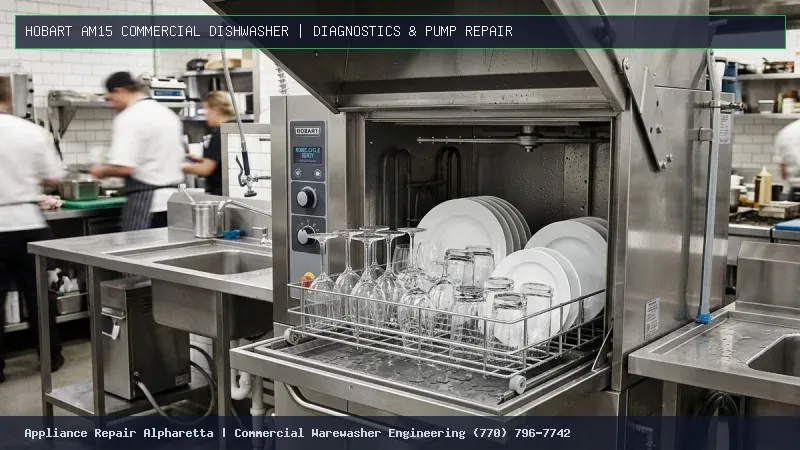
When a bustling restaurant kitchen, commercial banquet hall, catering commissary, or senior living culinary facility in Alpharetta encounters persistent Hobart AM15 dishwasher error codes or sudden loss of wash pump pressure, dishwashing operations screech to a dead halt. The Hobart AM15 door-type warewasher is widely regarded as the undisputed workhorse of the American foodservice industry, capable of cycling 58 to 65 commercial dish racks per hour. However, the grueling demands of back-to-back meal services, combined with high-mineral city water supplies, grease laden food soils, and corrosive sanitizing chemicals, frequently lead to severe wash impeller cavitation, calcified booster heaters, or electronic board communication lockouts. Operating with weak wash pressure or unresolved fault codes risks non-compliance with Fulton County Board of Health sanitation codes mandating a minimum 180°F sanitizing rinse or precise chemical sanitization. Our factory-trained commercial technicians deliver rapid same-day emergency triage across North Point Parkway, Downtown Alpharetta, Windward Parkway, and Old Milton. Discover our full spectrum of commercial dishwasher repair solutions designed to keep dish rooms operating at peak efficiency. For immediate priority commercial dispatch in Alpharetta, call our service center at (770) 796-7742.
Quick Answer: How to Resolve Hobart AM15 Error Codes & Low Wash Pressure?
Hobart AM15 dishwasher error codes (such as ‘door’, ‘P1’, ‘P2’, ‘E2’, or ‘SHUT’) typically point to magnetic door switch misalignments, wash tank temperature thermistor faults, or automated drain ball valve obstructions. Low wash pump pressure most commonly results from mineral-calcified wash arm nozzles, a clogged scrap screen basket starving the pump inlet, or shredded impeller blades caused by stray flatware or broken glass. Technicians first verify 208V/240V/480V 3-phase line voltage, inspect the wash pump motor run capacitor, clean scrap screens, and verify pump impeller integrity before clearing control board error states.
Listen to 60-Second Commercial Warewasher Diagnostic Summary
Narrated by Master Warewasher Technician Brian M.
Check Same-Day Commercial Tech Availability in Your Alpharetta Neighborhood
Recently Serviced on North Point Parkway, Alpharetta
Hobart AM15 Advansys Wash Impeller Replacement & Booster Element Restoration • Fulton Health Inspection Passed 100/100 ★★★★★
Table of Contents: Hobart AM15 Diagnostic Manual
- 1. Hobart AM15 Engineering & Hydraulic Architecture
- 2. Operational Symptoms of Warewasher Failure
- 3. Visual Before & After Restoration Showcase
- 4. Comprehensive Master Hobart AM15 Error Codes Directory
- 5. Root Causes of Low Wash Pump Hydraulic Pressure
- 6. Safe Commercial Kitchen Shift Troubleshooting Steps
- 7. When to Stop DIY: Electrical, Chemical & Health Code Hazards
- 8. Commercial Decision Matrix: Repair vs. Replace AM15 Units
- 9. Interactive Commercial Dishwasher Cost Estimator
- 10. Factors Influencing Warewasher Repair Costs in Fulton County
- 11. Technical Electrical & Ohms Telemetry Diagnostics
- 12. OEM Hobart Replacement Parts Reference Table
- 13. Daily, Weekly & Monthly Commercial Warewasher Maintenance
- 14. Sanitation Compliance & 3-Phase Electrical Safety Rules
- 15. Frequently Asked Questions (Master Technician Accordion)
- 16. Commercial Appliance Service Resources & Internal Links
- 17. Commercial Key Takeaways
- 18. Priority Commercial Dispatch Call to Action
1. Hobart AM15 Engineering & Hydraulic Architecture
Understanding how the Hobart AM15 operates is essential for both commercial kitchen stewards and facility managers who rely on spotless, legally sanitized tableware. Unlike residential appliances that rely on modest fractional-horsepower motors and extended wash cycles, the Hobart AM15 utilizes a formidable 2-horsepower wash pump motor coupled to an precision-engineered centrifugal cast impeller. This pump draws water from an insulated stainless steel sump tank holding approximately 14 gallons of 150°F to 160°F wash water, circulating it through upper and lower rotating wash manifolds at dynamic pressures exceeding 20 pounds per square inch (PSI). Review our specialized commercial appliance repair programs for facility-wide coverage across all commercial cooking and sanitation assets.
In hot-water sanitizing installations common throughout Alpharetta’s culinary venues, the machine integrates a high-output internal electric booster heater or connects to an external steam heat exchanger. During the final 10-second rinse phase, clean water is injected through dedicated rinse nozzles at a strictly regulated 180°F to 195°F. This thermal shock instantly kills pathogens on dinner plates and glassware while utilizing the residual surface heat to ensure rapid flash-drying without towel contact. When electronic controls monitor temperature, water level, or cycle timing discrepancies, the microprocessor aborts the cycle and presents specific diagnostic codes. If your facility relies on multi-zone equipment, our technicians also provide expert service for dishwasher repair across all undercounter and pass-through configurations.
Modern iterations, such as the Hobart AM15VL (Ventless with energy recovery), incorporate a vapor condensing fan coil that captures exhaust steam to preheat incoming cold water to 110°F. This engineering eliminates the requirement for an expensive type II commercial ventilation hood. However, this added sophistication introduces auxiliary solenoid valves, differential pressure sensors, and thermistors that demand certified diagnostic skills when faults manifest. Whether you operate a sports bar in Milton or an upscale bistro in Avalon, our field staff ensures minimal business disruption through our dedicated same-day appliance repair fleet.
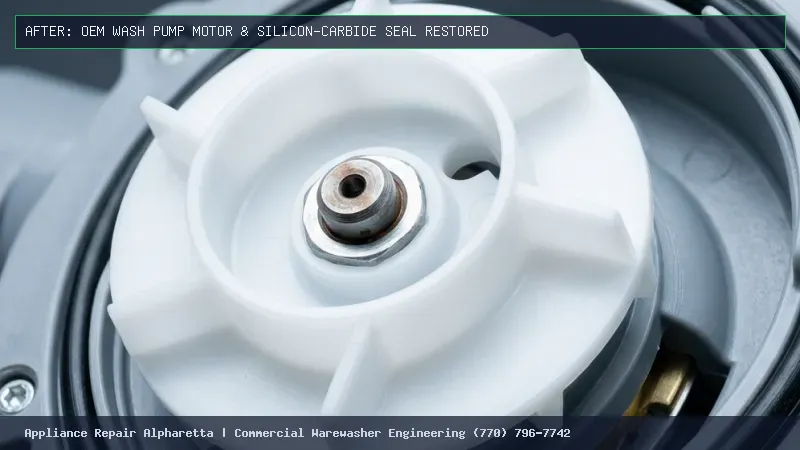
The mechanical engineering of the AM15 wash tank relies on a heavy-gauge 304 stainless steel welded unibody. Because caustic alkaline detergents with pH values exceeding 11.5 circulate continuously at 155°F, every component exposed to the wash liquor—from the cast bronze or brass pump impeller to the silicon carbide mechanical face seals—must withstand both intense chemical corrosion and hydrodynamic stress. The electronic control center, located behind the lower front access panel or within the top control cowl on Advansys units, utilizes a dedicated solid-state sequencer board that continuously monitors inputs from tank float switches, safety door interlocks, high-limit manual reset thermostats, and NTC temperature sensors. When these inputs deviate from rigid NSF parameter windows, the system initiates a programmed safety lockout.
2. Operational Symptoms of Warewasher Failure
Recognizing the early warning signals of a deteriorating Hobart AM15 warewasher enables kitchen supervisors to request corrective maintenance before a catastrophic shutdown occurs during peak dinner rush. Below are the primary mechanical, hydraulic, and electrical symptoms observed in commercial kitchens throughout Fulton County:
- Greasy, Spotty, or Gritty Dinnerware: Plates emerge with dried sauce, cheese residue, or lipstick marks on glassware, indicating that dynamic wash pressure has dropped below the threshold required to strip heavy food soils.
- Flashing Error Codes on Digital Display: The microprocessor flashes alternating alphanumeric warnings such as ‘door’, ‘P1’, ‘P2’, ‘E2’, ‘dr’, or ‘SHUT’ and refuses to initiate wash cycles.
- Grinding, Screeching, or Roaring Wash Pump Motor: The 2-HP motor emits an alarming metallic screech or deep hum, indicating failed motor bearings, a damaged mechanical ceramic face seal, or foreign debris lodged within the pump volute.
- Failure to Reach Sanitizing Rinse Temperature (Below 180°F): The machine locks out or displays temperature alerts because the booster heater immersion element has calcified or an over-temperature safety limit has tripped.
- Slow Fill or Continuous Overflowing Tank: The unit takes more than 5 minutes to complete its initial fill, or water continuously discharges past the overflow tube into the floor drain due to scale on the float level sensor.
- Wash Arms Not Rotating: While the wash motor hums, the upper or lower stainless steel wash arm assemblies remain motionless inside the cabinet, pointing to broken end caps, blocked nozzles, or stripped center hub bushings.
When warewashers begin exhibiting these symptoms alongside refrigeration issues in commercial kitchens, addressing issues across equipment classes becomes paramount. Our cross-trained technicians simultaneously service food storage systems through our expert commercial refrigerator repair team, safeguarding both cold chain stability and culinary sanitation.
A particularly deceptive symptom is the “cycling without heat” syndrome. In this failure state, the dishmachine cycles through wash and rinse stages without throwing an error code on legacy analog AM15 models, yet the water never reaches statutory temperatures. Stewards often fail to notice the lack of steam until an inspector dips an irreversible thermal test strip or checks the wash tank dial thermometer. The cause is frequently an open high-limit thermal safety switch or a pitted heating contactor that drops coil voltage under load.
4. Comprehensive Master Hobart AM15 Error Codes Directory
The Hobart AM15 electronic microcomputer constantly runs self-diagnostic algorithms to protect internal components and guarantee compliance with National Sanitation Foundation (NSF) standards. Below is an exhaustive breakdown of the official Hobart AM15 diagnostic error codes encountered during commercial service calls in Alpharetta:
Error Code: ‘door’ (Door Interlock Open Fault)
The AM15 display will flash ‘door’ whenever the microprocessor detects that the door circuit is open while a cycle command is requested. The machine uses magnetic proximity reed switches mounted to the frame that sense magnets on the door lift arms. Common causes include bent door guides, loose magnetic actuators, broken door springs allowing the door to sag 1/4 inch, or a failed reed switch whose contacts have pitted open. If the doors are visibly closed but ‘door’ continues flashing, a continuity check across terminals J4-1 and J4-2 on the control board will isolate a defective switch.
Error Code: ‘P1’ (Wash Tank Thermistor Open / Shorted)
Error P1 signifies that the wash tank temperature probe (NTC thermistor) circuit is open or registering temperatures outside of normal culinary operating parameters (below 32°F or above 212°F). When P1 occurs, the machine disables tank heat contactors to prevent thermal runaway. Technicians disconnect the thermistor harness and measure resistance across the probe: at room temperature (77°F / 25°C), a healthy Hobart thermistor should read approximately 10,000 ohms (10kΩ). Readings of zero ohms or infinity dictate immediate thermistor replacement.
Error Code: ‘P2’ (Booster Heater Thermistor Circuit Fault)
Similar to P1, Error P2 targets the booster heater thermistor located inside the high-temperature electric booster tank. In hot-water sanitizing AM15 models, the booster must elevate rinse water to a minimum of 180°F. If the thermistor leads become corroded from steam moisture or mineral scale encrusts the sensing bulb, erratic resistance values cause the board to lockout the booster contactor. Resolving P2 requires inspecting wire harnesses for physical chafing and verifying sensor calibration using an precision immersion thermometer.
Error Code: ‘E2’ (Water Fill Timeout / Water Level Failure)
Error E2 appears if the wash tank fails to reach its prescribed operating water level within the programmed timeout window (typically 3.5 to 5 minutes from cycle initiation). This fault frequently arises during morning opening procedures. Primary culprits include clogged water line strainer screens, a malfunctioning incoming water solenoid valve coil, insufficient building water pressure (below 15 PSI dynamic flow pressure), or a water level float switch stuck in the down position due to grease or scale accumulation.
Error Code: ‘dr’ / ‘SHUT’ (Drain Valve Jam or Auto-Drain Failure)
In Hobart AM15 machines equipped with motorized auto-drain ball valves, ‘dr’ or ‘SHUT’ indicates that the drain valve motor failed to reach its fully open or fully closed limit switch within 15 seconds. In commercial kitchens, flatware, toothpicks, ramekin plastic lids, or lemon seeds frequently bypass damaged scrap screens and lodge directly into the drain ball orifice. This mechanically locks the actuator motor, drawing excess current and triggering the safety shutdown code.
Error Code: ‘LL’ (Low Water Level Safety Interlock)
The ‘LL’ warning protects heating elements and wash pump seals from catastrophic dry-fire damage. If water level drops below the minimum safe threshold during an active cycle—due to an unseated drain ball or a siphon leak in the overflow tube—the control board immediately de-energizes the 2-HP pump motor and disconnects all tank heaters. Restoring operation requires diagnosing whether the sump is physically losing water or if mineral encrustation has seized the magnetic float ring against its vertical brass stem.
Error Code: ‘HL’ (High Limit Thermostat Safety Tripped)
‘HL’ indicates that the manual-reset high-limit safety thermostat mounted directly to the booster tank or wash tank has tripped. These bi-metal safety switches open at 215°F to prevent boiling water and steam explosion hazards. A trip is almost always triggered by dry-firing, severe calcium scale coating that prevents heat transfer into water, or welded contactor points that keep elements permanently energized. A manual button reset behind the lower access panel will temporarily reset the switch, but the underlying thermal cause must be professionally repaired.
5. Root Causes of Low Wash Pump Hydraulic Pressure
When dish room staff report that dishes are not cleaning despite the machine running without flashing error codes, the problem almost universally stems from a degradation in wash pump hydraulic pressure. Our field diagnostics reveal five primary mechanical causes:
1. Clogged or Calcified Wash Arm Nozzles
The upper and lower wash arms of the Hobart AM15 feature precision-stamped orifice nozzles engineered to create overlapping fan patterns. Hard water minerals precipitate out of solution at 150°F, creating a concrete-like calcium layer. Furthermore, meat fibers, pasta, and citrus pulp become forced into the nozzle tips. When 40% of the nozzles are obstructed, hydraulic volume drops, spray reach diminishes, and wash arms fail to rotate with sufficient RPM.
2. Worn or Damaged Centrifugal Pump Impeller
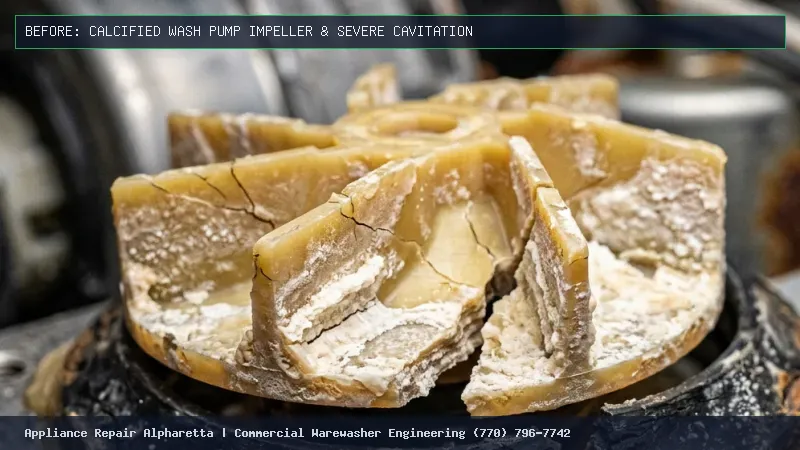
The cast pump impeller spins at 3,450 RPM inside the pump housing. Over several years of continuous heavy operation, microscopic abrasive particulate in food soils (sand from salad greens, ground spices) slowly erodes the impeller vanes. More drastically, foreign metallic objects (butter knives, ramekins) dropping into the sump can shear vanes clean off the impeller hub. An impeller with reduced diameter or eroded vanes cannot generate the required 20+ PSI head pressure.
3. Blocked Pump Suction Strainer & Scrap Screens
The wash pump draws water through a stainless steel pump intake strainer. If dish room personnel fail to dump and scrub the scrap basket between meal rushes, a thick blanket of fat, lettuce, and breading coats the intake screen. This starves the pump of water, causing severe cavitation—a destructive phenomenon where low pressure causes water to vaporize into bubbles that violently implode against the impeller, producing a loud rattling sound and destroying water pressure.
4. Compromised Mechanical Shaft Seal & Air Ingestion
The pump motor shaft is isolated from hot wash water by a spring-loaded ceramic and carbon mechanical face seal. When this seal wears out from harsh chemical detergents or dry-running, it not only allows water to drip into the motor bearings, but can also draw air into the suction side of the pump during operation. Air binding dramatically reduces the pump’s hydraulic efficiency, causing surging wash pressure.
5. Dropped Electrical Phase on 3-Phase Motors
Many Hobart AM15 installations operate on 208V or 480V 3-phase electrical supplies. If one fuse or leg on the building breaker panel blows (single-phasing), the wash motor may continue to turn sluggishly, drawing massive current while producing less than 30% of its rated horsepower. The motor will grow intensely hot and trip its internal thermal overload switch within minutes. Facilities experiencing broad electrical or refrigeration disruptions can rely on our comprehensive emergency appliance repair team for rapid response.
6. Safe Commercial Kitchen Shift Troubleshooting Steps
Before placing an emergency service call, kitchen managers and lead stewards can safely execute these systematic preliminary checks without opening electrical enclosures:
Step 1: Perform Daily Wash and Rinse Arm Inspection
Unscrew the upper and lower wash arm knurled thumb retainers. Remove both arm assemblies from the machine. Check that the end caps are firmly secured. Visually sight through each spray orifice. If lemon seeds or debris are visible, flush the arms under a high-pressure pre-rinse faucet and clean nozzle holes using a wooden toothpick or paperclip. Never drill or enlarge the factory nozzle openings, as this ruins water balance.
Step 2: Clean Scrap Screens & Pump Suction Strainer
Drain the machine completely. Lift out the two perforated stainless steel scrap baskets and dump all collected solid waste into a trash receptacle. Remove the pump intake strainer screen located in the deep sump pocket. Scrub the fine mesh with a nylon deck brush under warm running water to remove grease slime. Inspect the bottom of the sump for dropped silverware or broken glass that could be pulled into the pump volute upon restarting.
Step 3: Verify Proper Seating of Door & Actuator Magnets
If the display reads ‘door’, examine the lifting mechanism. Ensure that the door tracks on both sides are clean of dried detergent crust. Lubricate the guides with a food-safe silicone lubricant if necessary. Check that the door handles pull down fully and that the stainless steel counter-balance spring has not snapped. Check that the small rectangular magnet mounted on the door arm aligns precisely with the stationary reed sensor mounted to the upper frame.
Step 4: Check Incoming Water Supply Valves & Pressure Gauge
Locate the building water shutoff valve serving the warewasher and ensure it is fully open. During a rinse cycle, inspect the incoming water pressure gauge mounted on the booster inlet piping. The flow pressure must read between 15 and 25 PSI (ideally 20 PSI dynamic flow). If the pressure drops below 15 PSI when the solenoid opens, check your external inline PRV (pressure reducing valve) or inspect the building water supply.
Step 5: Execute Master Microprocessor Power Cycle
To clear transient communication faults or sensor glitches, turn off the machine power switch. Locate the main electrical wall disconnect switch or breaker panel serving the unit. Switch the circuit breaker OFF. Wait a full 60 seconds to allow the microprocessor filter capacitors to discharge completely. Switch the breaker ON, power up the AM15, and initiate an automatic fill sequence. If error codes persist, professional technical diagnosis is mandated.
7. When to Stop DIY: Electrical, Chemical & Health Code Hazards
Critical Commercial Safety Warnings for Restaurant Staff
Commercial warewashers are industrial machines operating with dangerous combinations of extreme electrical energy, scalding hot water, and corrosive caustic chemicals. Restaurant staff and in-house maintenance personnel must stop DIY attempts and contact certified technicians when encountering the following scenarios:
- 208V / 240V / 480V 3-Phase Arc Flash Risks: The main control cabinet houses line voltages that carry fatal arc-flash potential. Only OSHA-trained technicians wearing NFPA 70E compliant PPE should perform testing inside live electrical enclosures.
- 180°F Scalding Water & Steam Hazards: The booster heater operates at water temperatures that cause third-degree burns within one second. Never open inspection plugs or loosen pipe unions while the system is pressurized or hot.
- Hazardous Sanitizing Chemicals: In low-temp AM15 chemical sanitizing setups, sodium hypochlorite (chlorine bleach) and concentrated acids must never be mixed, as they create lethal chlorine gas.
- Fulton County Board of Health Red-Tag Violations: Operating a commercial dishmachine with final rinse temperatures below 180°F (or below 120°F with chemical sanitizer below 50 PPM) violates FDA Food Code 4-703.11, subjecting the restaurant to immediate point deductions or kitchen closure.
8. Commercial Decision Matrix: Repair vs. Replace AM15 Units
A new Hobart AM15 warewasher represents a substantial capital expenditure, with retail pricing typically ranging from $11,500 to $18,500+ depending on booster wattage and ventless energy recovery packages. Deciding whether to repair an aging unit or invest in a brand-new replacement requires evaluating operating hours, chassis integrity, and component repair costs:
| Diagnostic Parameter | Recommend OEM Field Repair | Consider Unit Replacement |
|---|---|---|
| Machine Operating Age | Under 10–12 years in standard commercial service | Exceeds 15+ years of intense 3-shift daily operation |
| Stainless Tank & Frame | Heavy gauge 304 stainless structurally sound with zero pinholes | Severe tank pitting, stress fractures, or unrepairable sump rust-through |
| Cost of Current Repair | Repair quote is under 40% of the replacement machine value | Cumulative repairs (motor, board, booster) exceed 55% of new unit |
| NSF Sanitation Compliance | Booster reaches 180°F; rinse pressure stabilizes at 20 PSI | Chamber cannot maintain temperature due to terminal heat loss |
| Parts Availability | 100% factory OEM Hobart parts readily available in local trucks | Legacy obsolete microcontrollers requiring discontinued harnesses |
;
10. Factors Influencing Warewasher Repair Costs in Fulton County
Commercial foodservice operators understand that commercial appliance repair pricing differs significantly from residential appliance service. When calculating repair investments for a Hobart AM15 in Alpharetta, four primary factors govern the final invoice:
- Commercial Electric Utility Configuration: Machines configured for 480V 3-phase require heavy industrial-grade contactors, step-down control transformers, and specialized arc-rated testing, which carry slightly higher replacement component costs than 208V single-phase units.
- Genuine Hobart OEM Parts vs. Aftermarket Knockoffs: Hobart manufactures its replacement parts to rigorous NSF and UL commercial standards. We exclusively install genuine factory-engineered impellers, silicon carbide seals, and OEM thermistors, ensuring optimal fit and warranty protection.
- Extent of Mineral Calcification: Severe hard water scale requires specialized chemical deliming agents and labor-intensive mechanical descaling of booster immersion elements and water level probes before new components can be safely installed.
- Emergency Dispatch Timing: Standard scheduled weekday appointments maintain standard commercial service rates, whereas emergency midnight triage during Saturday banquet services may incorporate after-hours emergency dispatch premiums. For broader commercial refrigeration support, explore our specialized commercial freezer repair services.
11. Technical Electrical & Ohms Telemetry Diagnostics
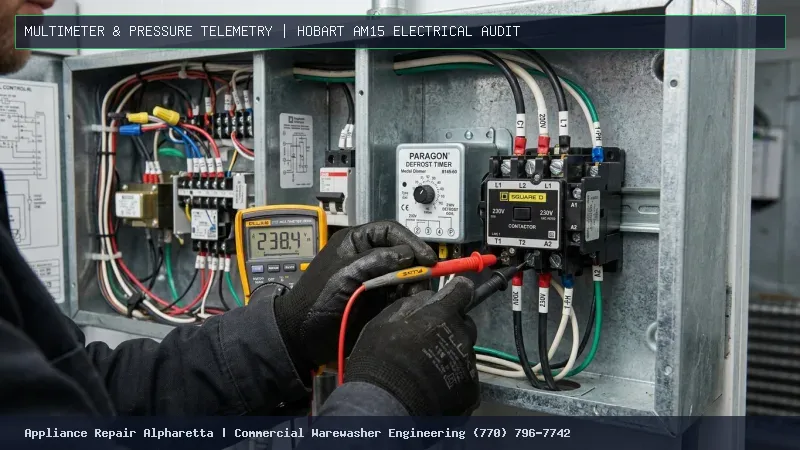
Professional commercial diagnostics eliminate guesswork by systematically comparing measured physical resistance, voltage drop, and amp draws against factory engineering specifications. Below is the official telemetry diagnostic reference table used by our master technicians when servicing the Hobart AM15:
| Component Tested | Terminals / Test Location | Factory Spec Resistance (Ohms) | Operating Voltage / Current | Failure Condition Reading |
|---|---|---|---|---|
| Wash Tank Thermistor (NTC) | Harness Plug J1-1 to J1-2 | 10,000 Ω (10kΩ) at 77°F / 2.5kΩ at 150°F | 5V DC reference signal from PCB | 0 Ω (Shorted) or ∞ Infinite Ω (Open circuit) • Causes P1 |
| Booster Heater Thermistor | Harness Plug J2-1 to J2-2 | 10,000 Ω (10kΩ) at 77°F / 1.1kΩ at 180°F | 5V DC reference signal from PCB | Resistance drifted >20% off curve • Causes P2 Lockout |
| Wash Pump Motor Winding | Contactor 1M Terminals T1-T2-T3 | 0.8 Ω to 1.6 Ω balanced across phases | 208V/240V/480V 3-Phase / 6.2A–7.8A RLA | Phase imbalance >5% or reading to ground <10 MΩ (Megger) |
| Electric Booster Element (5kW) | Element Screw Terminals | 8.6 Ω to 10.2 Ω per phase element | 208V / 240V AC / 20.8A to 24A draw | ∞ Infinite Ω (Burnt element coil) • Lukewarm rinse water |
| Magnetic Door Reed Switch | Board Connector J4-1 to J4-2 | Closed: <0.5 Ω / Open: ∞ Infinite Ω | 12V DC logic sense loop | High resistance (>5 Ω) when doors pulled down • ‘door’ error |
| Water Fill Solenoid Coil | Solenoid Spade Connectors | 180 Ω to 260 Ω | 120V AC or 208V AC supply coil | ∞ Infinite Ω (Blown solenoid coil) • Causes E2 Fill Timeout |
12. OEM Hobart Replacement Parts Reference Table
Using authentic factory parts ensures long-term reliability and compliance with original equipment NSF sanitation listings. Below are the authentic OEM part numbers frequently installed during Hobart AM15 field restorations in Alpharetta:
| Component Description | OEM Hobart Part Number | Primary Function & Failure Mode |
|---|---|---|
| Cast Wash Pump Impeller | #00-294625 / #00-294626 | Generates 20+ PSI hydraulic wash spray; fails from bone jams or abrasive erosion |
| Pump Mechanical Shaft Seal Kit | #00-087711-00263-1 | Silicon carbide face seal; prevents water leaks into motor bearing cavity |
| Door Proximity Magnetic Switch | #00-294500-00001 | Hermetically sealed reed switch; signals closed hood state to microcontroller |
| Wash / Booster Thermistor Probe | #00-294396-00001 | 10kΩ NTC temperature sensing probe; triggers P1 or P2 when shorted or drifted |
| Water Fill Solenoid Valve (1/2″ NPT) | #00-294503-00002 | Direct-acting water intake valve; diaphragms calcify, causing slow fill or weeping |
| Main Microprocessor Control Board | #00-893033 / #00-893034 | Master solid-state sequencer; coordinates cycles, sanitization, and error reporting |
13. Daily, Weekly & Monthly Commercial Warewasher Maintenance
A rigorous commercial maintenance protocol prevents 85% of unexpected dishmachine failures, protects warewasher longevity, and guarantees spotless health department ratings:
Daily Shift Breakdown:
- Drain the tank completely after every major meal rush (lunch and dinner).
- Remove, clean, and thoroughly scrub the stainless steel scrap screens and pump intake strainer.
- Wipe down door guides and interior chamber walls to prevent grease film buildup.
- Leave the hood propped open overnight to allow the wash cabinet to dry, preventing microbial mold growth.
Weekly Procedures:
- Unscrew upper and lower wash and rinse arms; inspect each nozzle for bone fragments or seeds.
- Check wash arm center bearings for excess play or binding; replace worn O-rings.
- Inspect the detergent and rinse aid chemical suction tubes to verify peristaltic pumps are drawing freely.
Monthly Chemical Deliming:
- Execute a full chemical deliming cycle using an approved commercial phosphoric acid-based deliming solution.
- Fill the unit, add the prescribed chemical volume, and run the automated deliming program for 30 minutes.
- Inspect the internal booster and tank heating elements; scale should dissolve, revealing clean stainless steel sheaths. If your kitchen also operates high-capacity ice production, review our commercial maintenance procedures for commercial ice maker repair.
14. Sanitation Compliance & 3-Phase Electrical Safety Rules
Compliance with OSHA, National Electrical Code (NEC), and county public health regulations is mandatory for commercial kitchen operations. Adhere to these essential safety directives:
- Lockout / Tagout (LOTO): Always engage the external wall disconnect switch and apply an OSHA-approved lock and tag before removing front lower inspection panels or servicing wash pump motors.
- Verify Thermal Sanitization Daily: Use NSF-certified waterproof temperature test strips or a calibrated digital thermal probe on a dish surface. The surface temperature must reach at least 160°F to guarantee a 5-log pathogen reduction.
- Keep Electrical Components Dry: Never direct a high-pressure commercial hose or spray nozzle directly at the machine’s control console, motor enclosure, or junction boxes during end-of-night kitchen wash-downs.
- Ensure Ground Fault Protection: Ensure the dishmachine grounding lug is securely bonded to the building grounding electrode with heavy copper wire to prevent stray voltage in wet dish room environments.
15. Frequently Asked Questions (Master Technician Accordion)
Below are detailed answers to the most common technical questions posed by Alpharetta chefs, restaurant managers, and facility engineers regarding Hobart AM15 commercial dishwashers:
Q1: Why does my Hobart AM15 keep flashing ‘door’ when the doors are completely closed?
A flashing ‘door’ message indicates that the electronic control board is not receiving continuity across its door safety reed switch circuit. Even if the hood looks closed, several physical issues can prevent contact: dried detergent crust inside the vertical door guide tracks stopping the door 1/4 inch shy of full descent, worn or stretched door counter-balance springs, or a misaligned magnetic actuator. If the magnet and switch physically align, the internal magnetic reed switch contacts have likely failed or suffered wire harness damage. Our technicians test continuity across terminals J4-1 and J4-2 on the control board to isolate the switch.
Q2: What causes the Hobart AM15 wash pump pressure to drop so low that dishes come out dirty?
Low wash pump pressure is almost universally caused by one of four mechanical or hydraulic issues: (1) Clogged scrap screens or pump intake strainer starving the centrifugal pump of water and causing cavitation; (2) Mineral scale and food debris obstructing nozzle orifices on the rotating wash arms; (3) A chipped, eroded, or broken cast pump impeller that can no longer generate 20+ PSI head pressure; or (4) A leaking mechanical shaft seal allowing air to be drawn into the pump volute. Cleaning the screens and unclogging nozzles resolves 50% of issues; impeller or seal failure requires OEM component replacement.
Q3: What does Hobart AM15 Error Code P1 mean, and how do I fix it?
Error P1 alerts you to an open or shorted wash tank thermistor circuit. The machine relies on this 10kΩ NTC sensor to regulate the 150°F wash tank heater. When the circuit is broken, the control board disables tank heat for safety. A technician disconnects the probe plug and measures resistance across the thermistor leads. At 77°F, it should read 10,000 ohms; at 150°F, it should drop to roughly 2,500 ohms. A reading of infinity or zero confirms a failed thermistor probe (Hobart part #00-294396-00001) that must be replaced.
Q4: How hot should the final sanitizing rinse water be on a Hobart AM15?
In standard high-temperature hot-water sanitizing AM15 models, the final rinse water must reach a minimum of 180°F (and not exceed 195°F) at the dish rack level, as mandated by NSF Standard 3 and the Fulton County Health Department. In chemical-sanitizing AM15 models, the wash water must be at least 120°F, accompanied by 50 to 100 PPM of approved chlorine sanitizing chemical. If your high-temp unit rinse gauge reads below 180°F, the booster heater element has likely calcified, a high-limit thermostat has tripped, or incoming building water is below the 110°F/140°F inlet specification.
Q5: What is the cause of Hobart Error Code E2?
Error E2 is a water fill timeout code. If the water level inside the wash tank does not actuate the upper float switch within approximately 4 minutes from the start of the fill cycle, the machine shuts off the fill solenoid to prevent pump dry-running. Primary causes include a closed building water shutoff valve, a clogged inline water line strainer screen, an open solenoid coil (measured at 180–260 ohms), or a sticky water level float switch weighted down by hard water lime scale.
Q6: Why is water constantly leaking past the overflow tube into the floor drain?
Continuous drainage during idle periods usually means the incoming water fill solenoid valve is weeping. Hard water minerals or sand sediment scratch the rubber diaphragm inside the brass valve body, preventing the spring from seating completely when power is de-energized. Alternatively, if the water level rises past the overflow while the machine is on, the water level float switch may be stuck down, causing the board to continuously energize the fill solenoid.
Q7: How often should a commercial kitchen delime a Hobart AM15 warewasher?
In North Fulton County (Alpharetta, Milton, Roswell), municipal water contains moderate to high mineral hardness. High-volume restaurants serving 200+ covers daily should perform a chemical deliming cycle at least once every 2 to 4 weeks. If a white powdery haze or calcified crust is visible on the stainless steel chamber walls or heating element coils, deliming should be executed immediately using an approved commercial deliming acid.
Q8: What electrical supply does the Hobart AM15 require?
The Hobart AM15 is versatile and field-convertible to several electrical supplies: 208V to 240V single-phase, 208V to 240V 3-phase, and 480V 3-phase (at 50/60 Hz). Models with an integrated electric booster heater (such as the 8.5kW or 13kW booster) require dedicated high-amperage commercial circuits (ranging from 40A to 80A depending on voltage and phase). Always check the serial data plate inside the front service door to verify specific electrical ratings.
Q9: Why does the wash pump motor hum loudly but refuse to spray water?
A loud hum without motor rotation indicates a locked rotor condition. The most frequent cause is a physical obstruction (such as a broken ramekin piece, chicken bone, or dessert fork) lodged between the rotating impeller vanes and the stationary volute housing. On single-phase machines, a blown motor start capacitor will also produce a hum without rotation. On 3-phase machines, losing one leg of electrical power (single-phasing) will cause intense humming and immediate thermal overload tripping.
Q10: Can I run a commercial warewasher without a water softener in Alpharetta?
While physically possible, operating an AM15 without water treatment in North Fulton leads to rapid equipment deterioration. Water hardness above 3 grains per gallon (GPG) creates rapid calcium encrustation on booster immersion elements, reducing heating efficiency by up to 40% and causing element burnout within 12 to 18 months. Installing an ion-exchange commercial water softener or polyphosphate scale-inhibiting filtration system dramatically reduces service calls and detergent consumption.
Q11: What is the purpose of the Hobart AM15 auto-drain ball valve?
The auto-drain valve replaces the manual overflow standpipe found in older dishmachines. When the operator pushes the power off button or initiates the automated shutdown cycle, an electric actuator motor turns a stainless steel ball valve 90 degrees to drain the sump completely. It then cycles the rinse pump to flush down the tank walls automatically. If solid debris jams the ball, the display flashes ‘dr’ or ‘SHUT’ and requires manual debris extraction.
Q12: How many dish racks can a Hobart AM15 wash per hour?
Under standard NSF sanitizing cycle settings, the Hobart AM15 washes 58 racks per hour. When operating on high-speed chemical sanitizing cycles, throughput increases to approximately 65 racks per hour. For ventless AM15VL models utilizing steam condensation recovery cycles, cycle times are extended by 30 seconds to capture moisture, resulting in approximately 40 racks per hour.
Q13: Why are the wash arms not spinning even though the pump is running?
Hobart wash arms rotate through hydraulic jet reaction force from the angled nozzle tips. If the arms are stationary while the pump runs, the nozzles on the ends of the arms are blocked, the arm end caps have fallen off (dumping water straight out without rotational vector), or the central spindle nylon bushings have worn out and seized against the hub. Removing, cleaning, and inspecting the arms restores rotation immediately.
Q14: Can a Hobart AM15 be converted from hot-water sanitize to chemical sanitize?
Yes. The Hobart AM15 platform features programmable microcontroller parameters that allow certified technicians to toggle the machine between high-temp hot water sanitation (180°F rinse) and low-temp chemical sanitation (120°F rinse with chemical sanitizer pump). When switching, external chemical feed tubes and concentration sensors must be calibrated to guarantee compliance with sanitation mandates.
Q15: How fast can a commercial service technician arrive in Alpharetta for an emergency dishmachine repair?
Because dishmachine failures can halt entire restaurant food service operations, we maintain emergency commercial response routes across North Fulton County. For emergency dispatches across Alpharetta, Milton, Roswell, and Johns Creek, our certified technicians typically arrive on-site within 45 to 90 minutes with mobile inventories stocked with genuine Hobart impellers, seals, thermistors, and contactors.
Q16: How do I test the Hobart AM15 wash pump motor run capacitor on single-phase models?
On single-phase 208V/240V AM15 models, the 2-HP wash motor incorporates an oil-filled run capacitor rated between 30µF and 50µF at 370V/440V AC. With power locked out and capacitor safely discharged through a 20kΩ 5W bleeder resistor, test capacitance using a digital multimeter set to microfarads (µF). If the reading deviates more than ±5% from the nominal rating, or if the terminal canister shows bulging or oil leakage, replace the capacitor immediately to restore full starting torque.
16. Commercial Appliance Service Resources & Internal Links
As North Fulton County’s leading commercial kitchen and laundry equipment repair service, we maintain comprehensive technical coverage for all commercial facility needs. Explore our core service capabilities and diagnostic resources:
Commercial Cooking Services
Precision service for commercial ranges, combi ovens, fryers, and deck ovens.
Cold Storage Systems
Emergency walk-in cooler, reach-in freezer, and draft beer kegerator maintenance.
Commercial Ice Machines
Factory triage for Hoshizaki, Scotsman, and Manitowoc nugget and cube ice units.
Local Service Areas
Same-day commercial technician dispatch across North Fulton and South Forsyth.
We also deliver localized commercial repair services across neighboring communities: explore our certified coverage in Roswell, GA, Milton, GA, and Johns Creek, GA.
17. Commercial Key Takeaways
- The Hobart AM15 is an industrial workhorse cycling up to 65 racks per hour, but its performance depends on clean wash nozzles, intact scrap screens, and uncompromised hydraulic pressure.
- Error codes (‘door’, ‘P1’, ‘P2’, ‘E2’, ‘dr’) provide direct telemetry pointing to magnetic reed switch gaps, thermistor circuit anomalies, or drain valve obstructions.
- Low wash pressure is most commonly caused by clogged spray nozzles, pump cavitation from obstructed intake screens, or sheared pump impeller vanes.
- Fulton County Health Regulations mandate a 180°F sanitizing rinse (or 120°F with chemical sanitization) to maintain an active food service operating permit.
- Daily cleaning of scrap baskets and monthly chemical deliming cycles prevent over 85% of catastrophic pump and booster element failures.
- Always observe OSHA Lockout/Tagout protocols around 208V/240V/480V commercial wiring and 180°F booster tanks to prevent arc flash and severe scald injuries.
- Factory-trained commercial technicians in Alpharetta provide fast same-day response with genuine OEM Hobart impellers, seals, and thermistors in stock.
Need Certified Appliance Repair Today?
Skip the phone line — book direct local priority dispatch across Alpharetta, Milton, Roswell & Johns Creek.