
High-volume commercial dining kitchens operating along Avalon Boulevard and Alpharetta City Center rely heavily on Pitco commercial deep fryers to sustain relentless lunch rushes and high-capacity evening dinner seatings. When a Pitco fryer abruptly shuts down in the middle of peak operational service due to a tripping high limit switch—also referred to in foodservice engineering as the Energy Cut-Off (ECO) safety mechanism—fry stations grind to an immediate, costly halt. In this exhaustive technical guide, our master commercial cooking equipment technicians break down the precise thermodynamics, millivolt electrical dynamics, capillary hydraulic expansion mechanics, and component failure modes behind high limit switch trip events, equipping kitchen operators, facilities directors, and culinary engineers with the diagnostic telemetry necessary to restore uncompromised frying performance.
Quick Diagnostic Answer for Commercial Kitchen Operators
A Pitco commercial deep fryer high limit switch trips when the sensing bulb detects frying medium temperatures reaching or exceeding 450°F (232°C), mechanically popping an internal snap-action diaphragm that breaks electrical continuity (displaying infinite resistance or OL on a digital multimeter) across the millivolt safety circuit. The primary root causes include an out-of-calibration or stuck mechanical operating thermostat, heavy polymerized carbon crust insulating the temperature probe, a dislodged capillary bulb bracket allowing contact with radiant heat exchanger tubes, or low cooking oil levels creating localized boiling hot spots. If the high limit switch trips when the oil is below 400°F, the switch assembly itself has suffered internal spring fatigue, hydraulic fluid leakage, or contact resistance and requires OEM replacement.
Listen to 60-Second Diagnostic Summary
Narrated by Jason J. (Master Certified Commercial Gas Appliance Specialist)
Check Same-Day Tech Availability in Your Corridor
Recently Serviced on Avalon Boulevard & Old Milton Parkway
Pitco SG14S Gas Fryer High Limit ECO Switch Replacement & Millivolt Thermopile Calibration • Verified 5.0 ★★★★★
Pitco SG14S Commercial Fryer High Limit Switch Tripping & Premature Flame Drop Restoration
Avalon Boulevard at Alpharetta City Center Dining Corridor, Alpharetta, GA 30009
90-Day Commercial Parts & Labor Warranty Active
High-Volume Upscale Gastropub Line Kitchen
Pitco SG14S-C/FD Solstice Natural Gas 50-lb Fryer
Main burner extinguishing after 8 minutes of frying; manual red reset button tripped with oil at 360°F
Jason J. (Certified Master Commercial Foodservice Specialist)
Diagnostic Multimeter & Manometry Telemetry
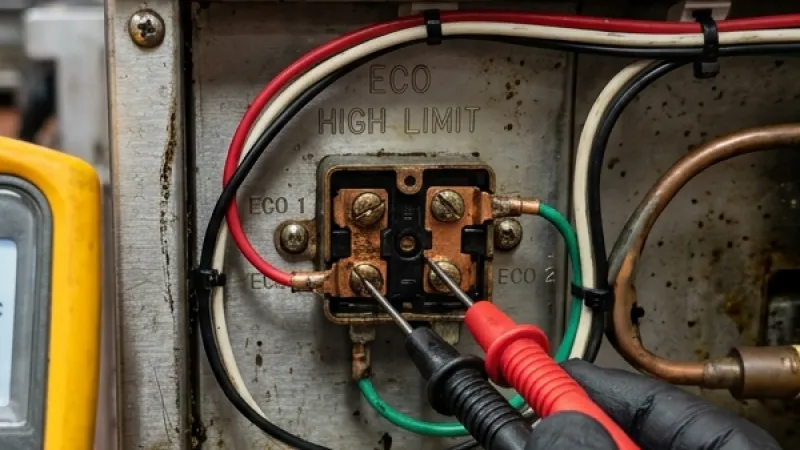
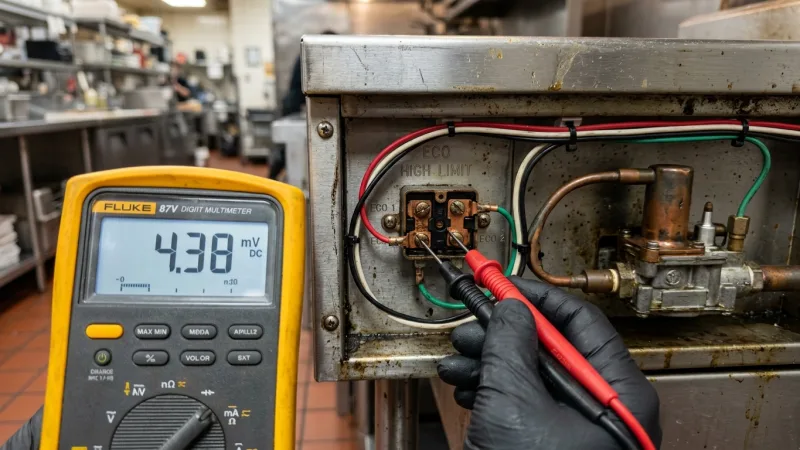
- High Limit ECO Switch Trip Continuity: Multimeter reading across ECO terminal spade lugs registered infinite resistance (OL / open loop) when tripped. When cooled to room temperature, switch continuity measured 3.8 Ω instead of true 0.0 Ω, revealing severe internal carbonization and micro-arcing on the gold-flashed contact points.
- 750mV Thermopile Output (Powerpile Generation): Open-circuit pilot flame generation registered 695 mV DC (within 650–750 mV specification). Closed-circuit voltage under active burner solenoid load collapsed severely to 310 mV DC (factory minimum operating threshold: 450–550 mV DC), indicating compounding electrical load resistance.
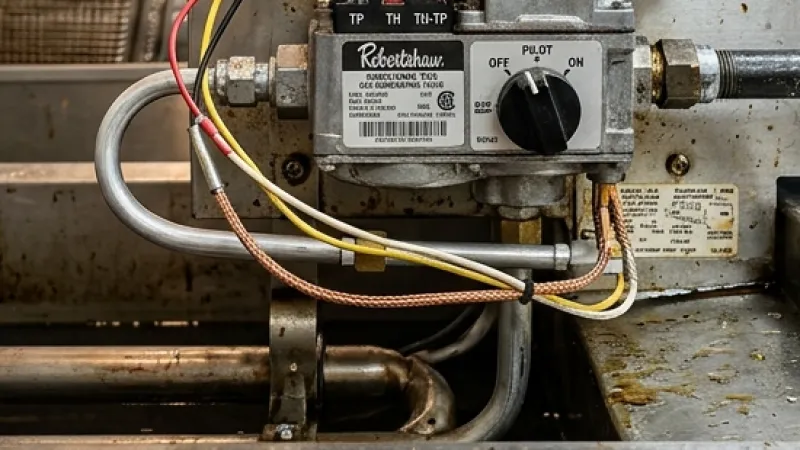
- Robertshaw 7000 Millivolt Combination Gas Valve Coil Resistance: Measured 12.4 Ω across TH-TP and TH operator terminals (factory tolerance: 11.5–13.5 Ω), confirming the main gas valve magnetic solenoid operator was electrically sound.
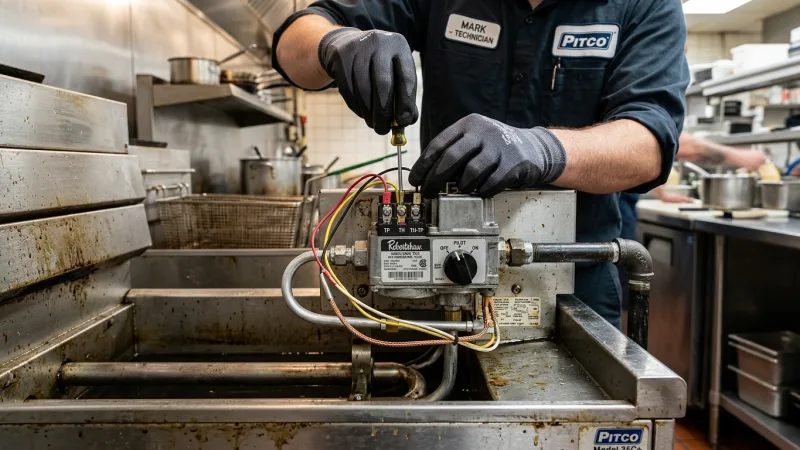
- Capillary Bulb Inspection: Capillary bulb holding bracket at the front heat tube baffle had sheared its stainless retainer clip, allowing the sensing bulb to tilt downward and contact the 480°F heat exchanger tube wall directly.
Corrective Actions & OEM Part Restoration
Our master technician safely drained the frypot into a mobile filtering caddy, isolated the manual gas quarter-turn ball valve, and unthreaded the high limit compression stuffing box gland nut. Removed the compromised high limit switch and installed a brand-new factory-original Pitco OEM High Limit ECO Switch (Part #60125401) rated for 450°F cut-out. Securely anchored the new sensing bulb in the middle zone of the frypot using heavy-gauge OEM stainless retaining clips (Part #B3300701), ensuring a minimum 1/2-inch clearance barrier away from the combustion fire-tube surfaces. Re-terminated the high limit millivolt harness with high-temperature silver-plated flag terminals, eliminating all contact drop resistance.
Post-Repair Verification: High limit continuity measured true 0.0 Ω across terminals; thermopile closed-circuit voltage stabilized at 512 mV DC under full main burner firing; oil reached 375°F setpoint with smooth mechanical thermostat cycling; verified zero tripping during 45-minute continuous high-load recovery torture test. Kitchen returned to 100% capacity in time for Friday dinner service.
Table of Contents
- Commercial Deep Fryer Thermal Engineering & Millivolt Circuit Architecture
- Operational Symptoms of High Limit ECO Switch Tripping & Thermal Lockout
- Visual Before & After Restoration Showcase
- Primary Root Causes of Pitco High Limit Switch Tripping
- Safe Commercial Kitchen Diagnostic Protocols & Step-by-Step Field Testing
- Critical Commercial Gas Safety Thresholds & When Kitchen Operators Must Stop DIY
- Heavy-Duty Commercial Fryer Repair vs. Replacement Decision Matrix & Fifty Percent Rule
- Instant Commercial Deep Fryer Repair Cost Estimator
- Commercial Fryer Repair Cost Determining Factors & Financial Planning
- Professional Multimeter Telemetry & Component Ohms Diagnostics
- Pitco Combustion & Safety Control Component Anatomy
- Commercial Fryer Preventative Maintenance & Boil-Out Procedures
- Commercial Gas Isolation & High-Temperature Oil Safety Protocols
- Thermodynamic Heat Exchanger Kinetics & Film Boiling Hot Spots
- Millivolt Power Generation Physics & Seebeck Thermopile Dynamics
- Robertshaw Combination Gas Valve Electromechanics & Magnetic Holding Circuitry
- Capillary Tube Hydraulic Fluid Expansion & Bellows Snap-Action Mechanics
- Fulton County Commercial Kitchen Health Codes & NFPA 96 Vent Hood Compliance
- Frequently Asked Questions
- Commercial Foodservice Appliance Repair Silos & Equipment Navigation
- Key Commercial Kitchen Operational & Engineering Takeaways
- Priority Commercial Gas Deep Fryer Technician Dispatch
Commercial Deep Fryer Thermal Engineering & Millivolt Circuit Architecture
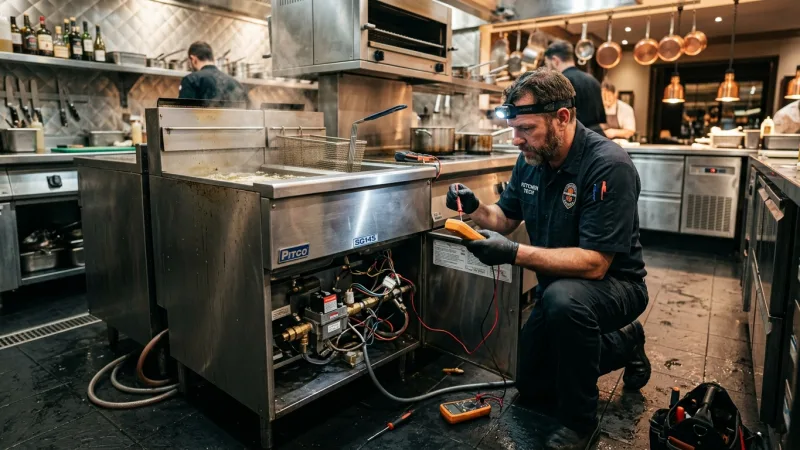
Operating high-volume commercial deep fryers requires an intricate balance between severe thermal combustion output and micro-electrical safety controls. In modern foodservice operations across North Fulton, Pitco Solstice series fryers (such as the SG14, SG14S, SG18, and economy 35C+ and 45C+ platforms) utilize atmospheric gas burners that generate between 110,000 and 150,000 BTU/hr of thermal energy. This combustion takes place inside elongated cast iron or aluminized steel immersion fire-tubes submerged directly within the cooking oil reservoir. Thermal energy transfers through the tube walls via conductive and convective heat exchange into 40 to 65 pounds of liquid shortening or high-oleic frying oil. To support the demanding requirements of enterprise kitchens, our field engineers deliver turnkey commercial appliance repair throughout the Greater Atlanta metropolitan corridor.
Unlike residential kitchen equipment that relies on 120-volt or 240-volt alternating current to operate electronic spark modules and relay control boards, standard commercial Pitco fryers operate on a completely self-generating, closed-loop millivolt electrical control system. The fundamental power source is a coaxial 750-millivolt (mV) thermopile generator—often termed a powerpile—positioned directly adjacent to the constant-burning pilot flame. When the pilot flame envelopes the tip of the thermopile, the differential temperature across its internal series of bi-metallic thermocouple junctions converts thermal energy into direct current (DC) electrical potential via the Seebeck effect. Restaurant operators requiring fast support across the city can readily schedule service with our factory-trained specialists in Alpharetta, GA.
This self-generating circuit operates under minuscule electrical potential: between 650 and 750 mV DC open circuit, and 450 to 550 mV DC closed circuit under load. In this millivolt loop, electrical resistance is the enemy of system reliability. Every component in the series safety loop—including the mechanical RX operating thermostat, the manual reset high limit Energy Cut-Off (ECO) switch, the safety magnet coil inside the Robertshaw 7000 series combination gas valve, and the wiring harness terminals—must maintain virtually zero electrical contact resistance. If resistance accumulates at any point in the circuit, total millivolt potential drops below the hold-in threshold of the gas valve electromagnet, dropping the main gas burner or extinguishing the pilot entirely.
The high limit switch acts as the ultimate failsafe in this millivolt chain. Positioned physically inside the frypot near the upper surface of the combustion tubes, the high limit switch consists of a fluid-filled copper or stainless steel capillary bulb connected via a narrow tube to a snap-action electrical switch mounted in the front component compartment. The switch contacts are normally closed (NC), permitting millivolt current to circulate freely between the thermopile and the gas valve coil. Under normal cooking conditions between 325°F and 375°F, internal hydraulic fluid expansion remains below the trip threshold. However, if oil temperatures rise uncontrollably toward 450°F (232°C)—the critical safety ceiling mandated by Underwriters Laboratories (UL) and the National Fire Protection Association (NFPA)—fluid expansion inside the capillary bulb forces an internal diaphragm to snap outward, violently opening the electrical contacts, shattering circuit continuity, and instantly dropping power to the combination gas valve operator.
Operational Symptoms of High Limit ECO Switch Tripping & Thermal Lockout
In an active restaurant kitchen, line cooks and station supervisors rarely observe the exact millisecond a high limit switch trips. Instead, they suddenly notice that french fries, chicken tenders, or calamari coming out of the fryer vat are soggy, pale, and saturated with grease. When the kitchen manager investigates, the frypot oil temperature has plummeted to ambient room levels or hovers at 200°F. Recognizing the distinct symptoms of an ECO trip versus general ignition failure allows kitchen staff to communicate accurate diagnostic data to emergency service technicians. Commercial establishments with complex kitchen batteries can also count on our expert technicians for commercial oven and range repair across North Fulton.
The classic indicator of an activated high limit safety shutdown on a Pitco fryer is the physical position of the red manual reset button located on the face of the high limit switch body inside the lower service door. On standard Pitco Solstice units, the high limit switch is mounted on the front vestibule baffle. When an over-temperature condition occurs, the internal mechanical spring snaps, pushing the red button outward by approximately 1/8 to 3/16 of an inch with a distinct tactile click. Once tripped, the fryer cannot ignite its main burners under any circumstances until the oil cools down significantly below 400°F and an operator manually depresses the red reset button until it locks back into its seated position.
Another critical symptom pattern involves premature or unwarranted tripping during high-demand cooking cycles. In this scenario, the frypot oil never actually approaches the dangerous 450°F threshold. In fact, a calibrated chef thermometer placed in the oil might read a standard 350°F or 360°F, yet the high limit switch unexpectedly trips every 15 to 30 minutes. Line cooks frequently attempt to work around this issue by continuously reaching under the hot fryer chassis to push the reset button between fry drops. This operational behavior is not only a severe occupational safety hazard, but it also signals that localized thermal hot spots, heavy carbon scale accumulation, or internal contact oxidation are actively degrading the safety mechanism.
A third failure manifestation involves an immediate pilot outage. In certain Pitco models and millivolt configurations featuring an interlocked pilot magnet circuit, the high limit switch is wired in series with the pilot thermocouple or thermopile powerpile. When the high limit trips or its internal contacts corrode and produce micro-arcing, the millivolt potential drops below 110 mV DC—the minimum holding voltage of the gas valve pilot electromagnet. As a result, the pilot flame shuts off completely, and the pilot button will not stay engaged when released, leaving the entire fryer cold and non-functional until mechanical diagnosis is performed.
Visual Before & After Restoration Showcase
The physical and electrical degradation of commercial fryer safety controls is dramatic when viewed through high-resolution macro photography. Below is a real field restoration comparison from a commercial line kitchen call on Avalon Boulevard in Alpharetta, highlighting the extreme thermal fouling that precipitates premature high limit lockouts versus the gleaming factory OEM replacement.
Primary Root Causes of Pitco High Limit Switch Tripping
When diagnosing a Pitco commercial deep fryer high limit switch tripping event, experienced technicians categorize the failure into two fundamental thermodynamic domains: true over-temperature events (where the cooking oil genuinely exceeds safe limits) and nuisance/premature trips (where the switch activates despite safe bulk oil temperatures). Understanding each mechanical and electrical root cause is essential for accurate field repair.
Defective Operating Thermostat Mechanical Calibration Drift or Contact Welding
The operating thermostat (Pitco OEM RX series mechanical capillary thermostat) is responsible for regulating frying oil between 200°F and 375°F. It uses a liquid-filled bulb situated in the frypot to hydraulically open and close an electrical contact switch. Over years of thermal cycling in busy restaurant kitchens, the internal mechanical contacts can suffer electrical arc pitting and physical welding, fusing the contacts permanently shut. Alternatively, the capillary tube can lose hydraulic fluid through microscopic stress fractures, causing the thermostat to under-read the actual oil temperature. In either condition, the gas valve remains continuously energized, pumping 120,000 BTU/hr of unthrottled heat into the frypot until the oil surpasses 450°F, forcing the high limit ECO switch to execute an emergency safety shutdown. For high-volume kitchens facing immediate operational crises, our emergency dispatch units provide same-day appliance repair throughout the Alpharetta culinary district.
Severe Heat Exchanger Tube Crumb Buildup & Localized Combustion Hot Spots
Pitco fryers utilize an engineered cold zone beneath the combustion fire-tubes designed to trap food sediment, breading, and crumbs, preventing them from carbonizing. However, during heavy operational volume, food particles often settle directly across the top curves of the immersion tubes instead of falling into the cold zone. Over time, these breading deposits bake into a dense, rock-hard layer of carbonized slag. This carbon layer acts as a powerful thermal insulator, preventing heat from dissipating evenly into the oil. The steel tube walls beneath the slag reach temperatures exceeding 600°F, creating violent localized film boiling hot spots. If the high limit bulb is located adjacent to these hot spots, radiant heat spikes trigger the ECO switch even when the main oil volume measures only 350°F. When rapid intervention is critical to maintain food safety and health code compliance, kitchen operators can call upon our emergency appliance repair line for rapid commercial triage.
Capillary Bulb Dislodgement and Mechanical Contact with Fire-Tubes
Inside the Pitco stainless steel frypot, the high limit capillary bulb must be suspended securely in free-flowing oil, held precisely by factory stainless steel retaining clips (Part #B3300701). During vigorous kitchen scrubbing, wire brush cleaning, or careless insertion of heavy fry baskets, these retaining clips can bend, crack, or dislodge. When a clip fails, the copper capillary bulb falls against the outer skin of the immersion fire-tube. Because the surface temperature of the combustion tube easily exceeds 500°F while the main burner is firing, conductive metal-to-metal heat transfer instantly triggers the high limit switch within minutes of ignition. Restaurants across neighboring areas including Milton, GA experience this exact mechanical failure frequently following aggressive end-of-night frypot cleaning routines.
Low Oil Volume Operating Conditions & Dry-Firing Thermal Spikes
A critical operational cause of high limit tripping is insufficient cooking oil volume in the frypot. Commercial fryers require oil to cover the immersion fire-tubes by at least 1.5 to 2 inches to ensure adequate convective heat dissipation. If an inexperienced prep cook fires the main burners when the oil level is below the minimum fill line, thermal mass is drastically reduced. The exposed or thinly covered upper surfaces of the fire-tubes overheat rapidly, creating massive thermal gradients that activate the high limit ECO switch. If dry-firing occurs with an empty frypot, the high limit switch will trip within 60 to 90 seconds, and sustained dry-firing will permanently deform the stainless steel frypot seams, resulting in oil leaks and catastrophic equipment destruction.
Internal High Limit Switch Degradation, Hydraulic Fluid Leakage & Contact Resistance
Like all mechanical safety controls subjected to unrelenting thermal vibration and corrosive cooking oil environments, high limit switches have an operational lifespan of approximately 3 to 5 years in high-volume commercial kitchens. Over millions of heating cycles, the internal snap-action beryllium copper spring loses its temper, lowering the trip threshold from 450°F down to 380°F or even 350°F. Additionally, microscopic stress corrosion cracking at the capillary tube braze joint can permit trace amounts of hydraulic fluid to escape. Furthermore, micro-arcing across the internal silver contact points introduces 2 to 5 ohms of parasitic resistance, causing excessive millivolt voltage drops that drop the gas valve solenoid even when the switch has not mechanically tripped.
Safe Commercial Kitchen Diagnostic Protocols & Step-by-Step Field Testing
Troubleshooting a tripping high limit switch on a Pitco commercial deep fryer requires disciplined diagnostic procedures using calibrated measurement instruments. Attempting haphazard part replacements or improperly handling 350°F cooking oil creates immense risk of severe third-degree burns and kitchen fire incidents. Master technicians execute the following four-stage field protocol to pinpoint the root cause with scientific precision. Our certified field specialists also provide dedicated support in adjacent culinary hubs like Roswell, GA.
Phase 1: Oil Temperature Verification with NIST-Traceable Thermometer
Before disconnecting any electrical wiring or declaring a high limit switch defective, the technician must measure the true bulk oil temperature. Using a calibrated digital immersion thermometer with a type K thermocouple probe, suspend the probe tip in the exact geometric center of the frypot, submerged approximately 1.5 inches below the oil surface and 1 inch above the immersion tubes. Set the operating thermostat dial to 350°F and fire the burners. Monitor the temperature as the fryer heats up. If the burner fails to shut off when the thermometer crosses 375°F and continues firing past 400°F toward 450°F, the operating thermostat is definitively failed and must be replaced immediately. If the high limit trips while the thermometer reads between 320°F and 360°F, proceed to Phase 2 to isolate false tripping.
Phase 2: High Limit ECO Switch Continuity & Resistance Testing
Isolate the fryer gas supply by turning the manual gas shutoff valve perpendicular to the gas flex line. Disconnect the two spade wire leads attached to the high limit switch terminals on the front compartment baffle. Set a True-RMS digital multimeter (such as a Fluke 87V) to the lowest resistance (ohms Ω) scale. Place the meter test probes securely against the two bare brass spade terminals of the high limit switch. Under normal ambient conditions with oil cooled below 380°F and the reset button engaged, the multimeter must display exactly 0.0 Ω (continuous closed circuit). If the meter reads infinite resistance (OL / Open Loop), press the red reset button firmly. If the button clicks and continuity drops to 0.0 Ω, the switch was mechanically tripped. However, if the meter registers any resistance between 0.5 Ω and 20 Ω, the internal switch contacts are severely pitted or oxidized, introducing parasitic voltage drop that will inevitably collapse the millivolt circuit.
Phase 3: Thermopile Open-Circuit vs. Closed-Circuit Millivolt Testing
Next, evaluate the power generation capability of the 750mV thermopile. With the pilot flame burning brightly and contacting the upper 3/8 to 1/2 inch of the thermopile tip, disconnect the thermopile leads from the Robertshaw gas valve terminals (labeled TP and TH-TP). Attach the multimeter leads set to millivolts DC (mV DC). A healthy Pitco thermopile must generate an open-circuit potential of 650 to 750 mV DC within 2 to 3 minutes of pilot ignition. Reconnect the leads to the gas valve, turn the operating thermostat to call for heat, and measure the closed-circuit voltage under load. The voltage across TP and TH-TP must remain between 450 and 550 mV DC. If closed-circuit voltage drops below 400 mV DC, the thermopile is weak, the pilot flame is starved for gas, or excessive circuit resistance is bleeding off power.
Phase 4: Robertshaw Combination Gas Valve Coil Impedance Verification
Disconnect all wire leads from the gas valve operator terminals (TH, TP, and TH-TP). Set the multimeter to the resistance (Ω) function. Measure across the operator solenoid coil terminals (between TH and TH-TP). A standard Robertshaw 7000 series millivolt valve operator coil must register between 11.5 Ω and 13.5 Ω at 70°F ambient room temperature. If the reading is under 10 Ω (shorted internal windings) or reads OL (open coil windings), the solenoid operator cannot generate sufficient magnetic flux to lift the internal gas valve plunger, preventing main burner ignition regardless of thermostat or high limit status.
Critical Commercial Gas Safety Thresholds & When Kitchen Operators Must Stop DIY
Commercial deep fryers pose unique and severe fire risks in foodservice operations. Cooking oil is a flammable liquid that undergoes auto-ignition (spontaneous combustion) once its temperature reaches its flash point—typically between 475°F and 525°F depending on the age, degradation, and fatty acid composition of the shortening. The high limit ECO switch at 450°F is the single barrier standing between standard kitchen food preparation and an uncontrolled Class K grease fire capable of engulfing an entire kitchen line. When troubleshooting issues along commercial strips in Johns Creek, GA, our certified technicians enforce strict safety boundaries.
NEVER, UNDER ANY CIRCUMSTANCES, JUMPER OR BYPASS A HIGH LIMIT SWITCH: In misguided attempts to finish a busy dinner service, unqualified line cooks or maintenance handymen occasionally install a temporary wire jumper across the high limit switch terminals to bypass a tripping switch. This practice is extremely dangerous and constitutes gross negligence under NFPA 96 and OSHA workplace safety regulations. Bypassing the ECO switch removes all over-temperature protection. If the operating thermostat sticks closed, the oil will boil over violently, ignite upon contact with the combustion tubes, and trigger the kitchen’s overhead Ansul fire suppression system, dumping thousands of gallons of chemical wet agent, shutting down the gas main, and causing catastrophic property damage and potential life-threatening injuries.
Immediate Professional Intervention Thresholds: Commercial kitchen operators must immediately cease in-house troubleshooting and summon a licensed commercial gas technician under the following conditions:
- Persistent Gas Odor: Any smell of raw natural gas or liquid propane near the fryer base, gas flex hose, or quick-disconnect coupling indicates an active combustible gas leak.
- Oil Temperature Exceeding 390°F: If frying oil visibly smokes and temperatures climb past 390°F without the burners cycling off, the main gas valve or thermostat has suffered mechanical failure.
- Capillary Tube Kinking or Severing: If the thin copper tube connecting the high limit bulb to the switch is crimped, fractured, or leaking hydraulic fluid, the switch is permanently broken and cannot be calibrated.
- Solder Melting or Charred Wiring: Evidence of heat damage, melted insulation, or burned terminal blocks inside the front control vestibule indicates severe flue gas rollout or draft back-pressure.
Heavy-Duty Commercial Fryer Repair vs. Replacement Decision Matrix & Fifty Percent Rule
When facing a major component failure on a Pitco commercial deep fryer, restaurant general managers and executive chefs must evaluate whether investing capital into repairs makes fiscal sense compared to purchasing a brand-new commercial frying system. In the commercial foodservice equipment sector, experienced operators apply the Fifty Percent Rule: if the total cost of repairing the equipment (parts plus certified commercial labor) exceeds 50% of the cost of acquiring a replacement unit, and the equipment has exhausted more than half of its expected commercial service life, replacement is typically the superior long-term strategy. Facilities managing complete sculleries and warewashing stations can also balance equipment budgets by reviewing our commercial commercial dishwasher repair solutions.
Below is a comprehensive decision evaluation matrix engineered by our commercial foodservice specialists to guide kitchen management through this critical capital expenditure decision:
| Evaluation Criteria | Economic Repair Recommended | Total Replacement Mandated |
|---|---|---|
| Equipment Service Age | 1 to 7 Years in high-volume operation | 10+ Years or unknown heavy kitchen history |
| Stainless Frypot Integrity | Pristine welds; zero stress cracking; no oil weeping | Pitted tank metal; micro-cracks along weld seams; oil dripping onto burners |
| Combustion Tube Condition | Smooth surfaces; clean baffles; zero burn-through holes | Severe internal flaking; warped fire-tubes; carbon burnout |
| Required Component Scope | High Limit Switch, Thermopile, Thermostat, or Pilot Assembly | Leaking Stainless Tank requiring complete tank replacement + full rebuild |
| Estimated Total Repair Cost | $240 – $580 (Parts & Certified Labor) | $1,600 – $2,400+ (Approaching price of new fryer) |
| Operational ROI Timeline | Immediate return; full service restored within 2 hours | High risk of repeat failures on decaying chassis |
Instant Commercial Deep Fryer Repair Cost Estimator
Transparent equipment repair estimates allow restaurant operators to make rapid business decisions during critical line interruptions. Use our interactive commercial fryer repair estimator widget below to calculate realistic diagnostic and repair price expectations tailored to Pitco equipment:
Commercial Fryer Repair Cost Determining Factors & Financial Planning
Budgeting for commercial kitchen equipment maintenance requires understanding the variables that influence final invoices. Unlike standard residential repairs, commercial foodservice equipment repairs must comply with municipal mechanical codes, NFPA guidelines, and strict health department sanitation standards. In addition to commercial hot-side equipment, hospitality facilities often maintain laundry utility systems where specialized commercial dryer repair is required to keep kitchen linens and chef uniforms clean.
The primary cost factors governing a Pitco high limit switch restoration include:
- Genuine Factory OEM Replacement Parts: A certified Pitco factory OEM high limit switch assembly (such as Pitco Part #60125401 or #PP10084) is manufactured with high-grade copper capillary tubing, precision bimetal diaphragms, and silver-gold contacts rated specifically for millivolt current transmission. Counterfeit or generic aftermarket switches frequently drift out of calibration or feature high-resistance contacts that cause premature failures. OEM switches typically cost between $95 and $175 depending on model specifications.
- Vat Drainage and Boil-Out Requirements: Replacing an immersion capillary bulb requires draining 40 to 65 pounds of hot cooking oil into sanitary storage receptacles. If the tank is severely fouled with carbon scale, a professional chemical boil-out and neutralizing rinse is mandatory to ensure the new sensor bulb is not immediately contaminated, adding approximately 1 hour of specialized labor.
- Emergency Peak-Hour Dispatch Premiums: When a fryer fails in the middle of a Friday or Saturday dinner service, waiting for regular business hours can cost a busy restaurant thousands of dollars in lost cover revenue. Same-day emergency rush dispatch ensures a certified technician arrives on-site within 45 to 90 minutes equipped with fully stocked mobile inventory.
- Comprehensive Combustion Analysis & Safety Certification: A reputable commercial cooking equipment specialist does not merely swap a switch and leave. The service includes digital manometer pressure testing of the gas manifold (3.5″ W.C. for Natural Gas, 10.0″ W.C. for LP), closed-circuit millivolt telemetry logging, and thermal cycling verification to certify NFPA code compliance.
Professional Multimeter Telemetry & Component Ohms Diagnostics
Scientific diagnostic troubleshooting separates master commercial gas technicians from amateur guessers. By measuring exact electrical continuity, voltage generation, and winding resistance across the circuit, our technicians diagnose the root failure without unnecessary component swapping. Similar rigorous telemetry standards are utilized when servicing commercial laundry and utility equipment through our commercial washing machine repair protocols across North Fulton.
Use the interactive component search filter below to look up factory benchmark specifications for Pitco commercial fryer electrical circuits:
| Component & Test Point | Operating State | Factory Nominal Target | Failure / Fault Threshold | Diagnostic Consequence |
|---|---|---|---|---|
| High Limit ECO Switch (Terminals 1 to 2) | Normal Operating Temp (<400°F) | 0.0 Ω (Continuous Closed Circuit) | > 0.2 Ω or OL (Tripped) | Internal contact oxidation or mechanical 450°F trip; cuts gas valve |
| 750mV Thermopile Powerpile (Unloaded) | Open Circuit (Pilot Burning 3 Mins) | 650 to 750 mV DC | < 550 mV DC | Weak pilot impingement or degraded thermocouple junctions; cannot hold load |
| 750mV Thermopile Powerpile (Under Load) | Closed Circuit (Main Burner Firing) | 450 to 550 mV DC | < 400 mV DC | Voltage collapse causes Robertshaw valve plunger to drop; burner cuts out |
| Robertshaw 7000 Main Operator Coil | De-energized (TH to TH-TP Terminals) | 11.5 Ω to 13.5 Ω at 70°F | < 10.0 Ω or OL | Shorted or open solenoid winding; valve operator cannot lift off seat |
| Robertshaw Safety Magnet Holding Coil | De-energized (Pilot Magnet Base) | 0.02 Ω to 0.05 Ω | > 0.15 Ω or OL | Safety magnet drop-out; pilot knob will not stay depressed |
| Operating Thermostat Contacts (RX Series) | Calling for Heat (Dial Set to 350°F) | 0.0 Ω (Closed Circuit) | > 0.1 Ω (Contact Pitting) | Parasitic contact voltage drop reduces circuit millivoltage below hold-in threshold |
Pitco Combustion & Safety Control Component Anatomy
A deep understanding of the mechanical and electromechanical architecture of Pitco commercial fryers enables proactive equipment stewardship. Each component operates in tight synchronization with adjacent subsystems. High-end food operations often complement their hot line cooking suites with premium preservation systems where specialized Sub-Zero appliance repair safeguards sensitive raw proteins and ingredients before they ever hit the fryer.
High Limit ECO Switch Assembly (Pitco Part #60125401 / #PP10084)
The high limit switch assembly comprises three integral components: the fluid-filled sensing bulb, the capillary lead tube, and the snap-action switch housing. The sensing bulb contains an engineered non-conductive thermal fluid that expands predictably as heat increases. The narrow capillary tube transfers this volumetric fluid displacement into a sealed bellows chamber within the switch body. When internal hydraulic pressure reaches the calibration threshold equivalent to 450°F ± 10°F, the bellows snaps over-center, separating the silver-plated contact leaves. The manual red reset button latches the contacts in the open state, preventing automatic re-ignition until human intervention takes place.
Coaxial 750-Millivolt Thermopile Generator (Pitco Part #60114401)
The thermopile is an array of multiple thermocouple junctions connected electrically in series. By placing the hot junctions directly within the blue cone of the standing pilot flame while keeping the cold junctions shielded at the base, an electrical potential difference of up to 750 millivolts DC is generated. This self-contained electrical generation eliminates the need for external building electricity, ensuring that Pitco gas fryers can operate completely independently during power outages—a major reliability advantage for commercial restaurants during severe weather events.
Robertshaw 7000 Series Combination Gas Valve
The Robertshaw 7000 millivolt gas combination valve serves as the central fuel distribution manifold for the fryer. It houses an integrated manual gas cock (OFF-PILOT-ON), a gas pressure regulator, a pilot safety magnet assembly, and a main burner operator diaphragm. The valve requires two distinct electrical signals to function: the pilot thermocouple generates 20–30 mV to hold open the internal pilot safety disc, while the thermopile powers the main operator coil when the thermostat and high limit contacts are closed.
Pitco Solstice Atmospheric Burner Tubes & Vortex Baffles
Pitco’s patented Solstice burner system uses atmospheric cast iron burners firing into rectangular stainless immersion tubes. Inside each tube, engineered stainless steel vortex baffles spin and slow down the exhaust flue gases. This aerodynamic design extracts maximum thermal energy from the combustion gases before they exit through the rear flue collector, achieving thermal efficiency ratings of up to 70%—significantly reducing kitchen air conditioning loads and restaurant gas utility expenses.
Commercial Fryer Preventative Maintenance & Boil-Out Procedures
Preventative maintenance is the cornerstone of commercial kitchen profitability. More than 70% of premature high limit switch failures, carbonized sensing bulbs, and gas valve coil burnout events can be completely prevented through rigorous cleaning protocols. In gourmet restaurant kitchens featuring heavy-duty cooking suites, preserving thermal stability is just as critical as maintaining precise cooking temperatures on luxury lines supported by our Viking appliance repair technicians.
Daily Oil Filtration and Sediment Evacuation
At the conclusion of every lunch and dinner shift, kitchen personnel must filter cooking oil using either an integrated Pitco Solstice Filter Drawer system or a portable filtering caddy. Once oil is drained into the lower filter pan, use a high-temperature scraper and scrub wand to sweep all accumulated crumbs and batter debris downward from the combustion fire-tubes into the cold zone. Drain all debris through the full-port drain valve. Never permit food debris to sit on the combustion tubes overnight, as residual heat will bake the crumbs into rock-hard carbon glaze.
Weekly Chemical Boil-Out Protocol
Every seven to fourteen days (depending on cooking volume and batter density), commercial fryers require a chemical boil-out procedure to strip polymerized oils from the stainless steel tank walls, combustion fire-tubes, and capillary sensing bulbs:
- Drain all oil completely and store or discard in accordance with local environmental regulations.
- Fill the frypot with fresh water up to the lower oil level mark. Add commercial fryer boil-out compound (formulated with sodium hydroxide or heavy alkaline degreasers) according to manufacturer dilution guidelines.
- Set the operating thermostat to the lowest boil-out temperature setting (typically 190°F to 200°F). NEVER allow the water solution to boil vigorously, as violent boiling will foam over the tank rim, soaking the front gas valve and electrical wiring below.
- Simmer the solution for 20 to 30 minutes while using a non-scratch nylon scrubbing pad to clean the outer surfaces of the high limit capillary bulb, operating thermostat bulb, and tube curves. Never use steel wool or metal scrapers on capillary bulbs, as abrasions can rupture the thin copper walls.
- Drain the solution safely. Immediately rinse the vat thoroughly with cold water. Neutralize alkaline residues by rinsing the interior with a 1:10 solution of white vinegar and water, followed by a final fresh water rinse.
- Towel-dry the entire tank interior thoroughly before refilling with fresh cooking oil. Moisture left in the tank creates violent steam splatter when oil is heated.
Commercial Gas Isolation & High-Temperature Oil Safety Protocols
Servicing commercial gas appliances demands strict compliance with occupational safety protocols. Commercial cooking oil heated to 350°F possesses massive thermal mass and sticks to human skin, causing catastrophic full-thickness burns in fractions of a second. High-capacity culinary production centers also rely on our precision calibration services for specialized Thermador appliance repair across residential and commercial cooking equipment.
Mandatory Safety Rules for Technicians and Kitchen Operators:
- Dual Fuel Isolation Verification: Always close the yellow-handled manual quarter-turn gas ball valve located on the gas drop pipe behind the fryer hood line. Rotate the gas valve knob on the Robertshaw combination valve to the OFF position. Use electronic combustible gas leak sniffers or liquid leak detection bubble solution on all threaded pipe joints whenever gas connections are disturbed.
- Oil Temperature Cooling Threshold: Never drain or handle cooking oil for diagnostic testing until the temperature drops below 120°F (49°C), unless utilizing a dedicated, enclosed, pump-driven mobile filtering system equipped with insulated high-temperature transfer hoses.
- Personal Protective Equipment (PPE): Technicians performing hot-line diagnostics must wear heavy-duty neoprene gauntlet gloves rated for 400°F contact heat, safety splash goggles, a full-length heavy canvas or leather apron, and non-slip steel-toe oil-resistant safety boots.
- Fusible Link Fire Protection Awareness: When working beneath commercial exhaust hoods, avoid placing high-intensity halogen work lamps or open flames directly beneath fusible link sprinkler heads or Ansul micro-switches, as ambient temperatures exceeding 212°F can trigger unintentional wet chemical fire suppression discharge.
Thermodynamic Heat Exchanger Kinetics & Film Boiling Hot Spots
The heat transfer mechanics of commercial immersion-tube fryers are governed by complex thermodynamic kinetics. When natural gas combusts inside a Pitco Solstice fire-tube, flame temperatures exceed 1,800°F (982°C). The inner wall of the immersion tube absorbs radiant and convective energy, transmitting heat via thermal conduction across the 12-gauge aluminized steel shell to the outer wall in direct contact with frying oil. Maintaining thermodynamic balance is essential across all kitchen suites, just as thermal sensor stability is maintained in high-performance German engineering supported by our Bosch appliance repair team.
Under optimal fluid dynamics, heat transfer occurs through nucleate convection: microscopic convection currents circulate cooler oil upward from the bottom of the vat, sweeping heat away from the tube surface and maintaining tube skin temperatures at a safe 390°F to 420°F. However, if oil breaks down due to age, chemical hydrolysis, or crumb accumulation, the boundary layer fluid viscosity increases drastically. When viscous oil contacts the hot fire-tube, heat cannot dissipate fast enough, transitioning the fluid boundary into film boiling. In film boiling, a continuous microscopic vapor barrier of gaseous oil and steam insulates the tube from the bulk liquid. Without liquid oil to absorb heat, the outer tube metal spikes to over 550°F. If the high limit ECO switch capillary bulb is mounted within this boundary layer or touches the tube, the 450°F cut-out threshold is breached within minutes, precipitating an instant safety shutdown.
Millivolt Power Generation Physics & Seebeck Thermopile Dynamics
The thermopile power generator utilized in Pitco millivolt fryers operates on the thermoelectric Seebeck effect, first discovered by physicist Thomas Johann Seebeck in 1821. Inside a 750mV thermopile (such as Pitco Part #60114401), approximately 16 to 24 individual pairs of dissimilar metal conductors (typically constantan and iron or chromel alloys) are connected electrically in series and packaged inside an armored copper jacket.
When heat from the constant-burning pilot flame impinges upon the tip of the thermopile assembly (the “hot junction”) while the base remains at ambient kitchen air temperature (the “cold junction”), electrons migrate away from the hot end toward the cooler end. Because the thermoelectric coefficients of the two dissimilar metals differ, an electromotive force (EMF) is established across each junction pair. With 20 pairs connected in series, the microscopic voltage generated by each individual junction (approx. 35 to 40 mV) accumulates into an aggregate potential difference of 700 to 750 mV DC.
Because millivolt circuits have virtually zero voltage headroom, Ohm’s law ($I = V / R$) dictates that even an infinitesimal increase in circuit resistance severely curtails current flow. When 500 mV powers a 12.5 Ω gas valve operator coil, current flow is exactly 40 milliamps (mA). If terminal corrosion, a loose spade connector, or a degraded high limit switch contact adds just 3.0 Ω of parasitic resistance to the circuit (raising total circuit resistance to 15.5 Ω), circuit current plunges from 40 mA down to 32 mA. This 20% drop in current weakens the magnetic flux of the gas valve solenoid below the critical threshold required to overcome the spring-loaded internal plunger, causing the valve to slam shut and cutting off main burner fuel supply.
Robertshaw Combination Gas Valve Electromechanics & Magnetic Holding Circuitry
The Robertshaw 7000 millivolt combination valve represents a masterpiece of purely mechanical and electromechanical fluid control. Operating without external electric relays, integrated microprocessors, or 120V grid power, the valve manages gas flow via two independent safety stages. Understanding these valve mechanics parallels the precision electromechanical assemblies our technicians service across commercial dishwashing and baking appliances supported by our KitchenAid appliance repair specialists.
The first stage is the pilot safety magnet. When an operator pushes the pilot dial down to light the standing pilot, a mechanical shaft physically presses a soft iron armature against an electromagnet coil inside the valve body. Once the pilot flame heats the single-lead thermocouple to produce 20 to 30 mV DC, the electromagnet develops sufficient magnetic holding force to hold the pilot safety disc open against a heavy return spring. If the pilot flame blows out or the thermocouple drops below 8 mV DC, the magnetic force collapses, and the return spring snaps the safety disc shut, cutting all gas flow to both the pilot and main burners within 90 seconds.
The second stage is the main gas operator solenoid. When the high limit switch is closed (0.0 Ω) and the operating thermostat calls for heat, the 750mV thermopile energizes the operator solenoid coil (11.5–13.5 Ω). This solenoid lifts a precision internal pilot valve disc, directing gas pressure behind a large synthetic rubber diaphragm. The gas pressure difference across the diaphragm overcomes main spring tension, lifting the main valve disc off its brass seat and delivering regulated gas (3.5″ W.C. natural gas) to the main burner manifold. When the high limit trips, electrical continuity breaks instantly; the operator solenoid de-energizes; bleed gas vents safely; and spring pressure snaps the main diaphragm closed within 0.1 seconds, eliminating all burner flames.
Capillary Tube Hydraulic Fluid Expansion & Bellows Snap-Action Mechanics
The engineering mechanism behind the Pitco high limit ECO switch relies on the principles of thermal hydraulics. The capillary bulb submerged inside the frypot contains a carefully calibrated volume of an inert, thermally stable hydraulic fluid with a high boiling point and a precise volumetric thermal expansion coefficient ($beta$).
As oil temperature increases, thermal energy conducts through the thin-walled copper bulb into the internal fluid charge. In accordance with thermal expansion physics, the volumetric increase of the fluid ($Delta V = V_0 cdot beta cdot Delta T$) forces hydraulic fluid through the microscopic inner bore of the capillary lead tube toward the switch head. The capillary tube itself has an extremely small internal diameter (approximately 0.020 inches), ensuring that temperature variations along the tube run outside the oil vat have negligible impact on the total fluid volume.
Inside the switch enclosure, the hydraulic fluid enters a micro-bellows assembly or a stamped beryllium-copper disc diaphragm. As fluid pressure climbs to approximately 350 to 400 PSI (corresponding to 450°F at the sensing bulb), the force exerted against the diaphragm exceeds the mechanical over-center bias of an internal bistable spring mechanism. The diaphragm abruptly snaps downward. This mechanical snap action separates the electrical contacts with extreme velocity (sub-millisecond speed), minimizing electrical arc formation and preventing contact erosion. Simultaneously, a mechanical latch engages, holding the contacts apart until an operator physically depresses the manual reset button with sufficient force to snap the bistable spring back over-center.
Fulton County Commercial Kitchen Health Codes & NFPA 96 Vent Hood Compliance
Operating commercial deep fryers in Fulton County, Georgia requires strict compliance with municipal commercial health codes and National Fire Protection Association standards. NFPA 96 (Standard for Ventilation Control and Fire Protection of Commercial Cooking Operations) and the International Mechanical Code (IMC) mandate that every commercial deep fryer must be equipped with two independent temperature-limiting control mechanisms: an operating thermostat and an independent high limit safety cut-off.
Under local Fulton County Environmental Health and Fire Marshal inspection criteria:
- Tamper-Proof Calibration: High limit switches must be non-adjustable factory-sealed units rated for cut-off at or below 475°F (Pitco engineers calibrate specifically to 450°F to provide an extra safety margin). Any sign of field tampering or manual modification results in immediate red-tagging of the appliance by county inspectors.
- Automatic Fuel Shutoff Interlock: In accordance with NFPA 17A and UL 300 standards, all gas fryers must be connected via an approved quick-disconnect flexible gas line featuring a certified manual safety shutoff valve and tied into the kitchen’s hood exhaust fire suppression system. When an overhead fire suppression system discharges, an upstream mechanical gas shutoff valve (such as an ASCO solenoid valve) must instantly cut all gas flow to the entire cooking battery.
- Sanitation & NSF Certification: All capillary tubes entering the frypot must pass through approved stainless steel compression stuffing box fittings with food-grade high-temperature Teflon packing glands to prevent cooking oil weeping onto internal combustion chassis elements.
Frequently Asked Questions
Explore our comprehensive diagnostic archive answering the most critical operational and technical questions regarding Pitco commercial deep fryer high limit switch tripping and millivolt electrical servicing:
What causes a Pitco commercial deep fryer high limit switch to trip repeatedly?
A Pitco fryer high limit switch trips primarily due to an out-of-calibration operating thermostat allowing oil temperatures to exceed 450°F, heavy carbon crust insulating the temperature sensing bulb, a dislodged capillary bulb bracket resting directly against the 500°F combustion fire-tubes, or low oil levels causing localized film boiling hot spots. If the oil temperature is verified under 400°F with a calibrated immersion thermometer, the high limit switch has suffered internal spring fatigue or contact resistance and requires replacement.
How do I test a Pitco high limit switch using a digital multimeter?
Isolate the fryer gas supply and disconnect the two spade wire leads from the high limit switch terminals. Set a digital multimeter to the lowest resistance (ohms Ω) scale and touch the meter probes to the bare switch terminals. When the oil is below 400°F and the reset button is engaged, the meter must display exactly 0.0 Ω continuity. If it displays infinite resistance (OL) or any value above 0.2 Ω, the switch has tripped, suffered internal contact arc pitting, or broken internally.
Can I bypass the high limit switch temporarily to finish a dinner rush?
No. Never under any circumstances jumper or bypass a commercial fryer high limit switch. The high limit is the ultimate fire prevention safety mechanism. Bypassing it can result in runaway heating where cooking oil exceeds its auto-ignition temperature (475°F–525°F), leading to catastrophic spontaneous grease fires, hood fire suppression discharge, and severe personal injury.
What is the exact trip temperature rating of a Pitco high limit switch?
Standard Pitco commercial gas fryer high limit switches (such as OEM Part #60125401) are factory-calibrated to trip at precisely 450°F (232°C) with a tolerance of ± 10°F. This provides a crucial safety buffer below the 475°F minimum auto-ignition threshold of commercial cooking oils.
Why won’t the red high limit reset button stay pushed in?
The red reset button will not latch into position if the sensing bulb and cooking oil have not cooled down below approximately 380°F. If the switch still refuses to latch after the oil has cooled to room temperature, the internal mechanical bistable spring or latching mechanism has broken, requiring full replacement of the switch assembly.
What millivolt readings should a healthy 750mV thermopile produce?
When tested disconnected from the gas valve (open circuit), a healthy Pitco thermopile should generate between 650 mV and 750 mV DC with the pilot flame enveloping the tip. Under closed-circuit operating load with the main gas valve energized, voltage should stabilize between 450 mV and 550 mV DC. Readings below 400 mV DC under load indicate a failing thermopile or excessive circuit resistance.
How does an out-of-calibration operating thermostat cause high limit tripping?
The operating thermostat should cut power to the gas valve when the oil reaches the setpoint (e.g. 350°F). If its capillary bulb loses hydraulic fluid or its internal mechanical contacts weld shut, it will fail to open the circuit. The burners will continue firing continuously until the oil reaches 450°F, forcing the high limit switch to trip to prevent a fire.
What is the resistance of a Robertshaw 7000 millivolt gas valve operator coil?
The operator solenoid coil on a standard Robertshaw 7000 series millivolt combination gas valve should measure between 11.5 Ω and 13.5 Ω at room temperature when tested across the TH and TH-TP terminals. Readings below 10 Ω indicate shorted windings, while infinite resistance indicates an open coil.
How does sediment buildup on the combustion fire-tubes cause false tripping?
Crumb and batter debris that settles directly onto the upper surfaces of the immersion fire-tubes bakes into dense carbon scale. This scale insulates the metal, causing localized tube skin temperatures to spike over 550°F. The high limit bulb senses this radiant hot spot, triggering a trip even though bulk oil in the center of the vat is only 350°F.
What happens if the high limit capillary bulb touches the fire-tube directly?
If the stainless mounting clip breaks or bends and allows the copper capillary bulb to contact the immersion tube, conductive heat transfer causes the bulb to heat up to the tube surface temperature (450°F–500°F) within 5 to 10 minutes of burner firing, tripping the switch prematurely while cooking oil is still lukewarm.
How often should a commercial Pitco fryer undergo a chemical boil-out?
Commercial kitchens should execute a chemical boil-out every 7 to 14 days, depending on frying volume. Regular boil-outs strip polymerized grease and carbon glaze from heat tubes and capillary bulbs, preventing localized hot spots and maintaining accurate thermostat calibration.
What gas pressure is required for Pitco commercial deep fryers?
For Natural Gas models, the manifold pressure measured at the gas valve pressure tap must be 3.5 inches Water Column (W.C.) under full burner firing load. For Liquid Propane (LP) units, manifold pressure must be calibrated to 10.0 inches W.C. Incoming line pressure must be between 7″ and 14″ W.C.
Can a bent or kinked capillary tube be repaired or straightened?
No. The capillary tube contains a microscopic hydraulic passage. If the tube is kinked, pinched, or crimped, fluid flow is permanently obstructed. If punctured, hydraulic fluid escapes. In either case, the entire high limit switch assembly must be replaced as an integrated factory unit.
How does low oil volume cause the high limit to trip?
When oil level is below the minimum fill line, the upper portions of the immersion fire-tubes are exposed or thinly covered. Heat cannot transfer into the diminished oil volume, causing rapid thermal spikes and overheating the tube walls, which trips the high limit switch within 1 to 2 minutes.
What is the expected lifespan of a Pitco high limit switch in a busy kitchen?
In high-volume commercial dining environments operating 12 to 16 hours daily, high limit switches typically last 3 to 5 years before thermal cycling fatigue degrades the internal bistable spring calibration or contact resistance develops.
Why does the pilot extinguish when the high limit switch trips on some models?
In certain Pitco models and millivolt interlock designs, the high limit switch contacts are wired in series with the pilot safety thermocouple circuit. When the high limit trips, it breaks the thermocouple millivolt current, causing the valve’s safety magnet to drop out and extinguish the pilot flame entirely.
What warranty coverage is provided on Pitco commercial high limit repairs?
All commercial Pitco high limit switch and electrical restorations performed by our master technicians include a comprehensive 90-day commercial parts and labor warranty, backed by authentic factory OEM replacement components and full combustion telemetry verification.
Commercial Foodservice Appliance Repair Silos & Equipment Navigation
Explore our dedicated commercial kitchen repair services and localized equipment support corridors across the North Fulton dining ecosystem:
- Commercial Appliance Repair Master Services – Complete turnkey hot-side and cold-side foodservice equipment maintenance.
- Commercial Oven and Heavy-Duty Range Diagnostics – Burner orifice de-liming, pilot safeties, and ignition repair.
- Commercial Warewashing and Dishwasher Restorations – High-temp sanitizing wash booster heaters and wash pumps.
- Same-Day Emergency Kitchen Priority Dispatch – Rapid 45–90 minute on-site arrival during peak restaurant covers.
- Alpharetta Restaurant Equipment Service Corridor – Dedicated support for Avalon Boulevard and Alpharetta City Center.
- Milton & Crabapple Foodservice Equipment Repair – Rural kitchen and boutique bistro commercial care.
Key Commercial Kitchen Operational & Engineering Takeaways
- The 450°F Safety Ceiling: The Pitco high limit ECO switch is an indispensable life-safety control designed to snap open at 450°F to prevent disastrous cooking oil auto-ignition grease fires.
- Zero Jumper Policy: Bypassing a high limit switch is illegal under NFPA 96 and presents an existential fire hazard to kitchen staff and commercial properties.
- Millivolt Circuit Sensitivity: Because Pitco fryers generate only 750 mV DC, contact resistance above 0.2 Ω will cause main gas valve drop-out and nuisance flame extinguishment.
- Diagnostic Thermometer Verification: Always verify true oil temperature with a calibrated immersion thermometer before replacing safety controls to determine whether an over-temperature or nuisance trip is occurring.
- Capillary Bulb Clearance: Ensure the high limit bulb maintains a minimum 1/2-inch clearance from immersion fire-tubes using genuine OEM stainless retaining clips.
- Sediment Management: Prevent localized film boiling hot spots by filtering oil twice daily and executing chemical boil-outs every 7 to 14 days.
- Gas Pressure Precision: Confirm stable 3.5″ W.C. natural gas manifold pressure under full firing load to avoid burner tube overheating.
- OEM Component Mandate: Only install authentic Pitco OEM high limit switches with gold-flashed contacts to guarantee reliable millivolt circuit continuity.
Priority Commercial Gas Deep Fryer Technician Dispatch
Fast Commercial Kitchen Line Restoration Across Alpharetta
When a Pitco deep fryer high limit switch trips during dinner service on Avalon Boulevard or Alpharetta City Center, every minute of downtime costs revenue and delays kitchen tickets. Our certified master commercial cooking gas specialists carry authentic Pitco OEM high limit switches, thermopiles, thermostats, and Robertshaw valves for immediate on-site restoration.