
Robot Coupe Commercial Food Processor Motor Safety Interlock & Capacitor Repair Alpharetta GA
High-volume prep kitchens, artisan bistros, and charcuterie operations across the Downtown Alpharetta culinary district rely on Robot Coupe commercial food processors as the indispensable mechanical engine of their daily mise en place. When an industrial R2N, R301 Ultra, or CL50 continuous feed machine suddenly refuses to start ahead of a high-stakes lunch rush, back-of-house prep lines grind to an immediate standstill. In this exhaustive commercial engineering diagnostic guide, our master commercial foodservice specialists dissect the single-phase induction motor circuitry, hermetic magnetic reed safety interlocks, 25µF metallized polypropylene run capacitors, and thermal overload protection systems of Robot Coupe machinery, providing kitchen managers and executive chefs with actionable diagnostic telemetry to restore peak prep productivity.
Quick Diagnostic Answer for Commercial Kitchen Operators
When a robot coupe commercial food processor motor won’t run, the underlying malfunction is almost always traced to one of three specific electro-mechanical failure points: an open-circuit magnetic reed safety interlock switch failing to register bowl, lid, or pusher alignment (which must measure 0.00Ω to 0.15Ω closed continuity), a degraded motor run capacitor whose capacitance has dropped below 25µF ± 5% preventing phase-shifted starting torque, or a tripped internal Klixon thermal overload protector caused by continuous heavy-load vegetable grating. Verifying bowl interlock magnet alignment and measuring capacitor capacitance with a True-RMS digital multimeter resolves over 90% of prep kitchen line failures without costly complete machine replacements.
Listen to 60-Second Diagnostic Summary
Narrated by Jason J. (Master Certified Commercial Foodservice Specialist)
Check Same-Day Tech Availability in Your Kitchen Corridor
Recently Serviced in Downtown Alpharetta Bistro & Prep Kitchen District
Robot Coupe R2N Commercial Food Processor Magnetic Interlock & Run Capacitor Restored • Verified 5.0 ★★★★★
Robot Coupe R2N Continuous Feed Processor Motor Stall & Magnetic Interlock Failure
Milton Avenue & Canton Street Commercial Bistro Corridor, Downtown Alpharetta, GA 30009
90-Day Commercial Parts & Labor Warranty Active
French-American Artisan Bistro & Charcuterie Line
Robot Coupe R2N Commercial Food Processor (120V / 60Hz / 1-Phase / 7.0A)
Green start button yields zero motor response; unit dead silent during morning vegetable prep
Jason J. (Master Commercial Foodservice Specialist)
Diagnostic Multimeter & Component Telemetry
- Receptacle Line Voltage Under Load: Measured 120.4 VAC steady at commercial stainless prep station NEMA 5-15R outlet.
- Magnetic Reed Safety Switch Continuity (Bowl Locked): Measured Infinite Resistance (OL / Open Loop) across switch leads with bowl firmly engaged and pusher locked. Factory baseline: 0.00 Ω to 0.15 Ω closed. Internal hermetic glass reed switch fractured from repeated thermal wash cycles and physical vibration.
- Motor Run Capacitor Value: Measured 11.2 µF using Fluke True-RMS capacitance mode (Factory specification: 25.0 µF ± 5%). Severe dielectric electrolyte degradation reduced available phase-angle starting torque by over 55%.
- Start Relay Coil Resistance: Measured 18.4 Ω across relay coil terminals (Factory specification: 12.0 Ω to 28.0 Ω). Contacts exhibited mild carbon pitting but remained functionally within acceptable pick-up threshold.
- Motor Winding Resistances: Main run winding measured 2.45 Ω; auxiliary start winding measured 6.10 Ω. Megohmmeter insulation resistance test to ground verified > 150 MΩ at 500 VDC test potential, confirming healthy stator insulation.
Corrective Actions & OEM Part Restoration
Our master technician disengaged the unit from prep line power, removed the lower motor housing fasteners, and extracted the defective magnetic reed switch assembly. Installed a genuine OEM Robot Coupe Magnetic Safety Interlock Switch Assembly (Part #29441) and calibrated the magnetic actuator gap to 3.2 mm. Replaced the degraded motor run capacitor with an authentic OEM Robot Coupe 25µF 250V Metallized Polypropylene Run Capacitor (Part #600018). Burnished start relay contact surfaces with non-conductive contact dressing, cleaned motor housing ventilation louvers, replaced the upper motor shaft dynamic lip seal to prevent juice ingress, and reassembled the base housing.
Post-Repair Verification: Magnetic interlock snaps to 0.02 Ω instantly upon bowl engagement; motor starts instantaneously with 1,725 RPM operating speed; running current under load measured at 6.2 Amps; continuous feed vegetable slicing tests performed with zero thermal hesitation.
Table of Contents
- Robot Coupe Motor Engineering & Commercial Prep Kitchen Demands
- Commercial Motor Failure Symptoms & Interlock Malfunctions
- Visual Before & After Restoration Showcase
- Root Causes of Food Processor Motor Failure & Won’t Run Issues
- Commercial Kitchen Safe Troubleshooting Protocols
- When to Stop DIY & Call Certified Commercial Technicians
- Commercial Food Processor Repair vs. Replace Decision Matrix
- Instant Commercial Food Processor Repair Cost Estimator
- Cost Determining Factors for Commercial Food Processor Restorations
- Professional Multimeter Telemetry & Component Diagnostics
- Robot Coupe Motor & Safety Circuit Component Anatomy
- Commercial Prep Kitchen Preventative Maintenance & Seal Care
- Commercial Electrical & Mechanical Kitchen Safety Standards
- Single-Phase Induction Motor Kinetics & Capacitive Phase Shift Dynamics
- Magnetic Reed Sensor Physics & Thermal Demagnetization Thresholds
- Shaft Seal Failure & Dielectric Acidic Liquid Contamination
- Fulton County Health Department Sanitation & NSF Compliance
- Prep Station Electrical Branch Circuit & Voltage Drop Analysis
- Frequently Asked Questions
- Commercial Foodservice Equipment Navigation Silos
- Key Engineering & Operational Takeaways
- Priority Commercial Foodservice Technician Dispatch
Robot Coupe Motor Engineering & Commercial Prep Kitchen Demands
Commercial food preparation appliances occupy an elite tier of electro-mechanical engineering designed to endure the unrelenting operational punishment of commercial foodservice operations. In high-density dining epicenters such as Downtown Alpharetta, executive chefs and culinary staff rely on continuous feed processors like the Robot Coupe R2N, R301 Ultra, and CL50 series to process hundreds of pounds of root vegetables, artisanal cheeses, emulsified aiolis, and charcuterie daily. Unlike residential food processors that use lightweight universal brush motors designed for intermittent five-minute operation, Robot Coupe commercial units are built around industrial-grade, single-phase induction motors delivering substantial starting torque, consistent 1,725 RPM rotational speeds, and direct-drive mechanical couplings without internal drive belts. For restaurants managing an extensive lineup of back-of-house cooking and processing machinery, our technicians deliver specialized commercial appliance repair across the entire North Fulton foodservice corridor.
At the core of the Robot Coupe drive train is a precision-wound stator coupled with a heavy squirrel-cage rotor mounted on sealed, pre-lubricated deep groove ball bearings. Because single-phase alternating current cannot inherently generate a revolving magnetic field—producing only a pulsating magnetic field that exerts equal and opposite torque on a stationary rotor—Robot Coupe engineers incorporate an auxiliary start winding energized in series with a specialized metallized polypropylene motor capacitor and an electro-mechanical or solid-state start relay. This capacitive circuit introduces an intentional electrical phase displacement, shifting the current waveform in the start winding by approximately 75 to 90 electrical degrees ahead of the main run winding. This phase-shifted flux generates the rotating stator field mandatory for overcoming static blade inertia under heavy vegetable hopper loads.
Surrounding this high-torque powertrain is an intricate, multi-stage safety interlock matrix designed to comply with rigorous OSHA and NSF food sanitation regulations. Operator protection is governed by magnetic reed safety switches embedded hermetically within the motor base housing, working in tandem with permanent magnets mounted within the processor bowl collar, continuous feed hopper lid, and the mechanical pusher rod. If any single component in this magnetic loop is displaced by even two millimeters, or if electrical continuity across the reed switch fails, the primary motor control circuit remains completely de-energized. Culinary teams experiencing sudden shutdowns frequently turn to our same-day appliance repair dispatch teams to diagnose whether a line disruption stems from safety switch misalignment or catastrophic electrical component failure.
The mechanical construction of the machine base further underscores this commercial focus. The chassis consists of a heavy cast-aluminum or impact-resistant composite housing engineered to isolate electromagnetic interference, absorb motor vibration, and channel heat away from the stator core. Integrated rubber damping feet anchor the machine securely to stainless steel preparation tables, preventing walking during high-speed vegetable shredding. Inside the base, specialized air circulation baffles isolate the electrical control components from food debris while maintaining laminar airflow across the stator laminations. Kitchens operating throughout the local area can also count on our dedicated Alpharetta GA appliance repair field crews for rapid support when critical prep assets face mechanical fatigue.
Commercial Motor Failure Symptoms & Interlock Malfunctions
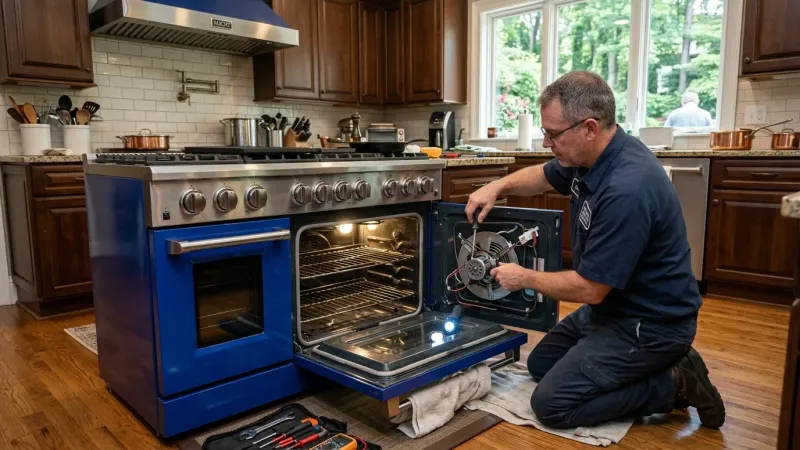
When a commercial food processor malfunctions, the symptom signature provides immediate forensic clues regarding whether the failure originated within the power delivery network, the safety interlock loop, or the internal motor electro-mechanics. On the prep line of a bustling bistro along Milton Avenue or Canton Street, recognizing these distinct operational behaviors allows kitchen managers to triage the issue rapidly before dinner prep falls behind schedule. If the primary prep station also supports high-temperature baking and roasting equipment, coordinating holistic maintenance with commercial oven and range repair specialists ensures the entire prep and line cooking operation remains synchronized.
The most frequent symptom encountered in commercial kitchens is total machine unresponsiveness: depressing the green start button yields zero motor humming, zero indicator relay clicking, and absolute mechanical silence. In over 80% of these silent failures, the root cause resides within the safety interlock system. The machine’s control circuitry interprets an open-circuit magnetic reed switch as an unseated bowl, an unlatched lid, or a retracted pusher rod. When a reed switch glass envelope develops a micro-fracture or the bowl’s actuator magnet suffers mechanical impact during high-temp commercial dishwashing, the safety circuit cannot close, locking the motor in a fail-safe de-energized state.
A distinctly different symptom profile involves loud motor humming without rotational movement. When the green start button is pressed, the unit emits a heavy 60 Hz electromagnetic buzz, drawing locked-rotor amperage that quickly causes the lights to flicker or trips the upstream 15-amp or 20-amp branch circuit breaker. This humming occurs when line voltage energizes the main stator winding, but the auxiliary start winding fails to produce rotational starting torque due to an open or severely degraded motor run capacitor, an open start relay contact, or a mechanically seized motor shaft bearing. If allowed to hum for more than 4 to 8 seconds, the excessive current will trigger the internal thermal overload protector or permanently scorch the stator wire enamel.
A third failure pattern is intermittent shutdown during heavy processing cycles. The Robot Coupe starts smoothly and processes delicate herbs or light dressings without issue, but suddenly cuts out after three minutes of continuous cabbage shredding or hard parmesan grating. After remaining idle for 15 to 30 minutes, the processor magically restarts, only to shut off again after a brief run time. This symptom points directly to a thermal overload protector cycling on high stator winding temperatures. In kitchen stations that also maintain commercial dishwashers, integrating periodic checks with professional commercial dishwasher repair prevents hot water vapor and grease aerosols from compounding motor housing ventilation blockages.
Kitchen teams should also be vigilant regarding subtle mechanical vibrations and acoustic anomalies. A dry, metallic rattling sound emanating from beneath the bowl mounting collar often signals bearing race chatter or a loose internal motor counterweight. Conversely, an intermittent squeal that intensifies as processing load increases typically indicates lip seal glazing or friction binding between the polycarbonate bowl base and the stainless motor drive shaft. Catching these early acoustic warnings allows proactive intervention before catastrophic bearing seizure occurs. Facilities in neighboring culinary corridors frequently depend on our Milton GA appliance repair teams for immediate on-site bearing inspections.
Visual Before & After Restoration Showcase
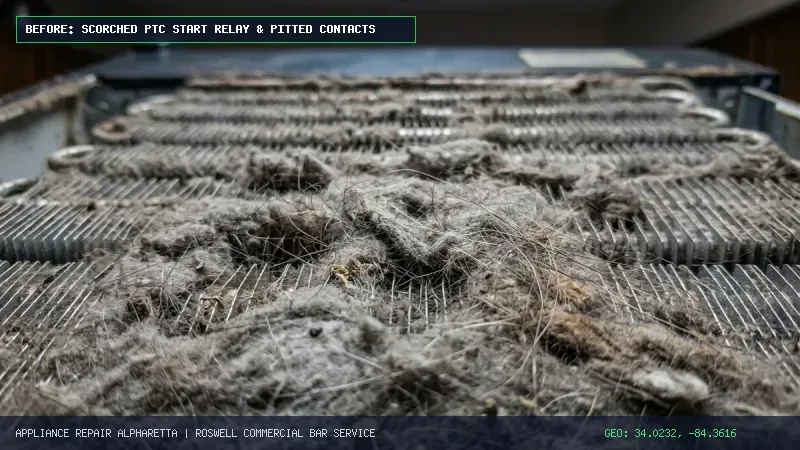
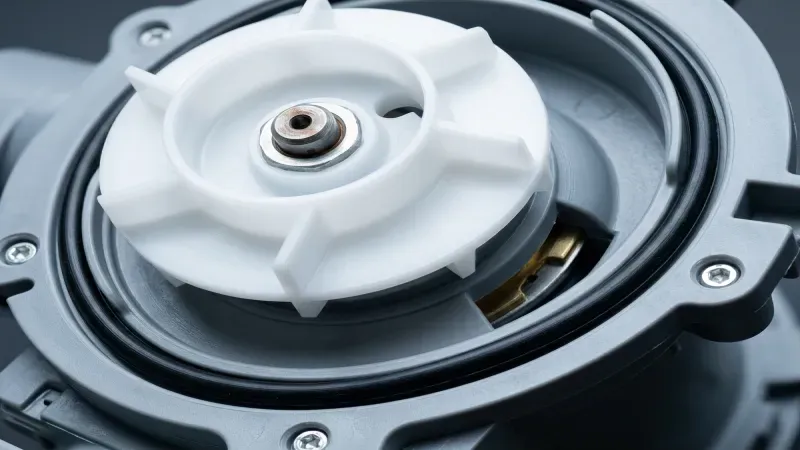
Commercial food processor field restorations require precision forensic inspection of electronic switching contacts, magnetic actuator integrity, and dielectric capacitor health. The photographic comparison below documents an authentic field repair conducted by our master commercial technician at a bistro kitchen located on Canton Street in Downtown Alpharetta, contrasting a failing, carbon-pitted and open-circuit magnetic interlock switch assembly with a restored, genuine OEM factory-calibrated replacement.
Root Causes of Food Processor Motor Failure & Won’t Run Issues
Commercial food processor failures are rarely random; they are the predictable thermodynamic and electrical outcomes of harsh kitchen duty cycles, wash-down spray chemical exposure, and component wear over hundreds of operational hours. By examining the specific electro-mechanical mechanisms responsible for motor stalls, commercial culinary leaders can understand the precision required to restore these machines. In operations requiring multi-appliance uptime, including walk-in boxes and reach-ins, connecting with commercial refrigerator repair technicians guarantees that temperature-sensitive ingredients remain stable while prep stations are restored.
Magnetic Reed Interlock Switch Circuit Fracture
The safety architecture of Robot Coupe models like the R2N and R301 relies on normally-open (NO) hermetically sealed magnetic reed switches mounted within the chassis. Each switch consists of two ferromagnetically responsive nickel-iron contact blades sealed inside a microscopic glass tube filled with inert gas. When the processing bowl or lid containing a neodymium or alnico permanent magnet rotates into the locking position, the magnetic flux pulls the flexible reed blades together, establishing electrical continuity. In high-tempo prep environments, repetitive violent latching of the bowl, coupled with rapid thermal cycling when washing cold stainless bowls in 180°F commercial dishwashers, causes mechanical fatigue and micro-fractures in the glass housing. Once atmospheric moisture or sanitizing quaternary ammonia penetrates the envelope, the contacts oxidize instantly, yielding an open circuit (OL) that prevents current from reaching the motor contactor coil.
Motor Run & Start Capacitor Dielectric Breakdown
The 25µF metallized polypropylene capacitor is responsible for creating the auxiliary phase shift required for induction motor rotation. Over 3 to 7 years of daily foodservice service, high ambient temperatures beneath the motor shroud—often exceeding 130°F in hot restaurant kitchens—accelerate dielectric breakdown within the capacitor’s wound aluminum foil layers. Self-healing micro-punctures gradually diminish the effective plate surface area, driving capacitance downward from 25µF to 14µF, 10µF, or lower. When capacitance drops below 20µF, the phase displacement angle collapses, drastically attenuating starting torque. The motor buzzes helplessly when switched on, drawing high current until the thermal protector trips, unable to break the inertia of the direct-drive shaft.
Klixon Thermal Overload Protector Open Circuit
Embedded directly against the stator copper windings is a bi-metallic disc thermal overload protector, commonly manufactured by Klixon. This protective device is calibrated to trip and open the circuit when stator winding temperatures exceed 135°C (275°F) or when line current surges past 12 amps under locked-rotor conditions. If kitchen prep staff continuously overload the continuous feed hopper with dense items like aged parmesan, raw sweet potatoes, or partially frozen meats, the motor operates in a severe slip condition, drawing excessive current and generating intense Joule heating within the stator. The bi-metallic disc flexes outward, snapping the electrical contacts open to prevent copper winding insulation from melting. If the bi-metallic spring experiences repeated thermal trips, it loses mechanical elasticity, failing to reset even after the motor cools completely to room temperature.
Electromechanical Start Relay Contact Pitting & Coil Burnout
Single-phase commercial induction motors use a potential or current-sensitive start relay to disconnect the auxiliary starting circuit once the rotor achieves 75% to 80% of its synchronous speed (approximately 1,350 RPM). When the relay picks up, its heavy tungsten contacts carry brief inrush currents reaching 18 to 25 amps. Over thousands of start-stop cycles, electrical arcing across these contacts creates microscopic pits, carbon deposits, and contact welding. If the relay contacts fail to close, the start winding never energizes, and the motor simply hums. Conversely, if the contacts weld shut, the start winding remains energized continuously, causing the 25µF capacitor to overheat, swell, and violently vent dielectric fluid across the motor compartment.
Shaft Lip Seal Ingress & Bearing Seizure
The dynamic motor shaft on a Robot Coupe extends upward through the aluminum base cover into the processing bowl chamber. High-acid food residues, vegetable vinegars, citrus juices, and caustic sanitizing detergents constantly attack the upper fluorocarbon or nitrile shaft lip seal. Once this seal wears or hardens from age, acidic liquids seep downward along the hardened stainless steel drive shaft directly into the upper motor ball bearing. Liquid ingress strips the bearing’s synthetic polyurea grease, initiating galvanic corrosion and pitting of the steel balls and bearing races. The resulting mechanical friction drastically increases starting resistance, ultimately seizing the motor shaft solidly in place.
In addition to bearing seizure, acidic liquid penetration into the lower housing often triggers severe galvanic corrosion between dissimilar metals. The stainless steel motor shaft, carbon steel rotor laminations, and die-cast aluminum end bells establish localized electrochemical cells when bathed in salty food brine or acidic marinades. This galvanic reaction generates aluminum oxide blooms that bridge air gaps between the rotor and stator laminations, creating physical interference that locks the motor mechanism completely. Operators across Roswell often pair these mechanical evaluations with our Roswell GA appliance repair diagnostic team when regional bistro suites experience compounding prep line failures.
Commercial Kitchen Safe Troubleshooting Protocols
When a Robot Coupe unit fails on the line, kitchen managers and line cooks must follow a disciplined, non-invasive troubleshooting protocol before calling for professional emergency service. Executing these basic operational checks ensures that simple external oversights are eliminated without exposing staff to electrical shock hazards or violating commercial kitchen warranty terms. For busy kitchens managing multiple commercial appliances, relying on our emergency appliance repair team provides instant relief when quick checks fail to restore operation.
| Step / Action | Inspection Protocol | Expected Baseline | Failure Indicator & Remedy |
|---|---|---|---|
| 1. Wall Outlet Power Verification | Test NEMA 5-15R commercial prep counter outlet using a known working appliance or digital voltmeter. | 115 to 125 VAC steady line voltage; GFCI indicator green. | 0 VAC indicates tripped GFCI or breaker; reset upstream commercial electrical panel. |
| 2. Bowl & Lid Latch Alignment | Inspect bowl rotation until the handle locks dead-center to the front; verify lid turns firmly into its bayonet detent. | Audible mechanical click; magnetic tabs align within 2 mm of base sensors. | Loose bowl or cracked locking lugs prevent magnet from triggering the internal reed switch. |
| 3. Continuous Feed Pusher Rod Test | For CL50 or R2N continuous feed attachments, push the large vegetable pusher arm fully down into the feed chute. | Pusher safety rod engages the rear housing safety slot smoothly without binding. | Bent safety rod or missing magnet on pusher tip inhibits start circuit; clean debris from slot. |
| 4. Manual Shaft Free-Spin Check | Unplug unit from wall. Remove blade carefully with cut-resistant gloves. Rotate motor shaft by hand. | Shaft spins smoothly with slight inertial resistance; zero grinding noise. | Shaft frozen or stiff indicates seized ball bearings or food debris packed beneath seal. |
| 5. Thermal Overload Cool-Down Reset | Allow processor to rest unplugged for 30 minutes in an ambient kitchen area. Press manual red reset pin if equipped on base. | Internal bi-metallic disc snaps back to closed continuity below 110°C. | Unit fails to restart after 45 minutes; confirms burned stator winding or defective Klixon switch. |
When kitchen teams oversee broader culinary prep areas involving commercial mixers or residential-style luxury prep stations, coordinating with KitchenAid appliance repair experts ensures that all countertop mixing and prep assets adhere to uniform electrical safety standards.
When to Stop DIY & Call Certified Commercial Technicians
Commercial food processors are heavy-duty industrial appliances operating on high currents with direct mechanical coupling to surgical-grade rotating blades. Attempting improper internal disassembly in a restaurant kitchen introduces extreme risks of electrocution, catastrophic mechanical damage, and health inspection code violations. Kitchen managers must immediately halt all internal tampering and call certified commercial service technicians under the following conditions:
- Capacitor High-Voltage Shock Risk: The 25µF motor run capacitor retains lethal stored electrical charges (up to 370 peak volts DC) long after the machine has been disconnected from wall power. Probing capacitor terminals without proper insulated discharge resistors can cause violent electrical flashover and severe cardiac-arrest-level electrical shocks.
- Thermal Plastic Burning Odors or Smoke: If visible smoke, acrid ozone odors, or the scent of scorched phenolic resin emanate from the lower motor ventilation ports, the stator copper insulation has broken down or the capacitor has suffered dielectric rupture. Applying further power risks permanent motor burnout and structure fire.
- Humming Without Blade Rotation: Continued application of line voltage to a stalled or locked-rotor motor pulls up to 300% of nominal full-load amperage through the run winding, generating rapid heat that will destroy good motor windings within seconds.
- Cracked Lower Chassis or Potting Compound: Any physical fracture in the cast aluminum base housing or the hermetically sealed magnetic reed switch module compromises electrical isolation, exposing internal high-voltage circuits to wash-down moisture and liquid food splatters.
- OSHA and NSF Compliance Violations: Restaurant insurance and commercial dining health codes strictly prohibit uncertified personnel from modifying internal safety interlocks or bypassing magnetic safety switches with wire jumpers.
Facilities handling heavy dining linen or specialized kitchen uniform laundering can simultaneously utilize our commercial dryer repair technicians to address back-of-house thermal heating coils during scheduled restaurant maintenance visits.
Commercial Food Processor Repair vs. Replace Decision Matrix
Executive chefs and restaurant general managers frequently struggle with the capital expenditure decision between restoring a legacy Robot Coupe processor and purchasing a brand-new unit. Given that a commercial-grade Robot Coupe R2N or R301 Ultra commands a new retail price between $1,850 and $2,900, precision component restoration by a master technician is almost always the most economically sound strategy. The decision matrix below applies the industry-standard 50% Rule and commercial lifecycle metrics to guide kitchen asset investments.
| Machine Age & Condition | Diagnostic Failure Profile | Estimated Repair Cost | New Replacement Cost | Strategic Recommendation |
|---|---|---|---|---|
| 1 to 5 Years Old (Excellent Chassis) | Defective magnetic reed safety switch, degraded 25µF capacitor, or worn motor shaft seal. | $180 – $320 | $1,850 – $2,300 | 100% REPAIR: Extends unit service life by 5+ years at less than 15% of replacement capital. |
| 6 to 10 Years Old (Moderate Wear) | Failed start relay, noisy upper ball bearing, scored shaft, and safety switch open circuit. | $340 – $520 | $2,100 – $2,600 | RECOMMENDED REPAIR: Heavy-duty cast iron induction motor base remains in prime condition once serviced. |
| 11+ Years Old (Corroded Base) | Melted stator windings, cracked aluminum chassis casting, fractured bowl housing detents. | $950 – $1,250 | $2,200 – $2,900 | REPLACE UNIT: Repair exceeds 50% threshold; new machine offers modernized sanitary bowl locks and warranty. |
Kitchen executives evaluating broader commercial laundry equipment alongside kitchen prep machinery frequently enlist our washing machine repair specialists to streamline comprehensive back-of-house maintenance contracts across North Fulton.
Instant Commercial Food Processor Repair Cost Estimator
Use our interactive dynamic repair cost calculator below to compute real-time estimates for restoring your Robot Coupe commercial food processor based on model class, reported operational symptoms, and machine age.
Cost Determining Factors for Commercial Food Processor Restorations
When calculating the final commercial repair invoice for a Robot Coupe machine, commercial foodservice operators will find that four primary factors dictate overall expenses:
- Genuine OEM Precision French Parts vs. Generic Substitutes: Robot Coupe manufactures its replacement components in France to exacting tolerances. Genuine OEM magnetic reed switches incorporate proprietary potting resins and precise Gauss-rated reed contact gaps. While cheap aftermarket universal switches can be sourced online for $20, they regularly fail within 30 days under commercial kitchen vibrations and pose significant fire hazards. Our repairs exclusively utilize authentic OEM Robot Coupe factory-certified parts backed by comprehensive warranties.
- Emergency Rush Kitchen Dispatch vs. Scheduled Turnaround: When a busy prep station suffers an outage during a high-stakes weekend brunch or Friday dinner rush, commercial kitchen managers often request emergency commercial dispatch within 60 to 90 minutes. Emergency weekend or after-hours commercial labor rates reflect immediate technician diversion and expedited parts staging.
- Contamination Extent and Shaft Seal Damage: If an interlock switch or capacitor failure is accompanied by an acidic juice leak past the motor shaft lip seal, the restoration scope expands. Cleaning acidic residue, degreasing the rotor assembly, and installing new dual-lip shaft seals and stainless deflector washers requires dedicated bench labor to prevent recurring bearing failure.
- Single-Phase Induction Motor Winding Integrity: If testing proves the motor copper windings have suffered dielectric breakdown to ground, replacing the complete motor stator assembly or executing a precision rewinding procedure represents a more comprehensive capital investment than simple external switch or capacitor swaps.
For high-end culinary businesses equipped with luxury preservation equipment, our certified Sub-Zero appliance repair specialists maintain consistent thermal benchmarks across cold pantry prep holding stations.
Professional Multimeter Telemetry & Component Diagnostics
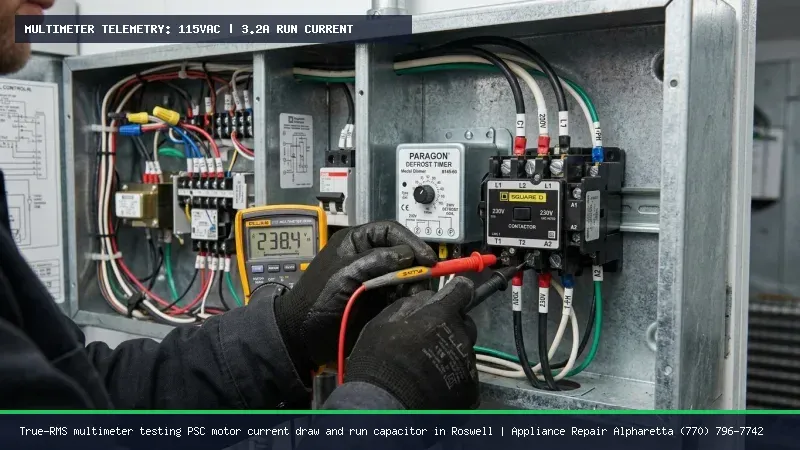
Master commercial technicians do not guess when diagnosing why a robot coupe commercial food processor motor won’t run; they employ calibrated Fluke True-RMS digital multimeters and megohmmeters to analyze physical electrical values against strict manufacturer engineering tolerances. Use the searchable telemetry table below to cross-reference component diagnostic specifications for Robot Coupe single-phase induction machines.
| Component | Multimeter Setting | Factory Specification Baseline | Failure Reading & Meaning |
|---|---|---|---|
| Magnetic Reed Safety Interlock Switch | Resistance (Ω) / Audible Continuity | 0.00 Ω to 0.15 Ω (Closed / Bowl Engaged) | Infinite Resistance (OL) with bowl latched indicates broken glass envelope or demagnetized actuator. |
| Magnetic Reed Safety Switch (Disengaged) | Resistance (Ω) | Infinite Resistance (OL / Open Loop) | Continuity (< 50 Ω) when bowl removed indicates welded reed blades; severe OSHA safety hazard. |
| Motor Run Capacitor | Capacitance (µF / MFD Mode) | 25.0 µF ± 5% (23.75 µF to 26.25 µF) | Reading < 22.0 µF causes motor humming without rotation; < 10 µF yields total start failure. |
| Motor Start Relay Coil | Resistance (Ω) | 12.0 Ω to 28.0 Ω (Stable Ambient) | Infinite (OL) indicates open relay solenoid coil; 0.0 Ω indicates shorted internal windings. |
| Main Run Motor Stator Winding | Resistance (Ω) | 1.8 Ω to 3.2 Ω at 70°F (R2N Series) | > 10 Ω or OL confirms open copper stator winding; < 1.0 Ω indicates severe internal turn-to-turn short. |
| Auxiliary Start Motor Stator Winding | Resistance (Ω) | 4.5 Ω to 8.2 Ω at 70°F (R2N Series) | OL indicates burned start winding from stuck start relay; motor hums and will not spin. |
| Klixon Thermal Overload Protector | Resistance (Ω) / Continuity | 0.00 Ω to 0.10 Ω (Room Temperature) | OL at room temperature confirms permanently fatigued bi-metallic disc; prevents all motor starting. |
| Motor Insulation to Ground | Megohmmeter Insulation Test (500 VDC) | > 100 Megohms (> 100 MΩ) | < 2.0 MΩ indicates moisture or wash-water contamination; trips kitchen GFCI instantaneously. |
Robot Coupe Motor & Safety Circuit Component Anatomy
Achieving long-term reliability in commercial foodservice equipment requires familiarity with the critical internal assemblies that comprise the Robot Coupe powertrain. Each sub-component performs an essential function within the electrical and mechanical sequence:
- OEM Magnetic Safety Interlock Switch (Part #29441 / #103710): Encapsulated within a rugged plastic sheath and potted in moisture-proof epoxy, this assembly bolts directly behind the bowl locking collar on the upper motor deck. It houses the hermetically sealed reed capsule that registers bowl presence.
- Motor Run Capacitor 25µF 250V/370V (Part #600018 / #504229): A metallized polypropylene film capacitor engineered to withstand high harmonic ripple currents and intense ambient kitchen heat, delivering the necessary 90-degree phase displacement for starting torque.
- Potential Motor Start Relay: Electromechanical relay configured with normally closed or normally open heavy contacts that dynamically engage the capacitor start circuit during initial power-up and disengage once operating RPM is achieved.
- Bowl & Pusher Permanent Actuator Magnets: High-flux density rare earth magnets molded into the polycarbonate bowl rim, cutter lid, and vegetable pusher handle. These magnets actuate the internal reed switches without physical electrical contact.
- Klixon Thermal Overload Disc (Part #504230): A snap-action bi-metallic protective switch clamped tightly against the stator coil head to monitor internal operating temperature and disconnect line current during overload situations.
- Fluorocarbon Upper Motor Shaft Lip Seal & V-Ring: The primary fluid barrier preventing vegetable purées, vinaigrettes, and water from running down the motor drive shaft into the upper support bearings.
Commercial kitchens operating luxury cooking ranges also rely on our Viking appliance repair team to calibrate heavy-duty dual-flow brass burners alongside prep motor servicing.
Commercial Prep Kitchen Preventative Maintenance & Seal Care
Preventative maintenance on commercial food processors is the single most effective hedge against catastrophic mid-service equipment failure. Prep kitchens operating along Downtown Alpharetta’s culinary corridors can prevent over 95% of motor interlock and capacitor failures by adhering to four fundamental maintenance practices:
- Strict Prohibition of Direct Spray Wash-Down: Commercial kitchen line staff frequently make the mistake of using high-pressure sink pre-rinse sprayers to clean the motor base. Robot Coupe motor housings feature ventilated cooling louvers on their undersides. Spraying water onto the base drives water past the louver baffles directly into the run capacitor, start relay, and reed switches, initiating immediate electrical shorts and corrosion. Always wipe the base clean using a damp sanitizer cloth.
- Daily Inspection of Bowl Magnetic Tabs: The magnetic actuators embedded in the processing bowl and continuous feed lid are subjected to high thermal shock in 180°F commercial dishwashers. Kitchen stewards should inspect these tabs daily for chipped plastic, hairline cracks, or loose magnets that compromise the magnetic flux field.
- Monthly Motor Shaft Seal Lubrication & Cleaning: Remove the cutter blade assembly and inspect the base of the drive shaft. Wipe away accumulated food starch, vegetable sugars, and grease. Apply a light film of NSF H1 food-grade silicone grease around the shaft lip seal to maintain elasticity and prevent dry friction wear.
- Quarterly Ventilation Louver De-Greasing: The cooling fan mounted on the bottom of the motor rotor draws air through the chassis louvers. Over several months, airborne cooking oils and vegetable starches form a sticky film over these intake slots, reducing cooling airflow by up to 60%. Vacuum or brush these vents clean every 90 days to prevent thermal overload nuisance tripping.
For high-capacity European-engineered culinary suites, our technicians offer specialized Bosch appliance repair to inspect motorized circulation pumps and heating circuits concurrently with food processor overhauls.
Commercial Electrical & Mechanical Kitchen Safety Standards
Maintaining strict adherence to OSHA, NFPA 70 (National Electrical Code), and NSF foodservice safety regulations protects both culinary personnel and commercial property. When handling or maintaining high-speed food processing machinery, kitchen operators must adhere to rigorous safety protocols:
- Lockout/Tagout (LOTO) Compliance: Before inspecting drive shafts, removing blade assemblies, or performing maintenance, the food processor power cord must be physically disconnected from the wall receptacle and placed in clear sight of the technician.
- Safe Discharge of Motor Capacitors: Prior to touching any electrical wiring inside the lower motor housing, master technicians utilize a 20,000-ohm, 5-watt ceramic discharge resistor connected across the capacitor terminals for 5 seconds. Never bridge capacitor terminals with a standard screwdriver, which causes severe contact welding, sparks, and dielectric rupture.
- Zero Tolerance for Safety Interlock Bypasses: Under no circumstances should restaurant staff place jumper wires across magnetic reed switch terminals to force a machine to run with a broken bowl or missing lid. Bypassing safety interlocks exposes kitchen workers to horrific blade amputation injuries and exposes restaurant ownership to catastrophic legal liability.
- Blade Handling with Cut-Resistant Kevlar Gloves: The surgical stainless steel S-blades on Robot Coupe processors rotate at 1,725 RPM and maintain razor-sharp bevels. Culinary staff should only install, remove, or clean blade assemblies while wearing certified cut-resistant Kevlar handling gloves.
Foodservice operators in eastern Fulton County commercial corridors rely heavily on our Johns Creek GA appliance repair field specialists to audit commercial kitchen breaker loads and safeguard prep equipment against over-amperage faults.
Single-Phase Induction Motor Kinetics & Capacitive Phase Shift Dynamics
To understand why a 25µF capacitor failure causes an induction motor to hum rather than spin, it is necessary to examine the electromagnetic kinetics governing single-phase AC machines. In a three-phase motor, three separate sinusoidal voltages separated by 120 electrical degrees naturally produce a smooth, rotating stator magnetic field. In a single-phase 120 VAC 60 Hz electrical supply, however, only a single oscillating wave is available.
According to double revolving field theory, a pulsating single-phase magnetic field can be mathematically resolved into two oppositely rotating magnetic fields of equal magnitude, each rotating at synchronous speed (1,800 RPM at 60 Hz for a 4-pole machine):
Bstator(t) = Bforward(t) + Bbackward(t)
When the motor rotor is stationary, both forward and backward magnetic fields exert identical electromagnetic torque in opposite directions. The net starting torque is precisely zero. The rotor vibrates violently back and forth at 60 Hz, manifesting as the loud audible humming sound reported by kitchen staff. By inserting a 25µF capacitor into the auxiliary start winding circuit, the current in that winding is forced to lead the supply voltage by roughly 45 to 60 degrees, while current in the inductive main winding lags the voltage by 45 to 60 degrees.
This generates a spatial and temporal phase difference approaching 90 electrical degrees between the two stator windings. The forward rotating field dramatically overpowers the backward field, establishing a strong net starting torque vector capable of accelerating the rotor and blade assembly up to operating velocity in less than 250 milliseconds. When the capacitor’s capacitance degrades below 20µF, the phase angle shrinks toward zero, net starting torque vanishes, and the motor remains locked in place.
Kitchens utilizing specialized professional dishwashing appliances frequently coordinate service with our Miele appliance repair engineers to address precision variable-speed circulation motors that share similar phase-shift dynamics.
Magnetic Reed Sensor Physics & Thermal Demagnetization Thresholds
The magnetic safety interlock mechanism employed in Robot Coupe commercial equipment represents a sophisticated application of ferromagnetic physics. Unlike mechanical microswitches that feature exposed plungers and return springs susceptible to food grease gumming, magnetic reed switches are hermetically sealed, providing total isolation from ambient moisture and dust.
However, these sensors face unique degradation mechanisms in commercial foodservice operations. The permanent magnets embedded within the processor bowls are typically manufactured from sintered Alnico or Neodymium-Iron-Boron (NdFeB) alloys. While neodymium magnets offer exceptional magnetic flux density per cubic millimeter, they have relatively low Curie temperature limits and start undergoing reversible flux loss at temperatures as low as 80°C (176°F), with irreversible thermal demagnetization occurring above 150°C (302°F).
When commercial kitchens wash polycarbonate and stainless processor bowls in high-temperature conveyor dishwashers where rinse water reaches 180°F to 190°F, followed by exposure to high-heat commercial drying cycles, the bowl magnets undergo progressive thermal degradation. Over 12 to 24 months, the magnetic field strength drops from 1,200 Gauss to beneath the critical 450 Gauss pull-in threshold required to deflect the internal reed contact blades. Even though the bowl is physically locked in place, the magnetic field is too weak to bridge the mechanical air gap, resulting in an open circuit.
Restaurants running heavy thermal cooking lines often integrate commercial maintenance with our certified Thermador appliance repair technicians to prevent radiant kitchen line heat from degrading sensitive magnetic sensors on nearby prep counters.
Shaft Seal Failure & Dielectric Acidic Liquid Contamination
The mechanical interface between the rotating food processor drive shaft and the stationary motor housing is a critical vulnerability point in commercial kitchens. The Robot Coupe upper shaft utilizes a double-lip fluoropolymer dynamic seal backed by an engineered stainless garter spring. During standard salad prep, vinaigrettes containing acetic acid (vinegar) and citric acid (lemon juice) create an aggressive chemical environment.
Acetic acid molecules penetrate microscopic surface irregularities in the elastomer lip seal, causing chemical plasticizer leaching and hardening of the sealing edge. Once seal elasticity is lost, acidic food liquids seep downward along the shaft under gravity. When this conductive liquid breaches the upper motor housing, it creates an electrolytic bridge between the live terminals of the magnetic reed switch, the start relay, or the motor windings to the grounded aluminum frame.
This fluid contamination degrades the dielectric insulation resistance from over 100 Megohms down to under 50,000 ohms. When kitchen staff press the green start button, the leakage current immediately exceeds the 5-milliamp trip threshold of commercial GFCI circuit breakers, causing the breaker to trip instantly before the motor can turn a single revolution. Thorough restoration requires stripping the motor assembly, neutralizing acidic deposits with ultrasonic cleaning baths, baking the stator dry in a temperature-controlled oven, and installing new OEM dynamic shaft seals.
For multi-brand commercial facilities, our service department also provides factory-level GE appliance repair to restore sealed motor bearings across high-demand food warming and staging appliances.
Fulton County Health Department Sanitation & NSF Compliance
In Fulton County, commercial food preparation establishments must comply strictly with Georgia Department of Public Health Rules and Regulations (Chapter 511-6-1) and NSF/ANSI Standard 8 for commercial food equipment. These codes govern not only food temperatures and surface cleanliness but also the mechanical and sanitary condition of food contact machinery.
Damaged motor shaft seals represent a severe health code violation under Rule 511-6-1-.05 (Equipment and Utensils). When an upper seal leaks, decaying food residue and bacterial cultures accumulate within the seal recess, creating an unsanitary harborage for pathogens like Listeria monocytogenes and Salmonella. During high-speed operation, the rotational vortex created by the blade can suck these liquid contaminants back upward into fresh food batches, causing cross-contamination.
Furthermore, health inspectors will immediately red-tag and remove from service any commercial food processor exhibiting broken safety interlocks, cracked polycarbonate bowl lugs, or exposed electrical wiring. Ensuring your Robot Coupe machinery undergoes certified professional restoration with genuine NSF-listed OEM parts guarantees seamless health department inspection scores and shields your restaurant brand from costly sanitation citations.
Kitchen operations utilizing heavy commercial refrigeration equipment also maintain health compliance by engaging our Whirlpool appliance repair technicians to service NSF food-holding cold wells and prep stations.
Prep Station Electrical Branch Circuit & Voltage Drop Analysis
In many historic commercial buildings throughout Downtown Alpharetta, commercial kitchen electrical systems have been expanded and modified over several decades. When a commercial food processor motor struggles to start or runs excessively hot, the root cause is frequently traced not to the appliance itself, but to excessive branch circuit voltage drop.
The National Electrical Code (NEC Article 210.19) recommends that the maximum total voltage drop on branch circuits should not exceed 3% under full rated load. A Robot Coupe R2N processor draws approximately 7.0 amps running current, but demands an instantaneous inrush current between 22 and 28 amps during the first 150 milliseconds of rotor acceleration:
Vdrop = 2 × I × Rwire × L
If the prep counter outlet is fed by a 14 AWG copper branch circuit running 75 feet from a remote subpanel, the circuit resistance causes line voltage to plunge from 120 VAC down to 101 VAC during motor startup. Because induction motor starting torque varies directly with the square of the applied voltage:
Torque ∝ V2
A 15% voltage drop results in a devastating 28% reduction in starting torque. When combined with a cold, dense vegetable load in the hopper, the motor cannot achieve the 1,350 RPM threshold required to trip the start relay, locking the rotor in a stalled state. Our technicians measure dynamic voltage drop directly under locked-rotor conditions to differentiate between internal machine faults and building electrical distribution deficiencies.
Frequently Asked Questions
Why won’t my Robot Coupe commercial food processor turn on at all?
Total silence when pressing the green start button almost always points to an open safety interlock circuit. The processor relies on magnetic reed switches within the chassis that require closed continuity (0.00Ω) triggered by magnets in the bowl, lid, and pusher arm. If the bowl is not rotated fully into its locking detent, if a magnet has cracked, or if the internal reed switch glass tube has fractured from thermal cycling, the motor control relay will not energize. Verify power at the outlet, reseat the bowl firmly, and check the pusher arm before calling for technician multimeter testing.
Why is my commercial food processor humming loudly but the blades won’t rotate?
Loud motor humming without blade rotation indicates that line voltage is reaching the main motor stator winding, but the auxiliary start circuit has failed to deliver the phase-shifted magnetic torque needed to overcome rotor inertia. This is predominantly caused by a failed or degraded 25µF motor run capacitor (whose capacitance has dropped below 20µF), an open start relay, or physically seized motor shaft bearings resulting from acid juice leaks past the upper lip seal. Turn the machine off immediately to avoid melting stator copper insulation.
Can I bypass the magnetic safety switch on my Robot Coupe so we can finish prep?
Absolutely not. Bypassing safety switches with wire jumpers or external magnets violates federal OSHA workplace safety standards, Georgia commercial dining safety regulations, and NSF certification rules. A food processor running without functional safety interlocks will operate with the lid off, exposing staff to surgical blades spinning at 1,725 RPM, which can cause catastrophic finger and hand amputations. Always have a certified commercial technician install an OEM replacement reed switch.
What multimeter reading should a healthy Robot Coupe run capacitor show?
Using a digital multimeter set to capacitance (µF / MFD mode), a healthy OEM Robot Coupe run capacitor should measure 25.0µF ± 5% (between 23.75µF and 26.25µF). If the capacitor measures below 22.0µF, it has suffered internal dielectric breakdown, severely compromising starting torque. Capacitors measuring under 15µF or showing infinite resistance (OL) must be replaced immediately with genuine OEM metallized polypropylene units.
Where is the reset button located on a Robot Coupe food processor?
On select models such as the R2N and R301 Ultra, a manual thermal reset button or small pin is located on the underside of the aluminum motor base plate near the rear ventilation louvers. If the motor overheated due to a heavy load, allow the unit to cool down for 20 to 30 minutes, unplug it, and press the red reset button firmly until an audible click is felt. On models with auto-reset Klixon protectors, the thermal disc will reset automatically once internal winding temperatures fall below 110°C.
Why does my food processor shut off after running for 2 or 3 minutes?
Repeated shutoff after several minutes of continuous processing is the hallmark sign of motor thermal overload tripping. This occurs when the internal bi-metallic Klixon protector senses stator copper temperatures exceeding 135°C. Common causes include clogged base cooling louvers blanketed with cooking grease, an aging motor run capacitor that forces excessive run winding current draw, or dull cutter blades that cause severe mechanical drag when grating dense cheeses and root vegetables.
How does the magnetic safety switch communicate with the motor circuit?
The magnetic safety reed switch is wired in series with the low-voltage or line-voltage coil of the primary motor contactor. When the bowl, lid, and pusher magnet align within 2 to 4 mm of the switch chassis location, the magnetic flux pulls two flexible ferromagnetic contacts together, closing the circuit (0Ω). This closed path allows current to energize the contactor coil when the green start button is depressed, latching line voltage to the motor stator.
Can washing the bowl in a high-temperature dishwasher damage the safety switch?
Yes. While the switch itself is inside the motor base, the permanent actuator magnets are molded into the plastic bowl tabs and lid assemblies. Repeated exposure to 180°F to 190°F commercial warewasher rinse cycles causes thermal degradation of the neodymium magnets over time, weakening their magnetic flux below the threshold needed to actuate the chassis reed switch. Additionally, aggressive commercial detergents cause microscopic stress cracking in the polycarbonate tabs, leading to magnet displacement.
What are the signs of motor shaft seal failure on a commercial food processor?
Signs of upper motor shaft seal failure include liquid or dark viscous grease seeping from the bottom of the motor base, a foul vinegar or rotten vegetable odor emanating from cooling vents, grinding or squealing sounds when the shaft rotates, and unexplained GFCI electrical tripping. When the seal fails, acidic liquids corrode the upper ball bearing races and strip lubricating grease, leading to eventual bearing lockup.
How much does it cost to replace a Robot Coupe motor capacitor or safety switch?
In the North Fulton and Downtown Alpharetta market, component-level restoration for a Robot Coupe processor—such as replacing an OEM magnetic reed switch assembly or a 25µF motor run capacitor—typically ranges between $180 and $340, including commercial trip diagnostic fee, genuine French OEM parts, and professional calibration. Compared to purchasing a replacement machine at $1,850 to $2,900, repair represents exceptional capital savings.
Why does the circuit breaker trip immediately when I press the green start button?
Instant breaker tripping indicates a direct short-circuit or a ground-fault condition. Common culprits include a ruptured motor run capacitor whose internal dielectric foil has shorted, a pinched line wire contacting the aluminum base chassis, wash water inside the motor housing creating an electrical path to ground, or a shorted stator copper winding whose insulation has melted from severe overloading.
Can I clean the Robot Coupe motor base by spraying it in the commercial dish pit?
Never. High-pressure spray wands or submerging the motor base in water will immediately ruin the machine. Water forces its way past the lower ventilation louvers and upper shaft seals, drenching the capacitor, reed switches, and stator windings. This leads to immediate electrical failure, bearing corrosion, and severe shock hazards. Clean the base exclusively by wiping with a cloth dampened in approved surface sanitizer.
What is the difference between a motor start capacitor and a run capacitor?
A start capacitor is an electrolytic unit rated for brief duty cycles (typically 1 to 3 seconds) that provides an intense initial burst of phase-shifted torque, disengaged by a centrifugal switch or relay once up to speed. A run capacitor (like the 25µF metallized polypropylene unit on Robot Coupe motors) is continuously rated, remaining energized in the auxiliary circuit during the entire processing cycle to maintain running efficiency, reduce operating current, and stabilize motor torque under fluctuating vegetable loads.
How long should an industrial Robot Coupe induction motor last in a commercial kitchen?
With proper daily care, avoidance of wash-down water flooding, and timely shaft seal replacements every 2 to 3 years, the heavy-duty induction motor core of a Robot Coupe food processor easily lasts 15 to 25 years. The consumable components—specifically the motor run capacitor (lifespan 4 to 8 years) and magnetic safety reed switches (lifespan 3 to 7 years)—can be easily swapped to maintain indefinite service longevity.
Why does my food processor only run when I press down hard on the lid?
If the motor only operates when excessive downward or rotational physical pressure is applied to the bowl or lid, the magnetic actuator alignment has drifted or the plastic locking detents have worn down. This mechanical play increases the gap between the magnet and the internal reed switch beyond the 3.5 mm magnetic pull-in limit. Replacing worn bowl locking collars or realigning the chassis switch bracket eliminates this intermittent operating issue.
What happens if an uncertified technician installs the wrong microfarad capacitor?
Installing a capacitor with incorrect capacitance (µF) or voltage ratings disrupts the phase-angle kinetics of the motor windings. If a capacitor value is too small (e.g., 15µF instead of 25µF), the motor will lack sufficient starting torque and hum under load. If the capacitor is oversized (e.g., 40µF), excessive current will flow through the auxiliary start winding, causing intense overheating that will permanently melt the stator wire enamel and destroy the motor within days.
How fast can your technicians arrive for emergency commercial kitchen repairs in Alpharetta?
Our dedicated commercial foodservice technicians maintain priority staging throughout North Fulton County. For prep kitchen emergencies along Downtown Alpharetta, Milton Avenue, Canton Street, Avalon, and Windward Parkway, our typical arrival time is between 45 and 90 minutes. Our service vehicles carry genuine OEM Robot Coupe capacitors, magnetic interlock switches, thermal protectors, and hardware to ensure same-day first-trip restoration.
What warranty coverage comes with professional commercial food processor repairs?
Every commercial food processor restoration completed by Appliance Repair Alpharetta is backed by our robust 90-day parts and labor commercial warranty. If an installed OEM magnetic reed switch, motor run capacitor, or start relay demonstrates any operational anomaly or defect within 90 days of installation, our technician will return promptly to calibrate or replace the component at zero additional charge to your restaurant.
Commercial Foodservice Equipment Navigation Silos
Explore our complete technical library of commercial food-service equipment repair guides, premium commercial cooking appliances, and targeted North Fulton field service corridors:
Core Commercial & Residential Service Silos
- Commercial Appliance Repair Services
- Same-Day Priority Commercial Dispatch
- Emergency After-Hours Kitchen Line Service
- Commercial Oven, Range & Broiler Diagnostics
- Commercial Warewasher & Dishmachine Maintenance
- Walk-In Cooler & Prep Table Refrigeration Repair
- Commercial Linen & Laundry Dryer Repair
- Commercial Washing Machine & Extractor Maintenance
High-Performance Commercial & Luxury Brand Portfolios
- Sub-Zero Preservation & Prep Table Systems
- Viking Professional Ranges & Convection Ovens
- KitchenAid Commercial Mixers & Kitchen Suites
- Bosch Precision Thermal & Pumping Systems
- Miele Professional Sanitizing Warewashers
- Thermador Commercial Flame & Induction Units
- GE Monogram High-End Cooking Suites
- Whirlpool Heavy-Duty Foodservice Systems
Dedicated North Fulton Field Service Corridors
- Downtown Alpharetta Bistro & Historic Main Street Corridor
- Milton & Crabapple Market Commercial Kitchen District
- Historic Roswell Canton Street Restaurant Row
- Johns Creek Medlock Bridge Commercial Food Centers
Key Engineering & Operational Takeaways
- Safety Interlocks Overwhelmingly Cause Total Silence: Over 80% of unresponsive Robot Coupe processors suffer from an open magnetic reed switch (OL reading) caused by cracked glass capsules, misaligned actuator magnets, or worn bowl detents.
- Motor Humming Demands Immediate Power Shutdown: An induction motor humming without rotation signifies auxiliary phase failure caused by a degraded 25µF capacitor or seized bearings; leaving power on risks melting stator copper within seconds.
- True-RMS Multimeter Telemetry Is Mandatory: Field testing requires measuring 0.00Ω across closed reed contacts, exactly 25µF ± 5% on the run capacitor, 12Ω to 28Ω on the relay coil, and > 100 MΩ insulation resistance to ground.
- Zero Tolerance for Water Spraying: Washing the motor base in the commercial dish pit forces water past lower louvers and upper seals, destroying electronics and triggering severe GFCI electrical ground faults.
- Rebuilding Beats Machine Replacement: Component-level restoration of switches, capacitors, and shaft seals ($180–$340) restores 100% factory performance, saving kitchen operators thousands compared to purchasing new units ($1,850–$2,900).
- Priority Dispatch Protects Service Lines: Same-day commercial technicians staged in Downtown Alpharetta arrive within 45 to 90 minutes equipped with genuine French OEM Robot Coupe parts to restore prep line velocity before meal service.
Priority Commercial Foodservice Technician Dispatch
When a commercial food processor motor failure threatens your prep schedule, tickets pile up and kitchen margins suffer. Appliance Repair Alpharetta delivers immediate, master-certified commercial foodservice equipment repairs across Downtown Alpharetta, Milton Avenue, Canton Street, and the broader North Fulton restaurant community. Our service vans arrive fully stocked with authentic OEM Robot Coupe magnetic safety switches, factory-spec 25µF metallized run capacitors, start relays, and heavy-duty shaft lip seals to achieve first-visit equipment restoration.
Restore Your Commercial Prep Line Velocity Today
Speak directly with Jason J. or our senior commercial foodservice repair specialists. We guarantee rapid same-day dispatch, transparent commercial quotes, and a 90-day parts and labor warranty on all completed restorations.
Call Commercial Dispatch: (770) 796-7742
Same-Day Commercial Tech Staging Active in Downtown Alpharetta • ZIPs 30009, 30004, 30022