
Samsung French Door Refrigerator RS28A5561SR Not Cooling — Complete Diagnostic & Repair Guide Alpharetta GA
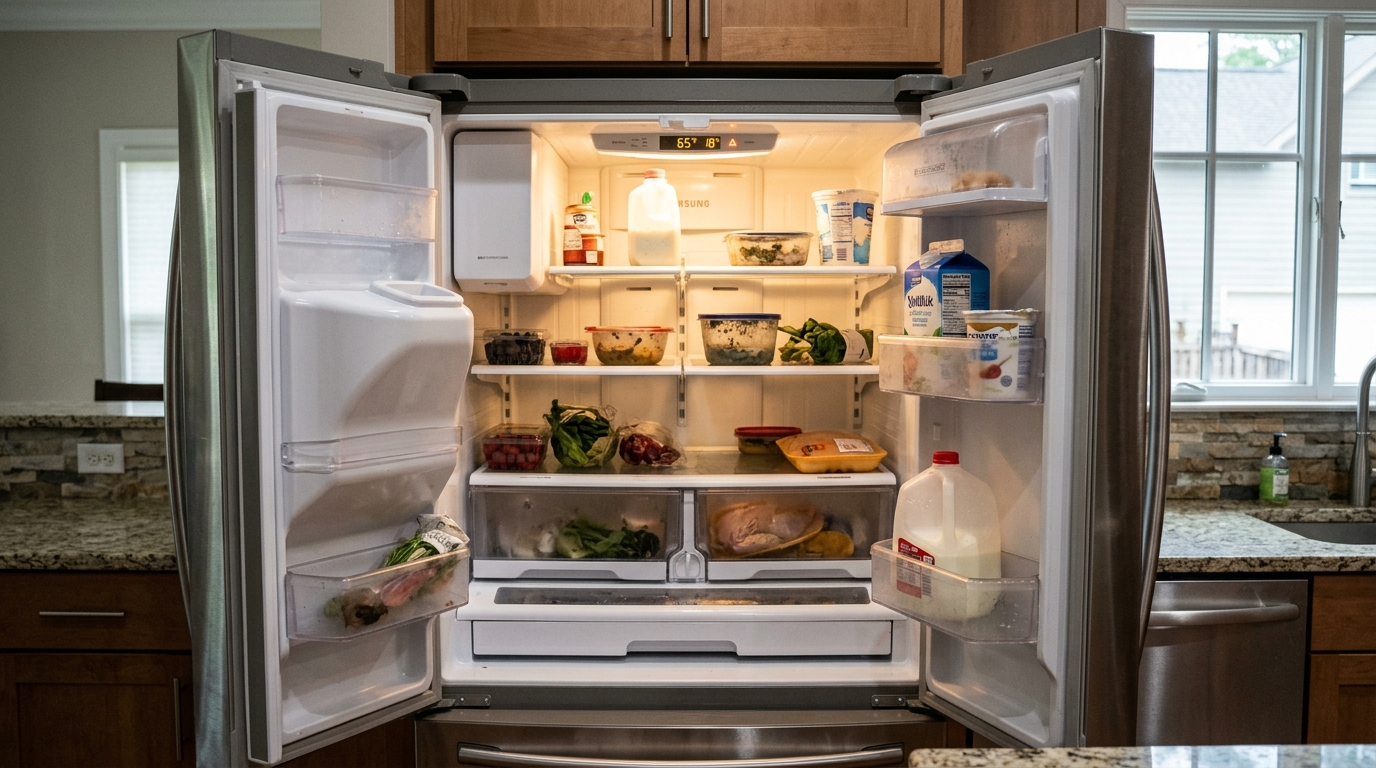
If your Samsung RS28A5561SR French Door refrigerator is not cooling but the compressor is clicking, you are likely facing a start relay or condenser fan issue. This extensive guide provides comprehensive, step-by-step diagnostic and repair instructions specifically for Alpharetta, GA homeowners facing this frustrating appliance problem.
Quick Answer
A Samsung refrigerator not cooling with a clicking sound is typically caused by a failed compressor start relay, a dirty condenser coil, or a malfunctioning condenser fan motor. Unplug the fridge, clean the coils, and inspect the relay. If the relay rattles when shaken, it needs replacement. For professional help, call Appliance Repair Alpharetta GA at (770) 796-7742.
Table of Contents
- Introduction
- Symptoms
- Common Causes
- Step-by-Step Troubleshooting
- When to Stop DIY
- Repair vs Replace
- Estimated Cost Factors
- How Professionals Diagnose
- Common Parts Involved
- Maintenance Tips
- Safety Tips
- FAQs
- Related Services
- Related Problems
- Related Brand Pages
- Related Location Pages
- Key Takeaways
- Schedule Service
Introduction
Dealing with a warm refrigerator is stressful, especially when it’s a premium model like the Samsung RS28A5561SR French Door refrigerator. When you live in Alpharetta, GA, the heat of the summer can make a failing refrigerator a race against time before food spoils. This comprehensive guide will walk you through the diagnostic process, common causes, and repair steps for a Samsung refrigerator that is not cooling, specifically focusing on scenarios where the compressor is clicking but the interior remains warm. Modern appliances are marvels of engineering, but this complexity often means that fixing them requires an intricate understanding of thermistors, control boards, and sealed systems.
Whether you’re located in Windward, near Avalon, or anywhere else in Alpharetta, understanding the mechanics of your Samsung refrigerator can save you time, money, and stress. Our certified technicians at Appliance Repair Alpharetta GA see this specific fault frequently. The RS28A5561SR is a fantastic appliance, but like all modern refrigerators, it relies on a delicate balance of electronic sensors, control boards, and mechanical components to maintain its target temperatures. The Samsung RS28A5561SR is known for its spacious design and advanced features, but when the cooling mechanism fails, those features mean nothing. Food preservation relies strictly on maintaining internal temperatures below 40 degrees Fahrenheit in the fresh food section and 0 degrees in the freezer.
In this guide, we’ll dive deep into the technical aspects of why your Samsung fridge isn’t cooling. We’ll explore the start relay, the compressor, the condenser coils, and the electronic control board. You’ll learn how to identify the clicking sound, what it means for your compressor’s health, and how to test components using a digital multimeter. We’ll also provide real-world ohm readings and resistance values so you can confidently diagnose the issue. For instance, testing a PTC start relay resistance which should measure between 5-7 ohms cold, or understanding that the condenser fan motor operates at 120VAC, pulling around 0.5A with roughly 240 ohms of winding resistance, is critical for an accurate diagnosis.
Remember, while DIY repairs can be rewarding, refrigerator systems involve high voltage and pressurized refrigerants. Safety must always be your top priority. The refrigerant used in the RS28A5561SR is R-600a (isobutane), an environmentally friendly but highly flammable gas operating at a pressure of 25-30 PSI. Only certified professionals should attempt to manipulate the sealed system. If you ever feel uncomfortable, our local Alpharetta technicians are just a phone call away at (770) 796-7742. We offer a $79 service fee (waived with repair) and a 90-day warranty on all parts and labor. We pride ourselves on quick response times, comprehensive diagnostics, and reliable repairs for the local community.
Symptoms of a Samsung Refrigerator Not Cooling
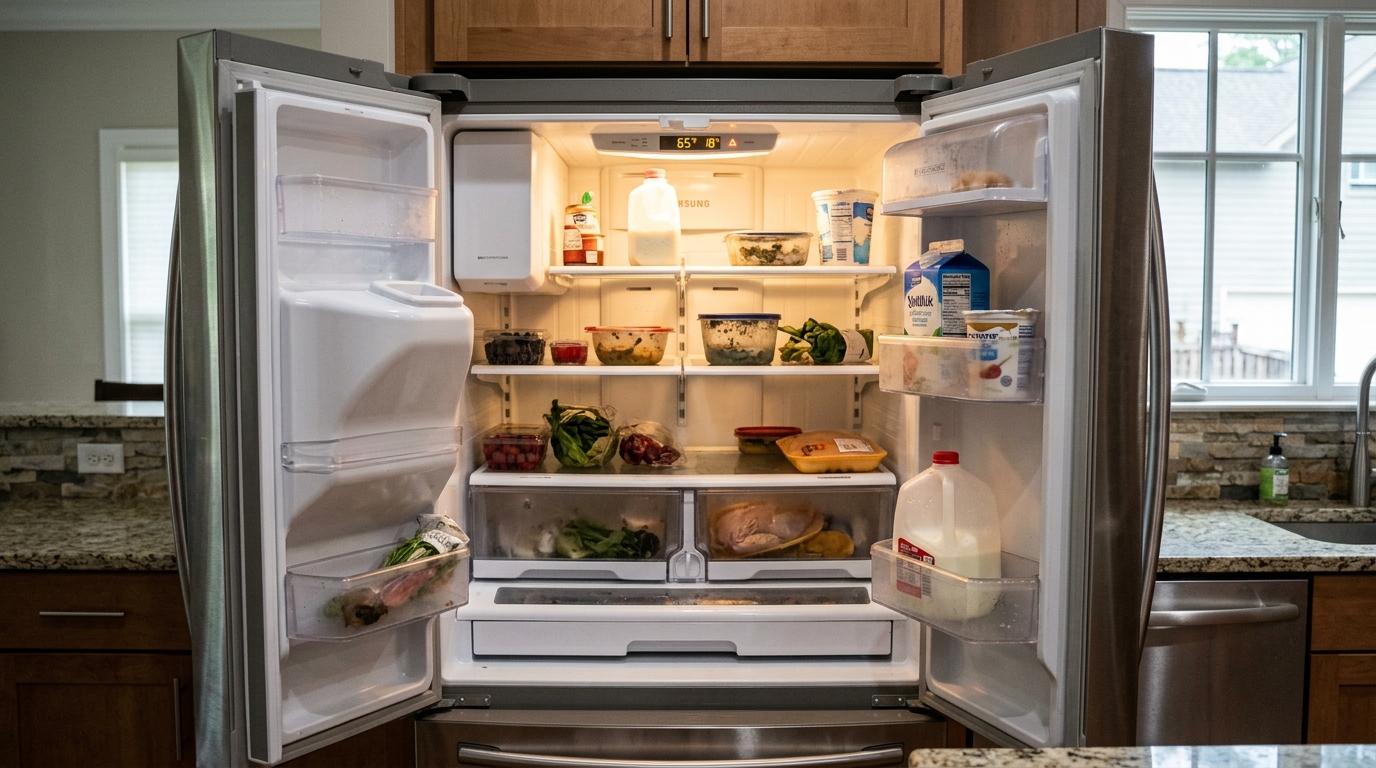
Before diving into the causes, it’s crucial to accurately identify the symptoms. The Samsung RS28A5561SR will often exhibit several warning signs before completely failing to cool. Recognizing these signs early can sometimes prevent major component failure and save you hundreds of dollars in repair or food replacement costs.
1. Clicking Sound from the Back
One of the most common and telltale signs of a compressor starting issue is a distinct clicking sound coming from the lower rear section of the refrigerator. This click occurs every 3 to 5 minutes. It’s the sound of the overload protector tripping because the compressor is drawing too much current and failing to start. If you hear this click followed by silence (no hum of the compressor), the start relay or the compressor itself is likely the culprit. The variable speed inverter compressor operates at 120VAC and requires the precise functionality of this relay. When the relay fails, the compressor simply cannot turn over, leading to this rhythmic, frustrating clicking noise.
2. Warm Interior Temperatures
The most obvious symptom is a warm interior. You might notice your milk spoiling faster or your ice cream getting soft. The digital display on the Samsung RS28A5561SR might still show the target temperature (e.g., 37°F for the fridge and 0°F for the freezer), but the actual ambient temperature inside is much higher. In some cases, the display will flash or show an error code indicating a temperature discrepancy. This is incredibly deceptive, as the user might believe the fridge is functioning correctly simply because the digital panel claims it is at the set temperature. Always use an external thermometer if you suspect a cooling issue.
3. Excessive Condensation and Frost
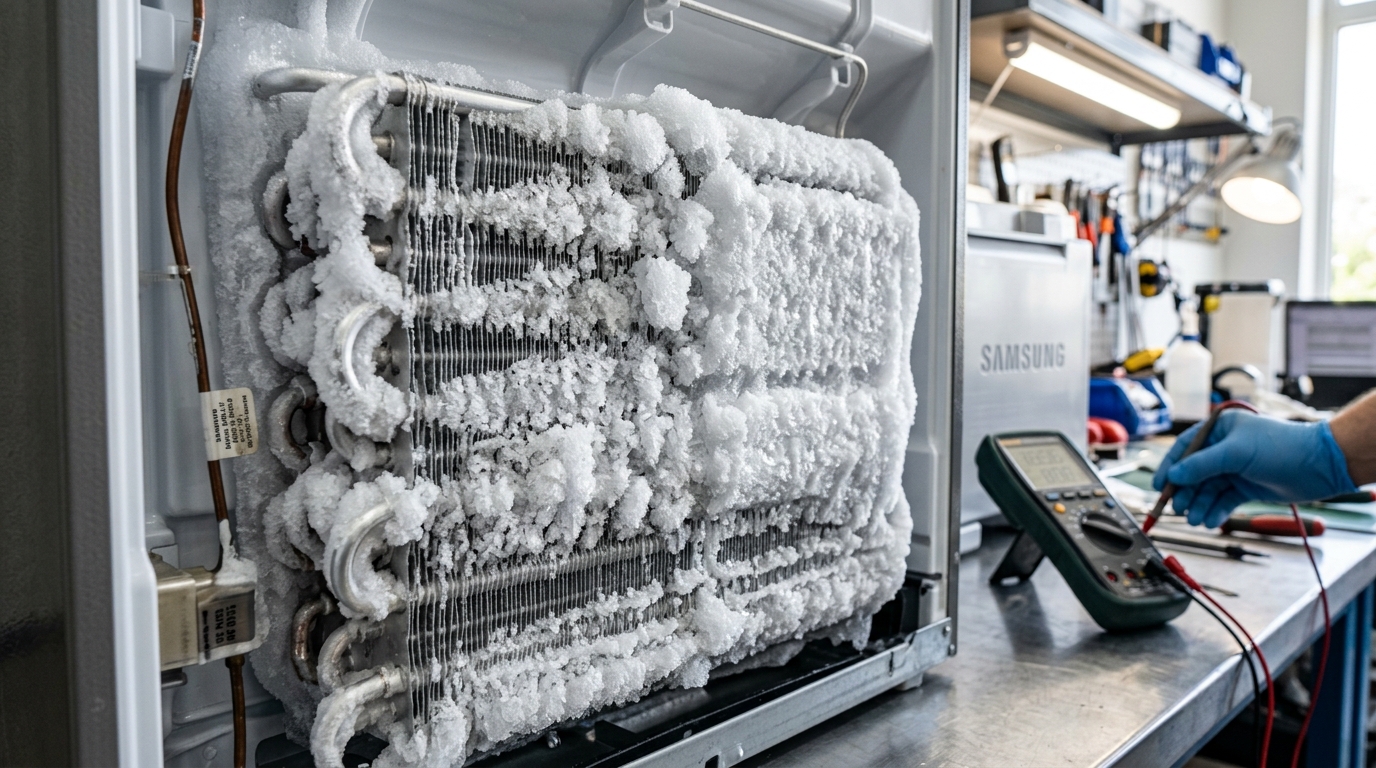
If the refrigerator is struggling to cool, it may run longer cycles, leading to excessive condensation inside the fresh food compartment. You might see water droplets on the ceiling or shelves. In the freezer, this can manifest as an unusual buildup of frost, particularly on the back wall where the evaporator coils are located. Frost indicates that moisture is entering the system and freezing on the coldest surfaces. If the defrost heater (which draws 350W, has roughly 40 ohms resistance, and operates on 120VAC) fails, this frost will continually build up, completely choking the airflow.
4. Fan Running Constantly (or Not at All)
Listen carefully to the refrigerator. If the compressor isn’t running, but the refrigerator senses it’s warm, the evaporator and condenser fans might run continuously in a futile attempt to cool the unit. Conversely, if a fan motor has failed, you won’t hear the usual whirring sound, and the lack of airflow will rapidly lead to warm temperatures. The evaporator fan motor is a 12VDC component that operates directly from the main control board. A failure here stops the circulation of cold air from the evaporator coils into the main compartments.
5. Control Panel Unresponsive or Flashing
Sometimes, a cooling issue is tied to the main control board (like the EBR84940101). If the board is failing, the front display might become unresponsive to touch, or the temperature digits might flash continuously. This is often a sign of a communication error between the sensors and the main board. The control board handles the relay outputs for the defrost mechanism, the fans, and the damper. A failure in the microprocessor or a burnt trace on the board can paralyze the entire refrigerator.
6. Error Codes Displayed on Panel
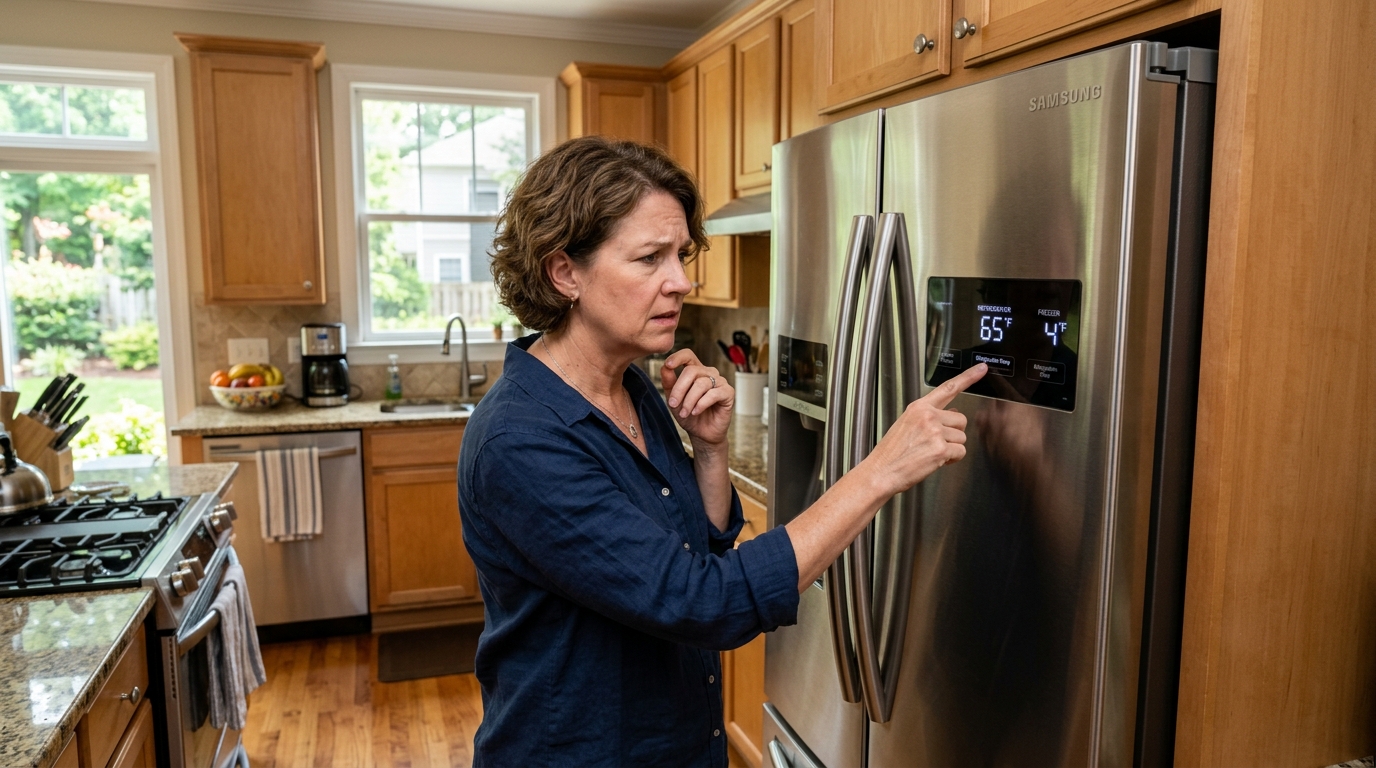
Modern Samsung models like the RS28A5561SR are equipped with self-diagnostic systems that generate error codes. You might see codes like 5E (indicating a defrost sensor error), 22E (condenser fan error), or 41C/42C (control board communication errors). These codes are direct hints from the internal computer about what subsystem has failed. Understanding these codes greatly accelerates the troubleshooting process.
Common Causes: Why Your Samsung Isn’t Cooling
Understanding the root cause is the first step toward a successful repair. For the Samsung RS28A5561SR, several components work in tandem to produce cold air. When one fails, the entire system is compromised. Our Alpharetta technicians consistently trace cooling failures back to these core components.
1. Failed Compressor Start Relay
The start relay is a small electrical device attached to the side of the compressor. It provides a momentary surge of power to start the compressor motor. Over time, the internal components of the relay (often a PTC thermistor) can degrade and fail. When it fails, the compressor cannot start, resulting in the clicking sound described earlier. This is the most common cause of a clicking, non-cooling refrigerator. Remember, the PTC start relay resistance should measure between 5-7 ohms when cold. If it measures infinite resistance, the relay is definitely dead.
2. Dirty Condenser Coils
The condenser coils are responsible for dissipating the heat removed from the interior of the refrigerator. If these coils are caked with dust, pet hair, and debris—a common issue in Alpharetta homes—they cannot release heat efficiently. The compressor has to work harder and longer, eventually overheating and shutting down on the overload protector. This chronic overheating drastically shortens the lifespan of the compressor and increases your electric bill.
3. Defective Condenser Fan Motor
The condenser fan draws air over the condenser coils and the compressor to keep them cool. If the fan motor fails, the compressor will quickly overheat and turn off. You can usually test the fan motor by checking for continuity with a multimeter or observing if the blades turn freely. The condenser fan motor runs on 120VAC, draws about 0.5A, and has a winding resistance of roughly 240 ohms. Without this fan, the sealed system’s high side pressure skyrockets, causing catastrophic failure.
4. Faulty Thermistor (Temperature Sensor)
The thermistor monitors the temperature inside the refrigerator and sends this information to the control board. The control board uses this data to regulate power to the compressor and evaporator fan. If a thermistor fails, it may read incorrectly, telling the control board that the refrigerator is cold when it’s actually warm. A good NTC thermistor on a Samsung should typically read around 16,000 ohms at 32°F, approximately 10,000 ohms at 50°F, and about 5,500 ohms at 68°F. Deviation from these values indicates a faulty sensor.
5. Main Control Board Failure
The main control board (part number EBR84940101) is the brain of the refrigerator. It controls the compressor, fans, defrost system, and display. If the board has a burnt solder joint, a blown capacitor, or a faulty relay, it may stop sending voltage to the cooling components. Diagnosing a bad control board usually involves verifying that all sensors are good and that the board is receiving power but not outputting it. This board provides the precise relay outputs for the defrost cycle, fans, and the air damper.
6. Sealed System Leak (R-600a Refrigerant)
A more severe cause is a leak in the sealed system. The RS28A5561SR uses R-600a (isobutane) refrigerant. If there is a micro-leak in the evaporator or condenser coils, the refrigerant slowly escapes. As the system loses pressure (normal operating pressure is 25-30 PSI), it loses its ability to transfer heat. This repair requires an EPA-certified technician, as it involves specialized welding and handling of a flammable gas.
7. Defrost System Failure
The defrost system ensures that ice doesn’t block the evaporator coils. It includes the defrost heater (350W, ~40 ohms, 120VAC) and the bi-metal defrost thermostat (which opens at 47°F and acts as a safety cutoff at 131°F). If either of these components fails, ice completely blocks the airflow from the evaporator fan, resulting in a freezer that is cold but a fresh food compartment that is warm.
Step-by-Step Troubleshooting (DIY Safe)
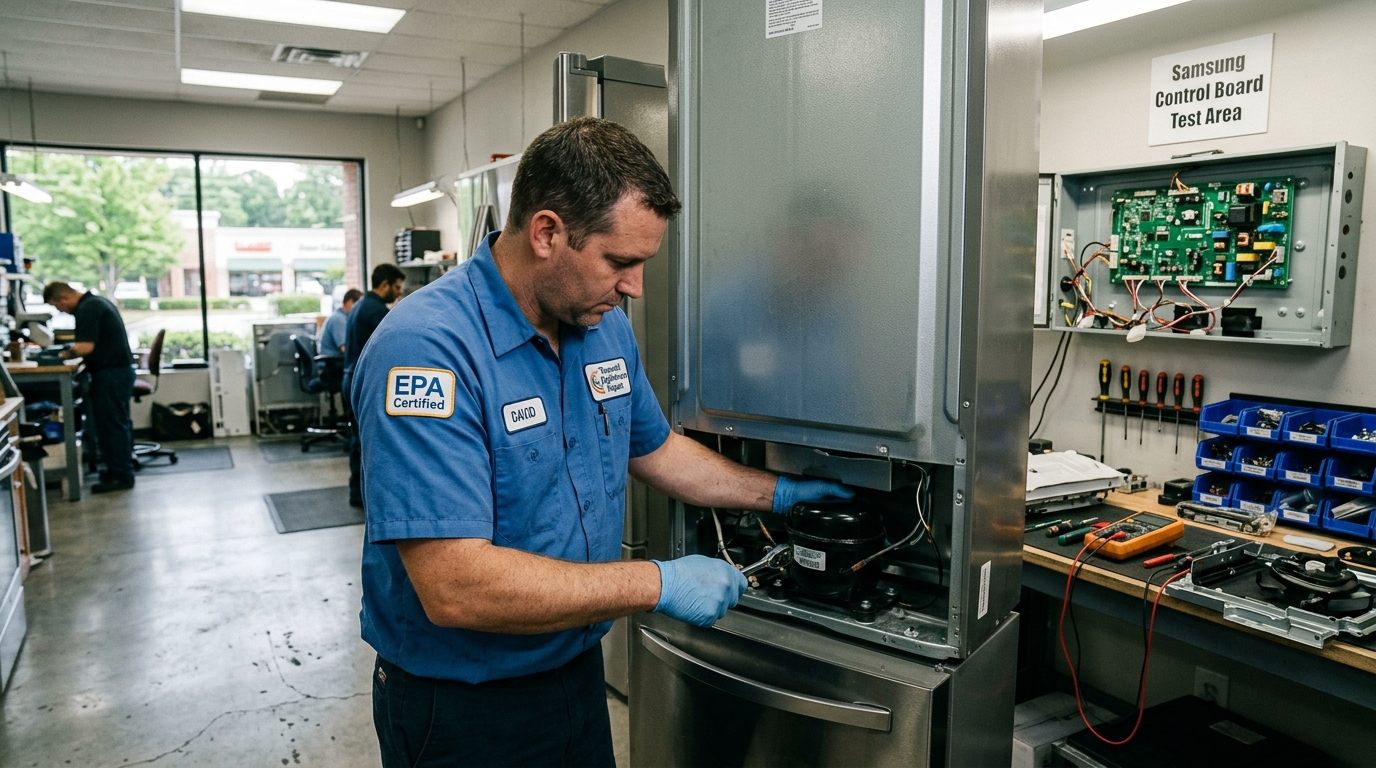
If you’re comfortable with basic hand tools and a multimeter, you can perform several diagnostic steps safely. Always prioritize safety. These steps are designed to help you pinpoint the issue without unnecessarily opening the sealed refrigerant system.
Step 1: Unplug the Refrigerator
Never work on an appliance while it is connected to power. Unplug the refrigerator from the wall outlet. If you cannot reach the plug, turn off the circuit breaker dedicated to the refrigerator at your main electrical panel. Verify the power is off by opening the doors and checking if the interior lights are extinguished.
Step 2: Clean the Condenser Coils
Remove the lower rear access panel (or front grille, depending on the exact model configuration). Use a vacuum cleaner with a brush attachment and a long, flexible coil brush to remove all dust and debris from the condenser coils. Ensure the area around the compressor is clean and free of obstructions. A clean coil allows the R-600a refrigerant to condense properly back into a liquid state.
Step 3: Inspect the Condenser Fan
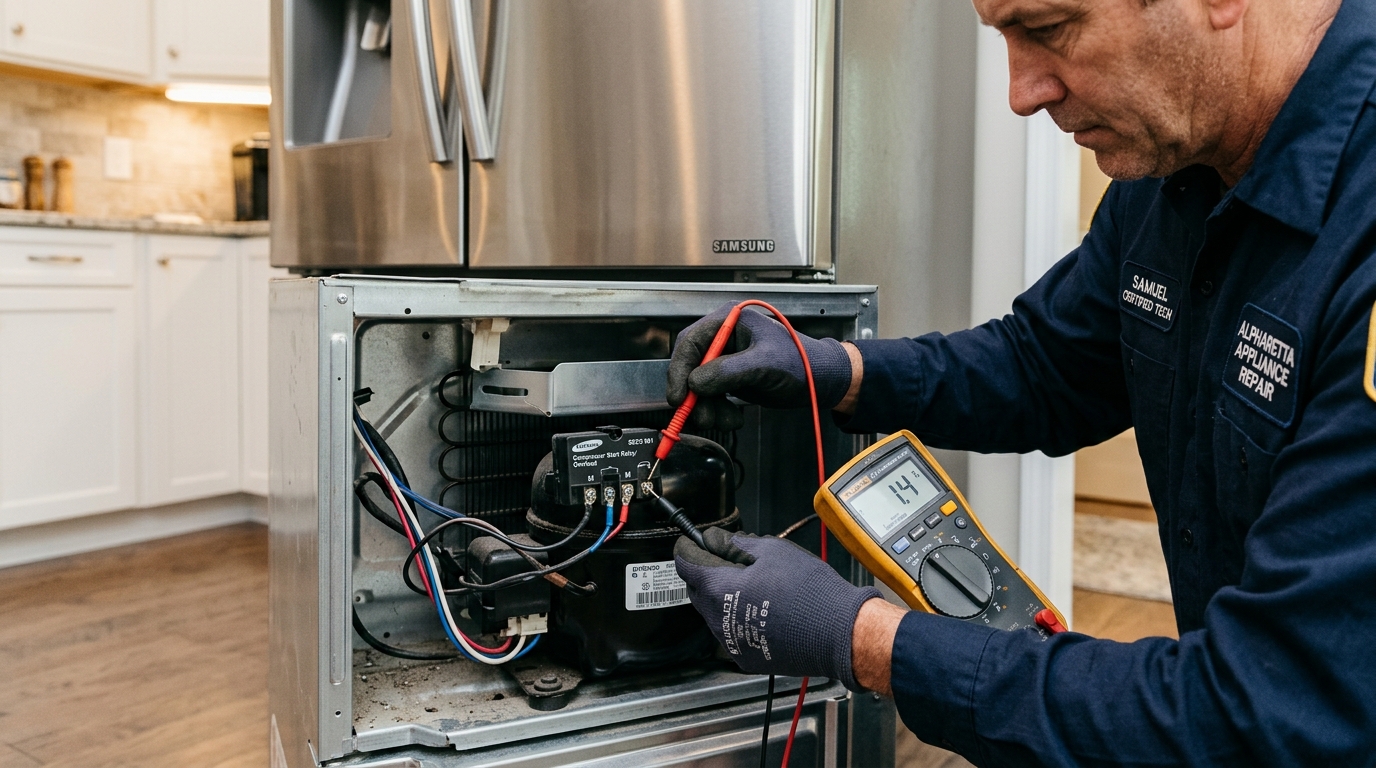
While the rear panel is off, locate the condenser fan next to the compressor. Try spinning the fan blades by hand. They should spin freely with no resistance. If the blades are stiff or binding, the fan motor needs replacement. You can test the motor’s windings with a multimeter—you should see around 240 ohms of resistance. If it reads ‘OL’ (open loop), the motor has failed internally.
Step 4: Access the Start Relay
Locate the variable speed inverter compressor (the large, black, dome-shaped tank). Attached to the side of the compressor is a small plastic box containing the start relay and overload protector. Carefully remove the wire retaining clip and pull the relay assembly off the compressor pins.
Step 5: The “Rattle Test” for the Relay
Hold the start relay close to your ear and shake it gently. If you hear a rattling sound (like sand or small pebbles inside), the internal ceramic disc of the PTC thermistor has shattered, and the relay is definitely bad. It must be replaced immediately. This is the most common reason for the clicking sound.
Step 6: Test Relay with a Multimeter
If it doesn’t rattle, you should still test it. Set your multimeter to measure resistance (Ohms). Place the probes into the two run and start terminal holes on the relay. A good PTC start relay for this Samsung model will typically read between 5-7 ohms cold. If it reads open (OL or infinite resistance), it is faulty and cannot pass voltage to the compressor start windings.
Step 7: Test the Compressor Pins
With the relay removed, you will see three metal pins on the side of the compressor. Set your multimeter to Ohms. Measure the resistance between each pair of pins (Start to Run, Start to Common, Run to Common). The resistance of Start to Common plus Run to Common should equal Start to Run. If any reading shows an open circuit (OL) or a direct short to the compressor casing (measure from each pin to a clean spot on the copper line), the compressor has failed.
Step 8: Reassemble and Test
If you found a bad relay and replaced it, or if you cleaned very dirty coils, reattach the relay, plug in the refrigerator, and wait. The compressor should start with a smooth hum, and you should feel warmth on the condenser coils and cool air blowing in the freezer within 15 minutes. It may take up to 24 hours for the internal temperatures to fully stabilize.
Step 9: Test the Thermistors
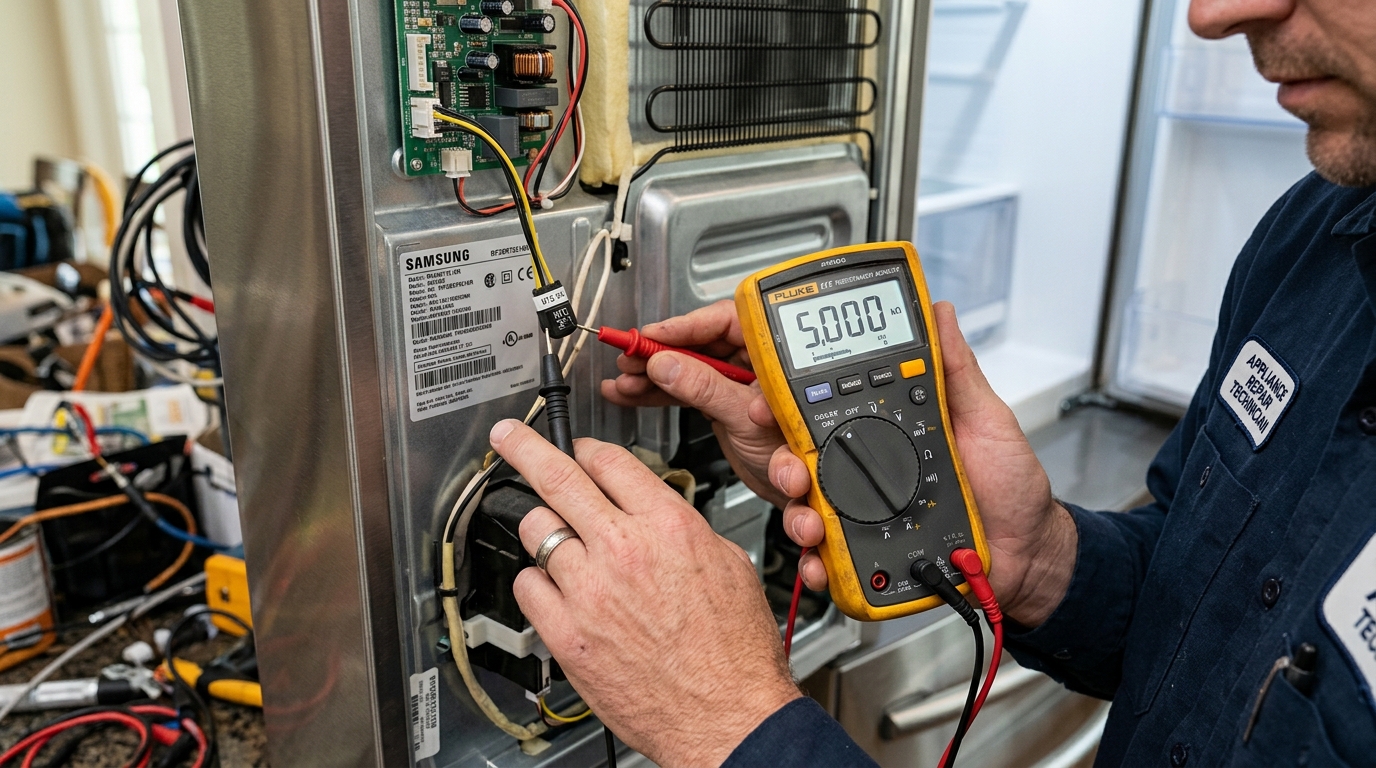
If the mechanical components are fine, you may have a sensor issue. Locate the thermistors in the fridge and freezer compartments. Disconnect them and use a multimeter to check their resistance. An NTC thermistor should read ~16,000 ohms at 32°F, ~10,000 ohms at 50°F, and ~5,500 ohms at 68°F. If the readings are far off, the control board is receiving bad data and cannot cool properly.
Step 10: Check the Defrost Heater
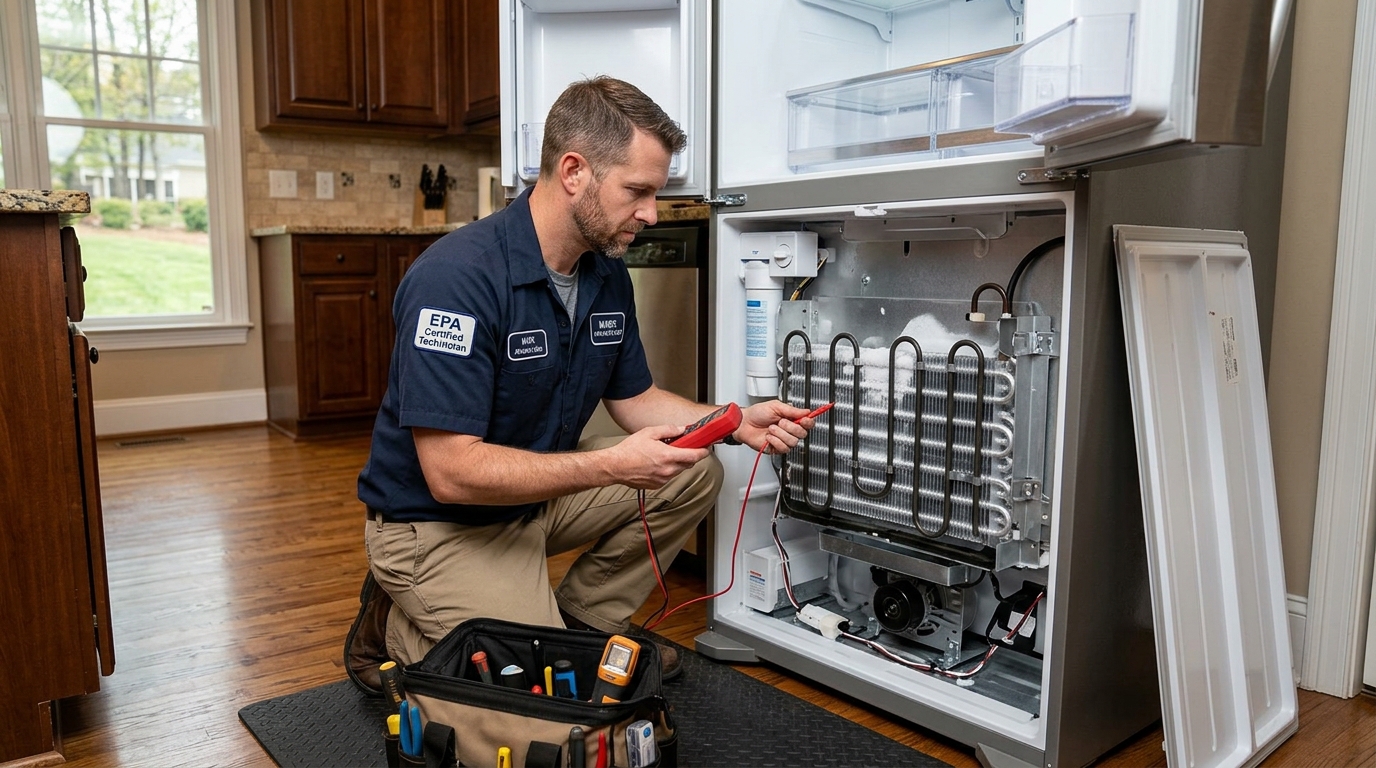
If you have frost buildup, access the evaporator coils in the freezer. Unplug the defrost heater and measure its resistance. A healthy defrost heater for the RS28A5561SR should read around 40 ohms and is rated for 350W at 120VAC. If it reads open, the heater is broken and ice will continue to accumulate, blocking airflow.
When to Stop DIY (Warning Signs)
While basic troubleshooting is encouraged, some repairs require professional expertise, specialized tools, and EPA certification. Pushing past your knowledge limits can result in further damage to the appliance, risk of electrical shock, or illegal venting of refrigerant.
STOP DIY IMMEDIATELY IF:
- You suspect a refrigerant leak: Refrigerant (Freon/R-134a/R-600a) handling requires an EPA Section 608 certification. Venting refrigerant is illegal and dangerous. The R-600a used in this unit is highly flammable (isobutane), and any spark near a leak can cause a severe fire or explosion.
- The compressor is electrically shorted: If your multimeter shows continuity between a compressor pin and the metal casing, the compressor is dead. Replacing a compressor involves brazing copper lines, flushing the system, and pulling a deep vacuum, which is not a DIY job.
- You smell burning plastic or electrical smoke: This indicates a serious electrical fault, potentially with the main control board (EBR84940101) or wiring harness. Unplug the unit immediately to prevent a fire hazard.
- You encounter complex control board diagnostics: Diagnosing relay outputs from the main board to the variable speed inverter compressor requires understanding low-voltage communication signals. Improper testing can permanently fry the board.
- You are uncomfortable with multimeter testing: Working with live voltage can be lethal. If you are unsure how to use a multimeter safely, call a professional.
Repair vs Replace Guide
Deciding whether to repair your Samsung RS28A5561SR or replace it entirely depends on the cost of the repair, the age of the unit, and its overall condition. Refrigerators are significant investments, and you want to make the most financially sound decision.
| Component Failure | Repair Recommendation | Appliance Age Factor |
|---|---|---|
| Start Relay / Overload | Highly Recommended. Very cost-effective repair. | Worth it at any age. |
| Condenser Fan Motor | Recommended. Extends compressor life significantly. | Worth it at any age. |
| Thermistor / Sensor | Highly Recommended. Cheap parts and simple swap. | Worth it at any age. |
| Defrost Heater / Bi-metal | Recommended. Fixes frost buildup issues permanently. | Worth it at any age. |
| Main Control Board (EBR84940101) | Usually Recommended, but parts can be pricey. | Consider replacement if fridge is > 10 years old. |
| Variable Speed Inverter Compressor | Evaluate carefully. Major sealed system repair requiring EPA cert. | Replace unit if > 7-10 years old, unless compressor is under specific warranty. |
Estimated Cost Factors for Alpharetta
While exact prices vary based on parts availability and labor time, here are the factors that influence repair costs in the Alpharetta area when dealing with a Samsung RS28A5561SR:
- Diagnostic Fee: Our standard service call is $79, which covers the trip and professional diagnosis. This is waived if you proceed with the repair. We believe in transparent pricing and no hidden fees.
- Parts Cost: Components vary wildly. Start relays are generally inexpensive (under $50). Evaporator (12VDC) and Condenser (120VAC) fan motors range from $50 to $120. Control boards (like the EBR84940101) can be significantly more expensive, often ranging from $150 to $300+. A new inverter compressor can cost hundreds of dollars just for the part.
- Labor Time: A relay replacement takes less than an hour. A control board swap is also relatively quick. However, replacing an evaporator fan motor requires disassembling the interior of the freezer, which takes longer. Sealed system work (compressor replacement, repairing leaks in the R-600a system) takes several hours and involves brazing and vacuum pumps.
- OEM vs Aftermarket: We always recommend using Original Equipment Manufacturer (OEM) Samsung parts for longevity and reliability. For complex electronics like thermistors (which rely on precise ohm curves like ~16,000 ohms at 32°F) or main control boards, aftermarket parts often fail to meet exact specifications and can cause erratic behavior.
How Professionals Diagnose
When an Appliance Repair Alpharetta GA technician arrives at your home, they don’t just guess. They use a systematic approach and professional tools to ensure a precise, first-time fix:
- Service Modes & Diagnostics: We enter the Samsung diagnostic mode (forced operation) using the front panel buttons. This allows us to manually force the compressor, fans, and defrost heaters on and monitor their performance in real-time, bypassing the thermostat logic. We also check for stored error codes (like 5E, 22E, 41C, 42C).
- Multimeter Precision: We measure precise ohm readings to evaluate sensor integrity. For example, knowing that a good NTC thermistor should read ~5,500 ohms at 68°F allows us to identify a sensor that is “drifting” out of spec even if it hasn’t completely failed. We also test the defrost heater (~40 ohms) and the bi-metal thermostat (checking that it opens correctly at 47°F).
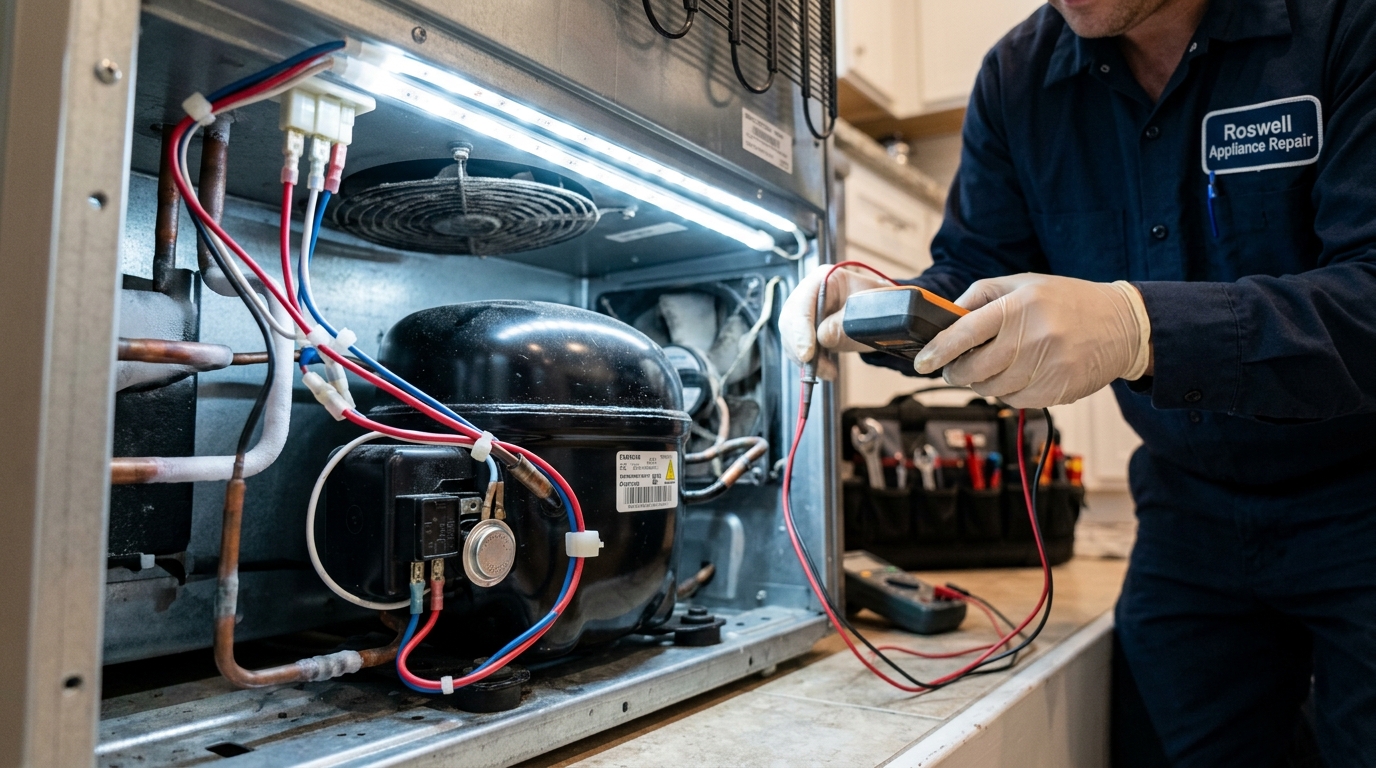
- Amp Draw Testing: Using a professional amp clamp, we measure the current drawn by the compressor during startup. A normal running inverter compressor might pull a very low, steady amperage, but if it’s locked up mechanically, it will spike significantly before the overload clicks off. We also check the condenser fan motor current (should be ~0.5A at 120VAC).
- Refrigerant Pressure Gauges: If a sealed system issue is suspected (no cooling despite the compressor running and fans blowing), we use specialized line tap valves and gauges to measure the high and low-side refrigerant pressures. A healthy R-600a system operates at 25-30 PSI. A pressure reading close to zero or negative indicates a severe leak or a restriction in the capillary tube.
Common Parts Involved in Cooling
Familiarize yourself with these key components of your Samsung RS28A5561SR. Understanding their roles helps demystify the appliance’s operation:
- Start Relay (PTC): The most common point of failure for “clicking” issues. It measures 5-7 ohms cold and helps start the compressor.
- Overload Protector: Protects the compressor from drawing too much current and overheating. Often replaced with the start relay as a set.
- Condenser Fan Motor (120VAC, 0.5A): Cools the compressor and condenser coils. Located in the bottom rear, it has about 240 ohms of winding resistance.
- Evaporator Fan Motor (12VDC): Circulates cold air from the freezer into the fresh food compartment. Controlled directly by the main board.
- NTC Thermistors: Temperature sensors with precise resistance curves (~16,000 ohms at 32°F, ~10,000 ohms at 50°F, ~5,500 ohms at 68°F).
- Defrost Heater (120VAC, 350W): Melts ice off the evaporator coils. Measures ~40 ohms resistance.
- Bi-metal Defrost Thermostat: A safety switch that opens at 47°F (8°C) to stop the heater, with a hard cutoff at 131°F (55°C).
- Main Control Board (EBR84940101): The brain of the unit, sending relay outputs to fans, the defrost heater, and the inverter.
- Variable Speed Inverter Compressor: Operates at 120VAC, varying its speed to match cooling demand, making it highly efficient but mechanically complex.
Maintenance Tips to Prevent Future Issues
Preventative maintenance is the absolute best way to extend the life of your Samsung refrigerator and avoid costly repairs. By dedicating a few minutes a few times a year, you can save hundreds of dollars.
- 1. Clean Condenser Coils Biannually: This cannot be overstated. Vacuum the coils every six months. If you have pets that shed, do it every three months. A clogged coil forces the compressor to run hotter and longer, leading to early failure.
- 2. Inspect and Clean Door Gaskets: The rubber seals around the doors keep the cold air in and warm, humid air out. Clean them with mild soapy water. Test the seal by closing a dollar bill in the door; if it pulls out easily, the seal is weak, causing the fridge to run constantly and frost to build up rapidly.
- 3. Don’t Overstuff the Interior: The evaporator fan relies on clear pathways to circulate air. Blocking the air vents inside the refrigerator prevents cold air from circulating properly, leading to warm spots, freezing in the crisper drawers, and overworking the compressor.
- 4. Keep the Top Clear: Don’t store items on top of the refrigerator, as this can impede airflow and trap heat radiating from the cabinet.
- 5. Ensure Proper Clearance: Make sure there is adequate space (at least 1-2 inches) behind and above the refrigerator for air circulation. The heat removed from the interior must have somewhere to go.
- 6. Change Water Filters Promptly: A clogged water filter can cause issues with the ice maker and water dispenser, leading to leaks or frozen water lines which can eventually impact the overall thermal balance of the fridge.
- 7. Monitor the Temperature Display: Keep an eye out for flashing displays or error codes like 5E or 22E, addressing them immediately rather than waiting for total failure.
Safety Tips
Never compromise on safety when dealing with appliances. The Samsung RS28A5561SR involves high voltage, sharp metals, and pressurized systems.
Important Safety Warnings:
- Electrical Hazard: Capacitors on the main control board and inverter board can hold a lethal charge even after the refrigerator is unplugged. Discharge capacitors safely using an insulated resistor before handling boards.
- Flammable Refrigerant: The R-600a (isobutane) refrigerant is highly flammable. Do not use open flames or create sparks near the compressor or sealed system lines if a leak is suspected.
- Sharp Edges: The sheet metal inside the appliance case, especially around the condenser coils and evaporator, can be razor-sharp. Always wear protective gloves when reaching into tight spaces.
- Proper Lifting: Refrigerators are incredibly heavy. Use a proper appliance dolly and have a helper if you need to move the unit away from the wall to access the back. Dragging the fridge can severely damage your flooring.
Advanced Diagnostic Deep-Dive for the Samsung RS28A5561SR
For those interested in the deep technical intricacies of how the Samsung RS28A5561SR manages temperature control, this section provides an extended analysis of the electronic and mechanical systems. The RS28A5561SR is not just a box that gets cold; it is a sophisticated thermal management system governed by a complex array of sensors, microprocessors, and variable-speed components.
The Variable Speed Inverter Compressor System
Unlike older refrigerators that use a single-speed AC compressor (which is either 100% on or 100% off), the Samsung RS28A5561SR utilizes a variable speed inverter compressor. This compressor is driven by an inverter board that receives a low-voltage pulse-width modulation (PWM) signal from the main control board. Depending on the cooling demand, the inverter board varies the frequency of the AC voltage it sends to the compressor, allowing the compressor to run at different RPMs (typically ranging from 1200 to 4500 RPM).
When the compressor runs at a lower speed, it consumes significantly less energy, runs quieter, and maintains a more stable temperature. However, this complexity means that a failure can occur in the main board, the communication harness, the inverter board, or the compressor windings themselves. To diagnose an inverter compressor that isn’t running, a technician must first verify that the main board is sending the correct low-voltage signal to the inverter board. If the signal is present, the technician must then check the high-voltage output from the inverter board to the compressor. If the inverter receives the signal but outputs nothing, the inverter board has failed.
Dual Evaporator Technology (Twin Cooling Plus)
The RS28A5561SR features Samsung’s Twin Cooling Plus technology, meaning it has two separate evaporators—one in the fresh food compartment and one in the freezer compartment. A single variable speed compressor serves both evaporators, utilizing a 3-way stepper valve to direct the flow of refrigerant. This system prevents odors from mixing between the compartments and allows for independent humidity control.
If the fresh food section is warm but the freezer is cold, the issue might not be the compressor at all. It could be a failure of the fresh food evaporator fan (the 12VDC motor), a frozen fresh food evaporator coil (indicating a defrost system failure in that specific compartment), or a malfunctioning 3-way stepper valve stuck in the position that only feeds the freezer evaporator. diagnosing a stepper valve requires a specialized diagnostic tool or entering the refrigerator’s service mode to manually toggle the valve positions and monitor the temperature change in the corresponding evaporator lines.
Thermistor Resistance Curves Detail
Thermistors are Negative Temperature Coefficient (NTC) resistors. This means their resistance decreases as the temperature increases. Accurate diagnosis requires knowing the specific resistance-to-temperature curve for Samsung thermistors. The control board uses this resistance to calculate exact temperatures. Here is the detailed breakdown of the expected values for the RS28A5561SR:
- At -4°F (-20°C): Approx. 32,600 Ohms
- At 5°F (-15°C): Approx. 25,300 Ohms
- At 14°F (-10°C): Approx. 19,800 Ohms
- At 32°F (0°C): Approx. 16,000 Ohms (Critical freezing point threshold)
- At 41°F (5°C): Approx. 12,700 Ohms
- At 50°F (10°C): Approx. 10,000 Ohms
- At 68°F (20°C): Approx. 5,500 Ohms
- At 77°F (25°C): Approx. 5,000 Ohms (Standard room temperature testing point)
If you test a thermistor that is sitting in a glass of ice water (which is exactly 32°F), it should read very close to 16,000 ohms. If it reads 5,000 ohms in ice water, it is out of specification, telling the control board the fridge is 77°F, which will cause the compressor to run constantly and freeze everything. If it reads infinite resistance (OL), the thermistor circuit is open, generating an error code on the display.
Defrost System Deep Dive
The defrost system is critical for maintaining airflow. The RS28A5561SR has an adaptive defrost control system. Instead of defrosting on a strict timer, the control board (EBR84940101) calculates the optimal time to defrost based on the compressor run time, the number of door openings, and the ambient temperature. When it initiates a defrost cycle, it turns off the compressor and fans and sends 120V AC to the defrost heater (350W, ~40 ohms) strapped to the bottom of the evaporator coils.
A bi-metal defrost thermostat acts as a safety switch. It remains closed (allowing current to flow) while the coils are cold. Once the ice melts and the coil temperature rises to 47°F (8°C), the bimetal opens, breaking the circuit. It has a final safety cutoff at 131°F (55°C) to prevent melting the plastic interior. If the bimetal fails in the open position, the heater will never turn on. If the heater itself breaks, no heat is generated. In both scenarios, ice will build up, completely blocking the 12VDC evaporator fan, resulting in a warm refrigerator.
Frequently Asked Questions (FAQs)
Here are answers to 18 of the most common questions our Alpharetta customers ask about their Samsung refrigerators:
1. Why is my Samsung fridge clicking and not cooling?
The clicking sound is the overload protector tripping because the variable speed inverter compressor is trying to start but failing. This is usually due to a bad PTC start relay.
2. How much does it cost to replace a compressor start relay?
It’s generally one of the more affordable repairs, typically costing less than $200 including the $79 service call, parts, and labor.
3. What does error code 5E mean on my Samsung fridge?
Error code 5E indicates a fault with the defrost sensor (thermistor). It means the control board is receiving out-of-range resistance values from the sensor.
4. What does error code 22E mean?
Error 22E points to a failure of the condenser fan motor. The fan is either locked up or the motor windings (which should read ~240 ohms) have failed.
5. What do error codes 41C or 42C indicate?
These codes typically signify a communication error with the main control board (EBR84940101), often meaning the board has failed or there is a wiring harness issue.
6. Can I replace the start relay myself?
Yes, if you are comfortable with basic tools and follow safety procedures. Ensure the fridge is unplugged. The relay should measure 5-7 ohms cold.
7. How long does a Samsung refrigerator compressor last?
A well-maintained inverter compressor should last 10-15 years. Dirty coils significantly reduce this lifespan due to chronic overheating.
8. Will a dirty condenser coil stop my fridge from cooling?
Yes. Extreme dust buildup prevents the R-600a refrigerant from releasing heat, causing the high-side pressure to spike and the compressor to shut down.
9. What should the resistance of a Samsung thermistor be at 32°F?
At exactly 32°F (like in a glass of ice water), an NTC thermistor should read approximately 16,000 ohms.
10. Why is there ice buildup in my freezer but the fridge is warm?
This points to an evaporator fan failure (12VDC motor) or a defrost system problem (heater or bi-metal thermostat). Air cannot circulate to the fresh food section.
11. What is the operating pressure of the R-600a refrigerant?
In a properly functioning Samsung RS28A5561SR, the operating pressure is generally around 25-30 PSI. Only certified techs should measure this.
12. Does unplugging a Samsung fridge reset it?
Yes, leaving it unplugged for 5-10 minutes performs a hard reset on the control board, potentially clearing temporary software glitches.
13. What is Force Defrost mode?
It’s a diagnostic setting used by technicians to manually override the control board and send 120VAC to the defrost heater to test if it draws the correct ~350W.
14. Should I buy an OEM or aftermarket start relay?
Always choose OEM parts for Samsung appliances to ensure correct resistance specifications (5-7 ohms) and longevity.
15. How do I know if the main control board (EBR84940101) is bad?
It requires testing inputs and outputs. If the board receives power but doesn’t send voltage out via its relays to the compressor or fans, the board is likely failed.
16. Is it worth repairing a 10-year-old Samsung fridge?
If it’s a minor part like a relay, thermistor, or fan, yes. If it needs a new variable speed compressor, it’s usually better to replace the refrigerator.
17. Can a power surge damage my refrigerator?
Yes, power surges easily fry sensitive electronic components like the main control board or inverter board. We highly recommend installing a whole-house surge protector.
18. How quickly can your Alpharetta technicians arrive?
We prioritize “not cooling” emergencies and offer prompt, often same-day service in the Alpharetta, Roswell, and Milton areas.
Related Services
- Expert Refrigerator Repair in Alpharetta
- Professional Washer & Dryer Repair
- Oven and Range Repair Services
- Dishwasher Troubleshooting & Repair
- Dryer Vent Cleaning Services
Related Problems
Related Brand Pages
Related Location Pages
- Appliance Repair in Alpharetta, GA
- Appliance Repair in Roswell, GA
- Appliance Repair in Milton, GA
- Appliance Repair in Johns Creek, GA
Key Takeaways
- A clicking sound combined with no cooling usually indicates a failed start relay (should be 5-7 ohms) or variable speed inverter compressor issue.
- Dirty condenser coils are a leading cause of premature compressor failure and poor cooling performance, spiking the operating pressure of the R-600a system.
- DIY replacement of a start relay or thermistor is possible and cost-effective, but accurate multimeter diagnosis is crucial.
- The “rattle test” is a quick way to identify a shattered PTC start relay.
- The condenser fan motor operates at 120VAC, draws ~0.5A, and should measure ~240 ohms resistance.
- The defrost system relies on a 350W heater (~40 ohms) and a bi-metal thermostat that opens at 47°F.
- NTC thermistors must read specific resistances (e.g., ~16,000 ohms at 32°F) for the control board (EBR84940101) to operate properly.
- Error codes like 5E, 22E, 41C, and 42C provide direct insight into component failures.
- For complex electrical or sealed system issues, always rely on an EPA-certified professional due to the highly flammable nature of R-600a.

Schedule Your Samsung Repair in Alpharetta Today
Don’t let a broken refrigerator ruin your day or your groceries. The longer a faulty system runs, the higher the risk of catastrophic compressor failure. If your Samsung RS28A5561SR isn’t cooling and you need professional help in Alpharetta, GA, our highly trained team is ready to schedule your samsung repair. We understand the technical specifications of these units inside and out.
Need Professional Appliance Repair?
Our certified technicians carry common Samsung parts and can get your refrigerator cooling again quickly. We utilize advanced diagnostic tools to pinpoint issues with control boards, thermistors, and sealed systems. We offer a transparent $79 service fee, which is completely waived if you choose to proceed with our repair quote. No hidden fees, just honest service.
Call (770) 796-7742 to Schedule Service
Backed by our comprehensive 90-day parts and labor warranty.
Need Certified Appliance Repair Today?
Skip the phone line — book direct local priority dispatch across Alpharetta, Milton, Roswell & Johns Creek.