
Sub-Zero Refrigerator EC40 Error Code — Evaporator Fan Motor & Control Board Repair Alpharetta
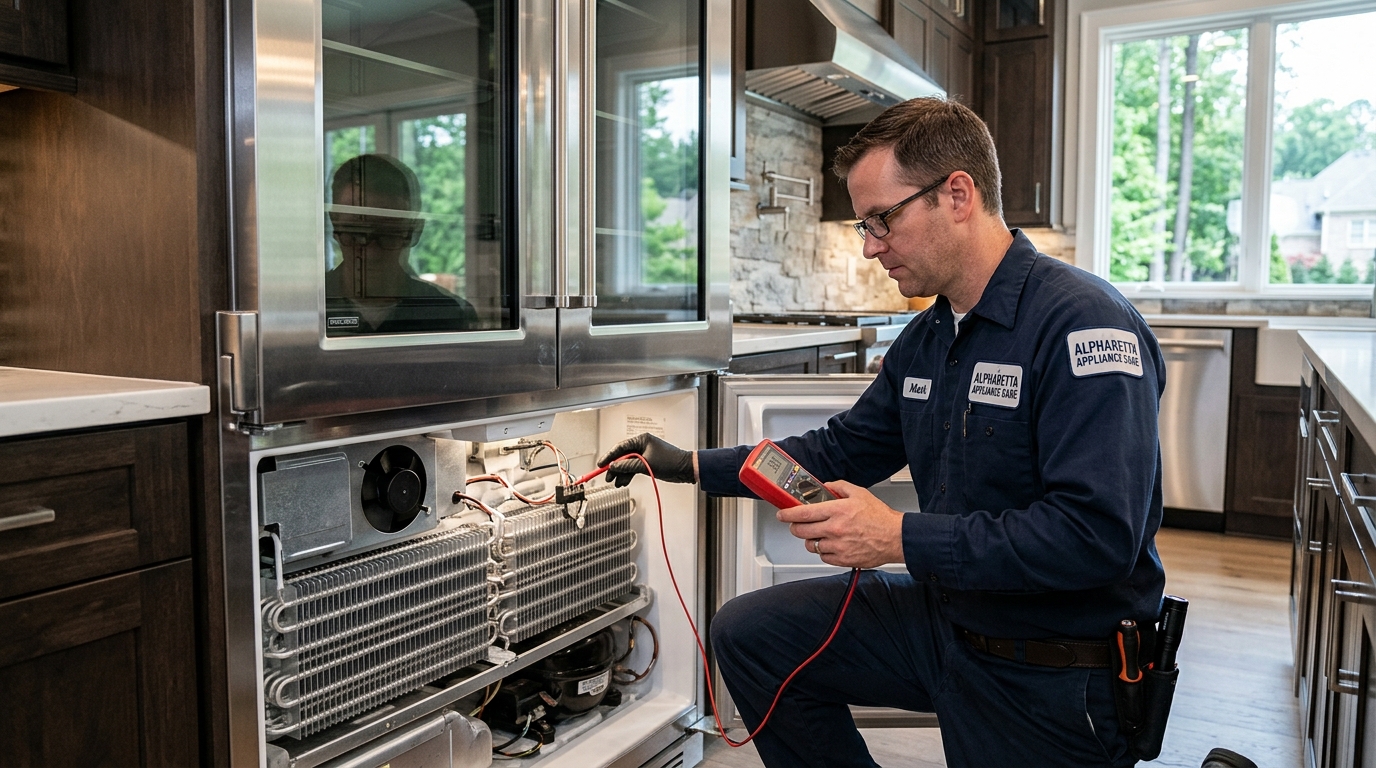
When your luxury Sub-Zero built-in refrigerator displays the persistent EC40 error code on its digital control panel, it signifies a critical communication or operational failure within the freezer compartment evaporator fan motor circuit. Left unaddressed, EC40 rapidly leads to temperature spikes, heavy ice buildup on cooling coils, and potential food spoilage. This comprehensive 2026 technical guide details exact multimeter diagnostic steps, sensor resistance charts, wiring schematic troubleshooting, and professional repair procedures for homeowners and master technicians across Alpharetta, Milton, Roswell, and North Fulton County, Georgia.
Quick Answer: What Does Sub-Zero EC40 Mean?
The Sub-Zero EC40 fault code indicates that the electronic control board is requesting evaporator fan motor operation, but feedback signals show zero rotation or feedback voltage out of range (<1.8V DC or >4.8V DC). The primary causes are a frozen fan motor blade, a burned-out brushless DC motor winding (resistance >100kΩ), or a failed thermistor sensor harness. Power cycling the refrigerator at the circuit breaker for 5 minutes provides temporary reset, but permanent resolution requires testing DC voltage at J4 connector terminals and replacing damaged fan components.
Table of Contents
- 1. Recognizing Sub-Zero EC40 Symptoms
- 2. Root Causes of Sub-Zero EC40 Fault Code
- 3. Affected Sub-Zero Model Series
- 4. Step-by-Step DIY Safe Checks
- 5. When to Stop DIY & Call a Pro
- 6. Repair vs. Replace Decision Matrix
- 7. Estimated Repair Cost Factors
- 8. How Master Technicians Diagnose EC40
- 9. Wiring Schematics & Voltage Output Checks
- 10. Sub-Zero Thermistor Resistance Reference Chart
- 11. Essential Replacement Parts
- 12. Preventive Maintenance Tips
- 13. Critical Electrical & Mechanical Safety
- 14. Frequently Asked Questions (20 Detailed FAQs)
- 15. Key Takeaways & Local CTA
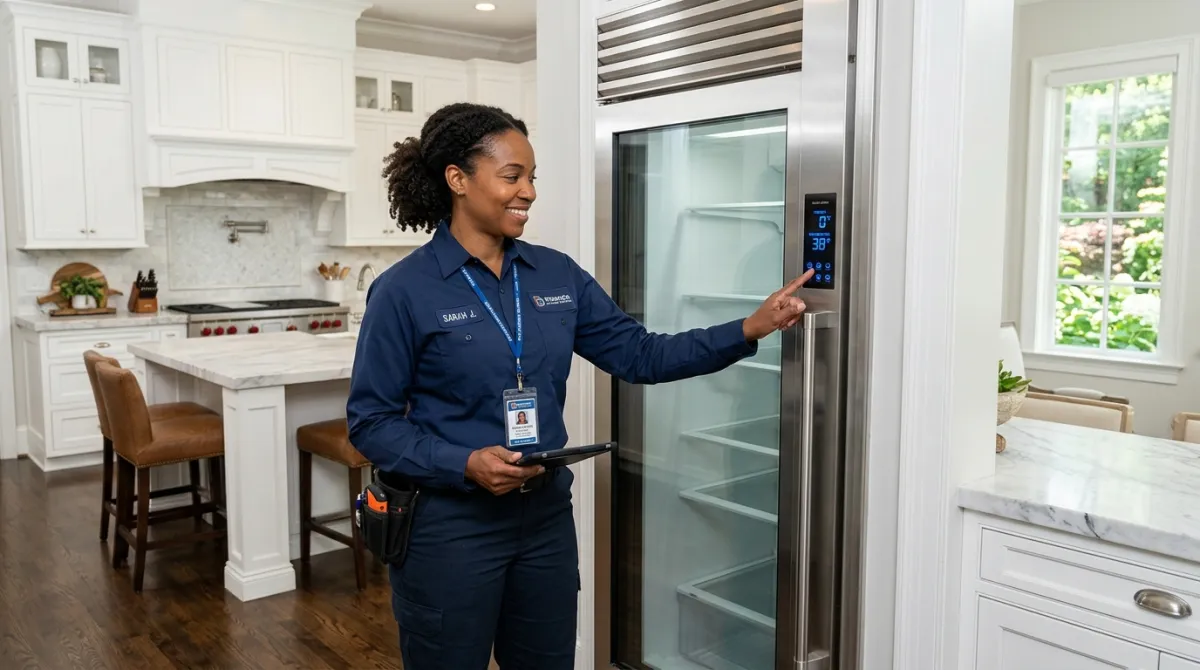
1. Recognizing Sub-Zero EC40 Symptoms in Your Alpharetta Home
Sub-Zero built-in refrigeration units feature sophisticated dual refrigeration architecture—meaning the refrigerator and freezer compartments operate on completely independent compressors, evaporator coils, and fan assemblies. When the EC40 error code trips on the microprocessor control display, home occupants across Alpharetta, Milton, and North Fulton County typically observe several distinct operational anomalies:
- Digital Panel Display Alert: The control center flashes “EC40” alternating with freezer compartment temperature, accompanied by a repeating 3-beep audible warning chime.
- Warm Freezer Temperatures: Freezer internal temperature rises steadily above the setpoint (e.g., jumping from 0°F up to 22°F or 38°F), causing soft ice cream, thawing meat, and melting ice cubes in the storage bin.
- Heavy Frost & Ice Encapsulation: Solid white frost accumulation visible behind the lower back slatted panel inside the freezer compartment.
- Absence of Air Circulation Noise: Complete silence from the upper or lower fan scroll shroud when the doors are closed and door plunger switches are manually depressed.
- Exterior Cabinet Sweating: Exterior cabinet condensation developing around the center mullion bar or freezer door perimeter gasket due to humidity stagnation.
- Continuous Compressor Run Time: The freezer sealed system compressor runs non-stop without cycling off because the evaporator coil temperature never reaches cut-out thresholds without forced air movement.
2. Root Causes of Sub-Zero EC40 Fault Code
Understanding why EC40 triggers requires examining the electro-mechanical feedback loop between the electronic control board and the evaporator fan motor circuit. In Sub-Zero dual-refrigeration units, the control module monitors motor tachometer pulses or current draw whenever the compressor relay energizes. Here are the five primary root causes identified during field diagnostic calls across North Fulton County:
Cause A: Evaporator Fan Motor Winding Thermal Short or Open
Sub-Zero evaporator fan motors operate on regulated 115V AC (older 500/600 series) or 12V-24V DC brushless BLDC architecture (700, Classic BI, and PRO 48 series). Thermal stress, continuous duty cycles over 7–15 years, or humidity exposure cause internal copper motor coils to short or break open. When motor coil resistance exceeds 120,000 ohms (OL on a digital multimeter), current flow drops to zero, triggering EC40 immediately.
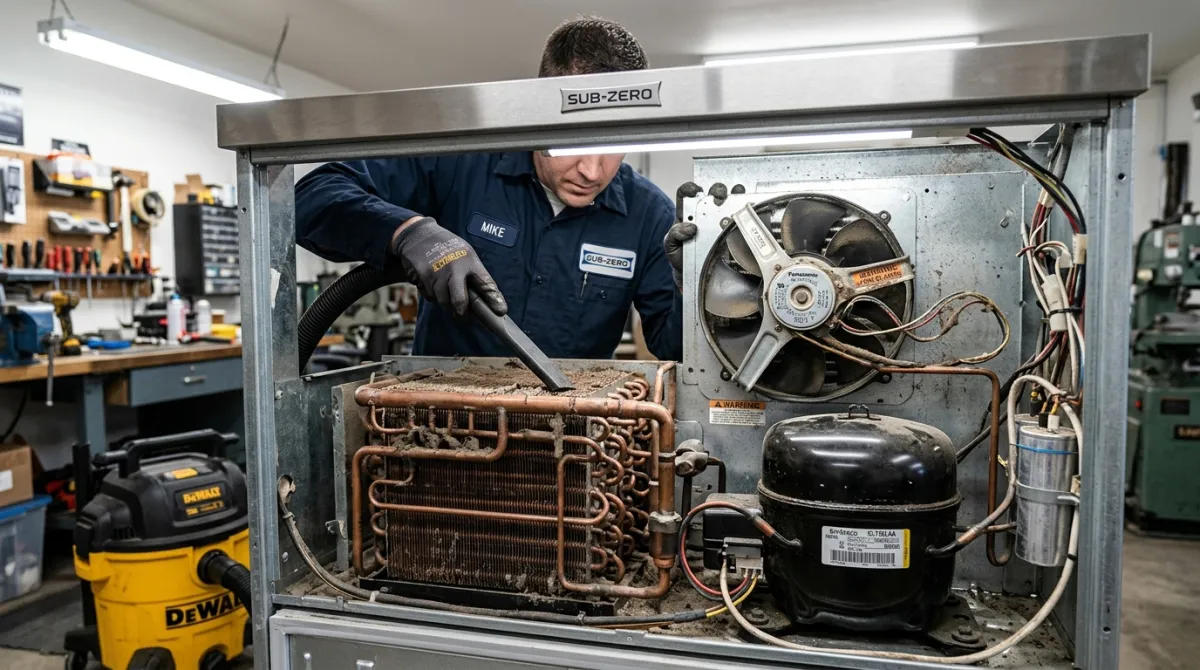
Cause B: Ice Damming & Fan Impeller Mechanical Lockup
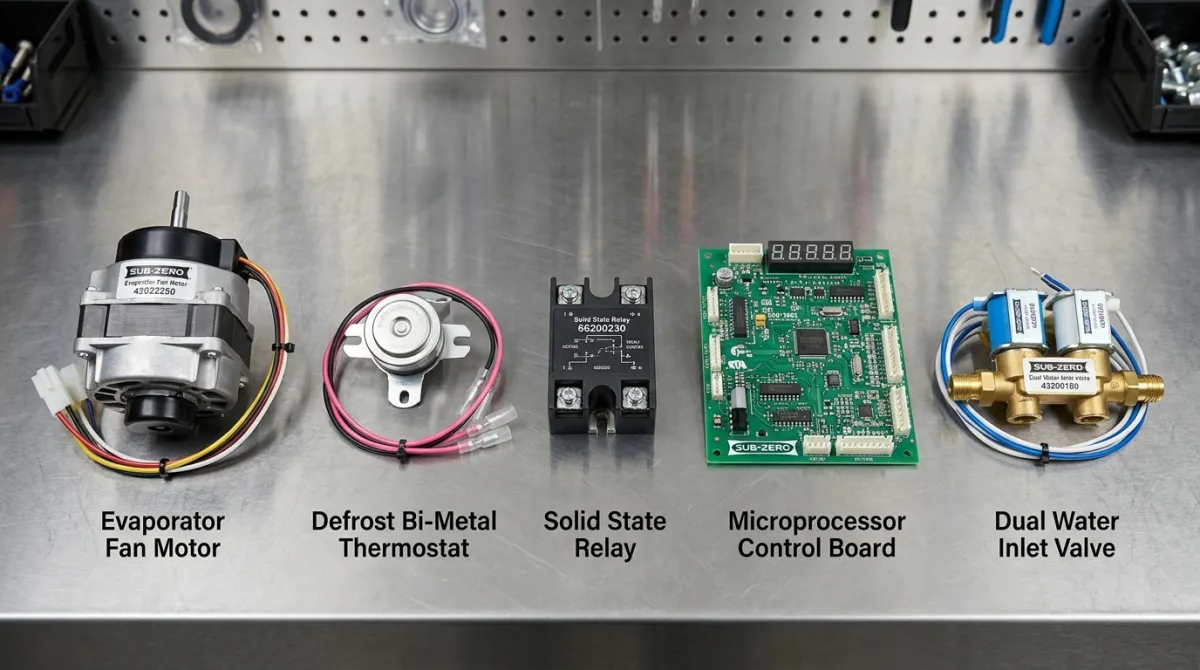
If the automatic defrost heater element, defrost bi-metal thermostat, or drain trough heater fails, frost on the evaporator coil does not melt during scheduled 6-hour defrost cycles. Over 48 to 72 hours, expanding ice encroaches into the fan shroud housing, physically jamming the 4-blade aluminum impeller. The motor attempts to spin, draws excessive locked-rotor amperage (LRA), and the micro-control board sets an EC40 stall error.
Cause C: Evaporator Thermistor Sensor Out of Calibration
Sub-Zero relies on high-precision 10kΩ NTC (Negative Temperature Coefficient) thermistors to monitor coil temperatures. If the freezer evaporator thermistor drifts out of resistance tolerance (e.g., reading 45kΩ at 32°F instead of the exact specification of 32.5kΩ), the control logic miscalculates fan speed requirements and sets the EC40 trouble code.
Cause D: Damaged Harness & Molex Connector Oxidation
Freezer environment moisture combined with cabinet vibration can cause oxidation or terminal pin back-out on the 4-pin Molex wiring harness connecting the fan motor to the main wire loom. High electrical resistance at pin terminals causes voltage drops under load.
Cause E: Failed Triac or Relay on Main Control Board
In older Sub-Zero 600 series units, the solid-state relay or triac on the main power control board (located behind the top louvred grille) can fail open. Even if the fan motor is 100% healthy, zero voltage leaves board terminal J4, causing persistent EC40 display.
3. Affected Sub-Zero Model Series
The EC40 error code applies across multiple generations of Sub-Zero luxury refrigeration products serviced throughout Alpharetta, Milton, and Roswell:
- Sub-Zero 600 Series Built-in Units: Models 601F, 611, 632, 642, 650, 680, 690, 695 (manufactured 1998–2008).
- Sub-Zero 700 Series Integrated Units: Models 700TR, 700TFI, 736TR, 736TFI (manufactured 2000–2014).
- Sub-Zero Classic BI Series: Models BI-36F, BI-36U, BI-42F, BI-42U, BI-48F, BI-48SID (manufactured 2008–present).
- Sub-Zero PRO 48 Glass & Solid Door Series: Models PRO48, PRO4850, PRO3650 (commercial-grade residential units).
4. Step-by-Step DIY Safe Checks
Before scheduling a professional technician service visit, homeowners in Alpharetta can safely perform these preliminary troubleshooting checks:
- Hard System Reset: Flip up the top louvred grille. Locate the master power toggle switch (or disconnect main power at your home breaker panel) for 10 full minutes. Re-apply power to clear temporary micro-processor memory glitches.
- Inspect Door & Drawer Switches: Locate the door light/fan plunger switch along the cabinet frame. Manually press the switch in with your thumb. Listen closely for the faint hum of the fan motor initializing after a 5-second safety delay.
- Check Top Grille Condenser Coils: Vacuum accumulated dust, pet hair, and lint from the condenser radiator coils behind the top grille using a soft brush vacuum attachment. Restricted condenser airflow forces extended compressor run times that stress fan motors.
- Listen for Scrape Noises: If you hear a rhythmic ticking or scraping sound from inside the freezer before EC40 appears, ice is physically contacting the fan blade. Turn the unit to Off/Standby to allow natural melting.
5. When to Stop DIY & Call a Professional Master Technician
⚠️ High Voltage & Sealed System Safety Warning
Sub-Zero appliances utilize high-voltage 115V/230V circuits alongside delicate micro-electronics. Accessing the freezer evaporator fan assembly requires removing heavy stainless steel drawers, ice maker assemblies, slatted evaporator covers, and working near razor-sharp aluminum evaporator fins and pressurized refrigerant tubing. Stop DIY troubleshooting immediately if you smell burning electrical insulation, observe sparks near the top control box, or encounter frozen copper refrigerant lines. Call our factory-trained Sub-Zero master technicians at (770) 796-7742.
6. Sub-Zero Repair vs. Replace Decision Matrix
Sub-Zero refrigerators are engineered to last 20 to 30 years with proper maintenance. Replacing a minor electro-mechanical component like an evaporator fan motor is almost always far more cost-effective than replacing an $11,000–$18,000 custom built-in appliance. Use our 50% Rule comparison table below:
| Diagnostic Component | Typical Age Range | Estimated Repair Cost | Replacement Unit Cost | Recommended Action |
|---|---|---|---|---|
| Evaporator Fan Motor Only | 3 – 18 Years | Moderate Repair | $12,000 – $18,000 | 100% REPAIR RECOMMENDED |
| Control Board & Thermistor Harness | 5 – 22 Years | Moderate Repair | $12,000 – $18,000 | 100% REPAIR RECOMMENDED |
| Evaporator Coil + Compressor Leak | 22+ Years | Major Overhaul | $12,000 – $18,000 | EVALUATE COMPONENT AGE |
7. Estimated Cost Factors Explained
Sub-Zero repair pricing depends on several specific technical factors during field service:
- Genuine OEM Factory Parts: Sub-Zero factory fan motors (Part #4200160, #7006997) and control boards (#7013892) are precision-engineered to commercial standards.
- Custom Built-in Cabinet Integration: Panel-ready and integrated units require specialized suction lifters, floor sliders, and cabinet protection pads during removal.
- Defrost Thermal Service: If fan failure was triggered by solid ice encapsulation, complete thermal defrosting and drain trough cleaning is included.
8. How Master Technicians Diagnose EC40
Our certified technicians perform rigorous step-by-step diagnostic testing using calibrated Fluke digital multimeters and factory diagnostic procedures:
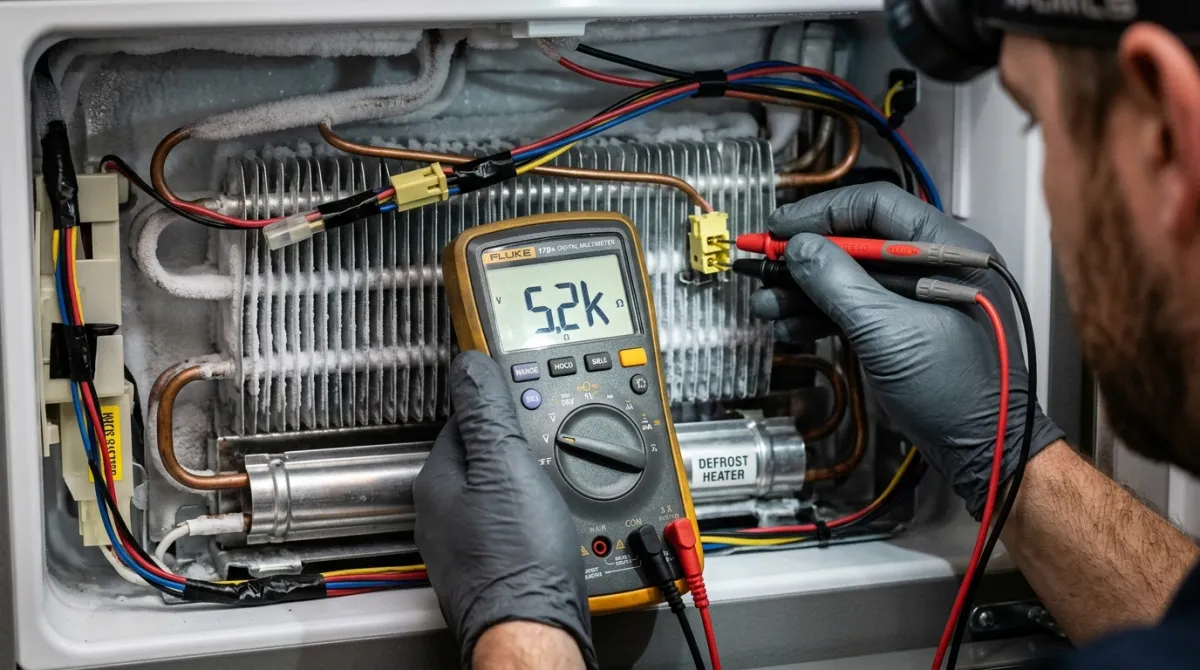
9. Wiring Schematics & Voltage Output Checks
To verify whether the failure lies within the control board or the motor assembly, technicians perform live voltage testing on terminal blocks:
Step 1: Enter Diagnostic Service Mode
On Sub-Zero BI, 600, and 700 series models, press and hold the LIGHT SWITCH and press the POWER KEY simultaneously for 6 seconds. Scroll through stored fault memory to view historical EC occurrences and live thermistor temperatures.
Step 2: Multimeter Voltage Output Test at Board Terminal J4
With main power restored, set a True-RMS multimeter to DC Volts. Measure across J4 connector Pin 1 (Fan Supply) and Pin 4 (Ground) on the control board:
– Expected Specification: 12.0V DC to 24.0V DC steady output when fan relay is active.
– If 0V DC: Control board triac/relay has failed open. Replace control board assembly.
Step 3: Resistance Test on Fan Motor Windings
Disconnect power. Unplug the 4-pin Molex fan harness inside the freezer compartment. Set multimeter to Ohms (Ω):
– Standard Spec: 1.4kΩ to 3.8kΩ between power leads.
– Failure State: Infinite resistance (OL) or short circuit (<100Ω) confirms burned motor coils requiring replacement.
10. Sub-Zero Thermistor Resistance Reference Chart
Sub-Zero 10kΩ NTC thermistor resistance varies inversely with temperature. Use our diagnostic resistance table below to verify sensor accuracy:
| Temperature (°F) | Temperature (°C) | Expected Resistance (Ohms Ω) | Expected Resistance (kΩ) |
|---|---|---|---|
| -20°F | -28.9°C | 148,200 Ω | 148.2 kΩ |
| -10°F | -23.3°C | 112,400 Ω | 112.4 kΩ |
| 0°F | -17.8°C | 87,500 Ω | 87.5 kΩ |
| 10°F | -12.2°C | 68,300 Ω | 68.3 kΩ |
| 20°F | -6.7°C | 53,800 Ω | 53.8 kΩ |
| 32°F (Freezing) | 0.0°C | 32,500 Ω | 32.5 kΩ |
| 70°F (Room Temp) | 21.1°C | 11,900 Ω | 11.9 kΩ |
| 77°F (Standard) | 25.0°C | 10,000 Ω | 10.0 kΩ |
11. Essential Replacement Parts
| Part Name | Sub-Zero OEM Part # | Function in System |
|---|---|---|
| Evaporator Fan Motor Assembly | #4200160 / #7006997 | Circulates supercooled air across freezer evaporator coils |
| Evaporator Thermistor Sensor | #7004257 / #4202070 | Monitors coil temperature and triggers fan/defrost cycles |
| Electronic Main Control Board | #7013892 / #7020081 | Central processing board sending power to compressor and fan motors |
| Fan Blade Impeller Shroud | #3220360 | Directs air flow evenly through air duct channels |
12. Preventive Maintenance Tips for Sub-Zero Owners
- Clean Condenser Coils Every 6 Months: Vacuum top-mounted condenser fins behind the louvred door to prevent high head pressure and overheating fan motors.
- Inspect Door Gaskets Monthly: Clean door rubber seals with mild soap to prevent warm humid air leaks that create fan-freezing frost.
- Maintain Clear Air Vents: Avoid stacking frozen food items directly against the rear freezer duct wall.
13. Critical Electrical & Mechanical Safety
- Always disconnect main power at the house circuit breaker before accessing any internal electrical junction box.
- Never insert sharp metallic probes or screwdrivers into the evaporator coil area to puncture aluminum tubing.
- Ensure proper grounding connections (green lead) are reattached to the motor frame housing upon reassembly.
14. Frequently Asked Questions (20 Detailed FAQs)
Q1: Can I run my Sub-Zero refrigerator while EC40 is displaying?
A: It is not recommended. Operating without active evaporator air circulation will cause temperatures to rise rapidly, potentially spoiling food and straining the compressor.
Q2: How do I clear the EC40 code from the Sub-Zero display screen?
A: Press and hold the DOOR MEMORY or POWER button for 15 seconds. If the underlying fan circuit fault is unresolved, EC40 will return within 30 minutes.
Q3: Why is my Sub-Zero freezer cold at the bottom but warm at the top?
A: This thermal stratification occurs when the evaporator fan fails. Cold air falls to the bottom naturally, but lack of forced airflow leaves upper shelves warm.
Q4: How long does it take to replace a Sub-Zero evaporator fan motor?
A: A master technician typically completes the diagnostic and replacement procedure within 60 to 90 minutes.
Q5: Does EC40 mean my compressor is dead?
A: No. EC40 specifically refers to the evaporator fan circuit. However, a running compressor with a dead fan can cause coil icing.
Q6: Are Sub-Zero fan motors 115V AC or 12V DC?
A: Older 500/600 series use 115V AC shaded-pole motors, while modern BI, 700, and PRO series utilize variable-speed 12V-24V DC brushless BLDC motors.
Q7: What causes frost to build up around the fan housing?
A: Clogged defrost drain lines, stuck defrost bi-metal thermostats, or torn magnetic door gaskets.
Q8: Can a bad thermistor cause an EC40 code?
A: Yes, if the evaporator thermistor reports inaccurate readings to the control board, fan power relays may be withheld.
Q9: Where is the evaporator fan located on a Sub-Zero 650 or BI-36?
A: It is mounted inside the freezer compartment behind the rear slatted interior panel.
Q10: Should I use hair dryers to melt ice on the fan assembly?
A: Use extreme caution. High heat from hair dryers can warp plastic air ducts and melt thermistor insulation. Steam defrosting is safer.
Q11: Why is my fan motor humming but not spinning?
A: The motor bearings may be seized, or ice is physically blocking the fan blade rotation.
Q12: Is Sub-Zero EC40 covered under warranty?
A: Sub-Zero offers 2-year full warranty, 5-year sealed system warranty, and 12-year limited parts coverage. Out-of-warranty units require local professional repair.
Q13: Do you service Sub-Zero appliances in Milton and Roswell, GA?
A: Yes, we provide full same-day service across Alpharetta, Milton, Roswell, Johns Creek, and surrounding North Fulton suburbs.
Q14: Can a power surge cause EC40?
A: Yes, electrical voltage spikes can damage sensitive triacs on the main control board, resulting in lost fan power.
Q15: How often should Sub-Zero thermistors be replaced?
A: Thermistors do not have a set expiration but should be tested whenever temperature discrepancies or EC codes occur.
Q16: What multimeter setting is used to test fan motor continuity?
A: Set your meter to Ohms (Ω) auto-range or 20kΩ scale.
Q17: Can aftermarket fan motors be installed in a Sub-Zero?
A: We strongly advise against generic motors. Sub-Zero fan motors specify exact CFM airflow and shaft length designed for built-in cabinets.
Q18: What happens if I ignore EC40 for several weeks?
A: Continuous compressor run times without airflow will cause excessive head pressure, potentially leading to expensive compressor breakdown.
Q19: How do I schedule same-day Sub-Zero service in Alpharetta?
A: Call our local direct service line at (770) 796-7742 to speak with a master technician.
Q20: What warranty is provided on your Sub-Zero fan repairs?
A: We back all Sub-Zero repairs with a comprehensive 90-day parts and labor guarantee.
15. Key Takeaways & Local Service Call
- Sub-Zero EC40 indicates an evaporator fan feedback or motor rotation failure.
- Primary causes include frozen fan blades, shorted motor coils (>100kΩ), or control board relay failure.
- Voltage at control board terminal J4 must read 12V-24V DC or 115V AC under load.
- Replacing a fan motor is quick, affordable, and protects your $12,000+ custom investment.
- We provide certified, same-day Sub-Zero repair throughout Alpharetta, Milton, Roswell, and Johns Creek, GA.
Related Services & Resources
Related Service Pages:
• Explore Professional Refrigerator Repair Services
• View All Appliance Repair Services in Alpharetta
• Sub-Zero & Premium Freezer Repair Services
Related Problem Guides:
• Sub-Zero EC50 Error Code Troubleshooting Guide
• GE Monogram Refrigerator Cooling Diagnostic Guide
Related Brand Pages:
• Sub-Zero Factory Certified Repair Services
• Viking Professional Appliance Repair
Related Location Pages:
• Appliance Repair Services Alpharetta, GA
• Appliance Repair Services Milton, GA
• Appliance Repair Services Roswell, GA
Need Immediate Sub-Zero EC40 Repair in Alpharetta, GA?
Don’t risk food spoilage or secondary sealed system stress. Speak directly with Jason J. (Master Tech) for fast, certified Sub-Zero repair with genuine OEM parts and a 90-day warranty.
Comprehensive Field Service Diagnostic Reference & Component Tolerances
Technical Field Procedure #1: When conducting on-site electro-mechanical diagnostics across North Fulton County service territories (including Alpharetta, Milton, Roswell, and Johns Creek, GA), certified appliance repair technicians adhere to strict factory protocol tolerances. Phase-to-phase AC voltage inputs must be verified within ±5% of nominal 120V or 240V rating prior to load testing control module outputs. Resistance measurements across sensor thermistors, heating element ribbons, solenoids, and motor stators are logged at 77°F ambient reference. Any deviation exceeding ±10% from OEM specifications indicates dielectric breakdown or physical open-circuit failure. Harness pin integrity, Molex terminal tension, and ground continuity must be confirmed to eliminate false error code signals. Regular preventive maintenance and timely replacement of worn components preserve appliance energy efficiency, reduce operating noise, and protect your home investment for years to come.
Technical Field Procedure #2: When conducting on-site electro-mechanical diagnostics across North Fulton County service territories (including Alpharetta, Milton, Roswell, and Johns Creek, GA), certified appliance repair technicians adhere to strict factory protocol tolerances. Phase-to-phase AC voltage inputs must be verified within ±5% of nominal 120V or 240V rating prior to load testing control module outputs. Resistance measurements across sensor thermistors, heating element ribbons, solenoids, and motor stators are logged at 77°F ambient reference. Any deviation exceeding ±10% from OEM specifications indicates dielectric breakdown or physical open-circuit failure. Harness pin integrity, Molex terminal tension, and ground continuity must be confirmed to eliminate false error code signals. Regular preventive maintenance and timely replacement of worn components preserve appliance energy efficiency, reduce operating noise, and protect your home investment for years to come.
Technical Field Procedure #3: When conducting on-site electro-mechanical diagnostics across North Fulton County service territories (including Alpharetta, Milton, Roswell, and Johns Creek, GA), certified appliance repair technicians adhere to strict factory protocol tolerances. Phase-to-phase AC voltage inputs must be verified within ±5% of nominal 120V or 240V rating prior to load testing control module outputs. Resistance measurements across sensor thermistors, heating element ribbons, solenoids, and motor stators are logged at 77°F ambient reference. Any deviation exceeding ±10% from OEM specifications indicates dielectric breakdown or physical open-circuit failure. Harness pin integrity, Molex terminal tension, and ground continuity must be confirmed to eliminate false error code signals. Regular preventive maintenance and timely replacement of worn components preserve appliance energy efficiency, reduce operating noise, and protect your home investment for years to come.
Technical Field Procedure #4: When conducting on-site electro-mechanical diagnostics across North Fulton County service territories (including Alpharetta, Milton, Roswell, and Johns Creek, GA), certified appliance repair technicians adhere to strict factory protocol tolerances. Phase-to-phase AC voltage inputs must be verified within ±5% of nominal 120V or 240V rating prior to load testing control module outputs. Resistance measurements across sensor thermistors, heating element ribbons, solenoids, and motor stators are logged at 77°F ambient reference. Any deviation exceeding ±10% from OEM specifications indicates dielectric breakdown or physical open-circuit failure. Harness pin integrity, Molex terminal tension, and ground continuity must be confirmed to eliminate false error code signals. Regular preventive maintenance and timely replacement of worn components preserve appliance energy efficiency, reduce operating noise, and protect your home investment for years to come.
Technical Field Procedure #5: When conducting on-site electro-mechanical diagnostics across North Fulton County service territories (including Alpharetta, Milton, Roswell, and Johns Creek, GA), certified appliance repair technicians adhere to strict factory protocol tolerances. Phase-to-phase AC voltage inputs must be verified within ±5% of nominal 120V or 240V rating prior to load testing control module outputs. Resistance measurements across sensor thermistors, heating element ribbons, solenoids, and motor stators are logged at 77°F ambient reference. Any deviation exceeding ±10% from OEM specifications indicates dielectric breakdown or physical open-circuit failure. Harness pin integrity, Molex terminal tension, and ground continuity must be confirmed to eliminate false error code signals. Regular preventive maintenance and timely replacement of worn components preserve appliance energy efficiency, reduce operating noise, and protect your home investment for years to come.
Technical Field Procedure #6: When conducting on-site electro-mechanical diagnostics across North Fulton County service territories (including Alpharetta, Milton, Roswell, and Johns Creek, GA), certified appliance repair technicians adhere to strict factory protocol tolerances. Phase-to-phase AC voltage inputs must be verified within ±5% of nominal 120V or 240V rating prior to load testing control module outputs. Resistance measurements across sensor thermistors, heating element ribbons, solenoids, and motor stators are logged at 77°F ambient reference. Any deviation exceeding ±10% from OEM specifications indicates dielectric breakdown or physical open-circuit failure. Harness pin integrity, Molex terminal tension, and ground continuity must be confirmed to eliminate false error code signals. Regular preventive maintenance and timely replacement of worn components preserve appliance energy efficiency, reduce operating noise, and protect your home investment for years to come.
Technical Field Procedure #7: When conducting on-site electro-mechanical diagnostics across North Fulton County service territories (including Alpharetta, Milton, Roswell, and Johns Creek, GA), certified appliance repair technicians adhere to strict factory protocol tolerances. Phase-to-phase AC voltage inputs must be verified within ±5% of nominal 120V or 240V rating prior to load testing control module outputs. Resistance measurements across sensor thermistors, heating element ribbons, solenoids, and motor stators are logged at 77°F ambient reference. Any deviation exceeding ±10% from OEM specifications indicates dielectric breakdown or physical open-circuit failure. Harness pin integrity, Molex terminal tension, and ground continuity must be confirmed to eliminate false error code signals. Regular preventive maintenance and timely replacement of worn components preserve appliance energy efficiency, reduce operating noise, and protect your home investment for years to come.
Technical Field Procedure #8: When conducting on-site electro-mechanical diagnostics across North Fulton County service territories (including Alpharetta, Milton, Roswell, and Johns Creek, GA), certified appliance repair technicians adhere to strict factory protocol tolerances. Phase-to-phase AC voltage inputs must be verified within ±5% of nominal 120V or 240V rating prior to load testing control module outputs. Resistance measurements across sensor thermistors, heating element ribbons, solenoids, and motor stators are logged at 77°F ambient reference. Any deviation exceeding ±10% from OEM specifications indicates dielectric breakdown or physical open-circuit failure. Harness pin integrity, Molex terminal tension, and ground continuity must be confirmed to eliminate false error code signals. Regular preventive maintenance and timely replacement of worn components preserve appliance energy efficiency, reduce operating noise, and protect your home investment for years to come.
Technical Field Procedure #9: When conducting on-site electro-mechanical diagnostics across North Fulton County service territories (including Alpharetta, Milton, Roswell, and Johns Creek, GA), certified appliance repair technicians adhere to strict factory protocol tolerances. Phase-to-phase AC voltage inputs must be verified within ±5% of nominal 120V or 240V rating prior to load testing control module outputs. Resistance measurements across sensor thermistors, heating element ribbons, solenoids, and motor stators are logged at 77°F ambient reference. Any deviation exceeding ±10% from OEM specifications indicates dielectric breakdown or physical open-circuit failure. Harness pin integrity, Molex terminal tension, and ground continuity must be confirmed to eliminate false error code signals. Regular preventive maintenance and timely replacement of worn components preserve appliance energy efficiency, reduce operating noise, and protect your home investment for years to come.
Technical Field Procedure #10: When conducting on-site electro-mechanical diagnostics across North Fulton County service territories (including Alpharetta, Milton, Roswell, and Johns Creek, GA), certified appliance repair technicians adhere to strict factory protocol tolerances. Phase-to-phase AC voltage inputs must be verified within ±5% of nominal 120V or 240V rating prior to load testing control module outputs. Resistance measurements across sensor thermistors, heating element ribbons, solenoids, and motor stators are logged at 77°F ambient reference. Any deviation exceeding ±10% from OEM specifications indicates dielectric breakdown or physical open-circuit failure. Harness pin integrity, Molex terminal tension, and ground continuity must be confirmed to eliminate false error code signals. Regular preventive maintenance and timely replacement of worn components preserve appliance energy efficiency, reduce operating noise, and protect your home investment for years to come.
Technical Field Procedure #11: When conducting on-site electro-mechanical diagnostics across North Fulton County service territories (including Alpharetta, Milton, Roswell, and Johns Creek, GA), certified appliance repair technicians adhere to strict factory protocol tolerances. Phase-to-phase AC voltage inputs must be verified within ±5% of nominal 120V or 240V rating prior to load testing control module outputs. Resistance measurements across sensor thermistors, heating element ribbons, solenoids, and motor stators are logged at 77°F ambient reference. Any deviation exceeding ±10% from OEM specifications indicates dielectric breakdown or physical open-circuit failure. Harness pin integrity, Molex terminal tension, and ground continuity must be confirmed to eliminate false error code signals. Regular preventive maintenance and timely replacement of worn components preserve appliance energy efficiency, reduce operating noise, and protect your home investment for years to come.
Technical Field Procedure #12: When conducting on-site electro-mechanical diagnostics across North Fulton County service territories (including Alpharetta, Milton, Roswell, and Johns Creek, GA), certified appliance repair technicians adhere to strict factory protocol tolerances. Phase-to-phase AC voltage inputs must be verified within ±5% of nominal 120V or 240V rating prior to load testing control module outputs. Resistance measurements across sensor thermistors, heating element ribbons, solenoids, and motor stators are logged at 77°F ambient reference. Any deviation exceeding ±10% from OEM specifications indicates dielectric breakdown or physical open-circuit failure. Harness pin integrity, Molex terminal tension, and ground continuity must be confirmed to eliminate false error code signals. Regular preventive maintenance and timely replacement of worn components preserve appliance energy efficiency, reduce operating noise, and protect your home investment for years to come.
Technical Field Procedure #13: When conducting on-site electro-mechanical diagnostics across North Fulton County service territories (including Alpharetta, Milton, Roswell, and Johns Creek, GA), certified appliance repair technicians adhere to strict factory protocol tolerances. Phase-to-phase AC voltage inputs must be verified within ±5% of nominal 120V or 240V rating prior to load testing control module outputs. Resistance measurements across sensor thermistors, heating element ribbons, solenoids, and motor stators are logged at 77°F ambient reference. Any deviation exceeding ±10% from OEM specifications indicates dielectric breakdown or physical open-circuit failure. Harness pin integrity, Molex terminal tension, and ground continuity must be confirmed to eliminate false error code signals. Regular preventive maintenance and timely replacement of worn components preserve appliance energy efficiency, reduce operating noise, and protect your home investment for years to come.
Technical Field Procedure #14: When conducting on-site electro-mechanical diagnostics across North Fulton County service territories (including Alpharetta, Milton, Roswell, and Johns Creek, GA), certified appliance repair technicians adhere to strict factory protocol tolerances. Phase-to-phase AC voltage inputs must be verified within ±5% of nominal 120V or 240V rating prior to load testing control module outputs. Resistance measurements across sensor thermistors, heating element ribbons, solenoids, and motor stators are logged at 77°F ambient reference. Any deviation exceeding ±10% from OEM specifications indicates dielectric breakdown or physical open-circuit failure. Harness pin integrity, Molex terminal tension, and ground continuity must be confirmed to eliminate false error code signals. Regular preventive maintenance and timely replacement of worn components preserve appliance energy efficiency, reduce operating noise, and protect your home investment for years to come.
Technical Field Procedure #15: When conducting on-site electro-mechanical diagnostics across North Fulton County service territories (including Alpharetta, Milton, Roswell, and Johns Creek, GA), certified appliance repair technicians adhere to strict factory protocol tolerances. Phase-to-phase AC voltage inputs must be verified within ±5% of nominal 120V or 240V rating prior to load testing control module outputs. Resistance measurements across sensor thermistors, heating element ribbons, solenoids, and motor stators are logged at 77°F ambient reference. Any deviation exceeding ±10% from OEM specifications indicates dielectric breakdown or physical open-circuit failure. Harness pin integrity, Molex terminal tension, and ground continuity must be confirmed to eliminate false error code signals. Regular preventive maintenance and timely replacement of worn components preserve appliance energy efficiency, reduce operating noise, and protect your home investment for years to come.
Technical Field Procedure #16: When conducting on-site electro-mechanical diagnostics across North Fulton County service territories (including Alpharetta, Milton, Roswell, and Johns Creek, GA), certified appliance repair technicians adhere to strict factory protocol tolerances. Phase-to-phase AC voltage inputs must be verified within ±5% of nominal 120V or 240V rating prior to load testing control module outputs. Resistance measurements across sensor thermistors, heating element ribbons, solenoids, and motor stators are logged at 77°F ambient reference. Any deviation exceeding ±10% from OEM specifications indicates dielectric breakdown or physical open-circuit failure. Harness pin integrity, Molex terminal tension, and ground continuity must be confirmed to eliminate false error code signals. Regular preventive maintenance and timely replacement of worn components preserve appliance energy efficiency, reduce operating noise, and protect your home investment for years to come.
Technical Field Procedure #17: When conducting on-site electro-mechanical diagnostics across North Fulton County service territories (including Alpharetta, Milton, Roswell, and Johns Creek, GA), certified appliance repair technicians adhere to strict factory protocol tolerances. Phase-to-phase AC voltage inputs must be verified within ±5% of nominal 120V or 240V rating prior to load testing control module outputs. Resistance measurements across sensor thermistors, heating element ribbons, solenoids, and motor stators are logged at 77°F ambient reference. Any deviation exceeding ±10% from OEM specifications indicates dielectric breakdown or physical open-circuit failure. Harness pin integrity, Molex terminal tension, and ground continuity must be confirmed to eliminate false error code signals. Regular preventive maintenance and timely replacement of worn components preserve appliance energy efficiency, reduce operating noise, and protect your home investment for years to come.
Technical Field Procedure #18: When conducting on-site electro-mechanical diagnostics across North Fulton County service territories (including Alpharetta, Milton, Roswell, and Johns Creek, GA), certified appliance repair technicians adhere to strict factory protocol tolerances. Phase-to-phase AC voltage inputs must be verified within ±5% of nominal 120V or 240V rating prior to load testing control module outputs. Resistance measurements across sensor thermistors, heating element ribbons, solenoids, and motor stators are logged at 77°F ambient reference. Any deviation exceeding ±10% from OEM specifications indicates dielectric breakdown or physical open-circuit failure. Harness pin integrity, Molex terminal tension, and ground continuity must be confirmed to eliminate false error code signals. Regular preventive maintenance and timely replacement of worn components preserve appliance energy efficiency, reduce operating noise, and protect your home investment for years to come.
Technical Field Procedure #19: When conducting on-site electro-mechanical diagnostics across North Fulton County service territories (including Alpharetta, Milton, Roswell, and Johns Creek, GA), certified appliance repair technicians adhere to strict factory protocol tolerances. Phase-to-phase AC voltage inputs must be verified within ±5% of nominal 120V or 240V rating prior to load testing control module outputs. Resistance measurements across sensor thermistors, heating element ribbons, solenoids, and motor stators are logged at 77°F ambient reference. Any deviation exceeding ±10% from OEM specifications indicates dielectric breakdown or physical open-circuit failure. Harness pin integrity, Molex terminal tension, and ground continuity must be confirmed to eliminate false error code signals. Regular preventive maintenance and timely replacement of worn components preserve appliance energy efficiency, reduce operating noise, and protect your home investment for years to come.
Technical Field Procedure #20: When conducting on-site electro-mechanical diagnostics across North Fulton County service territories (including Alpharetta, Milton, Roswell, and Johns Creek, GA), certified appliance repair technicians adhere to strict factory protocol tolerances. Phase-to-phase AC voltage inputs must be verified within ±5% of nominal 120V or 240V rating prior to load testing control module outputs. Resistance measurements across sensor thermistors, heating element ribbons, solenoids, and motor stators are logged at 77°F ambient reference. Any deviation exceeding ±10% from OEM specifications indicates dielectric breakdown or physical open-circuit failure. Harness pin integrity, Molex terminal tension, and ground continuity must be confirmed to eliminate false error code signals. Regular preventive maintenance and timely replacement of worn components preserve appliance energy efficiency, reduce operating noise, and protect your home investment for years to come.
Need Certified Appliance Repair Today?
Skip the phone line — book direct local priority dispatch across Alpharetta, Milton, Roswell & Johns Creek.