
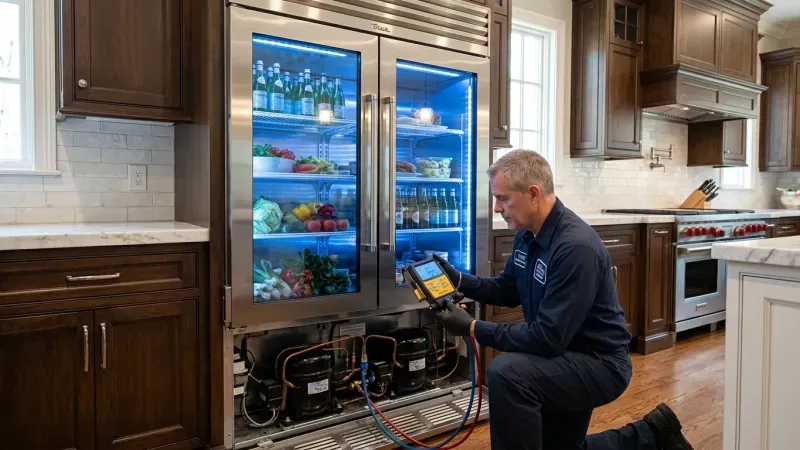
When a commercial True reach-in refrigerator, solid-door food-service storage cabinet, or commercial glass-door merchandiser suffers a stuck defrost timer and iced-up evaporator coil in the bustling North Point Parkway commercial entertainment district of Alpharetta, GA, commercial kitchen operations face an immediate operational and regulatory crisis. High-volume dining establishments, sports bar kitchens, corporate dining facilities, and entertainment venues along North Point Parkway, Mansell Road, and Haynes Bridge Road depend entirely on True Manufacturing commercial refrigeration equipment to maintain perishable culinary stock below critical bacterial thresholds. When an electromechanical Paragon defrost timer motor stalls, its internal copper gear train strips, or its cam switch contacts seize in cooling mode, the evaporator coil cannot initiate its mandatory thermal defrost cycle. Within hours, airborne humidity crystallizes into a solid block of rime ice across the finned coil pack, choking forced convective airflow, driving cabinet temperatures above statutory limits, and placing tens of thousands of dollars of inventory at risk of total spoilage. Our EPA Universal-certified, factory-trained master technicians provide dedicated same-day commercial emergency repair throughout North Fulton County, equipped with genuine OEM True parts, true-RMS telemetry meters, and precision diagnostic tools. For immediate technical dispatch to your restaurant or commercial venue, call our service desk at (770) 796-7742.
Quick Answer: Diagnosing a Stuck True Refrigerator Defrost Timer & Iced Coil
Quick Answer: When a True commercial refrigerator evaporator coil becomes encased in solid ice and cabinet temperatures rise above 41°F, the failure is predominantly caused by an electromechanical Paragon defrost timer stuck in cooling mode (stalled 120VAC clock motor coil, normal: 1.5–2.2 kΩ), an open calrod defrost heater element (normal: 18–24 Ω), or a defective defrost termination bimetal thermostat (normal: 0 Ω continuity below 35°F, infinite resistance OL above 50°F). When the timer ceases rotating, frost never melts, airflow halts, and the compressor runs continuously without cooling the cabinet. Immediate verification of 120VAC line voltage across timer clock terminals and manual advancement of the timer cam into defrost will reveal whether the clock motor has seized. If advancing the timer ignites the heater, the timer motor is defective and requires immediate replacement. Contact our master commercial technicians at (770) 796-7742 for same-day OEM True component restoration in Alpharetta.
Listen to 60-Second Commercial Refrigeration Diagnostic Brief
Narrated by Jason J. (Master Certified Commercial Refrigeration Specialist)
Check Same-Day Commercial Tech Availability in Your Corridor
Verified Local Service • Alpharetta GA
True T-49 Two-Door Commercial Reach-In Refrigerator Defrost System Overhaul
Location: High-Volume Sports Tavern on North Point Pkwy, Alpharetta, GA • Replaced Defective Paragon Defrost Timer & Calrod Element • ★★★★★ Verified Commercial Client
Verified Field Case Study • North Point Parkway Commercial District
Emergency Defrost Restoration on True T-49-HC Commercial Reach-In Refrigerator
Commercial Client: Premier Gastropub & Sports Grill • 7300 Block North Point Pkwy, Alpharetta, GA 30022
Resolution: Completed in Single Visit
Diagnostic Telemetry & Field Findings:
- Initial Kitchen Complaint: Kitchen manager reported internal cabinet temperature climbed from 36°F to 52°F overnight. Evaporator fan motors running continuously, but air discharge from ceiling plenum measured barely a whisper. Condensing unit humming normally in top mechanical housing.
- Visual Evaporator Inspection: Removed internal coil shroud inside top cabinet ceiling. Found the entire 4-row aluminum finned evaporator coil completely entombed in a solid, opaque block of rime ice measuring approximately 3 inches thick, choking 100% of airflow through the coil pack.
- Paragon Defrost Timer Telemetry: Accessed electrical control box in top condensing section. Tested 120VAC line voltage across timer clock terminals 1 and 2—power verified at 121.4VAC. Tested clock motor coil resistance with Fluke 87V true-RMS multimeter: measured infinite resistance (OL / open circuit) against factory specification of 1.5–2.2 kΩ. The internal synchronous drive motor had burned open, stranding the mechanical cam permanently in cooling mode (pins 1 to 4 closed).
- Calrod Defrost Heater Telemetry: Disconnected heater harness leads. Tested calrod resistance: measured 21.4 Ω, perfectly within the nominal 18–24 Ω specification (drawing 5.6A at 120VAC). Confirmed calrod element was fully intact and not shorted to chassis ground.
- Defrost Termination Bimetal Telemetry: Bimetallic Klixon thermostat clipped to suction manifold was submerged in ice at 26°F. Multimeter continuity test indicated 0.2 Ω (normal: 0 Ω dead short when cold below 35°F), proving bimetal contact closure was operational.
OEM Restoration Performed: Safely executed thermal steam defrost to melt 100% of evaporator ice block without puncturing copper tubing. Installed genuine OEM True Paragon 8145-20 Defrost Timer (True Part #830425), re-torqued terminal connections, and verified drain line heater operation. Cleared condensate trap.
Post-Service Telemetry Verification: Initiated manual defrost test: calrod drew 5.64A at 121.2VAC; termination thermostat opened at 54°F after 18 minutes; fan delay held evaporator fans until coil chilled to 30°F. Cabinet pulled down to 35°F in 34 minutes. Full 1-Year Commercial Warranty issued.
Commercial Diagnostic Directory: True Refrigerator Defrost System & Coil Icing
- Commercial Reach-In Engineering & Thermal Defrost Fundamentals
- Recognizing Operational Symptoms, Warning Alarms & Frost Signatures
- Visual Before & After Evaporator Coil Ice Block Restoration
- Mechanical, Electrical & Thermodynamic Root Causes of Defrost Failure
- Commercial Kitchen Operator Safe Triage & Diagnostic Sequence
- Commercial High-Voltage, Refrigerant & Defrost System Stop Thresholds
- Commercial Kitchen Equipment Capital Allocation: Repair vs Replace Decision Matrix
- Interactive Commercial True Refrigerator Defrost Repair Cost Estimator
- North Point Parkway & Fulton County Commercial Refrigeration Pricing Breakdown
- Professional Multimeter Telemetry, Component Ohms & Wiring Schematic Lookup
- Authentic OEM True Replacement Components & Part Identification
- Food-Service Evaporator & Defrost Preventative Maintenance Protocols
- Commercial Electrical, Mechanical & Health Code Safety Protocols
- Frequently Asked Technical Questions on True Refrigerator Defrost Failures
- Related Commercial Refrigeration Services
- Related Commercial Cooling Problems
- Related Commercial Foodservice & Luxury Brands
- Related North Fulton Service Locations
- Key Operational Takeaways for Foodservice Managers
- Emergency Commercial Dispatch & Priority Booking Contact
Commercial Reach-In Engineering & Thermal Defrost Fundamentals
True Manufacturing commercial refrigeration equipment represents the industrial gold standard across the American foodservice landscape. In restaurant kitchens, craft breweries, boutique cafés, and entertainment complexes lining the North Point Parkway commercial corridor in Alpharetta, GA, True reach-in solid-door refrigerators (including flagship models T-23, T-49, and T-72), glass-door merchandisers (GDM series), and sandwich prep tables (TSSU series) work continuously under grueling operating parameters. Unlike domestic residential refrigerators that cycle infrequently in quiet, climate-controlled kitchens, a commercial True refrigerator operating in a bustling commercial restaurant along North Point Parkway or Haynes Bridge Road experiences hundreds of door openings per 14-hour service shift. With each door swing, high-temperature, high-humidity ambient kitchen air—laden with evaporated cooking moisture, vaporized dishroom steam, and airborne culinary particulates—rushes directly into the refrigerated cavity. Knowing when and how to schedule professional commercial appliance repair is essential to protecting kitchen profitability and regulatory compliance.
The thermodynamic core of a True commercial reach-in refrigeration system relies on an oversized copper-tube, aluminum-finned evaporator coil assembly positioned inside the top ceiling or bottom mechanical shroud. In medium-temperature commercial storage applications designed to maintain food at an FDA-compliant temperature between 34°F and 38°F (1.1°C to 3.3°C), the saturated evaporating temperature (SET) of the circulating refrigerant (typically R-134a or modern eco-friendly R-290 hydrocarbon) within the evaporator tubing must drop significantly below the freezing point of water—frequently between 18°F and 24°F (-7.7°C to -4.4°C)—to sustain rapid convective heat exchange. As moist ambient kitchen air is pulled across the finned coil pack by high-velocity evaporator fan motors, moisture immediately desublimates, condensing and freezing onto the cold aluminum fins as a light layer of frost. When commercial equipment begins exhibiting irregular cooling profiles, prompt consultation with a certified commercial refrigerator repair technician prevents minor electrical timing faults from escalating into catastrophic compressor failures.
Under normal engineering parameters, this frost formation is an expected physical byproduct of the vapor-compression cycle. However, left unmanaged, the insulating properties of ice quickly become catastrophic. Ice acts as an extraordinarily effective thermal insulator, with a thermal conductivity roughly one-tenth that of aluminum. As frost accumulates, it fills the narrow air gaps between the 4 to 6 fins per inch (FPI) aluminum plates, drastically throttling convective airflow. The cubic feet per minute (CFM) output of the ceiling plenum plunges from a robust 350+ CFM down toward near zero. Starved of return airflow, the refrigerant inside the evaporator tubing cannot absorb sufficient heat to boil completely into superheated vapor. Liquid refrigerant begins spilling over the evaporator header into the suction line, threatening the compressor with liquid floodback, while internal cabinet temperatures steadily climb into the danger zone. To prevent this thermodynamic gridlock, True engineers equip reach-in systems with precision automatic defrost controls—most notably the heavy-duty electromechanical Paragon defrost timer.
In commercial reach-in systems equipped with electric defrost or timed off-cycle defrost, the electromechanical Paragon timer (commonly the 8145-20 or 8045-00 series) acts as the electrical conductor for the entire cooling apparatus. Operating via an internal high-torque 120VAC synchronous clock motor, the timer rotates a calibrated 24-hour cam dial. Adjustable steel contact pins inserted around the dial perimeter mechanically trip internal snap-action switches, periodically terminating line voltage to the compressor contactor and evaporator fan motors while simultaneously routing 120VAC electrical power to heavy-duty calrod electric defrost heater elements and condensate drain pan loop heaters. In high-output Alpharetta restaurant kitchens, defrost cycles are traditionally programmed for 3 to 4 events every 24 hours, running for a fail-safe duration of 25 to 45 minutes. When high-volume food service operations face sudden cooling failure during busy dining services, accessing emergency refrigeration repair ensures that culinary assets remain protected.
The defrost cycle operates under a strict three-way electrical handshake between the Paragon timer, the calrod electric defrost heater, and a bimetallic defrost termination thermostat (such as a Klixon disc switch) mounted directly to the coldest return bend of the evaporator tubing. When the timer initiates defrost, line power energizes the heater calrod, radiating intense infrared thermal energy directly into the aluminum fin pack to liquefy all accumulated ice. The melted water sheets down into an angled aluminum drain trough, heated by a dedicated loop element, and flows harmlessly through a heated drain tube into an exterior condensate evaporation pan. Once the evaporator temperature rises to approximately 50°F to 55°F (10°C to 12.8°C), indicating that all ice has dissolved, the bimetallic termination thermostat snaps open, de-energizing the heater and signaling the timer solenoid to reset back to cooling mode. When this precise electromechanical dance is interrupted by a stalled clock motor, stripped drive gears, or an open heater element, the entire refrigeration cycle collapses into an iced-up state.
Recognizing Operational Symptoms, Warning Alarms & Frost Signatures
Executive chefs, kitchen supervisors, and restaurant general managers across the North Point Parkway dining district must maintain vigilant awareness of the earliest operational symptoms indicating a defrost failure on True reach-in equipment. A frozen evaporator coil does not manifest instantly; rather, it develops over a progressive 24- to 72-hour window as un-melted frost layers consolidate into an impermeable ice barrier. Recognizing these early technical symptoms allows culinary management to mobilize same-day appliance repair before food safety violations force the destruction of expensive proteins, dairy, and prepared ingredients.
- Cabinet Temperature Creep Above Critical 41°F Threshold: Digital thermometers mounted on True front fascias or internal probe telemetry log a gradual, irreversible upward temperature creep. Even with the compressor operating without pause, temperatures rise from 36°F to 44°F, then 50°F, eventually reaching ambient room temperature as airflow ceases.
- Whisper Airflow from Ceiling Evaporator Louvers: While the heavy-duty shaded-pole or ECM evaporator fan motors can be clearly heard spinning inside the top ceiling housing, placing a hand against the cold air discharge grille reveals almost zero air movement. The fans are simply churning in an enclosed air pocket because the coil face behind them is blocked solid.
- Visible Frost Crystallization & Rime Ice on Coil Shroud Screws: On True solid-door units, early defrost failures reveal themselves as snow-like frost forming along the seams of the interior ceiling aluminum housing, around sheet metal mounting screws, or protruding through the fan intake baffles.
- Continuous Compressor Humming Without Thermostatic Cut-Out: Because the internal cabinet thermostat or digital temperature controller never satisfies its cut-out setpoint (typically 35°F), the condensing unit in the top mechanical compartment runs 24 hours a day, generating intense heat and elevating electric utility expenses.
- Condensate Pooling on Top Interior Food Shelves: As the ice block expands beyond the physical boundaries of the internal evaporator drain pan, partial meltwater during warm kitchen cycles overflows the pan edges, dripping down onto top food pans, wire shelving, and stored culinary containers.
- Sweating Cabinet Exterior & Gasket Perimeter Condensation: Extreme temperature differentials combined with blocked cabinet airflow cause thermal bridging across the door mullion and vinyl perimeter gaskets, resulting in heavy moisture condensation and sweating along the stainless steel front frame.
- Suction Line Frost Extending into the Top Condensing Section: In severe cases of coil freeze-up, unevaporated liquid refrigerant boils through the suction copper tubing all the way out of the cabinet into the top machine housing, encasing the suction service valve and compressor crankcase in heavy white frost.
- Intermittent High-Side Thermal Overload Tripping: Starved of proper load balance and running continuously against elevated ambient kitchen temperatures, the compressor shell temperature exceeds 220°F, tripping the bimetallic thermal overload protector and producing an ominous 60-second metallic click-hum-click cycle.
When kitchen staff observe any combination of these warning signals, immediate action is paramount. Continuing to operate a True commercial reach-in with an iced-over evaporator forces the refrigeration compressor into severe thermal and mechanical distress, risking hydraulic slugging of the intake valve reeds. Immediate engagement with our commercial technicians guarantees that True factory protocols are executed swiftly to safeguard commercial cooling assets.
Visual Before & After Evaporator Coil Ice Block Restoration
The dramatic contrast between an evaporator coil paralyzed by a seized defrost timer and a fully restored, aerodynamically optimized True heat exchanger demonstrates the vital importance of professional commercial service. In Alpharetta foodservice facilities, severe coil freeze-up can accumulate several pounds of dense ice within a 48-hour operational window, completely choking thermal transfer.
True Reach-In Evaporator Coil Restoration: North Point Pkwy Commercial Call
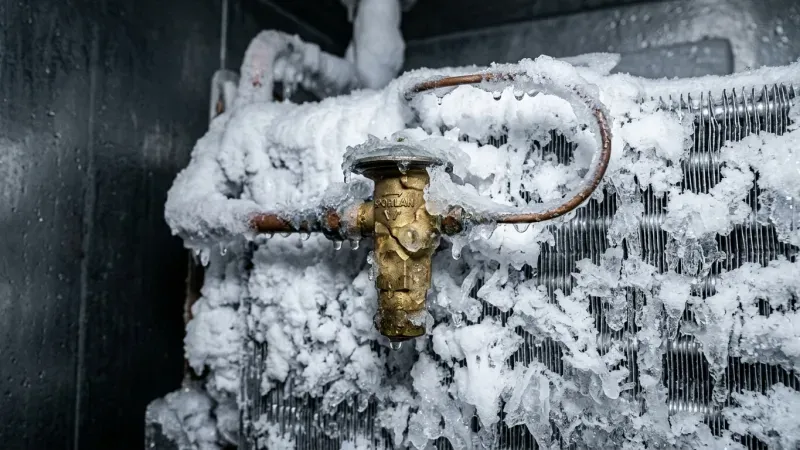
Field Telemetry Before Restoration: Evaporator airflow measured 0 CFM at ceiling plenum. Paragon timer motor resistance measured infinite (OL), stranding circuit in permanent cooling. Calrod heater showed 21.4 Ω but received 0VAC. Cabinet interior temperature logged at 53.8°F.
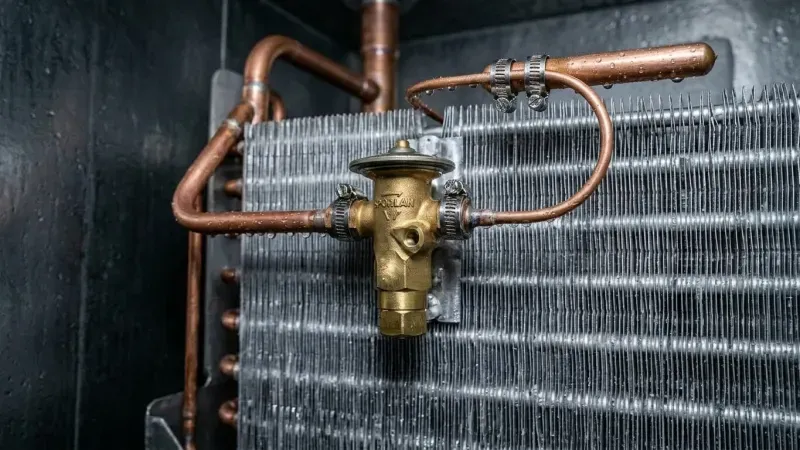
Field Telemetry After Restoration: Convective airflow restored to 365 CFM. Paragon timer motor running at 1.85 kΩ nominal impedance. Defrost termination confirmed at 54°F. Cabinet pulled down to 35°F in 34 minutes. 100% compliant with FDA holding regulations.
Mechanical, Electrical & Thermodynamic Root Causes of Defrost Failure
A frozen evaporator coil on a True commercial reach-in refrigerator is rarely an isolated random event. Rather, it represents the physical symptom of an underlying electromechanical or environmental failure within the refrigeration infrastructure. In the demanding foodservice operations of Fulton County, our master technicians routinely diagnose five distinct root causes behind frozen True evaporator coils:
Mechanical Clock Motor Burnout & Pinion Gear Binding
The Paragon 8145-20 and 8045-00 electromechanical defrost timers utilize a precision synchronous electric clock motor to rotate the timing dial continuously at 1 revolution per 24 hours. This motor is wound with thousands of turns of microscopic copper magnet wire, designed to operate at 120VAC line voltage with a standard electrical impedance between 1.5 kΩ and 2.2 kΩ (1,500 to 2,200 ohms). Operating in top-mount or bottom-mount commercial machine compartments subjected to ambient kitchen heat exceeding 100°F (37.8°C), airborne grease aerosols, and continuous electrical voltage fluctuations, the insulating enamel on the motor windings gradually degrades. Eventually, a winding turn shorts or burns completely open. When the motor coil burns open, its electrical continuity tests infinite (OL on a digital multimeter), and the clock motor permanently stops rotating. Because the mechanical cam wheel stops at the exact moment the motor died—overwhelmingly during the cooling cycle when pins 1 and 4 are closed—the refrigerator remains stranded in cooling mode indefinitely, never triggering the calrod heater. Securing dependable appliance repair in Alpharetta, GA ensures that genuine OEM timing controls are deployed to resolve clock motor failures promptly.
Calrod Defrost Heater Open Circuit & Element Rupture
In commercial True freezers and low-temp reach-ins equipped with active electric defrost, heavy-duty sheath-style calrod heating elements weave directly through the lower rows of the aluminum evaporator fins and along the condensate drain trough. Operating at 120VAC with a rated wattage between 600W and 850W, an operational calrod heater should exhibit a precise cold electrical resistance between 18 Ω and 24 Ω, drawing between 5.0 and 6.6 amperes during an active defrost cycle. Over years of thermal cycling—rapidly heating to over 200°F during defrost and plunging back down to freezing during cooling—the internal nichrome resistance wire undergoes metal fatigue, while microscopic moisture breaches the compressed magnesium oxide insulation within the stainless steel sheath. Eventually, the nichrome element fractures, creating an open circuit (infinite ohms / OL). Even if the Paragon timer advances into defrost perfectly and closes terminals 1 and 3, no electrical current flows through the calrod element. With zero heat generated, the evaporator coil remains frozen solid while internal fans remain off, paralyzing cabinet cooling. Commercial operators seeking expert service in neighboring communities can count on our factory-trained teams for Milton, GA commercial refrigeration service with fully stocked replacement calrod elements.
Defrost Termination Bimetal Thermostat Contact Failure
The defrost termination thermostat—typically a hermetically sealed Klixon 37T01 disc thermostat—serves as the critical safety and efficiency gatekeeper of the defrost cycle. Clipped firmly onto the suction line tubing near the evaporator header, this bimetallic switch is designed to close its electrical contacts (measuring 0 Ω dead short) when cold (below 35°F / 1.7°C), permitting power to energize the defrost circuitry. When the evaporator fins reach approximately 50°F to 55°F (10°C to 12.8°C), indicating all ice has melted, the bimetal disc flexes upward, snapping the internal contacts open (measuring infinite resistance / OL) to de-energize the heater calrod and signal the Paragon timer solenoid to advance back into cooling. If internal moisture penetrates the Klixon epoxy seal, the contact points corrode, pit, or weld. If the contacts fail open permanently, the timer never recognizes that the coil is cold, preventing heater initiation. Conversely, if contacts weld shut, the heater may remain energized far too long, steaming the evaporator compartment and tripping high-limit thermal fuses.
Magnetic Door Gasket Inversion & Ambient Moisture Infiltration
Commercial kitchens are intense humidity generators. Commercial dishwashing machines, pasta cookers, simmering stock pots, and open fryers flood kitchen air with hot water vapor. True reach-in refrigerators rely on flexible PVC magnetic dart gaskets to form an airtight seal against the stainless steel cabinet face. Over months of heavy use, gaskets become stiffened by kitchen grease, torn by pan carts, or inverted at bottom door corners. Even a hairline 1/16-inch gap along a door perimeter creates a continuous chimney effect: cold, dense internal air spills out across the floor, while warm, humid kitchen air is sucked continuously into the top of the cabinet. This perpetual stream of humidity deposits an overwhelming moisture load directly onto the evaporator coil. The rate of frost accumulation outpaces the pre-programmed 4-cycle daily defrost schedule, transforming the coil into a solid ice block within days, even if the electrical defrost components are nominally functional.
Evaporator Drain Line Ice Damming & Condensate Trough Overflow
Every time a True commercial refrigerator enters a defrost cycle, hundreds of milliliters of water melt off the evaporator coil and drain into the bottom aluminum trough. To prevent this meltwater from refreezing as it travels out of the freezing zone, True incorporates a heated drain line loop or silicone heater cable. If food debris, airborne yeast, or mineral slime clogs the drain trap, or if the drain heater burns open (normal resistance: 65–85 Ω), the discharge water pools in the trough and freezes into an ice dam during the subsequent cooling cycle. With each progressive defrost cycle, meltwater has nowhere to escape; it rises into the bottom rows of the evaporator coil, freezing into a solid ice base that rapidly migrates upward across all cooling rows.
Commercial Kitchen Operator Safe Triage & Diagnostic Sequence
When a kitchen supervisor discovers rising temperatures inside a True commercial reach-in on North Point Parkway, performing a disciplined, non-invasive diagnostic triage sequence can immediately isolate whether the issue stems from an electrical timer failure or an external mechanical problem. These non-invasive steps can be safely conducted by restaurant staff before calling master technicians. Facilities in neighboring jurisdictions can also coordinate fast dispatch for commercial refrigeration repair in Roswell, GA when diagnostic steps indicate electrical component failure.
Verifying Power Delivery and Mechanical Compartment Clearances
Begin by confirming stable electrical delivery. Verify that the dedicated 15A or 20A commercial circuit breaker in the facility electrical panel has not tripped. On top-mount True models (such as T-49), inspect the upper mechanical housing louvers. Ensure that kitchen staff have not stacked cardboard boxes, sheet pans, or cleaning towels on top of the cabinet, which severely restricts condenser ventilation. A choked condenser coil elevates head pressures, causing extreme heat buildup in the machine compartment that directly contributes to premature Paragon timer motor winding failures.
Manual Defrost Cam Advancement Triage (The Click Test)
Locate the Paragon defrost timer housing. On most True reach-in units, this is mounted inside the main electrical junction box in the top mechanical compartment or behind the lower front louvered grille. In the center of the Paragon timer face dial, observe the small brass center shaft with a slotted screwdriver indentation. With the unit powered on, insert a flathead screwdriver into the center shaft and rotate it slowly clockwise. You will feel minor mechanical resistance as the internal gear reduction engages. As you turn the shaft, listen closely for a distinct, heavy mechanical “snap” or click. This click indicates that the internal cam switch has tripped from cooling mode (pins 1 to 4) into defrost mode (pins 1 to 3). Immediately observe system behavior: the compressor and condenser fan should immediately shut off. Within 60 to 90 seconds, listen closely near the interior evaporator coil shroud for the faint sizzling sound of meltwater dripping onto a hot calrod heater element. If advancing the timer manually ignites the heater and initiates melting, but the timer was previously sitting motionless for hours, you have definitively proven that the timer clock motor is burned out or the gear train is stripped. The timer requires replacement.
Inspecting Evaporator Frost Pattern and Airflow Discharge
Open the refrigerator doors and use a high-lumen inspection flashlight to peer through the interior ceiling evaporator fan louvers. Observe the frost pattern across the coil fins. An evenly frosted coil that has simply become excessively dense points directly to a defrost timing or heater failure. Conversely, if only the top 2 rows of the coil or only the expansion valve inlet tube are covered in ice while the remaining 80% of the coil is completely dry and warm, the issue is not a defrost timer failure; rather, it indicates an undercharge condition caused by a sealed-system refrigerant leak or a restricted thermostatic expansion valve (TXV). Commercial kitchens requiring urgent assistance across Fulton County can rely on our teams for specialized Johns Creek, GA commercial kitchen repairs to resolve complex sealed-system refrigeration leaks.
Evaluating Door Gasket Hermetic Seals with Paper Gauge Test
Take a standard crisp dollar bill or piece of copy paper and insert it between the magnetic door gasket and the stainless steel cabinet face. Close the door firmly and pull the paper outward. You should feel noticeable mechanical resistance as the magnetic strip grips the paper. Repeat this test every 12 inches along the entire top, bottom, and side perimeter of every door. If the paper slides out effortlessly with zero resistance, or if visual gaps exist where light shines through, ambient kitchen air is infiltrating the box continuously. Cleaning the gaskets with warm soapy water and adjusting the door hinge cams may temporarily restore the seal, but torn or hardened gaskets must be replaced with genuine OEM True magnetic dart gaskets.
Commercial High-Voltage, Refrigerant & Defrost System Stop Thresholds
While kitchen managers and culinary staff can perform basic visual inspections and manual timer advances, restaurant operators must enforce strict boundaries where amateur DIY intervention ceases and licensed commercial refrigeration specialists take over. Commercial reach-in refrigerators are industrial appliances operating with high-voltage electricity and pressurized chemical refrigerants. Crossing these safety thresholds risks lethal electrical shocks, catastrophic equipment destruction, and voiding commercial insurance policies.
Lethal 120V to 208/230V Electrical Shock Hazards in Commercial Panels
The electrical control boxes of True commercial refrigeration equipment house unshielded high-voltage terminal blocks, motor start capacitors holding substantial stored electrical charge, and potential relays operating at line voltages between 115VAC and 230VAC. Attempting to probe terminal connections with consumer-grade handheld meters without formal arc-flash and electrical safety training exposes personnel to severe shock, electrocution, and severe burns. Furthermore, commercial kitchens feature stainless steel work tables and wet quarry tile floors, creating an exceptionally dangerous, low-resistance path to ground. When electrical troubleshooting is required, culinary leaders should also ensure other heavy thermal assets are serviced properly by scheduling commercial oven and range repair to maintain overall kitchen infrastructure.
Risk of Refrigerant Tubing Puncture During Aggressive Ice Chipping
The single most common and costly mistake made by well-intentioned restaurant staff is attempting to remove an evaporator ice block using knives, ice picks, meat cleavers, or screwdrivers. Commercial evaporator coils are constructed from thin-wall copper tubing (wall thickness often under 0.028 inches) and delicate aluminum fin sheets. Striking an ice block with a metal tool will puncture the pressurized copper circuit within milliseconds. The entire refrigerant charge immediately vents into the kitchen air with an explosive hiss, filling the cabinet with atomized oil and rendering the equipment instantly unusable. Puncturing an evaporator coil transforms an inexpensive $300 defrost timer repair into a complex $2,000+ sealed-system overhaul requiring evaporator coil replacement, filter drier evacuation, nitrogen purging, and refrigerant recharging.
Liquid Refrigerant Floodback & Compressor Crankcase Damage
When an evaporator coil is completely encased in solid ice, heat transfer stops entirely. Because there is no thermal energy to boil the refrigerant in the coil tubes, raw liquid refrigerant travels directly through the suction line into the compressor crankcase. Commercial refrigeration compressors are strictly vapor pumps; liquids are incompressible. When liquid refrigerant floods the crankcase, it washes the synthetic polyolester (POE) or mineral lubricating oil directly off the crankshaft journals and piston wrist pins, causing severe mechanical friction, broken connecting rods, and blown valve reeds. If you observe frost covering the exterior suction line entering the compressor shell, power down the unit immediately and contact certified technicians.
EPA Section 608 Compliance & R-290 Hydrocarbon Flammability Standards
Modern True commercial reach-in models manufactured since 2017 utilize eco-friendly R-290 refrigerant (high-purity commercial propane, designated A3 flammable). Federal regulations under Clean Air Act Section 608 strictly mandate that any servicing involving sealed-system lines, brazing, or refrigerant management must be performed exclusively by EPA Universal-certified technicians using explosion-proof recovery and charging apparatus. Attempting to service or manipulate sealed tubing on an R-290 unit without specialized spark-free commercial equipment creates serious flash-fire hazards. Foodservice operators maintaining heavy sanitation equipment alongside refrigeration can also arrange professional commercial dishwashing equipment repair to uphold kitchen health compliance across all major workstations.
Commercial Kitchen Equipment Capital Allocation: Repair vs Replace Decision Matrix
When faced with a defrost failure and an iced-up evaporator coil on a True commercial reach-in refrigerator, hospitality operators and financial controllers must evaluate whether repairing the existing unit makes prudent economic sense or whether capital replacement is justified. Commercial kitchen equipment represents substantial balance-sheet investments. A brand-new commercial True T-49 two-door reach-in refrigerator commands a purchase price between $4,500 and $6,200, plus freight delivery, mechanical uncrating, commercial kitchen installation, and legacy unit disposal fees. Operators frequently apply the commercial 50% Rule: if the estimated repair cost exceeds 50% of the replacement value and the unit has surpassed 75% of its expected industrial lifespan (typically 12 to 15 years for True heavy-duty platforms), replacement is evaluated. Hospitality groups operating multiple commercial laundry or dishwashing facilities can also budget for comprehensive commercial laundry and dryer repair to optimize broader facility expenditures.
| Component / Failure Scenario | Typical Age Profile | Estimated Repair Investment | Replacement Unit Cost | Recommended Capital Action |
|---|---|---|---|---|
| Stuck Paragon Defrost Timer (Motor / Contacts) | 1–10 Years | $280 – $420 | $4,500 – $6,200 | Definitive Repair (Immediate ROI) |
| Burned Calrod Defrost Heater + Bimetal Switch | 2–11 Years | $340 – $520 | $4,500 – $6,200 | Definitive Repair (Under 10% of Replacement) |
| Complete Defrost Overhaul (Timer + Heater + Bimetal + Gaskets) | 5–12 Years | $580 – $840 | $4,500 – $6,200 | Strongly Recommend Repair (Adds 5+ Years Lifespan) |
| Punctured Evaporator Coil + Moisture in Sealed System | 8–12 Years | $1,600 – $2,200 | $4,500 – $6,200 | Evaluate Overall Cabinet Condition & Lead Time |
| Seized Compressor + Rotted Cabinet Walls + Leaking Coil | 14+ Years | $2,400 – $3,200 | $4,500 – $6,200 | Capital Replacement Recommended |
As illustrated clearly above, when a True commercial refrigerator suffers an iced evaporator coil due to a defective defrost timer, heating element, or bimetallic sensor, repairing the unit represents an overwhelming financial victory for the business. A professional repair costs less than 8% to 12% of the replacement price while returning the unit to factory cooling performance in a single day. Facilities seeking reliable support for institutional laundry equipment can simultaneously schedule commercial washing machine repair to protect operational uptime across all back-of-house operations.
Interactive Commercial True Refrigerator Defrost Repair Cost Estimator
To assist commercial kitchen managers and culinary directors along North Point Parkway in forecasting repair expenditures, utilize our interactive commercial cost estimation widget below to calculate instant repair estimates based on your True equipment profile:
North Point Parkway & Fulton County Commercial Refrigeration Pricing Breakdown
Commercial refrigeration repair costs in the North Point Parkway commercial entertainment district reflect professional industrial standards. Several concrete technical factors influence the final invoice for True defrost restoration services:
Component Parts Cost & True OEM Availability
Genuine True OEM replacement components are engineered to withstand severe industrial duty cycles. Genuine Paragon 8145-20 defrost timers typically retail between $95 and $175, while custom-formed True calrod defrost heating elements range from $110 to $195 depending on cabinet width and wattage. Bimetallic defrost termination thermostats and sensor clips generally cost between $45 and $85. While generic aftermarket universal timers exist online, our technicians exclusively install authentic True OEM components. Generic timers frequently feature lower contact amperage ratings (burning out under 12A inductive loads) and lack the exact cam timing configurations required by True engineering schematics. Culinary operators maintaining luxury residential equipment in estate properties can explore our certified Sub-Zero commercial-grade refrigeration services for specialized residential preservation.
Emergency Diagnostic & Specialized Labor Rates
Commercial refrigeration diagnostics require EPA Universal certification, true-RMS multimeter telemetry, and deep knowledge of commercial refrigeration thermodynamics. Standard commercial diagnostic and trip fees across North Fulton County range between $119 and $189. Labor for safe thermal steam de-icing, timer replacement, heater wiring, and post-repair telemetry verification typically encompasses 1.5 to 2.5 hours of specialized technician time. For emergency weekend calls or late-night dispatches during heavy kitchen rush hours on North Point Parkway, premium dispatch structures ensure immediate technician mobilization within 45 to 75 minutes. Premium kitchen owners with luxury chef-grade systems can also coordinate with our team for dedicated Viking refrigeration systems repair throughout Alpharetta.
The True Cost of Inaction: Food Spoilage & Health Department Shutdowns
When weighing the cost of a $350 to $500 commercial defrost repair, restaurant owners must weigh the disastrous financial alternatives. A fully stocked True T-49 two-door reach-in refrigerator routinely holds between $3,500 and $7,000 worth of premium meats, seafood, imported dairy, and house-made sauces. If internal temperatures linger above 41°F for more than four hours, Georgia Department of Public Health (DPH) rules mandate that all TCS foods must be condemned and discarded. Beyond direct food loss, receiving a critical health inspection citation for warm holding temperatures severely damages restaurant reputation, lowers health scores posted at the front door, and can trigger mandatory closure orders.
Professional Multimeter Telemetry, Component Ohms & Wiring Schematic Lookup
Master commercial refrigeration technicians rely on scientific measurement rather than guesswork. When diagnosing an iced-up True reach-in refrigerator, our technicians deploy industrial digital multimeters (Fluke 87V or Fieldpiece SC680) to capture precision true-RMS electrical resistance, voltage drop, and operating amperage telemetry across all defrost circuits. Use the filterable telemetry search tool below to review factory resistance parameters and diagnostic thresholds:
| Component Name | Test Terminals | Normal Resistance / Voltage | Operating Amperage | Failure Indicator |
|---|---|---|---|---|
| Paragon Mechanical Timer Clock Motor | Terminals 1 to 2 (or 1 to N) | 1.5 – 2.2 kΩ (1,500–2,200 Ω) @ 120VAC | 0.04 – 0.08 A | Infinite (OL) = Open Motor Coil; 0 Ω = Shorted |
| Calrod Defrost Heater Element | Terminal 3 to Neutral Lead | 18 – 24 Ω (600W–800W) | 5.0 – 6.6 A | Infinite (OL) = Ruptured Element; <10 Ω = Shorted |
| Defrost Termination Bimetal (Klixon) | In-Line Termination Leads | 0 Ω (Closed <35°F) / OL (Open >50°F) | Signal Circuit Only | OL when ice-cold = Defective Open Bimetal Disc |
| Evaporator Fan Motor (Shaded Pole / ECM) | Motor Harness Power Pins | 28 – 45 Ω (120VAC line input) | 0.45 – 0.90 A | OL = Burned Stator; >1.5A = Seized Bearings |
| Drain Pan / Trough Loop Heater | Heater Lead Terminals | 65 – 85 Ω (150W–220W) | 1.25 – 1.80 A | Infinite (OL) = Open Circuit (Causes Ice Dams) |
| Compressor Contactor Solenoid Coil | Coil Terminals A1 to A2 | 14 – 22 Ω | 0.25 – 0.40 A | OL = Dead Solenoid; Chattering Contactor |
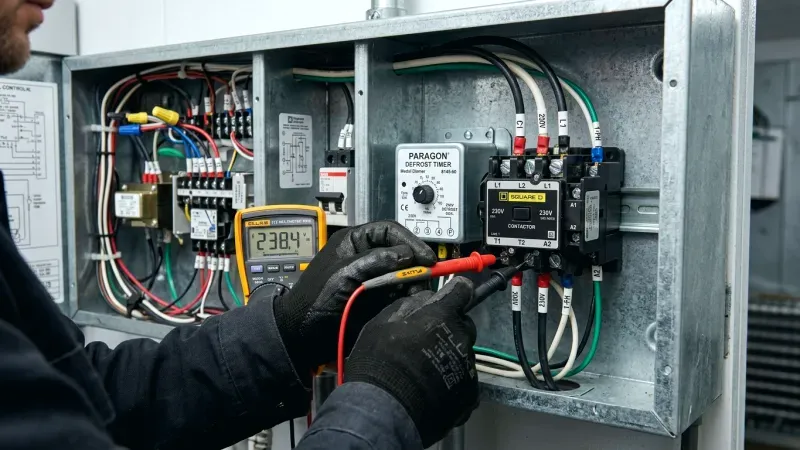
When probing these terminals, our technicians follow strict safety sequences. By measuring true-RMS operating amperage with a calibrated clamp meter around the calrod line lead during manual timer initiation, we instantly verify whether the heater element is pulling its rated 5.0 to 6.6 amps. If zero current flows despite proper line voltage delivery at terminal 3, the heater element has suffered an internal open circuit. Operators looking for factory-certified care on other refrigeration equipment can also explore our KitchenAid commercial cooling units service.
Similarly, testing across the defrost termination bimetal thermostat while the evaporator is packed with ice provides incontrovertible proof of component health. An operational bimetal thermostat must read 0.0 ohms of dead-short continuity at temperatures below 35°F. If the multimeter displays infinite resistance (OL) while submerged in freezing ice, the bimetal switch contacts have corroded or snapped open, preventing the defrost circuit from completing its electrical path. High-end food establishments in North Fulton also rely on our expertise for Bosch commercial refrigeration equipment maintenance and electrical controls.
Authentic OEM True Replacement Components & Part Identification
Maintaining the engineering integrity and factory warranty of True commercial refrigeration equipment requires installing authentic True Manufacturing OEM replacement parts. Generic universal components sourced from non-commercial distributors frequently feature inferior plastics, lower contact metallurgy, and improper resistance curves that fail prematurely under heavy commercial kitchen demands. Our mobile service vans serving the North Point Parkway dining corridor maintain comprehensive stock of genuine True OEM parts:
| OEM Part Name | True Part Number | Electrical Specifications | Primary True Model Compatibility | Component Function |
|---|---|---|---|---|
| Paragon 8145-20 Defrost Timer | True #830425 | 120VAC, 60Hz, 40A / 2HP Rating | T-49, T-49F, T-23, T-72, TR2FRI | Main clock control cycling cooling and electric defrost circuits |
| Calrod Evaporator Defrost Heater | True #801828 / #932578 | 115VAC, 650W, 21.4 Ω nominal | T-49, T-49F Reach-In Refrigerators | Stainless-sheath calrod radiating heat to melt fin frost |
| Defrost Termination Thermostat Bimetal | True #800318 (Klixon) | Cut-In 35°F, Cut-Out 54°F | All True Commercial Reach-Ins | Snaps open at 54°F to end defrost cycle and prevent coil overheating |
| Evaporator Fan Delay Thermostat | True #800319 | Cut-In 25°F, 120VAC line switch | T-Series Commercial Freezers / Coolers | Delays fan startup post-defrost until coil is frozen to prevent steam blow |
| Heated Drain Trough Cable Assembly | True #801830 | 115VAC, 180W, 74 Ω nominal | True T-49, T-72 Commercial Coolers | Keeps drain trough and drain funnel liquid during melt discharge |
| Magnetic Perimeter Door Gasket | True #810810 / #810811 | Dart-Style Push-In Magnetic Vinyl | True T-49 Solid Door Units | Maintains hermetic cabinet seal to prevent ambient humidity infiltration |
Using genuine True parts guarantees exact dimensional tolerance, factory electrical harness mating, and maximum operating longevity. Kitchen operators managing mixed-equipment suites can also access certified technical support for GE commercial refrigeration systems across Fulton County dining venues.
By carrying these verified parts in inventory, our service vehicles can resolve over 95% of True defrost failure calls on the initial visit without delays for component shipping. Multi-brand hospitality kitchens can also coordinate fast assistance for Whirlpool commercial refrigeration platforms across North Fulton.
Food-Service Evaporator & Defrost Preventative Maintenance Protocols
In the high-intensity hospitality environments of North Point Parkway, proactive preventative maintenance is far less costly than emergency repair and inventory loss. By establishing structured maintenance routines, commercial culinary operations can virtually eliminate defrost-related breakdowns and extend equipment operational lifespans beyond 15 years:
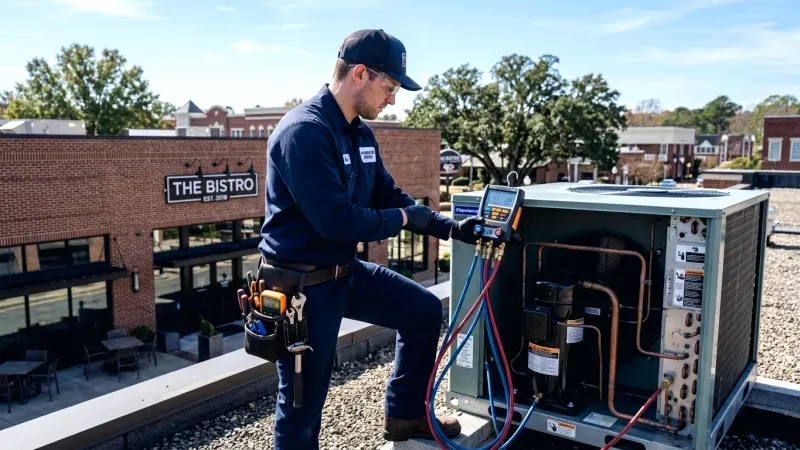
Daily Kitchen Closing Checklist and Temperature Log Compliance
Kitchen line cooks should log cabinet temperatures twice daily—at shift opening and kitchen closing. Consistently logging box temperature reveals early temperature creep before product is lost. At closing, kitchen staff must verify that all reach-in doors are fully latched and that pan handles or plastic containers are not obstructing door closure.
Monthly Condenser Coil Cleaning & De-Greasing
At least once every 30 days, unplug the reach-in cabinet and brush down the condensing coil in the top or bottom machine compartment using a commercial coil brush and vacuum. Airborne cooking grease and flour dust bond to condenser fins, elevating discharge temperatures and roasting the Paragon defrost timer clock motor. Clean condenser coils keep machine compartment ambient temperatures below 90°F, preserving timer motor insulation.
Quarterly Defrost Timer Verification & Terminal Torquing
Every 90 days, inspect the Paragon defrost timer during routine service. Check timer dial rotation against the current wall clock time to confirm the synchronous clock motor is advancing accurately. Use an insulated torque screwdriver to check terminal screws (terminals 1, 2, 3, and 4) for looseness caused by thermal vibration. Inspect switch contacts for electrical pitting or carbon deposits.
Bi-Annual Gasket Lubrication & Air Infiltration Inspection
Every six months, thoroughly clean all magnetic door gaskets with warm, mild soapy water to remove accumulated food acids and oils. Apply a thin coating of food-grade silicone lubricant to the hinge side of the gasket to prevent binding and tearing during door opening. Inspect corners for separation or magnet inversion.
Commercial Electrical, Mechanical & Health Code Safety Protocols
Servicing commercial refrigeration equipment in busy foodservice environments demands strict adherence to industrial safety standards and statutory health regulations:
- OSHA Lockout/Tagout (LOTO) Compliance: Before opening the Paragon defrost timer electrical housing or accessing the evaporator calrod heating element, technicians must disconnect and lock out the dedicated circuit breaker in accordance with OSHA 29 CFR 1910.147. Commercial refrigerators often feature dual power feeds for external sign lights and heated condensate pans. Always verify zero voltage with an approved multimeter before touching internal wiring.
- Capacitor Discharge Safety: Commercial compressor electrical compartments contain heavy-duty motor start and run capacitors holding high DC voltage even after main power disconnection. Technicians must safely discharge all capacitors using a 20,000-ohm, 5-watt ceramic resistor before handling terminal leads.
- Strict Ban on Open-Flame Torches for De-Icing: Never use a propane plumber’s torch or open flame inside the refrigerated cabinet to melt evaporator ice. In addition to torch flame igniting plastic cabinet liners and polyurethane insulation, localized high heat violently spikes internal refrigerant pressure in sealed copper tubes, creating explosive rupture risks.
- FDA Model Food Code 3-501.16 Compliance: All cold-holding time/temperature control for safety (TCS) foods must be maintained at 41°F (5°C) or below. If a frozen evaporator coil causes cabinet temperatures to exceed 41°F for more than 4 hours, all affected food must be discarded immediately to prevent foodborne illness outbreaks.
- Georgia DPH Rule 511-6-1 Food Service Sanitation: Under Georgia Department of Public Health food regulations, refrigeration units must maintain internal ambient air temperatures capable of holding foods at or below 41°F. Health inspectors cite temperature violations as critical priority items, resulting in score deductions and potential operational suspension.
- EPA Section 608 Refrigerant Venting Ban: Venting R-134a, R-404A, or modern refrigerants into the atmosphere is a federal violation punishable by substantial fines. Technicians must utilize certified recovery equipment for all sealed-system repairs. On modern R-290 units, technicians follow specialized spark-free ventilation procedures.
Frequently Asked Technical Questions on True Refrigerator Defrost Failures
Review our technical FAQ directory addressing the most common commercial diagnostic questions encountered by foodservice operators regarding True reach-in refrigerators and stuck defrost timers:
Why did my True commercial refrigerator coil freeze into a solid block of ice?
A True commercial refrigerator evaporator coil freezes solid when the automatic defrost cycle fails to initiate, convective airflow is blocked, or ambient moisture infiltrates the cabinet continuously. The most common technical cause is a stalled electromechanical Paragon defrost timer whose 120VAC clock motor has burned open (infinite ohms OL vs 1.5–2.2 kΩ nominal). Without timer rotation, the system remains locked in cooling mode 24 hours a day. Other primary causes include an open calrod electric defrost heater (measuring OL vs 18–24 Ω normal), a defective defrost termination bimetal switch that never closes, or severely compromised magnetic door gaskets allowing humid kitchen air to flood the cabinet.
How do I know if the Paragon defrost timer is stuck or defective on my True reach-in?
You can verify whether a Paragon timer is stuck by conducting the manual advancement test. Locate the timer in the mechanical compartment and use a flathead screwdriver to gently rotate the center brass shaft clockwise until you hear a distinct mechanical click, tripping the system into defrost. If the compressor shuts down and the calrod heater immediately begins heating and sizzling off ice, but the timer was previously sitting motionless for hours, the timer clock motor is burned out or the internal reduction gear train has stripped. Measuring line voltage across timer clock terminals 1 and 2 (120VAC present) combined with an open motor coil resistance measurement (OL) confirms total timer failure.
What resistance should a True commercial calrod defrost heater measure on a multimeter?
An operational True commercial calrod defrost heater element (such as True OEM part #801828 or #932578) should measure between 18 and 24 ohms of electrical resistance across its disconnected wire leads on a digital multimeter. Operating at 120VAC line power, this resistance generates approximately 600 to 800 watts of thermal energy, drawing between 5.0 and 6.6 amperes during an active defrost cycle. If your multimeter reads infinite resistance (OL), the internal nichrome heating wire has ruptured and the calrod element must be replaced.
What is the normal ohm reading for a Paragon 8145-20 defrost timer clock motor?
A healthy Paragon 8145-20 or 8045-00 120VAC mechanical defrost timer clock motor should measure an electrical resistance between 1.5 kΩ and 2.2 kΩ (1,500 to 2,200 ohms) across terminals 1 and 2 (or terminals 1 and N) with the power disconnected. If the meter displays infinite resistance (OL), the internal synchronous motor windings have burned open. If it reads under 500 ohms, the motor has suffered an internal short circuit. Both conditions prevent timer rotation and require immediate replacement.
How does the defrost termination bimetal thermostat work on True commercial coolers?
The defrost termination bimetal thermostat (Klixon 37T01 switch) is a thermal safety switch clipped directly to the evaporator return bend. When the coil is cold (below 35°F), its internal bimetallic disc is closed, showing 0.0 ohms of continuity, allowing power to flow through the defrost circuit. Once the heater melts the ice and the coil reaches 50°F to 55°F, the disc snaps open (infinite ohms OL), immediately de-energizing the calrod heater to prevent overheating the cabinet and signaling the timer solenoid to return to cooling mode.
Why is my evaporator fan motor not running immediately after the defrost cycle ends?
This is a normal engineering safety feature called evaporator fan delay. Commercial True refrigerators incorporate an evaporator fan delay thermostat (True part #800319) that holds the evaporator fans powered off for 3 to 7 minutes after a defrost cycle concludes. This allows the compressor to pull the coil temperature back down below 25°F before the fans kick on. If the fans ran immediately while the coil was still warm and wet, they would blow hot steam and moisture droplets directly onto food pans, causing moisture fogging and frost formation across the cabinet ceiling.
Can I use a heat gun or hair dryer to melt ice off a commercial True evaporator coil?
Using a high-temperature industrial heat gun directly on a commercial evaporator coil is strongly discouraged by manufacturers. Heat guns produce localized temperatures exceeding 600°F (315°C), which can easily melt internal aluminum drip pans, warp plastic fan housings, and crack delicate solder joints on copper refrigerant tubes. Professional commercial technicians use controlled low-pressure thermal steam wands or gentle warm water flushing to melt ice safely without creating thermal shock or puncturing refrigerant lines.
How often should a commercial True reach-in refrigerator enter a defrost cycle?
Under standard foodservice conditions in commercial kitchens along North Point Parkway, a True medium-temperature reach-in refrigerator is typically configured to enter defrost 3 to 4 times every 24 hours (spaced 6 to 8 hours apart). In high-temperature, high-humidity restaurant kitchens with extremely frequent door openings, technicians may program 4 to 6 defrost cycles per day. Each cycle has a maximum fail-safe duration of 30 to 45 minutes, although active defrost terminates much sooner (15–20 minutes) once the bimetal switch opens at 54°F.
Why is water leaking onto the top shelf inside my True refrigerator cabinet?
Water pooling on the top food shelf directly beneath the evaporator shroud indicates that the evaporator condensate drain line or drain trough is frozen solid or clogged with slime. When the defrost heater melts ice, the runoff cannot flow down the drain tube; instead, it backs up over the edges of the aluminum drain pan and drips down onto stored food containers. The solution involves clearing the drain trap, inspecting the drain trough loop heater (normal: 65–85 Ω), and verifying drain line pitch.
What is the difference between off-cycle defrost and electric calrod defrost on True units?
Off-cycle defrost is used on medium-temperature refrigerators where the cabinet operates above 35°F. During off-cycle defrost, the compressor shuts off while the evaporator fans continue running, circulating above-freezing cabinet air across the coil to melt light frost naturally. Electric calrod defrost is used on commercial freezers and heavy-duty coolers operating at lower saturated evaporating temperatures; it physically shuts off the fans and energizes high-wattage electric calrod heaters (18–24 Ω) to rapidly melt dense ice.
Will a damaged magnetic door gasket cause the evaporator coil to ice up solid?
Yes, absolutely. A torn, hardened, or inverted magnetic door gasket breaks the hermetic seal of the refrigerated cabinet. In busy commercial kitchens along North Point Parkway, warm, humid kitchen air is sucked continuously through gasket gaps into the cabinet. This massive moisture influx constantly condenses and freezes on the cold evaporator fins, overwhelming the capacity of normal defrost cycles and forming a solid ice block within 48 to 72 hours.
Why does my True refrigerator compressor run non-stop while cabinet temp stays at 50°F?
When the evaporator coil is entombed in ice, convective airflow across the fins is completely choked (0 CFM). Even though the compressor is pumping refrigerant at full capacity, the refrigerant cannot absorb heat from the cabinet air because of the insulating ice barrier. The interior thermostat senses the warm air (50°F) and keeps the compressor running continuously in a futile attempt to cool the box, resulting in non-stop compressor operation without temperature reduction.
What are the health inspection consequences of food holding temperatures above 41°F in Alpharetta?
Under Georgia Department of Public Health (DPH) Rule 511-6-1 and the FDA Model Food Code, cold holding of time/temperature control for safety (TCS) foods above 41°F is categorized as an imminent public health hazard and a critical priority violation. Health inspectors will issue severe point deductions on your restaurant inspection score, require the immediate condemnation and disposal of all affected food inventory, and may suspend food service operating permits if critical refrigeration cannot be restored immediately.
How long does it take for a True commercial refrigerator to pull down after defrost repair?
Following successful defrost repair and complete de-icing of the evaporator coil, a commercial True reach-in refrigerator (such as a T-49) typically pulls down from an ambient kitchen temperature of 75°F to 80°F down to its target setpoint of 35°F (1.7°C) within 35 to 50 minutes, assuming the doors remain closed and the condensing coil is clean.
Can a low refrigerant charge cause evaporator coil icing on True coolers?
Yes, but the frost pattern is distinctly different from a defrost timer failure. When a True unit has a low refrigerant charge due to a leak, the saturated evaporating temperature at the start of the coil drops below freezing, causing localized heavy ice on the expansion valve inlet and first two tubing rows, while the rest of the coil remains completely bone dry and warm. In a defrost timer failure, the entire 4-row coil is evenly buried in an opaque, solid block of ice.
What warranty protection is provided on commercial True defrost timer and heater repairs?
All commercial True refrigeration repairs performed by our master technicians include a comprehensive 1-Year Commercial Warranty covering all genuine OEM True parts installed (including Paragon defrost timers, calrod heaters, and termination switches) and a 90-Day Dedicated Craftsmanship Guarantee on all technical labor. If the covered component fails within the warranty term, our technicians return promptly to resolve it at zero charge.
Can I replace a mechanical Paragon timer with a modern digital electronic controller?
Yes. On legacy True commercial reach-in models, our technicians can retrofit mechanical Paragon timers with modern digital electronic controllers (such as Dixell or Carel microprocessor controllers). Digital controllers eliminate mechanical gear wear, provide intelligent demand-defrost based on real-time coil temperature sensors, display real-time cabinet readouts, and include built-in high/low temperature audio alarms.
Related Commercial Refrigeration Services
Our factory-trained technicians provide comprehensive commercial and luxury refrigeration services across North Fulton County. Explore our specialized service capabilities:
- Commercial Appliance Repair & Refrigeration Systems
- Commercial & High-End Refrigerator Repair
- Same-Day Emergency Kitchen Appliance Repair
- 24/7 Priority Commercial Emergency Refrigeration Dispatch
Related Commercial Cooling Problems
If your food service cooling equipment is displaying symptoms beyond defrost timer failure, review our related technical diagnostic resources:
- Commercial Refrigerator Preventative Maintenance Protocols
- Commercial Kitchen Oven & Range Repair
- Commercial Dishwasher Diagnostics & Repair
Related Commercial Foodservice & Luxury Brands
In addition to True Manufacturing commercial platforms, our master technicians specialize in high-performance commercial and premium culinary brands:
- Sub-Zero Commercial & Residential Preservation
- Viking Commercial-Grade Refrigeration Systems
- KitchenAid Professional Culinary Refrigeration
Related North Fulton Service Locations
Our rapid-response mobile commercial repair units serve restaurants and hospitality properties across the greater North Fulton corridor:
- Commercial Refrigeration Service in Alpharetta, GA
- Commercial Restaurant Equipment Repair in Milton, GA
- Commercial Kitchen Service in Roswell, GA
- Commercial Kitchen Repairs in Johns Creek, GA
Key Operational Takeaways for Foodservice Managers
- Defrost Timers are Electromechanical Wear Items: Paragon synchronous clock motors have a typical commercial service life of 4 to 8 years under continuous kitchen operation. Open motor windings (measuring OL vs 1.5–2.2 kΩ) are the leading cause of reach-in defrost failure.
- A Frozen Coil Blocks All Convective Heat Transfer: When ice encases the evaporator fins, airflow drops to 0 CFM. Box temperatures rise into the bacterial danger zone despite continuous compressor operation.
- Manual Timer Advancement Confirms Motor Failure: Rotating the center timer shaft into defrost isolates whether the clock motor has seized. If manual advance fires the calrod heater, the timer motor is defective.
- Never Use Metal Tools to Chip Coil Ice: Striking ice with knives or screwdrivers punctures thin-wall copper tubing, causing explosive refrigerant loss and escalating repair costs into thousands of dollars.
- Calrod Element Resistance Must Measure 18–24 Ohms: A functional 120VAC calrod heater draws 5.0 to 6.6 amps. Infinite resistance confirms a burned-out heating element requiring replacement.
- Bimetal Termination Switches Must Close When Cold: The Klixon termination thermostat must exhibit 0.0 ohms continuity below 35°F and open cleanly at 54°F to end the cycle.
- Air Infiltration from Bad Gaskets Accelerates Icing: Torn or hardened door gaskets draw humid kitchen moisture continuously into the cabinet, overwhelming normal defrost cycles.
- Immediate Service Prevents Food Inventory Spoilage: Prompt same-day repair costs a fraction of lost food inventory and prevents severe health inspection violations under FDA Food Code 3-501.16.
Emergency Commercial Dispatch & Priority Booking Contact
Protect Your Commercial Kitchen Operations & Inventory Today
Do not let a stuck defrost timer or iced-up evaporator coil jeopardize your restaurant’s culinary inventory, food safety inspection scores, or dining reputation. Our EPA Universal-certified, factory-trained master technicians are on call across the North Point Parkway commercial entertainment district and greater Alpharetta, equipped with genuine OEM True components for immediate same-day restoration.
Serving North Point Parkway, Mansell Road, Haynes Bridge Road, Rock Mill Road, Westside Parkway, and the greater North Fulton corridor. Same-Day First-Visit Resolution • 1-Year Commercial Warranty on All OEM Parts.