
Whirlpool Gas Dryer WGD5000DW Not Heating — Igniter, Thermal Fuse & Gas Valve Repair Guide Alpharetta GA
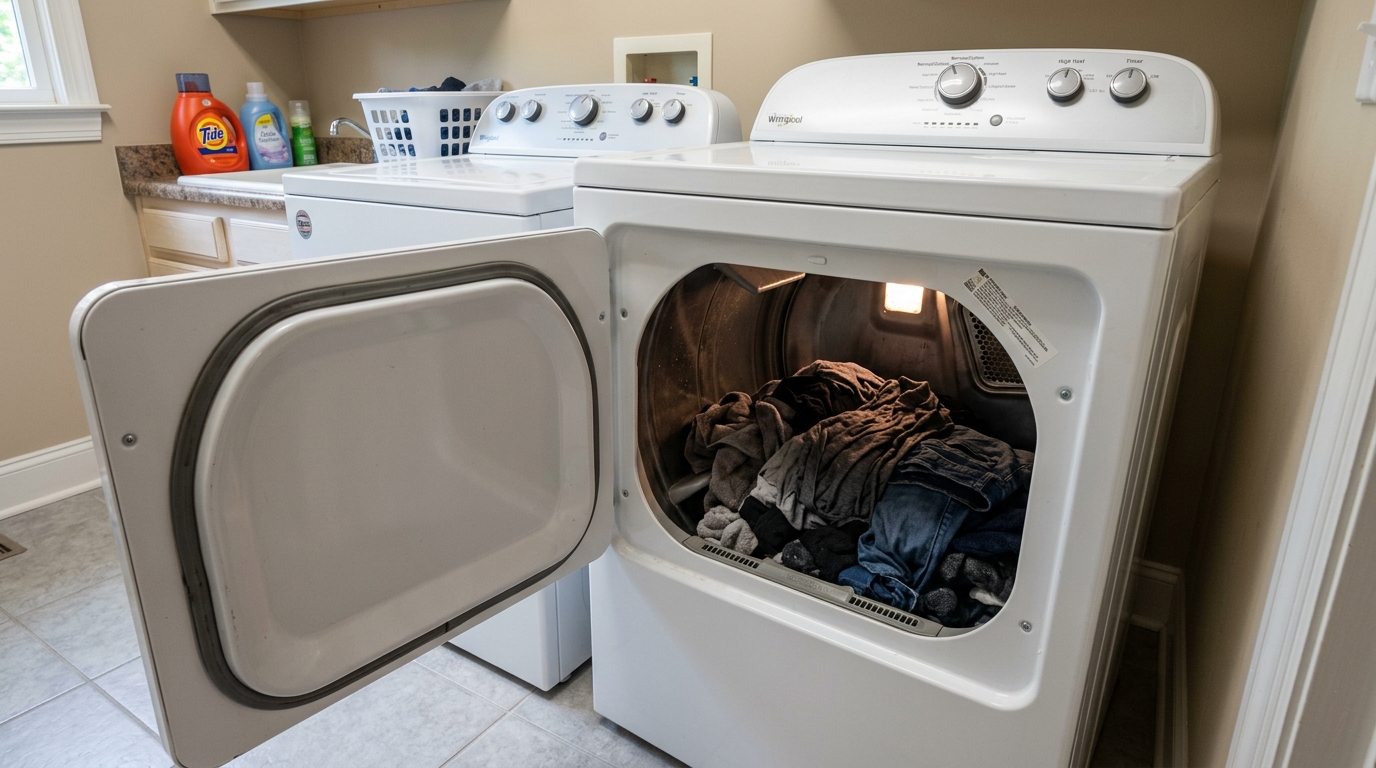
If your Whirlpool WGD5000DW gas dryer is tumbling endlessly but leaving your laundry cold and damp, you are facing one of the most frustrating but common laundry dilemmas. A gas dryer that refuses to heat up in Alpharetta, GA, can disrupt your entire weekly routine. Fortunately, the core components responsible for producing heat—such as the silicon carbide igniter, thermal fuse, and gas valve coils—can be systematically tested and replaced. This comprehensive, technical guide will walk you through diagnosing a no-heat failure, understanding your machine’s intricate safety circuits, and determining exactly when to call (770) 796-7742 for expert intervention.
Quick Answer: Why is My Whirlpool WGD5000DW Gas Dryer Not Heating?
The most frequent cause for a Whirlpool gas dryer tumbling without heating is a blown thermal fuse (which should test for continuous continuity; if it reads infinite ohms, it has tripped at 296°F). Other prime suspects include a failed silicon carbide igniter (normal resistance is 80-105 ohms), defective gas valve coils (primary ~1300 ohms, secondary ~500-600 ohms), or a malfunctioning radiant flame sensor (50-200 ohms). Always shut off the gas supply and unplug the machine before inspecting.
Table of Contents
- Introduction: Understanding the Whirlpool WGD5000DW
- Detailed Symptoms of a Non-Heating Gas Dryer
- Common Causes of No Heat in Gas Dryers
- Step-by-Step Troubleshooting Guide
- When to Stop DIY and Call a Professional
- Repair vs. Replace Decision Matrix
- Estimated Cost Factors for Gas Dryer Repairs
- How Professionals Diagnose heating failures
- Common Parts Involved in Heating Circuits
- Maintenance Tips to Prevent Future Failures
- Gas & Electrical Safety Guidelines
- Frequently Asked Questions (FAQs)
- Related Repair Services
- Related Appliance Problems
- Related Brand Pages
- Related Location Pages
- Key Takeaways
- Schedule Your appliance repair Today
Introduction: Understanding the Whirlpool WGD5000DW
The Whirlpool WGD5000DW is a robust, reliable, and highly popular gas dryer known for its efficient drying cycles and straightforward electromechanical design. Unlike electric dryers that rely on large heating elements drawing 240 volts of electricity, the WGD5000DW utilizes natural gas or liquid propane to generate a controlled flame. This flame provides the intense thermal energy required to evaporate moisture from your garments as they tumble. Understanding how this specific model orchestrates its heating cycle is paramount to diagnosing failures accurately. When you select a heat setting and press start, the drive motor engages, spinning the drum and operating the blower wheel. Simultaneously, a centrifugal switch within the motor closes, sending 120VAC to the primary heating circuit.
The Whirlpool WGD5000DW has a rich history as a staple in many Alpharetta, GA homes. Introduced as a highly efficient mid-range model, it balances affordability with performance. Homeowners in Alpharetta frequently choose this model due to its spacious 7.0 cu. ft. capacity and reliable gas heating mechanism. Over the years, the WGD5000DW has proven to be a workhorse, handling large loads of family laundry with ease. The straightforward mechanical timer and durable drum rollers have made it a favorite among those who prefer longevity over complex electronic controls. However, like any mechanical device, it is subject to wear and tear, particularly in its heating components.
Many Alpharetta homeowners have shared their experiences with the WGD5000DW, often highlighting its fast drying times when operating optimally. A common scenario we hear involves a family returning from a weekend trip to Lake Lanier, only to find their trusty Whirlpool dryer tumbling their wet towels endlessly without producing heat. The frustration of dealing with damp, musty-smelling clothes is a shared sentiment. Yet, the consensus remains that when repaired, this model often provides years of extended service. The key is understanding that the components causing the no-heat issue are precisely engineered safety and operational mechanisms designed to fail safely rather than cause catastrophic damage.
The sequence of events to produce a flame is highly choreographed and deeply dependent on safety mechanisms. First, power flows through the operating thermostat (also known as the cycling thermostat), the high-limit thermostat, and the thermal fuse. If any of these safety devices detect an unsafe temperature—such as the thermal fuse blowing at 296°F (147°C)—the circuit is broken, and no electricity reaches the ignition components. If the path is clear, voltage reaches the radiant flame sensor and the silicon carbide igniter. The igniter begins to glow intensely hot, drawing approximately 2.5 to 3 amps of current. Once the radiant sensor detects the intense heat from the glowing igniter, it opens its internal contacts, redirecting current through the gas valve coils. The coils then actuate, opening the gas valve. The raw gas flows out, hits the glowing igniter, and combusts. This delicate balance of electrical continuity and thermal sensing means that a failure at any single point will leave your dryer tumbling endlessly without a drop of heat. The sequence of events to produce a flame is highly choreographed and deeply dependent on safety mechanisms. First, power flows through the operating thermostat (also known as the cycling thermostat), the high-limit thermostat, and the thermal fuse. If any of these safety devices detect an unsafe temperature—such as the thermal fuse blowing at 296°F (147°C)—the circuit is broken, and no electricity reaches the ignition components. If the path is clear, voltage reaches the radiant flame sensor and the silicon carbide igniter. The igniter begins to glow intensely hot, drawing approximately 2.5 to 3 amps of current. Once the radiant sensor detects the intense heat from the glowing igniter, it opens its internal contacts, redirecting current through the gas valve coils. The coils then actuate, opening the gas valve. The raw gas flows out, hits the glowing igniter, and combusts. This delicate balance of electrical continuity and thermal sensing means that a failure at any single point will leave your dryer tumbling endlessly without a drop of heat. The sequence of events to produce a flame is highly choreographed and deeply dependent on safety mechanisms. First, power flows through the operating thermostat (also known as the cycling thermostat), the high-limit thermostat, and the thermal fuse. If any of these safety devices detect an unsafe temperature—such as the thermal fuse blowing at 296°F (147°C)—the circuit is broken, and no electricity reaches the ignition components. If the path is clear, voltage reaches the radiant flame sensor and the silicon carbide igniter. The igniter begins to glow intensely hot, drawing approximately 2.5 to 3 amps of current. Once the radiant sensor detects the intense heat from the glowing igniter, it opens its internal contacts, redirecting current through the gas valve coils. The coils then actuate, opening the gas valve. The raw gas flows out, hits the glowing igniter, and combusts. This delicate balance of electrical continuity and thermal sensing means that a failure at any single point will leave your dryer tumbling endlessly without a drop of heat.

For residents in Alpharetta, GA, facing a mountain of wet laundry, understanding this ignition sequence is the first step toward reclaiming your appliance. Our technicians at Appliance Repair Alpharetta GA have dismantled and repaired hundreds of these units. We know that while the symptoms may appear identical—cold clothes—the underlying fault can range from a clogged exhaust vent triggering a safety fuse to a microscopically cracked igniter coil. Let’s delve into the specific symptoms that will help you pinpoint the exact cause of your heating failure. For residents in Alpharetta, GA, facing a mountain of wet laundry, understanding this ignition sequence is the first step toward reclaiming your appliance. Our technicians at Appliance Repair Alpharetta GA have dismantled and repaired hundreds of these units. We know that while the symptoms may appear identical—cold clothes—the underlying fault can range from a clogged exhaust vent triggering a safety fuse to a microscopically cracked igniter coil. Let’s delve into the specific symptoms that will help you pinpoint the exact cause of your heating failure. For residents in Alpharetta, GA, facing a mountain of wet laundry, understanding this ignition sequence is the first step toward reclaiming your appliance. Our technicians at Appliance Repair Alpharetta GA have dismantled and repaired hundreds of these units. We know that while the symptoms may appear identical—cold clothes—the underlying fault can range from a clogged exhaust vent triggering a safety fuse to a microscopically cracked igniter coil. Let’s delve into the specific symptoms that will help you pinpoint the exact cause of your heating failure.
Detailed Symptoms of a Non-Heating Gas Dryer
Recognizing the nuanced symptoms your Whirlpool WGD5000DW is exhibiting can drastically reduce your troubleshooting time. A gas dryer that isn’t heating doesn’t just fail in one universal way; the timing and nature of the failure offer critical clues about which component in the ignition sequence has faltered.
1. Dryer Tumbles But Stays Completely Cold
This is the most universal complaint. You initiate a normal cycle, the drum rotates seamlessly, you can hear the blower motor humming, and the timer advances. However, when you open the door after forty-five minutes, the interior drum is cold, and the clothes are just as wet as when they left the washer. This complete lack of thermal activity usually points to a break early in the electrical circuit. If the machine never even attempts to ignite, the prime suspects are safety devices that have deliberately cut power to prevent a fire hazard. Specifically, a blown thermal fuse or a tripped high-limit thermostat are the most common culprits. It could also indicate that the primary drive motor’s centrifugal switch has failed to close the heater circuit, though this is less common than a fuse failure. This is the most universal complaint. You initiate a normal cycle, the drum rotates seamlessly, you can hear the blower motor humming, and the timer advances. However, when you open the door after forty-five minutes, the interior drum is cold, and the clothes are just as wet as when they left the washer. This complete lack of thermal activity usually points to a break early in the electrical circuit. If the machine never even attempts to ignite, the prime suspects are safety devices that have deliberately cut power to prevent a fire hazard. Specifically, a blown thermal fuse or a tripped high-limit thermostat are the most common culprits. It could also indicate that the primary drive motor’s centrifugal switch has failed to close the heater circuit, though this is less common than a fuse failure. This is the most universal complaint. You initiate a normal cycle, the drum rotates seamlessly, you can hear the blower motor humming, and the timer advances. However, when you open the door after forty-five minutes, the interior drum is cold, and the clothes are just as wet as when they left the washer. This complete lack of thermal activity usually points to a break early in the electrical circuit. If the machine never even attempts to ignite, the prime suspects are safety devices that have deliberately cut power to prevent a fire hazard. Specifically, a blown thermal fuse or a tripped high-limit thermostat are the most common culprits. It could also indicate that the primary drive motor’s centrifugal switch has failed to close the heater circuit, though this is less common than a fuse failure.

2. Igniter Glows Bright Orange But No Flame is Produced
If you remove the small inspection peephole cover at the bottom front of the dryer (or listen very carefully), you might observe a distinct sequence. You hear a click, see a bright, fiery orange glow emanating from the burner tube area, and wait for the characteristic “whoosh” of gas igniting. But the whoosh never comes. The glow persists for a few moments, fades away, and the cycle repeats fruitlessly. This symptom is a classic indicator that the electrical circuit is intact up to the igniter, but the gas delivery is failing. The radiant flame sensor is recognizing the heat and signaling the gas valve to open, but the gas valve coils are too weak to pull the heavy metallic armature against the gas pressure. Defective gas valve coils (solenoids) are almost certainly to blame here, though a closed manual gas supply valve or a faulty radiant sensor failing to switch circuits can also mimic this behavior. If you remove the small inspection peephole cover at the bottom front of the dryer (or listen very carefully), you might observe a distinct sequence. You hear a click, see a bright, fiery orange glow emanating from the burner tube area, and wait for the characteristic “whoosh” of gas igniting. But the whoosh never comes. The glow persists for a few moments, fades away, and the cycle repeats fruitlessly. This symptom is a classic indicator that the electrical circuit is intact up to the igniter, but the gas delivery is failing. The radiant flame sensor is recognizing the heat and signaling the gas valve to open, but the gas valve coils are too weak to pull the heavy metallic armature against the gas pressure. Defective gas valve coils (solenoids) are almost certainly to blame here, though a closed manual gas supply valve or a faulty radiant sensor failing to switch circuits can also mimic this behavior. If you remove the small inspection peephole cover at the bottom front of the dryer (or listen very carefully), you might observe a distinct sequence. You hear a click, see a bright, fiery orange glow emanating from the burner tube area, and wait for the characteristic “whoosh” of gas igniting. But the whoosh never comes. The glow persists for a few moments, fades away, and the cycle repeats fruitlessly. This symptom is a classic indicator that the electrical circuit is intact up to the igniter, but the gas delivery is failing. The radiant flame sensor is recognizing the heat and signaling the gas valve to open, but the gas valve coils are too weak to pull the heavy metallic armature against the gas pressure. Defective gas valve coils (solenoids) are almost certainly to blame here, though a closed manual gas supply valve or a faulty radiant sensor failing to switch circuits can also mimic this behavior.
3. Dryer Heats Intermittently or Flame Drops Out Prematurely
In this scenario, the dryer does produce heat initially. If you open the door five minutes into the cycle, you feel warm air. However, as the cycle progresses, the heat vanishes, and the clothes take three or four full cycles to dry. This intermittent failure is incredibly frustrating and typically points to thermal degradation of electronic components. Gas valve coils are notorious for working fine when cold but failing to hold the valve open once they heat up and their internal electrical resistance changes. Alternatively, the cycling thermostat may have become erratic, opening the circuit too early and failing to close it again when the drum temperature drops. Poor airflow from a partially clogged vent can also cause the high-limit thermostat to short-cycle, constantly cutting off the heat before the clothes can dry. In this scenario, the dryer does produce heat initially. If you open the door five minutes into the cycle, you feel warm air. However, as the cycle progresses, the heat vanishes, and the clothes take three or four full cycles to dry. This intermittent failure is incredibly frustrating and typically points to thermal degradation of electronic components. Gas valve coils are notorious for working fine when cold but failing to hold the valve open once they heat up and their internal electrical resistance changes. Alternatively, the cycling thermostat may have become erratic, opening the circuit too early and failing to close it again when the drum temperature drops. Poor airflow from a partially clogged vent can also cause the high-limit thermostat to short-cycle, constantly cutting off the heat before the clothes can dry. In this scenario, the dryer does produce heat initially. If you open the door five minutes into the cycle, you feel warm air. However, as the cycle progresses, the heat vanishes, and the clothes take three or four full cycles to dry. This intermittent failure is incredibly frustrating and typically points to thermal degradation of electronic components. Gas valve coils are notorious for working fine when cold but failing to hold the valve open once they heat up and their internal electrical resistance changes. Alternatively, the cycling thermostat may have become erratic, opening the circuit too early and failing to close it again when the drum temperature drops. Poor airflow from a partially clogged vent can also cause the high-limit thermostat to short-cycle, constantly cutting off the heat before the clothes can dry.
4. Strong Smell of Gas Without Heat
This is a critical, highly dangerous symptom. If you start the dryer, hear the motor run, and immediately smell raw natural gas but feel no heat, you must shut the appliance off instantly and close the gas supply valve. This indicates that the gas valve is opening, but the igniter is failing to combust the fuel. This could be due to an igniter that is receiving voltage but not glowing hot enough to reach the ignition temperature of the gas, or a severe mechanical failure within the burner assembly causing improper gas-to-air mixture. Do not attempt to run the machine again until a professional has evaluated the gas train assembly. This is a critical, highly dangerous symptom. If you start the dryer, hear the motor run, and immediately smell raw natural gas but feel no heat, you must shut the appliance off instantly and close the gas supply valve. This indicates that the gas valve is opening, but the igniter is failing to combust the fuel. This could be due to an igniter that is receiving voltage but not glowing hot enough to reach the ignition temperature of the gas, or a severe mechanical failure within the burner assembly causing improper gas-to-air mixture. Do not attempt to run the machine again until a professional has evaluated the gas train assembly. This is a critical, highly dangerous symptom. If you start the dryer, hear the motor run, and immediately smell raw natural gas but feel no heat, you must shut the appliance off instantly and close the gas supply valve. This indicates that the gas valve is opening, but the igniter is failing to combust the fuel. This could be due to an igniter that is receiving voltage but not glowing hot enough to reach the ignition temperature of the gas, or a severe mechanical failure within the burner assembly causing improper gas-to-air mixture. Do not attempt to run the machine again until a professional has evaluated the gas train assembly.
5. Timer Does Not Advance on Auto-Dry Settings
Many users notice that when they set the dryer to an “Automatic Dry” or “Moisture Sensing” cycle, the timer never advances, and the dryer runs for hours without stopping. The automatic cycles rely on a moisture sensor (two metal strips inside the drum) and the actual evaporation of moisture to advance the timer. If there is no heat, the moisture never evaporates, the clothes stay wet, and the sensors keep telling the control board that the load needs more time. While this seems like a timer failure, it is actually just a secondary symptom of the primary heating failure. The machine is waiting for heat that will never arrive. Many users notice that when they set the dryer to an “Automatic Dry” or “Moisture Sensing” cycle, the timer never advances, and the dryer runs for hours without stopping. The automatic cycles rely on a moisture sensor (two metal strips inside the drum) and the actual evaporation of moisture to advance the timer. If there is no heat, the moisture never evaporates, the clothes stay wet, and the sensors keep telling the control board that the load needs more time. While this seems like a timer failure, it is actually just a secondary symptom of the primary heating failure. The machine is waiting for heat that will never arrive. Many users notice that when they set the dryer to an “Automatic Dry” or “Moisture Sensing” cycle, the timer never advances, and the dryer runs for hours without stopping. The automatic cycles rely on a moisture sensor (two metal strips inside the drum) and the actual evaporation of moisture to advance the timer. If there is no heat, the moisture never evaporates, the clothes stay wet, and the sensors keep telling the control board that the load needs more time. While this seems like a timer failure, it is actually just a secondary symptom of the primary heating failure. The machine is waiting for heat that will never arrive.
Common Causes of No Heat in Gas Dryers
When investigating a Whirlpool WGD5000DW that won’t heat, we focus on the components that carry electrical current to the burner assembly and the parts that physically manage the gas flow. Here is a deep dive into the most frequent offenders responsible for stopping your laundry in its tracks.
The Thermal Fuse: The Ultimate Safety Net
The thermal fuse is unequivocally the most common reason for a sudden lack of heat in a Whirlpool gas dryer. Located on the blower housing, this small, white, rectangular device is designed to be a one-time sacrificial component. Its sole purpose is to monitor the temperature of the air exiting the drum. For the WGD5000DW, the thermal fuse is rated to open the circuit at exactly 296°F (147°C). If the internal temperature exceeds this threshold, the bi-metal link inside the fuse snaps, permanently severing the electrical connection to the gas valve and igniter. Once blown, the fuse must be replaced; it cannot be reset. More importantly, a blown thermal fuse is almost always a symptom of a larger problem—specifically, a severely restricted exhaust vent. If hot air cannot escape the dryer, it backs up into the blower housing, superheating the area and destroying the fuse. The location of this fuse on the WGD5000DW is on the exhaust duct near the blower, making it highly sensitive to back-pressure from lint blockages. The thermal fuse is unequivocally the most common reason for a sudden lack of heat in a Whirlpool gas dryer. Located on the blower housing, this small, white, rectangular device is designed to be a one-time sacrificial component. Its sole purpose is to monitor the temperature of the air exiting the drum. For the WGD5000DW, the thermal fuse is rated to open the circuit at exactly 296°F (147°C). If the internal temperature exceeds this threshold, the bi-metal link inside the fuse snaps, permanently severing the electrical connection to the gas valve and igniter. Once blown, the fuse must be replaced; it cannot be reset. More importantly, a blown thermal fuse is almost always a symptom of a larger problem—specifically, a severely restricted exhaust vent. If hot air cannot escape the dryer, it backs up into the blower housing, superheating the area and destroying the fuse. The location of this fuse on the WGD5000DW is on the exhaust duct near the blower, making it highly sensitive to back-pressure from lint blockages. The thermal fuse is unequivocally the most common reason for a sudden lack of heat in a Whirlpool gas dryer. Located on the blower housing, this small, white, rectangular device is designed to be a one-time sacrificial component. Its sole purpose is to monitor the temperature of the air exiting the drum. For the WGD5000DW, the thermal fuse is rated to open the circuit at exactly 296°F (147°C). If the internal temperature exceeds this threshold, the bi-metal link inside the fuse snaps, permanently severing the electrical connection to the gas valve and igniter. Once blown, the fuse must be replaced; it cannot be reset. More importantly, a blown thermal fuse is almost always a symptom of a larger problem—specifically, a severely restricted exhaust vent. If hot air cannot escape the dryer, it backs up into the blower housing, superheating the area and destroying the fuse. The location of this fuse on the WGD5000DW is on the exhaust duct near the blower, making it highly sensitive to back-pressure from lint blockages.

Silicon Carbide Igniter Failure
The igniter is the spark plug of your gas dryer. It is a fragile, hairpin-shaped piece of silicon carbide that acts as a high-resistance heating element. When 120 volts of alternating current pass through it, the intense resistance causes the material to glow white-hot, easily reaching the temperatures required to ignite natural gas. Interestingly, the current draw changes as it heats. It starts at approximately 3.2 amps when cold and drops to about 2.5 amps when it reaches its operating temperature of 1800°F. However, silicon carbide is extremely brittle. Over hundreds of heating cycles, the material expands and contracts, eventually developing microscopic hairline cracks. Once a crack forms, the electrical continuity is broken, and the igniter will no longer glow. A healthy WGD5000DW igniter should read between 80 and 105 ohms of resistance on a multimeter. If your meter displays “OL” (Open Loop) or infinite resistance, the igniter is dead. Furthermore, touching the grey carbide element with bare hands can leave oils that create a hot spot, leading to premature failure, which is why technicians always handle them by the ceramic base. The igniter is the spark plug of your gas dryer. It is a fragile, hairpin-shaped piece of silicon carbide that acts as a high-resistance heating element. When 120 volts of alternating current pass through it, the intense resistance causes the material to glow white-hot, easily reaching the temperatures required to ignite natural gas. Interestingly, the current draw changes as it heats. It starts at approximately 3.2 amps when cold and drops to about 2.5 amps when it reaches its operating temperature of 1800°F. However, silicon carbide is extremely brittle. Over hundreds of heating cycles, the material expands and contracts, eventually developing microscopic hairline cracks. Once a crack forms, the electrical continuity is broken, and the igniter will no longer glow. A healthy WGD5000DW igniter should read between 80 and 105 ohms of resistance on a multimeter. If your meter displays “OL” (Open Loop) or infinite resistance, the igniter is dead. Furthermore, touching the grey carbide element with bare hands can leave oils that create a hot spot, leading to premature failure, which is why technicians always handle them by the ceramic base.
Weak or Failing Gas Valve Coils (Solenoids)
The gas valve assembly utilizes electromagnetic coils (solenoids) to open the internal valves and release gas into the burner tube. The Whirlpool design typically features a three-coil system: one primary coil and two secondary coils, often packaged as a 2-prong and 3-prong set. The primary coil acts as a master switch for the gas, while the secondary coils fine-tune the holding pressure. A very common failure mode is for these secondary coils to weaken over time. They fail first because they endure continuous thermal stress while holding the valve open. They may have enough strength to open the valve when the dryer is first started and the coils are cool. However, as the dryer runs and the ambient temperature inside the cabinet rises, the coils’ internal resistance increases. If the wire windings inside the coil begin to break down, the magnetic field weakens, and the coil drops the armature, shutting off the gas mid-cycle. This results in the “intermittent heat” symptom described earlier. The gas valve assembly utilizes electromagnetic coils (solenoids) to open the internal valves and release gas into the burner tube. The Whirlpool design typically features a three-coil system: one primary coil and two secondary coils, often packaged as a 2-prong and 3-prong set. The primary coil acts as a master switch for the gas, while the secondary coils fine-tune the holding pressure. A very common failure mode is for these secondary coils to weaken over time. They fail first because they endure continuous thermal stress while holding the valve open. They may have enough strength to open the valve when the dryer is first started and the coils are cool. However, as the dryer runs and the ambient temperature inside the cabinet rises, the coils’ internal resistance increases. If the wire windings inside the coil begin to break down, the magnetic field weakens, and the coil drops the armature, shutting off the gas mid-cycle. This results in the “intermittent heat” symptom described earlier. The gas valve assembly utilizes electromagnetic coils (solenoids) to open the internal valves and release gas into the burner tube. The Whirlpool design typically features a three-coil system: one primary coil and two secondary coils, often packaged as a 2-prong and 3-prong set. The primary coil acts as a master switch for the gas, while the secondary coils fine-tune the holding pressure. A very common failure mode is for these secondary coils to weaken over time. They fail first because they endure continuous thermal stress while holding the valve open. They may have enough strength to open the valve when the dryer is first started and the coils are cool. However, as the dryer runs and the ambient temperature inside the cabinet rises, the coils’ internal resistance increases. If the wire windings inside the coil begin to break down, the magnetic field weakens, and the coil drops the armature, shutting off the gas mid-cycle. This results in the “intermittent heat” symptom described earlier.
Radiant Flame Sensor Malfunctions
The radiant flame sensor is a critical traffic cop in the electrical circuit, mounted on the side of the burner cone. It operates using a bimetal disk that responds to the intense infrared heat of the igniter. When the dryer starts, the sensor’s internal contacts are closed, allowing electricity to bypass the gas valve coils and flow directly to the igniter. As the igniter glows hotter, the heat radiating through the sensor’s window causes the bimetal disk to warp and snap open. This breaks the circuit to the igniter and redirects the voltage through the gas valve coils, causing them to open. Corrosion on the sensor window or internal contacts can cause false readings, either failing to open when hot or failing to close when cold. If the sensor fails and its contacts fuse closed, the igniter will glow continuously, but the gas valve will never open. If the sensor’s contacts fail in the open position, the igniter will never receive power to begin glowing. The radiant flame sensor is a critical traffic cop in the electrical circuit, mounted on the side of the burner cone. It operates using a bimetal disk that responds to the intense infrared heat of the igniter. When the dryer starts, the sensor’s internal contacts are closed, allowing electricity to bypass the gas valve coils and flow directly to the igniter. As the igniter glows hotter, the heat radiating through the sensor’s window causes the bimetal disk to warp and snap open. This breaks the circuit to the igniter and redirects the voltage through the gas valve coils, causing them to open. Corrosion on the sensor window or internal contacts can cause false readings, either failing to open when hot or failing to close when cold. If the sensor fails and its contacts fuse closed, the igniter will glow continuously, but the gas valve will never open. If the sensor’s contacts fail in the open position, the igniter will never receive power to begin glowing.
High-Limit Thermostat and Cycling Thermostat
The WGD5000DW utilizes two primary thermostats to regulate temperature. The cycling thermostat (operating thermostat) is located on the blower housing and controls the normal operational temperature, typically opening at 155°F to shut off the burner and closing at 120°F to reignite it. Its role in temperature regulation is vital for drying clothes safely. The high-limit thermostat, in contrast, is mounted directly on the exhaust duct near the burner funnel. It acts as a secondary safety backup to the thermal fuse, designed to cut power to the burner if the internal cone temperature exceeds 250°F. The difference between the cycling thermostat and the high-limit thermostat is their operational thresholds and purpose: one is for normal cycling, the other for emergency cut-off. If the dryer vent is restricted, the high-limit thermostat will constantly trip and reset, causing the burner to short-cycle and vastly increasing drying times. The WGD5000DW utilizes two primary thermostats to regulate temperature. The cycling thermostat (operating thermostat) is located on the blower housing and controls the normal operational temperature, typically opening at 155°F to shut off the burner and closing at 120°F to reignite it. Its role in temperature regulation is vital for drying clothes safely. The high-limit thermostat, in contrast, is mounted directly on the exhaust duct near the burner funnel. It acts as a secondary safety backup to the thermal fuse, designed to cut power to the burner if the internal cone temperature exceeds 250°F. The difference between the cycling thermostat and the high-limit thermostat is their operational thresholds and purpose: one is for normal cycling, the other for emergency cut-off. If the dryer vent is restricted, the high-limit thermostat will constantly trip and reset, causing the burner to short-cycle and vastly increasing drying times.
Step-by-Step Troubleshooting Guide
If you possess a reliable digital multimeter and basic hand tools, you can safely diagnose the cause of your Whirlpool WGD5000DW’s heating failure. This guide outlines the systematic approach used by professional appliance repair technicians. DANGER: Always unplug the dryer from the wall outlet and turn off the gas supply valve before beginning any disassembly.
Step 1: Verify the Basics (Power and Fuel)
Before tearing into the machine, eliminate the obvious. Verify that the dryer is plugged into a functioning 120V outlet. Check your household breaker panel to ensure the circuit hasn’t tripped. Next, visually inspect the gas supply valve behind the dryer. The handle should be parallel to the gas pipe (open), not perpendicular (closed). If you recently moved the dryer or had plumbing work done, the valve might have been shut off inadvertently. Finally, check that the exhaust vent hose is not crushed against the wall, which would choke the airflow and cause the safety sensors to trip immediately.

Step 2: Access the Internal Components
To reach the heating components on the WGD5000DW, you must remove the lower front access panel or the entire front panel, depending on the specific manufacturing run. Generally, you can use a putty knife to release the two spring clips holding the top panel down near the front corners. Lift the top panel back. Inside, locate the two 5/16″ hex-head screws securing the front panel to the side cabinet. Remove these screws, disconnect the door switch wiring harness, and carefully lift the front panel off its lower mounting tabs. You now have full access to the burner assembly on the right side and the blower housing on the left.
Step 3: Test the Thermal Fuse for Continuity
Locate the thermal fuse on the blower housing (it’s the white, plastic, oblong piece with two wires attached). Pull the two wire connectors off the fuse terminals. Set your digital multimeter to the lowest Ohms setting (or the continuity beep setting). Touch one multimeter probe to each terminal on the fuse. You should read 0.0 to 1.0 ohms, indicating a closed circuit. If your meter reads “OL” or infinity, the fuse has blown. Crucial Note: If the fuse is blown, you must thoroughly clean the entire exhaust venting system from the dryer to the exterior of your house before installing a new fuse, or the new one will blow during the very first cycle.
Step 4: Inspect and Test the Igniter
Examine the igniter mounted near the end of the burner tube. Look closely at the grey, U-shaped silicon carbide element. Do you see any white powdery residue or visible cracks? If so, it’s definitively broken. To test it electrically, trace the wires from the igniter to their plastic quick-disconnect plug. Unplug the connector. Insert your multimeter probes into the two terminals on the igniter side of the plug. A healthy WGD5000DW igniter will read between 80 and 105 ohms. An open reading (OL) confirms the igniter has failed and must be replaced carefully, avoiding touching the new element with bare fingers.

Step 5: Test the Gas Valve Coils (Solenoids)
Locate the gas valve assembly; it sits squarely in the middle of the burner configuration and has two separate coil blocks mounted on top of it. One coil has three wire terminals, and the other has two. Unplug the wiring harnesses from both coils. Set your multimeter to the 2k (2000) Ohms scale. For the two-terminal coil, probe the two prongs; you should see roughly 1000-1300 ohms. For the three-terminal coil, test between the terminals in pairs. Terminals 1 and 2 should read about 1300-1400 ohms, and terminals 1 and 3 should read about 500-600 ohms. If any of these readings are significantly off, or show an open circuit, the coils are defective. Given their low cost, it is standard industry practice to replace both coils simultaneously in a set.
Step 6: Test the Flame Sensor and Thermostats
If the fuse, igniter, and coils all pass their static multimeter tests, you must check the remaining inline safety devices. Unplug the wires from the radiant flame sensor (mounted on the burner funnel). At room temperature, it must show continuity (near 0 ohms). Do the same for the high-limit thermostat (mounted on the funnel above the sensor) and the cycling thermostat (mounted on the blower housing). All three of these devices are normally closed switches at room temperature and must show continuity. If any show an open circuit when cold, that specific sensor has failed in the open position and must be replaced.
Step 7: Voltage Check at Igniter Terminal
If all static resistance tests pass, you must check for live 120VAC at the igniter terminal. With the dryer running and calling for heat, carefully measure the voltage across the two terminals of the plug leading to the igniter. You should read 120VAC. If you read 0VAC, power is being interrupted before reaching the igniter, pointing to a faulty timer, motor switch, or broken wire.
Step 8: Check Drum Rotation and Belt
The centrifugal switch on the drive motor requires the drum to rotate to engage the heating circuit. If the belt is broken, the drum won’t rotate, and the switch won’t close, meaning no heat. Physically check the drum to ensure it turns smoothly and verify the belt is intact and tensioned correctly on the idler pulley.
When to Stop DIY and Call a Professional
While testing basic continuity is safe for a cautious homeowner, gas appliances carry inherent risks that should not be underestimated. Knowing your limits is crucial for protecting your home and family in Alpharetta.
Warning Signs to Cease DIY Efforts
- Gas Odors: If you smell gas at any time other than the split-second during normal ignition, stop immediately. Do not attempt to repair gas leaks yourself. Shut the valve and call a professional.
- Stripped Screws on the Gas Valve: The small screws holding the gas coils onto the valve body are prone to stripping. If you cannot easily remove them, attempting to force them can crack the delicate gas valve body, resulting in a dangerous leak and a much more expensive repair.
- Live Voltage Testing: If all static continuity tests pass, the next step involves testing for 120VAC live power at the igniter connector while the machine is running. This exposes you to lethal voltages and spinning pulleys. Leave live voltage diagnostics to certified technicians.
- Drive Motor Centrifugal Switch Failure: If the thermostats, coils, and igniter are fine, the issue might be the motor’s centrifugal switch failing to provide power to the heater circuit. Replacing a dryer motor is a complex, heavy job requiring specialized knowledge of internal wiring schematics.
Repair vs. Replace Decision Matrix
Is your Whirlpool WGD5000DW worth fixing? Gas dryers are generally excellent candidates for repair because their fundamental heating technology rarely changes, and parts are widely available and relatively inexpensive.
| Component Failure | Repair Feasibility | Recommendation |
|---|---|---|
| Thermal Fuse Blown | Very High (Inexpensive Part) | Highly Recommend Repair. Ensure vent is cleaned simultaneously. |
| Igniter Broken/Burned Out | High (Straightforward Swap) | Highly Recommend Repair. Routine maintenance item. |
| Gas Valve Coils Weak | High (Accessible, low cost) | Highly Recommend Repair. Solves intermittent heat perfectly. |
| Main Control Timer Failed | Moderate (Expensive OEM part) | Consider Repair. Depends on age of unit (if >10 years, weigh options). |
| Complete Gas Valve Body Assembly | Low (Complex, high liability) | Consider Replacement. If the brass body is cracked, repair costs skyrocket. |
Estimated Cost Factors for Gas Dryer Repairs
While we cannot provide exact, down-to-the-penny pricing without inspecting your specific machine, understanding the economic landscape of gas dryer repair in Alpharetta helps you make an informed decision. At Appliance Repair Alpharetta GA, we operate with transparent, flat-rate pricing. We charge a standard $79 service fee to dispatch a certified technician to your home, perform a rigorous multi-point diagnostic, and pinpoint the exact cause of your WGD5000DW’s lack of heat. Most importantly, if you choose to proceed with our quoted repair, that $79 service fee is completely waived, meaning you only pay for the parts and the labor required to install them. While we cannot provide exact, down-to-the-penny pricing without inspecting your specific machine, understanding the economic landscape of gas dryer repair in Alpharetta helps you make an informed decision. At Appliance Repair Alpharetta GA, we operate with transparent, flat-rate pricing. We charge a standard $79 service fee to dispatch a certified technician to your home, perform a rigorous multi-point diagnostic, and pinpoint the exact cause of your WGD5000DW’s lack of heat. Most importantly, if you choose to proceed with our quoted repair, that $79 service fee is completely waived, meaning you only pay for the parts and the labor required to install them. While we cannot provide exact, down-to-the-penny pricing without inspecting your specific machine, understanding the economic landscape of gas dryer repair in Alpharetta helps you make an informed decision. At Appliance Repair Alpharetta GA, we operate with transparent, flat-rate pricing. We charge a standard $79 service fee to dispatch a certified technician to your home, perform a rigorous multi-point diagnostic, and pinpoint the exact cause of your WGD5000DW’s lack of heat. Most importantly, if you choose to proceed with our quoted repair, that $79 service fee is completely waived, meaning you only pay for the parts and the labor required to install them.
| Replacement Part | Estimated Part Cost Range | Relative Repair Complexity |
|---|---|---|
| Thermal Fuse | $15 – $30 | Low |
| Igniter | $40 – $70 | Medium |
| Gas Valve Coils | $30 – $60 | Medium |
| Thermostat Kit | $35 – $65 | Medium |

The total cost will fluctuate primarily based on the cost of the OEM (Original Equipment Manufacturer) replacement parts. For instance, replacing a blown thermal fuse is generally the most economical repair, as the part itself is inexpensive and easily accessible. Swapping out a cracked silicon carbide igniter or a set of weakening gas valve coils falls into the mid-range of repair costs. These are standard wear-and-tear components that technicians carry fully stocked on their service vans, allowing for rapid, single-visit resolutions. More substantial repairs, such as replacing the entire burner assembly, the main mechanical timer block, or the main drive motor (which houses the heater circuit’s centrifugal switch), require more expensive parts and extended labor hours, pushing the repair cost higher. Regardless of the component, every repair we complete is backed by our comprehensive 90-day warranty on both parts and labor, ensuring your peace of mind long after the service call is complete. The total cost will fluctuate primarily based on the cost of the OEM (Original Equipment Manufacturer) replacement parts. For instance, replacing a blown thermal fuse is generally the most economical repair, as the part itself is inexpensive and easily accessible. Swapping out a cracked silicon carbide igniter or a set of weakening gas valve coils falls into the mid-range of repair costs. These are standard wear-and-tear components that technicians carry fully stocked on their service vans, allowing for rapid, single-visit resolutions. More substantial repairs, such as replacing the entire burner assembly, the main mechanical timer block, or the main drive motor (which houses the heater circuit’s centrifugal switch), require more expensive parts and extended labor hours, pushing the repair cost higher. Regardless of the component, every repair we complete is backed by our comprehensive 90-day warranty on both parts and labor, ensuring your peace of mind long after the service call is complete.
How Professionals Diagnose Heating Failures
When our EPA 608 Licensed, Master Technicians arrive at your home, they don’t just guess; they utilize a rigorous, schematic-driven diagnostic protocol. We start by analyzing the specific wiring diagram for the WGD5000DW. Using commercial-grade True-RMS digital multimeters, we first verify the integrity of the grounding system and the incoming 120VAC line voltage under load to ensure a voltage drop isn’t causing weak component performance. A full gas circuit live voltage trace is performed to map out exactly where the voltage is interrupted. We also perform a combustion analysis to check if the gas-to-air mixture is optimal, ensuring the burner operates cleanly without producing excess carbon monoxide. When our EPA 608 Licensed, Master Technicians arrive at your home, they don’t just guess; they utilize a rigorous, schematic-driven diagnostic protocol. We start by analyzing the specific wiring diagram for the WGD5000DW. Using commercial-grade True-RMS digital multimeters, we first verify the integrity of the grounding system and the incoming 120VAC line voltage under load to ensure a voltage drop isn’t causing weak component performance. A full gas circuit live voltage trace is performed to map out exactly where the voltage is interrupted. We also perform a combustion analysis to check if the gas-to-air mixture is optimal, ensuring the burner operates cleanly without producing excess carbon monoxide. When our EPA 608 Licensed, Master Technicians arrive at your home, they don’t just guess; they utilize a rigorous, schematic-driven diagnostic protocol. We start by analyzing the specific wiring diagram for the WGD5000DW. Using commercial-grade True-RMS digital multimeters, we first verify the integrity of the grounding system and the incoming 120VAC line voltage under load to ensure a voltage drop isn’t causing weak component performance. A full gas circuit live voltage trace is performed to map out exactly where the voltage is interrupted. We also perform a combustion analysis to check if the gas-to-air mixture is optimal, ensuring the burner operates cleanly without producing excess carbon monoxide.
If the dryer runs but has no heat, we perform a live dynamic test of the burner circuit. We attach a clamp-on ammeter to the main power lead feeding the igniter. When the dryer starts, we monitor the amperage draw. A healthy igniter drawing power should spike to roughly 2.5 to 3.2 amps as it glows. If we see zero amps, we know the circuit is broken before the igniter (pointing to the thermal fuse, thermostats, or motor switch). If we see the proper amperage, we wait for the radiant sensor to “click” open. When it does, the amperage should drop slightly as current is redirected to the gas valve coils. If the amperage stays high and the igniter stays glowing indefinitely, we know the radiant sensor has failed. If the amperage drops but the valve doesn’t open (no gas sound), we can definitively condemn the gas valve coils. This targeted, data-driven approach allows us to pinpoint the exact failing micro-component rather than unnecessarily replacing entire expensive assemblies. If the dryer runs but has no heat, we perform a live dynamic test of the burner circuit. We attach a clamp-on ammeter to the main power lead feeding the igniter. When the dryer starts, we monitor the amperage draw. A healthy igniter drawing power should spike to roughly 2.5 to 3.2 amps as it glows. If we see zero amps, we know the circuit is broken before the igniter (pointing to the thermal fuse, thermostats, or motor switch). If we see the proper amperage, we wait for the radiant sensor to “click” open. When it does, the amperage should drop slightly as current is redirected to the gas valve coils. If the amperage stays high and the igniter stays glowing indefinitely, we know the radiant sensor has failed. If the amperage drops but the valve doesn’t open (no gas sound), we can definitively condemn the gas valve coils. This targeted, data-driven approach allows us to pinpoint the exact failing micro-component rather than unnecessarily replacing entire expensive assemblies. If the dryer runs but has no heat, we perform a live dynamic test of the burner circuit. We attach a clamp-on ammeter to the main power lead feeding the igniter. When the dryer starts, we monitor the amperage draw. A healthy igniter drawing power should spike to roughly 2.5 to 3.2 amps as it glows. If we see zero amps, we know the circuit is broken before the igniter (pointing to the thermal fuse, thermostats, or motor switch). If we see the proper amperage, we wait for the radiant sensor to “click” open. When it does, the amperage should drop slightly as current is redirected to the gas valve coils. If the amperage stays high and the igniter stays glowing indefinitely, we know the radiant sensor has failed. If the amperage drops but the valve doesn’t open (no gas sound), we can definitively condemn the gas valve coils. This targeted, data-driven approach allows us to pinpoint the exact failing micro-component rather than unnecessarily replacing entire expensive assemblies.
Common Parts Involved in Heating Circuits
To demystify the inner workings of your dryer, here is a detailed breakdown of the exact OEM parts that constitute the heating system of the Whirlpool WGD5000DW.
- Thermal Fuse (Part #WP3392519): The primary safety guardian. If exhaust temps hit 296°F, this non-resettable fuse blows, killing the burner circuit to prevent a fire.
- Gas Valve Coil Kit (Part #279834): Contains both the 2-prong and 3-prong solenoids. These electromagnets lift the metal plungers inside the gas valve to release fuel. They frequently degrade from thermal cycling.
- Flat Igniter (Part #279311): The high-resistance silicon carbide element that glows white-hot to ignite the gas stream. Very fragile and prone to cracking over years of use.
- Radiant Flame Sensor (Part #WP338906): A heat-sensitive switch mounted near the igniter. It detects the igniter’s heat and redirects electrical current from the igniter to the gas coils at precisely the right moment.
- High-Limit Thermostat (Part #WP3400583): A secondary, resettable safety switch that cuts power if the burner housing exceeds 250°F, usually due to poor airflow.
- Operating/Cycling Thermostat (Part #WP3387134): The primary temperature control switch. It cycles the burner on and off to maintain the requested drum temperature (e.g., 155°F on high heat).

Maintenance Tips to Prevent Future Failures
Preventative maintenance is the absolute best way to extend the lifespan of the fragile heating components in your Whirlpool gas dryer. The vast majority of heating failures, particularly blown thermal fuses and scorched high-limit thermostats, are direct consequences of neglect.
- Clean the Lint Screen Every Single Load: This is non-negotiable. A clogged lint screen restricts airflow instantly, forcing the internal cabinet temperatures to spike and stressing the thermal safety devices.
- Annual Deep Vent Cleaning: The transition hose behind the dryer and the solid ductwork running through your walls to the outside must be professionally cleaned at least once a year. A restricted vent is the #1 cause of blown thermal fuses. Ensure the exterior flapper valve opens freely when the dryer is running.
- Inspect the Transition Hose: Ensure the flexible duct connecting the dryer to the wall is made of semi-rigid aluminum, not the dangerous corrugated plastic or thin foil slinky-style foil. Make sure it is not crushed or severely kinked.
- Vacuum the Blower Housing: Every couple of years, remove the front panel and carefully vacuum out the lint that bypasses the filter and accumulates around the blower wheel and motor. This prevents motor overheating and reduces fire risk.
- Do Not Overload the Drum: Stuffing the dryer to the brim prevents proper air circulation through the wet clothes. This traps heat near the burner funnel, causing the thermostats to short-cycle and wear out prematurely.
| Task | Quarterly | Annually |
|---|---|---|
| Lint Screen Cleaning | Every Load | N/A |
| Check External Vent Flapper | Yes | Yes |
| Deep Professional Vent Cleaning | No | Yes |
| Internal Cabinet Vacuuming | No | Yes (or Bi-annually) |
Gas & Electrical Safety Guidelines
Working on a gas dryer involves a unique intersection of hazards: 120-volt electrical circuits, explosive natural gas or liquid propane, and the risk of lethal carbon monoxide (CO) production if combustion is compromised. Safety cannot be an afterthought.
Critical Safety Protocols
1. Electrical Isolation: Unplug the dryer from the wall receptacle before removing any access panels. Never rely on just turning off the machine’s timer dial. If you must test live voltage for advanced diagnostics, wear insulated gloves and use category III rated test probes.
2. Gas Shutoff: Always locate and turn off the manual gas shutoff valve located on the supply line behind the dryer before servicing internal components. If the valve is stuck, do not force it; call a plumber or your gas utility company to replace the valve.
3. Carbon Monoxide Awareness: Gas dryers exhaust products of combustion, including carbon monoxide. Ensure your vent piping is perfectly sealed with foil tape (never duct tape) and vents completely to the outdoors. Never run a gas dryer with a disconnected or heavily damaged exhaust vent.
4. Leak Testing: If you loosen or disconnect the flexible gas supply line, you must use a specialized liquid gas leak detector solution (or soapy water) on the fittings when you reconnect them. Turn the gas on and watch for expanding bubbles. If bubbles form, tighten the connection or replace the flared fitting immediately.

Frequently Asked Questions (FAQs)
1. Why is my Whirlpool WGD5000DW dryer spinning but not heating?
The most common reasons are a blown thermal fuse (usually caused by a clogged exhaust vent), a cracked silicon carbide igniter, or failing gas valve solenoid coils. The machine spins because the motor circuit is separate from the heating safety circuit.
2. Can I reset the thermal fuse on my Whirlpool gas dryer?
No. The thermal fuse on the WGD5000DW is a one-time, sacrificial safety device. Once the internal bi-metal link breaks due to excessive heat (296°F), it cannot be reset and must be replaced with a new part.
3. How do I test the igniter on my gas dryer?
Unplug the dryer, access the igniter on the burner assembly, unplug its wire harness, and use a multimeter to test for resistance across its two terminals. A good WGD5000DW igniter should read between 80 and 105 ohms. If it reads infinite resistance (OL), it is broken.
4. What are the symptoms of bad gas valve coils?
The classic symptom is intermittent heating. The dryer may produce heat for the first 5-10 minutes, but as the coils heat up, their internal resistance rises, they lose their magnetic pull, and the gas valve snaps shut, leaving the rest of the cycle cold.
5. I see an orange glow, but there’s no flame. What does that mean?
If the igniter glows bright orange but no flame ignites, the electrical circuit is good up to the burner, but gas is not being released. This almost always points to defective gas valve coils that are too weak to open the valve, or a stuck radiant flame sensor.
6. Does the WGD5000DW have a heating element?
No, because it is a gas dryer, it does not have a large electric heating element coil like electric dryers do. It generates heat by burning natural gas or liquid propane via a burner tube and igniter system.
7. How much does it cost to fix a gas dryer that won’t heat?
Costs vary based on the part. A thermal fuse replacement is typically the cheapest repair, while replacing gas coils or an igniter is slightly more. We charge a $79 service fee for diagnostics, which is fully waived if you proceed with our repair quote.
8. Is it safe to replace gas dryer parts myself?
While replacing a thermal fuse is relatively safe if you unplug the machine, working with gas valve components carries severe risks of gas leaks and carbon monoxide poisoning if not assembled and tested correctly. We strongly advise professional service for gas train components.
9. Why does my dryer smell like gas but not get hot?
This is extremely dangerous. It means the gas valve is opening, but the igniter is failing to combust the fuel, releasing raw gas into the drum and exhaust. Shut off the dryer and the gas supply valve immediately and call a professional. This could point to an igniter that is receiving voltage but not glowing hot enough.
10. Can a clogged lint filter stop my dryer from heating?
Yes, absolutely. A severely clogged lint filter severely restricts airflow, causing heat to back up into the cabinet. This rapid temperature spike will trip the high-limit thermostat or permanently blow the thermal fuse, disabling the heat circuit.
11. How do I know if my radiant flame sensor is bad?
If the sensor fails in the “closed” position, the igniter will glow endlessly, but the gas valve will never open. If it fails in the “open” position, the igniter will never receive power to glow in the first place. It should test for continuity (near 0 ohms) at room temperature.
12. Where is the thermal fuse located on the WGD5000DW?
The thermal fuse is mounted directly on the blower wheel housing. You must remove the lower front access panel or the entire front cabinet panel to access it. It is a white, rectangular plastic piece with two wire terminals.
13. How long should a Whirlpool gas dryer igniter last?
Under normal daily use, a silicon carbide igniter typically lasts between 3 to 7 years. However, vibration, physical impacts, or touching the carbide element with bare hands during installation can cause premature failure in just months.
14. Can a bad drive motor cause a no-heat issue?
Yes, though less common. The drive motor contains a centrifugal switch that closes only when the motor reaches full operating speed. This switch completes the 120V circuit to the heating components. If this internal switch burns out, the motor will spin, but the dryer will never heat.
15. Why does my dryer take 3 cycles to dry clothes?
This indicates the burner is short-cycling. It is producing heat, but a restricted exhaust vent is causing the high-limit thermostat to cut the flame off prematurely to prevent a fire. The vent must be professionally cleaned to restore proper airflow and drying times.
16. Do electric dryers have igniters?
No, electric dryers do not have igniters or gas valves. They use a high-voltage (240V) electric heating element coil to generate heat. Only gas dryers use an igniter system to light a gas flame for heat.
17. What is the Whirlpool warranty on the WGD5000DW?
Typically, Whirlpool provides a one-year limited warranty on the WGD5000DW from the date of purchase. This covers parts and labor for defects in materials or workmanship. Always check your specific owner’s manual or receipt, as extended warranties might apply.
18. What is the difference between LP and natural gas conversion?
Gas dryers come factory-set for Natural Gas. To use Liquid Propane (LP), a conversion kit must be installed. This involves changing the burner orifice to a smaller size, as LP operates at a higher pressure and contains more energy per cubic foot than natural gas. Failure to convert properly can result in dangerously large flames and soot buildup.

Related Repair Services
If you are experiencing issues beyond just a lack of heat, our team offers comprehensive appliance repair solutions across the spectrum. Explore our specialized service pages for more information:
- Expert Washer & Dryer Repair Services
- Professional Refrigerator Diagnostics
- Gas Oven & Range Repair
- Professional Dryer Vent Cleaning Services
- Dishwasher Repair
Related Appliance Problems
Is your appliance throwing a confusing digital code or making a strange noise? Dive into our troubleshooting databases to narrow down the specific malfunction:
Related Brand Pages
While this guide focuses on the Whirlpool WGD5000DW, our Master Technicians are factory-trained to service a wide array of premium and standard appliance brands. Learn more about our brand-specific expertise:
- Samsung Appliance Repair
- LG Appliance Repair Specialists
- GE & GE Profile Appliance Repair
- Bosch Appliance Repair
- KitchenAid Appliance Repair
Related Location Pages
We provide expert appliance repair services throughout the North Metro Atlanta area. Check our dedicated location pages for specific service areas and local response times:
- Appliance Repair in Alpharetta, GA
- Appliance Repair in Roswell, GA
- Appliance Repair in Milton, GA
- Appliance Repair in Johns Creek, GA
Key Takeaways
- A blown thermal fuse is the most common cause of a Whirlpool WGD5000DW gas dryer not heating, usually due to poor airflow from a clogged vent.
- The silicon carbide igniter is fragile and prone to cracking; it should read 80-105 ohms of resistance.
- Gas valve coils can fail intermittently when hot, causing the dryer to heat initially and then run cold.
- Never bypass any safety thermostat or thermal fuse; doing so creates an extreme fire hazard.
- Always disconnect power and shut off the gas supply before attempting any diagnostic tests or repairs on a gas dryer.
- Professional diagnostics involve live voltage tracing and combustion analysis to pinpoint exact component failures safely.
- Regular vent cleaning and lint screen maintenance are crucial for extending the lifespan of heating components.
- If you smell raw gas without the dryer running, shut off the supply valve immediately and seek professional assistance.
Schedule Your Appliance Repair Today
Don’t let a cold dryer disrupt your household routine. Our EPA-certified technicians at Appliance Repair Alpharetta GA have the parts and expertise to diagnose and repair your Whirlpool WGD5000DW quickly and safely. We stand behind our work with a 90-day warranty on parts and labor. Call us today at (770) 796-7742 to schedule your service appointment. The $79 service fee is waived completely when you proceed with the repair. Let us handle the technical diagnostics so you can get back to a smoothly running laundry room.
The WGD5000DW is engineered for maximum efficiency, but any restriction in airflow can compromise the heating components. Routine checks of the ventilation system cannot be overstated in their importance. A clear vent allows the blower to push hot, moist air out, while a blocked vent forces the thermal safety devices to work overtime, ultimately leading to premature component failure. Furthermore, consistent maintenance ensures that your appliance remains safe and operational for many years, preserving the integrity of both your clothing and the machine itself. The WGD5000DW is engineered for maximum efficiency, but any restriction in airflow can compromise the heating components. Routine checks of the ventilation system cannot be overstated in their importance. A clear vent allows the blower to push hot, moist air out, while a blocked vent forces the thermal safety devices to work overtime, ultimately leading to premature component failure. Furthermore, consistent maintenance ensures that your appliance remains safe and operational for many years, preserving the integrity of both your clothing and the machine itself. The WGD5000DW is engineered for maximum efficiency, but any restriction in airflow can compromise the heating components. Routine checks of the ventilation system cannot be overstated in their importance. A clear vent allows the blower to push hot, moist air out, while a blocked vent forces the thermal safety devices to work overtime, ultimately leading to premature component failure. Furthermore, consistent maintenance ensures that your appliance remains safe and operational for many years, preserving the integrity of both your clothing and the machine itself. The WGD5000DW is engineered for maximum efficiency, but any restriction in airflow can compromise the heating components. Routine checks of the ventilation system cannot be overstated in their importance. A clear vent allows the blower to push hot, moist air out, while a blocked vent forces the thermal safety devices to work overtime, ultimately leading to premature component failure. Furthermore, consistent maintenance ensures that your appliance remains safe and operational for many years, preserving the integrity of both your clothing and the machine itself. The WGD5000DW is engineered for maximum efficiency, but any restriction in airflow can compromise the heating components. Routine checks of the ventilation system cannot be overstated in their importance. A clear vent allows the blower to push hot, moist air out, while a blocked vent forces the thermal safety devices to work overtime, ultimately leading to premature component failure. Furthermore, consistent maintenance ensures that your appliance remains safe and operational for many years, preserving the integrity of both your clothing and the machine itself. The WGD5000DW is engineered for maximum efficiency, but any restriction in airflow can compromise the heating components. Routine checks of the ventilation system cannot be overstated in their importance. A clear vent allows the blower to push hot, moist air out, while a blocked vent forces the thermal safety devices to work overtime, ultimately leading to premature component failure. Furthermore, consistent maintenance ensures that your appliance remains safe and operational for many years, preserving the integrity of both your clothing and the machine itself. The WGD5000DW is engineered for maximum efficiency, but any restriction in airflow can compromise the heating components. Routine checks of the ventilation system cannot be overstated in their importance. A clear vent allows the blower to push hot, moist air out, while a blocked vent forces the thermal safety devices to work overtime, ultimately leading to premature component failure. Furthermore, consistent maintenance ensures that your appliance remains safe and operational for many years, preserving the integrity of both your clothing and the machine itself. The WGD5000DW is engineered for maximum efficiency, but any restriction in airflow can compromise the heating components. Routine checks of the ventilation system cannot be overstated in their importance. A clear vent allows the blower to push hot, moist air out, while a blocked vent forces the thermal safety devices to work overtime, ultimately leading to premature component failure. Furthermore, consistent maintenance ensures that your appliance remains safe and operational for many years, preserving the integrity of both your clothing and the machine itself. The WGD5000DW is engineered for maximum efficiency, but any restriction in airflow can compromise the heating components. Routine checks of the ventilation system cannot be overstated in their importance. A clear vent allows the blower to push hot, moist air out, while a blocked vent forces the thermal safety devices to work overtime, ultimately leading to premature component failure. Furthermore, consistent maintenance ensures that your appliance remains safe and operational for many years, preserving the integrity of both your clothing and the machine itself. The WGD5000DW is engineered for maximum efficiency, but any restriction in airflow can compromise the heating components. Routine checks of the ventilation system cannot be overstated in their importance. A clear vent allows the blower to push hot, moist air out, while a blocked vent forces the thermal safety devices to work overtime, ultimately leading to premature component failure. Furthermore, consistent maintenance ensures that your appliance remains safe and operational for many years, preserving the integrity of both your clothing and the machine itself. The WGD5000DW is engineered for maximum efficiency, but any restriction in airflow can compromise the heating components. Routine checks of the ventilation system cannot be overstated in their importance. A clear vent allows the blower to push hot, moist air out, while a blocked vent forces the thermal safety devices to work overtime, ultimately leading to premature component failure. Furthermore, consistent maintenance ensures that your appliance remains safe and operational for many years, preserving the integrity of both your clothing and the machine itself. The WGD5000DW is engineered for maximum efficiency, but any restriction in airflow can compromise the heating components. Routine checks of the ventilation system cannot be overstated in their importance. A clear vent allows the blower to push hot, moist air out, while a blocked vent forces the thermal safety devices to work overtime, ultimately leading to premature component failure. Furthermore, consistent maintenance ensures that your appliance remains safe and operational for many years, preserving the integrity of both your clothing and the machine itself. The WGD5000DW is engineered for maximum efficiency, but any restriction in airflow can compromise the heating components. Routine checks of the ventilation system cannot be overstated in their importance. A clear vent allows the blower to push hot, moist air out, while a blocked vent forces the thermal safety devices to work overtime, ultimately leading to premature component failure. Furthermore, consistent maintenance ensures that your appliance remains safe and operational for many years, preserving the integrity of both your clothing and the machine itself. The WGD5000DW is engineered for maximum efficiency, but any restriction in airflow can compromise the heating components. Routine checks of the ventilation system cannot be overstated in their importance. A clear vent allows the blower to push hot, moist air out, while a blocked vent forces the thermal safety devices to work overtime, ultimately leading to premature component failure. Furthermore, consistent maintenance ensures that your appliance remains safe and operational for many years, preserving the integrity of both your clothing and the machine itself. The WGD5000DW is engineered for maximum efficiency, but any restriction in airflow can compromise the heating components. Routine checks of the ventilation system cannot be overstated in their importance. A clear vent allows the blower to push hot, moist air out, while a blocked vent forces the thermal safety devices to work overtime, ultimately leading to premature component failure. Furthermore, consistent maintenance ensures that your appliance remains safe and operational for many years, preserving the integrity of both your clothing and the machine itself.
The WGD5000DW is engineered for maximum efficiency, but any restriction in airflow can compromise the heating components. Routine checks of the ventilation system cannot be overstated in their importance. A clear vent allows the blower to push hot, moist air out, while a blocked vent forces the thermal safety devices to work overtime, ultimately leading to premature component failure. Furthermore, consistent maintenance ensures that your appliance remains safe and operational for many years, preserving the integrity of both your clothing and the machine itself. The WGD5000DW is engineered for maximum efficiency, but any restriction in airflow can compromise the heating components. Routine checks of the ventilation system cannot be overstated in their importance. A clear vent allows the blower to push hot, moist air out, while a blocked vent forces the thermal safety devices to work overtime, ultimately leading to premature component failure. Furthermore, consistent maintenance ensures that your appliance remains safe and operational for many years, preserving the integrity of both your clothing and the machine itself. The WGD5000DW is engineered for maximum efficiency, but any restriction in airflow can compromise the heating components. Routine checks of the ventilation system cannot be overstated in their importance. A clear vent allows the blower to push hot, moist air out, while a blocked vent forces the thermal safety devices to work overtime, ultimately leading to premature component failure. Furthermore, consistent maintenance ensures that your appliance remains safe and operational for many years, preserving the integrity of both your clothing and the machine itself. The WGD5000DW is engineered for maximum efficiency, but any restriction in airflow can compromise the heating components. Routine checks of the ventilation system cannot be overstated in their importance. A clear vent allows the blower to push hot, moist air out, while a blocked vent forces the thermal safety devices to work overtime, ultimately leading to premature component failure. Furthermore, consistent maintenance ensures that your appliance remains safe and operational for many years, preserving the integrity of both your clothing and the machine itself. The WGD5000DW is engineered for maximum efficiency, but any restriction in airflow can compromise the heating components. Routine checks of the ventilation system cannot be overstated in their importance. A clear vent allows the blower to push hot, moist air out, while a blocked vent forces the thermal safety devices to work overtime, ultimately leading to premature component failure. Furthermore, consistent maintenance ensures that your appliance remains safe and operational for many years, preserving the integrity of both your clothing and the machine itself. The WGD5000DW is engineered for maximum efficiency, but any restriction in airflow can compromise the heating components. Routine checks of the ventilation system cannot be overstated in their importance. A clear vent allows the blower to push hot, moist air out, while a blocked vent forces the thermal safety devices to work overtime, ultimately leading to premature component failure. Furthermore, consistent maintenance ensures that your appliance remains safe and operational for many years, preserving the integrity of both your clothing and the machine itself. The WGD5000DW is engineered for maximum efficiency, but any restriction in airflow can compromise the heating components. Routine checks of the ventilation system cannot be overstated in their importance. A clear vent allows the blower to push hot, moist air out, while a blocked vent forces the thermal safety devices to work overtime, ultimately leading to premature component failure. Furthermore, consistent maintenance ensures that your appliance remains safe and operational for many years, preserving the integrity of both your clothing and the machine itself. The WGD5000DW is engineered for maximum efficiency, but any restriction in airflow can compromise the heating components. Routine checks of the ventilation system cannot be overstated in their importance. A clear vent allows the blower to push hot, moist air out, while a blocked vent forces the thermal safety devices to work overtime, ultimately leading to premature component failure. Furthermore, consistent maintenance ensures that your appliance remains safe and operational for many years, preserving the integrity of both your clothing and the machine itself. The WGD5000DW is engineered for maximum efficiency, but any restriction in airflow can compromise the heating components. Routine checks of the ventilation system cannot be overstated in their importance. A clear vent allows the blower to push hot, moist air out, while a blocked vent forces the thermal safety devices to work overtime, ultimately leading to premature component failure. Furthermore, consistent maintenance ensures that your appliance remains safe and operational for many years, preserving the integrity of both your clothing and the machine itself. The WGD5000DW is engineered for maximum efficiency, but any restriction in airflow can compromise the heating components. Routine checks of the ventilation system cannot be overstated in their importance. A clear vent allows the blower to push hot, moist air out, while a blocked vent forces the thermal safety devices to work overtime, ultimately leading to premature component failure. Furthermore, consistent maintenance ensures that your appliance remains safe and operational for many years, preserving the integrity of both your clothing and the machine itself. The WGD5000DW is engineered for maximum efficiency, but any restriction in airflow can compromise the heating components. Routine checks of the ventilation system cannot be overstated in their importance. A clear vent allows the blower to push hot, moist air out, while a blocked vent forces the thermal safety devices to work overtime, ultimately leading to premature component failure. Furthermore, consistent maintenance ensures that your appliance remains safe and operational for many years, preserving the integrity of both your clothing and the machine itself. The WGD5000DW is engineered for maximum efficiency, but any restriction in airflow can compromise the heating components. Routine checks of the ventilation system cannot be overstated in their importance. A clear vent allows the blower to push hot, moist air out, while a blocked vent forces the thermal safety devices to work overtime, ultimately leading to premature component failure. Furthermore, consistent maintenance ensures that your appliance remains safe and operational for many years, preserving the integrity of both your clothing and the machine itself. The WGD5000DW is engineered for maximum efficiency, but any restriction in airflow can compromise the heating components. Routine checks of the ventilation system cannot be overstated in their importance. A clear vent allows the blower to push hot, moist air out, while a blocked vent forces the thermal safety devices to work overtime, ultimately leading to premature component failure. Furthermore, consistent maintenance ensures that your appliance remains safe and operational for many years, preserving the integrity of both your clothing and the machine itself. The WGD5000DW is engineered for maximum efficiency, but any restriction in airflow can compromise the heating components. Routine checks of the ventilation system cannot be overstated in their importance. A clear vent allows the blower to push hot, moist air out, while a blocked vent forces the thermal safety devices to work overtime, ultimately leading to premature component failure. Furthermore, consistent maintenance ensures that your appliance remains safe and operational for many years, preserving the integrity of both your clothing and the machine itself. The WGD5000DW is engineered for maximum efficiency, but any restriction in airflow can compromise the heating components. Routine checks of the ventilation system cannot be overstated in their importance. A clear vent allows the blower to push hot, moist air out, while a blocked vent forces the thermal safety devices to work overtime, ultimately leading to premature component failure. Furthermore, consistent maintenance ensures that your appliance remains safe and operational for many years, preserving the integrity of both your clothing and the machine itself.
The WGD5000DW is engineered for maximum efficiency, but any restriction in airflow can compromise the heating components. Routine checks of the ventilation system cannot be overstated in their importance. A clear vent allows the blower to push hot, moist air out, while a blocked vent forces the thermal safety devices to work overtime, ultimately leading to premature component failure. Furthermore, consistent maintenance ensures that your appliance remains safe and operational for many years, preserving the integrity of both your clothing and the machine itself. The WGD5000DW is engineered for maximum efficiency, but any restriction in airflow can compromise the heating components. Routine checks of the ventilation system cannot be overstated in their importance. A clear vent allows the blower to push hot, moist air out, while a blocked vent forces the thermal safety devices to work overtime, ultimately leading to premature component failure. Furthermore, consistent maintenance ensures that your appliance remains safe and operational for many years, preserving the integrity of both your clothing and the machine itself. The WGD5000DW is engineered for maximum efficiency, but any restriction in airflow can compromise the heating components. Routine checks of the ventilation system cannot be overstated in their importance. A clear vent allows the blower to push hot, moist air out, while a blocked vent forces the thermal safety devices to work overtime, ultimately leading to premature component failure. Furthermore, consistent maintenance ensures that your appliance remains safe and operational for many years, preserving the integrity of both your clothing and the machine itself. The WGD5000DW is engineered for maximum efficiency, but any restriction in airflow can compromise the heating components. Routine checks of the ventilation system cannot be overstated in their importance. A clear vent allows the blower to push hot, moist air out, while a blocked vent forces the thermal safety devices to work overtime, ultimately leading to premature component failure. Furthermore, consistent maintenance ensures that your appliance remains safe and operational for many years, preserving the integrity of both your clothing and the machine itself. The WGD5000DW is engineered for maximum efficiency, but any restriction in airflow can compromise the heating components. Routine checks of the ventilation system cannot be overstated in their importance. A clear vent allows the blower to push hot, moist air out, while a blocked vent forces the thermal safety devices to work overtime, ultimately leading to premature component failure. Furthermore, consistent maintenance ensures that your appliance remains safe and operational for many years, preserving the integrity of both your clothing and the machine itself. The WGD5000DW is engineered for maximum efficiency, but any restriction in airflow can compromise the heating components. Routine checks of the ventilation system cannot be overstated in their importance. A clear vent allows the blower to push hot, moist air out, while a blocked vent forces the thermal safety devices to work overtime, ultimately leading to premature component failure. Furthermore, consistent maintenance ensures that your appliance remains safe and operational for many years, preserving the integrity of both your clothing and the machine itself. The WGD5000DW is engineered for maximum efficiency, but any restriction in airflow can compromise the heating components. Routine checks of the ventilation system cannot be overstated in their importance. A clear vent allows the blower to push hot, moist air out, while a blocked vent forces the thermal safety devices to work overtime, ultimately leading to premature component failure. Furthermore, consistent maintenance ensures that your appliance remains safe and operational for many years, preserving the integrity of both your clothing and the machine itself. The WGD5000DW is engineered for maximum efficiency, but any restriction in airflow can compromise the heating components. Routine checks of the ventilation system cannot be overstated in their importance. A clear vent allows the blower to push hot, moist air out, while a blocked vent forces the thermal safety devices to work overtime, ultimately leading to premature component failure. Furthermore, consistent maintenance ensures that your appliance remains safe and operational for many years, preserving the integrity of both your clothing and the machine itself. The WGD5000DW is engineered for maximum efficiency, but any restriction in airflow can compromise the heating components. Routine checks of the ventilation system cannot be overstated in their importance. A clear vent allows the blower to push hot, moist air out, while a blocked vent forces the thermal safety devices to work overtime, ultimately leading to premature component failure. Furthermore, consistent maintenance ensures that your appliance remains safe and operational for many years, preserving the integrity of both your clothing and the machine itself. The WGD5000DW is engineered for maximum efficiency, but any restriction in airflow can compromise the heating components. Routine checks of the ventilation system cannot be overstated in their importance. A clear vent allows the blower to push hot, moist air out, while a blocked vent forces the thermal safety devices to work overtime, ultimately leading to premature component failure. Furthermore, consistent maintenance ensures that your appliance remains safe and operational for many years, preserving the integrity of both your clothing and the machine itself. The WGD5000DW is engineered for maximum efficiency, but any restriction in airflow can compromise the heating components. Routine checks of the ventilation system cannot be overstated in their importance. A clear vent allows the blower to push hot, moist air out, while a blocked vent forces the thermal safety devices to work overtime, ultimately leading to premature component failure. Furthermore, consistent maintenance ensures that your appliance remains safe and operational for many years, preserving the integrity of both your clothing and the machine itself. The WGD5000DW is engineered for maximum efficiency, but any restriction in airflow can compromise the heating components. Routine checks of the ventilation system cannot be overstated in their importance. A clear vent allows the blower to push hot, moist air out, while a blocked vent forces the thermal safety devices to work overtime, ultimately leading to premature component failure. Furthermore, consistent maintenance ensures that your appliance remains safe and operational for many years, preserving the integrity of both your clothing and the machine itself. The WGD5000DW is engineered for maximum efficiency, but any restriction in airflow can compromise the heating components. Routine checks of the ventilation system cannot be overstated in their importance. A clear vent allows the blower to push hot, moist air out, while a blocked vent forces the thermal safety devices to work overtime, ultimately leading to premature component failure. Furthermore, consistent maintenance ensures that your appliance remains safe and operational for many years, preserving the integrity of both your clothing and the machine itself. The WGD5000DW is engineered for maximum efficiency, but any restriction in airflow can compromise the heating components. Routine checks of the ventilation system cannot be overstated in their importance. A clear vent allows the blower to push hot, moist air out, while a blocked vent forces the thermal safety devices to work overtime, ultimately leading to premature component failure. Furthermore, consistent maintenance ensures that your appliance remains safe and operational for many years, preserving the integrity of both your clothing and the machine itself. The WGD5000DW is engineered for maximum efficiency, but any restriction in airflow can compromise the heating components. Routine checks of the ventilation system cannot be overstated in their importance. A clear vent allows the blower to push hot, moist air out, while a blocked vent forces the thermal safety devices to work overtime, ultimately leading to premature component failure. Furthermore, consistent maintenance ensures that your appliance remains safe and operational for many years, preserving the integrity of both your clothing and the machine itself.

Need Certified Appliance Repair Today?
Skip the phone line — book direct local priority dispatch across Alpharetta, Milton, Roswell & Johns Creek.