
Wolf Range Igniter Clicking Non-Stop — Spark Module & Burner Electrode Diagnostic Guide Alpharetta
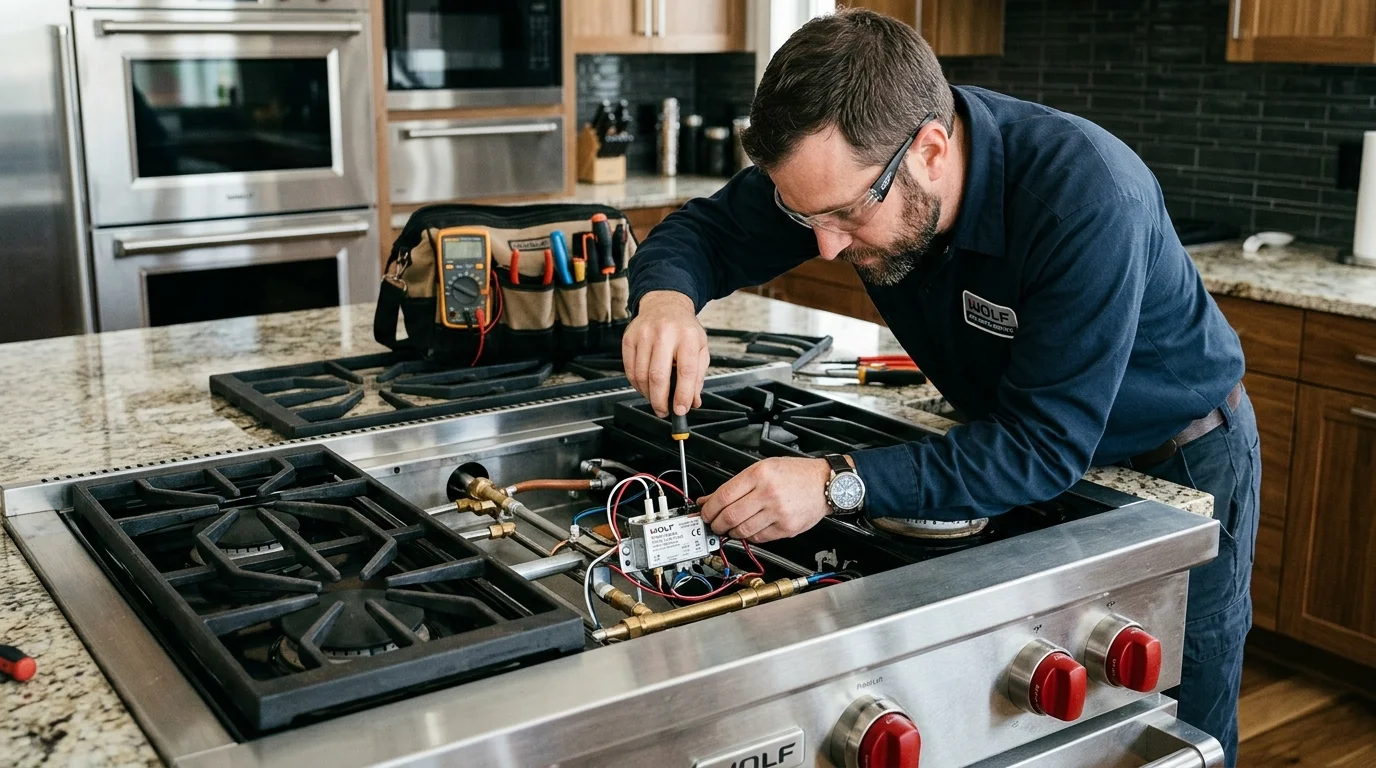
If you are hearing a continuous, rapid clicking noise from your Wolf Professional Gas Range even when all the burner control knobs are turned completely OFF, or if one specific surface burner clicks continuously without successfully lighting the gas flame, you are likely experiencing a fault within the spark ignition system. This comprehensive guide covers everything from the spark module assembly (parts 815554 / 815555) to the microswitch harness and flame sense re-ignition circuit on Wolf R488CG, GR304, and DF488 models, helping residents of Alpharetta GA diagnose and resolve this frustrating issue.
Table of Contents
- Introduction to Wolf Range Ignition Systems
- Detailed Symptoms of Igniter Malfunctions
- Common Causes of Continuous Clicking
- Step-by-Step Troubleshooting Guide
- When to Stop DIY and Call a Pro
- Repair vs Replace Analysis
- Estimated Cost Factors for Wolf Range Repair
- How Professionals Diagnose the Igniter System
- Common Parts Involved in Ignition
- Preventative Maintenance Tips
- Crucial Safety Tips
- Frequently Asked Questions (FAQs)
- Related Appliance Repair Services
- Related Appliance Problems
- Related Appliance Brands We Service
- Our Service Area Locations
- Key Takeaways
Introduction to Wolf Range Ignition Systems
Wolf professional dual fuel and gas ranges are engineered to deliver unparalleled cooking performance, making them a centerpiece in luxury kitchens throughout Alpharetta, Milton, Roswell, and Johns Creek. Models like the Wolf R488CG, GR304, and DF488 Professional Dual Fuel & Gas Range utilize sophisticated electronic ignition and flame-sensing technologies to ensure instantaneous and reliable burner ignition. However, like any high-end appliance operating in an environment subjected to intense heat, moisture, and cooking greases, these precision components can occasionally falter. When they do, one of the most recognizable and irritating symptoms is the incessant, rapid clicking of the spark igniters.
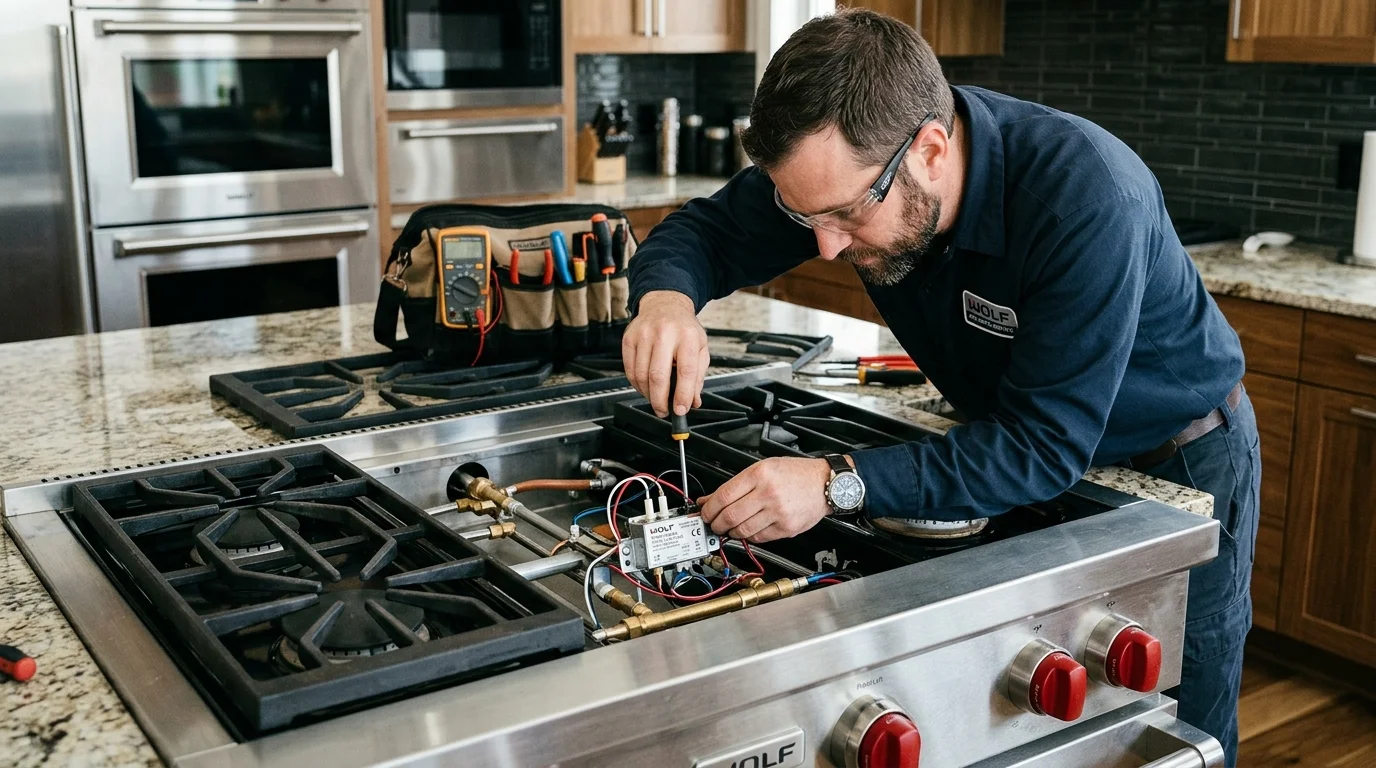
Understanding the architecture of the Wolf ignition system is paramount to resolving these issues. Unlike older ranges that relied on standing pilot lights, modern Wolf ranges employ a 120VAC electronic spark ignition system paired with a flame sense re-ignition circuit. This system is comprised of several integrated components: the individual microswitches mounted on the burner valve shafts, the high-voltage spark module assembly (typically part numbers 815554 or 815555 for 4-receptacle and 6-receptacle variants), the ceramic spark electrodes (igniters), and the grounding path through the burner base and cap.
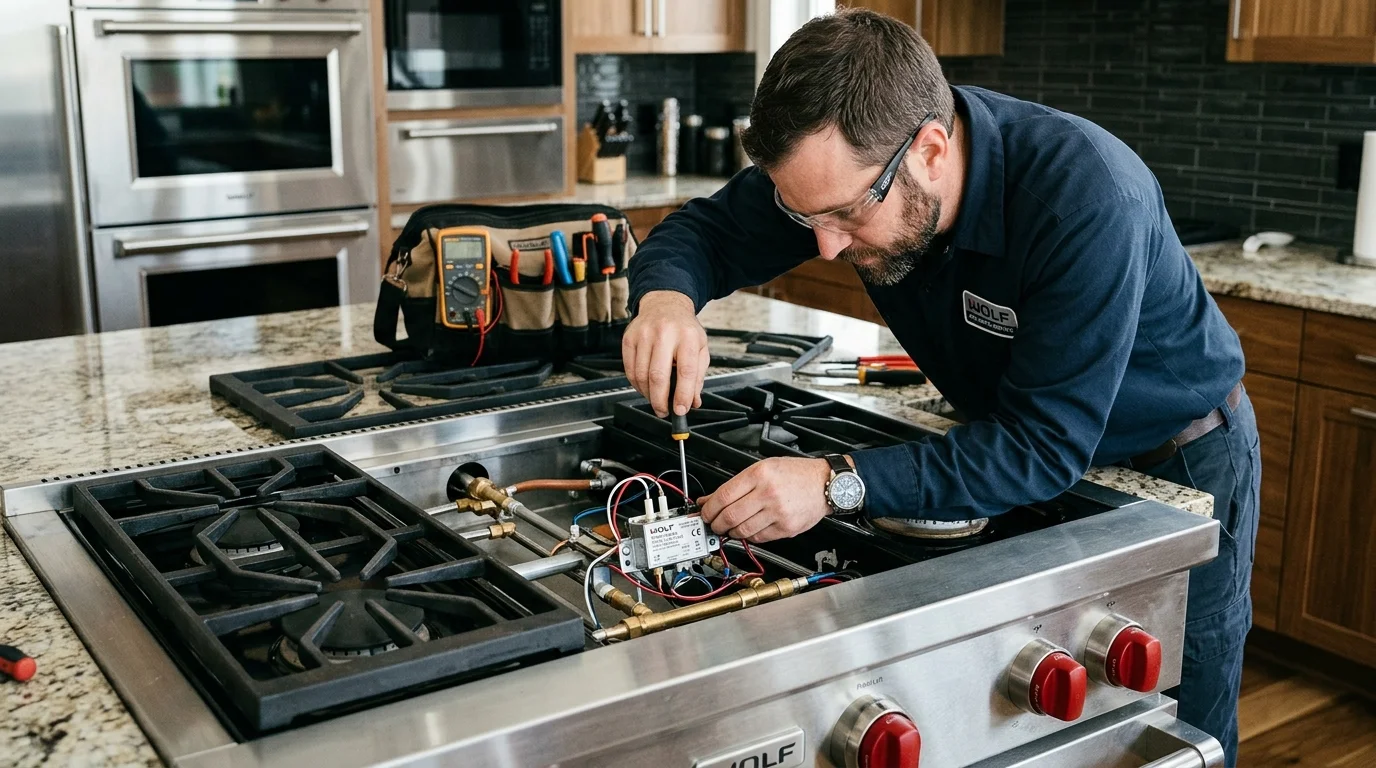
When you push in and turn a burner control knob on your Wolf range, you physically close a microswitch attached to the brass valve stem. This switch completes a 120-volt AC circuit, sending a signal to the spark module. The module acts as a step-up transformer, converting the standard household voltage into a high-voltage pulse, typically ranging from 10,000 to 15,000 volts (10-15kV). This immense voltage travels through highly insulated ignition wires to the ceramic spark electrode positioned near the burner head. The voltage then arcs across the small air gap between the electrode tip and the grounded metal burner cap, creating the visible and audible spark that ignites the gas.
Once the gas ignites, the flame sense re-ignition circuit takes over. This is a critical safety and convenience feature found on premium appliances like the Wolf R488CG. The spark module continuously monitors the presence of a flame using a process called flame rectification. The module sends a very small AC voltage to the electrode. The gas flame itself acts as a conductor and a rectifier, converting the AC voltage into a minute direct current (DC) signal—typically between 0.5 to 3.0 microamps DC. As long as the module detects this microampere DC current, it knows the flame is lit and ceases the sparking. If a sudden draft extinguishes the flame, the DC current stops, and the module instantly triggers an automatic re-ignition spark to relight the burner before raw gas can accumulate in the kitchen.
For expert assistance, you can always rely on our professional oven and range repair service right here in Alpharetta.
Detailed Symptoms of Igniter Malfunctions
While the primary complaint is often described simply as a “clicking stove,” the exact nature of the symptom can point directly to the underlying component failure. Paying close attention to when and how the clicking occurs is the first step in accurate diagnosis for your Wolf R488CG or DF488 range.
Continuous Rapid Clicking with All Knobs Off
If you walk into your kitchen and hear a continuous, non-stop clicking sound even though all the burner control knobs are in the OFF position, the most likely culprit is a stuck closed microswitch. The spark module is receiving a constant 120VAC command to generate a spark. Because the module usually fires all surface igniters simultaneously on these models, you will see a spark at every burner. This is almost exclusively caused by moisture intrusion—perhaps water from a recent boil-over or liquid cleaning solution—seeping down the valve shaft and shorting the internal contacts of the microswitch harness assembly.
One Burner Clicks but Won’t Light
If you turn on a specific burner and it clicks rapidly but fails to ignite the gas, while other burners light normally, the issue is isolated to that specific burner’s components. You should first verify that gas is actually flowing by listening for the hiss of gas. If gas is present, the problem might be a cracked ceramic spark electrode. A hairline crack in the ceramic insulation can allow the high-voltage spark to short to the chassis below the burner head, rather than arcing across the intended gap at the burner cap. Alternatively, heavy carbon or grease buildup on the igniter tip can insulate it, preventing a strong spark.
Burner Lights but Clicking Continues
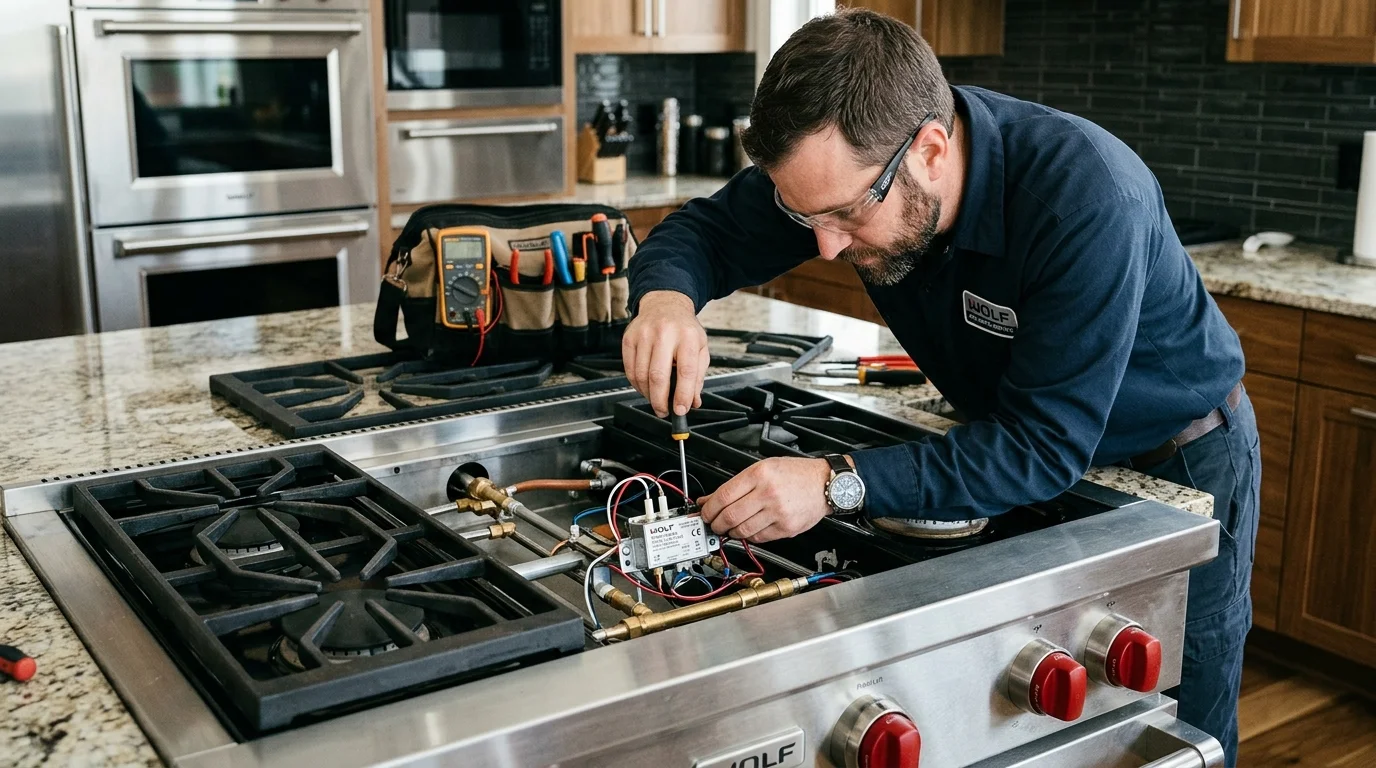
This is a classic failure of the flame sense re-ignition circuit. You turn the knob, the spark ignites the gas, you have a beautiful blue flame, but the clicking refuses to stop. In this scenario, the spark module is failing to detect the flame rectification signal. This could be due to a dirty igniter acting as a poor conductor for the microampere current, a misaligned burner cap interrupting the ground path, a break in the wiring harness between the electrode and the module, or a failure within the internal solid-state circuitry of the spark module itself (part 815554 or 815555). The module essentially thinks the flame has blown out and is desperately trying to relight it.
Intermittent or Weak Sparking
Sometimes the clicking is not rapid and continuous, but rather sluggish, intermittent, or weak. The spark may look yellow or orange instead of a crisp, bright blue-white. This indicates low voltage reaching the spark gap. It can be caused by a failing spark module that is no longer capable of producing the full 10-15kV output, poor grounding of the range to the household electrical supply, or high resistance in the ignition wires due to heat degradation over time.
Clicking Triggered by Oven Operation
On dual fuel models like the DF488, where the oven is electric but the surface burners are gas, you might occasionally experience surface burner clicking when the oven is turned on. This is rare but typically points to a neutral wiring issue or a shared ground fault where electrical noise or voltage feedback from the oven’s high-draw bake/broil elements is trickling into the sensitive spark module circuit, falsely triggering it. This requires advanced electrical troubleshooting by Alpharetta appliance repair technicians.
Common Causes of Continuous Clicking
Diagnosing a clicking Wolf gas range requires understanding the specific electrical and mechanical failures that trigger the symptom. Here is a deep dive into the most common causes, complete with technical specifications and likely scenarios.
1. Moisture Intrusion and Shorted Microswitches
The microswitch harness assembly is perhaps the most vulnerable component in the ignition system. Located directly beneath the burner control knobs and behind the front control panel, these switches sit precisely where liquid from heavy boilovers naturally flows. A microswitch contains delicate metallic contacts that close the 120VAC circuit to the spark module. When water, soapy cleaning solutions, or liquid grease infiltrates the switch housing, it creates an unintended conductive path across the contacts. Even if the switch is mechanically open (the knob is OFF), the moisture completes the electrical circuit, sending a continuous signal to the spark module. In technical terms, the resistance across the open switch drops from near infinity (OL on a multimeter) to just a few ohms, sufficient to carry the trigger voltage.
2. Failed Spark Re-Ignition Module (815554 / 815555)
The spark module is the brains and the brawn of the ignition system. Whether your Wolf range utilizes the 4-receptacle (815554) or 6-receptacle (815555) module, its internal solid-state components are subjected to significant heat and electrical stress over years of use. The internal step-up transformer can fail, causing weak or no spark. More commonly related to the “continuous clicking” symptom is a failure in the flame sensing rectification circuit. The module relies on detecting 0.5 to 3.0 microamps DC. If the internal circuitry degrades and loses the ability to measure this tiny current, it will persistently trigger the automatic re-ignition feature, assuming the flame is out even when it’s burning robustly.
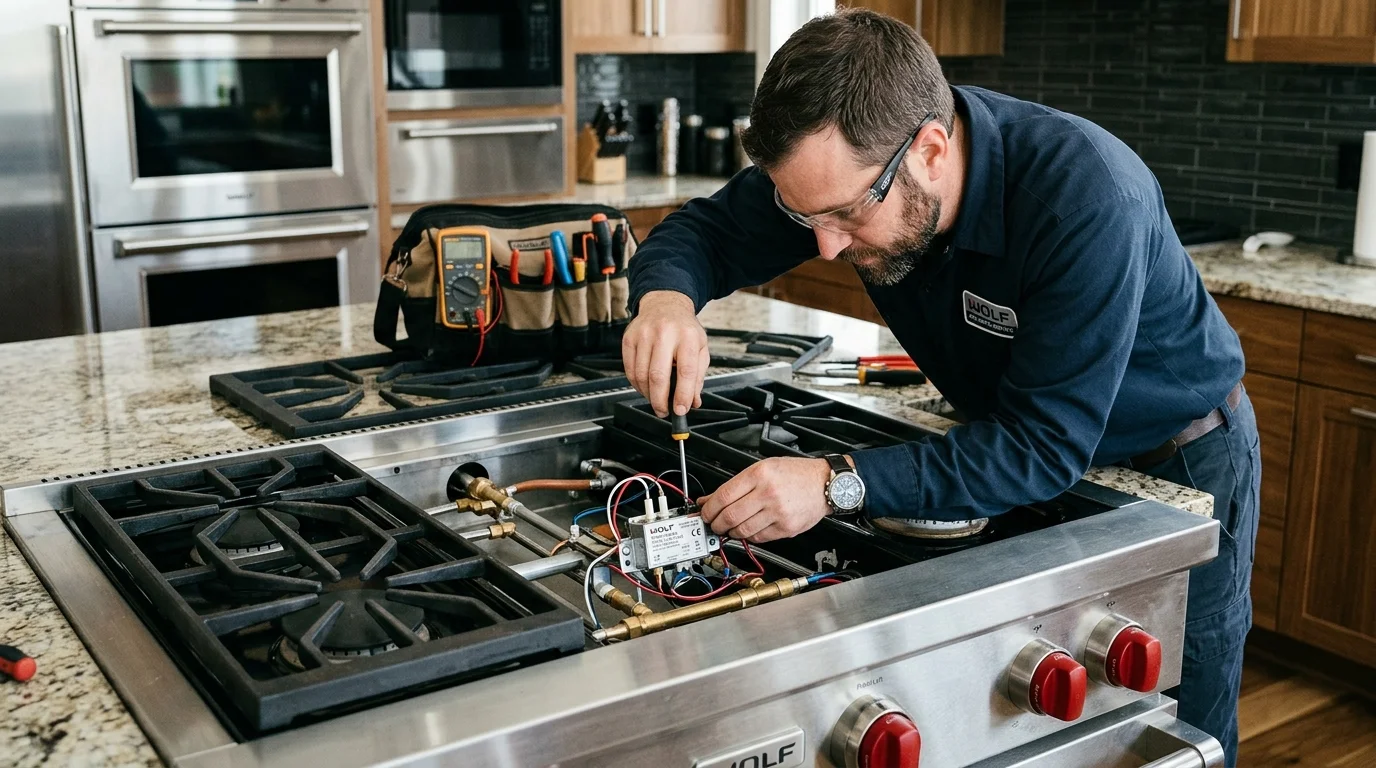
If you suspect module failure, it’s wise to contact a gas appliance repair specialist to verify the voltage inputs and outputs before purchasing expensive replacement parts.
3. Carbon and Grease Buildup on Spark Electrode
The dual-ring sealed burner electrode relies on a clean, conductive path to establish the microampere flame sense current. Over time, the ceramic insulator and the metal tip of the igniter can become coated with baked-on carbon, grease, and food debris. Carbon is highly resistive. This buildup can insulate the electrode from the flame, preventing the flame rectification process from occurring. As a result, the spark module does not receive the DC current feedback and continues to click. Furthermore, severe carbon tracking on the ceramic insulator can create a conductive path directly to ground, bypassing the spark gap entirely and resulting in no spark at the burner cap.
4. Misaligned or Dirty Burner Caps
The burner cap is not just a decorative cover; it is a critical functional component of the electrical circuit. The high-voltage spark must jump from the electrode tip to the metal burner cap to find ground. If the burner cap is not seated correctly on the burner base, the air gap may be too large for the spark to cross, resulting in no ignition. More importantly for the continuous clicking issue, a dirty burner base or cap can interrupt the ground path required for the flame sense circuit. If the base is covered in rust or heavy oxidation, the microampere DC current cannot flow back to the chassis ground, leading the module to trigger the re-ignition spark. Regular cleaning is essential, which is why we often discuss this during our appliance repair services in Roswell GA.
5. Cracked Ceramic Igniter Insulation
The ceramic body of the spark electrode is designed to insulate the 10-15kV high voltage until it reaches the tip. Due to the extreme thermal cycling (heating up and cooling down repeatedly), this ceramic can develop microscopic hairline cracks. When a crack occurs, the high-voltage electricity follows the path of least resistance. Instead of traveling all the way up to the tip to arc to the burner cap, the spark will arc through the crack directly to the metal burner base below. This hidden spark will not ignite the gas, leaving you with a burner that clicks but won’t light. A visual inspection under a bright flashlight is usually required to spot these subtle defects.
Step-by-Step Troubleshooting Guide
If you are experiencing the relentless clicking of your Wolf range, you can perform several safe, DIY troubleshooting steps to identify the root cause. Please ensure you prioritize safety by disconnecting power before removing any panels.
Step 1: Disconnect Power Immediately
The very first step to silence the clicking and ensure your safety is to disconnect the electrical power to the range. Unplug the unit from the wall outlet. If the plug is inaccessible, locate your home’s electrical panel and flip the dedicated circuit breaker for the range to the OFF position. Wait at least 60 seconds before proceeding to allow any residual high voltage in the spark module to dissipate.
Step 2: Dry Out the Microswitches
If the clicking started after a boil-over, spill, or intensive cleaning, moisture is the likely culprit. Remove the control knobs by pulling them straight off the valve stems. Use a hairdryer on a low or medium heat setting and gently direct the warm air toward the brass valve stems and the exposed microswitch harnesses behind the control panel. Do not use high heat, as you could melt the plastic switch housings. Spend 10-15 minutes thoroughly drying the area. Wait an hour, restore power, and see if the clicking has stopped.
Step 3: Deep Clean the Burner Caps and Bases
Remove all burner grates and burner caps. Inspect the underside of the caps and the top of the burner bases for heavy grease, carbon buildup, rust, or food debris. Use a stiff nylon brush (or an old toothbrush) and a degreasing cleaner to thoroughly scrub these components. The metal-to-metal contact between the cap and the base must be clean to provide a solid ground path for the spark and flame sense circuit. Dry them completely before reinstalling.
Step 4: Clean the Ceramic Igniters
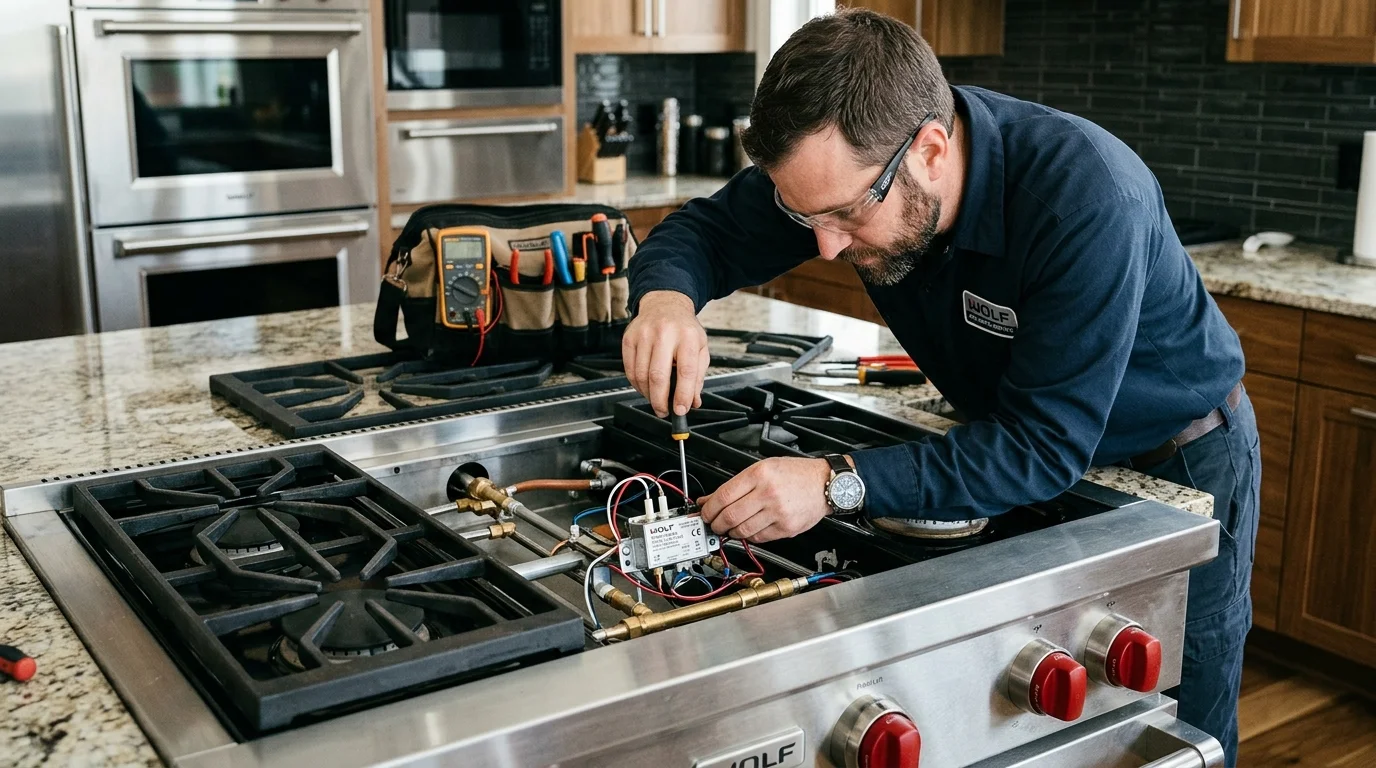
While the caps are off, carefully inspect the ceramic spark electrodes protruding near the burner heads. If the metal tip is black with carbon, gently clean it using a piece of fine emery cloth or high-grit sandpaper. Be extremely gentle, as the ceramic is fragile. Wipe down the white ceramic body with a soft cloth dipped in rubbing alcohol to remove any invisible grease films that could cause electrical tracking to ground.
Step 5: Verify Proper Burner Cap Alignment
When reassembling, ensure that the burner caps sit perfectly flat and flush on the burner bases. Most Wolf dual-ring sealed burners have small alignment pins or specific indents that ensure the cap is positioned correctly relative to the igniter. A crooked or wobbling burner cap will disrupt the spark gap and the flame geometry, leading to continuous clicking after the burner lights.
Step 6: Perform a Visual Spark Test
Restore power to the range. Turn off all room lights to make it easier to see the sparks. Turn one burner knob to the Lite position. You should see a strong, bright blue-white spark arcing clearly from the electrode tip to the burner cap. Check every burner. If you see a weak yellow spark, or a spark jumping from the base of the ceramic insulator instead of the tip, you have identified a faulty igniter or a failing spark module.
Step 7: Check for Proper Polarity and Grounding
Wolf’s flame rectification circuit is highly sensitive to the electrical supply. The wall outlet must have correct polarity (Hot and Neutral are not reversed) and a strong, verified earth ground. You can use a simple, inexpensive plug-in receptacle tester with indicator lights to verify your outlet is wired correctly. A missing ground will cause erratic spark module behavior and continuous clicking while the flame is lit.
Step 8: Isolate the Faulty Microswitch (Advanced DIY)
If the clicking is continuous with all knobs off and drying didn’t work, you must isolate the shorted switch. With power disconnected, access the microswitches behind the control panel. Disconnect the wire harness from one microswitch at a time. After disconnecting one switch, restore power. If the clicking stops, you have found the faulty switch. If it continues, disconnect power, reconnect that switch, and move to the next one. Note: Do not attempt this if you are not comfortable working with multimeter diagnostics and electrical components.
When to Stop DIY and Call a Pro
While clearing away carbon and drying out microswitches are manageable tasks for most homeowners, the Wolf ignition system operates on lethal voltages. The spark module outputs up to 15,000 volts. If your basic cleaning and drying efforts do not resolve the issue, it is time to stop DIY intervention and contact a professional who specializes in high-end appliances.
You should absolutely call a professional if you experience any of the following:
- You smell raw gas when the burners are off.
- The main home circuit breaker trips when you attempt to use the stove.
- You see visible scorch marks, melted plastic, or burned wires behind the control panel.
- You have isolated the problem to a faulty spark module or wiring harness, which requires specialized testing equipment and OEM parts access to replace correctly.
Don’t hesitate to reach out for help with appliances not working if you feel overwhelmed by the diagnostic process.
Repair vs Replace Analysis
When facing a malfunction on a high-end appliance like a Wolf R488CG, owners often wonder if it’s worth fixing or if they should consider replacement. Because these are luxury, built-to-last appliances, repair is almost always the financially and practically sound choice.
| Consideration | Repair (Igniter System Fix) | Replacement (New Wolf Range) |
|---|---|---|
| Estimated Cost | $250 – $650 (Parts & Labor) | $8,000 – $16,000+ |
| Lifespan Impact | Extends life by many years; Wolf ranges regularly last 20+ years. | Starts a new lifespan, but with massive upfront depreciation. |
| Turnaround Time | 1-3 hours (Same or next day service usually available) | Weeks to months (Ordering, delivery, complex installation) |
| Environmental Impact | Low. Keeps heavy machinery out of landfills. | High manufacturing and disposal footprint. |
Given that ignition components are consumable parts designed to be replaced, fixing a clicking igniter is a standard maintenance procedure, much like changing brake pads on a luxury car.
Estimated Cost Factors for Wolf Range Repair
The total cost to resolve a continuous clicking issue on your Wolf range will depend heavily on exactly which component has failed. Here is a breakdown of what you might expect when hiring a professional.
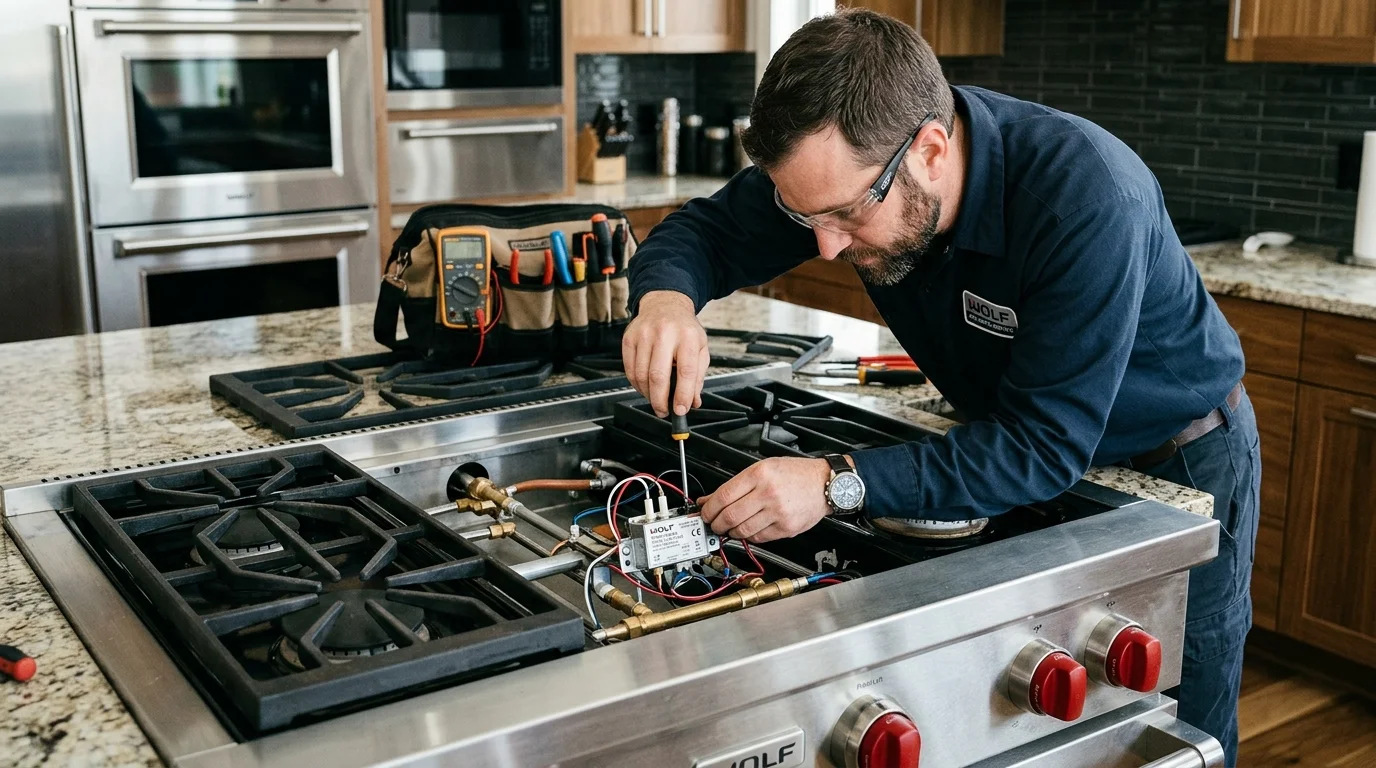
- Service Call/Diagnostic Fee: Usually around $79 to $120. At our company, this fee is typically waived if you proceed with the repair.
- Spark Module Assembly (815554/815555): The OEM part itself generally costs between $150 and $250. Labor to access the back of the stove, remove the old module, wire the new one, and test the system adds another $150-$200.
- Microswitch Harness: A complete replacement harness for a 4 or 6-burner configuration costs roughly $100-$180 for the part. The labor is more intensive here, as it requires removing the front bullnose and control panel, bringing total costs to around $300-$450.
- Ceramic Spark Electrode: These are relatively inexpensive, costing about $30-$50 each. If this is the only issue, the total repair might be under $200.
Always insist on Genuine Wolf OEM parts to ensure the longevity of the repair and maintain the integrity of the flame sense circuit. For a precise quote, visit our appliance repair services in Johns Creek GA page.
How Professionals Diagnose the Igniter System
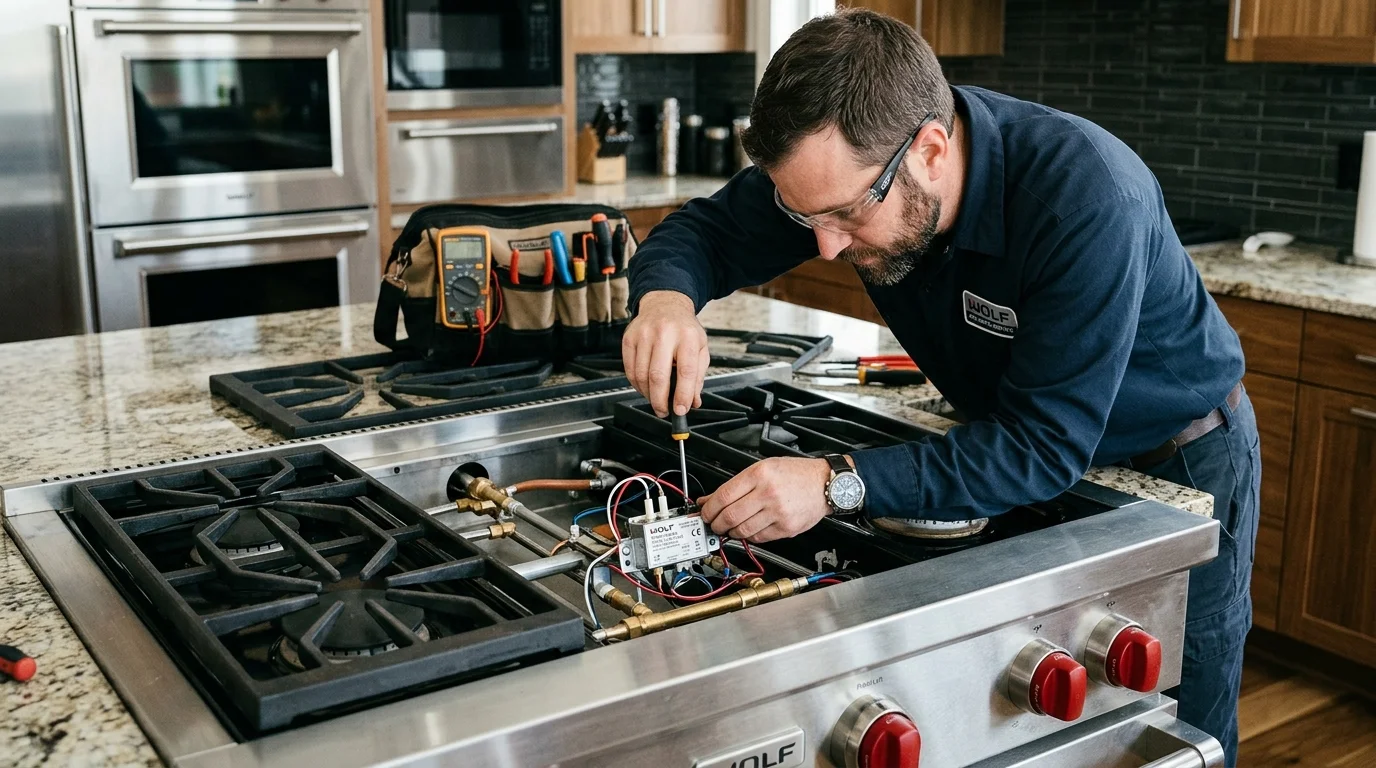
When a Master Technician arrives to fix your Wolf range, they don’t just guess at the problem. They employ precise diagnostic procedures using professional-grade multimeters and schematic analysis to pinpoint the exact failure point.
1. Microswitch Continuity Testing
The technician will first disconnect power and access the microswitches. Using a multimeter set to measure resistance (Ohms), they will test each switch individually. A properly functioning open switch (knob OFF) should read ‘OL’ (Open Loop or infinite resistance). If a switch reads close to 0 Ohms or even fluctuating low resistance while the knob is OFF, it is shorted internally, usually from moisture, and must be replaced.
2. Spark Module Input Voltage Verification
To determine if the spark module is receiving the correct command, the technician will restore power and carefully measure the AC voltage arriving at the module’s input terminals. When a burner knob is turned to Lite, they should see a steady 120VAC. If the voltage is present but the module is not producing a spark, the module has failed.
3. Flame Rectification (DC Microamp) Testing
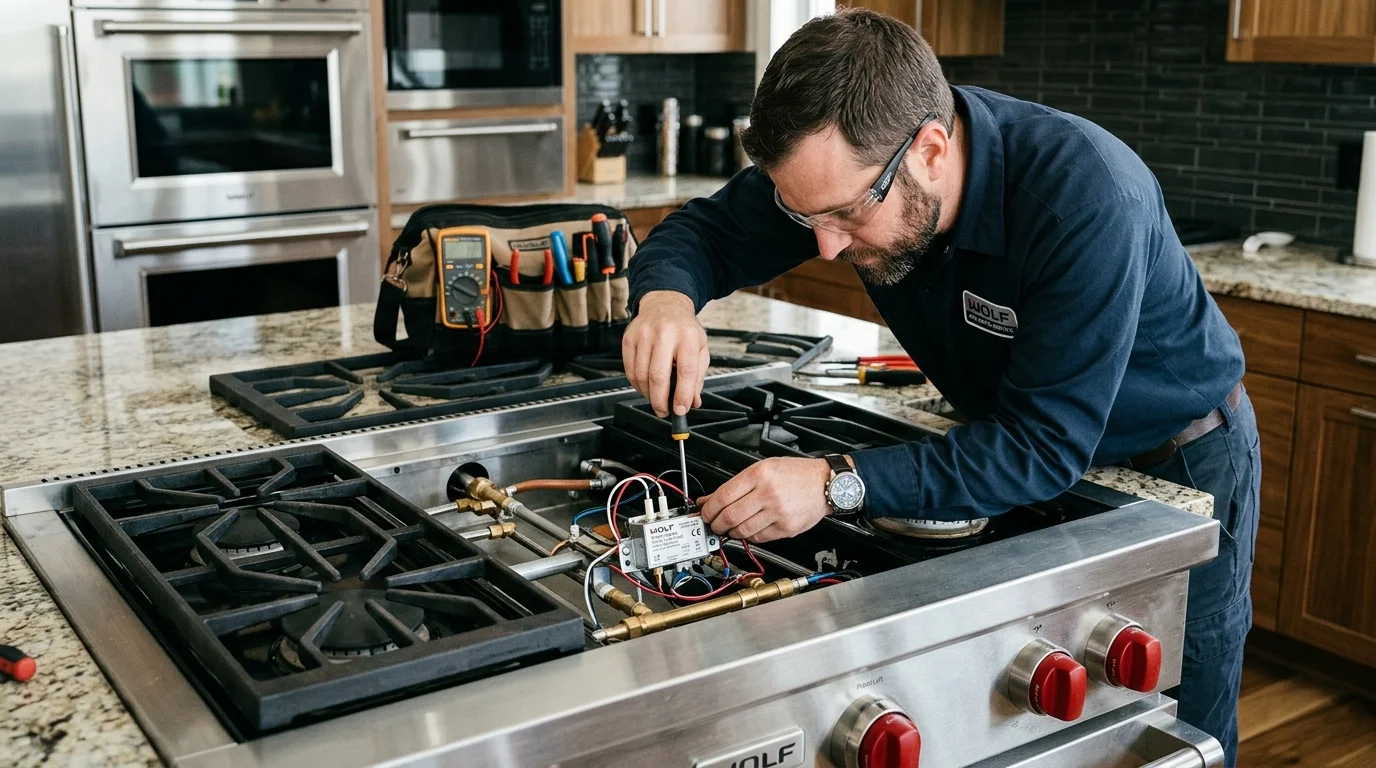
This is the most critical test for a burner that lights but continues to click. The technician will place their multimeter in series with the flame sense wire (or use a specialized microamp clamp meter) and set it to read DC Microamps (µA). Once the burner is lit, they monitor the reading. A healthy flame sense circuit will generate a steady DC current, typically between 0.5 and 3.0 µA, depending on the specific Wolf model. If the reading is erratic, below 0.5 µA, or drops to zero, the module cannot detect the flame. The technician will then investigate the igniter, the ground path, and the wiring to correct the signal loss. This type of deep diagnostic work is why many residents trust our Wolf appliance repair experts.
Common Parts Involved in Ignition
Familiarizing yourself with the exact parts involved can help you understand the repair process and converse intelligently with your technician.
- Spark Module (815554 / 815555): The heart of the system. 815554 is typically for 4-burner configurations, while 815555 handles 6-burner setups. It houses the step-up transformer and the sensitive flame rectification circuitry.
- Microswitch Harness: A daisy-chained series of small, black rectangular switches mounted to the gas valves. They are sold as a complete harness assembly because replacing individual switches requires delicate splicing in a high-heat environment, which is not recommended.
- Ceramic Spark Electrode (Igniter): The white ceramic post with a metal wire running through it, located next to the burner. It withstands direct flame and delivers the 15kV spark.
- Burner Cap and Base: While not electrical components per se, their material composition (brass/cast iron) and physical cleanliness are vital for the grounding of the electrical circuit.
Preventative Maintenance Tips
The best way to avoid expensive igniter repairs on your Wolf range is through diligent, correct maintenance practices.
| Maintenance Action | Frequency | Why It Matters |
|---|---|---|
| Wipe up spills immediately | After every use | Prevents liquids from seeping down valve shafts and shorting the microswitches. |
| Clean burner caps & bases | Weekly | Maintains the critical ground path necessary for the flame sense circuit to operate. |
| Clean ceramic igniters gently | Monthly | Removes carbon buildup that insulates the spark and blocks the microamp DC signal. |
| Avoid flooding the control panel | Always | Never spray cleaner directly onto knobs; spray onto a cloth first to prevent fluid intrusion. |
| Professional Inspection | Annually | Ensures gas pressures are correct and internal wiring is not degrading from heat. |
Following these steps will drastically reduce the likelihood of encountering the dreaded non-stop clicking issue. If you need help with a different appliance, remember we also offer comprehensive dishwasher repair services.
Crucial Safety Tips
Working with gas appliances carries inherent risks. Always prioritize safety above all else.
Always shut off the main gas supply valve behind the range before removing any internal components. If you ever smell a strong odor of gas (like rotten eggs) that does not dissipate quickly, do not attempt to turn on the stove, do not flip any light switches, evacuate the home immediately, and call your local gas provider.
Frequently Asked Questions (FAQs)
Here are some of the most common questions our technicians answer regarding Wolf range igniter issues in the Alpharetta area.
1. Why is my Wolf stove clicking but not lighting?
This usually means the spark is occurring, but the gas isn’t reaching it, or the spark is weak. It could be a cracked ceramic electrode shorting to ground, a clogged gas orifice, or a misaligned burner cap. Ensure the burner cap is seated correctly first.
2. Can I fix a shorted microswitch myself?
If it’s shorted due to recent moisture, drying it with a hairdryer on low heat often works. However, if the internal contacts are fused or corroded, the entire harness must be replaced, which is a job best left to professionals.
3. How much does a Wolf spark module (815554/815555) cost?
The OEM part typically ranges from $150 to $250. Professional installation and comprehensive system testing will add to the total cost.
4. Why does the clicking continue after the flame is lit?
This is a failure of the flame sense circuit. The module cannot detect the microamp DC current from the flame. This is often caused by a dirty igniter, dirty burner cap interrupting ground, or a faulty spark module.
5. Is it safe to use my oven if the surface burners are clicking?
Generally, yes, especially on dual fuel models like the DF488 where the oven is electric. However, the clicking is annoying, and you should leave the range unplugged when not in use until it’s repaired.
6. How do I clean the ceramic igniter safely?
Use a very soft cloth with rubbing alcohol to remove grease. For stubborn carbon on the metal tip, gently use a piece of fine emery cloth. Do not apply pressure to the white ceramic body, as it breaks easily.
7. My igniter only sparks on one side; is that normal?
No. On Wolf ranges, a single spark module usually controls all surface igniters simultaneously. If one isn’t sparking, its specific electrode, wire, or ground path is compromised.
8. Does a boil-over always ruin the microswitches?
Not always. A quick wipe-up might prevent liquid from penetrating the control panel. If liquid does get in, prompt drying can often save the switches before corrosion sets in.
9. Can a bad ground outlet cause ignition problems?
Absolutely. The flame rectification circuit requires a solid earth ground to function. If your home’s outlet is ungrounded or has a weak ground, the module will fail to sense the flame and click continuously. If you suspect electrical issues, you might also be interested in our microwave repair solutions.
10. Should I replace all igniters if one fails?
It’s not strictly necessary, but if the range is older and one ceramic has failed due to thermal fatigue, the others might be close behind. Replacing them all during one service call can save labor costs down the road.
11. What is flame rectification?
It’s the process where the AC voltage sent by the spark module is converted into a measurable DC microampere current by the ionized gases within the gas flame. The module reads this DC current to confirm the burner is lit.
12. How long does a typical Wolf range repair take?
Most igniter or spark module replacements can be completed by our certified technicians in 1 to 2 hours.
13. Do you use OEM Wolf parts?
Yes, we strongly advocate for and utilize Genuine Wolf OEM parts to ensure perfect compatibility and maintain the high performance standards of your appliance.
14. Can I use WD-40 to clean the microswitches?
No! WD-40 is flammable and can leave a residue that attracts dust and grease, worsening the problem over time. Use only compressed air or a hairdryer to dry them.
15. Why does my range click when I turn on the oven?
This usually indicates electrical feedback or a shared neutral/ground issue within the range’s internal wiring harness, requiring a professional electrical diagnosis.
16. Will a power surge damage the spark module?
Yes, the solid-state circuitry inside the spark module (815554/815555) is susceptible to voltage spikes. A whole-home surge protector is recommended for high-end appliances.
17. How can I test if gas is flowing?
When you turn the knob, you should hear a distinct hissing sound and smell a faint odor of natural gas or propane. If you hear/smell nothing while it clicks, the gas valve may be closed or the regulator may be faulty.
18. My igniter clicks slowly, is that normal?
No, a healthy spark module produces rapid, crisp clicks (multiple times per second). Slow clicking indicates a failing capacitor inside the module or low supply voltage.
Related Appliance Repair Services
Beyond professional ranges, our technicians are highly trained across a spectrum of luxury home appliances. If you are experiencing issues with other units in your kitchen, we can help.
- Expert refrigerator repair services for cooling and ice maker issues.
- Comprehensive washer and dryer repair to keep your laundry room functional.
- Specialized wine cooler repair to protect your vintage collections.
- Garbage disposal repair and replacement for swift kitchen cleanups.
Related Appliance Problems
Appliance issues rarely happen in isolation. If you are dealing with other frustrating symptoms, explore our diagnostic resources.
- Identify the root cause of loud, unusual sounds on our guide to appliances making noise.
- Decipher flashing lights and warnings on our comprehensive appliance error codes database.
- See the full list of common appliance problems we fix.
Related Appliance Brands We Service
Our expertise extends beyond Wolf ranges. We service all major luxury and premium appliance brands.
- Expert Sub-Zero appliance repair (Wolf’s sister company).
- Professional KitchenAid appliance repair specialists.
- Certified Bosch appliance repair services.
Our Service Area Locations
We provide rapid, reliable appliance repair services to the northern Atlanta suburbs.
- Prompt service available for appliance repair in Alpharetta GA.
- Dedicated technicians for appliance repair in Milton GA.
- Serving homes requiring appliance repair in Sandy Springs GA.
Key Takeaways
- Continuous clicking when knobs are OFF is usually caused by moisture shorting the microswitch harness behind the control panel.
- Clicking that continues after the burner lights points to a failure in the flame sense re-ignition circuit, often due to dirty burner caps, a soiled ceramic igniter, or a faulty spark module (815554 / 815555).
- Drying out wet switches with a hairdryer on low heat is a safe, effective first DIY step.
- Maintaining clean burner bases and caps is essential for the electrical ground path required for ignition and flame sensing.
- Due to the 15,000-volt output of the spark module, advanced electrical troubleshooting should be handled by a qualified professional from our oven and range repair team.
Stop the Clicking Today
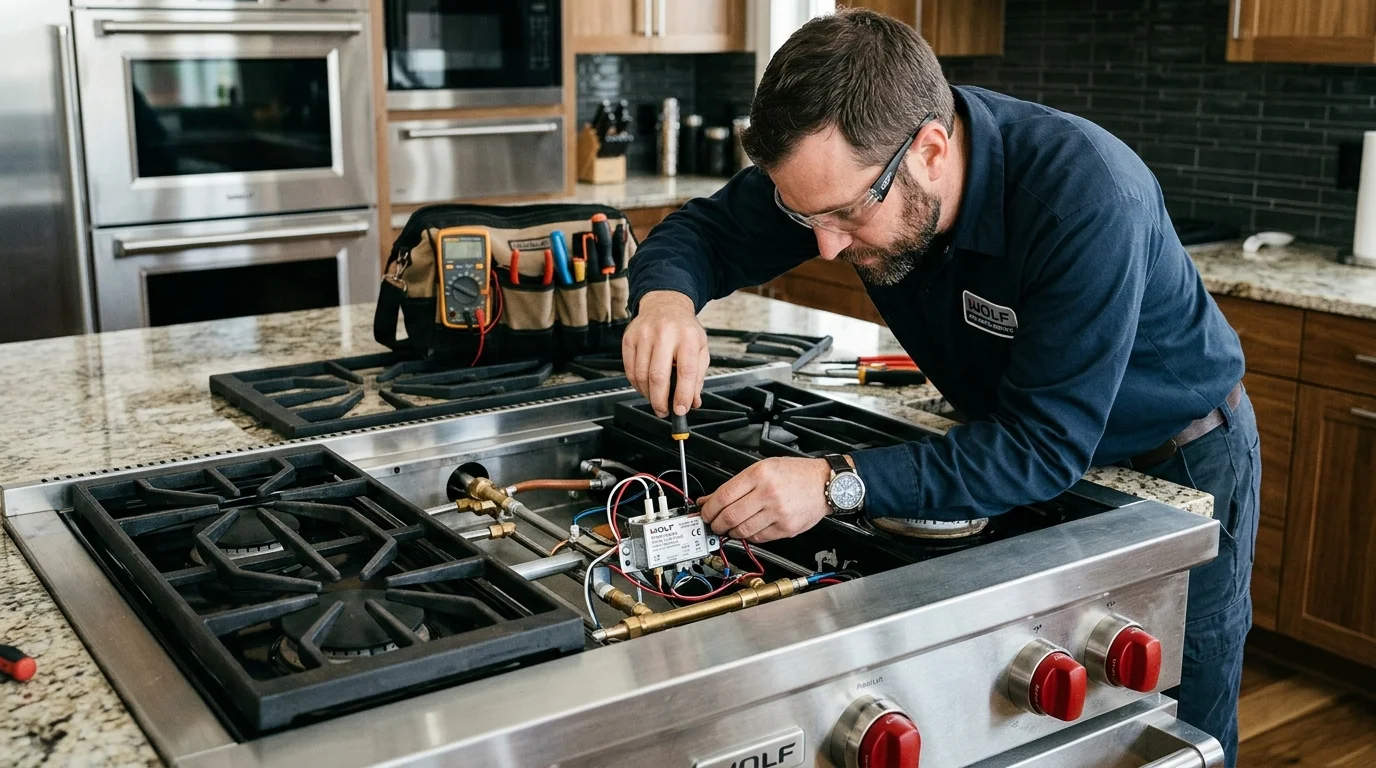
Don’t let a malfunctioning ignition system ruin your cooking experience or compromise your kitchen’s safety. Our certified Master Technicians are experts in Wolf range diagnostics and carry genuine OEM parts to resolve your issue swiftly.
Call Jason J. at (770) 796-7742
Service fee: $79 (waived with repair) | 90-day parts and labor warranty
Need Certified Appliance Repair Today?
Skip the phone line — book direct local priority dispatch across Alpharetta, Milton, Roswell & Johns Creek.