
Commercial Walk-In Cooler Not Cooling: High Temp Alarm Troubleshooting & Emergency Commercial Refrigeration Repair in Alpharetta, GA
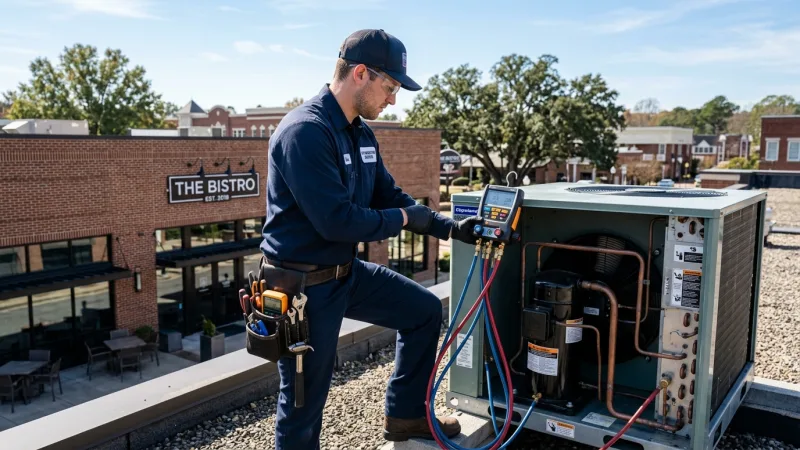
When a commercial walk-in cooler climbs above the critical 40°F food safety threshold and triggers a high-temperature alarm in a busy restaurant, country club, or food distribution facility, every minute counts toward preventing catastrophic inventory loss and regulatory citations. This comprehensive technical guide breaks down the precise electrical, mechanical, and thermodynamic causes behind commercial walk-in cooler failure—from frozen evaporator coils and stuck thermostatic expansion valves to defective defrost timers and low refrigerant charges—complete with master technician multimeter telemetry, actionable facility diagnostics, and priority emergency dispatch across Alpharetta, Milton, Roswell, and Johns Creek, GA.
Quick Diagnostic Answer: Why Is Your Walk-In Cooler Not Cooling?
A commercial walk-in cooler not cooling while displaying a high-temperature alarm is most commonly caused by an iced-over evaporator coil block, a failed mechanical defrost timer (stuck in refrigeration or defrost mode), a malfunctioning Sporlan thermostatic expansion valve (TXV) with a lost power element charge, or severe grease and dust buildup on the exterior condenser coil. If the condensing unit compressor is humming but the suction line is warm and box fans circulate ambient air, the system has either suffered a closed-loop refrigerant leak or an unseated solenoid valve.
Immediate Action: Confirm that the condensing unit breaker has not tripped, check that evaporator fan motors are spinning freely at 1550 RPM, verify the door sweep and vinyl strip curtains are sealing tightly, and contact an EPA-certified commercial technician immediately at (770) 796-7742 before internal food temperatures exceed 41°F.
Listen to 60-Second Commercial Refrigeration Brief
Narrated by Jason J. (Master Certified Commercial Refrigeration Specialist)
Check Same-Day Commercial Tech Availability in Your North Fulton Corridor
Recently Serviced in Downtown Alpharetta & Avalon Commercial District
Copeland 2.5 HP Discus Condensing Unit & Sporlan TXV Power Element Replacement Completed • Box Temperature Restored to 36.4°F • Verified 5.0 ★★★★★
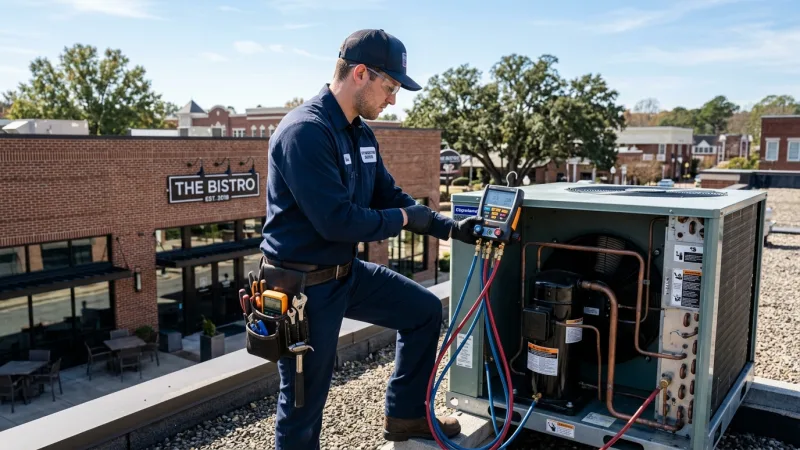
Commercial Walk-In Cooler Diagnostic Guide: Table of Contents
- Understanding Commercial Walk-In Cooler Architecture and Critical Temperature Zones
- Common Symptoms: How to Decode Warning Signs Before Food Spoilage Occurs
- Field Restoration Showcase: Severe Evaporator Frosting Before & After OEM Service
- Primary Mechanical & Electrical Causes Behind Temperature Rise and Lockouts
- Step-by-Step Safe Facility Troubleshooting & Inspection Protocols
- When to Stop: Critical Safety Hazards, High Voltage, and EPA Regulations
- Commercial Decision Analysis: Repairing vs. Replacing Commercial Condensing Units
- Interactive Instant Commercial Refrigeration Repair Cost Estimator
- Key Variables Influencing Commercial Walk-In Repair Invoices
- How Master Technicians Diagnose Failures: Multimeter Ohms & Pressure Telemetry Lookup
- Essential Commercial OEM Components, Valve Assemblies, and Controllers
- Commercial Preventative Maintenance Routine for Georgia Hospitality Operations
- Occupational Safety, Refrigerant Pressures, and High-Voltage Arc Flash Protocols
- Frequently Asked Questions (Interactive Accordion Diagnostic Library)
- Emergency Commercial Dispatch Areas Across North Fulton County & Booking Information
Understanding Commercial Walk-In Cooler Architecture and Critical Temperature Zones
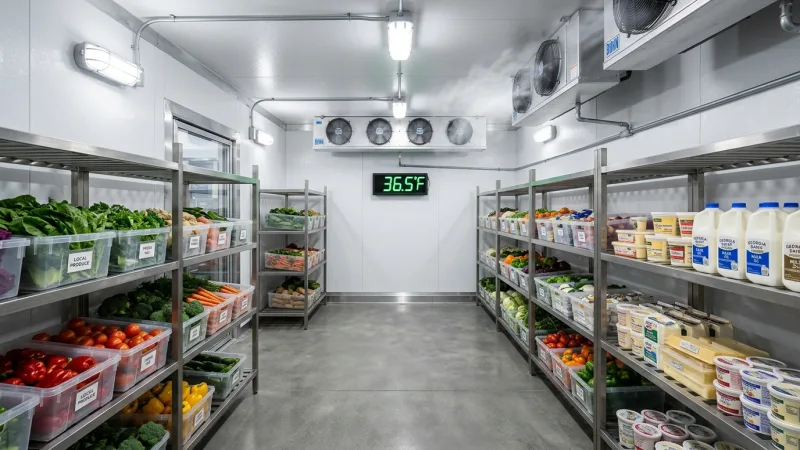
Operating a successful commercial culinary establishment, country club dining room, craft microbrewery, or pharmaceutical distribution warehouse in North Fulton County demands unbroken cold-chain integrity. When you depend on heavy-duty commercial cold storage, a sudden failure is not merely a household inconvenience—it represents an urgent operational crisis. Commercial walk-in coolers are engineered to sustain a strict internal product holding temperature between 35°F and 38°F (1.6°C to 3.3°C). Under standard Food and Drug Administration (FDA) Food Code standards and Georgia Department of Public Health environmental safety regulations, potentially hazardous foods that linger above 41°F (5°C) for more than four cumulative hours must be condemned and discarded to prevent foodborne illness outbreaks.
In modern commercial culinary environments across Alpharetta and surrounding communities, hundreds of pounds of premium beef, seafood, poultry, dairy, and aged produce are constantly held within walk-in coolers. A single high-temperature excursion lasting overnight or during a weekend shift can wipe out $8,000 to $25,000 in perishable inventory, entirely separate from the devastating brand damage caused by canceling dinner reservations or shutting down weekend event catering. Our factory-certified specialists in commercial appliance repair understand that rapid diagnosis and fast physical parts replacement are vital to keeping commercial kitchens operational.
Unlike residential domestic refrigerators that rely on small fractional-horsepower reciprocating compressors with static capillary tubes, a commercial walk-in cooler functions via a split-system thermodynamic refrigeration circuit. This split assembly separates the high-side heat rejection apparatus—typically a semi-hermetic or hermetic Copeland scroll condensing unit mounted outdoors on the roof or on a concrete ground pad—from the low-side heat absorption assembly, which consists of a forced-air evaporator coil manufactured by Bohn, Larkin, Trenton, or Heatcraft suspended inside the insulated box ceiling.
Connecting these two distinct physical stages are high-pressure liquid lines and low-pressure insulated suction lines that cycle high-performance modern refrigerants such as R-404A, R-448A, R-449A, or eco-friendly R-452A under high operating pressures. Because these systems run continuously under heavy commercial thermal door-opening loads, grease vapors from fry lines, and intense southern summer heat, even a minor drift in mechanical calibration or electrical control can rapidly cause the entire system to lose cooling capacity. When your digital thermostat flashes a high-temperature alarm, understanding whether the fault originates in the airflow path, the electrical logic controls, or the closed sealed refrigeration loop is the first step toward decisive commercial recovery.
Common Symptoms: How to Decode Warning Signs Before Food Spoilage Occurs
Commercial walk-in cooler cooling failures rarely occur completely without warning. In most commercial kitchens, the refrigeration system exhibits subtle mechanical, audible, or visual distress signals hours or days before the box temperature finally climbs through the 41°F ceiling. Commercial facility operators and executive chefs who train kitchen staff to recognize these early indicators can resolve minor component wear before it turns into an emergency compressor burnout. Below are the primary diagnostic symptoms encountered by our field technicians:
- Digital Controller Flashing High Temp (“HI” or “AL1”): Most commercial walk-ins utilize digital microprocessor thermostats manufactured by Carel, Dixell, or Ranco. When the interior air probe detects temperatures exceeding the programmed high limit (typically set at 42°F with a 45-minute delay), the display alternates between the actual box temperature and a blinking alarm code while sounding an intermittent audible beeper.
- Solid Sheet Frost or Snowy Ice on the Evaporator Coil Face: Peering through the protective wire guard of the ceiling-mounted evaporator coil should reveal dark, bare aluminum fins with light moisture beads dripping into the condensate pan. If you observe thick, snowy frost bridging the fin gaps or solid ice blocking the fan blades, thermal airflow has collapsed.
- Condensing Unit Rapid Cycling or Short Cycling: When the outdoor Copeland or Tecumseh condensing unit switches on for 20 seconds, violently shuts down with a loud click, and attempts to restart a minute later, the system is tripping its high-pressure safety cutout or low-pressure control switch due to abnormal system pressures.
- Hissing or Bubbling Sounds at the Liquid Line Sight Glass: Located near the receiver tank on the condensing unit is a brass moisture-indicating sight glass. During steady-state cooling, the sight glass should be completely full of clear liquid refrigerant. If you see continuous streams of bubbles, foam, or flashing vapor, the system is starving for refrigerant due to a leak or a clogged liquid line filter-drier.
- Evaporator Fans Running Hot or Vibrating Violently: If one of the two or three evaporator fan motors inside the walk-in has seized, the remaining fans cannot move sufficient cubic feet per minute (CFM) across the coil. This creates an immediate drop in heat absorption, leading to frost accumulation and warm ambient box air.
- Excessive Condensation or Water Droplets on Ceilings and Walls: Warm, humid kitchen air infiltrating through degraded vinyl strip curtains or misaligned magnetic door gaskets causes heavy atmospheric moisture to condense onto cold stainless panels and box ceilings, adding massive latent heat loads that overpower the refrigeration cycle.
If your facility is located near the North Point commercial corridor or Old Milton Parkway, our rapid-response teams providing same-day appliance repair can mobilize with mobile inventory vehicles fully stocked with universal commercial contactors, Sporlan expansion valves, dual-pressure switches, and electronic defrost controls to stabilize your walk-in cooler before expensive spoilage occurs.
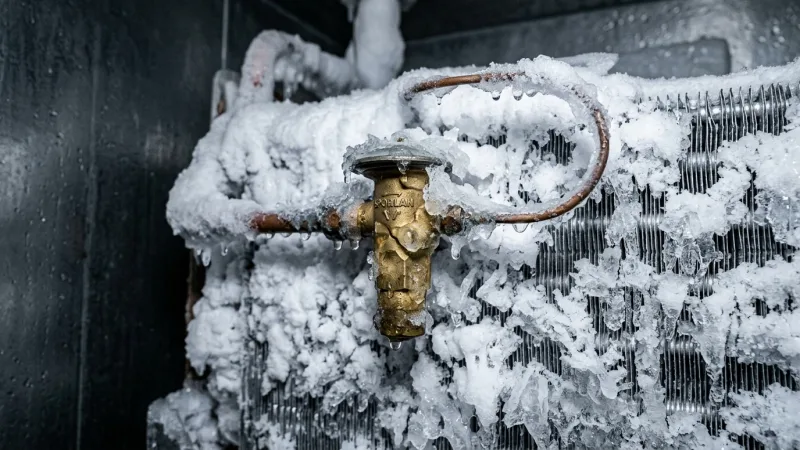
Field Diagnosis: A downtown restaurant walk-in cooler displaying 54°F. Inspection revealed complete air starvation caused by a thick sheet of frost encasing the aluminum fin block and a Sporlan brass thermostatic expansion valve that lost its internal thermal sensing charge, freezing in an almost closed position.
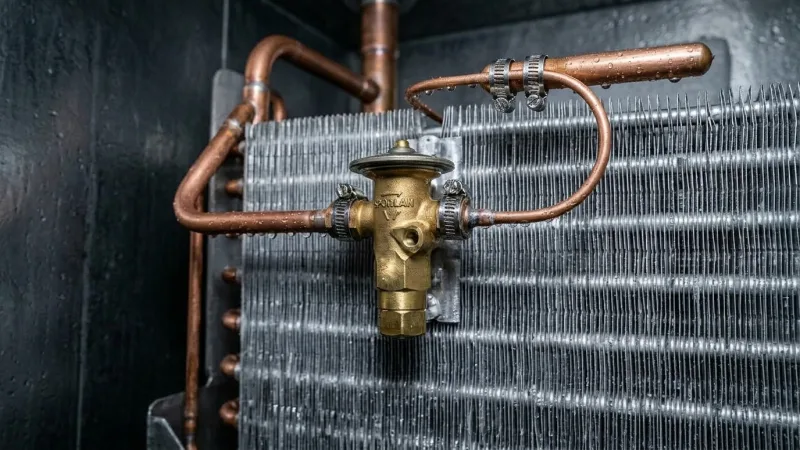
Restoration Outcome: Master technicians performed a controlled high-flow warm air defrost, evacuated the refrigeration circuit, brazed in a brand-new factory Sporlan OEM expansion valve with an external equalizer, replaced the liquid line filter-drier, pulled a 350-micron deep vacuum, and recharged virgin R-448A to factory superheat. Steady box temperature returned to 36.2°F.
Primary Mechanical & Electrical Causes Behind Temperature Rise and Lockouts
Commercial walk-in cooler failures are governed by exact thermodynamic principles. When heat cannot be absorbed inside the insulated box or rejected outside at the condensing unit, system equilibrium fails. Decades of commercial field service across North Georgia have proven that over 90% of walk-in cooler cooling failures stem from seven distinct mechanical and electrical root causes:
1. Thermostatic Expansion Valve (TXV) Orifice Clogging or Power Element Charge Loss
The thermostatic expansion valve (commonly manufactured by Sporlan, Danfoss, or Alco) acts as the precision metering device of the commercial refrigeration circuit. Positioned directly upstream of the evaporator distributor tubes, the TXV regulates the exact mass flow rate of high-pressure liquid refrigerant into low-pressure atomized mist based on evaporator outlet superheat.
Over time, the hermetically sealed power element atop the brass valve body can suffer a microscopic fracture along its capillary tubing or sensing bulb weld, releasing its internal refrigerant charge into the atmosphere. Without internal vapor pressure pushing downward on the internal stainless steel diaphragm, the valve’s internal return spring forces the needle into its seat, completely choking off refrigerant delivery to the evaporator. When this occurs, the suction pressure plummets into a deep vacuum, the compressor overheats from lack of cool suction gas, and the walk-in box temperature steadily rises.
2. Frozen Evaporator Coil Caused by Defrost Timer Failure
Because commercial walk-in cooler evaporator coils operate with surface refrigerant temperatures between 25°F and 28°F to maintain a 36°F room, ambient atmospheric moisture pulled across the coil naturally condenses and freezes into frost. To prevent this frost from choking off airflow, commercial walk-in coolers rely on timed off-cycle or electric defrost intervals controlled by an electro-mechanical timer (such as the industry-standard Paragon 8145-20 or Grasslin mechanical timer) or an electronic digital defrost board.
If the synchronous micro-motor powering the Paragon defrost clock burns out, or if internal electrical contacts pit and fuse together, the timer permanently stops advancing. Should the timer stick during the cooling cycle, the walk-in will run for days without entering defrost mode. Layer upon layer of moisture solidifies into an impenetrable solid block of ice across the entire aluminum fin surface. Once the fin passages are choked, the evaporator fans merely circulate warm air over a frozen block, leading to catastrophic cooling loss. In contrast to domestic units handled during standard refrigerator repair, commercial walk-in evaporators require industrial defrost procedures to prevent fin warping.
3. Low Refrigerant Charge from Closed-System Vibration Micro-Leaks
Commercial refrigeration circuits are hermetically sealed closed systems; they do not consume, burn, or evaporate refrigerant during normal operation. If a walk-in cooler is low on R-404A or R-448A refrigerant, an active physical leak exists. High-vibration environments—such as copper lines vibrating against compressor mounting frames, cracked flare fittings on pressure transducers, corroded Schrader service valves, or pinhole punctures in copper return bends caused by galvanized steel bracket corrosion—are common culprits.
As refrigerant escapes, system operating pressures drop. The lower boiling pressure causes the remaining liquid refrigerant to vaporize immediately upon entering the first few circuits of the evaporator coil, creating a localized band of heavy ice on the bottom rows while the top rows remain warm and dry. Eventually, the low-pressure safety control trips to protect the compressor from destructive overheating. Recharging refrigerant without pinpointing and nitrogen-testing the physical leak violates EPA regulations and guarantees another cooling failure within days.
4. Heavy Commercial Kitchen Grease and Dirt Clogging the Condenser Coils
Whether situated on an exterior rooftop directly above commercial kitchen exhaust hoods or tucked into a back prep hallway, the outdoor condensing unit must reject all the heat extracted from inside the walk-in cooler into the surrounding atmosphere. In restaurant environments, grease particulates, kitchen exhaust smoke, cottonwood seeds, and ambient airborne dust are forcefully drawn into the dense aluminum condenser coil fins by high-velocity condenser fan blades.
When a thick thermal blanket of grease and debris coats the condenser fins, airflow is severely restricted, and thermodynamic heat rejection drops dramatically. As a consequence, high-side head pressure skyrockets beyond 380 to 420 PSI. To prevent mechanical motor rupture and high-temperature thermal oil breakdown inside the Copeland scroll compressor, the high-pressure safety switch abruptly cuts 230V control power to the compressor contactor, shutting down cooling entirely until head pressures cool.
5. Evaporator Fan Motor Bearing Seizure and Airflow Starvation
The evaporator coil assembly mounted inside the ceiling of a walk-in cooler utilizes two, three, or four fractional-horsepower (typically 1/15 HP to 1/20 HP) ECM or shaded-pole fan motors designed to pull air upward through the frozen fin matrix and discharge chilled air horizontally across the box ceiling. Because these motors operate 24 hours a day in a 100% relative humidity, near-freezing environment, their sleeve or ball bearings eventually dry out of factory lubricant or become contaminated by moisture ingress.
When an evaporator fan motor seizes, its electrical motor winding draws locked-rotor amperage and trips its internal thermal overload protector. Without forced airflow across the evaporator coil, the boiling refrigerant cannot absorb sensible heat from the room. The latent heat of moisture in the stagnant box quickly freezes solid across the coil face, compounding the failure. If your business is situated in Milton or Crabapple, our certified technicians providing appliance repair in Milton, GA arrive equipped with OEM replacement commercial fan motors, brackets, and aerodynamic fan blades for immediate field restoration.
6. Liquid Line Solenoid Valve Mechanical Failure or Burned Solenoid Coil
Commercial walk-in refrigeration systems employ a pump-down control strategy. When the digital thermostat reaches its setpoint (e.g. 36°F), it does not directly cut electrical power to the large 230V compressor outside. Instead, it de-energizes the 120V or 208/230V electromagnetic coil of the liquid line solenoid valve located immediately upstream of the TXV inside the box. When the solenoid drops shut, liquid refrigerant flow is halted, and the outdoor compressor continues pumping until all refrigerant in the evaporator is stored safely in the outdoor receiver tank, whereupon a low-pressure switch shuts down the compressor.
If the electromagnetic solenoid coil burns out (measuring infinite ohms on a multimeter), or if internal brass piston components bind due to mechanical debris or foreign sludge, the valve remains firmly closed even when the thermostat demands cooling. The system remains stuck in pump-down lockout, the outdoor compressor never receives a pressure rise to close its low-pressure contacts, and the walk-in cooler steadily warms up while staff wonder why the outdoor condensing unit is silent.
7. Degraded Heavy-Duty Magnetic Door Gaskets and Torn Vinyl Strip Curtains
While mechanical components generate the cooling, the physical insulated polyurethane envelope of the walk-in cooler maintains it. Commercial kitchen staff constantly wheel heavy dunnage carts, milk crates, and hand trucks through the walk-in entrance doorway. Over months of high-impact use, heavy-duty magnetic perimeter vinyl door gaskets tear, pull away from their dart tracks, or crack along bottom corners.
A 1/4-inch continuous gap around a commercial walk-in door allows thousands of cubic feet of hot, 75°F ambient kitchen air saturated with cooking humidity to be sucked into the box daily via chimney effect. This excessive thermal infiltration introduces severe latent heat loads that vastly exceed the rated British Thermal Units (BTU/hr) capacity of the condensing unit. Furthermore, the massive moisture ingress accelerates evaporator coil frosting, turning a 6-hour defrost schedule into an all-day ice battle.
Step-by-Step Safe Facility Troubleshooting & Inspection Protocols
When you discover your commercial walk-in cooler creeping upward in temperature, executing a disciplined, safe visual and operational inspection can save precious time and help our dispatch specialists mobilize the precise replacement hardware. Perform the following checks before opening mechanical control panels:
Step 1: Verify Main Electrical Disconnects and Circuit Breakers
Locate the main commercial electrical distribution panel supplying your commercial kitchen or storage area. Check the dedicated double-pole 208V/230V breaker labeled “Walk-In Condensing Unit” and the separate 115V or 208V single-pole breaker labeled “Walk-In Evaporator / Lights”. If a breaker is tripped to its middle position, firmly reset it to OFF, wait ten seconds, and switch it firmly to ON. In addition, walk out to the outdoor condensing unit or rooftop and verify that the external weatherproof fused knife switch or safety disconnect handle is fully engaged.
Step 2: Inspect the Ceiling Evaporator Assembly for Airflow Obstruction
Enter the walk-in cooler box and look directly up at the evaporator coil housing mounted to the rear ceiling. First, ensure that food boxes, shelving racks, or plastic storage containers are not stacked within 24 inches of the evaporator discharge fans or suction intake face. Commercial evaporators require clear, unobstructed laminar air paths to circulate chilled air across the entire square footage of the room. Stacking boxes directly against the coil creates air turbulence and causes immediate thermal short-cycling.
Step 3: Visual Inspection for Solid Evaporator Coil Ice Bridging
Use a high-output flashlight to shine directly through the aluminum coil fins behind the fan guards. If you see light, clean aluminum fins with thin dew drops, your coil is thermodynamically clear. If you see an opaque, solid wall of white ice encasing the fins and copper tubing, your walk-in has suffered a defrost failure or airflow blockage. Safety Mandate: Never take an ice pick, screwdriver, or hammer to chip ice away from a commercial evaporator coil. The aluminum fins and copper tubes are under high refrigerant pressure and can easily puncture, releasing hundreds of dollars of refrigerant and causing painful chemical frostbite.
Step 4: Check Evaporator Fan Motor Rotation and Air Discharge Velocity
Place your hand approximately 12 inches in front of each individual evaporator fan discharge grill. You should feel a powerful, steady draft of cold air blowing directly outward into the room. If one fan is completely still while adjacent fans spin, or if a motor is emitting a loud electrical humming or grinding noise while hot to the touch, the fan motor has failed mechanically or suffered an open electrical winding.
Step 5: Inspect Magnetic Door Gasket Compression and Latch Engagement
Close the heavy walk-in cooler door and visually inspect the perimeter vinyl gasket along the top, strike edge, and hinge side. Insert a standard dollar bill between the rubber gasket and the metal door frame, close the door, and pull the bill out. You should feel firm, uniform mechanical resistance all the way around the door frame. If the bill slides out effortlessly, the door hinges have sagged, the hydraulic door closer requires hydraulic tension adjustment, or the perimeter gasket is torn and leaking cold air.
Step 6: Verify Outdoor Condensing Unit Fan and Compressor Status
If safe and accessible, inspect the outdoor condensing unit. Is the condenser fan spinning at full speed and discharging warm air upward? Can you hear the low-frequency rumble of the Copeland compressor running, or is the unit completely silent? If the compressor is silent while the indoor fans run, the system is locked out on a safety switch or control circuit fault. Facilities located in Roswell or along the Chattahoochee corridor can count on our factory-trained experts in appliance repair in Roswell, GA for rapid same-day commercial diagnostics.
When to Stop: Critical Safety Hazards, High Voltage, and EPA Regulations
Critical Commercial Safety Warning: Cease Internal Tampering
Commercial walk-in cooler systems operate under severe high-voltage electrical power (208V/230V single-phase or 460V 3-phase) and closed sealed refrigeration pressures exceeding 400 PSI. Facility managers and culinary personnel must never attempt to bypass pressure switches, jumper contactor coils, or connect unauthorized gauge sets.
Federal Clean Air Act Section 608 regulations strictly prohibit unlicensed individuals from handling, evacuating, or charging commercial refrigerants. Bypassing safety switches can cause catastrophic compressor hydraulic lock, violent motor casing explosion, electrical arc flash, or immediate system contamination.
You must immediately halt internal facility troubleshooting and summon a licensed master technician when:
- You smell pungent burnt electrical insulation or acrid ozone near the condensing unit or evaporator control box.
- The main circuit breaker trips instantly upon being reset, indicating a dead short to ground within the compressor motor windings.
- You discover an oily residue coating copper refrigeration lines or fittings, which confirms an active pressurized refrigerant rupture.
- The compressor body is burning hot to the touch (>225°F discharge line temperature) while the suction line is lukewarm, indicating severe mechanical breakdown or catastrophic valve plate failure.
- The digital electronic controller display shows fatal hardware errors (e.g. Carel “E01” probe failure or Dixell “P1” open sensor alarm).
When critical commercial limits are breached, reach out immediately to our local emergency line at (770) 796-7742 for 24/7 commercial priority triage.
Commercial Decision Analysis: Repairing vs. Replacing Commercial Condensing Units
When faced with a major commercial refrigeration breakdown—such as an internal compressor burnout, a severely corroded evaporator fin coil, or an obsolete R-22 legacy condensing unit—hospitality business owners and facility directors must weigh capital expenditure against ongoing operational risk. In commercial refrigeration management, the standard industry guideline is the 50% Commercial Lifecycle Rule: If the total estimated cost of repairs exceeds 50% of the cost of a brand-new factory condensing unit, and the current machine is beyond 60% of its anticipated useful service lifespan (typically 12 to 15 years for Copeland scroll equipment), total unit replacement is the financially prudent path.
| Diagnostic Failure Scenario | System Age Profile | Recommended Action | Financial & Operational Rationale |
|---|---|---|---|
| Failed Sporlan TXV or Defrost Timer | Any Age (1–15 Years) | Repair / Replace Part | Low component cost relative to system value; restores factory thermodynamic balance immediately with full warranty. |
| Burnt Evaporator Fan Motor or Relay | 1–12 Years | Replace Motor Assembly | Standard maintenance item; modern high-efficiency ECM motors reduce electrical utility draw by 40% inside the walk-in box. |
| Compressor Burnout (Modern R-404A/R-448A) | Under 7 Years | Replace Compressor Only | Condenser coil and cabinet chassis have significant remaining lifespan; full acid acid-cleanup suction burnout filter-drier install protects investment. |
| Compressor Burnout on Legacy R-22 Unit | 12+ Years | Replace Complete Condensing Unit | R-22 refrigerant is phased out and cost-prohibitive; upgrading to a modern R-448A Copeland scroll package guarantees 10+ years of high reliability. |
| Multiple Pinhole Leaks in Evaporator Coil | 10+ Years | Replace Evaporator Coil Box | Epoxy or solder patching corroded aluminum fins fails repeatedly under continuous thermal expansion; installing a new Bohn coil eliminates leaks. |
Whether your facility needs an immediate mechanical parts replacement or a total condensing unit overhaul, our specialists in emergency appliance repair evaluate your physical assets objectively to maximize your return on investment while eliminating downtime risks.
Key Variables Influencing Commercial Walk-In Repair Invoices
Commercial refrigeration pricing differs fundamentally from domestic appliance repairs due to specialized licensing, heavy-duty industrial components, EPA refrigerant handling certification, and hazardous physical access requirements (such as two-story rooftop condensing units). When reviewing an itemized diagnostic proposal from a commercial service provider, the final invoice reflects five core mechanical factors:
- Compressor Displacement and Horsepower Rating: Commercial walk-in coolers utilize compressors ranging from 1/2 HP up to 3.5 HP Discus semi-hermetic or high-efficiency Copeland scroll models. Larger displacement motors carry higher factory component costs and require high-capacity electrical contactors and dual-element time-delay fuses.
- Refrigerant Recovery, Deep Vacuum, and Mass Volume: When a pressurized refrigeration repair is required (such as replacing a punctured coil, filter-drier, or TXV), EPA regulations mandate complete recovery of all remaining refrigerant into DOT-approved recovery cylinders. Following brazing with 15% silver alloy under an inert nitrogen sweep, the technician must use an industrial two-stage vacuum pump and digital micron gauge to pull the entire system down below 500 microns before weighing in virgin factory refrigerant by the ounce.
- Physical Access and Rooftop Rigging Logistics: If the condensing unit is situated in an open ground-level loading dock, labor time is minimal. However, if the unit is installed atop a commercial multi-story commercial roof in Avalon or Downtown Alpharetta requiring extension ladders, safety harnesses, and heavy component hoisting ropes, service labor hours naturally adjust to account for OSHA safety protocols.
- Defrost Architecture (Air Defrost vs. Electric Defrost): Medium-temperature walk-in coolers operating above 35°F frequently utilize off-cycle air defrost, which is mechanically simpler. However, systems equipped with auxiliary electric defrost heater elements, high-limit bimetal klixon thermostats, and fan delay switches require multi-point electrical resistance diagnostics.
- Time of Call and Emergency Escalation: Standard business hour appointments scheduled in advance offer the most economical rates. When a high-temp alarm triggers on a Saturday evening during a major restaurant dinner rush, emergency dispatch guarantees immediate technician diversion to prevent catastrophic food losses.
If your facility also relies on commercial bar equipment, draft coolers, or heavy laundry systems, our certified regional technicians providing appliance repair in Johns Creek, GA provide synchronized multi-appliance commercial maintenance across your entire commercial property.
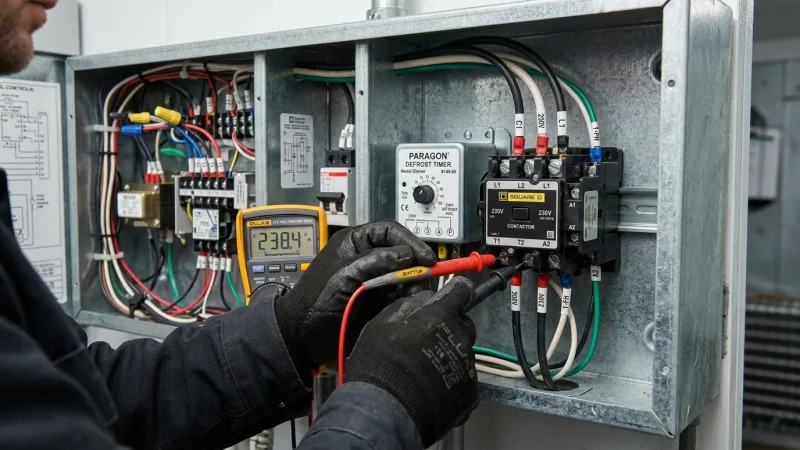
How Master Technicians Diagnose Failures: Multimeter Ohms & Pressure Telemetry Lookup
Master commercial refrigeration technicians never rely on guesswork. When diagnosing a walk-in cooler high-temperature complaint, our specialists execute a rigorous, data-driven diagnostic protocol utilizing precision digital multimeters (Fluke 116/87V), calibrated digital manifold gauges (Fieldpiece SMAN), and pipe-clamp thermistors. By cross-referencing electrical resistance (ohms), control voltage (VAC), operating pressures (PSIG), and calculated superheat/subcooling against factory engineering specifications, the exact root cause is identified with 100% precision.
| Component / Test Point | Nominal Spec (Healthy System) | Failure Threshold (Bad Component) | Diagnostic Indication & Technical Fix |
|---|---|---|---|
| Compressor Contactor Coil (230V) | 120–250 Ω resistance across A1–A2 | 0 Ω (Shorted) or ∞ Ω (Open Coil) | Contactor fails to pull in; compressor remains dead. Replace 230V 30A inductive contactor. |
| Paragon Defrost Timer Motor (8145-20) | 1,200–2,800 Ω across terminals 1–2 | ∞ Ω (Burned synchronous motor) | Timer clock motor stalled; cooler never enters or exits defrost. Replace timer mechanism. |
| Liquid Line Solenoid Valve Coil | 80–180 Ω across coil leads | ∞ Ω (Burned open coil) | Valve fails to open; system remains in continuous low-pressure pump-down. Replace OEM coil. |
| Evaporator Fan ECM Motor (115V/230V) | 15–45 Ω across main windings | Continuity to ground (<1 MΩ) | Motor grounded or seized bearings. Replace with OEM high-efficiency cast-iron ECM fan motor. |
| Evaporator Operating Superheat (TXV) | 8°F to 12°F Superheat at coil outlet | > 25°F (Starved) or < 4°F (Flooding) | High superheat = lost bulb charge or clogged screen. Replace Sporlan power head or valve. |
| Low-Pressure Control Cut-In / Cut-Out | Cut-In: 45–50 PSI | Cut-Out: 20–25 PSI | Contacts open below 15 PSI (Low Charge) | Refrigerant leak detected; low-pressure switch locks out compressor. Nitrogen leak check required. |
| High-Pressure Safety Switch (R-404A) | Closed (0 Ω across control contacts) | Open ∞ Ω (Tripped > 425 PSI) | Condenser coil choked with grease or dead condenser fan motor. Chemically clean coils & reset. |
);
Essential Commercial OEM Components, Valve Assemblies, and Controllers
Commercial walk-in coolers rely on industrial-grade parts engineered to withstand demanding continuous duty cycles. When an emergency breakdown occurs in a North Fulton kitchen, our mobile inventory vehicles arrive stocked with genuine OEM components from the industry’s most trusted manufacturers:
- Sporlan SBFV / EG Series Thermostatic Expansion Valves: Featuring selective thermostatic charges (C, Z, or ZP charges), stainless steel diaphragms, and replaceable brass power heads. These valves ensure micro-precision refrigerant flow without hunting or flooding.
- Copeland Scroll & Discus Semi-Hermetic Compressors: The gold standard in commercial refrigeration. Copeland scroll compressors provide superior volumetric efficiency, fewer moving parts, and high liquid-slugging tolerance compared to standard reciprocating hardware.
- Bohn / Heatcraft / Larkin Evaporator Fan Assemblies: Heavy-gauge galvanized steel fan motors featuring permanently lubricated ball bearings, thermal overload cutouts, and aerodynamically balanced aluminum fan blades engineered for high CFM distribution.
- Paragon 8145-20 & Grasslin Mechanical Defrost Clocks: Heavy-duty industrial time switches featuring 24-hour dials with adjustable 15-minute tripper pins, heavy silver contacts, and backup mechanical clutch mechanisms.
- Carel ir33 & Dixell XR60CX Electronic Microprocessor Controllers: Advanced digital thermostats featuring dual NTC thermistor inputs, RS-485 Modbus supervisory connectivity, customizable defrost cycles, and integrated high-decibel acoustic high-temp alarms.
- Sporlan Catch-All Liquid Line Filter-Driers: Employing molded ceramic porous cores with activated alumina and molecular sieve desiccants to trap microscopic moisture, brazing flux oxides, and acid byproducts before they reach the expansion valve.
If your facility also operates commercial Scotsman ice cubers or bar dispensers, our certified technicians servicing Scotsman ice maker repair carry synchronized commercial parts to address your entire commercial kitchen lineup in a single service visit.
Commercial Preventative Maintenance Routine for Georgia Hospitality Operations
The most effective strategy to avoid a catastrophic 7:00 PM walk-in cooler failure on a Saturday night is executing an institutional preventative maintenance program. The heavy humidity and airborne grease of the Greater Atlanta hospitality environment place immense thermal stress on commercial condensing equipment. Implement the following maintenance checklist to extend component lifespan and cut electrical utility bills by up to 25%:
- Monthly Condenser Coil Chemical Cleaning: Use a self-rinsing, non-acidic alkaline coil cleaner and low-pressure water spray to flush grease, cooking oil mist, and road dust from exterior condensing coils. Warning: Never use high-pressure pressure washers, which instantly fold and flatten delicate aluminum fins.
- Quarterly Condensate Drain Line Flushing: Pour a gallon of warm water mixed with an EPA-approved commercial biocidal drain pan tablet into the ceiling evaporator drain pan. This prevents gelatinous microbial slime (zooglea algae) from choking the 3/4-inch PVC drain line and overflowing water into the food storage area.
- Monthly Door Gasket and Vinyl Strip Inspection: Clean magnetic door seals using mild detergent and warm water. Wipe down clear vinyl strip curtains and immediately replace torn or missing strips to stop cold air pooling onto kitchen floors.
- Bi-Annual Electrical Contactor and Terminal Retorquing: Under continuous thermal expansion and vibration, electrical screw terminals loosen. A certified technician should inspect contactor silver contacts for pitting, test operating capacitor microfarads (MFD), and retorque all line connections.
- Quarterly Operating Superheat and Subcooling Verification: Have a licensed commercial technician log operating suction pressure, discharge head pressure, and actual pipe temperatures to verify that the TXV is maintaining proper 8°F to 12°F superheat without refrigerant starvation.
Occupational Safety, Refrigerant Pressures, and High-Voltage Arc Flash Protocols
Commercial refrigeration systems involve extreme mechanical and electrical forces that demand strict adherence to OSHA workplace safety and National Electrical Code (NEC) regulations. Kitchen management and facility personnel must adhere to the following core safety protocols:
- Lockout/Tagout (LOTO) Compliance: Prior to opening any electrical junction box, testing fan motors, or servicing condensing units, technicians must attach a physical padlock and warning tag to the main disconnect handle to prevent accidental energization from remote kitchen staff.
- Refrigerant Frostbite and Vapor Asphyxiation: Liquid refrigerants boil at sub-zero temperatures (e.g. R-404A boils at -51.8°F at atmospheric pressure). Direct skin contact with escaping liquid refrigerant results in instant deep cryogenic tissue frostbite. Always wear certified nitrile or leather safety gloves and ANSI-rated eye protection when working near service ports.
- Arc Flash Protection on 208V/230V 3-Phase Circuits: The fault current available at commercial main service panels can exceed 10,000 to 22,000 Amperes. Disconnecting or testing live 3-phase compressor contactors without appropriate personal protective equipment (PPE) risks devastating arc flash explosions.
- Interior Safety Glow-in-the-Dark Release Handles: Federal and state workplace codes require that every walk-in cooler door be equipped with an unshielded, mechanical interior safety latch release that glows in the dark, allowing trapped personnel to strike the latch and exit even if the door is padlocked from the exterior.
Frequently Asked Questions (Interactive Accordion Diagnostic Library)
Click any diagnostic question below to expand detailed master technician insights regarding commercial walk-in cooler troubleshooting, food safety regulations, and emergency dispatch:
Q1: What temperature should a commercial walk-in cooler maintain under Georgia health codes?
Under Georgia Department of Public Health Chapter 511-6-1 and the FDA Food Code, commercial walk-in coolers must maintain cold-holding food temperatures at or below 41°F (5°C) at all times. In professional practice, commercial refrigeration equipment is calibrated to cycle between 35°F and 38°F (1.6°C to 3.3°C) to ensure that even during peak lunch and dinner kitchen rushes with frequent door openings, internal core product temperatures remain safely below the 41°F danger threshold.
Q2: Why is my commercial walk-in cooler evaporator coil completely covered in solid ice?
A solid sheet of ice across a walk-in cooler evaporator coil indicates that the system failed to execute its scheduled defrost cycle or lost proper airflow. The most common causes are a stalled Paragon 8145-20 mechanical defrost timer, a seized evaporator fan motor, an extreme refrigerant undercharge that causes partial localized coil freezing, or torn magnetic door gaskets that allow continuous humid kitchen air to enter and freeze across the cold aluminum fins.
Q3: Can I manually chip ice off the commercial evaporator coil with a screwdriver or knife?
Absolutely not. Chipping ice off an evaporator coil with metal instruments almost always punctures the paper-thin aluminum fins or soft copper refrigerant tubing. A puncture causes immediate high-pressure refrigerant blowout, risks painful cryogenic frostbite to your hands, and transforms a routine defrost repair into an expensive emergency sealed-system braze and recharge job costing upwards of $1,200. Always defrost coils safely using warm airflow or by engaging manual defrost mode on the timer.
Q4: How does a commercial technician diagnose a bad Sporlan thermostatic expansion valve (TXV)?
Technicians diagnose a faulty TXV by measuring operating superheat at the evaporator outlet tube using digital pipe-clamp thermistors and digital manifold gauges. If the system exhibits high superheat (>25°F) while the suction pressure is abnormally low and the sight glass shows solid liquid, the valve is starving the coil. The technician will test the thermal power head by immersing the sensing bulb in warm water; if suction pressure fails to respond instantly, the internal power element charge has escaped and the valve must be replaced.
Q5: How long does food remain safe inside a commercial walk-in cooler when power goes out?
If the walk-in door remains strictly sealed, a well-insulated commercial polyurethane box will maintain food temperatures below the critical 41°F threshold for approximately 4 to 6 hours. If the box temperature exceeds 41°F for more than four cumulative hours, perishable proteins, dairy, and prepared foods enter the “Temperature Danger Zone” (41°F to 135°F) and must be discarded under health inspection standards.
Q6: What causes the outdoor Copeland condensing unit to short cycle every few minutes?
Short-cycling is typically triggered by a safety control tripping. The high-pressure cutout switch will trip if the condenser coil is packed with kitchen grease, the condenser fan motor has failed, or the system was overcharged. Alternatively, an extreme refrigerant leak or restricted liquid line filter-drier will drop suction pressure below the low-pressure switch cutout point, causing rapid on-off cycling.
Q7: How much does it typically cost to repair a commercial walk-in cooler in Alpharetta, GA?
Commercial walk-in cooler repair costs typically range from $280 to $650 for electrical and control faults (defrost timer replacement, contactor installation, or ECM fan motor service). Major sealed-system interventions—such as Sporlan TXV replacement with refrigerant recovery or commercial leak repairs—range between $650 and $1,350. Full Copeland scroll compressor replacements average between $1,450 and $2,800 depending on horsepower and crane/rooftop logistics.
Q8: What is the difference between air defrost and electric defrost on walk-in coolers?
Air defrost (off-cycle defrost) is used in medium-temperature walk-in coolers operating at 35°F to 38°F. The compressor shuts down while the evaporator fans continue running, pulling above-freezing room air across the coil to melt light frost. Electric defrost is utilized in walk-in freezers and low-temperature coolers (below 34°F) where room air is too cold to melt ice; electric resistance heater rods embedded in the coil energize to melt frost while evaporator fans are delayed to avoid blowing steam into the box.
Q9: Why is there water leaking on the floor inside my commercial walk-in cooler?
Water pooling on the walk-in floor is almost always caused by a clogged condensate drain line. Dust and airborne yeast in commercial kitchens create microbial slime that blocks the 3/4-inch PVC drain trap. During defrost cycles, meltwater overflows the evaporator drain pan and cascades onto food shelves and the floor. Clearing the drain line with nitrogen and installing biocidal drain pan strips resolves the issue.
Q10: What does bubbling or foaming in the liquid line sight glass mean?
A continuous stream of bubbles or vapor foam in the sight glass indicates that the liquid refrigerant has dropped in pressure and begun “flashing” into vapor before reaching the TXV. This confirms that the system is significantly undercharged due to a refrigerant leak, or that a severe restriction exists in the liquid line filter-drier upstream of the sight glass.
Q11: Can a restaurant operate with a walk-in cooler running at 45°F temporarily?
No. Running at 45°F violates state and municipal health codes. Potentially hazardous foods (PHF) held between 41°F and 135°F enter the rapid bacterial growth range. During an inspection, any food held above 41°F without time-as-a-public-health-control documentation will be cited as a critical violation and ordered destroyed. Immediate technician dispatch is essential.
Q12: How often should commercial walk-in condenser coils be cleaned in North Fulton?
In commercial restaurant environments, rooftop condensing coils should be professionally cleaned at least once every 60 to 90 days. If the condensing unit is located indoors near deep fryers or charbroilers, monthly chemical degreasing is recommended to prevent head pressure overloads and premature compressor valve burnout.
Q13: Why is my walk-in cooler freezing vegetables and produce placed near the ceiling?
Freezing top-shelf product occurs when the digital thermostat differential is miscalibrated, the temperature sensor probe has slipped from its factory position and is touching cold metal tubing, or the thermostat relay contacts have welded closed, causing the compressor to run 100% of the time without cycling off.
Q14: What is the lifespan of a commercial walk-in cooler condensing unit?
With quarterly preventative maintenance, high-quality Copeland scroll condensing units typically deliver an operational lifespan of 12 to 15 years. Evaporator coils generally last 10 to 12 years before fin corrosion and copper micro-pinholes necessitate replacement. Neglecting coil cleaning can cut compressor lifespan in half.
Q15: Are your commercial refrigeration technicians EPA Section 608 certified?
Yes. All of our commercial refrigeration specialists hold universal EPA Section 608 certifications, enabling them to legally service, recover, evacuate, and charge all Type I, Type II, and Type III low-pressure, medium-pressure, and high-pressure commercial refrigeration systems in full compliance with federal environmental statutes.
Q16: How fast can a commercial emergency technician arrive at my Alpharetta restaurant?
We maintain dedicated on-call commercial service vans stationed across Alpharetta, Milton, Roswell, and Johns Creek. For active high-temperature alarms in restaurants, grocery facilities, and country clubs, our emergency dispatch target arrival window is typically between 45 and 90 minutes from dispatch confirmation.
Specialized Commercial & Cold-Chain Repair Services
- Commercial Appliance Repair Alpharetta GA – Comprehensive commercial kitchen, refrigeration, and heavy laundry solutions.
- Refrigerator Repair Alpharetta GA – Residential, commercial reach-in, and luxury built-in cooling systems.
- Emergency Appliance Repair Service – Priority same-day dispatch for high-temperature alarms and electrical shorts.
- Same-Day Appliance Repair Service – Rapid diagnostic triage and mobile inventory for prompt restoration.
Related Commercial & Refrigeration Diagnostic Guides
Commercial & Luxury Refrigeration Brands Serviced
Dedicated North Fulton Commercial Dispatch Coverage
Our EPA-certified commercial refrigeration vans provide rapid emergency response across all primary commercial dining and hospitality hubs:
- Commercial Appliance Repair Alpharetta GA – Avalon, Downtown Alpharetta, North Point, and Windward Parkway.
- Commercial Appliance Repair Milton GA – Crabapple Market, Birmingham Crossroads, and equestrian club facilities.
- Commercial Appliance Repair Roswell GA – Historic Canton Street dining district and Holcomb Bridge corridor.
- Commercial Appliance Repair Johns Creek GA – Medlock Bridge, Technology Park, and country club dining facilities.
Key Operational Takeaways for Commercial Walk-In Coolers
- Commercial walk-in cooler product holding temperatures must never exceed 41°F under Georgia Department of Public Health food safety codes.
- A solid sheet of ice across the evaporator coil is primarily caused by a stalled mechanical defrost timer, a burned ECM fan motor, or a failed Sporlan TXV valve.
- Never chip ice away from aluminum evaporator fins with screwdrivers or knives; soft copper tubing punctures lead to costly refrigerant release and chemical frostbite.
- Bubbling or foaming in the liquid line sight glass confirms a serious refrigerant leak or severe liquid line filter-drier restriction.
- Dirty, grease-packed rooftop condenser coils cause head pressures to skyrocket above 400 PSI, triggering thermal compressor shutoffs.
- Quarterly professional maintenance including coil degreasing, drain line clearing, and contactor inspection cuts walk-in breakdowns by over 75%.
- All refrigeration circuit interventions require EPA Section 608 certified technicians utilizing precision digital manifold gauges and vacuum pumps.
- Same-day emergency commercial response is available 24/7 across Alpharetta, Milton, Roswell, and Johns Creek by calling (770) 796-7742.
Protect Your Commercial Kitchen Inventory & Food Safety Rating
Do not let a climbing walk-in cooler high-temperature alarm jeopardize thousands of dollars in perishable food inventory or interrupt your dinner service. Our EPA-certified commercial refrigeration specialists arrive equipped with factory Sporlan valves, Bohn fan motors, and Copeland hardware for prompt, reliable restoration.
Serving Restaurants, Country Clubs, Markets & Facilities throughout Alpharetta, Milton, Roswell, Johns Creek & Fulton County, GA.
Need Certified Appliance Repair Today?
Skip the phone line — book direct local priority dispatch across Alpharetta, Milton, Roswell & Johns Creek.