
Commercial Ice Machine Not Dropping Ice: Harvest Cycle Failure Troubleshooting & Repair in Milton, GA
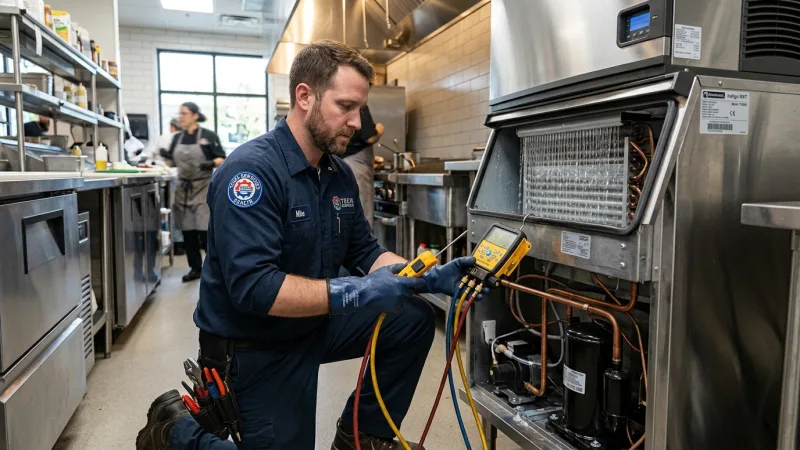
When a commercial ice machine runs through its continuous freeze cycle but fails to release the frozen slab into the storage bin during the harvest phase, beverage operations across Milton restaurants, golf clubhouse bars, and medical facilities grind to an immediate halt. This authoritative commercial diagnostic guide examines the exact thermodynamic, mechanical, and electronic root causes behind ice harvest lockouts—from defective hot gas bypass solenoid valves and miscalibrated ice thickness probes to scale-encrusted evaporator grids and failed mechanical harvest assist pins—providing master technician telemetry, safe facility triage, and immediate priority emergency dispatch across Milton, Alpharetta, Roswell, and Johns Creek, GA.
Quick Diagnostic Answer: Why Is Your Commercial Ice Machine Not Dropping Ice?
A commercial ice machine that freezes ice but will not drop it during harvest is almost always suffering from a failed hot gas bypass solenoid valve (which fails to route hot discharge vapor into the evaporator grid to melt the bond), a miscalibrated or calcified ice thickness probe (preventing the electronic controller from sensing a completed slab), a stuck harvest assist mechanical pin or pushrod, or heavy lime scale and calcium delamination on the nickel-plated evaporator plates that mechanically traps the ice cubes inside their grid cells.
Immediate Action: Turn the machine selector switch from ICE to OFF (or CLEAN) to initiate a manual warm defrost, avoid using metal scrapers or screwdrivers against delicate nickel plating, verify water line pressure, and contact a certified commercial technician at (770) 796-7742 before the machine enters a permanent safety freeze-up lockout.
Listen to 60-Second Commercial Ice Diagnostic Brief
Narrated by Jason J. (Master Certified Commercial Refrigeration Specialist)
Check Same-Day Ice Machine Tech Availability in Milton & North Fulton
Recently Serviced in Milton & Crabapple Hospitality District
Manitowoc Indigo 500 lb Cuber Harvest Assist Solenoid & Hot Gas Valve Replacement Completed • Full Bin Restored • Verified 5.0 ★★★★★
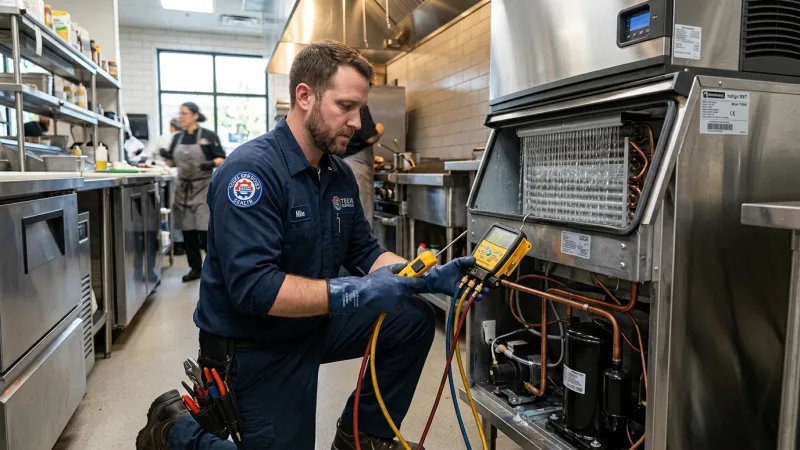
Commercial Ice Machine Harvest Guide: Table of Contents
- The Thermodynamics of Commercial Ice Making: Freeze vs. Harvest Cycles
- Recognizing Harvest Failure Symptoms: Long Freeze Locks and Overgrown Ice Bridges
- Field Restoration Showcase: Frozen Ice Evaporator Grid Before & After Chemical Descaling
- Primary Mechanical & Electrical Root Causes of Ice Release Failure
- Step-by-Step Safe Kitchen Facility Troubleshooting & Inspection Protocols
- When to Stop: Evaporator Plate Damage, High Voltage, and EPA Regulations
- Commercial Decision Framework: Repairing Components vs. Full Machine Overhaul
- Interactive Instant Commercial Ice Machine Repair Cost Estimator
- Key Variables Influencing Commercial Ice Machine Repair Pricing
- Master Technician Multimeter & Telemetry Lookup Table
- Critical OEM Commercial Ice Machine Parts and Valve Assemblies
- Preventative Maintenance & Sanitization Protocol for Milton Establishments
- Health Code Sanitization, Water Filtration, and Electrical Safety Standards
- Frequently Asked Questions (Interactive Accordion Diagnostic Library)
- Emergency Commercial Dispatch Areas Across Milton & North Fulton County
The Thermodynamics of Commercial Ice Making: Freeze vs. Harvest Cycles
In the fast-paced hospitality and dining landscape of Milton, Crabapple, and northern Fulton County, a high-capacity commercial ice maker is the unsung engine of daily food service operations. From chilling craft cocktails and preserving fresh seafood displays to supporting bulk banquet catering and country club beverage stations, an uninterrupted supply of crystal-clear gourmet ice is indispensable. When a commercial machine abruptly stops dropping ice, the breakdown instantly triggers operational chaos, forcing managers to divert staff to purchase bagged retail ice while cocktail programs falter and health department compliance is jeopardized.
Unlike a standard residential refrigerator ice maker that uses a plastic mold and a slow mechanical sweep arm, a commercial automatic ice cuber—manufactured by industry leaders like Manitowoc, Hoshizaki, Scotsman, or Ice-O-Matic—functions as a sophisticated thermodynamic heat pump. These machines produce between 300 and 1,200 pounds of ice every 24 hours through a tightly synchronized, multi-stage electronic sequence divided into two primary operations: the Freeze Cycle and the Harvest Cycle. Our specialists in commercial appliance repair regularly diagnose the complex boundaries between these two stages.
During the freeze cycle, a heavy-duty water recirculation pump draws purified water from a lower sump trough and cascades a uniform, laminar sheet of water downward across the face of a vertically mounted, nickel-plated copper evaporator grid. Cold liquid refrigerant (typically R-404A or R-410A) boils inside copper tubing soldered to the back of the evaporator plate at temperatures dropping to 0°F to 10°F (-18°C to -12°C). As pure water freezes in layers inside each individual cube cell, minerals and impurities are washed away into the sump. Over 12 to 22 minutes, individual ice cubes form, connected across the front by a thin 1/8-inch continuous ice bridge.
Once the ice bridge reaches its calibrated thickness, the machine’s microprocessor controller initiates the crucial Harvest Cycle. This stage requires a complete thermodynamic reversal: the water pump shuts down, the water dump valve purges mineral-heavy residual water, and the electronic controller energizes the hot gas bypass solenoid valve. This valve diverts superheated, high-pressure discharge gas directly from the compressor outlet into the evaporator coil, warming the nickel grid to approximately 40°F to 45°F within 60 to 90 seconds. This rapid defrost melts the microscopic bond holding the ice cubes to the metal grid. Assisted by gravity, mechanical harvest assist pins, or air assist solenoids, the entire slab slides downward, pushes open the magnetic water curtain, and falls into the storage bin. When any single link in this precision sequence fails, the slab remains locked to the plate, and ice production ceases entirely.
Recognizing Harvest Failure Symptoms: Long Freeze Locks and Overgrown Ice Bridges
Harvest cycle failures present distinctive audible, visual, and operational symptoms long before the ice bin is completely empty. Recognizing these warning signs early allows bar managers and culinary directors to halt equipment before a catastrophic freeze-up crushes the evaporator plate or destroys the compressor. Look for the following mechanical signals:
- Extended Freeze Cycle Timeouts (Long Freeze Lockout): Standard freeze cycles last 14 to 22 minutes depending on ambient water and room temperature. If the machine continues running in freeze mode for 45 to 60 minutes without switching to harvest, the electronic control board will eventually trip a safety freeze lockout (e.g. Manitowoc Error E01 or Hoshizaki 1-beep alarm) to prevent evaporator freeze damage.
- Massive Overgrown Ice Slab Encasing the Evaporator Face: Opening the front service curtain reveals an impenetrable sheet of solid white ice 1 to 2 inches thick completely encasing the evaporator grid cells, distribution tube, and harvest sensor. This “freeze-up” happens when the harvest cycle triggers but the slab fails to drop, followed by the machine initiating another freeze cycle on top of the existing ice.
- Hissing Sound Without Evaporator Warming: When harvest begins, the compressor tone should change from a high-pitched hum to a deeper low-frequency rumble, accompanied by the distinct rushing sound of hot gas entering the coil. If you hear a click but the copper inlet tube to the evaporator remains freezing cold, the hot gas solenoid valve is electrically or mechanically seized.
- Water Curtain Stuck Ajar or Swinging Continuously: The plastic water curtain suspended over the evaporator plate contains a tiny permanent magnet that interacts with a magnetic reed switch on the chassis. If an ice slab partially releases and jams behind the curtain, the curtain remains pushed open, locking the machine in safety shutdown mode.
- Cloudy, Hollow, or Deformed Ice Cubes in the Bin: Before complete harvest failure occurs, machines often produce fragile, hollow, or misshapen cubes. This indicates inadequate water flow, early harvest termination, or severe mineral scaling on the grid cells that prevents uniform ice formation.
- Audible Groaning or Clicking from Harvest Assist Solenoids: On Manitowoc Indigo cubers, a mechanical harvest assist pin pushes through the back of the plate during harvest to physically nudge the slab free. If the internal solenoid coil is weak or the mechanical pin is bent, you will hear repetitive clicking as the pin fails to dislodge the heavy slab.
If your facility is experiencing any of these ice machine symptoms along Highway 9 or Birmingham Crossroads, our master technicians providing appliance repair in Milton, GA arrive equipped with specialized diagnostic testing instruments and genuine factory OEM harvest components.
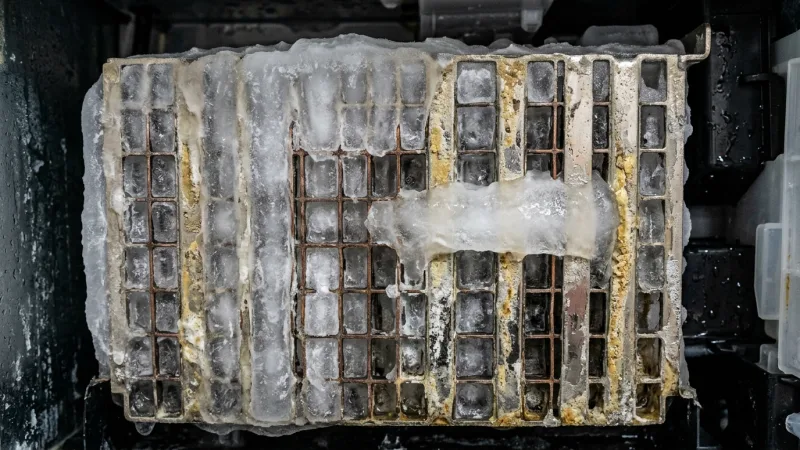
Field Diagnosis: A country club banquet ice machine in Milton displaying continuous harvest timeouts. Inspection revealed a solid 1.5-inch thick frozen ice bridge mechanically bonded to the nickel-plated copper grid cells due to severe calcium scale buildup and a failed hot gas bypass solenoid coil.
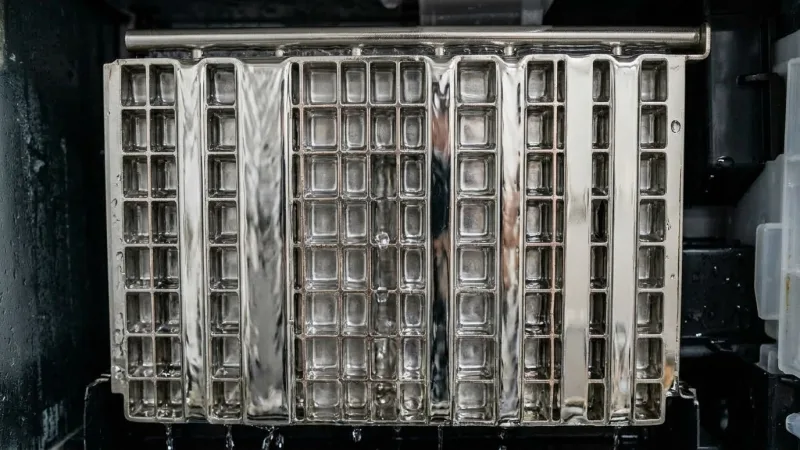
Restoration Outcome: Master technicians executed a gentle chemical descale using nickel-safe food-grade cleaner, replaced the defective 208V hot gas solenoid coil, recalibrated the ice thickness bridge sensor to exactly 1/8 inch, and sanitized the water circuit. Harvest drops now cycle cleanly in 72 seconds.
Primary Mechanical & Electrical Root Causes of Ice Release Failure
When a commercial ice machine fails to drop ice, the fault is never mysterious. Decades of specialized field service in North Fulton kitchens demonstrate that harvest lockouts stem from six critical mechanical, chemical, and electrical failures:
1. Defective Hot Gas Bypass Solenoid Valve or Burnt Solenoid Coil
The hot gas bypass valve is the thermodynamic heart of the harvest cycle. Connecting the high-pressure discharge line directly to the evaporator inlet, this normally closed solenoid valve must snap open the instant the control board energizes its magnetic coil. When opened, it bypasses the condenser and thermostatic expansion valve, dumping hot 160°F to 180°F compressor discharge gas straight into the cold evaporator coil.
If the electrical solenoid coil burns open (measuring infinite ohms on a digital multimeter), or if the internal stainless steel plunger and pilot orifice become mechanically jammed by brazing slag or oxidized refrigeration oil, the valve remains firmly shut. The evaporator remains freezing cold, unable to melt the microscopic frost bond anchoring the ice slab to the metal grid. The machine runs until its safety harvest timer times out (typically 3.5 to 4.5 minutes), whereupon the controller shuts down cooling on an error lockout.
2. Miscalibrated or Heavily Calcified Ice Thickness Sensing Probe
Modern commercial cubers rely on an electronic conductivity probe suspended directly in front of the evaporator grid to detect when the ice bridge is ready for harvest. As water flows continuously over the growing ice, the outer surface of the freezing slab eventually touches the metal probe tip. The tiny electrical current flowing through the water to chassis ground signals the microprocessor that the bridge has reached factory thickness (nominally 1/8 inch or 3.2 mm).
In North Georgia municipal water systems, dissolved calcium carbonate and magnesium ions precipitate onto the probe face, forming an insulating crust of white mineral scale. This scale blocks the electrical sensing current, causing the machine to believe the ice is still too thin. The freeze cycle continues unchecked for 40+ minutes, building a massive overgrown ice block that mechanically fuses across the entire box and cannot be dislodged during harvest. Conversely, if the probe bracket bends too close to the plate, harvest initiates prematurely, creating paper-thin, hollow cubes that shatter.
3. Severe Lime Scale, Mineral Pitting, and Nickel Plating Delamination
The evaporator plate of a commercial ice maker is a high-precision heat exchanger made of copper clad in a microscopic layer of mirror-finish nickel plating. Nickel provides exceptional corrosion resistance and a super-slick surface that allows ice slabs to slide off effortlessly under gravitational pull during harvest.
When facility staff neglect quarterly descaling or mistakenly use aggressive hydrochloric or muriatic acids rather than certified nickel-safe cleaners, the protective nickel plating peels, bubbles, or delaminates. This exposes the bare, porous copper beneath. Liquid water penetrates these microscopic copper pits and freezes into solid ice anchors, locking the cube slab to the metal grid with immense physical force. Even when the hot gas valve functions flawlessly, the ice remains physically anchored to the delaminated grid until it melts completely into water.
4. Harvest Assist Solenoid Pin Failure (Manitowoc Indigo Systems)
To accelerate harvest drops and reduce compressor heat load, Manitowoc commercial cubers utilize a mechanical harvest assist mechanism located behind the evaporator plate. This assembly features a high-force linear solenoid that drives a rounded mechanical push pin through a small sealed opening in the plate, physically pushing the center of the ice slab away from the grid during the harvest defrost cycle.
Over thousands of cycles, the internal return spring can weaken, the mechanical pin can accumulate calcium scale and bind inside its guide bushing, or the electrical solenoid coil can suffer an open circuit. Without this mechanical assist, surface tension and suction keep the heavy ice slab clinging to the wet vertical grid, triggering repeated harvest timeouts and eventual machine lockout.
5. Defective Water Curtain Magnetic Reed Switch
The plastic splash curtain hanging over the front of the evaporator serves a dual purpose: it keeps circulating water inside the sump trough during the freeze cycle, and it acts as the primary harvest completion sensor. When the ice slab drops, it physically swings the curtain outward. A tiny permanent magnet molded into the curtain moves away from a sealed magnetic reed switch mounted on the cabinet frame. The momentary opening and closing of these electrical contacts signals the control board that the harvest was successful and commands the unit to begin the next freeze cycle.
If the magnetic reed switch sticks closed due to internal contact welding, if the curtain magnet has fallen out, or if scale prevents the curtain from swinging freely on its pivot pins, the board assumes the ice never dropped. In response, the machine remains stuck in harvest or enters an immediate diagnostic error lockout. If your restaurant operates in nearby Alpharetta, our factory-certified team performing appliance repair in Alpharetta, GA stocks universal magnetic curtain switches for all major commercial cuber brands.
6. Water Inlet Solenoid Valve Weeping or Passing Water Continuously
During the freeze cycle, the water inlet valve must close completely to maintain a fixed batch of water in the sump trough. If sand, silt, or calcium sediment lodges inside the internal rubber diaphragm seat of the brass water inlet valve, warm municipal tap water (often 68°F to 75°F in Georgia summers) continuously seeps into the sump throughout the entire freeze cycle.
This continuous influx of warm water constantly dilutes the chilled water bath, preventing the evaporator from reaching sub-freezing temperatures. The freeze cycle drags on indefinitely, ice bridge thickness becomes uneven, and the cooling circuit lacks the concentrated heat capacity to trigger an effective harvest cycle, leaving kitchen staff with an empty ice bin.
Step-by-Step Safe Kitchen Facility Troubleshooting & Inspection Protocols
When you discover your commercial ice machine stuck in freeze mode or displaying an error lockout, performing an immediate, disciplined visual and physical inspection can prevent permanent component destruction. Follow this safe facility protocol:
Step 1: Inspect the Water Curtain and Sump Water Level
Remove the front stainless steel access panel. Visually inspect the clear plastic water curtain suspended over the evaporator. Is the curtain hanging completely plumb, or is an ice slab partially propping it open? Gently lift the curtain and observe the water trough below. The water level should reach approximately 1/2 inch below the overflow standpipe. If the trough is completely dry, the water inlet valve or filtration system has choked.
Step 2: Check Ice Bridge Thickness and Evaporator Ice Formation
Examine the ice forming on the vertical evaporator grid. Are all cube cells filling uniformly from top to bottom, or is only the bottom third of the grid freezing? Uniform ice formation indicates a healthy refrigerant charge. Next, inspect the thickness of the ice bridge connecting the cubes. It should measure approximately 1/8 inch (the thickness of a five-cent nickel coin). If the bridge is 1/2 inch thick or solid across the entire face, the harvest initiation circuit has failed.
Step 3: Execute a Manual Harvest Cycle Test
Locate the main toggle or rocker switch on the front control box. Move the switch from ICE to OFF for 10 seconds, then toggle to HARVEST (or press the manual harvest button on digital touchscreen models like Manitowoc Indigo or Scotsman Prodigy). Observe the machine:
- The water pump should immediately shut off.
- The hot gas bypass valve should click audibly as its solenoid energizes.
- Within 60 to 90 seconds, the top inlet copper line feeding the evaporator should become hot to the touch.
- The ice slab should begin sweating, slide downward, and drop into the bin with a loud crash.
If the hot gas line remains freezing cold and the ice slab refuses to budge after 3 minutes, the hot gas solenoid has failed or the evaporator plate is severely delaminated.
Step 4: Inspect the Ice Thickness Probe for Mineral Scaling
With the machine powered OFF, inspect the stainless steel or brass probe element hanging in front of the grid. If the metal tip is coated in a rough, chalky white or yellowish crust of calcium scale, clean it gently using a soft cloth saturated with food-grade nickel-safe ice machine cleaner. Never use abrasive sandpaper or wire brushes, which scratch the sensing plating and cause erratic harvest timing.
Step 5: Verify Water Filtration and Inlet Pressure
Locate the external commercial water filtration manifold (typically Everpure, 3M, or Pentair) mounted adjacent to the machine. Check the water pressure gauges. Dynamic water inlet pressure must remain between 20 PSI and 80 PSI while the machine is filling. If the gauge drops below 20 PSI when the inlet valve opens, sediment cartridges are plugged and must be replaced immediately. If your facility is located in Roswell, our team providing appliance repair in Roswell, GA stocks replacement filtration cartridges and sanitary fittings.
When to Stop: Evaporator Plate Damage, High Voltage, and EPA Regulations
Critical Commercial Warning: Never Use Metal Tools on Evaporator Grids
When an ice machine freezes solid, frustrated kitchen staff often attempt to pry or chisel the ice slab off the grid using chef knives, screwdrivers, or ice picks. This action immediately destroys the machine.
The nickel-plated grid walls are microscopically thin. Puncturing or gouging the evaporator ruptures the sealed copper refrigerant channels underneath, releasing pressurized R-404A refrigerant, contaminating the food-contact water zone with compressor oil, and necessitating a complete evaporator replacement costing $1,800 to $3,200.
You must immediately halt facility troubleshooting and contact a licensed commercial technician when:
- The digital diagnostic display flashes continuous system lockouts (e.g. Manitowoc E01, E02, or E03, or Scotsman 8-flashing error codes).
- You smell burnt electrical resin or see scorched terminal wiring near the main control board or contactor.
- The compressor body is running scorching hot while the suction line is lukewarm, indicating severe internal valve bypass or loss of refrigerant.
- You discover green copper corrosion or peeling nickel plating on the grid face, indicating chemical delamination that cannot be repaired without professional plate resurfacing or replacement.
For fast emergency commercial service across Milton, call our direct commercial line at (770) 796-7742.
Commercial Decision Framework: Repairing Components vs. Full Machine Overhaul
Commercial ice machines operate in an exceptionally harsh environment: continuous 24/7 duty cycles, damp internal atmospheres, aggressive minerals in municipal water, and high ambient summer temperatures in commercial kitchens. When evaluating whether to replace a defective component or invest in a brand-new factory cuber head, restaurant operators should apply the Commercial Equipment Lifecycle Standard:
| Diagnostic Component Failure | Machine Age Profile | Recommended Action | Financial & Operational Rationale |
|---|---|---|---|
| Failed Hot Gas Solenoid Coil or Valve | Any Age (1–10 Years) | Replace Valve / Coil | Highly cost-effective repair; immediately restores reliable harvest cycling with full warranty coverage. |
| Calcified Probe or Water Curtain Switch | 1–8 Years | Clean or Replace Sensor | Inexpensive electronic hardware; eliminates false lockouts and restores factory cube bridge calibration. |
| Seized Water Recirculation Pump | 1–7 Years | Install New OEM Pump | Factory water pump replacement ensures uniform laminar sheet distribution without replacing the machine. |
| Evaporator Nickel Grid Delamination | 8+ Years | Replace Cuber Head | Evaporator plate replacement labor and parts cost often exceed 60% of a brand-new high-efficiency machine. |
| Compressor Burnout on Aged Legacy Unit | 10+ Years | Upgrade to New Machine | Modern machines use 25% less electricity and 20% less water while eliminating catastrophic acid burnout contamination. |
If your hospitality establishment also operates large walk-in cold rooms or reach-in chef coolers, our team providing same-day appliance repair can bundle diagnostic evaluations across all kitchen refrigeration systems in a single service appointment.
Key Variables Influencing Commercial Ice Machine Repair Pricing
Commercial ice machine repair invoices reflect several distinct technical and regulatory factors unique to food-contact commercial refrigeration equipment. When reviewing an itemized proposal, the investment is determined by five primary variables:
- Electrical Control vs. Sealed Refrigeration Loop Repair: Replacing an external sensor, magnetic curtain switch, or solenoid coil is non-invasive and rapid. Conversely, replacing a leaking hot gas valve body requires recovering refrigerant, cutting copper lines, brazing with silver solder under a nitrogen sweep, pulling a 500-micron deep vacuum, and recharging pure factory refrigerant.
- Severity of Calcium Scale and Sanitization Labor: If an ice machine has been neglected for over a year, multiple chemical descaling flushes are required to dissolve heavy lime scale deposits without pitting the nickel plating. Full sanitization following EPA and NSF guidelines requires dedicated technician labor time.
- Machine Ice Production Capacity (Daily Lbs): High-capacity 800 lb to 1,200 lb commercial heads use dual evaporator plates, larger displacement compressors, and multiple hot gas bypass circuits, which increase component sizes and diagnostic complexity.
- Accessibility and Physical Installation Constraints: Ice machines stacked atop beverage dispensers or mounted in tight utility alcoves with limited clearance require additional rigging labor compared to freestanding units on open storage bins.
- Authentic Factory OEM Parts vs. Generic Substitutes: We exclusively install genuine factory OEM components from Manitowoc, Hoshizaki, and Scotsman. Generic aftermarket coils often fail prematurely due to improper electrical inductance and heat tolerances.
For facilities operating luxury home appliances or high-end residential refrigeration in nearby country clubs, our specialists in refrigerator repair provide comprehensive multi-unit diagnostics during the same service call.
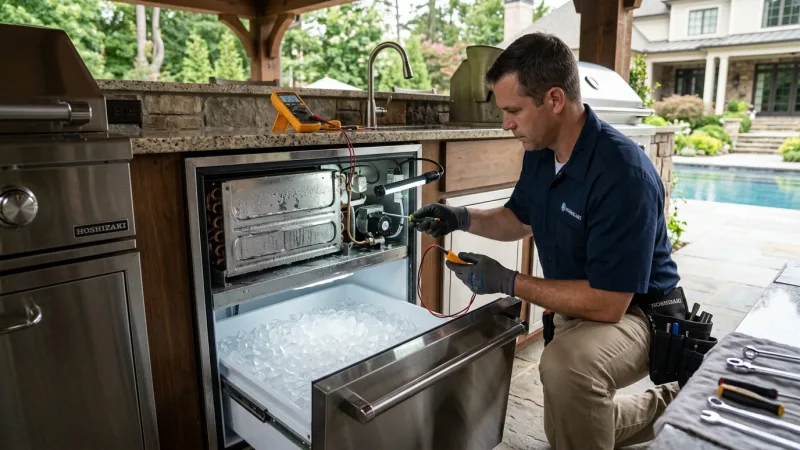
Master Technician Multimeter & Telemetry Lookup Table
Commercial refrigeration technicians employ calibrated digital multimeters and pressure gauges to isolate electrical failures from thermodynamic bottlenecks. Use the interactive telemetry search filter below to look up electrical resistance, operating voltages, and pressure criteria for commercial ice machine components:
| Component / Test Point | Nominal Spec (Healthy Cuber) | Failure Threshold (Bad Part) | Diagnostic Indication & Technical Fix |
|---|---|---|---|
| Hot Gas Bypass Solenoid Coil (120V/208V) | 80–220 Ω resistance across leads | 0 Ω (Shorted) or ∞ Ω (Burned Open) | Valve fails to energize during harvest; evaporator remains frozen. Replace OEM coil. |
| Water Curtain Magnetic Reed Switch | Closed: 0.0–0.2 Ω | Open: ∞ Ω | Permanently closed (contacts welded) | Board cannot sense ice slab drop; causes harvest lockout error. Replace reed switch. |
| Water Recirculation Pump Motor (115V/230V) | 18–42 Ω across run windings | Continuity to ground (<500 kΩ) | Pump seized or grounded; no water flow across grid. Replace OEM water pump assembly. |
| Harvest Assist Solenoid (Manitowoc) | 25–65 Ω across solenoid terminals | ∞ Ω (Open) or mechanically bound | Pin fails to push slab away from evaporator plate. Replace harvest assist assembly. |
| Suction Pressure During Harvest (R-404A) | Rises rapidly to 85–110 PSIG | Remains below 45 PSIG in harvest | Hot gas valve body jammed shut or compressor valve leak. Replace valve or compressor. |
| Water Inlet Valve Solenoid Coil | 180–350 Ω across terminals | ∞ Ω (Open) or valve leaking water | No water fill or continuous warm water leaking into sump. Replace brass water inlet valve. |
| Ice Thickness Sensor Bridge Gap | Exactly 1/8 inch (3.2 mm) from grid | Touching plate or > 1/4 inch gap | Premature harvest (hollow cubes) or freeze lockout (overgrown slab). Recalibrate probe gap. |
);
Critical OEM Commercial Ice Machine Parts and Valve Assemblies
Commercial ice machines utilize precision-engineered sanitary components built to meet National Sanitation Foundation (NSF) standard 12. Our service fleet maintains an extensive stock of genuine factory replacement parts:
- Danfoss & Alco Hot Gas Bypass Solenoid Valves: Direct-acting and pilot-operated brass refrigerant valves engineered for high-temperature discharge vapor duty with replaceable encapsulated moisture-proof coils.
- Manitowoc Indigo & QuietQube Harvest Assist Solenoids: Heavy-duty linear actuator assemblies featuring stainless steel push pins and sealed silicone boots engineered to deliver 15 lbs of mechanical release thrust.
- Gorman-Rupp & Hartell Water Recirculation Pumps: Submersible and externally mounted magnetic-drive water pumps featuring chemical-resistant Noryl impellers and stainless steel motor shafts.
- Hoshizaki Solid-State Float Switches & Thermistors: Hermetically sealed dual-contact float sensors and precision thermistors calibrated to signal water levels and harvest defrost completion.
- Scotsman Prodigy Plus Smart-Board Controllers: Microprocessor control modules equipped with AutoAlert diagnostic status lights, code recall memory, and ultrasonic bin level sensors.
- Nickel-Safe Food-Grade Chemical Descaling Solutions: Non-fuming citric and phosphoric acid formulations engineered to dissolve heavy calcium carbonate deposits without eroding microscopic nickel plating.
If your facility also operates commercial Scotsman ice cubers or bar dispensers, our certified technicians servicing Scotsman ice maker repair carry synchronized commercial parts to address your entire commercial kitchen lineup in a single service visit.
Preventative Maintenance & Sanitization Protocol for Milton Establishments
Under Georgia Department of Public Health guidelines, ice is legally classified as a food product. Contaminated, calcified ice makers not only suffer repeated harvest breakdowns but also risk severe health inspection citations. Implement this six-month maintenance routine:
- Quarterly Nickel-Safe Chemical Descaling: Run an automated clean cycle using EPA-registered, nickel-safe descaling solution to dissolve calcium scale from evaporator grid cells, water distribution tubes, and sump passages.
- Semi-Annual Complete EPA Sanitization: Following descaling, circulate an EPA-approved quaternary ammonium or sodium hypochlorite sanitizer solution through the water circuit to eradicate biofilm, black yeast, and slime molds.
- Bi-Annual Commercial Water Filter Replacement: Replace carbon block and polyphosphate scale-inhibiting cartridges on your filtration manifold every 6 months to prevent particulate fouling of inlet valve diaphragms.
- Monthly Air Filter & Condenser Coil Cleaning: Pull and wash reusable plastic mesh air filters, and vacuum aluminum condenser fins to keep high-side head pressures within factory specifications.
- Quarterly Water Curtain & Sump Inspection: Inspect the plastic water curtain for cracks or missing magnets, and verify that the sump dump valve opens fully to drain mineral-heavy water at the end of each cycle.
Health Code Sanitization, Water Filtration, and Electrical Safety Standards
Working around commercial ice making equipment requires strict adherence to food sanitation and electrical safety protocols:
- Cross-Contamination & Ice Scoop Sanitation: Never store the dedicated plastic or stainless steel ice scoop inside the ice bin. Scoops must be stored in an exterior wall-mounted sanitary holster and sanitized daily in a 3-compartment commercial sink.
- High-Voltage Water Hazard: Commercial ice makers combine high-voltage electrical circuits (115V, 208V, or 230V) with continuous water flow in close physical proximity. Always disconnect power at the circuit breaker before opening internal electrical compartments.
- Chemical Ingestion Safety: Never allow descaling acids or sanitizing chemicals to enter the ice storage bin. Always place a protective waterproof barrier over the bin opening during cleaning, or empty and sanitize the storage bin entirely after service.
- Air Gap Plumbing Compliance: The ice machine drain line and bin drain line must never connect directly to building sewer pipes. A physical air gap of at least 2 inches above an open floor sink is legally required to prevent sewage back-siphonage into food-contact zones.
Frequently Asked Questions (Interactive Accordion Diagnostic Library)
Click any diagnostic question below to expand master technician insights regarding commercial ice machine troubleshooting, harvest cycle repair, and Milton emergency dispatch:
Q1: How long should a commercial ice machine harvest cycle take?
On a healthy, properly calibrated commercial ice cuber, the harvest cycle should complete in 60 to 90 seconds (1 to 1.5 minutes). If the harvest cycle routinely takes longer than 2.5 minutes or exceeds the 3.5-minute safety timeout threshold, the hot gas bypass valve is weak, water temperature is too low, or the evaporator grid is encrusted with calcium scale.
Q2: Why does my ice machine make ice but the ice won’t fall off the grid?
When ice freezes but fails to drop, the system is failing to warm the evaporator plate during harvest. The most common cause is a burned-out hot gas bypass solenoid coil, which prevents warm discharge gas from circulating through the grid. Other primary causes include severe lime scale buildup that mechanically traps the cubes, or a defective harvest assist mechanical pin that fails to push the slab free.
Q3: What happens if I use an ice pick or knife to chip ice off the evaporator grid?
Using metal tools against an evaporator grid will almost certainly puncture the copper refrigerant tubing underneath or gouge the paper-thin nickel plating. A puncture releases high-pressure refrigerant, contaminates the food zone with oil, and permanently destroys the evaporator plate, requiring a complete replacement costing upwards of $2,000. Always defrost using warm water or the machine’s manual clean cycle.
Q4: How thick should the ice bridge connecting the cubes be?
The continuous ice bridge connecting the individual cubes across the front of the slab should measure exactly 1/8 inch (3.2 mm) thick—roughly the thickness of a standard U.S. five-cent nickel coin. If the bridge is thicker than 1/4 inch, the harvest probe is out of calibration or scaled over; if the bridge is too thin, cubes will break apart prematurely and jam the harvest curtain.
Q5: What causes a Manitowoc ice machine to display Error Code E03?
On Manitowoc Indigo and modern cubers, Error E03 indicates a Harvest Cycle Failure. It occurs when the machine experiences 3 consecutive harvest cycles that exceed the maximum time limit (3.5 minutes) without the water curtain opening. The controller enters a safety lockout to protect the compressor from thermal overload.
Q6: Can hard water in Milton cause my commercial ice machine to stop harvesting?
Yes. Hard municipal and well water in North Fulton contains dissolved calcium and magnesium minerals that precipitate out during the freezing process. This scale coats the nickel grid with a rough, sandpaper-like texture that physically grips the ice cubes, preventing gravity from sliding the slab off the plate during harvest. Dedicated scale-inhibiting water filtration and quarterly descaling are vital.
Q7: How much does it cost to repair a commercial ice machine harvest cycle failure in Milton, GA?
Standard electrical repairs—such as replacing a hot gas solenoid coil, water curtain reed switch, or ice thickness sensor—typically range between $280 and $550. Complete hot gas valve body replacements requiring refrigerant recovery and brazing range from $680 to $1,150. Full chemical descaling and sanitization service averages $280 to $450.
Q8: What is the difference between cube ice machines and nugget ice machines during harvest?
Cube ice machines use batch freezing with an evaporator grid and a dedicated hot gas harvest cycle to drop slabs. In contrast, nugget (flaker) ice machines use a continuous freezing cylinder with an internal rotating stainless steel auger that scrapes ice shavings upward through an extruding head without ever using a harvest cycle or hot gas bypass.
Q9: Why does my ice machine keep beeping continuously?
Continuous beeping indicates a critical safety lockout. On Hoshizaki ice makers, 1 beep every few seconds signifies a high discharge pressure or temperature alarm, while 3 beeps indicates a freeze-up or long freeze timeout. Counting the beep pattern tells the technician the exact fault code without opening the electrical box.
Q10: How do I test if the hot gas bypass solenoid coil is working?
With power disconnected, unplug the electrical leads to the solenoid coil and measure electrical resistance with a digital multimeter. A healthy 120V or 208V coil should read between 80 and 220 ohms. A reading of 0 ohms indicates a dead short, while an infinite (O.L.) reading confirms a burned-out open coil that cannot generate a magnetic field.
Q11: Can a leaking water inlet valve cause harvest failure?
Yes. If the water inlet valve seeps or weeps warm municipal water into the sump throughout the freeze cycle, the water bath never reaches proper sub-cooling temperatures. The freeze cycle drags on excessively, resulting in deformed, fragile ice bridges that break apart during harvest rather than dropping cleanly as a solid slab.
Q12: How often should commercial ice machines be descaled and sanitized in Georgia?
Manufacturers and food safety health inspectors recommend performing a full chemical descale and sanitization at least once every 6 months. In high-yeast environments—such as bakeries, microbreweries, or busy pizza kitchens—descaling every 60 to 90 days is essential to prevent severe microbial slime buildup.
Q13: Why is my commercial ice machine water curtain stuck open?
A curtain stuck open is usually caused by an ice slab that only partially released and jammed between the curtain and grid, or by mineral scale accumulating in the upper pivot hinge pins. If the curtain remains open for more than 30 seconds, the magnetic reed switch remains open, signaling the controller to shut down the machine to prevent water flooding.
Q14: What type of cleaner should be used on commercial ice maker evaporator grids?
You must exclusively use certified Nickel-Safe Commercial Ice Machine Cleaner (typically formulated with phosphoric and citric acids). Never use standard household delimers, bleach, or muriatic acid, which instantly strip the protective nickel plating and permanently ruin the evaporator plate.
Q15: What is the typical lifespan of a commercial ice maker?
With biannual descaling and proper water filtration, commercial ice makers generally last between 8 and 12 years. Units operating without water filters in hard-water environments often suffer premature compressor burnout or plate delamination within 4 to 6 years.
Q16: How quickly can an emergency ice machine technician arrive at my Milton restaurant?
We maintain dedicated on-call commercial refrigeration vans stationed across Milton, Crabapple, and North Fulton. For active ice machine harvest failures in restaurants, bars, and country clubs, our emergency dispatch arrival target is typically between 45 and 90 minutes from service confirmation.
Specialized Commercial & Cold-Chain Repair Services
- Commercial Appliance Repair Milton GA – Comprehensive commercial kitchen, walk-in cooler, and ice equipment repair.
- Refrigerator Repair Milton GA – Commercial reach-in, walk-in, and luxury built-in refrigeration service.
- Emergency Appliance Repair Service – Priority same-day commercial dispatch for active kitchen breakdowns.
- Same-Day Appliance Repair Service – Rapid diagnostic triage and mobile inventory for prompt equipment recovery.
Related Commercial & Ice Diagnostic Guides
Commercial & Ice Maker Brands Serviced
Dedicated North Fulton Commercial Dispatch Coverage
Our EPA-certified commercial refrigeration vans provide rapid emergency response across all primary commercial dining and hospitality hubs:
- Commercial Appliance Repair Milton GA – Crabapple Market, Birmingham Crossroads, and equestrian club facilities.
- Commercial Appliance Repair Alpharetta GA – Avalon, Downtown Alpharetta, North Point, and Windward Parkway.
- Commercial Appliance Repair Roswell GA – Historic Canton Street dining district and Holcomb Bridge corridor.
- Commercial Appliance Repair Johns Creek GA – Medlock Bridge, Technology Park, and country club dining facilities.
Key Operational Takeaways for Commercial Ice Machines
- Commercial ice harvest cycles should complete within 60 to 90 seconds under normal operation.
- Never use metal knives, ice picks, or screwdrivers to chip ice off evaporator plates; punctures cause expensive refrigerant leaks.
- A failed hot gas bypass solenoid coil (measuring open ohms) is the most common reason ice fails to release from the grid.
- Ice bridge thickness must be calibrated to exactly 1/8 inch (nickel coin thickness) to ensure clean slab drop.
- Hard water scale mechanically anchors ice cubes into grid cells; quarterly descaling with nickel-safe cleaner is essential.
- A stuck or misaligned water curtain magnetic reed switch will trigger immediate diagnostic harvest error lockouts.
- Continuous warm water weeping from a defective inlet valve prevents water from reaching sub-cooling temperatures.
- Emergency commercial service is available 24/7 across Milton, Alpharetta, Roswell, and Johns Creek at (770) 796-7742.
Restore Your Commercial Ice Production Before the Next Shift
Do not let a frozen evaporator grid or harvest lockout disrupt your restaurant bar, banquet event, or clubhouse operations. Our EPA-certified commercial ice specialists arrive with factory parts for Manitowoc, Hoshizaki, and Scotsman for fast, same-day restoration.
Serving Restaurants, Bars, Country Clubs & Commercial Kitchens throughout Milton, Alpharetta, Roswell, Johns Creek & Fulton County, GA.
Need Certified Appliance Repair Today?
Skip the phone line — book direct local priority dispatch across Alpharetta, Milton, Roswell & Johns Creek.