
Atosa Commercial Refrigerator Carel Controller Error P1 & Start Relay Diagnostic in Alpharetta, GA
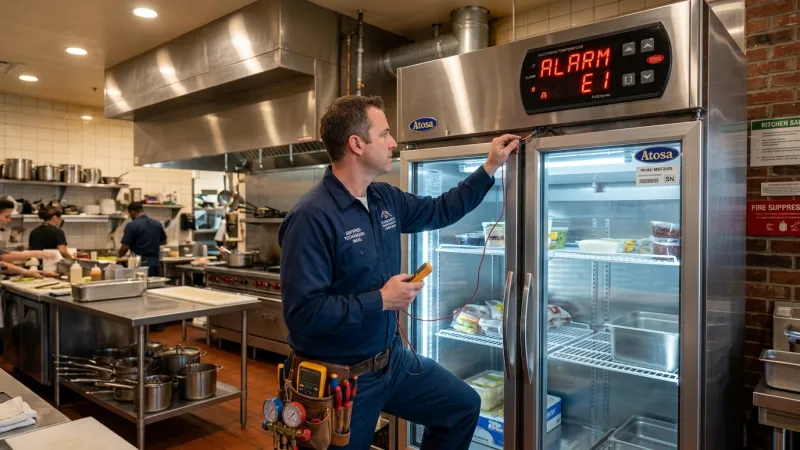
When a high-volume restaurant, catering commissary, hotel banquet kitchen, or specialty market in Alpharetta discovers an Atosa commercial refrigerator carel controller error p1 flashing on the top digital display alongside an intermittent clicking sound from the lower compressor compartment, kitchen managers face an urgent food safety crisis. Atosa reach-in refrigerators—such as the MBF8001 single-door, MBF8002 two-door, and MBF8003 three-door series—rely on sophisticated Italian-engineered Carel microprocessor controllers to govern precision cooling cycles and automated electric defrost intervals. An active Error P1 alert indicates a catastrophic room temperature sensor fault, meaning the controller has lost communication with its primary 10k-ohm negative temperature coefficient (NTC) thermistor probe. Without verified ambient temperature readings, the unit defaults to emergency timed duty-cycling, while accompanying start relay degradation risks permanently seizing the heavy-duty Embraco compressor. Explore our specialized commercial refrigeration and kitchen equipment repair solutions engineered to protect perishable inventory across Alpharetta. For priority commercial dispatch, call our master technical hotline at (770) 796-7742.
Quick Answer: What Causes Atosa Carel Error P1 & Compressor Clicking?
Atosa commercial refrigerator Error P1 indicates an open circuit, short circuit, or resistance drift in the Carel controller’s primary cabinet temperature probe (NTC thermistor). When P1 flashes, the Carel controller initiates safety parameter c4, running the compressor on a fixed 15-minute timer. If accompanied by a clicking noise from the compressor, the Embraco PTC solid-state start relay has overheated or shattered, repeatedly tripping the thermal overload protector and preventing the compressor from starting.
Listen to 60-Second Commercial Refrigeration Diagnostic Brief
Narrated by Master Cold-Side Specialist Tyler K.
Check Same-Day Commercial Tech Availability in Your Alpharetta Kitchen
Recently Serviced on Windward Parkway, Alpharetta
Atosa MBF8002 Dual-Door Reach-In • Carel Error P1 Diagnostic, OEM Probe Replacement & Embraco Start Relay Restoration • 100% Food Inventory Saved ★★★★★
Table of Contents: Atosa Commercial Refrigerator Diagnostic Manual
- 1. Carel Digital Controller Architecture & NTC Thermistor Physics
- 2. Operational Symptoms of Carel P1 Alarms & Compressor Start Failure
- 3. Visual Before & After Restoration Showcase
- 4. Common Causes: Why Error P1 Triggers & Relays Burn Out
- 5. Safe Kitchen Shift Troubleshooting Protocols for Managers
- 6. When to Stop DIY: R290 Hydrocarbon Flammability & High-Voltage Hazards
- 7. Commercial Decision Matrix: Repairing vs. Replacing Commercial Coolers
- 8. Interactive Commercial Refrigerator Repair Cost Estimator
- 9. Factors Influencing Commercial Refrigeration Invoices in Alpharetta
- 10. Technical Multimeter Testing: Probe K-Ohms, Relays & Compressor Windings
- 11. Genuine OEM Atosa & Carel Replacement Parts Catalog
- 12. Daily, Weekly & Monthly Commercial Refrigeration Preventive Maintenance
- 13. Georgia Food Health Department & FDA 41°F Holding Compliance
- 14. Advanced Carel Parameter Programming & Hydrodynamic Defrosting
- 15. Step-by-Step Professional NTC Probe & Start Relay Replacement Protocol
- 16. Frequently Asked Questions (Master Refrigeration Tech Accordion)
- 17. Commercial Kitchen Appliance Service Resources & Internal Links
- 18. Commercial Key Takeaways
- 19. Priority Commercial Dispatch Call to Action
1. Carel Digital Controller Architecture & NTC Thermistor Physics
Modern commercial foodservice refrigeration demands micro-degree precision to maintain perishable dairy, proteins, and produce beneath the statutory 41°F food safety threshold mandated by Fulton County Environmental Health inspectors. In Atosa commercial reach-in refrigerators, overall thermodynamic control is managed by an integrated Carel electronic micro-controller (typically model PJEZ or ir33 series). Unlike old electromechanical capillary dial thermostats that used expanding gas to close mechanical silver contacts, the Carel electronic controller operates on continuous solid-state analog-to-digital telemetry. Explore our primary refrigerator repair services for complete residential and commercial cold-side support across North Fulton County.
The controller interfaces with the refrigerated space through negative temperature coefficient (NTC) thermistors. An NTC thermistor is a ceramic semiconductor composed of metal oxides whose electrical resistance decreases non-linearly as temperature increases. In Atosa systems, the primary cabinet air probe (Probe 1 or Ambient Probe) is a 10K NTC sensor, meaning its electrical resistance is calibrated to exactly 10,000 ohms (10 kΩ) at 77°F (25°C). As the interior of the refrigerator chills down toward standard holding temperature (36°F to 38°F / ~2.2°C to 3.3°C), the sensor resistance rises predictably to approximately 27,000 to 29,000 ohms (27 kΩ to 29 kΩ). If commercial kitchen operations require companion walk-in storage troubleshooting, review our dedicated commercial walk-in cooler high temp alarm repair in Alpharetta, GA.
The Carel microprocessor continuously passes a micro-amperage reference voltage through terminals 1 and 2 on the rear terminal block to measure this resistive voltage drop. When the calculated resistance corresponds to a temperature higher than the programmed setpoint plus the differential (parameter rd, typically 38°F + 4°F = 42°F), the controller energizes an internal 16-amp mechanical relay. This relay sends 115 volts AC to the lower compressor compartment, powering the condenser fan motor and the Embraco hermetic compressor. For complete facility equipment maintenance, discover our comprehensive commercial appliance repair capabilities across commercial dining rooms.
When the controller reads an open circuit (infinite resistance) or a dead short circuit (zero resistance) across terminals 1 and 2, it immediately sounds an audible alarm buzzer and flashes Error Code P1 on the LED readout. Because the controller no longer knows whether the cabinet is at 20°F or 70°F, it enters a pre-programmed emergency fail-safe duty cycle determined by parameters c4 (compressor ON time with broken probe) and c5 (compressor OFF time with broken probe). By default on Atosa units, parameter c4 commands the compressor to run for 15 minutes, then shut down for 15 minutes. While this timed cycling prevents complete thermal runaway, it cannot respond to open doors or hot food loading during lunch and dinner rushes, inevitably allowing cabinet temperatures to drift into the food safety danger zone.
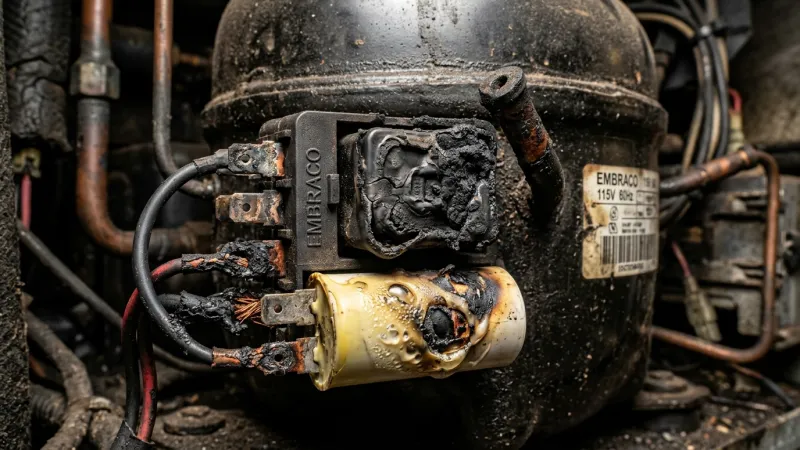
Compounding this issue, if the duty-cycle timer forces the compressor to attempt frequent starts against high head pressures—or if commercial kitchen grease has insulated the condenser coil—the compressor’s electrical starting components endure severe thermal stress. The solid-state positive temperature coefficient (PTC) start relay overheats. Once the PTC ceramic disc fractures or burns open, the compressor motor cannot engage its start winding. It draws locked rotor amperage (LRA) of 25 to 35 amps for 3 seconds until the bimetallic klixon overload protector clicks open with a loud pop, cutting power and leaving the refrigerator completely warm while Error P1 continues to flash above.
In North Fulton dining centers—such as those operating near Avalon, North Point Mall, and Windward Parkway—kitchen air temperatures during July and August routinely reach 95°F beneath commercial hood canopies. Under these heavy ambient loads, an Atosa refrigerator operating under an uncalibrated P1 duty cycle will experience rapid frost accumulation across the evaporator coil fins. Airflow chokes off completely, accelerating compressor overheating and creating simultaneous sensor and motor starting failures that demand emergency master technician intervention.
2. Operational Symptoms of Carel P1 Alarms & Compressor Start Failure
When an Atosa commercial refrigerator experiences a sensor failure or electrical starting fault, it produces specific operational symptoms that kitchen personnel must recognize before food safety is compromised:
- Flashing “P1” on Carel Display & Continuous Beeping: The digital temperature display alternates between the current approximate cabinet reading and the letters “P1”, accompanied by a high-pitched intermittent electronic buzzer alarm.
- Loud Rhythmic “CLICK … HUM … CLICK” from Bottom Compartment: Every 90 to 120 seconds, a metallic click sounds from the lower mechanical bay, followed by a low 3-second motor hum, concluding with a sharp snap as the overload protector trips open.
- Cabinet Temperatures Creeping Above 45°F: Despite the controller display indicating that cooling is demanded, internal ambient air and food product temperatures climb well past the health department’s 41°F safety limit.
- Solid Ice Slab Formation on Evaporator Coil: Because the Carel controller cannot track actual cabinet temperature, the timed duty cycle fails to coordinate with defrost intervals, allowing moisture to freeze solid across the upper evaporator fan plenum.
- Condenser Fan Runs, but Compressor Remains Silent and Scorching Hot: The lower condensing unit fan motor spins vigorously, but the black hermetic compressor shell is silent and so hot that water droplets vaporize upon contact.
- Burning Bakelite Plastic Odor Near Bottom Grill: A distinctive acrid electrical burning smell emanates from the lower compressor compartment, indicating thermal destruction of the PTC relay or blistered start capacitor casing.
- Food Freezing on Lower Shelves: In some sensor drift scenarios (where probe resistance reads higher than actual temperature), the controller believes the box is at 50°F when it is actually at 28°F, running the compressor continuously until produce freezes solid.
Facilities managing both reach-in and commercial freezing storage can review our specialized troubleshooting resources on commercial freezer repair for complete cold-line coverage across North Fulton restaurant kitchens.
Another telling operational symptom is “erratic temperature jumping” on the digital display. A cook might observe the screen display 38°F, jump to 72°F three seconds later, and then suddenly flash “P1”. This rapid fluctuation indicates a broken internal thermistor wire inside the cabinet harness that makes intermittent contact as the heavy stainless steel refrigerator doors slam shut during busy kitchen shifts.
Furthermore, when an Atosa refrigerator operates in emergency duty cycle mode (parameter c4) during humid Georgia summers, warm air pulled into the box through cracked magnetic door gaskets condenses rapidly on interior stainless steel side walls. Droplets freeze into vertical frost rivers along the rear air duct, choking off the bottom return air slots and preventing cold air from circulating to the lower storage pans.
4. Common Causes: Why Error P1 Triggers & Relays Burn Out
A thorough diagnostic investigation across hundreds of commercial refrigeration service calls in Alpharetta reveals six primary failure mechanisms responsible for Carel Error P1 alarms and compressor starting lockouts:
1. Moisture Penetration & Thermistor Element Corrosion
The ambient temperature probe inside an Atosa reach-in refrigerator is positioned in the upper airflow return stream directly adjacent to the evaporator coil. In high-humidity commercial kitchens, condensation continuously coats the sensor sheath. Over time, microscopic cracks in the silicone over-molding permit moisture to penetrate into the ceramic semiconductor pellet. The water causes internal dendritic corrosion and short-circuits the fine copper lead wires. The Carel controller detects zero resistance across terminals 1 and 2, instantly declaring a short-circuit P1 fault. For estate refrigeration systems facing similar thermistor failures, consult our Sub-Zero luxury refrigeration repair specialists.
Moisture ingress also causes severe “resistance drifting.” In these cases, the probe does not fail completely open or shorted, but its internal resistance shifts permanently by 5,000 to 15,000 ohms. Because the Carel controller relies entirely on mathematical ohm-to-temperature conversion tables, a drifted probe might report a cabinet temperature of 48°F when the actual air temperature is 34°F. This causes the controller to over-freeze produce, or conversely report 36°F while milk and poultry warm up to 48°F.
2. Mechanical Wire Pinching & Vibration Fatigue
The probe wiring harness travels from the top header display panel down through foamed-in-place polyurethane insulation or through stainless sheet metal wire chases to the evaporator housing. Repeated door slamming, shelving reconfigurations by kitchen staff, or vigorous interior wash-downs frequently snag and pinch this fine 22-gauge probe wire. Vibration from the upper evaporator fan motors rubs the wire insulation against sharp sheet metal edges, eventually severing the conductor. This creates an open-circuit fault that immediately triggers P1.
3. Embraco Compressor PTC Solid-State Start Relay Burnout
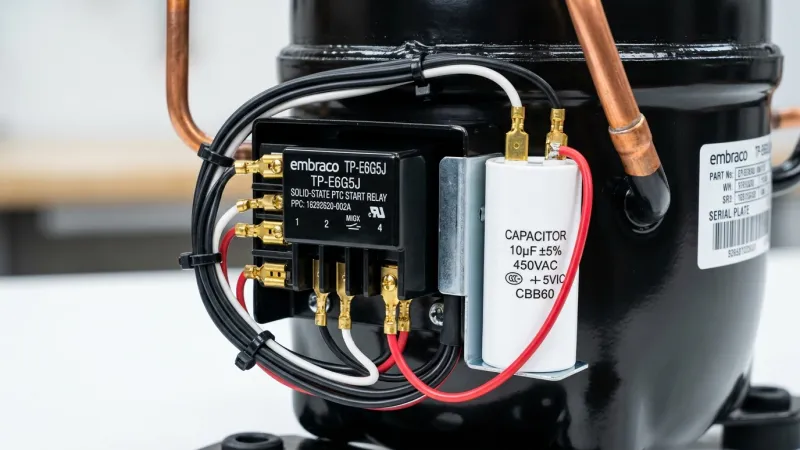
Most Atosa commercial reach-in coolers utilize Embraco hermetic reciprocating compressors (such as models EM2X3125U or NEU2168U) equipped with solid-state PTC (Positive Temperature Coefficient) start relays. When cold, the internal ceramic disc in the PTC relay has very low resistance (3 to 5 ohms), allowing a high inrush of current to energize the compressor’s start winding. As current flows, the ceramic disc heats up within fractions of a second, causing its resistance to spike to thousands of ohms and effectively disconnecting the start winding once the motor reaches 75% running speed.
However, if the refrigerator experiences rapid short-cycling—such as during Carel P1 emergency duty-cycling or brief power flickers during Alpharetta summer thunderstorms—the PTC disc does not have enough time to cool down between starts. Attempting to start the compressor with a scorching hot, high-resistance PTC disc starves the start winding. The compressor cannot break away from rotor inertia. The motor draws massive locked rotor current (LRA) until the ceramic disc literally shatters or burns into black ash inside its bakelite housing. Review our specialized brewery and draft cooler service in Beverage-Air commercial kegerator compressor relay repair in Roswell, GA.
4. Severe Condenser Coil Clogging Driving Extreme Head Pressure
In commercial restaurant kitchens, airborne flour, grease aerosol, cardboard dust, and mop lint are drawn directly into the lower condensing unit compartment by the condenser fan. Within three to six months, this debris forms a felt-like carpet over the aluminum condenser fins. With airflow blocked, high-pressure superheated refrigerant gas cannot condense into liquid. Discharge head pressures soar from normal operating levels (135 PSI on R290 or 175 PSI on R134a) to over 350 PSI. The compressor must work against crushing head pressure, dramatically increasing motor start torque requirements and causing start relays and overload protectors to burn out rapidly.
5. Corroded Controller Screw Terminal Connections
The rear terminal block of the Carel PJEZ controller uses tiny screw-clamp terminals. In commercial kitchen environments where chlorine bleach, quat sanitizers, and steam are omnipresent, corrosive vapors attack the copper and tin terminals. A thin film of oxidation on terminal 1 or 2 introduces 1,000 to 3,000 ohms of false resistance into the probe circuit. The controller interprets this false resistance as an artificial temperature drop, throwing off cooling cycles or causing intermittent P1 alarms that reset randomly. For ice storage and sanitation issues, explore our dedicated commercial ice machine repair services.
6. Weakened Run Capacitor or Blistered Start Capacitor
Embraco commercial compressors rely on motor run capacitors (typically 10µF to 15µF, 450VAC) to maintain motor phase displacement and improve running electrical efficiency. Over years of 24/7 commercial operation in hot kitchen mechanical bays, the internal dielectric oil inside the capacitor breaks down. As capacitance drops below its rated microfarad rating (±5%), motor running current increases, causing the compressor to run hotter and tripping the thermal overload switch during heavy meal services.
5. Safe Kitchen Shift Troubleshooting Protocols for Managers
When an Atosa refrigerator sounds an alarm or flashes Error P1, restaurant managers and lead culinary staff should execute the following safe preliminary triage protocols before calling for certified technical dispatch:
Step 1: Silence the Audible Carel Alarm Buzzer
To stop the irritating high-frequency buzzer from disrupting dining room guests or kitchen cooks, press any button on the Carel front keypad (typically the MUTE or SET button). This silences the acoustic beeper while leaving the visual “P1” alarm code flashing on the display as an active warning.
Step 2: Inspect Food Temperature with an Independent Probe
Do not rely on the flashing controller display. Take a calibrated handheld food safety digital probe thermometer and measure the internal product temperature of high-risk items (raw poultry, dairy, cooked meats) on the top, middle, and bottom shelves. If food temperatures have exceeded 41°F for more than two hours, execute immediate food safety holding protocols or transfer product to a working walk-in cooler.
Step 3: Listen to the Lower Mechanical Compartment
Kneel down near the bottom front vented grill. Listen carefully for 3 minutes: Is the compressor humming steadily and quietly with the condenser fan running? Or do you hear a repeating click every 90 seconds followed by silence? If you hear repeating clicks, the compressor is stalling against a burnt start relay; immediately unplug the unit to prevent irreversible motor winding burnout.
Step 4: Inspect the Condenser Coil for Dust Blanketing
Remove the front lower louvered access panel. Use a high-intensity flashlight to inspect the aluminum condenser coil fins located next to the compressor. If the fins are choked with a thick gray blanket of dust, grease, or flour, carefully vacuum the face using a soft-bristle brush attachment. Never bend or flatten the delicate aluminum fins.
Step 5: Perform a Hard Microprocessor Power Reset
Unplug the heavy 115V commercial power cord from the wall receptacle (or switch off the dedicated circuit breaker in the electrical panel) for a full 5 minutes. This allows residual capacitive voltage in the Carel controller logic board to discharge and gives the Embraco PTC start relay time to cool to room temperature. Restore power and observe whether Error P1 clears or returns immediately.
6. When to Stop DIY: R290 Hydrocarbon Flammability & High-Voltage Hazards
Critical Commercial Refrigeration Safety Directives
Modern commercial refrigeration equipment incorporates advanced refrigerants and high-energy electrical circuits that present severe injury, explosion, and regulatory hazards. Restaurant kitchen staff must halt DIY actions immediately when encountering:
- R290 Hydrocarbon Flammability (Propane Refrigerant): Contemporary Atosa commercial refrigerators utilize EPA-mandated R290 refrigerant (high-purity propane, ASHRAE A3 flammability rating). R290 is highly flammable and explosive when exposed to open flames, electric arcs, or unsealed relays. Only EPA Universal Section 608 certified technicians equipped with spark-proof recovery machines and combustible gas sniffers may service sealed refrigeration circuits.
- 115V / 208V Shock Hazards & Charged Capacitors: The compressor electrical enclosure contains motor start and run capacitors that store lethal electrical charges even when the unit is unplugged. Never touch compressor terminal pins or capacitor lugs with bare hands or uninsulated tools.
- Compressor Motor Internal Electrical Ground Faults: If a compressor motor winding has burned through its enamel insulation and shorted to the steel casing, the entire refrigerator chassis can become electrically energized if the building ground is compromised, presenting severe electrocution risks to line cooks.
- Never Force the Compressor to Run by Jumpering Controller Relays: Bypassing the Carel controller to force 115V directly to a stalled compressor will overheat the motor windings, permanently destroying the compressor and potentially triggering an electrical equipment fire.
7. Commercial Decision Matrix: Repairing vs. Replacing Commercial Coolers
A new commercial stainless steel reach-in refrigerator represents an investment ranging from $2,400 for a single-door unit to $5,800+ for a three-door pass-through model. Deciding whether to repair an active Error P1 / start relay condition or replace the refrigerator requires evaluating cabinet insulation, compressor health, and structural integrity:
| Diagnostic Factor | Repair Recommended (Maintain Asset) | Replace Recommended (Capital Upgrade) |
|---|---|---|
| Root Failure Mode | Failed NTC probe, burnt PTC relay, bad run capacitor, or controller board. | Grounded compressor windings, seized pump pistons, or internal refrigerant leak. |
| Equipment Age | Under 7 years old with intact magnetic door gaskets. | Over 10–12 years old with waterlogged cabinet insulation. |
| Estimated Repair Cost | Less than 25% of new replacement cost ($190 – $380 range). | Exceeds 50% of replacement cost (complete sealed system rebuild on old chassis). |
| Energy & R290 Efficiency | Modern R290 hydrocarbon system meeting DOE energy standards. | Legacy R134a unit with corroded steel chassis and high electric draw. |
In over 85% of Carel Error P1 and compressor start relay failure occurrences in Alpharetta restaurant kitchens, replacing the NTC thermistor probe, Embraco relay, and capacitor restores 100% factory performance, providing years of reliable service at a fraction of new equipment cost. Explore our rapid same-day appliance repair response team for fast commercial interventions.
;
9. Factors Influencing Commercial Refrigeration Invoices in Alpharetta
Commercial refrigeration repair costs in Alpharetta are determined by component engineering, diagnostic complexity, and the emergency nature of preserving perishable food inventory:
- Commercial Diagnostic Trip & Multi-Point Cold Audit: Professional dispatch, digital electronic controller interrogation, multimeter ohm verification, and compressor amp draw testing ($110–$180), credited toward completed repairs.
- Component Specifics: An authentic Carel blue NTC 10K thermistor probe is an economical repair ($65–$110 part cost), whereas replacing a damaged Carel PJEZ digital controller board or complete Embraco start kit with run capacitor carries higher component costs ($180–$320).
- Equipment Access & Architecture: Bottom-mount condensing units (standard on Atosa MBF reach-ins) are easily accessible from the front, whereas top-mount models or crowded under-counter prep stations require additional labor to slide out and access mechanical bays.
- Emergency Shift Timing: Urgent emergency evening, weekend, or holiday dispatch to rescue thousands of dollars in perishable food inventory carries modest premium rates to mobilize technicians immediately.
- Food Safety Holding Certification: Our technicians verify cabinet temperatures with NIST-calibrated infrared and immersion thermometers, ensuring compliance before signing off on the work order.
For commercial kitchens in critical downtime situations, learn more about our 24/7 emergency appliance repair response protocols across North Fulton County.
10. Technical Multimeter Testing: Probe K-Ohms, Relays & Compressor Windings
Certified commercial refrigeration specialists rely on quantitative multimeter telemetry to isolate sensor failures and electrical motor breakdown. Use the interactive filter below to search component parameters:
| Component / Test | Multimeter Setting | Factory Spec | Failure Threshold | Corrective Field Action |
|---|---|---|---|---|
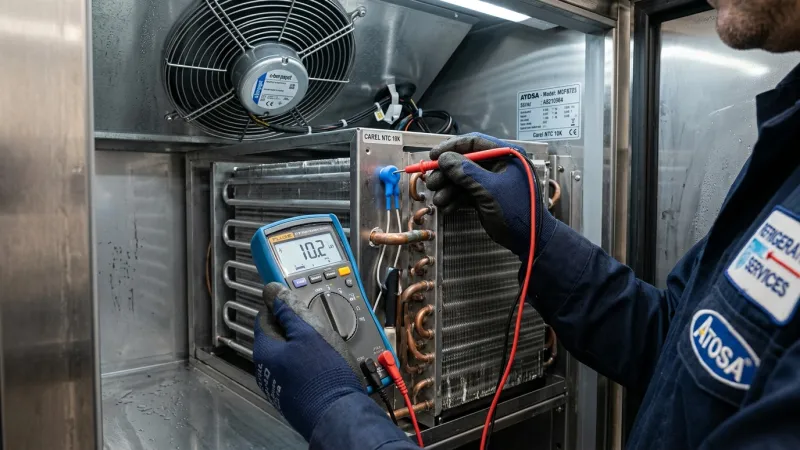
| Carel NTC Probe (Ambient 77°F) | Resistance (kΩ) | 9.8 kΩ – 10.2 kΩ | ∞ (Open) or < 1.0 kΩ | Replace Carel NTC 10K blue probe #W0302061. |
| Carel NTC Probe (Ice Bath 32°F) | Resistance (kΩ) | 27.5 kΩ – 29.5 kΩ | < 24.0 kΩ or > 33.0 kΩ | Sensor drifted; replace thermistor probe assembly. |
| Embraco PTC Start Relay (Cold) | Resistance (Ohms) | 3.2 Ω – 5.5 Ω | > 25.0 Ω or ∞ (Rattles) | Ceramic disc shattered; replace relay #213516003. |
| Klixon Overload Protector | Continuity (Cold) | 0.0 Ω – 0.3 Ω (Closed) | ∞ (Open Circuit) | Bimetal fatigued; replace overload #T0806/G6. |
| Compressor Run Winding (C to R) | Resistance (Ohms) | 1.2 Ω – 2.8 Ω | ∞ (Open) or < 0.5 Ω | Motor winding burnt; replace hermetic compressor. |
| Compressor Start Winding (C to S) | Resistance (Ohms) | 3.8 Ω – 7.2 Ω | ∞ or Shorted to Ground | Motor winding grounded; replace compressor. |
| Motor Run Capacitor (10µF) | Capacitance (µF) | 9.5 µF – 10.5 µF | < 8.5 µF or Leaking Oil | Replace 10µF 450VAC run capacitor. |
| Compressor Running Amps (RLA) | AC Clamp Meter (Running) | 3.2 A – 4.8 A | > 6.5 A (Overheating) | Clean condenser coil or check for overcharge. |
11. Genuine OEM Atosa & Carel Replacement Parts Catalog
Installing generic universal thermistors or automotive-grade relays into commercial Atosa refrigeration units will void manufacturer warranties and frequently causes false controller temperature readings. Our Alpharetta mobile warehouse trucks stock factory-certified OEM components:
Carel NTC 10K Blue Thermistor Probe
OEM Part #: W0302061 (Carel NTC015HP00)
Factory-sealed silicone moisture-proof 10K NTC room ambient temperature sensor with 1.5-meter leads.
Embraco Solid-State PTC Start Relay
OEM Part #: 213516003 / TP-E6G5J
Heavy-duty 4-pin solid-state PTC relay engineered for Embraco 115V R290 commercial refrigeration compressors.
Carel PJEZ Electronic Digital Controller
OEM Part #: W0302143 (PJEZC00000)
Complete 115V microprocessor controller with 16A compressor relay, 2 NTC probe inputs, and IP65 waterproof face.
Embraco Motor Overload Protector
OEM Part #: T0806/G6 (4TM445NFBYY-53)
Precision bimetallic thermal snap-switch protecting compressor motor windings against locked rotor current.
Motor Run Capacitor (10µF 450VAC)
OEM Part #: W0302025 (CBB60 Series)
Dielectric oil-filled AC motor run capacitor maintaining phase angle and low amp draw under heavy cooling loads.
EBM-Papst EC Evaporator Fan Motor
OEM Part #: W0301131 (115V Electronically Commutated)
High-efficiency electronically commutated fan motor providing steady laminar airflow across the evaporator coil.
12. Daily, Weekly & Monthly Commercial Refrigeration Preventive Maintenance
Preventing unexpected Carel controller alarms and catastrophic compressor burnout requires institutionalized preventive maintenance protocols across kitchen operations:
Daily Shift Protocols:
- Controller Display Verification: Confirm that the display shows a stable temperature between 36°F and 38°F with no flashing “P1” or “HA” high-temp alarm codes.
- Magnetic Door Gasket Inspection: Inspect the perimeter door gasket seals for tears or food debris. Perform the “dollar bill test”: close the door on a dollar bill; if it slips out easily, the gasket is leaking warm air.
- Air Return Clearance: Ensure kitchen prep cooks do not stack cardboard boxes or hotel pans flush against the interior rear air discharge plenum or bottom return slots.
Weekly Maintenance Procedures:
Every week, remove the lower front vented access grill. Inspect the condenser fan blade for free rotation and wipe away loose lint. Clean interior shelf tracks with warm sanitizer solution to prevent acidic food spills from corroding the stainless steel floor pan and lower sensor wiring chases.
Monthly Engineering Checks:
- Deep Condenser Coil Cleaning: Use a commercial coil vacuum with a stiff-bristle brush (or non-rinse foaming condenser cleaner) to dissolve embedded cooking grease from between aluminum coil fins.
- Evaporator Drain Line Inspection: Inspect the condensate drain pan beneath the unit to verify that defrost water flows freely and that the drain heating loop is functioning without standing stagnant water.
- NTC Probe Calibration Audit: Cross-check the controller readout against a calibrated immersion probe placed inside an ice water bath (32°F) inside the cabinet.
13. Georgia Food Health Department & FDA 41°F Holding Compliance
In Alpharetta and throughout Fulton County, the Environmental Health Services Division enforces stringent FDA Food Code standards for Time/Temperature Control for Safety (TCS) foods:
Critical Food Safety & Health Code Mandates
- Mandatory 41°F (5°C) Internal Product Threshold: All cold TCS foods (dairy, raw meats, cooked starches, cut melons) must be maintained at or below 41°F continuously. An uncalibrated P1 duty cycle that allows temperatures to reach 45°F–50°F triggers automatic mandatory product condemnation during unannounced health inspections.
- The 4-Hour Danger Zone Rule: If refrigeration failure allows food temperatures to enter the danger zone (41°F to 135°F) for more than 4 cumulative hours, all affected inventory must be discarded to prevent rapid bacterial proliferation of Salmonella, Listeria, and Clostridium perfringens.
- Daily Temperature Logging Requirements: Georgia commercial food establishments must maintain written or digital temperature logs recorded twice daily. A flashing Carel P1 alarm creates an immediate red flag for regulatory auditors.
- NSF / ANSI Standard 7 Commercial Certification: Commercial reach-in refrigerators must maintain NSF-7 certification for commercial food holding. Modifying electrical controls with non-certified generic relays voids NSF health compliance.
14. Advanced Carel Parameter Programming & Hydrodynamic Defrosting
Master commercial refrigeration technicians in Alpharetta possess factory-level access to the internal Carel parameter programming menu. The Carel PJEZ controller contains over 60 password-protected parameters governing compressor run times, defrost intervals, and alarm delays. Understanding parameter architecture is essential when replacing a controller or calibrating replacement probes:
Parameter /C1 (Probe 1 Calibration Offset): Allows fine-tuning of the NTC ambient sensor readout in 0.1°F increments. If a newly installed OEM probe reads 38.2°F in a certified 36.0°F calibration bath, the technician programs /C1 to -2.2°F to ensure absolute digital display precision.
Parameter c4 & c5 (Duty Cycle Failsafe Operation): Governs compressor behavior when Error P1 triggers. Parameter c4 defines compressor ON time in minutes (default: 15 mins), while c5 defines compressor OFF time (default: 15 mins). In emergency situations where a specialty probe must be couriered overnight, a technician can adjust c4 to 20 mins and c5 to 10 mins during summer months to prevent food spoilage while replacement parts are in transit.
Parameter dl (Defrost Interval) & dP (Defrost Duration): On reach-in refrigerators, off-cycle air defrost occurs every 6 hours (dl = 6) for a duration of 25 minutes (dP = 25). During defrost, the compressor relay opens while the evaporator fan continues running to melt frost using ambient box air. If an uncalibrated P1 sensor tricks the controller into skipping defrost cycles, the evaporator coil freezes into a solid block of ice within 48 hours.
Hydrodynamic defrost performance also relies on clean condensate drain pans. The heated discharge line from the Embraco compressor routes through a serpentine copper loop inside the lower plastic drain tray. Heat from the hot refrigerant gas vaporizes defrost meltwater naturally without requiring electric immersion heaters. If the compressor is failing to start due to a burnt PTC relay, this loop stays cold. Meltwater overflows the drain tray, flooding the kitchen floor and threatening food safety.
15. Step-by-Step Professional NTC Probe & Start Relay Replacement Protocol
Executing a permanent field repair on an Atosa commercial refrigerator exhibiting Carel Error P1 and compressor starting failure requires systematic execution of certified refrigeration service protocols:
Phase 1: High-Voltage Electrical Isolation
The technician disconnects the 115V commercial power cord and implements OSHA lockout/tagout (LOTO) protocols. The lower mechanical compartment is accessed by removing two stainless steel retaining screws from the bottom louvered grill.
Phase 2: Compressor Electrical Enclosure Disassembly & Relay Inspection
Using an insulated flat-head terminal tool, the technician removes the spring-wire retaining clip securing the black plastic electrical terminal cover to the Embraco compressor. The 10µF run capacitor is safely discharged using a 20,000-ohm 5-watt ceramic resistor. The technician unplugs the PTC solid-state start relay from the compressor terminal pins. The relay is shaken; a distinct rattling sound confirms that the internal ceramic thermistor disc has fractured from thermal shock.
Phase 3: Compressor Motor Winding Health Verification
Before installing a new start relay, the technician must verify that the compressor motor has not shorted to ground. A digital multimeter set to ohms is connected across the three copper terminal pins (Common, Start, Run). The technician verifies the fundamental motor equation: Resistance(C-to-S) + Resistance(C-to-R) = Resistance(S-to-R). A 500V digital megohmmeter (megger) tests each terminal to the bare copper compressor ground, confirming greater than 100 megohms of insulation integrity.
Phase 4: OEM Embraco Start Kit Installation
A genuine OEM Embraco solid-state PTC relay (#213516003), bimetallic overload protector (#T0806/G6), and new 10µF 450VAC run capacitor are installed onto the compressor terminal pins. Wires are dressed neatly, and the protective cover is snapped securely into place to maintain R290 spark-proof electrical sealing.
Phase 5: Carel NTC Probe Replacement & Calibration
The top facade header panel is opened. The technician disconnects the failed probe leads from terminals 1 and 2 of the Carel PJEZ controller. A new genuine Carel NTC 10K blue silicone probe (#W0302061) is routed through the factory wire chase into the evaporator return air stream. The probe is positioned exactly in the center of the return duct using the factory nylon standoff clip. Power is restored: the controller immediately clears Error P1, displays true cabinet temperature (e.g. 54°F), and energizes the compressor. A clamp-on ammeter verifies normal running current (3.8 amps), and the cabinet pulls down to 36°F within 45 minutes.
16. Frequently Asked Questions (Master Refrigeration Tech Accordions)
Below are 16 in-depth technical answers addressing the most critical operational and engineering questions encountered by Alpharetta culinary managers, restaurant owners, and foodservice maintenance staff:
1. What does Error Code P1 mean on an Atosa commercial refrigerator?
Error Code P1 on an Atosa commercial refrigerator indicates an active ambient cabinet temperature probe failure. The integrated Carel electronic micro-controller has detected an open circuit (broken wire), a short circuit (corroded lead), or an electrical resistance value outside acceptable operating limits across sensor input terminals 1 and 2. Because the controller can no longer read actual cabinet temperature, it sounds an audible buzzer and switches to a pre-programmed emergency timed duty-cycle (running the compressor 15 minutes on, 15 minutes off) to prevent complete food spoilage.
2. Can I continue using my Atosa refrigerator while Error P1 is flashing?
You can operate the unit only for a very brief period while monitoring food product temperatures manually using a calibrated probe thermometer. While the emergency duty cycle keeps the compressor running on a timer, it cannot adjust for frequent door openings or hot food loading during lunch and dinner rushes. Product temperatures will inevitably drift above the 41°F safety threshold, risking health department violations and bacterial growth. Furthermore, if accompanied by compressor clicking, the unit must be shut down immediately to avoid seizing the motor.
3. Why does my Atosa refrigerator compressor make a clicking noise every 2 minutes?
The rhythmic clicking sound is the bimetallic thermal overload protector tripping open to save the Embraco compressor motor from burning up. When the solid-state PTC start relay fails (often shattering internally from heat), the compressor motor cannot energize its start winding to begin spinning. The stationary motor draws locked rotor amperage (LRA)—up to 30 amps—causing the overload protector to overheat and click open within 3 to 5 seconds. After cooling down for two minutes, the overload resets, and the cycle repeats until power is removed or the relay is replaced.
4. What is the difference between Carel Error P1 and Error P2?
Error P1 specifically designates a failure of Probe 1, which is the ambient room/cabinet air temperature sensor governing compressor cooling cycles. Error P2 designates a failure of Probe 2, which is the evaporator coil temperature sensor clamped directly to the refrigeration piping inside the upper fan plenum. When P2 fails, the controller loses its defrost termination signal and defaults to timed defrost termination (parameter dP) rather than temperature-based termination, frequently causing excessive coil steaming or incomplete defrosting.
5. How do I silence the beeping alarm on my Atosa commercial refrigerator?
To mute the acoustic buzzer alarm on a Carel PJEZ or easy controller, press any single button on the front keypad (such as the SET button or the MUTE/DOWN arrow). The buzzer will silence immediately. However, the visual error code (“P1” or “HA”) will continue flashing on the digital display until the physical sensor failure is resolved or cabinet temperatures return below the high-temperature threshold.
6. How many ohms should a healthy Carel NTC 10K thermistor probe read?
Carel NTC thermistors are calibrated to standard negative temperature coefficient curves: At room temperature (77°F / 25°C), a healthy probe measures exactly 10,000 ohms (10.0 kΩ). In an ice water bath at freezing point (32°F / 0°C), the resistance rises to approximately 27,500 to 29,500 ohms (28.5 kΩ). At typical refrigerator setpoint (36°F / 2.2°C), it reads approximately 25,500 ohms. A reading of zero ohms indicates a short circuit, while infinite ohms indicates an open circuit.
7. What happens if I install a generic 5K or 20K thermistor instead of a 10K NTC probe?
Installing an incorrect resistance thermistor will completely corrupt controller telemetry. If a 5K probe is installed, the Carel controller will calculate that the cabinet is extremely hot (because resistance is low), running the compressor continuously until produce freezes solid at 20°F. If a 20K probe or PTC probe is installed, the controller will believe the cabinet is frozen, never turning the compressor on and allowing food to spoil at room temperature. Only genuine Carel NTC 10K blue sensors must be utilized.
8. Why did my Atosa Embraco compressor start relay burn out?
Embraco solid-state PTC start relays burn out primarily due to dirty condenser coils and frequent short-cycling. A clogged condenser coil drives refrigerant discharge pressures past 350 PSI, requiring immense torque to start the compressor pump. Furthermore, rapid power flickers or Carel P1 duty cycling force the compressor to restart before the PTC ceramic disc has cooled down. The overheated ceramic disc cannot pass start current, draws high locked rotor amperage, and eventually cracks or vaporizes from thermal stress.
9. What is R290 refrigerant, and does it require special service precautions?
R290 is specialized, high-purity propane engineered as an eco-friendly hydrocarbon refrigerant with zero ozone depletion potential (ODP) and an ultra-low global warming potential (GWP of 3). Because R290 is flammable (ASHRAE A3 safety class), commercial refrigerators are limited to a maximum factory charge of 150 grams. Only certified technicians using spark-proof recovery equipment, sealed electrical components, and combustible gas leak detectors are legally permitted to service R290 systems.
10. How do I change the temperature setpoint on an Atosa Carel controller?
To adjust the cooling setpoint on an Atosa Carel PJEZ controller: Press and hold the SET button for 3 seconds until the display begins flashing the current setpoint value (e.g. “38.0”). Use the UP or DOWN arrow keys to adjust the target temperature (standard food holding: 36.0°F to 38.0°F). Press the SET button again to confirm and store the new value. The display will stop flashing and return to reading live cabinet temperature.
11. How do I initiate a manual defrost cycle on an Atosa reach-in cooler?
To force an immediate manual defrost cycle: Press and hold the DEFROST button (marked with a melting water drop or snowflake icon) for 5 seconds until the defrost LED indicator illuminates or the display reads “dEF”. The controller will open the compressor relay and run the evaporator fan to melt accumulated frost. The cycle terminates automatically after 25 minutes or when evaporator probe P2 reaches 45°F.
12. Why is water pooling on the floor beneath my Atosa commercial cooler?
Water pooling beneath an Atosa reach-in occurs due to: (1) A clogged or algae-blocked condensate drain tube inside the rear evaporator channel; (2) A cracked or displaced plastic drain pan beneath the condensing unit; or (3) A failed compressor start relay. The compressor discharge line runs through the drain pan to boil off defrost water; if the compressor is not running, water cannot evaporate and overflows onto the kitchen floor.
13. What is the typical lifespan of an Atosa commercial reach-in refrigerator?
In high-volume commercial restaurant kitchens, an Atosa commercial refrigerator has an expected operational lifespan of 8 to 12 years when properly maintained. Regular quarterly condenser coil cleaning, annual start component audits, and prompt replacement of torn magnetic door gaskets are critical factors that prevent premature compressor pump failure and maximize equipment longevity.
14. Can a faulty door gasket cause Error P1 or start relay burnout?
Yes. A torn or stiff magnetic door gasket permits a continuous stream of warm, humid kitchen air to infiltrate the refrigerated cabinet. The high moisture content condenses directly onto the Carel NTC probe, accelerating sensor corrosion and short circuits. Furthermore, the constant heat load forces the compressor to run 100% of the time, causing the start relay and compressor shell to overheat severely, leading to premature electrical breakdown.
15. What is parameter c4 on the Carel controller, and why does it matter?
Parameter c4 is the factory emergency duty-cycle failsafe parameter programmed into Carel controllers. When the controller detects Error P1 (probe failure), it cannot read cabinet temperature. Parameter c4 defines the number of minutes the compressor runs during each cycle (default: 15 minutes). Companion parameter c5 defines the compressor rest time (default: 15 minutes). While this 50/50 duty cycle prevents the box from reaching 75°F, it cannot guarantee food holding compliance below 41°F.
16. How quickly can an emergency commercial refrigeration technician arrive in Alpharetta?
We maintain dedicated commercial refrigeration emergency service vehicles patrolling Alpharetta, Milton, Roswell, and Johns Creek. For urgent restaurant cooler-down calls, our typical dispatch arrival window is between 35 and 55 minutes. Our service trucks carry genuine OEM Carel NTC thermistors, digital controllers, Embraco PTC relays, run capacitors, and EBM fan motors on board to complete 100% of repairs in a single visit.
17. Commercial Kitchen Appliance Service Resources & Internal Links
Explore our complete network of commercial refrigeration maintenance, hot-side cooking services, and North Fulton service hubs:
Cold-Side Maintenance
Full technical coverage for reach-in coolers, walk-in boxes, freezers, and ice machines.
Commercial Walk-In Freezers
Defrost timers, evaporator coil icing diagnostics, and low-temp refrigeration.
Local Service Areas
Same-day priority commercial technician dispatch across Alpharetta and North Fulton.
We also deliver localized commercial repair services across neighboring North Fulton communities: explore our certified emergency response in Milton, GA for rapid culinary equipment diagnostics.
High-volume kitchens, breweries, and sports grills situated south of the river can access our dedicated repair fleet in Roswell, GA for fast cold-side and hot-side restorations.
Country clubs and banquet facilities along the eastern corridor can rely upon our certified refrigeration specialists in Johns Creek, GA for preventive maintenance and emergency service.
For boutique dining rooms, bistros, and upscale restaurants located in historic central commercial districts, review our dedicated service team for appliance repair in Downtown Alpharetta, GA.
18. Commercial Key Takeaways
- Atosa Carel Error P1 indicates an open circuit, short circuit, or resistance drift in the primary cabinet air NTC thermistor sensor.
- The controller initiates a safety duty cycle (parameter c4) running the compressor 15 minutes on, 15 minutes off, but cannot guarantee 41°F compliance.
- A repeating click from the compressor indicates a shattered Embraco solid-state PTC start relay tripping the thermal overload protector.
- Never jumper controller relays to force a stalled compressor to run, as locked rotor amperage will burn out motor windings.
- Genuine Carel NTC 10K blue sensors must read 10.0 kΩ at 77°F and 28.5 kΩ at 32°F ice water calibration.
- R290 hydrocarbon refrigerant is flammable and mandates EPA Section 608 certified technicians with spark-proof service tools.
- Replacing probes and start relays restores 100% factory performance at a fraction of commercial refrigerator replacement cost.
- Quarterly condenser coil cleaning prevents high head pressures that destroy compressor start components and waste kitchen electricity.
Need Certified Appliance Repair Today?
Skip the phone line — book direct local priority dispatch across Alpharetta, Milton, Roswell & Johns Creek.