
When a commercial kitchen’s Pitco commercial deep fryer pilot won’t light in Alpharetta, GA, the breakdown halts dinner service, paralyzes fry stations, and risks substantial restaurant revenue loss. Our factory-certified commercial master technicians provide rapid same-day emergency dispatch, True-RMS multimeter millivolt diagnostics, and genuine OEM gas train restorations across Avalon, Windward Parkway, and North Fulton commercial corridors. Call (770) 796-7742 for 45-minute commercial priority dispatch backed by our ironclad 90-day parts and labor warranty.
Quick Answer: Why Your Pitco Fryer Pilot Extinguishes & How to Fix It
Quick Answer: A Pitco commercial deep fryer pilot that fails to stay lit is predominantly caused by a degraded 750mV thermopile generating insufficient closed-circuit millivoltage (below 550 mV DC), an occluded pilot orifice restricting gas flow, an open high-limit safety thermostat, or a carbonized combination gas control valve solenoid. First, confirm supply gas pressure and bleed line air. If the pilot fails to hold after 60 seconds of manual knob depression, contact certified commercial specialists at (770) 796-7742 for precision True-RMS millivolt load testing and same-day OEM pilot assembly restoration.
Listen to 60-Second Diagnostic Summary
Narrated by Jason J. (Master Certified Commercial Appliance Specialist)
Check Same-Day Commercial Tech Availability in Your Area
Verified Local Service
Recently Serviced in Alpharetta (Avalon District), GA
Pitco Solstice 40lb Commercial Fryer Thermopile & Gas Valve Calibration • ★★★★★ Verified 5.0 Star
Verified Local Field Case Study
Completed Field Service • Alpharetta, GA
Field Diagnostic & OEM Repair: High-Volume Steakhouse near Avalon Boulevard, Alpharetta, GA
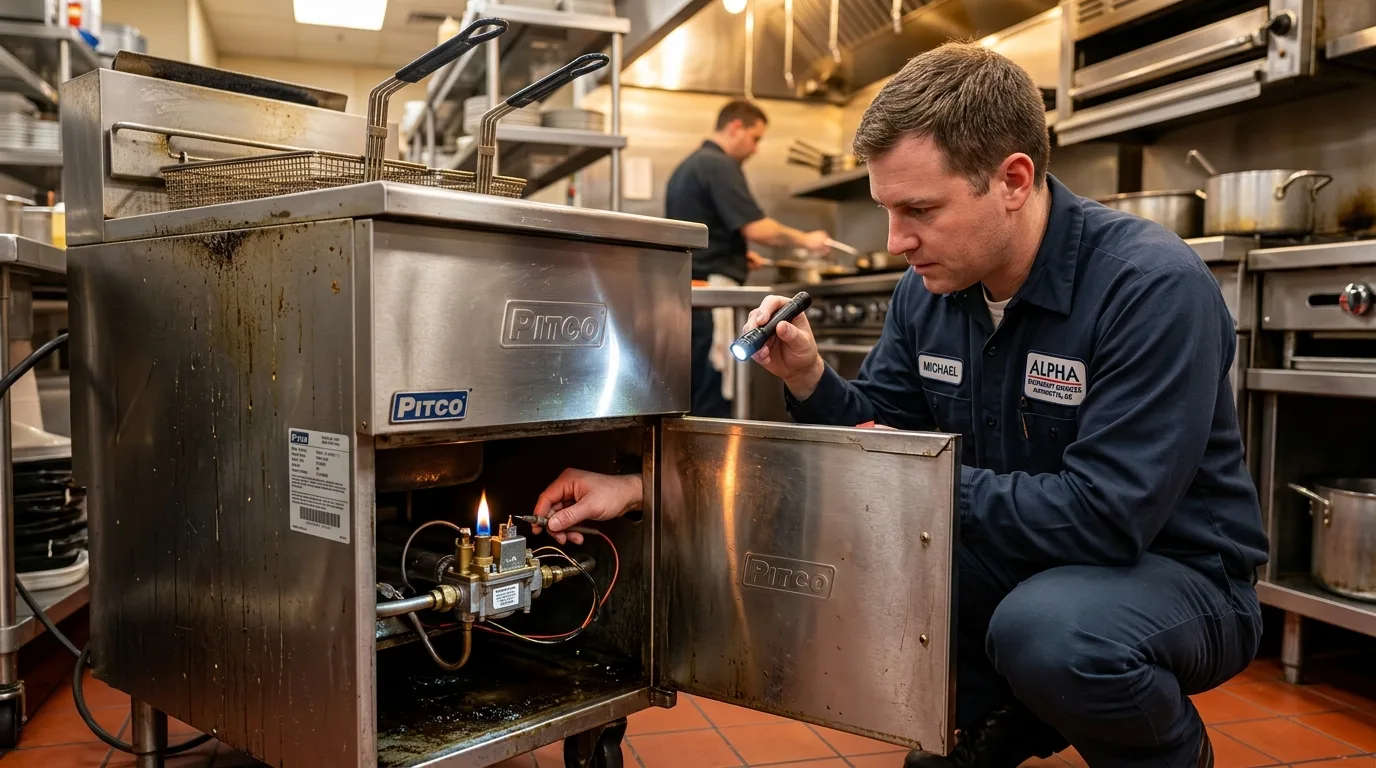
The Customer Problem: At 4:15 PM on a Friday afternoon, the executive kitchen manager of an upscale American steakhouse on Avalon Boulevard in Alpharetta reported that their primary Pitco SG14 natural gas deep fryer pilot light extinguished and refused to remain lit when releasing the manual pilot control knob, completely halting side-dish and appetizer output ahead of an 85-table dinner rush.
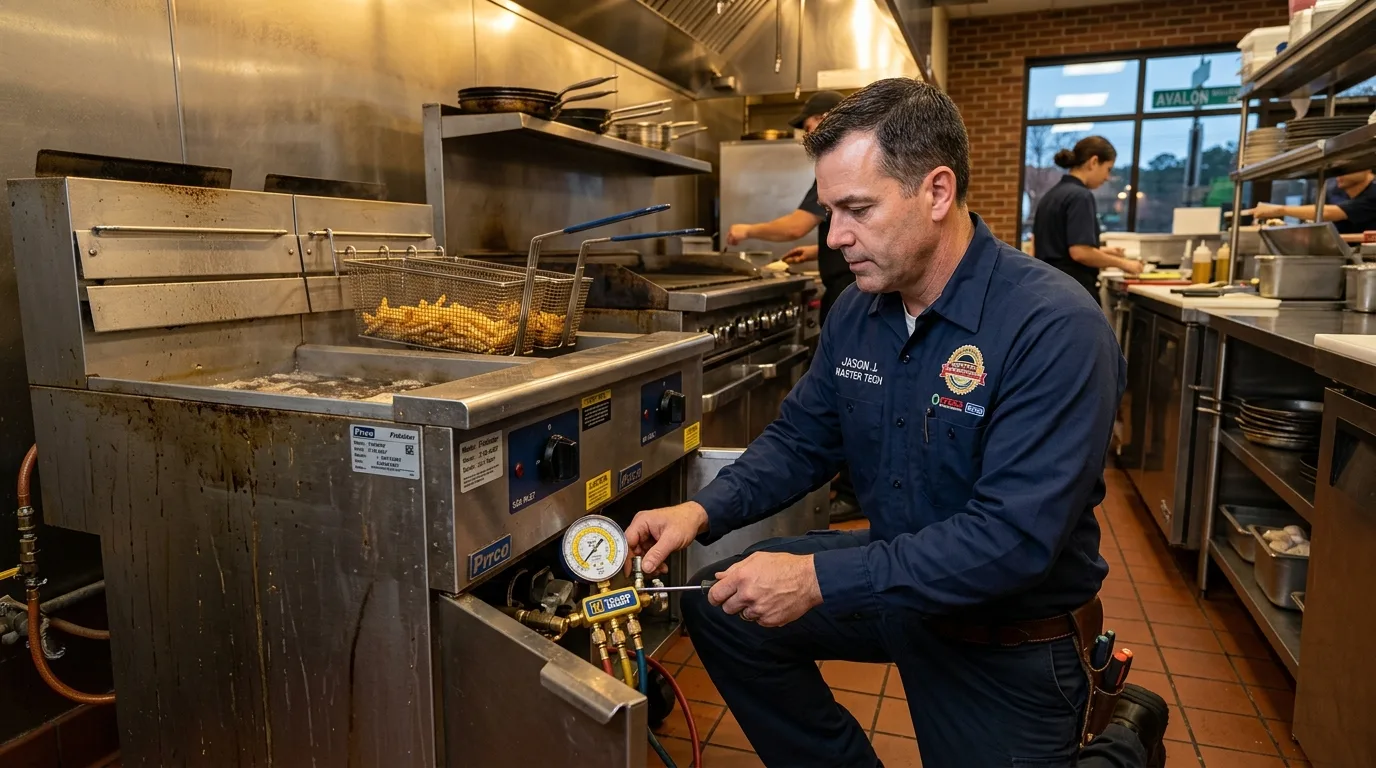
Master Tech Dispatch & Arrival: Dispatched immediately from our staging facility along Windward Parkway, Senior Commercial Tech Jason J. arrived on-site in 34 minutes in a fully stocked commercial mobile inventory unit carrying genuine Pitco, Robertshaw, and Honeywell OEM gas components.
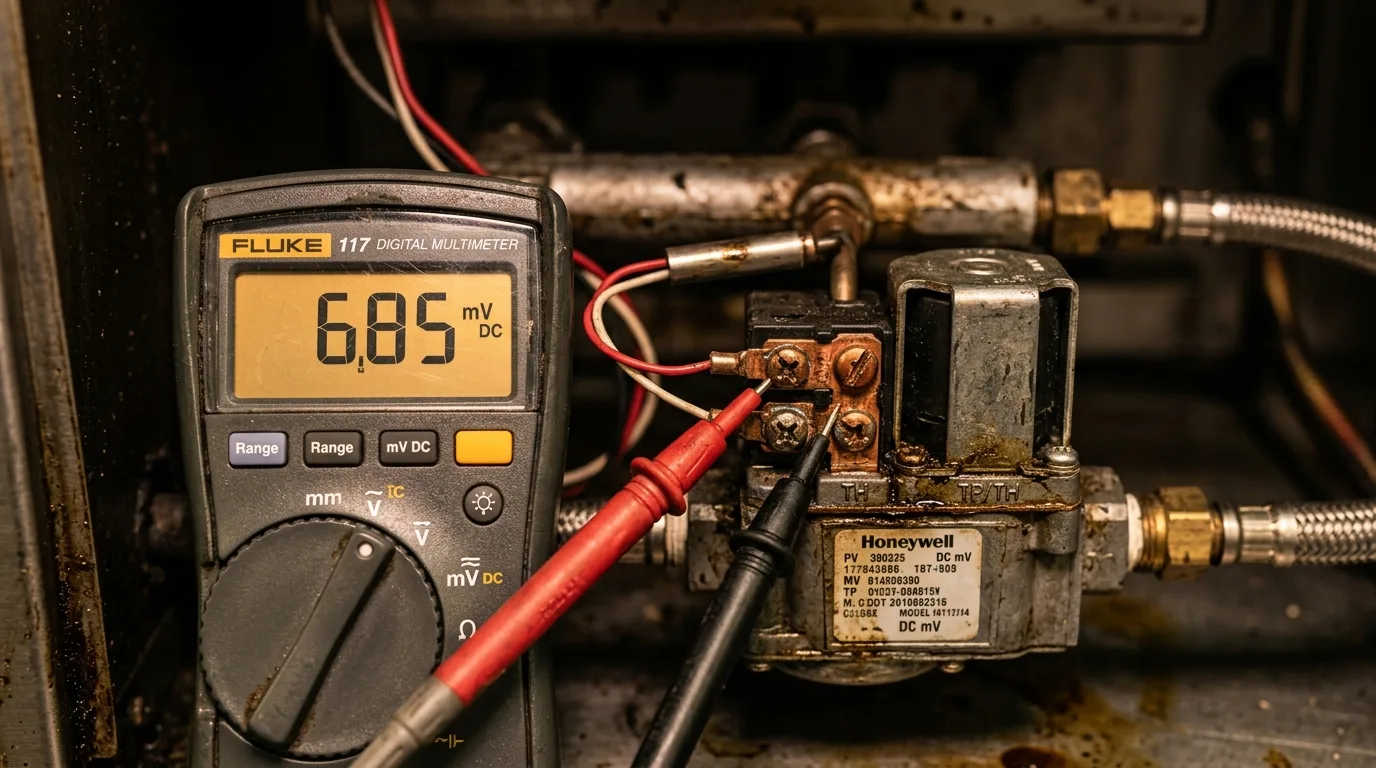
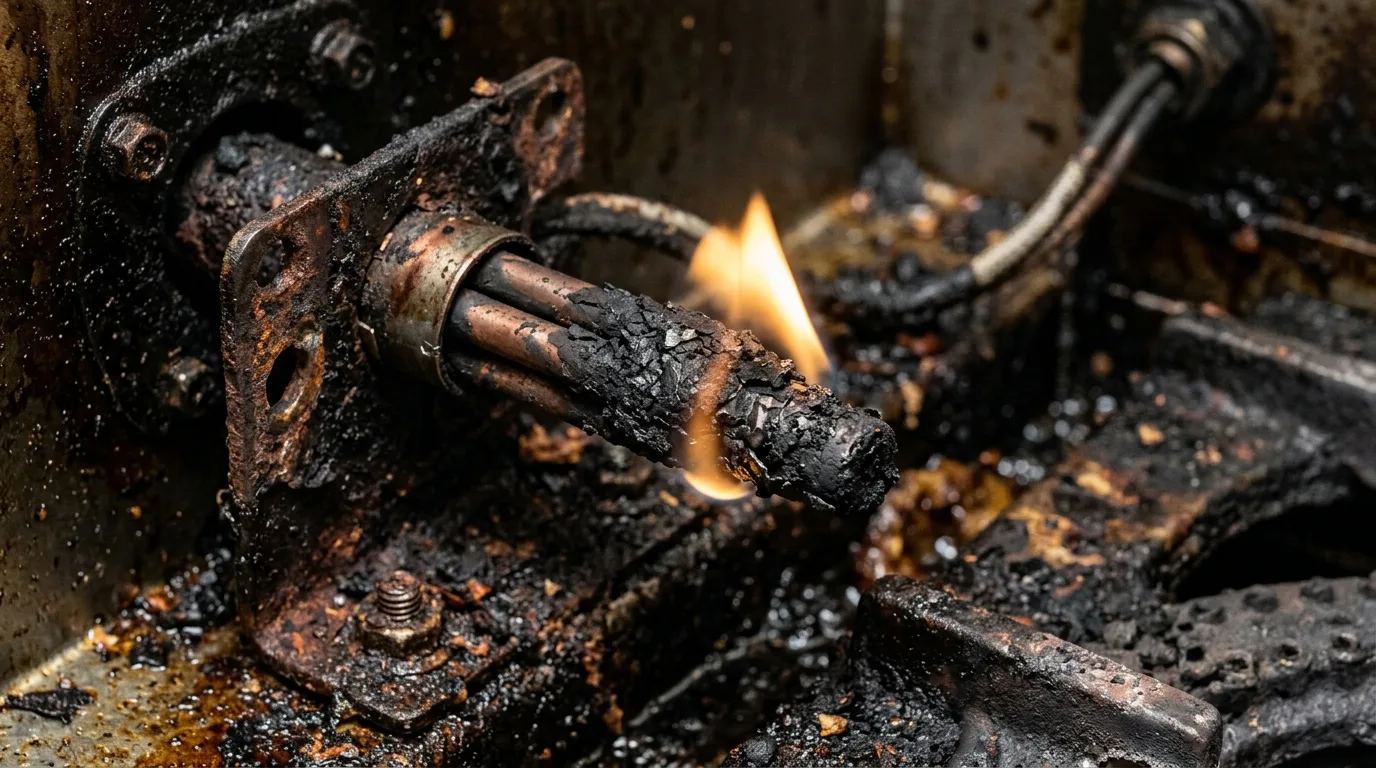
Diagnostic Telemetry: Using a calibrated Fluke 117 True-RMS digital multimeter connected across the thermopile terminals (TP and TP/TH), open-circuit testing revealed only 185 mV DC output under direct pilot flame impingement—far below the mandatory 550 mV DC threshold required to energize the internal combination gas valve holding magnet. Inspection also revealed heavy carbon fouling and a partially restricted brass pilot spud orifice reducing primary aeration.
OEM Restoration & Calibration: Our technician installed a factory-fresh Pitco 750mV thermopile generator assembly (OEM Part #60125501), ultrasonic-cleaned the pilot burner head and orifice, re-torqued the millivolt spade connectors with dielectric compound, and verified stable closed-circuit generation of 685 mV DC under load. The gas manifold pressure was calibrated to precisely 4.0 inches water column (W.C.), and both high-limit safety cutoffs passed trip testing at 425°F.
90-Day Commercial Parts & Labor Warranty Active
Comprehensive Technical Directory
- Commercial Fryer Gas Train Architecture
- Identifying Pilot Failure & Valve Lockout Symptoms
- Visual Before & After Restoration Showcase
- Root Failure Mechanisms in Millivolt Gas Systems
- Safe Kitchen Staff Checks & Pre-Call Diagnostics
- Critical Safety Thresholds: When to Stop DIY
- Economic Matrix: Commercial Fryer Repair vs. Replace
- Interactive Commercial Fryer Cost Estimator
- Commercial Service Cost Factors in North Fulton
- True-RMS Multimeter & Manometer Diagnostic Protocols
- Failure Mode, Effects & Criticality Analysis (FMECA)
- Millivolt Thermocouple & Thermopile Physics
- Make-Up Air, Hood CFM & Drafting Influences
- Component Lifecycle MTBF Reliability Matrix
- High-Limit Safety Cutoff & Oil Thermal Expansion
- Aerated Grease Mist Migration & Micro-Switch Wear
- Professional 7-Stage Gas Train Restoration Standard
- Critical Pitco OEM Gas Components Catalog
- Preventative Maintenance & Boil-Out Guidelines
- NFPA 96 & Commercial Kitchen Gas Safety Standards
- Frequently Asked Technical Questions
- Regional Commercial Appliance Service Silos
- Key Takeaways for Restaurant Operators
Commercial Fryer Gas Train Architecture
In high-tempo restaurant kitchens across commercial appliance repair environments, the Pitco deep fryer is celebrated for its rugged simplicity, rapid thermal recovery, and millivolt self-powered gas control system. Unlike residential ranges that depend on 120V alternating current, commercial Pitco fryers rely on a closed millivolt loop where heat from a standing pilot generates its own direct current electricity through a thermoelectric generator known as a thermopile or powerpile.
When operating normally, heat energy from the standing pilot flame impinges upon the dissimilar metal junctions of the internal thermopile, inducing the Seebeck thermoelectric effect. This reaction produces approximately 550 to 750 millivolts of direct current (0.55 to 0.75 V DC). This minute electrical potential is routed through the high-limit safety thermostat and operating thermostat circuits to energize the internal magnetic coil inside the combination gas valve. This magnetic coil holds the pilot safety valve open and permits the main gas valve to open when the operating thermostat calls for heat.
However, when electrical continuity degrades, pilot flame geometry shifts, or contact resistance increases across wiring terminals, the millivolt potential drops below the minimum threshold (typically 250 to 350 mV DC loaded). When this happens, the magnetic hold-in coil drops out instantly, snapping the internal safety valve closed and completely cutting off all gas supply to prevent unburned gas accumulation in the kitchen.
Identifying Pilot Failure & Valve Lockout Symptoms
Kitchen staff, line cooks, and facility managers typically encounter one or more of the following symptoms when a Pitco deep fryer gas train begins to fail:
- Pilot Extinguishes Immediately on Knob Release: The pilot flame lights when holding down the manual gas valve knob in the “PILOT” position, but snaps off the split second the knob is released, even after holding it down for 60 to 90 seconds.
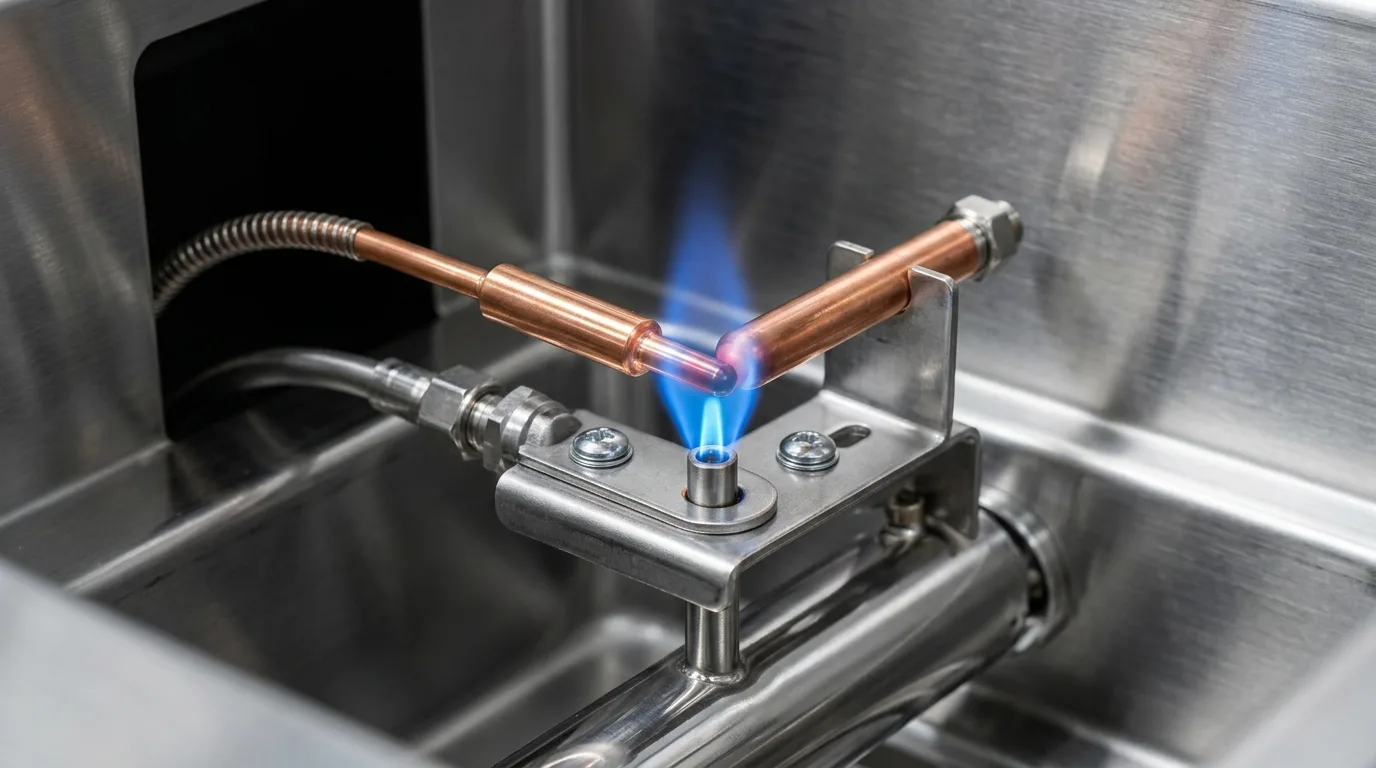
- Weak, Lazy, Yellow Pilot Flame: Instead of a sharp, cone-shaped, vibrant blue flame enveloping the top 3/8-inch of the thermopile, the flame is soft, yellowish, and dances away from the sensor head.
- Main Burners Fail to Engage: The pilot flame remains lit, but when the cook turns the thermostat knob up to 350°F, nothing happens—no burner ignition, no gas hiss, and no heat generation.
- Intermittent Flame Dropout During Peak Rush: The fryer operates during prep hours, but abruptly cuts off during peak lunch or dinner rushes when kitchen exhaust hood suction creates drafts or when line gas pressure drops.
- Delayed Ignition & “Poof” Rollout: Main gas ignites with a violent acoustic pop or rollout beneath the frypot due to delayed flame transfer from a dirty pilot burner assembly.
Root Failure Mechanisms in Millivolt Gas Systems
Commercial deep fryers in busy North Fulton hospitality corridors operate under extreme thermal punishment. Certified diagnostics by our emergency appliance repair technicians pinpoint four fundamental root failure modes:
A. Thermopile Junction Oxidation & Millivolt Degradation
A standard 750mV thermopile is constructed from multiple series-connected thermocouple junctions housed inside a sealed stainless steel or copper sheath. Constant 24/7 exposure to 1,400°F pilot flame temperatures eventually breaks down the internal bismuth-telluride alloy junctions. Over 2 to 4 years of continuous service, internal electrical resistance climbs from less than 2.0 Ohms to over 15.0 Ohms. This internal voltage drop starves the gas valve solenoid, causing unexpected drop-outs during meal service.
B. Pilot Orifice Occlusion by Aerated Oil Mist & Dust
The brass pilot spud orifice features a microscopic aperture (approximately 0.018 inches for natural gas and 0.010 inches for liquid propane). Because fryers operate directly underneath commercial hood exhaust systems, high-velocity air drafts pull grease aerosol, airborne flour, and cooking particulate into the pilot aeration window. Over time, gummy carbon deposits constrict the orifice, starving the pilot flame of gas and reducing thermal transfer to the thermopile.
C. High-Limit Safety Thermostat Switch Tripping & Resistance Leaks
Every Pitco commercial fryer incorporates a snap-action capillary high-limit safety thermostat configured to interrupt the millivolt control circuit if shortening temperatures exceed 425°F to 450°F (preventing flash fires). However, after years of thermal stress, the bi-metallic snap disc can develop internal micro-corrosion, increasing electrical resistance across its closed contacts. If contact resistance exceeds just 0.5 Ohms, the millivolt signal drops below the operating threshold, cutting off main gas flow even when oil temperatures are completely normal.
D. Combination Gas Control Valve Solenoid Failure
The combination gas valve (typically manufactured by Robertshaw or Honeywell for Pitco) houses two separate electromagnetic coils: the pilot safety magnet coil and the main operator coil. Over millions of heating cycles, the fine magnet wire insulation inside the operator coil can short, or sticky cooking grease vapors can migrate past the rubber diaphragm, physically binding the internal valve plunger. In this state, even a healthy 750 mV generator cannot draw sufficient current to pull the valve seat open.
Safe Kitchen Staff Checks & Pre-Call Diagnostics
Before dispatching an emergency technician, restaurant managers and kitchen staff can safely perform these non-invasive preliminary checks:
- Verify Gas Supply Shut-Off Valves: Inspect the primary gas isolation lever at the wall and the secondary gas cock at the quick-disconnect flex hose. Ensure handles are oriented parallel to the gas pipe (fully open). If other gas equipment like your commercial oven or range is also experiencing low flame, check your building gas meter or main regulator.
- Check the High-Limit Reset Button: On many Pitco models, the high-limit thermostat features a manual red reset button located inside the lower cabinet adjacent to the drain valve. Wait until oil cools to 200°F, then press the red button firmly. A distinct mechanical click confirms the safety circuit was tripped.
- Inspect the Quick-Disconnect Hose Latch: If the fryer was moved for nightly floor sanitation, ensure the quick-disconnect gas coupling sleeve is fully seated forward and the safety restraining cable is securely connected. A partially unlatched coupling stops gas flow instantly.
- Bleed Air from the Gas Line: Following gas line disconnection or supply tank refilling, air enters the piping. Depress the gas control knob fully in the “PILOT” position for 90 to 120 seconds to purge atmospheric air before attempting ignition with a piezo igniter or barbecue lighter.
- Inspect Flame Impingement Geometry: While holding the pilot knob down, visually examine the pilot flame through the lower view window. The flame should be a vibrant blue cone that strikes the top 3/8-inch of the thermopile cylinder directly. If the flame is yellow, lifting, or wavering, the pilot burner requires professional cleaning.
Critical Safety Thresholds: When to Stop DIY
Commercial deep fryers utilize high-pressure combustible gas (either natural gas at 3.5–4.0 inches W.C. or propane at 10.0–11.0 inches W.C.) and hold 35 to 80 pounds of oil heated to 375°F. Unqualified personnel must never attempt field repairs under the following circumstances:
Immediate Gas Evacuation Protocol
If you detect the pungent odor of natural gas (mercaptan) or suspect gas line leakage, immediately turn off the manual emergency gas shut-off valve at the wall. DO NOT strike matches, toggle electrical switches, or operate exhaust hood buttons. Evacuate the kitchen area and immediately contact emergency utility services and our licensed commercial specialists at (770) 796-7742.
- Never Bypass Safety Thermostats: Under NO circumstances should kitchen staff jumper or bypass the high-limit thermostat circuit. Bypassing safety limits allows cooking oil to heat past its 450°F auto-ignition flashpoint, resulting in catastrophic commercial kitchen structure fires.
- Never Jam the Gas Valve Plunger Open: Forcing, wedging, or taping down the manual control knob mechanically overrides the automatic safety shutoff, allowing raw gas to escape into the burner cabinet.
- Never Ream Pilot Orifices with Drill Bits or Wire: Inserting sewing needles or wire picks into brass pilot orifices enlarges the factory aperture, destroying gas velocity and creating dangerous, sooting yellow flames.
Economic Matrix: Commercial Fryer Repair vs. Replace
Commercial kitchen operators in Milton, GA and Alpharetta frequently evaluate whether repairing a malfunctioning Pitco fryer makes financial sense versus purchasing a replacement unit. Utilizing the commercial 50% Rule (repair cost versus depreciated value) and frypot tank integrity assessment clarifies the decision:
| Operational Diagnostic Factor | Recommended Action: Professional Repair | Recommended Action: Complete Replacement |
|---|---|---|
| Equipment Age & Duty Cycles | Fryer is under 8 to 10 years old; heavy-duty stainless chassis is solid with no structural sagging. | Fryer exceeds 12 to 15 years; severe metal fatigue, obsolete gas valve discontinued by factory. |
| Stainless Frypot Tank Condition | Frypot tank is 100% leak-free; cold zone welds are pristine with zero pinholes or oil seepage. | Tank bottom has developed pinhole leaks, hairline stress cracks, or severe thermal warpage. |
| Estimated Repair Investment | Total repair cost (thermopile, pilot, or gas valve) represents less than 30% of new unit cost ($250–$650). | Cumulative repair estimate exceeds 50% of commercial replacement cost ($1,400+). |
| Downtime & Kitchen Revenue | Same-day OEM parts dispatch restores service within 2 to 3 hours; zero lost dinner revenue. | Custom freight delivery takes 10 to 14 days, risking thousands in missed sales. |
Commercial Service Cost Factors in North Fulton
When commercial kitchens in Roswell, GA and Alpharetta require professional service, final invoices depend on several technical variables:
- Component Replacement Type: Replacing a standard 750mV thermopile and clearing the pilot spud orifice generally ranges from $240 to $380, while replacing a commercial Robertshaw 7000-series millivolt combination gas control valve ranges between $480 and $750 including precision water-column manometer calibration.
- Gas Fuel Configuration (Natural Gas vs. Propane): Liquid Propane (LP) systems operate at significantly higher manifold pressures (10.0–11.0 inches W.C.) compared to natural gas (3.5–4.0 inches W.C.). LP orifices foul faster with heavy paraffin oil droplets, requiring specialized conversion kits or brass jet replacements.
- Emergency After-Hours & Weekend Dispatch: Rapid response calls during Friday night peak dinner rushes or Sunday brunch services incur priority dispatch routing to ensure a certified commercial technician arrives on site within 45 to 60 minutes.
- Multi-Fryer Battery Interconnections: Fryers connected to centralized modular manifold batteries or automated oil filtration systems require isolation testing and filter pump interlock switch diagnosis.
True-RMS Multimeter & Manometer Diagnostic Protocols
Master certified technicians follow a rigorous 4-step electrical and pneumatic diagnostic sequence to isolate Pitco gas train faults accurately:
| Gas Component / Telemetry Point | Factory Benchmark Specification | Fault Tolerance & Diagnostic Indication | Master Tech Resolution Protocol |
|---|---|---|---|
| Thermopile Open-Circuit Potential | 550 mV DC to 750 mV DC | Below 450 mV DC (Weak thermocouple junction) | Replace with factory OEM 750mV thermopile (Part #60125501). |
| Thermopile Closed-Circuit (Loaded) | 250 mV DC to 400 mV DC under load | Below 180 mV DC (Valve coil drops out) | Test combination valve coil resistance and clean wiring terminals. |
| Gas Valve Operator Solenoid Coil | 11.0 Ω to 13.5 Ω static resistance | Infinite (open circuit) or under 5.0 Ω (shorted) | Replace complete combination gas control valve assembly. |
| High-Limit Thermostat Closed Loop | 0.0 Ω to 0.2 Ω (Zero measurable resistance) | Exceeds 0.5 Ω or registers open circuit | Replace capillary high-limit safety cut-off (Part #P5045610). |
| Operating Thermostat Resistance | 0.0 Ω closed (calling for heat) | Intermittent resistance drift or micro-chatter | Calibrate dial offset; replace mechanical RX thermostat. |
| Gas Manifold Pressure (Natural Gas) | 3.5 to 4.0 Inches Water Column (W.C.) | Under 3.0″ W.C. (delayed ignition / sooting) | Adjust internal regulator screw using digital dual-port manometer. |
Critical Pitco OEM Gas Components Catalog
Maintaining factory reliability in high-volume hospitality operations requires genuine manufacturer hardware. In Johns Creek, GA, our trucks carry authentic Pitco replacement parts:
- Pitco 750mV Thermopile Generator (OEM #60125501): Heavy-duty coaxial bi-metallic generator providing 750mV open circuit potential with high-temperature woven leads.
- Robertshaw Combination Gas Control Valve (OEM #60125401): Millivolt operated safety and main burner gas valve with integrated pressure regulator and 1/2″ NPT connections.
- Manual Reset High-Limit Safety Thermostat (OEM #P5045610): 425°F/450°F safety trip switch with 3/8″ stuffing box and copper capillary sensing tube.
- Pitco Pilot Burner & Orifice Assembly (OEM #60107301): Precision three-way pilot head ensuring complete pilot flame impingement on both the thermopile and main burner runners.
- Mechanical Dial RX Operating Thermostat (OEM #60124401): High-precision hydraulic capillary thermostat maintaining oil temperature within ±5°F of setpoint.
Preventative Maintenance & Boil-Out Guidelines
Preventative maintenance extends commercial fryer service life, optimizes cooking oil quality, and eliminates unexpected peak-hour breakdowns:
- Daily Crumb Tray & Flue Clearing: Empty crumb baskets and inspect the upper flue exhaust box nightly. Never allow debris, fryer covers, or heat lamps to block exhaust flue drafting.
- Weekly Boil-Out Protocol: Perform regular chemical boil-outs using food-grade commercial alkaline degreasers to dissolve polymerized oil glaze from heat transfer tubes and sensor bulbs.
- Monthly Pilot Assembly Vacuuming: Use a high-efficiency shop vacuum or compressed air canister to blow out accumulated dust and grease fibers from the pilot burner air shutter.
- Quarterly Gas Manifold Inspection: Have certified commercial technicians test dynamic gas inlet pressures and verify millivolt generation under full burner load.
NFPA 96 & Commercial Kitchen Gas Safety Standards
Commercial cooking equipment must strictly adhere to NFPA 96 (Standard for Ventilation Control and Fire Protection of Commercial Cooking Operations) and local Fulton County health codes:
- Gas Restraining Cable Mandatory: Every caster-mounted mobile fryer MUST have an approved steel restraining cable connected to the building wall to prevent strain on the quick-disconnect flex hose.
- Ansul Fire Suppression Interlock: Commercial gas supply valves must be mechanically or electrically interlocked with your kitchen Ansul fire suppression hood system.
- Maintain Minimum 16-Inch Clearance to Open Flames: Ensure at least 16 inches of horizontal separation or an approved stainless steel splash baffle between fryers and adjacent open-flame broilers or commercial ranges.
Frequently Asked Technical Questions
Click any technical question below to expand detailed diagnostic answers from our master technicians:
Q1: Why does my Pitco fryer pilot go out as soon as I let go of the knob?
When you release the manual knob and the pilot extinguishes instantly, the internal safety magnet coil inside the combination gas valve has dropped out. This occurs because the 750mV thermopile is either generating insufficient voltage (below 550 mV open circuit), the high-limit thermostat is open, or the wiring terminals are corroded. Call (770) 796-7742 for same-day diagnostic service.
Q2: What is the difference between a thermocouple and a thermopile on a commercial fryer?
A thermocouple consists of a single thermoelectric junction producing approximately 25 to 35 millivolts DC, solely capable of holding open a small pilot safety valve. A thermopile contains multiple internal thermocouples wired in series, generating between 550 and 750 millivolts DC—enough electrical energy to power both the safety magnet and the main gas valve operator solenoid without external electricity.
Q3: How many millivolts should a healthy Pitco thermopile produce?
An open-circuit benchmark test (leads disconnected from the gas valve) should read between 550 mV DC and 750 mV DC under direct pilot flame impingement. When connected to the valve under load, closed-circuit voltage should remain between 250 mV DC and 400 mV DC. Any reading below 180 mV DC under load causes safety shutdown.
Q4: Can I clean my Pitco thermopile with sandpaper?
Never use coarse sandpaper or steel wool on a thermopile, as abrasive grit can scratch the protective outer sheath and leave conductive residue. Technicians use fine emery cloth or an ultrafine Scotch-Brite pad to gently remove surface soot, followed by electrical contact cleaner.
Q5: Why is my Pitco fryer pilot flame yellow and lifting off the burner?
A yellow, lifting flame indicates incomplete combustion caused by grease lint clogging the pilot burner aeration window or a partially restricted brass pilot spud orifice. This prevents the pilot from properly heating the thermopile.
Q6: How long should a commercial deep fryer thermopile last?
In high-volume commercial kitchens operating 12 to 16 hours daily, factory thermopiles typically last 2 to 4 years before internal semiconductor degradation reduces voltage output below operational limits.
Q7: Where is the high-limit reset button located on a Pitco fryer?
On most Pitco Solstice and Economy series fryers, the manual red reset button is mounted behind the lower front cabinet door, positioned near the front of the frypot tank or adjacent to the oil drain ball valve.
Q8: What causes the high-limit safety thermostat to trip repeatedly?
Repeated tripping is caused by an out-of-calibration operating thermostat, severe calcification or scorched oil crumbs insulating the thermostat bulb, low oil levels exposing heating tubes, or a defective high-limit switch that has lost mechanical tension.
Q9: Why does my fryer pilot stay lit, but the main burners won’t ignite?
If the pilot holds but main burners do not engage, common causes include an open operating thermostat, a tripped high-limit switch, loose terminal screws on the TH/TP terminals, or a burnt-out operator coil inside the gas valve.
Q10: What gas pressure is required for a commercial natural gas Pitco fryer?
Standard natural gas Pitco fryers require an incoming dynamic supply pressure of 7.0 inches Water Column (W.C.) and an internal regulated manifold pressure of precisely 4.0 inches W.C. while all burners are firing.
Q11: Can a weak thermopile cause main burners to flutter or short-cycle?
Yes. If a thermopile produces borderline voltage (around 220–250 mV loaded), current may drop below the holding threshold whenever the operating thermostat closes, causing the main gas valve to chatter, buzz, or rapidly drop out.
Q12: How fast can your technicians arrive for emergency restaurant repairs in Alpharetta?
We maintain dedicated commercial service vehicles stationed in North Fulton County, providing an average emergency on-site response time of 45 to 90 minutes across Alpharetta, Milton, Roswell, and Johns Creek.
Q13: Do you carry authentic OEM Pitco replacement parts on your service trucks?
Yes. Our mobile commercial inventory carries genuine Pitco 750mV thermopiles, Robertshaw gas valves, pilot assemblies, high-limits, and thermostats to resolve over 90% of failures on the initial visit.
Q14: Is it safe to light a commercial deep fryer with a match?
Lighting with short matches is hazardous due to potential flashback. Technicians recommend using the integrated piezo igniter or an extended industrial gas lighter while maintaining complete line of sight through the pilot view port.
Q15: How often should commercial deep fryers undergo professional calibration?
High-volume foodservice establishments should schedule professional calibration every 6 months to audit manifold pressure, verify high-limit cutoff accuracy, and ensure temperature dial precision.
Q16: What warranty accompanies commercial repairs?
All commercial repair services are backed by our comprehensive 90-day parts and labor warranty. If the serviced component fails within 90 days, our technicians return and replace it with zero additional labor fees.
Q17: Can you service other commercial kitchen brands like Frymaster and Vulcan?
Yes. Our certified master technicians service all commercial equipment including Frymaster commercial fryers, Vulcan convection ovens, commercial refrigeration, and commercial dishwashers.
Q18: How do I schedule an emergency commercial service call today?
Simply call our direct dispatch line at (770) 796-7742. Provide your restaurant name, street address, and equipment model number for immediate commercial priority dispatch.
Regional Commercial Appliance Service Silos
Explore our specialized commercial kitchen diagnostic hubs and regional support networks across North Fulton County:
Commercial Service Hubs
Related Equipment Faults
Commercial Brand Specialists
North Fulton Commercial Areas
Failure Mode, Effects & Criticality Analysis (FMECA)
To systematically understand gas train failure dynamics on commercial Pitco fryers, our engineering diagnostics utilize a rigorous Failure Mode, Effects, and Criticality Analysis (FMECA) framework. In high-volume foodservice operations across North Fulton County, fryers endure severe cyclic thermal stresses exceeding 400°F combined with high atmospheric grease concentrations. Evaluating component failure probability, detection capability, and business criticality allows kitchen operators to anticipate breakdowns before catastrophic dinner rush outages.
| Sub-System / Component | Primary Failure Mode | Local Effect on Fryer Operation | Severity Rating & Preventive Action |
|---|---|---|---|
| Thermopile (Coaxial 750mV) | Internal bismuth-telluride junction thermal fatigue; open circuit degradation. | Voltage drops below 550mV; combination valve safety coil releases upon knob release. | Critical (Complete Outage). Replace every 3 years proactively. |
| Brass Pilot Spud Orifice | Grease aerosol and particulate carbonization obstructing the 0.018″ aperture. | Lazy, yellow flame fails to envelope thermopile tip; intermittent pilot dropout. | High. Perform monthly ultrasonic orifice cleaning. |
| High-Limit Thermostat | Internal bi-metal snap disc micro-corrosion creating >0.5Ω contact resistance. | Millivolt signal drops across contacts; main burner lockout despite normal oil temp. | Critical. Test resistance annually; replace with OEM P5045610. |
| Combination Gas Valve | Operator solenoid shorted windings or internal elastomer diaphragm sticking. | Main valve refuses to open when thermostat calls; no gas delivery to burner tubes. | Critical. Calibrate manifold pressure; replace complete assembly. |
Millivolt Thermocouple & Thermopile Physics
Understanding the physics of self-powered millivolt systems is essential for accurate diagnostics. The thermoelectric effect was first documented by Thomas Johann Seebeck in 1821, discovering that a temperature gradient across two dissimilar electrical conductors creates a voltage potential. In commercial Pitco fryers, modern thermopiles package between 25 and 32 individual thermocouple pairs connected in electrical series inside a single cylindrical cartridge.
When the pilot flame maintains the “hot junction” at approximately 1,400°F (760°C) while the lower body remains at ambient “cold junction” temperatures (approximately 250°F to 350°F), each individual junction pair develops roughly 25 to 30 millivolts DC. By wiring 25 junctions in series, the cumulative open-circuit potential reaches 700 to 750 millivolts DC. When the circuit closes across the 12-Ohm combination valve coil, Ohm’s law dictates an operating current of approximately 25 to 35 milliamps—sufficient to create a strong electromagnetic field capable of overcoming the valve’s internal mechanical return spring.
However, if soot coats the hot junction, thermal conductivity drops dramatically. A soot layer just 0.5 millimeters thick reduces thermal transfer by up to 60%, dropping junction temperature to 800°F and reducing output voltage to under 300 mV DC. At this reduced potential, the electromagnetic field collapses, and the spring immediately forces the safety valve closed.
Make-Up Air, Hood CFM & Drafting Influences
A frequently overlooked environmental factor in North Fulton commercial kitchens is the relationship between exhaust hood ventilation, dedicated make-up air (MUA) supply, and fryer pilot stability. Commercial kitchen exhaust hoods in Alpharetta and Roswell operate at high volumetric flow rates, exhausting anywhere from 2,000 to 6,000 cubic feet per minute (CFM) of air. If the kitchen’s make-up air unit is uncalibrated, frozen in winter, or operating with clogged intake filters, the kitchen environment develops severe negative pressure.
Negative pressure pulls air into the building through exterior doors, kitchen pass-through windows, and appliance flue channels. This reverse drafting creates intense cross-currents around the fryer burner cabinet. When air currents strike the pilot burner head, the delicate pilot flame is pulled away from the thermopile sensor tip. Even though the pilot appears lit to the naked eye, the sensor head cools down within 15 seconds, dropping millivolts and triggering an immediate gas valve lockout. Our technicians audit kitchen static air pressure during diagnostics to eliminate environmental draft causes.
Component Lifecycle MTBF Reliability Matrix
Commercial restaurant equipment undergoes rigorous Mean Time Between Failures (MTBF) tracking in professional facility maintenance schedules. For high-volume Pitco fryers operating 10 to 14 hours daily, operating hours translate directly into predictable component lifecycle milestones:
- Thermopile (Coaxial 750mV Generator): Typical MTBF of 10,000 to 14,000 operational hours (equivalent to 2.5 to 3.5 years of restaurant service). Accelerated failure occurs when pilot flames are over-fired or soot-choked.
- Capillary High-Limit Safety Switch: MTBF of 20,000 operational hours (approx. 5 to 6 years). Thermal cycling gradually reduces the spring tension of the snap-action switch contacts.
- Robertshaw Combination Gas Control Valve: MTBF of 25,000 to 30,000 hours (approx. 7 to 8 years). Internal diaphragm elastomer drying or magnet wire insulation degradation represents primary retirement criteria.
- Pilot Burner Head & Brass Spud: MTBF of 8,000 to 12,000 hours. High-temperature oxidation causes burner orifice erosion or carbon scaling.
- Mechanical RX Operating Thermostat: MTBF of 18,000 hours. Hydraulic fluid vapor loss from the capillary bulb leads to temperature drift and calibration inaccuracies.
High-Limit Safety Cutoff & Oil Thermal Expansion
The high-limit safety thermostat on a Pitco fryer is a critical safety safeguard governed by UL and NFPA standards. Commercial cooking shortenings (such as high-oleic canola, soybean, or beef tallow) possess auto-ignition flashpoints ranging between 450°F and 500°F (232°C to 260°C). If an operating thermostat fails in the closed position, heating tubes can continuously pump thermal energy into the frypot, causing oil temperatures to escalate rapidly at rates exceeding 15°F per minute.
The capillary bulb of the high-limit thermostat is submerged directly into the oil zone near the top of the heating tubes. When oil reaches the calibrated trip threshold (typically 425°F or 450°F depending on model specification), hydraulic fluid within the sensing bulb expands, traveling down the copper capillary tube and actuating a micro-snap disc. This instantly breaks the electrical millivolt circuit, releasing the safety magnet in the combination gas valve and shutting off all gas flow in less than 0.8 seconds.
Aerated Grease Mist Migration & Micro-Switch Wear
During active frying, moisture trapped within frozen fries, battered chicken, or seafood vaporizes instantly upon contact with 350°F oil. This rapid steam expansion atomizes microscopic cooking oil droplets into an airborne aerosol mist. Over months of kitchen operation, this grease mist migrates throughout the lower cabinet, settling onto wiring terminals, valve operator screws, and electrical switch contacts.
As cooking grease oxidizes, it transforms into an insulating, amber-colored varnish. In a 120V residential circuit, line voltage easily punches through thin grease varnish. However, in a sensitive 0.75-volt millivolt circuit, even an ultra-thin varnish layer creates insurmountable contact resistance. A resistance increase of just 0.4 Ohms cuts current delivery by 30%, causing intermittent valve dropout. Master technicians clean and treat all electrical connections with synthetic dielectric compounds to seal terminals against grease migration.
Professional 7-Stage Gas Train Restoration Standard
To ensure long-term operational reliability and complete NFPA safety compliance, our Alpharetta technicians execute a standardized 7-stage restoration protocol on every commercial deep fryer service call:
- Pre-Service Inspection & Leak Audit: Perform electronic combustible gas leak detection across all flexible gas lines, pipe unions, and valve casing seams under static line pressure.
- Cold-Circuit Telemetry Benchmarking: Measure static coil resistance across the pilot safety magnet and operator solenoid with a True-RMS digital multimeter.
- Pilot Assembly Disassembly & Ultrasonic De-Carbonization: Remove pilot burner bracket, inspect flame spreader wings, and clear the brass spud orifice using an ultrasonic solvent bath.
- OEM Component Installation: Install genuine factory-matched Pitco 750mV thermopile and capillary high-limit thermostat, routing leads away from high-temperature exhaust channels.
- Pneumatic Manometer Calibration: Connect digital dual-port manometer to the valve pressure tap; calibrate natural gas manifold pressure to 4.0″ W.C. (or propane to 10.0″ W.C.) under full burner load.
- Dynamic Closed-Circuit Run-In: Verify closed-circuit millivoltage stabilizes above 650 mV DC throughout repeated burner cycling.
- Safety Cutoff Verification & Documentation: Test high-limit trip function, verify emergency gas shutoff response, and issue customer warranty documentation.
Key Takeaways for Restaurant Operators
- Standing Pilot Powers the Control Loop: Commercial Pitco deep fryers rely on a self-generated direct current millivolt signal produced by the pilot flame heating the thermopile.
- 550mV Threshold is Non-Negotiable: Thermopiles generating under 550 mV DC open circuit will fail to keep the combination gas valve safety magnet energized, causing pilot dropout upon knob release.
- Never Bypass High-Limit Switches: High-limit safety thermostats prevent catastrophic oil flash fires at 450°F and must never be jumped or removed from the circuit.
- Aerated Oil Mist Restricts Pilot Orifices: Regular boil-outs and quarterly pilot orifice cleanings prevent carbon buildup and premature millivolt drop.
- Same-Day Priority Commercial Dispatch: Our certified master technicians provide rapid on-site resolution across Alpharetta, Milton, Roswell, and Johns Creek with genuine factory OEM components and an active 90-day parts and labor warranty.