
When a commercial kitchen’s Pitco commercial deep fryer pilot won’t stay lit in Milton, GA, the entire fry station grinds to a halt, sabotaging dinner service and threatening thousands of dollars in lost dining revenue across the Crabapple Road Dining District. Our master-certified commercial technicians specialize in rapid-dispatch millivolt diagnostics, True-RMS thermopile load telemetry, and precision combination gas valve restorations. Call (770) 796-7742 for 45-minute commercial priority dispatch backed by our ironclad 90-day commercial parts and labor warranty.
Quick Answer: Resolving Pitco Commercial Fryer Pilot Extinction
Quick Answer: A Pitco commercial deep fryer pilot that repeatedly extinguishes after releasing the pilot knob or cuts out during active frying is typically caused by a failing 750mV thermopile generating insufficient closed-circuit millivoltage (below 450 mV DC under load), a soot-occluded pilot burner orifice restricting flame impingement, an open 450°F high-limit safety thermostat, or degraded combination gas valve safety magnet coil windings. Begin by checking supply line pressure and ensuring the thermopile tip is submerged 3/8-inch into the pilot flame. If closed-circuit voltage drops below 450mV, call our certified commercial kitchen specialists at (770) 796-7742 for same-day OEM pilot assembly and gas train rebuilding.
Listen to 60-Second Diagnostic Summary
Narrated by Jason J. (Master Certified Commercial Appliance Specialist)
Check Commercial Technician Availability in Your Foodservice Corridor
Verified Commercial Service Call
Recently Serviced on Crabapple Road, Milton GA
Pitco SG14R Gas Fryer Thermopile Replacement & Manometer Pressure Calibration • 5.0 Star Commercial Rating
Crabapple Road Dining District Emergency Fryer Restoration
Dispatched to Heritage Walk / Crabapple Rd, Milton, GA 30004
Pitco Frialator SG14R Natural Gas Double Fryer Bank
Pilot Extinguishes Immediately Upon Releasing Dial; Drops During Rush
Open-Circuit: 410mV • Closed Load: 280mV (Spec: 450-550mV)
450°F High-Limit Intact (0.02 Ω) • Gas Press: 4.0″ W.C. Stable
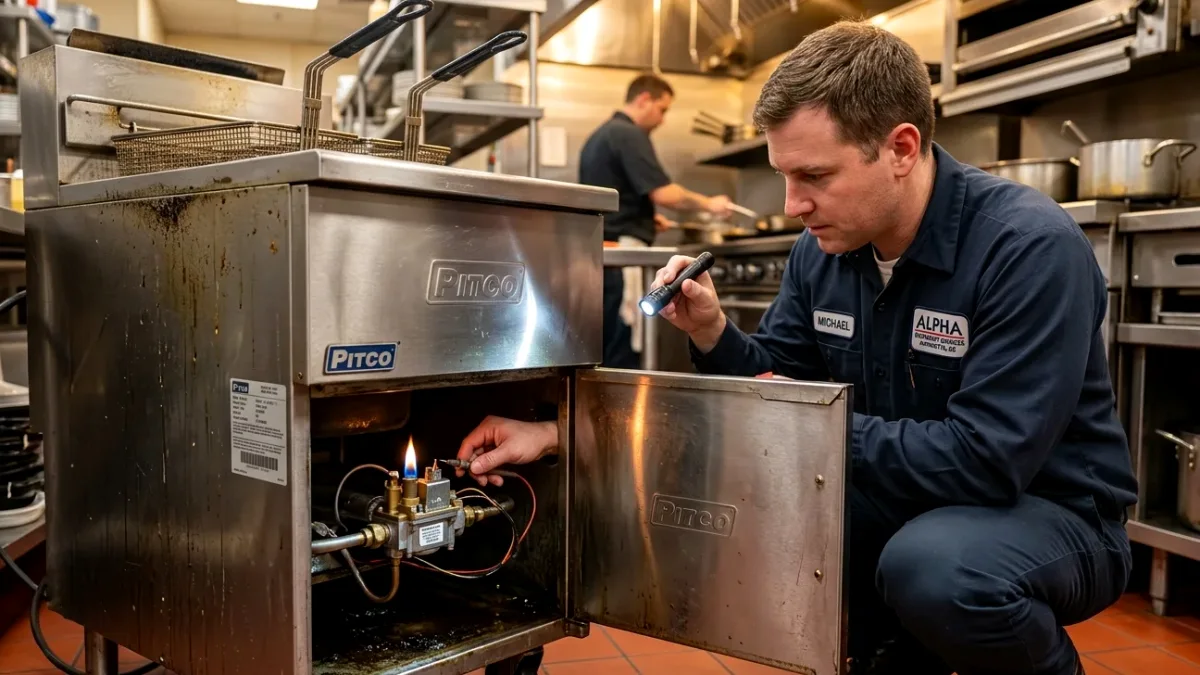
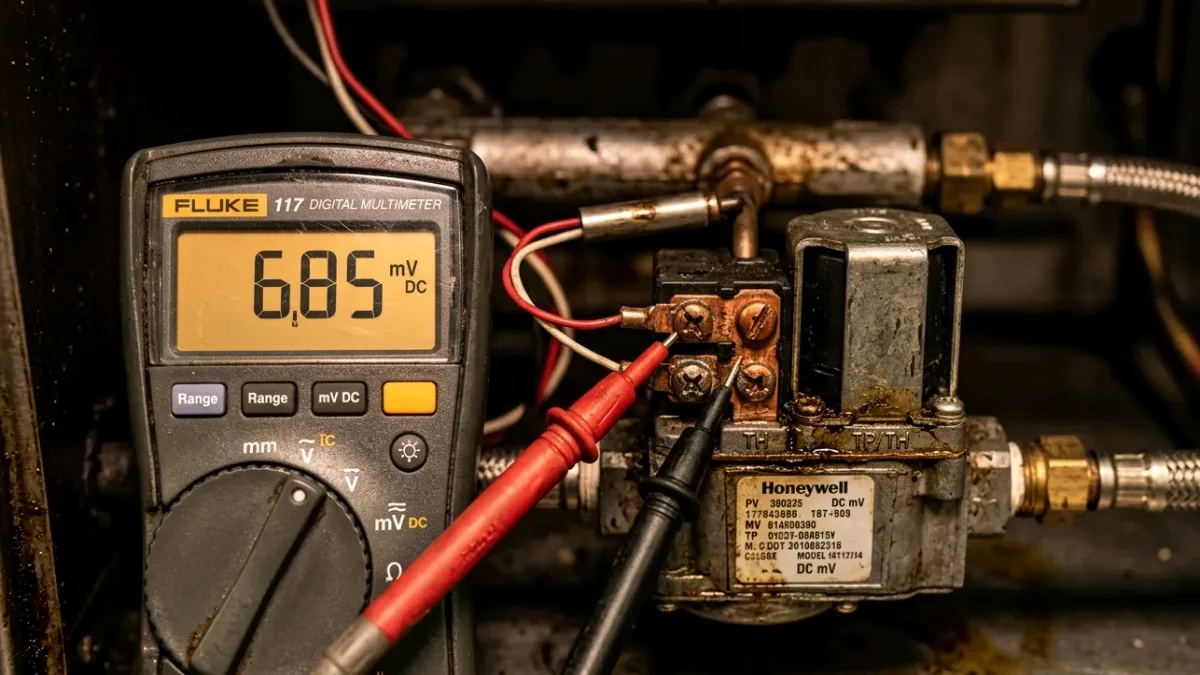
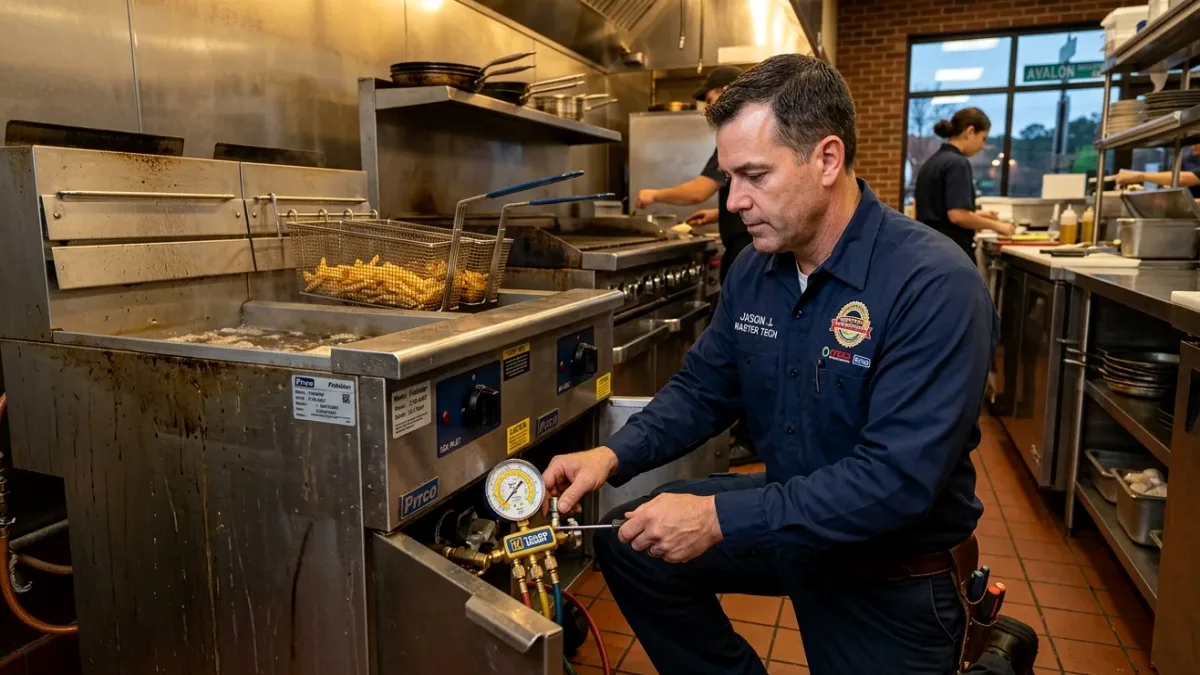
Technician Field Intervention: Dispatched within 42 minutes to a bustling farm-to-table bistro in the Crabapple Road Dining District during afternoon prep. Master Technician Jason J. tapped into the millivolt circuitry using a Fluke True-RMS multimeter. Static testing revealed the standing pilot flame was burning with an uneven lazy yellow tip. When measuring open-circuit thermopile output across the disconnected leads, the meter read only 410 mV DC. Upon reconnecting the circuit and turning the main gas dial to ON, voltage plummeted to 280 mV DC—far below the 450 mV minimum required to hold the Robertshaw combination gas valve magnet energized.
Resolution & Verification: The technician removed the pilot burner assembly, ultrasonic-cleaned the carbon-encrusted brass spud orifice, and installed a brand-new factory OEM Pitco 750mV thermopile generator (Pitco Part # 60125401). After reassembly and pilot re-ignition, open-circuit voltage surged to 780 mV DC. Under full dynamic main burner load with both fry vats heating, closed-circuit telemetry stabilized at a rock-solid 515 mV DC. The 450°F high-limit capillary bulb was inspected and verified securely seated in its immersion brackets. The entire service was finalized in under 55 minutes, fully protecting the restaurant’s Friday dinner service and backed by a comprehensive 90-day parts and labor commercial warranty.
Table of Contents: Commercial Fryer Pilot Diagnostics & Repair
- Commercial Fryer Ignition Architecture
- Symptoms of Pilot Flame Extinction
- Before & After Restoration Showcase
- Mechanical & Electrical Failure Causes
- Step-by-Step Safe Kitchen Inspection
- Critical Stop DIY Safety Thresholds
- Commercial Repair vs Replace Decision
- Instant Repair Cost Calculator
- Foodservice Repair Cost Factors
- Multimeter Telemetry & Ohms Table
- Critical Pitco OEM Components
- Preventative Maintenance & Boil-Out
- Commercial Kitchen Gas Safety Standards
- Commercial Deep Fryer FAQs
- Commercial Service Hubs & Brands
- Operator Technical Takeaways
- Commercial Emergency Dispatch
Commercial Fryer Ignition Systems and Milton Foodservice Reliability
In high-tempo restaurant kitchens across commercial appliance repair operations, the deep fryer is an indispensable pillar of culinary revenue. From crispy chicken tenders and seasoned hand-cut frites to gourmet seafood platters, a sudden pilot failure on a Pitco commercial deep fryer paralyzes the cook line immediately. Unlike residential ranges that utilize electronic spark reignition, the overwhelming majority of Pitco floor fryers—including the venerated 35C+, 40D, SG14, SG18, and SSH series—rely on a self-generating millivolt thermopile control loop.
This self-generating electrical architecture is celebrated throughout commercial foodservice for its brilliant independence from external 120V electrical wall outlets. The system harvests thermal energy directly from the standing pilot flame to generate direct-current (DC) electricity via the Seebeck thermoelectric effect. A specialized multi-junction generator, known in the trade as a 750-millivolt thermopile or powerpile, converts temperature differentials between dissimilar metals into electrical potential. That tiny electrical current powers both the safety holding magnet inside the combination gas valve and the main operating valve operator coil.
However, because this circuit functions entirely below one volt DC, there is zero tolerance for electrical resistance, carbon soot accumulation, or terminal oxidation. A minute resistance increase of just 0.5 Ohms or a slight millivolt voltage drop below 450 mV under full electrical load causes the internal electromagnet to collapse. When that magnet drops out, an internal spring slams the gas valve shut, extinguishing the pilot flame instantly and locking the fry tank into a hard safety shutdown.
For dining establishments in historic Milton, Crabapple Market, Birmingham Crossroads, and the greater North Fulton corridor, kitchen downtime translates directly to lost ticket times, frustrated table turns, and significant culinary waste. Fast, definitive identification of the root mechanical or electrical failure is crucial to restoring cooking operations before peak meal hours.
Operational Symptoms of Pitco Standing Pilot Flame Extinction
Diagnosing a commercial deep fryer pilot failure requires careful observation of how and when the flame extinguishes. Different symptom patterns reveal whether the primary failure lies in the thermocouple/thermopile generator, the gas supply pressure train, the mechanical thermostat, or the high-limit safety loop.
- Immediate Flame Drop Upon Releasing Knob: The pilot ignites cleanly while the manual control knob is held down in the PILOT position. However, after holding the knob for the recommended 60 seconds, the pilot flame vanishes the millisecond pressure on the dial is released. This points to insufficient open-circuit millivoltage or a seized safety magnet coil.
- Pilot Drops When Dial is Turned from PILOT to ON: The standing pilot holds steady while the control valve remains in the PILOT position. But as soon as the line cook rotates the dial to ON or the operating thermostat demands heat, the pilot abruptly snaps off. This classic symptom indicates that the thermopile cannot sustain closed-circuit voltage under the electrical load of the main gas valve coil.
- Intermittent Cutout During High-Volume Peak Service: The fryer runs normally during gentle afternoon prep, but once back-to-back baskets of frozen product are dropped into the vat, the pilot flame dies completely. This often reflects a drifting high-limit capillary switch, severe commercial hood exhaust drafts, or line gas pressure drop.
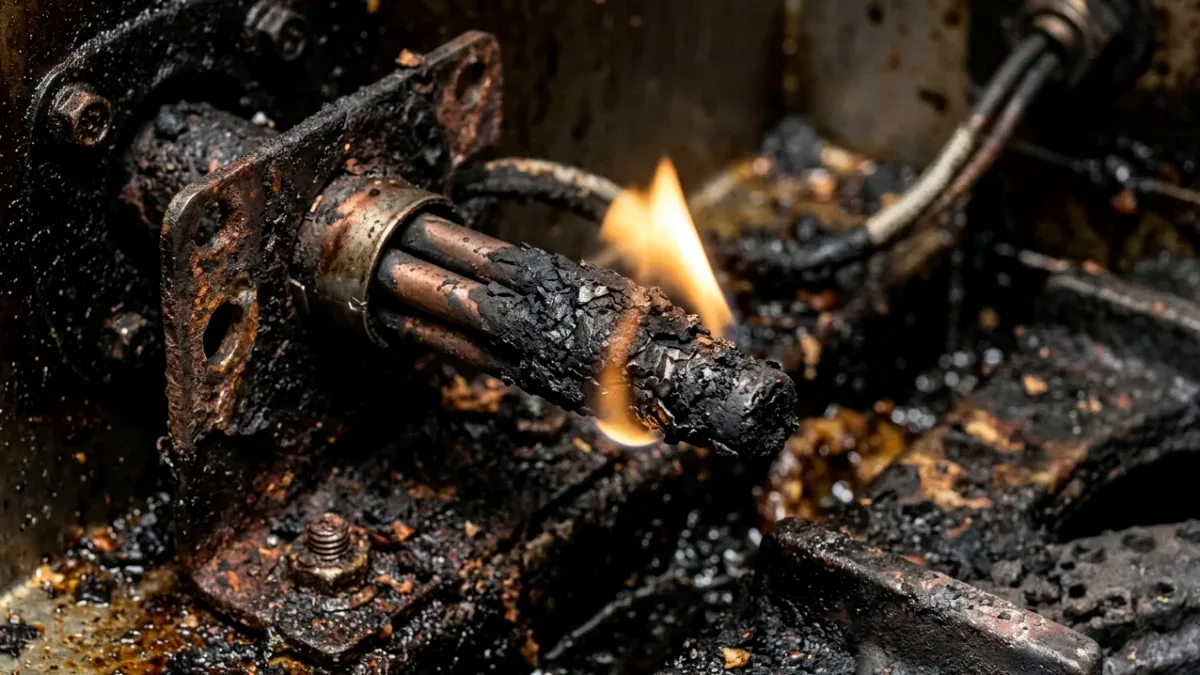
- Lazy Yellow Pilot Flame: Instead of a sharp, roaring blue torch flame engulfing the top 3/8-inch of the thermopile, the pilot burns with an elongated, lazy yellow flame that floats away from the sensor. This signifies severe carbon soot accumulation or an obstructed brass pilot orifice spud.
- Burner Relight Lockout: Following a standard recovery cycle, the main burners shut down as oil reaches target setpoint. When oil temperature subsequently falls, the main burners fail to relight because the standing pilot has extinguished quietly in the background.
Mechanical and Electrical Causes of Pitco Pilot Flame Outage
A commercial deep fryer’s millivolt circuit is an elegantly designed series loop. Any anomaly across gas pressure, thermal conversion, safety switching, or magnetic coil resistance will trigger an immediate flame outage. Understanding the underlying engineering factors allows commercial kitchen managers to recognize why professional diagnostics are required.
Degraded Thermopile Generator Millivoltage Under Load
The standard Pitco 750mV thermopile contains dozens of internal thermocouples connected in series within an armored steel sheath. Over months of continuous high-heat immersion, thermal fatigue and metallurgical oxidation degrade the internal bi-metallic junctions. While a failing thermopile might still produce 400 to 450 millivolts when disconnected (open-circuit), its internal electrical resistance spikes. As soon as the main operator valve coil is switched into the circuit, the loaded voltage collapses below 400 mV DC. The combination gas valve requires a minimum of 450 mV to 550 mV DC under load to overcome spring pressure and maintain pilot gas flow. When loaded voltage dips below 400 mV, the safety magnet drops out automatically.
Carbonized Pilot Orifice and Restricted Spud Jet
Commercial deep fryers operate in an airborne grease environment. Microscopic cooking oil aerosols and fine flour particles from breaded foods are drawn into the pilot burner’s primary air intake ports. Under intense thermal combustion, these organic particles bake into hard, glassy carbon deposits. This carbon restricts the micro-orifice inside the brass pilot spud, diminishing gas velocity and starving the flame of oxygen. A starved pilot flame produces a lazy, yellowish plume that cannot heat the thermopile junction past its 1,200°F generation threshold.
Open or Tripped 450 Degree High-Limit Safety Thermostat
Safety is paramount in commercial cooking equipment filled with 40 to 80 pounds of flammable 350°F cooking oil. Pitco integrates a specialized snap-action high-limit safety thermostat wired in direct series with the thermopile and gas valve magnet. If oil temperature spikes to 450°F (232°C), the high-limit switch trips open, severing the millivolt circuit and dropping the gas valve immediately. However, high-limit switches also suffer from mechanical fatigue. Repeated thermal expansion cycles can cause internal bimetal drift, causing the high-limit switch to trip open prematurely at normal cooking temperatures (such as 360°F or 375°F). If the high-limit circuit exhibits high resistance or opens, the pilot cannot remain lit.
Combination Gas Control Valve Solenoid Magnet Failure
The combination gas valve houses an ultra-fine copper wire magnet coil that holds the internal pilot safety valve open against a mechanical return spring. When energized with 11.5 to 13.5 Ohms of healthy coil resistance and sufficient millivoltage, the magnetic field holds the plunger securely. Over time, vibration, heat, and grease migration cause shorted coil turns or open windings within the valve body. Once coil resistance drifts out of specification, even a brand-new thermopile producing 750 mV will fail to keep the pilot valve latched.
Make-Up Air Imbalance and Commercial Hood Exhaust Drafts
Commercial kitchens in modern dining developments, like those along Crabapple Road in Milton, feature powerful commercial exhaust hoods moving thousands of cubic feet of air per minute (CFM). If kitchen make-up air systems are improperly balanced, strong negative air pressure or localized drafts can whip downward behind the fryer flue. These air currents can physically blow the delicate standing pilot flame away from the thermopile tip, cooling the sensor below its generation threshold in seconds.
Systematic Kitchen Troubleshooting and Field Inspection Protocols
Before calling for emergency service, restaurant managers and kitchen personnel can execute basic visual and procedural checks to rule out simple operational snags:
- Verify Gas Line Shutoff Valves: Inspect the primary gas isolation ball valve located behind the fryer equipment bank. Ensure the handle is fully aligned parallel with the gas hose, confirming full fuel flow.
- Execute Proper Ignition Depress Hold Duration: Turn the combination valve knob to PILOT. Firmly depress the dial fully and light the pilot flame using a long grill lighter or the built-in piezo igniter. Hold the knob down firmly for a full 60 to 75 seconds to allow the thermopile to reach thermal equilibrium before slowly releasing the dial.
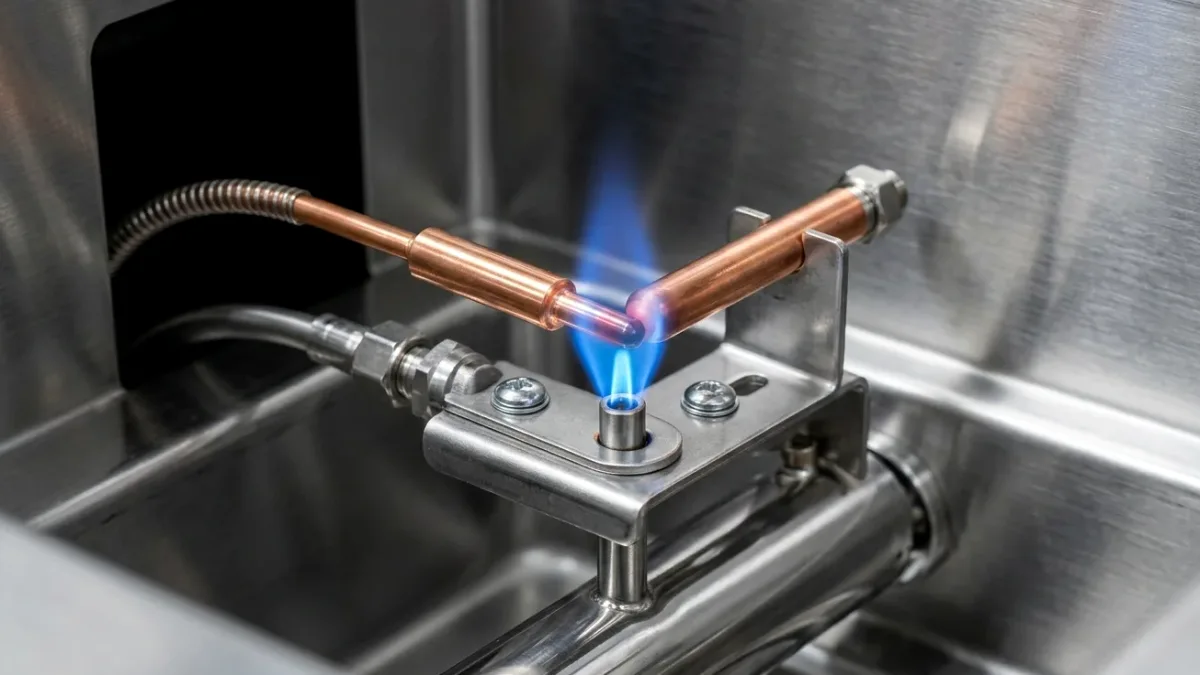
- Inspect the Pilot Flame Color and Geometry: Observe the burning flame. A healthy pilot flame is vibrant blue with a sharp, crisp cone that envelops the top 3/8-inch of the thermopile generator. If the flame is yellow, flickering, or barely licking the bracket, do not attempt to force operation.
- Verify Oil Level Above Minimum Line: Ensure cooking oil or shortening is filled completely above the minimum oil level indicator scribed on the fry tank rear wall. Operating with low oil can trigger hot spots that trip the 450°F high-limit safety bulb.
- Check Mechanical High-Limit Manual Reset: On manual-reset Pitco models, locate the red reset push-button positioned on the fryer front bulkhead or behind the lower door. If the oil is cool (below 300°F), press the red button firmly. If a distinct mechanical “click” is felt, the high-limit had tripped due to an overheat condition.
If executing these basic steps does not resolve the pilot outage, the failure involves internal gas pressures, thermopile millivolt loss, or safety circuit resistance that requires certified professional intervention. In such cases, commercial operators frequently rely on specialized same-day appliance repair to prevent extended dinner service closures.
Critical Stop DIY Protocols for Commercial Gas Appliances
Commercial gas appliances present extreme fire, explosion, and toxic gas hazards when handled without proper diagnostic instrumentation and mechanical training. Foodservice operators and line staff must immediately cease troubleshooting under the following conditions:
Immediate Stop DIY Emergency Warning
- Gas Odor Detected: If any scent of natural gas or rotten-egg mercaptan is noticed, evacuate the line immediately, shut the main kitchen emergency gas valve, and call the gas utility and certified technicians from outside the building.
- Repeated High-Limit Trips: Never attempt to bypass, jumper, or force a high-limit thermostat that continues to pop. Bypassing a high limit on a deep fryer can cause cooking oil to exceed its auto-ignition temperature (typically 750°F to 800°F), creating an explosive kitchen grease fire.
- Jumpering Safety Circuits: Never bypass the thermopile or combination valve safety holding coils using external batteries or clip leads. Doing so defeats the primary safety interlocks mandated by ANSI Z83 and NFPA 96.
- Altering Gas Pressure Regulators: Adjusting gas valve manifold pressure screws without a digital dual-port manometer risks over-firing the burner tubes, causing structural tank cracking and catastrophic oil leaks.
Commercial Fryer Economic Evaluation: Repair Versus Replacement Matrix
When commercial kitchen equipment suffers an ignition breakdown, culinary directors must weigh repair expenditures against the considerable capital investment of purchasing, freighting, and installing a brand-new commercial deep fryer bank. Commercial food-service operators rely on the established 50% Rule: if the total estimated cost of the repair exceeds 50% of the replacement value of an equivalent commercial fryer, or if the unit is beyond its operational lifespan, full replacement may be warranted.
Because standing pilot outages, thermopile failures, and combination gas control valve malfunctions are localized to external, replaceable gas train components, repairing a Pitco fryer is almost always the far more cost-effective decision. Replacing a thermopile or gas valve restores the fryer to original factory combustion standards at a fraction of the cost of new equipment. For comprehensive kitchen planning, restaurant operators frequently review general emergency appliance repair protocols across their commercial portfolios.
| Assessment Criteria | Proceed With Precision Repair | Evaluate Full Unit Replacement |
|---|---|---|
| Equipment Age | Under 7 Years (Solid Tank Integrity) | Over 10–12 Years with Heavy Corrosion |
| Fry Tank Condition | Clean Stainless Steel, Zero Weld Leaks | Thinning Metal, Pinhole Leaks, Burner Tube Cracks |
| Repair Cost Benchmark | $180 – $450 (Thermopile, Orifice, or Valve) | Exceeds $1,200+ on an Aging Base Model |
| Turnaround Time | Same-Day On-Site (Under 90 Minutes) | 5 to 14 Days Freight & Commercial Installation |
| Estimated Total Investment | Minor Operating Expense ($220 – $480) | $2,400 – $6,500+ Capital Outlay |
Commercial Fry Station Repair Cost Variables and Budget Benchmarks
Pricing for commercial cooking equipment service varies depending on equipment specifications, component accessibility, and service scheduling requirements. Knowing the primary cost drivers helps foodservice operators allocate their equipment maintenance reserves accurately:
- OEM Component Specifications: Commercial deep fryers utilize certified OEM parts engineered to withstand continuous commercial kitchen duty. Factory-spec Pitco 750mV thermopile generators (such as Pitco Part # 60125401 or Honeywell/Robertshaw equivalents) range from $65 to $145. Combination millivolt gas control valves (Pitco Part # 60125501) range from $220 to $480 depending on pipe sizing (1/2″ NPT or 3/4″ NPT) and fuel type.
- Commercial Diagnostic & Gas Safety Labour: Professional commercial diagnostic service involves electronic gas sniff testing, True-RMS multimeter telemetry, and dual-port digital manometer pneumatic calibration. Specialized commercial kitchen labor typically ranges between $140 and $220 per hour.
- High-Limit Safety Loop Configuration: Replacing a 450°F capillary high-limit switch requires careful draining of the vat, uncoupling the capillary bulb from its mounting bracket inside the frypot, and remounting the seal sleeve without bending the sensitive copper lead. High-limit components range from $90 to $180.
- Emergency After-Hours or Weekend Service: When a fryer pilot fails at 6:30 PM on a Friday or Saturday night in the Crabapple Dining District, restaurants require emergency rapid response. Immediate commercial emergency calls may incur a priority dispatch premium, balanced against the prevention of thousands of dollars in spoiled culinary revenue.
Professional Diagnostic Telemetry: True-RMS Millivolt and Ohms Field Reference
Master commercial technicians do not rely on guesswork or trial-and-error component swapping. Every diagnostic inspection is validated using precision True-RMS digital multimeter testing, static resistance audits, and loaded millivoltage telemetry. Commercial kitchen managers and maintenance engineers can reference our filterable telemetry lookup table below:
| Component / Test Circuit | Test Condition | Factory Nominal Value | Failure / Fault Threshold | Diagnostic Meaning |
|---|---|---|---|---|
| 750mV Thermopile Generator | Open-Circuit (Disconnected Leads) | 650 mV – 850 mV DC | < 550 mV DC | Thermocouple stack degraded or pilot flame weak |
| 750mV Thermopile Generator | Closed-Circuit (Under Full Load) | 450 mV – 550 mV DC | < 400 mV DC | Loaded voltage collapse; drops pilot magnet instantly |
| 450°F High-Limit Thermostat | Static Continuity (Room Temp) | 0.00 Ω – 0.05 Ω (Closed) | > 0.10 Ω or Open Loop (O.L.) | Internal switch contacts pitted, oxidized, or tripped |
| High-Limit Trip Temperature | Calibrated Oil Bath Thermal Test | 450°F (232°C) ± 10°F | Trips < 420°F (Premature Drift) | Thermal bulb out of calibration; cuts out mid-service |
| Pilot Magnet Holding Coil | Static Resistance at Terminals | 11.5 Ω – 13.5 Ω | < 9.0 Ω or > 16.0 Ω | Shorted coil windings or severed magnet lead |
| Main Valve Operator Solenoid | Static Resistance (TH-TP to TP) | 60.0 Ω – 70.0 Ω | < 50 Ω or Open Loop (O.L.) | Main gas operator coil failed; main burners won’t fire |
| Natural Gas Manifold Pressure | Dynamic Pressure at Valve Tap | 4.0 Inches Water Column (” W.C.) | < 3.5″ or > 4.5″ W.C. | Under-firing causes sooting; over-firing stresses vats |
| Liquid Propane (LP) Manifold | Dynamic Pressure at Valve Tap | 10.0 Inches Water Column (” W.C.) | < 9.0″ or > 11.0″ W.C. | Improper fuel mixture causes pilot flame lifting |
Critical Pitco Replacement Components and Gas Train Assemblies
Maintaining smooth operation across busy restaurant corridors requires immediate access to genuine factory-certified parts. Our commercial service vehicles carry complete Pitco OEM truck inventory, enabling single-visit repairs across North Fulton County. Key components include:
- Pitco 750mV Thermopile Generator (OEM Part # 60125401): Heavy-duty, high-output armored thermopile stack engineered specifically to sustain Robertshaw and Honeywell combination gas valve circuits under continuous commercial cooking temperatures.
- Pitco Combination Millivolt Gas Control Valve (OEM Part # 60125501): Factory-calibrated Robertshaw 7000BMVR series combination valve featuring integrated manual pilot gas valve, internal pressure regulator, and millivolt safety shutoff magnet.
- Pitco 450°F Manual-Reset High-Limit Thermostat (OEM Part # PP10084 / 60125402): Precision snap-action safety cutoff featuring an immersion capillary sensing bulb and liquid-expansion diaphragm calibrated to disconnect the circuit at 450°F.
- Pitco Pilot Burner & Orifice Assembly (OEM Part # 60124301): Complete stainless steel pilot bracket featuring factory-calibrated natural gas or LP brass spud orifice, dual flame spreader wings, and threaded thermopile retaining nut.
- Mechanical Operating Thermostat (OEM Part # 60125400): KX-series capillary bulb operating thermostat controlling cooking oil temperature from 200°F to 400°F with ± 5°F tight switching hysteresis.
Commercial Fryer Preventative Maintenance and Daily Boil-Out Procedures
Rigorous preventative maintenance is the single most effective defense against unexpected commercial fryer pilot failure and premature gas train breakdown. Foodservice kitchens should adhere to strict daily, weekly, and monthly maintenance protocols:
- Daily Pilot Flame Observation & Visual Check: At the start of each morning shift, inspect the standing pilot flame before opening gas to the main burners. Confirm the flame burns crisp blue and completely wraps the top half-inch of the thermopile generator.
- Weekly Boil-Out Procedure with Component Shielding: When executing standard weekly fryer boil-outs using commercial degreaser and hot water solutions, take extreme care to shield the combination gas valve and lower electrical wiring from splashing liquid. Water entering the gas valve casing causes rapid magnet corrosion and catastrophic circuit shorts.
- Bi-Weekly Pilot Bracket De-Carbonization: Using a soft brass wire brush, gently dislodge carbon flakes and airborne flour dust from the pilot bracket and flame ports. Never use steel wool, which can leave metallic fibers across low-voltage terminals.
- Monthly Capillary Bulb Inspection: Verify that the copper capillary tubes for both the operating thermostat and the 450°F high-limit safety switch remain securely fastened inside their factory immersion brackets. A loose sensing bulb resting against a heated burner tube will register false high temperatures, triggering unwanted safety shutoffs.
- Semi-Annual Professional Manometer & Telemetry Audits: Schedule semi-annual certified commercial check-ups to measure manifold gas pressure, inspect flue baffles for structural cracking, and record loaded millivolt telemetry before high-volume holiday dining rushes. For kitchens operating integrated hot line suites, coordinated maintenance across your commercial oven and range repair schedules ensures synchronized kitchen readiness.
Commercial Kitchen Gas Safety Standards and Thermal Protection Protocols
Operating commercial cooking equipment in North Fulton County mandates strict adherence to national and local safety codes, including NFPA 96 (Standard for Ventilation Control and Fire Protection of Commercial Cooking Operations) and ANSI Z83.11 / CSA 1.8 (Commercial Gas Food Service Equipment).
Because cooking oil is combustible and stores immense latent heat, the 450°F high-limit thermal cutoff represents a vital life-safety mechanism. Under NFPA guidelines, commercial kitchen fire suppression systems (such as wet chemical Ansul R-102 systems) are designed to actuate if vat temperatures run out of control. An operational, calibrated high-limit thermostat stops oil runaway hundreds of degrees before fire suppression discharge occurs. A premature discharge triggers automatic gas shutoff, discharges sticky potassium-based wet chemical throughout the kitchen line, and costs thousands of dollars in clean-up and lost revenue.
Furthermore, gas supply lines must feature commercial-grade quick-disconnect flex hoses with restraining cables to prevent line shearing during fryer roll-out for cleaning. Our certified technicians audit restraining cable tension and check gas union tightness with certified electronic combustible gas sniffers on every service call. Foodservice directors managing complex back-of-house operations often consult our regional commercial experts in Alpharetta, GA, nearby Roswell, GA, and the bustling dining corridors of Johns Creek, GA for comprehensive facility-wide appliance safety audits.
Comprehensive Commercial Deep Fryer Frequently Asked Questions
Explore our expert answers to common operational questions regarding Pitco commercial deep fryer standing pilot systems, thermopile generators, and gas valve troubleshooting:
Why does my Pitco fryer pilot go out immediately after releasing the knob?
The most frequent cause is a degraded 750mV thermopile generating insufficient open-circuit millivoltage (below 550 mV DC), an occluded pilot orifice restricting flame impingement, or a failed pilot safety magnet inside the combination gas valve. If the thermopile cannot generate sufficient electrical energy to hold the internal magnet plunger against its spring, the pilot valve slams shut the moment manual knob pressure is released.
What is the difference between a thermocouple and a thermopile on a commercial deep fryer?
A thermocouple consists of a single bimetallic junction generating approximately 25 to 30 millivolts (mV) DC, used primarily on residential appliances to hold a small pilot safety valve. A thermopile (or powerpile) is a series stack of dozens of thermocouples engineered to produce between 750 and 850 millivolts DC. This higher electrical power is required on self-powered commercial fryers to energize both the pilot safety magnet AND the main burner gas valve solenoid without external electrical power.
What should a healthy Pitco thermopile read on a digital multimeter?
Under open-circuit conditions (leads completely disconnected from the combination valve), a healthy 750mV thermopile heated by a crisp blue pilot flame should register between 650 mV and 850 mV DC. Under closed-circuit conditions (connected to the valve with main burners firing), loaded voltage should remain stable between 450 mV and 550 mV DC. Any reading below 400 mV under load indicates a failing thermopile that will cause random pilot dropouts.
At what temperature does the Pitco high-limit safety switch trip?
The factory Pitco high-limit safety thermostat is calibrated to trip mechanically at 450°F (232°C) ± 10°F. When tripped, it physically breaks the millivolt circuit, cutting gas flow to both the main burners and the pilot immediately to prevent cooking oil from reaching its auto-ignition fire threshold.
How do I know if the high-limit switch has tripped on my Pitco fryer?
On manual-reset models, locate the small red reset button on the fryer bulkhead. If the oil is below 380°F, pressing the red button will produce a firm tactile click if it had tripped. On an electrical multimeter, test continuity across the two high-limit terminals. A normal switch reads 0.00 to 0.05 Ohms (closed continuity). A tripped or failed switch reads Open Loop (O.L.) or high resistance.
Can I clean a carbonized pilot orifice with a needle or paperclip?
No, never insert steel needles, drills, or paperclips into a commercial brass pilot orifice. The precision metering hole is drilled to microscopic tolerances. Steel tools will ream or distort the soft brass opening, increasing fuel flow, creating an over-rich yellow sooting flame, and ruining the air-gas combustion mixture. Professional technicians soak orifices in ultrasonic solvent baths or use specialized brass broaches.
Why does the pilot extinguish as soon as the main burners turn on?
This indicates that the thermopile has degraded internal capacity. When the main operator valve coil is switched into the circuit, current draw causes loaded millivolts to plunge below 400 mV DC. Additionally, severe gas pressure drop in the supply line when main burners fire can starve the pilot tube, causing the pilot flame to shrink and release the magnet.
What manifold gas pressure is required for Pitco commercial deep fryers?
For natural gas (NG) models, the factory manifold pressure specification is 4.0 inches Water Column (” W.C.) under full burner load. For liquid propane (LP) models, the specification is 10.0 inches Water Column. Inlet static pressure should be between 7.0″ and 9.0″ W.C. for natural gas and 11.0″ to 14.0″ W.C. for LP.
How long should a commercial deep fryer thermopile last?
In high-volume commercial restaurant kitchens operating 12 to 16 hours daily, a commercial 750mV thermopile typically lasts 18 to 36 months. Continuous thermal immersion, airborne cooking oil varnish, and aggressive temperature cycling eventually degrade the internal junction stack, making periodic replacement a routine preventative task.
Can a draft from the kitchen exhaust hood extinguish the pilot?
Yes. If the commercial kitchen make-up air system is imbalanced or air supply louvers blow directly toward the rear of the fryer flue, downdrafts can push the standing pilot flame away from the thermopile tip or blow it out entirely. Proper hood balancing and installing factory Pitco flue deflector shields prevent draft-induced outages.
Is it safe to jumper the high-limit switch to finish dinner service?
ABSOLUTELY NOT. Jumpering a high-limit thermostat on a commercial fryer is a severe fire and safety violation. If the operating thermostat sticks in the ON position without high-limit protection, cooking oil will overheat to its auto-ignition point (approx. 750°F), erupting into an uncontrollable vat fire that can destroy the restaurant.
What are the coil resistance specifications for the combination gas valve?
On standard Robertshaw 7000BMVR combination millivolt gas valves, the pilot safety magnet holding coil should measure 11.5 to 13.5 Ohms. The main valve solenoid coil across the TH-TP and TP terminals should measure between 60.0 and 70.0 Ohms. Readings outside these ranges indicate internal coil degradation requiring valve replacement.
How fast can your technicians arrive in Milton, GA for an emergency fryer breakdown?
Our mobile commercial service units are stationed directly in North Fulton County, providing priority commercial emergency arrival in Milton within 45 to 90 minutes. We carry dedicated Pitco OEM parts on our service vehicles to complete repairs on the initial visit.
Do you service other commercial kitchen cooking equipment and dish machines?
Yes. In addition to deep fryers, our certified master technicians handle commercial dishwasher repair, high-temp conveyor dishmachines, deck ovens, flat-top griddles, charbroilers, and walk-in refrigeration across North Fulton foodservice kitchens.
What warranty accompanies commercial Pitco repairs?
Every commercial repair performed by Appliance Repair Alpharetta is backed by our comprehensive 90-day parts and labor warranty. If the replaced OEM component or restored circuit exhibits any fault within 90 days, our technicians return and resolve the issue with zero additional labor fees.
Can boiled-over cooking oil damage the gas control valve?
Yes. Severe vat boil-overs or careless boil-out chemical drainage allow boiling oil, caustic water, and grease to seep into the lower cabinet. If liquid enters the gas valve atmospheric vent or reaches the wire terminals, it creates high-resistance corrosion and seizes internal mechanical diaphragms, destroying the combination valve.
Do your technicians service commercial refrigeration systems during the same call?
Absolutely. Our dual-certified commercial technicians can diagnose cooking equipment and commercial refrigeration repair on the same emergency trip, including walk-in coolers, reach-in sandwich prep tables, and commercial ice machines.
What luxury and commercial range brands do your certified specialists support?
Across residential estates and executive club kitchens, our master technicians provide factory-grade diagnostics for Viking commercial cooking ranges, Sub-Zero refrigeration suites, Thermador commercial ranges, Bosch kitchen equipment, commercial dryer repair, commercial laundry systems, and KitchenAid food preparation equipment.
Commercial Foodservice Equipment Support and Cross-System Solutions
Explore our complete network of commercial kitchen repair solutions, brand specializations, and North Fulton service territories:
Primary Commercial Services
Related Cooking Equipment Faults
Premium Cooking & Kitchen Brands
Key Technical Takeaways for Foodservice Operators
- Millivolt Circuit Thresholds: The Pitco self-generating pilot loop requires a minimum of 650 mV DC open-circuit and 450–550 mV DC closed-circuit under full load. Any drop under 400 mV collapses the combination valve magnet.
- Zero Resistance Tolerance: Operating below 1 volt DC means minor terminal corrosion or grease varnish will sever the circuit. Connections must be micro-abraded and sealed with dielectric protectant.
- High-Limit Thermal Safety: The 450°F capillary high-limit thermostat is a life-safety switch wired in direct series; it must never be bypassed, jumpered, or overridden under any operational circumstance.
- Precision Gas Pressure: Correct manifold pressure (4.0″ W.C. natural gas / 10.0″ W.C. LP) is mandatory to sustain clean blue pilot flame impingement across the top 3/8-inch of the thermopile.
- Ultrasonic Cleaning Standard: Brass pilot spud orifices must never be cleared with steel wire or drill bits; ultrasonic solvent baths protect precision metering geometry.
- Economic Decision Standard: Gas train component replacement costs a fraction of full unit replacement and restores 100% factory reliability on fryers with sound vat integrity.
- Priority Milton Commercial Response: Fast commercial dispatch (45–90 minutes) across the Crabapple Road Dining District ensures minimal ticket interruption and zero dinner revenue loss.