
When a True T-49 commercial reach-in two-door refrigerator begins drifting upward into the danger zone above 41°F along Alpharetta’s bustling Old Milton Parkway restaurant corridor, commercial kitchen operations face immediate catastrophe. Solid frost encapsulation across the evaporator fin pack strangles convective static pressure, starving the food storage compartment of refrigerated airflow while forcing the heavy-duty condensing unit into endless, destructive duty cycles. Restoring factory refrigeration dynamics requires exact diagnostic triage across the Paragon 8145-20 defrost timer mechanism, bimetal defrost termination thermostat calibration, ECM evaporator fan motor telemetry, and suction operating pressures to protect thousands of dollars in perishable culinary inventory and ensure complete Georgia Department of Public Health compliance.
Quick Technical Answer: True T-49 Warm Evaporator Fan Coil Frost Failure
A True T-49 two-door commercial refrigerator warming up with heavy evaporator coil frost accumulation is typically triggered by one of four mechanical or electrical failures: (1) an electrically stalled or defective Paragon 8145-20 mechanical defrost timer failing to initiate defrost contact closure across terminals 1 and 3, (2) an open-circuit bimetallic defrost termination switch failing to close at 20°F (0Ω) or stuck open above 45°F (OL), preventing the calrod defrost heater from energizing, (3) failed ECM or shaded-pole evaporator fan motors causing static air starvation across the fin pack, or (4) torn vinyl magnetic perimeter door gaskets allowing warm, humid ambient kitchen air to enter continuously. Normal R-134a operating suction pressure must hold steady between 18 and 22 PSI; sub-normal suction accompanied by heavy ice crusting confirms airflow blockage or an active defrost cycle failure.
Listen to 60-Second Diagnostic Summary
Narrated by Jason J. (Master Commercial Refrigeration Specialist)
Check Same-Day Commercial Tech Availability in Your Alpharetta Neighborhood
Enter your facility ZIP code to verify dedicated commercial cold-side technician dispatch across Old Milton Parkway, Avalon, North Point, and Windward:
Recently Serviced on Old Milton Parkway • Alpharetta, GA
True T-49 Reach-In Defrost Timer 8145-20 & Bimetal Termination Switch Replacement • Verified 5.0 ★★★★★
Verified Field Case Study
Service Dispatch ID: #CS-TRUE-8841-ALPH
Commercial Kitchen Prep Line Emergency: True T-49 Reach-In Warm Cabinet & Evaporator Frost Lockout on Old Milton Parkway, Alpharetta
High-Volume Bistro Kitchen, Old Milton Pkwy Corridor (Alpharetta, GA 30009)
True T-49 Two-Door Solid Reach-In Commercial Refrigerator (R-134a)
Internal box temperature holding at 54°F; ice accumulating behind back shroud
Paragon 8145-20 Timer Motor Open (OL); Bimetal Switch Open at 22°F; Suction 11 PSI
Diagnostic Field Evaluation: A senior master commercial refrigeration technician was dispatched under an urgent 42-minute priority window to an Old Milton Parkway restaurant. The kitchen line reported that their primary two-door prep refrigerator had climbed to 54°F during lunch service, jeopardizing over $4,200 of vacuum-sealed proteins, dairy sauces, and fresh produce. Visual inspection inside the ceiling evaporator plenum revealed a dense, glacier-like block of ice bridging all aluminum coil fins and encasing the expansion valve bulb. Both shaded-pole evaporator fans were running continuously at 1,550 RPM, yet air discharge at the louvers had dropped to zero CFM due to total fin block.
Telemetry Testing & Root Cause Analysis: Electrical telemetry testing was executed utilizing a Fluke 117 True-RMS digital multimeter. Probing terminals 1 and 3 on the Paragon 8145-20 commercial defrost timer revealed 120 VAC applied voltage, but the internal synchronous timer motor coil measured infinite resistance (OL across motor pins), confirming clock coil burnout. The timer had locked permanently in the cooling mode, skipping mandatory 6-hour off-cycle/electric defrost routines for an estimated 10 days. Additionally, bench testing the clip-on evaporator bimetallic defrost termination switch submerged in an ice bath at 20°F revealed open contacts (infinite ohms / OL), meaning that even under manual defrost clock advance, the auxiliary circuit could not ground or trigger heater engagement. Gauge manifold connection to the low-side Schrader service port revealed 11.2 PSI suction pressure (normal operating band: 18 to 22 PSI), caused by the severely insulated evaporator coil failing to absorb latent heat from the box.
Factory OEM Resolution & Verification: The technician isolated commercial power at the dedicated 115V 20A disconnect. The frozen evaporator bundle was thoroughly and safely cleared using a commercial low-pressure steam defroster, preserving fin integrity and ensuring zero mechanical tube distortion. A factory-original OEM True 8145-20 defrost timer assembly (#801808) was installed, and the defective bimetal defrost thermostat (#800318) was replaced with a genuine 20°F cut-in / 45°F cut-out bimetal switch clamped securely to the evaporator suction header. The drain trough heater was continuity tested (confirming 142Ω nominal resistance). After restoring line power, a forced defrost cycle was initiated, proving flawless heater draw (4.8A) and clean termination. Upon returning to refrigeration mode, suction pressure stabilized within the factory design parameter of 19.8 PSI, and box temperatures plunged from 54°F to 37.2°F within 48 minutes. Perishable foods were fully protected, and full 90-day parts and labor warranty certificates were provided to the general manager.
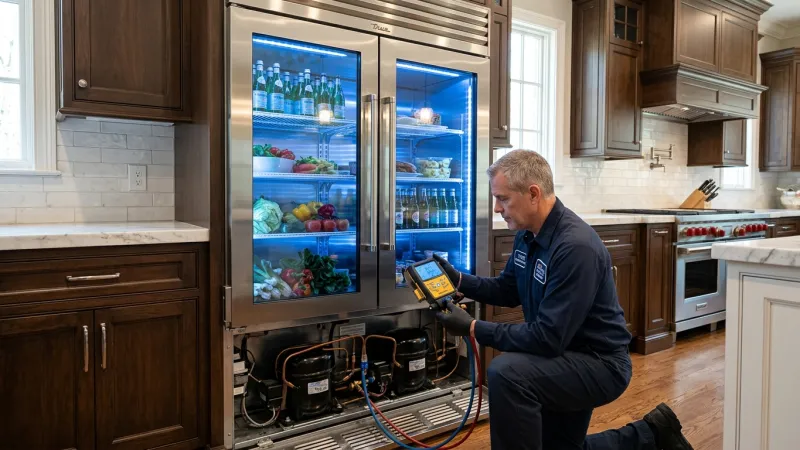
Figure 1: Certified commercial cold-side technician inspecting an iced evaporator assembly on a True T-49 reach-in refrigerator along Old Milton Parkway, Alpharetta, GA.
Table of Contents: True T-49 Commercial Evaporator Coil Restoration Guide
- Technical Engineering Architecture of the True T-49 Reach-In System
- Primary Operational Symptoms of Evaporator Frost Lockout
- Visual Field Restoration Showcase: Solid Ice Encapsulation vs. Factory Defrosted Assembly
- Root Engineering Causes of True T-49 Evaporator Fin Icing
- Step-by-Step Operator Troubleshooting & Visual Triage
- Critical Thresholds: When Kitchen Staff Must Halt DIY Interventions
- Commercial Repair vs. Unit Replacement Economic Framework
- Interactive Instant Commercial Refrigeration Repair Cost Estimator
- Commercial Refrigeration Expense Factors & Inventory Loss Exposure
- Master Multimeter Telemetry & Electrical Diagnostic Protocols
- Critical True T-49 OEM Components & Technical Specifications
- Comprehensive Commercial Preventative Maintenance Protocols
- Commercial High-Voltage Electrical & Hydrocarbon Refrigerant Safety
- Frequently Asked Technical Questions: True T-49 Cooling Operations
- Regional Commercial Kitchen Services & North Fulton Corridors
- Executive Takeaways for North Fulton Kitchen Managers
- Commercial Emergency Service Dispatch CTA
Technical Engineering Architecture of the True T-49 Reach-In System
The True T-49 stands as the quintessential workhorse of modern commercial food service, powering high-volume cook lines, bakery operations, and prep kitchens across North Fulton County. Engineered as a self-contained, two-door reach-in commercial refrigerator, the T-49 utilizes a bottom-mount condensing unit architecture paired with a ceiling-suspended interior evaporator coil assembly. This thermodynamic design optimizes balance by drawing warm air from the highest internal elevation of the cabinet, forcing it through a densely finned aluminum and copper evaporator pack, and returning laminar, sub-40°F air down the rear duct and along food storage pans. Maintaining this continuous convection requires every electromechanical component to operate in flawless synchronicity, which is why commercial culinary operators frequently rely on dedicated commercial refrigerator repair specialists when thermodynamic equilibrium collapses.
At the heart of the cooling system lies a high-efficiency hermetic compressor operating alongside a balanced capillary tube or thermostatic expansion valve metering system, traditionally charged with R-134a or modern eco-friendly R-290 (propane) refrigerant. The ceiling evaporator housing contains dual shaded-pole or electronically commutated (ECM) evaporator fan motors. Unlike domestic residential refrigerators that periodically pause air circulation during compressor off-cycles, commercial reach-ins require continuous evaporator fan operation during standard cooling routines to prevent localized thermal stratification, maintain uniform cabinet holding temperatures, and continuously sweep moisture away from cold aluminum surfaces. Understanding this high-capacity duty cycle is essential for kitchen supervisors who manage high-traffic culinary lines requiring reliable refrigerator repair protocols.
Defrost management on the True T-49 is controlled through either an off-cycle time-initiated, time-terminated sequence or an active electric defrost setup utilizing a heavy-duty mechanical Paragon 8145-20 series defrost time control. In a busy commercial restaurant environment—such as those operating along Old Milton Parkway where line cooks open stainless steel doors hundreds of times during peak lunch and dinner rushes—substantial volumes of warm, humid ambient kitchen air enter the cabinet. That moisture immediately condenses and freezes onto the sub-freezing aluminum evaporator fins. Under normal operating parameters, the defrost timer initiates scheduled defrost cycles every 6 hours, de-energizing the compressor and permitting either continuous fan circulation or electric calrod heating to shed frost into the condensate drain pan. When this sequence falters, frost accumulation cascades into an impenetrable ice barrier.
Primary Operational Symptoms of Evaporator Frost Lockout
Evaporator frost accumulation on a True T-49 does not occur instantaneously; rather, it manifests through a progressive sequence of subtle thermodynamic warning indicators before culminating in catastrophic refrigeration failure. The earliest observable symptom is an inexplicable drift in cabinet temperature, where digital display monitors or dial thermometers reflect 42°F to 48°F despite the electromechanical temperature control thermostat being dialed down to its coldest setpoint. Kitchen staff often mistake this early phase for door-opening fatigue, unaware that progressive refrigerator frost build-up is actively choking the internal fin spacing and reducing air movement across the food pans.
As frost deepens into solid structural ice, static air pressure behind the evaporator access shroud plummets. Kitchen staff will notice that while the twin evaporator fan motors can be heard buzzing at full speed, virtually no chilled air is discharging through the forward directional louvers. Placing a hand directly beneath the evaporator plenum reveals an absence of air movement, accompanied by a damp, musty odor caused by standing condensate trapped against cold aluminum surfaces. At this stage, the condensing unit in the bottom machine compartment will run continuously without cycling off, causing the compressor body and discharge lines to run excessively hot to the touch as the unit struggles in vain to satisfy the satisfaction setpoint.
The visual manifestations soon become unmistakable: frost begins creeping outward from the evaporator coil housing, coating the fan motor wire brackets, creeping down the back interior aluminum wall, and forming frozen teardrops along the condensate drain pan seams. In severe cases of total defrost lockout, solid blocks of ice expand into the fan blade rotation zone, generating loud rhythmic ticking, scraping, or high-pitched screeching noises as fan blades strike ice dams. If left unaddressed, the fan motor rotors mechanically seize, tripping thermal overloads and leaving the refrigerator completely vulnerable to rapid temperature spikes that threaten expensive culinary inventory.
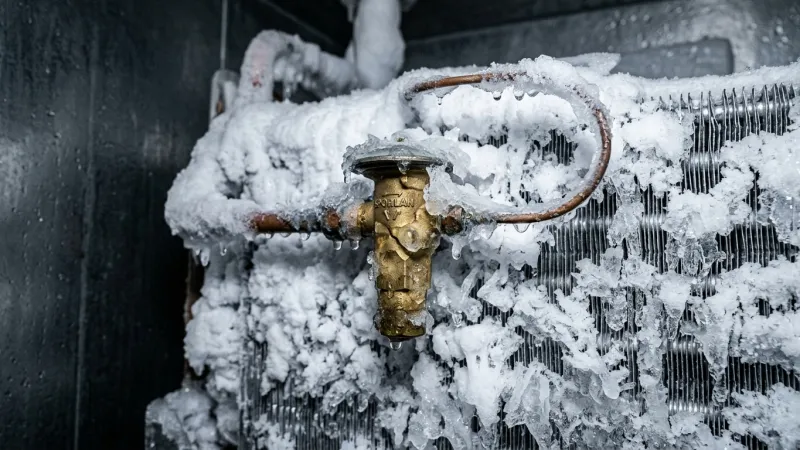
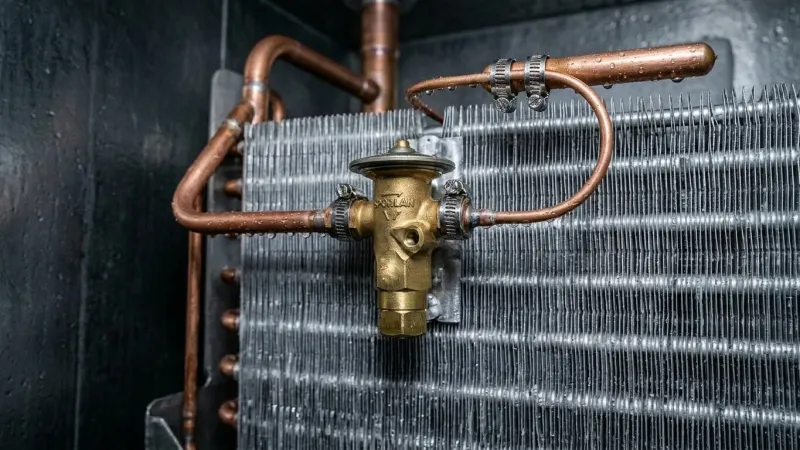
Root Engineering Causes of True T-49 Evaporator Fin Icing
Determining why an evaporator coil frosted over requires recognizing that frost is merely an acoustic or visual symptom of a deeper electrical, mechanical, or aerodynamic breakdown. The primary catalyst in commercial kitchens is an electromechanical failure of the defrost timer mechanism. On True T-49 units equipped with the factory Paragon 8145-20 timer, a small 115V synchronous motor powers internal reduction gears to trip cam lobes at scheduled intervals. Over years of grueling commercial duty, timer motor windings succumb to thermal stress and burn out, or miniature nylon gears strip. When the timer motor halts, the contacts remain permanently locked in cooling mode (pins 2 and 4 energized), completely bypassing defrost cycles. This breakdown necessitates prompt refrigerator defrost timer replacement to restore normal cycle modulation.
The second major failure point is the defrost termination bimetal thermostat, often referred to as the defrost cut-off switch. Clamped securely to the evaporator suction line manifold, this hermetically sealed disc switch is engineered to snap closed at low temperatures (typically 20°F or below) to complete the defrost heater circuit when the timer commands defrost, and snap open once the coil warms to 45°F to terminate heating and prevent excessive cabinet temperature spikes. Internal contact arcing, moisture ingress through cracked epoxy seals, or physical mechanical displacement from the copper tube will leave the bimetal stuck open. Under this fault state, even if the defrost timer commands defrost, zero electrical current reaches the calrod heater, leaving the aluminum fin pack completely frozen. Addressing these delicate sensor failures requires skilled commercial appliance repair technicians equipped with factory telemetry gear.
A third critical root cause is degraded or seized evaporator fan motors. Commercial reach-in evaporators require substantial velocity and static pressure to move dense, cold air across tightly spaced aluminum fins. If bearing lubrication dries out or electrical motor windings short, fan speed drops significantly from its 1,550 RPM design baseline to a sluggish rotation, or stalls completely. Without high-velocity air sweeping the latent heat from the food compartment across the coils, refrigerant inside the evaporator boils off at abnormally low temperatures, causing incoming moisture to freeze instantly and expand into an unbroken ice sheet. When fan motors begin dragging or humming, prompt refrigerator evaporator fan repair is necessary to avoid burning out the compressor motor windings.
Finally, external environmental factors and physical sealing failures contribute heavily to evaporator frost accumulation along busy commercial kitchen corridors. Commercial kitchens on Old Milton Parkway experience intense humidity during humid Georgia summers, coupled with ambient kitchen temperatures regularly exceeding 85°F near cooklines. If the heavy-duty magnetic vinyl door gaskets on the True T-49 become hardened, torn, or misaligned, a continuous stream of hot, moisture-saturated air is drawn into the negative-pressure interior of the cabinet. This perpetual moisture load overwhelms the standard defrost intervals, forming dense ice faster than the defrost system can melt it. Furthermore, a clogged condensate drain tube traps melted water inside the drain pan; during the subsequent refrigeration cycle, that standing pool freezes solid and creeps upward into the bottom coil passes, eventually encasing the entire evaporator pack.
Step-by-Step Operator Troubleshooting & Visual Triage
When an on-line cook or sous chef notices rising temperatures inside a True T-49 refrigerator, immediate non-invasive triage can prevent catastrophic inventory spoilage while establishing critical diagnostic clues for arriving service technicians. The first action kitchen management must take is verifying actual internal cabinet temperatures using a calibrated secondary digital probe or certified dial thermometer placed in a vessel of water or cooking oil on the middle shelf. Built-in electronic digital controllers or mechanical exterior dials can experience sensor drift or provide deceptive surface readings during a refrigerator warm cabinet emergency.
The second operator check focuses on physical perimeter air integrity. Inspect both upper and lower stainless steel door gaskets across all four corners of each door. Food grease, flour dust, and dried syrup frequently accumulate in the accordion pleats, preventing the embedded magnetic strip from seating tightly against the steel face frame. Conduct the classic commercial “dollar bill resistance test” by closing the refrigerator door on a clean piece of paper or currency at six distinct intervals around the perimeter. If the paper pulls out freely without firm magnetic drag, the gasket requires immediate sanitizing, realignment, or replacement to stop the relentless influx of moist kitchen air that accelerates coil freezing.
The third safe check involves visual inspection of the top interior evaporator plenum. Utilizing a bright flashlight, look upward through the protective wire guard and fan discharge louvers. Are the fan blades actively spinning at high velocity, or are they stopped dead, humming quietly, or vibrating erratically? Observe whether white, crystalline frost is visible on the rear aluminum walls or protruding beyond the lower edge of the drain pan. If thick frost or ice is clearly visible creeping outside the shroud, airflow through the coil has been severely restricted, signaling that the unit requires specialized refrigerator evaporator coil repair procedures.
The fourth triage step is an inspection of the mechanical defrost control. On True T-49 models equipped with a mechanical Paragon 8145-20 timer located inside the electrical junction enclosure or bottom compressor compartment, locate the central manual advance knob. Using a flathead screwdriver or finger pressure, gently rotate the advance dial clockwise until you hear and feel a heavy, distinct mechanical “click.” This manually trips the internal contacts out of refrigeration mode and into the defrost cycle. Listen carefully: the compressor and condenser fan should immediately de-energize. In units with electric defrost heaters, wait 5 to 10 minutes and monitor for the faint sound of sizzling water or mild radiant warmth at the bottom of the evaporator housing. If nothing happens, the defrost circuit is completely open, or the bimetal termination thermostat has failed.
Critical Thresholds: When Kitchen Staff Must Halt DIY Interventions
Commercial reach-in refrigerators are industrial mechanical appliances operating under severe mechanical pressures, volatile refrigerants, and high electrical current. While basic visual checks and perimeter sanitization are appropriate for culinary personnel, untrained kitchen employees must never attempt mechanical or electrical disassembly. The single most catastrophic error restaurant staff make during an icing emergency is attempting to chip away ice using metal spatulas, boning knives, or ice picks. The aluminum fins and thin-walled copper or aluminum evaporator tubing are extraordinarily delicate. A single slip with a metal tool will puncture the pressurized refrigeration line, discharging the entire refrigerant charge within seconds and transforming an inexpensive defrost repair into a multi-thousand-dollar emergency sealed system rebuild.
Similarly, staff must never direct industrial heat guns, propane blowtorches, or open flames into the evaporator housing to accelerate thawing. Intense localized heat warps the precision aluminum fan blades, melts internal high-temperature wiring harnesses, distorts EPS structural insulation foam, and risks detonating the hermetic refrigerant charge. On modern True T-49 units charged with R-290 (refrigerant-grade propane), an open flame or intense thermal shock represents an immediate flammability hazard. When an operator observes that a commercial refrigerator is simply refrigerator not defrosting, power should be safely maintained while food is transferred to backup cold storage, and a certified commercial specialist should be summoned immediately.
Kitchen staff must immediately cease all troubleshooting and call for licensed commercial dispatch whenever any of the following conditions occur: (1) electrical burning odors or scorched plastic smells emanating from the ceiling plenum or bottom compressor housing, (2) the dedicated 20A circuit breaker trips repeatedly upon resetting, (3) oily residue or bubbling refrigerant is spotted along copper tubes, (4) fan motors emit loud electrical grinding or buzzing sounds without rotating, or (5) internal cabinet temperatures remain above 41°F for more than two hours during active operation.
Commercial Repair vs. Unit Replacement Economic Framework
When confronting major component failures on a True T-49, restaurant owners and executive chefs must evaluate capital allocation using commercial industry standards rather than residential rules of thumb. True commercial reach-ins are heavy-duty industrial investments built with welded 300-series stainless steel, high-density foamed-in-place polyurethane insulation, and industrial-grade mechanical components engineered to endure 12 to 18 years of continuous commercial service. In high-demand restaurant environments, replacing high-wear electromechanical components is routinely cost-effective compared to buying a replacement unit, an operational dynamic common across both commercial refrigerators and heavy-duty commercial freezer repair scenarios.
The industry benchmark for commercial refrigeration capital planning is the Commercial 50% Rule: if the total estimated cost of professional restoration (including genuine OEM parts, specialized technician labor, and warranty coverage) is less than 50% of the replacement cost of a comparable brand-new commercial unit, and the cabinet chassis remains structurally sound without pervasive galvanic corrosion or insulation waterlogging, repairing the unit is virtually always the superior fiscal decision. A brand-new True T-49 two-door reach-in refrigerator currently commands between $4,500 and $6,200 plus commercial freight, professional uncrating, liftgate fees, and mechanical installation.
| Diagnostic Component Failure | Average OEM Repair Cost | Equipment Age Baseline | Recommended Action | Economic Rationale |
|---|---|---|---|---|
| Defrost Timer & Bimetal Switch | $240 – $420 | Any Age (1–15 Years) | Immediate Repair | Extremely high ROI; resolves icing completely with factory OEM controls. |
| Dual Evaporator Fan Motors (ECM) | $320 – $560 | Under 12 Years | Immediate Repair | Restores factory airflow velocity and extends compressor operating life. |
| Full Perimeter Magnetic Door Gaskets | $210 – $380 | Any Age (1–15 Years) | Immediate Repair | Eliminates moisture infiltration, lowers utility bills, and stops ice buildup. |
| Sealed System Evaporator Bundle Leak | $950 – $1,450 | Under 8 Years | Repair if Body Sound | Cost represents ~22% of replacement cost; viable on clean stainless bodies. |
| Burned Hermetic Compressor + Severe Rust | $1,850 – $2,400 | Over 13 Years | Replace Unit | Approaches 50% threshold; insulation fatigue and multiple old components present risk. |
Interactive Instant Commercial Refrigeration Repair Cost Estimator
Kitchen operators and facility directors need fast, transparent cost forecasting during commercial equipment breakdowns. Utilize our interactive estimator below to calculate approximate investment ranges for restoring True commercial reach-in refrigeration systems based on specific failure modes and component classifications:
Commercial Refrigeration Expense Factors & Inventory Loss Exposure
When evaluating commercial refrigeration expenditures, intelligent kitchen managers balance the cost of repair against the astronomical expense of culinary food waste and regulatory penalties. Under Georgia Department of Public Health Food Service Chapter 511-6-1 and FDA Food Code section 3-501.16, time/temperature control for safety (TCS) foods—including fresh poultry, premium cuts of beef, raw seafood, dairy products, and cooked prepared stocks—must remain at or below 41°F (5°C) at all times. If internal box temperatures breach 41°F for more than four hours, health regulations legally compel the operator to condemn and dispose of all stored contents. For a fully stocked True T-49 during weekend service on Old Milton Parkway, that represents an immediate inventory loss ranging from $3,500 to $8,000.
The actual investment for commercial repair is governed by several tangible technical variables. The primary determinant is component classification: mechanical switches such as the Paragon 8145-20 defrost timer or clip-on bimetal termination switch are relatively straightforward to replace, whereas high-output shaded-pole or variable-speed ECM evaporator fan motors require precision mechanical alignment, anti-vibration rubber bushing mounting, and exact electrical terminal pinning. Operators searching for qualified appliance repair Alpharetta GA services can count on factory-certified diagnostic equipment and transparent upfront billing.
A second expense factor is the severity of the evaporator ice pack. Clearing a lightly frosted fin pack can be accomplished swiftly during routine diagnostic procedures. However, an evaporator encased in a 4-inch-thick glacier of solid ice requires dedicated low-pressure steam thawing and hot-water injection to clear the drainage channels without warping delicate aluminum fins or damaging copper joints. Attempting to rush this process with blunt force damages surrounding structures, whereas professional steam decontamination completely liquefies the ice block, flushes stubborn algae and biofilm from the drain pan, and restores clear gravity drainage.
Master Multimeter Telemetry & Electrical Diagnostic Protocols
Certified commercial refrigeration diagnosticians never guess at component health; they execute rigorous electrical telemetry using calibrated True-RMS digital multimeters and digital pressure manifold systems. Diagnosing an iced evaporator on a True T-49 requires systematically evaluating the entire defrost control loop under both energized and de-energized conditions. When a defrost heater fails to energize, testing continuity across the heater element pins isolates open circuits, a routine standard across all commercial heating and refrigerator defrost heater repair calls.
The electrical heart of the defrost circuit on the True T-49 is the Paragon 8145-20 defrost timer. With the unit safely powered and the timer in refrigeration mode, measure voltage across timer terminals 1 and 3. The meter must register full line voltage of 115 to 120 VAC, confirming continuous power to the synchronous clock motor. Next, isolate line power, disconnect the terminal leads, and measure internal motor winding resistance across terminals 1 and 3. A healthy synchronous clock motor displays approximately 1,800 to 2,400 ohms. If the display reads “OL” (open loop / infinite resistance), the internal coil is burned out and the timer cannot advance mechanically.
The bimetallic defrost termination thermostat must be tested in direct correlation with temperature. This disc sensor, mounted firmly against the copper suction header tube, operates with an engineered hysteresis: it must remain closed (0.0 to 0.4 ohms) at 20°F or below to allow defrost current to pass, and it must snap fully open (OL / infinite ohms) once the coil surface reaches 45°F to terminate the heating phase. Technicians verify sensor calibration using a digital freeze-spray thermal test or ice bath, ensuring precision standard to refrigerator defrost thermistor calibration procedures.
On the thermodynamic refrigeration side, technicians attach low-loss quick-disconnect hoses to the low-side suction service valve. Under steady-state refrigeration operation with R-134a refrigerant and a 38°F cabinet, normal operating suction pressure must hold reliably between 18 and 22 PSI. If the suction pressure measures below 12 PSI while the compressor is running, yet the condenser coil is clean and the sight glass shows a solid column of liquid refrigerant, the depressed pressure is a direct result of zero airflow through an ice-choked evaporator pack.
| Component & Test Location | Test Condition & Temperature | Factory Nominal Telemetry | Defective Reading | Diagnostic Interpretation |
|---|---|---|---|---|
| Defrost Timer 8145-20 (Pins 1–3) | Power Applied (Cooling Mode) | 115 – 120 VAC Line Voltage | 0 VAC | Open feed wire, tripped breaker, or defective junction wiring. |
| Defrost Timer 8145-20 Motor Coil | Power De-Energized (Leads Off) | 1,800 – 2,400 Ω | OL (Infinite) or < 50 Ω | Burned clock motor winding; timer permanently stalled in cooling. |
| Bimetal Defrost Termination Switch | Cold State (Coil Temp ≤ 20°F) | 0.0 – 0.4 Ω (Closed Circuit) | OL (Infinite Ohms) | Contacts failed to close; defrost heater circuit cannot complete. |
| Bimetal Defrost Termination Switch | Warm State (Coil Temp ≥ 45°F) | OL (Open Circuit / Infinite) | 0.0 Ω (Stuck Closed) | Contacts welded shut; heater will overheat evaporator and box. |
| Calrod Defrost Heating Element | De-Energized Resistance Test | 24 – 32 Ω (Nominal 450–550W) | OL (Burned Open) | Severed internal nichrome resistance wire; zero defrost heat. |
| Evaporator Fan Motors (ECM 115V) | Running Current (Both Motors) | 0.35 – 0.65 Amps | 0.00A or > 1.20A | Mechanical bearing lock or burned electronic stator windings. |
| Evaporator Fan Motor Winding | Resistance Across Motor Leads | 48 – 75 Ω (Shaded Pole) | OL or < 5 Ω Short | Shorted stator coil or thermal fuse blown internally. |
| Low-Side Suction Pressure | R-134a Running (38°F Cabinet) | 18 – 22 PSI | < 14 PSI (Choked Coil) | Lack of air heat absorption across frosted evaporator fin pack. |
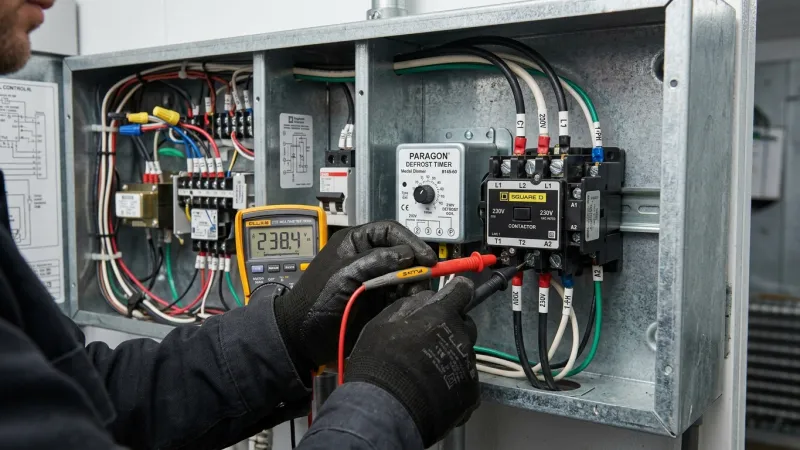
Figure 4: True-RMS multimeter telemetry testing of terminal block 1-3 on an 8145-20 defrost timer and bimetal switch assembly, Roswell, GA.
Critical True T-49 OEM Components & Technical Specifications
Precision repairs on True commercial equipment require authentic factory OEM components manufactured to exact electrical, thermodynamic, and mechanical tolerances. Generic aftermarket components frequently feature incorrect bimetal temperature curves or mismatched motor shaft depths that cause premature secondary breakdowns. Commercial kitchens maintain smooth operations through preventative parts management across refrigeration, cooking, and commercial ice machine repair equipment.
| OEM Component | True OEM Part # | Engineering Specifications | Operational Role |
|---|---|---|---|
| Commercial Defrost Timer | True #801808 (Paragon 8145-20) | 120V, 60Hz, 40A, Heavy Duty SPDT/DPDT | Initiates 4–6 hour defrost off-cycles / electric termination cycles. |
| Defrost Termination Bimetal | True #800318 (Klixon Series) | Close @ 20°F / Open @ 45°F, Hermetic Clip-On | Interrupts defrost heater circuit when coil fins reach 45°F. |
| Evaporator Fan Motor (ECM) | True #800403 / #932483 | 115V, 9W, 1,550 RPM, High-Efficiency ECM | Circulates continuous high-velocity convective airflow through fins. |
| Calrod Defrost Heater | True #801115 | 115V, 550W, Incoloy Sheath Element | Radiates direct heat along the base and fin pack during defrost. |
| Magnetic Door Gasket | True #810810 (25-1/8″ × 54-1/4″) | Heavy Vinyl Profile, Barium Ferrite Magnet | Hermetically seals stainless steel door perimeter against moisture. |
Comprehensive Commercial Preventative Maintenance Protocols
The relentless heat and airborne grease of a commercial restaurant kitchen environment impose severe strain on refrigeration condensing and evaporating coils. Implementing a rigorous preventative maintenance protocol is the most reliable strategy to prevent evaporator coil freezing and eliminate unexpected downtime during peak culinary service. Restaurant facilities operating in appliance repair Milton GA service territories benefit immensely from strict adherence to monthly and quarterly refrigeration maintenance checklists.
The foundational monthly task is thoroughly cleaning the bottom-mounted condenser coil pack. A fouled condenser cannot dissipate heat absorbed by the evaporator, forcing compressor head pressures to elevate dangerously. This thermal stress causes the capillary tube or TXV to feed liquid refrigerant inefficiently, which frequently initiates localized coil icing. Use an industrial HEPA coil vacuum paired with a soft-bristle nylon condenser brush to sweep dust, pet hair, and airborne grease in the direction of the aluminum fins. Never sweep across the fins, as soft aluminum fins will bend easily, permanently obstructing heat transfer channels.
On a quarterly schedule, facilities must flush the interior condensate drain lines. Pour a warm mixture of food-safe sanitizing solution or specialized condensate drain pan tablets down the rear evaporator drain trough. This flushes slime molds, yeast cultures, and bacterial biofilms that thrive in dark, cool drainage channels. If the drain line clogs, meltwater during the defrost cycle cannot escape into the bottom evaporation pan; instead, it backs up into the coil box, freezes into an immovable ice slab during the next refrigeration cycle, and rapidly encases the lower evaporator coils.
Commercial High-Voltage Electrical & Hydrocarbon Refrigerant Safety
Commercial refrigeration service demands uncompromising adherence to occupational safety standards. The True T-49 operates on a dedicated 115V, 20A branch electrical circuit capable of delivering lethal electrical shock during uninsulated diagnostic contact. Prior to accessing internal electrical raceways, servicing the Paragon 8145-20 timer, or touching calrod heater terminal lugs, technicians must execute full OSHA Lockout/Tagout (LOTO) protocols at the electrical breaker panel or local disconnect switch, an essential safety mandate across all appliance repair Roswell GA commercial kitchen calls.
Furthermore, modern True commercial refrigerators manufactured after 2017 are predominantly charged with R-290 (propane), a high-purity natural hydrocarbon refrigerant categorized under ASHRAE A3 flammable designations. Servicing R-290 refrigeration systems requires specialized non-sparking brushless vacuum pumps, intrinsically safe electronic recovery equipment, and continuous hydrocarbon gas leak monitors. Open flames, brazing torches, and standard non-sealed relays are strictly forbidden in proximity to open R-290 circuits; all line connections must be executed using factory-approved flame-free crimp fittings (such as ZoomLock or Lokring) to prevent ignition risks in commercial kitchens.
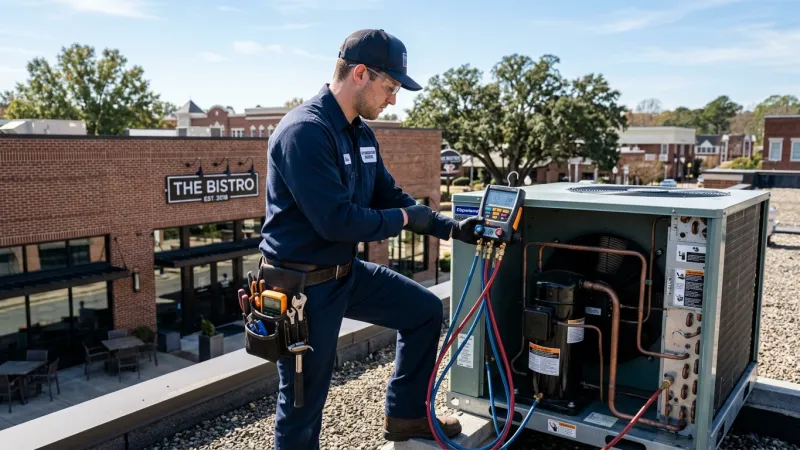
Figure 5: Master commercial refrigeration technician completing electrical calibration and gasket verification on Old Milton Parkway, Johns Creek, GA corridor.
Frequently Asked Technical Questions: True T-49 Cooling Operations
Why is my True T-49 refrigerator warm when the compressor is running continuously?
When a True T-49 compressor runs constantly but cabinet temperatures remain warm (above 41°F), the evaporator coil pack is almost certainly encased in a solid block of frost or ice. The ice acts as a thermal blanket that prevents heat absorption while physically choking convective air channels. Although the compressor is pumping refrigerant, chilled air cannot be circulated into the food storage area. This failure is most commonly triggered by an open defrost bimetal termination switch, a burned-out clock motor in the Paragon 8145-20 defrost timer, or seized evaporator fan motors.
How often should a True commercial reach-in refrigerator initiate defrost cycles?
Factory factory specifications for True reach-in refrigerators dictate that defrost cycles initiate every 6 hours (4 defrost cycles per 24-hour operating period), with each cycle lasting approximately 20 to 30 minutes, similar to timing sequences monitored in commercial walk-in freezer defrost timer coil icing maintenance. In models using off-cycle defrost, the compressor shuts off while evaporator fans run continuously to melt accumulated frost using cabinet air. In models equipped with electric defrost heaters, the calrod element energizes until the bimetal termination thermostat reaches 45°F, after which standard cooling promptly resumes.
Can I manually force a defrost cycle on a True T-49 to clear evaporator ice?
Yes. On True T-49 refrigerators utilizing an electromechanical Paragon 8145-20 defrost timer, kitchen staff can manually initiate defrost by turning the central brass or plastic advance knob clockwise with a flathead screwdriver until a distinct, heavy click is heard. This mechanically disengages terminals 2 and 4 (cooling circuit) and energizes terminal 3 (defrost circuit). However, manual advance is strictly a temporary diagnostic tool; if the timer motor coil is burned out or the bimetal switch is defective, manual advance will not fix the underlying automated cycle failure.
What are the normal multimeter resistance readings for an 8145-20 defrost timer?
When testing a genuine 120V Paragon 8145-20 defrost timer motor de-energized with leads disconnected, resistance across the motor clock terminals must measure between 1,800 and 2,400 ohms. A reading of “OL” (infinite resistance) proves the clock motor windings have burned open, freezing the timer gears permanently. When powered, voltage between terminal 1 (neutral) and terminal 3 (line) must register a steady 115 to 120 VAC.
How does the defrost termination bimetal switch operate on a True reach-in?
The bimetallic defrost termination thermostat (True OEM #800318) is a safety and cycle control switch clamped to the evaporator suction header. When the evaporator is cold (at or below 20°F), internal disc contacts remain closed (0.0 to 0.4 ohms), permitting current to energize the defrost heater or auxiliary controls. Once the defrost cycle melts the ice and the coil surface warms to 45°F, the internal disc snaps open (infinite ohms / OL), immediately shutting off the heater to protect cabinet contents from excessive heat spikes.
What suction pressure should I measure on an R-134a True T-49 during normal cooling?
On a properly charged True T-49 operating with R-134a refrigerant at steady state (box temperature between 36°F and 38°F), suction pressure measured at the low-side service port must fluctuate tightly between 18 and 22 PSI (corresponding to an evaporating saturation temperature of approximately 18°F to 24°F). Suction pressure below 14 PSI with an active compressor indicates severe evaporator airflow starvation, heavy ice buildup, or a restricted metering device.
Can damaged door gaskets cause the evaporator coil to freeze into a solid block?
Yes. In busy Alpharetta commercial restaurant kitchens, ambient kitchen humidity often exceeds 60% during summer months. If magnetic door gaskets are torn, brittle, or split, ambient moisture is drawn continuously into the cabinet by negative convective pressure. This excessive moisture load condenses on cold evaporator fins at a rate far exceeding the melting capacity of standard defrost cycles, turning the fin bundle into an impenetrable ice block within days.
Why should kitchen staff never use ice picks or knives to chip away evaporator ice?
Evaporator coils are engineered with paper-thin aluminum fins surrounding thin-walled copper or aluminum refrigerant tubing. Striking the ice with sharp metal tools inevitably punctures the refrigerant line, instantly blowing the pressurized refrigerant charge into the kitchen. This converts an economical defrost control repair into an expensive emergency sealed system rebuild requiring copper brazing, nitrogen pressure testing, deep evacuation, and new refrigerant charging.
How do electronically commutated (ECM) evaporator fan motors compare to legacy shaded-pole motors?
Modern True T-49 units utilize high-efficiency ECM evaporator fan motors (True OEM #932483) that consume up to 65% less electrical power than older shaded-pole motors. More importantly, ECM motors generate dramatically less parasitic internal motor heat inside the refrigerated cabinet, reducing the thermodynamic cooling load on the compressor. When replacing a failed motor, installing genuine factory OEM ECM replacements ensures identical torque curves and correct rotational velocity (1,550 RPM).
What happens if the evaporator condensate drain tube becomes plugged?
When the condensate drain line is blocked by fungal slime, yeast, or culinary debris, meltwater created during defrost cycles cannot drain out to the bottom pan. Instead, water pools inside the drain trough and creeps over the lower rows of the coil. When the compressor restarts, this standing pool freezes into a solid shelf of ice. With each successive defrost cycle, the ice slab grows thicker, eventually bridging the entire evaporator assembly and locking out airflow.
How does an electronic temperature controller error differ from a mechanical dial fault?
Later-generation True reach-ins utilize electronic controllers (such as LAE or Carel units) that display explicit fault codes when thermistors drift out of calibration, comparable to troubleshooting diagnostics detailed on Atosa commercial refrigerator Carel controller error P1 repair service calls. Legacy T-49 models utilize mechanical bellows thermostats that fail through internal gas loss, causing the switch to stick open (no cooling) or weld closed (continuous freezing), requiring multimeter contact continuity tests to differentiate from defrost timer faults.
What are the legal food holding temperature standards for commercial kitchens in Fulton County?
Under Georgia Department of Public Health Rules Chapter 511-6-1, all Time/Temperature Control for Safety (TCS) foods must be maintained at 41°F (5°C) or below. Any reach-in refrigerator operating above 41°F represents an imminent health violation. If food has remained above 41°F for more than 4 hours, health inspectors mandate immediate disposal of all perishable stock, making rapid emergency technician dispatch essential.
How do back bar cooler evaporator fan icing patterns compare to upright reach-in refrigerators?
Under-counter and bar equipment face severe space constraints where coils are mounted directly behind customer bottle lines, an issue frequently analyzed on Glastender commercial back bar cooler evaporator fan icing repair Alpharetta calls. Upright True T-49 reach-ins feature top-mounted ceiling plenums with larger coil face areas, meaning that ice encapsulation on a T-49 chokes a significantly larger volume of air and causes faster cabinet temperature spikes than low-profile bar coolers.
What are the safety requirements when working on R-290 hydrocarbon True refrigerators?
Servicing True units charged with R-290 (propane) requires EPA Section 608 universal certification and strict compliance with flammable refrigerant safety standards. Open-flame brazing torches must never be used while refrigerant is present in the circuit; recovery must be performed using explosion-proof hydrocarbon equipment with active workspace ventilation, and sealed tube joints must be sealed using certified press fittings.
How does a dirty condenser coil contribute to evaporator coil freezing?
When grease and dust blanket the bottom condenser coil, heat rejection is crippled, driving compressor head pressures upward. This thermodynamic imbalance causes refrigerant liquid to flash prematurely before reaching the metering device, starving portions of the evaporator coil while causing localized sub-cooling at the inlet. This uneven temperature gradient freezes passing moisture into localized ice bridges that expand across the entire fin pack.
Can a loose or drifting defrost termination bimetal cause partial coil frosting?
Yes. If the mechanical mounting clip holding the bimetal thermostat against the suction line loosens or slips, the sensor fails to register true suction tube temperature. It senses ambient cabinet air instead, snapping open prematurely before the electric heater has melted all the ice along the bottom and back coil passes. Over successive cycles, this residual ice accumulates into an immovable ice dam.
What warranty protection is provided on commercial True T-49 defrost repairs in North Fulton?
All commercial repairs performed by our factory-trained master technicians include a full 90-day comprehensive parts and labor warranty. We exclusively install genuine factory-certified True OEM components, ensuring exact manufacturer tolerances and long-term mechanical reliability across commercial kitchen facilities in appliance repair Johns Creek GA and surrounding corridors.
How fast can a commercial emergency technician reach my kitchen on Old Milton Parkway?
Because our certified commercial cold-side specialists are stationed directly throughout North Fulton County, our average emergency response window along Old Milton Parkway, Avalon, and Windward Parkway is between 45 and 90 minutes. We carry high-turnover OEM parts—including 8145-20 timers, bimetal thermostats, ECM motors, and temp controls—directly on our mobile service trucks to achieve single-visit restorations.
Regional Commercial Kitchen Services & North Fulton Corridors
Commercial Cold-Side Systems
Reach-in refrigerators, walk-in coolers, blast chillers, and prep stations.
Commercial Freezers & Ice
Walk-in freezers, cube & flake ice makers, and ice bin dispensers.
Commercial Cooking Suites
Ranges, convection ovens, fryers, steam tables, and salamanders.
Alpharetta Local Service Hub
Old Milton Parkway, Downtown Alpharetta, Avalon, and Windward.
Executive Takeaways for North Fulton Kitchen Managers
- 41°F Cold Food Holding is Legally Mandated: Internal food temperatures exceeding 41°F for more than four hours require mandatory disposal under Georgia Chapter 511-6-1.
- Solid Evaporator Frost Strangles Convective Airflow: Even with fans running at 1,550 RPM, ice bridging stops airflow and causes cabinet temperatures to spike rapidly.
- Verify Paragon 8145-20 Clock Coil Telemetry: Healthy clock coils display 1,800 to 2,400Ω across terminals 1-3; an “OL” reading confirms clock failure requiring timer replacement.
- Bimetal Switch Must Open at 45°F & Close at 20°F: Open bimetal circuits prevent calrod heaters from firing, leading to total evaporator ice encasement.
- Never Use Metal Tools to Chip Away Ice: Scraping or chipping easily punctures thin aluminum tubes, releasing pressurized refrigerant and causing thousands in damage.
- Same-Day Priority Response Protects Inventory: Call our Alpharetta dispatch line for 45–90 minute commercial technician arrival and guaranteed 90-day parts and labor warranty protection.