
Blodgett Commercial Convection Oven Blower Motor Centrifugal Switch Repair in Cumming, GA
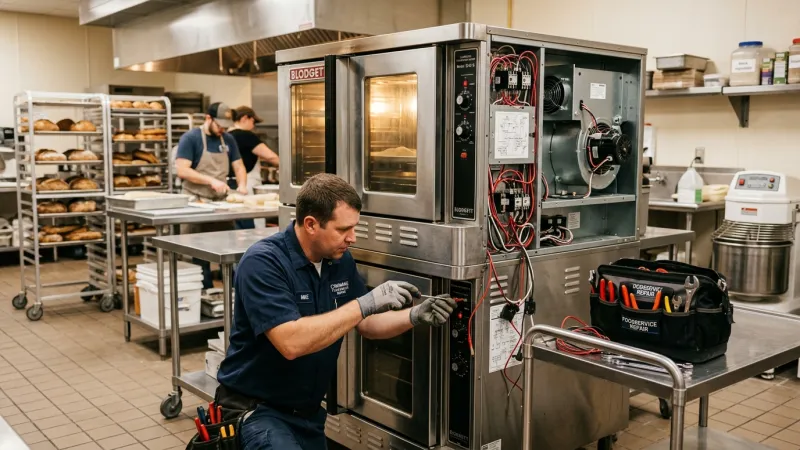
When an artisanal wholesale bakery, bagel shop, school cafeteria culinary center, or high-volume steakhouse in Cumming discovers that their blodgett convection oven blower motor repair issue has brought bread baking and roasting operations to a dead halt, kitchen productivity collapses immediately. Blodgett commercial convection ovens—including the legendary DFG-100 gas, DFG-200 double-depth, Zephaire series, and Mark V electric models—rely on a heavy-duty two-speed 1/2-horsepower blower motor to force superheated laminar airflow across stainless baking pans. What many kitchen managers do not realize is that the blower motor incorporates an internal centrifugal switch that acts as a vital safety interlock: if this switch fails to close, the gas burner valve or electric heating contactor is physically locked out, leaving the oven running cold. Explore our specialized commercial oven repair capabilities engineered to keep Cumming bakeries and restaurants firing at peak capacity. For priority emergency technician dispatch to your Cumming kitchen, contact our master commercial service line at (770) 796-7742.
Quick Answer: Why Does a Blodgett Convection Oven Blower Fail or Not Heat?
A Blodgett commercial convection oven blower motor fails to start or prevents the oven from heating primarily due to pitted or carbonized contacts on the internal centrifugal switch, a failed motor run capacitor, or seized sleeve bearings. The centrifugal switch must disengage the start winding at 75% speed while simultaneously closing an auxiliary safety circuit that permits the gas valve or heating elements to energize. If contacts are insulated by flour dust or arcing, heat is locked out.
Listen to 60-Second Commercial Convection Diagnostic Summary
Narrated by Master Cooking Equipment Specialist Craig B.
Check Same-Day Commercial Tech Availability in Your Cumming Kitchen
Recently Serviced on Market Place Blvd, Cumming
Blodgett DFG-100 Double-Stack Convection Oven • Replaced Burnt Centrifugal Switch & Rebalanced Squirrel Cage Blower • 100% Morning Bakery Production Saved ★★★★★
Table of Contents: Blodgett Commercial Convection Oven Diagnostic Manual
- 1. Forced-Air Aerodynamics & Centrifugal Switch Interlock Engineering
- 2. Operational Symptoms of Blower Motor & Switch Failure
- 3. Visual Before & After Restoration Showcase
- 4. Common Causes: Why Convection Blower Motors Fail in Commercial Kitchens
- 5. Safe Kitchen Shift Troubleshooting Protocols for Bakers & Chefs
- 6. When to Stop DIY: 240V/480V Electric Shock, Gas Pooling & Mechanical Pinch Points
- 7. Commercial Decision Matrix: Repairing vs. Replacing Commercial Convection Ovens
- 8. Interactive Commercial Convection Oven Repair Cost Estimator
- 9. Factors Influencing Commercial Oven Repair Invoices in Cumming
- 10. Technical Multimeter Testing: Centrifugal Switch, Windings & Interlocks
- 11. Genuine OEM Blodgett Replacement Parts Catalog
- 12. Daily, Weekly & Monthly Commercial Convection Oven Preventive Maintenance
- 13. NFPA 96 Commercial Cooking Exhaust & ANSI Z83.11 Compliance
- 14. Advanced Motor Torque Curves, Speed Selection & Gas Valve Interlocks
- 15. Step-by-Step Professional Blower Motor & Switch Replacement Protocol
- 16. Frequently Asked Questions (Master Cooking Tech Accordion)
- 17. Commercial Kitchen Appliance Service Resources & Internal Links
- 18. Commercial Key Takeaways
- 19. Priority Commercial Dispatch Call to Action
1. Forced-Air Aerodynamics & Centrifugal Switch Interlock Engineering
Commercial forced-air convection baking transformed high-volume foodservice by stripping away the insulating boundary layer of cold air that naturally envelops sheet pans in static radiant ovens. In a Blodgett commercial convection oven, heat transfer rates are increased by more than 30%, dropping baking temperatures by 50°F and reducing cook times by a quarter. This entire thermodynamic process depends on a precision-balanced, heavy-duty squirrel cage blower wheel driven by a specialized dual-speed (1725 RPM high / 1140 RPM low) commercial electric motor. Review our primary oven and range repair services for complete residential and commercial cooking equipment maintenance across North Fulton and Forsyth counties.
Because commercial convection ovens generate immense thermal energy—up to 55,000 BTUs on natural gas models like the DFG-100 or 12.5 kilowatts on electric Mark V units—operating the heating elements or gas burners without active forced airflow would cause catastrophic thermal destruction within minutes. Without continuous air circulation, heat pools at the top of the cavity, warping the heavy 14-gauge porcelain interior liner, melting door gaskets, and popping the high-limit safety thermostat. To prevent this hazard, Blodgett engineers incorporated an electro-mechanical safety interlock directly inside the blower motor: the centrifugal switch. For companion cooking line maintenance, explore our dedicated commercial cooktop and stove repair solutions.
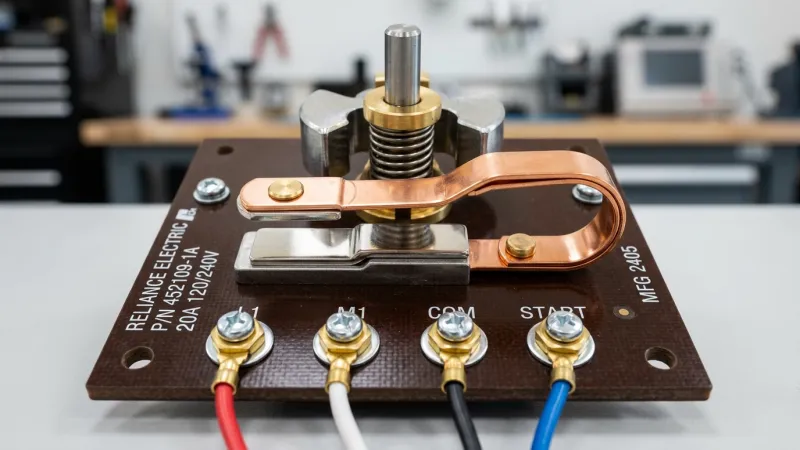
The centrifugal switch is a spring-loaded mechanical mechanism mounted to the rear rotor shaft inside the motor housing. It serves two distinct and critical electrical functions: First, on single-phase split-phase or capacitor-start motors, it connects the high-torque auxiliary start winding during initial startup. As the motor accelerates to approximately 75% of its rated operating speed, centrifugal force causes counterweights on the spinning shaft to overcome spring tension, snapping the start switch contacts open to take the start winding out of the circuit before it overheats. For facilities operating high-end institutional culinary equipment, discover our specialized built-in commercial oven service.
Second, and most importantly for troubleshooting cold ovens, the centrifugal switch mechanism incorporates an isolated set of auxiliary normally-open (N.O.) electrical contacts. When the motor reaches operating speed and the weights swing outward, this auxiliary contact snaps closed. This closed circuit completes the 24V or 115V control loop running to the Fenwal ignition control module on gas ovens, or to the heavy magnetic contactor coils on electric ovens. If the blower motor fails to start, runs too slowly, or if its internal centrifugal switch contacts become carbonized and pitted from electrical arcing, the safety circuit remains open. The motor may spin, but the gas valve never opens, spark ignition never initiates, and the oven runs completely cold.
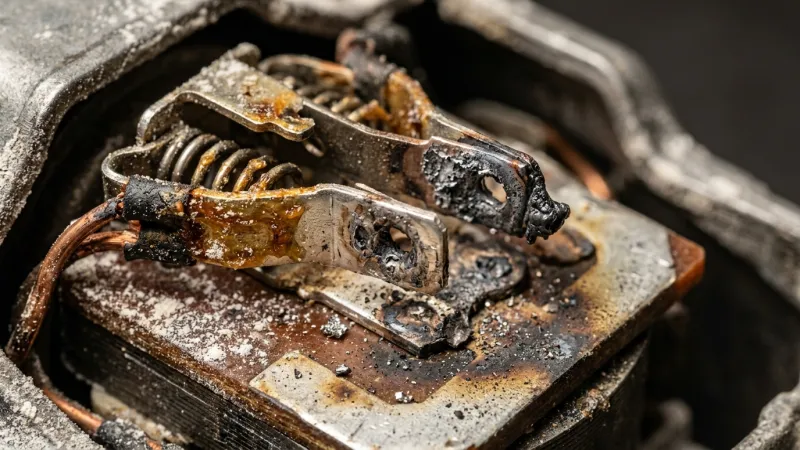
In commercial bakery environments across Cumming, airborne flour, powdered sugar, and aerosolized pan release shortening are constantly suspended in kitchen air. The rear-mounted convection blower motor pulls ambient air across its external housing to cool its internal windings. Over years of service, fine flour dust enters the motor through cooling louvers, settling directly onto the centrifugal switch contact points. Combined with grease vapors, this flour forms an insulating gummy residue. When the electrical switch opens and closes, micro-arcing bakes this residue into hard carbon scale, creating a high-resistance barrier that prevents the interlock circuit from conducting electricity even when the motor is running at full 1725 RPM speed.
Furthermore, commercial kitchen cooks frequently utilize the oven’s “COOL DOWN” switch mode at the end of baking shifts. In cool-down mode, the blower motor runs at maximum speed while the oven doors are cracked open to evacuate heat into kitchen exhaust hoods. If kitchen staff slam the heavy glass doors while the blower wheel is spinning at 1725 RPM, gyroscopic forces deflect the motor shaft. Over time, this causes excessive radial play in the bronze sleeve bearings, resulting in severe motor vibration that misaligns the centrifugal switch actuator arm and causes intermittent burner shutdowns.
2. Operational Symptoms of Blower Motor & Switch Failure
Recognizing the physical and electrical symptoms of a deteriorating Blodgett convection oven blower motor prevents costly midday baking cancellations. Kitchen personnel should monitor for these distinct failure indicators:
- Blower Motor Spins, but Oven Refuses to Heat: The fan wheel rotates normally on both high and low speeds, and the power light is illuminated, but the gas burner never sparks or electric elements stay stone cold. This classic symptom indicates that the centrifugal switch auxiliary interlock contacts have failed open.
- Loud Humming or Buzzing Without Motor Rotation: When the blower switch is flipped to ON, the motor emits a loud, deep 60-cycle electrical hum without spinning the squirrel cage wheel. The internal start winding is not engaging (due to a dirty centrifugal switch start contact) or the motor run capacitor has failed.
- Circuit Breaker Trips Immediately Upon Blower Startup: Flipping the oven master power switch instantly trips the commercial branch circuit breaker in the kitchen electrical panel, indicating shorted stator windings or a motor seized by hardened flour and bearing galling.
- Motor Operates on Low Speed, but Stalls on High Speed: The dual-speed winding switch fails to transition properly, causing the motor to shudder, drop RPMs, or overheat and trip its internal thermal overload protector during high-speed convection cycles.
- High-Pitched Squealing or Screeching Noise: As the oven heats up to 350°F, a loud metallic screech echoes from the rear of the unit. This points to dry, unlubricated sleeve bearings or a squirrel cage blower wheel rubbing against the rear interior baffle plate.
- Uneven Baking & Scorched Product on Front Racks: Cookies, biscuits, or roasted meats on the front half of sheet pans emerge raw while rear pans scorch, indicating that the blower wheel has loosened on its flat D-shaft, spinning freely without moving air.
- Electrical Burning Odor Emanating from Control Compartment: A pungent burnt-varnish smell fills the kitchen, caused by overheating stator coil enamel insulation when the motor struggles against seized bearings.
Commercial bakeries operating companion commercial fryers can also access our specialized service for Frymaster commercial fryer pilot flame and thermopile repair across neighboring kitchen facilities.
Another subtle diagnostic symptom is “chattering contactor noise.” In electric Blodgett ovens (Mark V series), an erratic centrifugal switch will cause the main 3-pole 50-amp heating contactors to rapidly cycle on and off with a machine-gun clicking sound. This rapid contactor chattering creates massive electrical arcing across the main contacts, destroying the contactor points and generating power surges that can damage electronic digital cook-and-hold timer boards.
In gas models equipped with Fenwal micro-processor ignition modules, an open centrifugal switch produces an immediate “air flow lockout” fault. The ignition control module senses the missing centrifugal switch continuity signal and enters a 1-hour diagnostic lockout, ignoring all thermostat calls for heat until the master power switch is completely reset.
4. Common Causes: Why Convection Blower Motors Fail in Commercial Kitchens
A detailed root-cause engineering audit across commercial cooking facilities in Cumming identifies six primary failure mechanisms that destroy convection oven blower motors and centrifugal switches:
1. Airborne Flour & Grease Infiltration into the Switch Housing
Commercial bakeries and pizza kitchens generate dense airborne starch particulate. The motor cooling fan draws this flour-laden air directly across the internal rotor assembly. When flour settles onto the silver contact points of the centrifugal switch, electrical sparks during contact make-and-break cycles caramelize the starch into an electrically non-conductive carbon coating. Eventually, the switch contacts can no longer conduct the low-voltage ignition interlock signal, preventing burner firing. For premium commercial ranges experiencing burner issues, consult our Vulcan commercial cooking appliance repair specialists.
In kitchens that roast meats or poultry in convection ovens, aerosolized animal grease and cooking oil mist also bypass the motor’s dust baffles. The grease coats the centrifugal counterweight pivot pins and return springs. The sticky grease attracts lint and flour, eventually gumming up the mechanical counterweights so they cannot slide along the shaft. The switch becomes mechanically stuck in either the open or closed position, preventing proper motor speed transition and burning out the start winding within seconds.
2. Sleeve Bearing Lubricant Carbonization & Shaft Galling
Blodgett commercial convection oven blower motors feature extended stainless steel shafts that penetrate directly through the oven insulation into the 500°F cooking cavity. High radiant heat conducts backward down the steel shaft into the motor’s front bronze sleeve bearing. Blodgett motors utilize oil-wicking reservoirs surrounding the porous bronze bushing. If regular annual re-oiling with high-temperature non-gumming SAE 20 turbine oil is neglected, the lubricating oil bakes into hard sludge. The dry shaft galling creates extreme friction, slowing motor RPMs until the centrifugal switch drops out. Review our heavy-duty cooking maintenance resources on Garland commercial range and oven service.
3. Out-of-Balance Squirrel Cage Blower Wheel Vibration
The forward-curved squirrel cage blower wheel inside the oven cavity accumulates heavy layers of baked-on grease, carbonized sugar, and food debris on its individual curved vanes. This accumulation is rarely uniform. An uneven 2-ounce grease cake on one side of the 10-inch wheel spinning at 1725 RPM produces violent centrifugal vibration. This continuous shaking fractures internal motor terminal welds, cracks the phenolic centrifugal switch mounting board, and prematurely destroys motor bearings.
4. Door Interlock Microswitch Chattering & Voltage Spikes
Every Blodgett convection oven features a heavy-duty door interlock microswitch located behind the lower front door hinge. Opening the door instantly cuts power to the blower motor to protect cooks from high-velocity 450°F air blasts. During busy restaurant services, kitchen line cooks violently open and close the oven doors dozens of times per hour. A misaligned or loose door switch chatters, rapidly cutting and restoring 115V or 208V power to the motor in fractions of a second. These rapid inductive voltage spikes generate intense electrical arcing across the centrifugal switch contacts, burning away the silver plating.
5. Defective Motor Run / Start Capacitor Breakdown
Single-phase Blodgett blower motors utilize an oil-filled motor capacitor (typically 15µF or 25µF, 370VAC) mounted inside the side control compartment. Operating in high ambient temperatures exceeding 140°F inside the control cabinet, the capacitor’s internal dielectric fluid breaks down over 3 to 5 years. As capacitance degrades below acceptable limits, the motor loses phase-shift starting torque. The motor sits in a stalled condition humming loudly, drawing 20+ amps until the thermal overload switch trips. If cold-side prep equipment also experiences electrical issues, check our guide on Atosa commercial refrigerator Carel controller repair in Alpharetta, GA.
6. Solid-State Speed Control Relay or Switch Contact Failure
The front control panel features a 2-speed rocker switch (HIGH / LOW). The switch routes power through different internal motor winding taps to toggle between 1725 RPM and 1140 RPM. Over thousands of mechanical cycles, the internal copper contacts within the rocker switch develop high contact resistance. This causes significant voltage drop, starving the motor windings of operating voltage and preventing the motor from reaching the centrifugal switch trip threshold.
5. Safe Kitchen Shift Troubleshooting Protocols for Bakers & Chefs
Before submitting an emergency service request, culinary shift managers and lead bakers in Cumming can perform these safe, non-invasive diagnostic triage checks:
Step 1: Test the Motor in “COOL DOWN” Mode
Turn the main oven control switch from OVEN ON to the COOL DOWN position with the doors fully closed. In cool-down mode, the thermostat and gas ignition circuitry are completely bypassed, sending direct line voltage to the blower motor. If the blower spins vigorously in cool-down mode but refuses to run in cook mode, the blower motor itself is electrically sound, pointing to a failed door microswitch or defective main rocker switch.
Step 2: Inspect Door Latch & Microswitch Actuation
Open the double doors. Inspect the bottom left hinge pin that contacts the door microswitch actuator arm. Close the doors firmly: do you hear a distinct, crisp mechanical “click” just before the door latch engages? If the doors are sagging or the strike catch is worn, the switch may not be fully depressing, cutting power to the motor and locking out heat.
Step 3: Manually Spin the Blower Wheel (With Power OFF)
MANDATORY: Turn OFF the commercial circuit breaker before reaching inside the oven. With the oven cold, reach into the rear center of the cooking cavity through the stainless baffle slots. Gently spin the squirrel cage wheel by hand. The wheel should rotate smoothly and coast freely for 3 to 5 revolutions. If the wheel feels stiff, gritty, or seized, the motor sleeve bearings have run dry or are choked with baked grease.
Step 4: Check for Motor Thermal Overload Reset
Some commercial Blodgett motors feature a small red manual-reset thermal overload button located on the rear bell housing of the motor (accessible from the rear of the oven cabinet). If the motor overheated, this button will pop out. Allow the motor to cool for 30 minutes, then press the red button firmly until it clicks. If it resets and trips again immediately upon starting, internal windings are shorted.
Step 5: Toggle Between High and Low Blower Speeds
With the oven powered on, switch the blower speed selector switch between HIGH and LOW. If the motor runs smoothly on LOW speed (1140 RPM) but hums and refuses to start on HIGH speed (1725 RPM), the high-speed winding tap is open, or the high-speed centrifugal switch contact is burnt out.
6. When to Stop DIY: 240V/480V Electric Shock, Gas Pooling & Mechanical Pinch Points
Critical Commercial Cooking Safety Directives
Commercial convection ovens operate under high electrical voltage, high gas pressure, and high-velocity rotating machinery that present extreme life-safety hazards. Kitchen staff must halt DIY troubleshooting immediately when encountering:
- Lethal 208V / 240V / 480V 3-Phase Electric Shock: The internal control compartment of commercial Blodgett ovens contains exposed electrical terminal strips, magnetic contactor lugs, and motor capacitors carrying lethal voltages. Never remove side control access panels while the oven is connected to building power.
- Raw Gas Odors & Delayed Burner Ignition: If you smell raw natural gas or propane, do not flip electrical switches or attempt to re-ignite the oven. Raw gas pooling in the baking cavity can explode violently upon contacting a spark or glowing igniter, blowing open the glass doors and inflicting severe burns.
- High-Speed Mechanical Amputation & Pinch Points: Never reach into the rear of the baking cavity or touch the squirrel cage blower wheel while power is applied to the oven. A 10-inch steel wheel spinning at 1725 RPM generates severe amputation and crushing forces.
- Bypassing the Centrifugal Switch Interlock: Never install electrical jumper wires across the centrifugal switch terminals to force the gas valve or heating elements to energize without the blower running. Firing a commercial convection oven without forced air will overheat the chamber to 900°F within minutes, triggering catastrophic building fires.
7. Commercial Decision Matrix: Repairing vs. Replacing Commercial Convection Ovens
A new commercial double-stacked Blodgett convection oven represents an investment ranging from $8,500 to $18,000+ depending on gas vs. electric utility, depth (standard vs. bakery depth), and programmable touch-screen digital controls. Deciding whether to repair a blower motor / centrifugal switch failure or replace the oven requires evaluating cabinet insulation, door structural alignment, and heat exchanger condition:
| Assessment Factor | Repair Recommended (Maintain Asset) | Replace Recommended (Capital Upgrade) |
|---|---|---|
| Root Failure Mode | Burnt centrifugal switch, failed motor capacitor, or worn motor bearings. | Cracked heat exchanger combustion tubes, rotted porcelain liner, twisted chassis. |
| Equipment Age | Under 10–12 years old with solid commercial baking performance. | Over 18–25 years old with obsolete wiring harnesses and structural door sag. |
| Estimated Repair Cost | Less than 15% to 20% of new replacement cost ($220 – $580 range). | Exceeds 45% of replacement cost (multiple motor, gas valve, and liner failures). |
| Thermal Recovery & Bake Evenness | Bakes evenly across all 5 rack positions once blower airflow is restored. | Suffers from chronic cold spots and air leakage despite new door gaskets. |
In more than 90% of Blodgett convection oven blower motor service calls in Cumming and Forsyth County, replacing the centrifugal switch, motor start capacitor, or complete OEM blower motor assembly fully restores factory baking performance, extending asset life by 5 to 10 additional years. For advanced commercial combi-steamer repairs, explore our specialized coverage for Rational iCombi Pro error code 20 steam generator descaling in Johns Creek, GA.
;
9. Factors Influencing Commercial Oven Repair Invoices in Cumming
Commercial convection oven repairs in Cumming reflect the rigorous standards of commercial gas and high-voltage electrical equipment. Major pricing components include:
- Commercial Diagnostic Trip & Airflow Telemetry: Professional onsite trip, full electrical motor winding analysis, capacitor microfarad testing, and safety interlock verification ($110–$180), credited toward completed repairs.
- Part Component Specifics: A genuine OEM centrifugal switch assembly or motor run capacitor is a budget-friendly repair ($75–$145 part cost), whereas an entire factory OEM Baldor/Reliance 1/2 HP 2-speed high-temperature blower motor represents a larger investment ($340–$550 part cost).
- Single vs. Double-Stacked Configuration: Lower ovens on double-stacked units require low-profile extraction tools and extra labor time to access the rear mechanical bay compared to top units at eye level.
- Early Morning Bakery Emergency Dispatch: Emergency service calls dispatched at 3:00 AM or 4:00 AM to rescue early morning bagel and bread production carry modest emergency labor rates to deploy master technicians before dawn.
- Combustion & Carbon Monoxide Certification: Following motor replacement on gas Blodgett units, technicians conduct digital flue gas analysis to certify zero carbon monoxide leakage and proper flame stoichiometry.
For commercial foodservice operators requiring urgent hot-line repairs, learn more about our 24-hour emergency commercial appliance repair protocols across Forsyth and North Fulton counties.
10. Technical Multimeter Testing: Centrifugal Switch, Windings & Interlocks
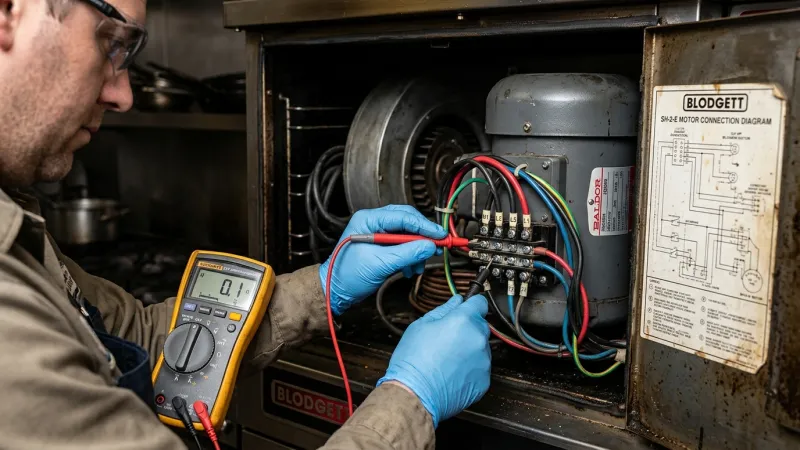
Certified commercial cooking technicians follow rigorous quantitative electrical testing to pinpoint blower motor and centrifugal switch faults. Use the interactive filter below to search component diagnostic parameters:
| Component / Test | Multimeter Setting | Factory Spec | Failure Threshold | Corrective Field Action |
|---|---|---|---|---|
| Centrifugal Switch (At Rest) | Continuity (Start Winding) | 0.0 Ω – 0.2 Ω (Closed) | ∞ (Open Circuit) | Clean contacts or replace centrifugal switch #16535. |
| Centrifugal Interlock (Running >75%) | Continuity (Burner Circuit) | 0.0 Ω – 0.2 Ω (Closed) | > 1.5 Ω (High Resistance) | Contacts pitted; replace switch assembly. |
| Main Run Winding (High Speed) | Resistance (Ohms) | 1.8 Ω – 3.2 Ω | ∞ (Open) or < 0.8 Ω | Stator shorted; replace blower motor #32244. |
| Low Speed Winding Tap | Resistance (Ohms) | 3.5 Ω – 5.8 Ω | ∞ or Shorted to Ground | Replace motor or check speed selector switch. |
| Motor Run Capacitor (25µF) | Capacitance (µF) | 23.7 µF – 26.3 µF | < 21.0 µF or Leaking | Replace 25µF 370VAC motor capacitor #18225. |
| Door Interlock Microswitch | Continuity (Doors Latched) | 0.0 Ω – 0.1 Ω (Closed) | ∞ (Open Circuit) | Align door hinge or replace microswitch #36444. |
| Full Load Amperage (High Speed) | AC Clamp Meter (115V Running) | 6.8 A – 8.4 A | > 11.0 A (Overloaded) | Check for seized bearings or drag on blower wheel. |
| Winding Insulation to Ground | 500V Megohmmeter (Megger) | > 100 MΩ (Megohms) | < 5.0 MΩ (Ground Fault) | Motor shorted to frame; replace motor immediately. |
11. Genuine OEM Blodgett Replacement Parts Catalog
Installing cheap universal HVAC furnace blower motors in a Blodgett commercial convection oven is a critical mistake. Commercial oven motors feature specialized high-temperature Class H insulation, extended stainless steel heat-dissipating drive shafts, and high-thrust sleeve bearings engineered for 500°F continuous duty:
1/2 HP 2-Speed Blower Motor (115V)
OEM Part #: 32244 / 53457
Heavy-duty Baldor/Reliance 1725/1140 RPM dual-speed split-phase motor with extended 1/2″ D-shaft and internal centrifugal switch.
OEM Centrifugal Switch Assembly
OEM Part #: 16535 (Reliance / Baldor Kit)
Complete spring-loaded centrifugal start switch and burner interlock contact board with heavy-gauge silver-alloy contact pads.
Blower Motor Run Capacitor (25µF 370VAC)
OEM Part #: 18225 (Oval Metal Casing)
Oil-filled high-temperature AC motor capacitor maintaining motor phase displacement and running efficiency under full heat load.
Door Interlock Safety Microswitch
OEM Part #: 36444 / 16534
Heavy-duty 15A roller lever microswitch actuated by lower door hinge to instantly cut blower power upon door opening.
Squirrel Cage Blower Wheel (10-3/4″ Diameter)
OEM Part #: 16646 (Forward-Curved Steel)
Dynamic factory-balanced forward-curved multiblade impeller wheel with dual set-screw mounting hub for 1/2″ shaft.
Fenwal Spark Ignition Control Module
OEM Part #: 20348 / 34480
Direct spark ignition module receiving the centrifugal switch interlock signal to govern 24VAC combination gas valve operation.
12. Daily, Weekly & Monthly Commercial Convection Oven Preventive Maintenance
Preventing unexpected blower motor freeze-ups and centrifugal switch failure requires institutionalized maintenance routines across commercial baking and roasting lines:
Daily Shift Protocols:
- End-of-Shift Cool Down Protocol: At closing, turn the switch to COOL DOWN with doors slightly ajar for 15 minutes before shutting off the master power. Never turn an oven off hot; residual 450°F heat bakes into the motor bearings.
- Blower Wheel Visual Inspection: Check the rear interior baffle for loose baking paper, foil, or utensils that could be sucked into the spinning blower wheel.
- Door Latch Cleaning: Wipe down the door catch and microswitch lever arm to prevent grease buildup that impedes smooth switch actuation.
Weekly Deep Cleaning:
Every week, remove the interior rack guides and unscrew the four thumb screws holding the rear porcelain baffle panel. Inspect the squirrel cage blower wheel. Use a brass-wire brush and commercial degreaser to scrub baked grease and carbon off the curved blades. An unbalanced wheel will destroy motor bearings within months.
Quarterly / Semi-Annual Engineering Maintenance:
- Motor Sleeve Bearing Lubrication: Apply 10 to 15 drops of high-temperature non-detergent SAE 20 electric motor oil into the front and rear oil ports on the motor bell housing. Never use spray penetrating oils (like WD-40) which wash away factory grease.
- Centrifugal Switch Dust Purge: Use clean, dry compressed air (30 PSI) to blow accumulated bakery flour and dust out of the rear motor housing louvers and switch contacts.
- Door Seal & Microswitch Calibration: Verify that the door microswitch disengages within 1 inch of door opening travel, preventing hot air blasts into staff faces.
13. NFPA 96 Commercial Cooking Exhaust & ANSI Z83.11 Compliance
Commercial convection ovens operating in Cumming and Forsyth County must comply with NFPA 96 ventilation mandates and ANSI Z83.11 commercial gas standards:
Mandatory Commercial Convection Oven Safety Standards
- Type I or Type II Commercial Ventilation Hood Canopy: Under NFPA 96, commercial gas convection ovens must be installed under a dedicated commercial exhaust hood providing minimum 6-inch overhang beyond oven sides and adequate draft to evacuate combustion products and grease vapors.
- Combustion Air Interlock Verification: If the commercial hood exhaust system shuts down, an automatic gas shutoff valve must terminate gas delivery to the convection oven cookline to prevent lethal carbon monoxide accumulation.
- ANSI Z83.11 Safety Interlock Integrity: The blower motor centrifugal switch is an ANSI-mandated life-safety interlock. Modifying, bypassing, or jumpering this switch voids factory certification, creates catastrophic fire hazards, and exposes restaurant operators to severe civil and insurance liability.
- Caster Restraining Cables: Ovens installed on rolling casters must have a certified stainless steel restraining cable anchored to building wall studs that is shorter than the flexible gas connector to prevent pipe rupture when moving ovens for cleaning.
14. Advanced Motor Torque Curves, Speed Selection & Gas Valve Interlocks
To master convection oven troubleshooting, one must understand the electrical schematic architecture governing Blodgett DFG and Zephaire commercial models. The control circuit utilizes a 115V primary circuit powering the blower motor and an isolated 24VAC step-down transformer circuit powering the gas ignition train:
The 2-Speed Motor Winding Circuit: The Baldor/Reliance 1/2 HP motor contains two separate stator run windings. When the operator selects HIGH speed on the front panel, 115VAC is applied across terminal M1 and COM, producing 1725 RPM for heavy sheet-pan roasting and standard baking. When LOW speed is selected, voltage routes through terminal M2, engaging a higher-pole winding that drops rotor speed to 1140 RPM. Low speed is critical for delicate bakery goods (such as meringues, soufflés, and light sponge cakes) where high-velocity air would ripple batter or blow parchment paper off sheet pans.
The Centrifugal Interlock Loop: Terminals 1 and 2 on the motor terminal board connect directly to the internal centrifugal switch auxiliary contact. This contact is wired in series with the 24VAC transformer secondary leg, the solid-state thermostat relay contacts, and terminal TH on the Fenwal DSI ignition module. Only after the motor attains 75% speed does this contact snap shut, allowing 24VAC to energize the Fenwal module. The Fenwal module then initiates its 15-second pre-purge, opens the dual solenoid combination gas valve (3.5″ W.C. natural gas), and sparks the pilot/burner igniter electrode.
If motor bearings develop high drag or the blower wheel rubs against the baffle, the motor may only spin at 1100 RPM when commanded to HIGH speed. Because 1100 RPM is insufficient to generate the centrifugal force required to swing the governor weights, the switch contacts never close. The motor runs continuously while the oven remains ice cold, presenting a classic diagnostic puzzle that leads inexperienced cooks to mistakenly replace the thermostat or gas valve when the centrifugal switch was simply failing to close.
15. Step-by-Step Professional Blower Motor & Switch Replacement Protocol
Replacing a Blodgett commercial convection oven blower motor or rebuilding its centrifugal switch assembly requires precision mechanical alignment and strict adherence to commercial gas and electrical safety standards:
Phase 1: Complete High-Voltage Lockout / Tagout
The technician disconnects the heavy-duty commercial power supply at the wall disconnect switch and shuts off the manual gas ball valve on the flexible gas drop. OSHA-compliant lockout/tagout locks and warning tags are installed.
Phase 2: Interior Blower Wheel Extraction
Inside the cold baking cavity, the technician removes rack guides and unbolts the rear porcelain baffle panel. Using a 5/32-inch Allen hex key with high-temperature anti-seize penetrant, the technician loosens the two square-head set screws securing the blower wheel hub to the flat D-shaft. A specialized commercial wheel puller tool extracts the blower wheel without bending the curved aluminum blades.
Phase 3: Rear Motor Extraction & Bench Disassembly
From the rear of the oven cabinet, the technician disconnects the motor wiring harness (terminals L1, M1, M2, COM, and the two centrifugal switch leads). The four heavy motor cradle mounting bolts are removed, and the 28-pound Baldor motor is extracted to a clean mobile service workbench. The rear bell housing is unbolted to access the centrifugal switch assembly.
Phase 4: OEM Centrifugal Switch Installation & Air Gap Calibration
The burnt switch board is removed. The technician inspects the rotating governor weights on the shaft, cleaning away gummed grease with electrical contact solvent. A brand-new OEM Blodgett centrifugal switch kit (#16535) is installed. Using precision feeler gauges, the contact air gap is set to exact factory specification (0.025 inches at rest). The switch is manually exercised to verify crisp, spring-loaded snap action.
Phase 5: Reassembly, Wheel Clearance & Dynamic Live Testing
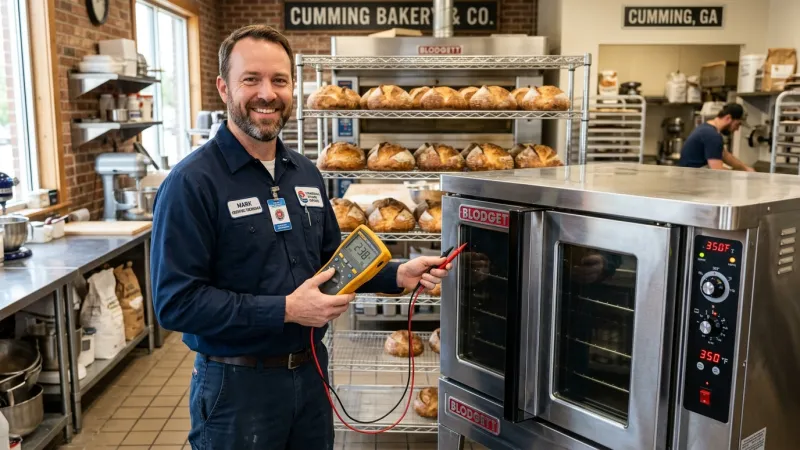
The motor is reinstalled into the rubber vibration-isolation cradle. The blower wheel is re-installed onto the shaft, carefully setting the critical 3/16-inch clearance gap between the wheel backplate and the interior chassis sheet metal to prevent friction rubbing when the oven expands at 450°F. Power and gas are restored: the technician tests both HIGH and LOW speeds, verifies instant 0.1-ohm centrifugal switch closure, and confirms immediate smooth burner ignition. Full load amperage (FLA) is verified on an AC clamp meter at 7.4 amps.
16. Frequently Asked Questions (Master Cooking Tech Accordions)
Below are 16 in-depth technical answers addressing the most critical operational and engineering questions encountered by Cumming commercial bakery owners, executive chefs, and foodservice operators regarding Blodgett convection ovens:
1. Why is my Blodgett commercial convection oven blower motor running, but the oven won’t heat?
This classic condition is caused by a failed internal centrifugal switch interlock contact. In Blodgett commercial convection ovens, the 24VAC gas ignition module or 208V/240V electric heating element contactors are wired in series through the blower motor’s internal centrifugal switch. This design ensures that the oven cannot fire heating elements or burners unless the blower is actively spinning to circulate heat. If the centrifugal switch contacts are burnt, oxidized by electrical arcing, or insulated by bakery flour dust, the electrical interlock remains open. The fan will spin, but the heating system remains locked out completely.
2. Why does my Blodgett convection oven blower hum loudly but fail to spin?
A loud 60-cycle electrical hum without motor shaft rotation occurs when: (1) The internal centrifugal start switch contacts are dirty or stuck open, preventing electrical current from energizing the high-torque auxiliary start winding; (2) The motor run capacitor (typically 15µF to 25µF) has failed open or lost capacitance; or (3) The motor’s bronze sleeve bearings have seized from dried, carbonized oil. If you hear this hum, shut off the power immediately; leaving a stalled motor energized will overheat the stator windings and cause irreversible burnout within 30 to 60 seconds.
3. What is the difference between a Blodgett DFG-100 and a DFG-200 convection oven?
The primary engineering difference is cabinet depth and pan loading orientation. The Blodgett DFG-100 is a standard-depth commercial convection oven where 18″ x 26″ commercial sheet pans are loaded left-to-right. The DFG-200 is a deep-depth (bakery depth) oven featuring an extra 4 inches of interior depth, allowing sheet pans to be loaded front-to-back or side-to-side. Because the DFG-200 has a larger interior volume, it requires a longer motor drive shaft and a specialized high-CFM squirrel cage blower wheel to ensure uniform heat circulation across all 5 rack positions.
4. Is it safe to bypass the blower motor centrifugal switch with a jumper wire?
ABSOLUTELY NEVER BYPASS THIS SWITCH. Jumpering the centrifugal switch interlock is an extreme fire hazard and a severe violation of ANSI Z83.11 and NFPA 96 life-safety standards. If the centrifugal switch is jumpered and the blower motor trips its breaker or seizes, the 55,000 BTU gas burners or 12.5 kW electric heating elements will continue firing into stagnant air. Without airflow, the oven cavity will superheat past 900°F within minutes, melting internal wiring, warping the porcelain liner, cracking glass doors, and igniting kitchen structure fires.
5. How often should a Blodgett commercial convection oven motor be lubricated?
In high-volume commercial restaurant and bakery kitchens, Blodgett blower motors equipped with oil ports should be lubricated every 6 to 12 months. Apply 10 to 15 drops of high-temperature non-detergent electric motor oil (SAE 20) into both the front and rear oil tubes located on the motor end-bells. Never over-oil, as excess oil can saturate the internal centrifugal switch contacts, attracting flour dust and accelerating electrical burnout. Motors with permanently sealed ball bearings require zero lubrication.
6. Can I install a generic HVAC furnace blower motor in a Blodgett commercial oven?
No. Standard residential HVAC furnace motors are completely unsuitable for commercial convection ovens. Blodgett motors are specially engineered industrial powerhouses featuring high-temperature Class H electrical winding insulation, extended precision-machined stainless steel D-shafts to bridge thick oven insulation, and specialized auxiliary centrifugal interlock circuits. Generic furnace motors will overheat and burn out within days, and their lack of a validated centrifugal interlock switch creates massive fire safety hazards.
7. Why does my Blodgett oven blower wheel make a screeching noise?
A loud metallic screeching or grinding noise indicates that: (1) The squirrel cage blower wheel has loosened on the motor shaft and has walked backward, rubbing against the porcelain interior rear baffle panel; (2) The motor’s bronze sleeve bearings have run dry and are galling against the steel shaft; or (3) The motor rubber vibration isolation mounts have rotted, allowing the motor to sag at an angle. If caught early, repositioning the wheel and tightening the hub set screws to 15 ft-lbs solves the issue before the wheel or shaft is ruined.
8. What does the door microswitch do on a Blodgett convection oven?
The door microswitch (OEM #36444) is a safety limit switch mounted behind the lower front door frame. When cooks open the doors, the switch opens immediately, cutting electrical power to the blower motor. This stops the high-velocity 450°F air stream instantly, preventing dangerous hot air and grease blasts from striking kitchen staff in the face. If the door switch breaks or sags out of alignment, the blower motor will not run even when the doors are tightly latched.
9. Why does my oven bake unevenly between the top and bottom racks?
Uneven convection baking indicates restricted airflow or motor speed issues: (1) The blower motor is operating only on LOW speed (1140 RPM) due to a defective speed selector switch or bad high-speed winding; (2) The squirrel cage wheel is caked with 1/4-inch of baked-on grease, reducing air volume (CFM) by 50%; (3) Kitchen staff have covered sheet racks with aluminum foil, blocking vertical air channels; or (4) The rear baffle panel is bent or installed upside down, disrupting aerodynamic discharge slots.
10. Can a worn motor run capacitor prevent a Blodgett oven from heating?
Yes. If the motor capacitor loses capacitance, the motor may not reach its required 75% speed threshold (approximately 1300 RPM on high speed). Without sufficient speed, the centrifugal governor weights cannot swing outward to close the auxiliary safety switch contacts. Because the safety interlock remains open, the gas valve or heating elements will never energize, leaving the oven running cold despite the motor humming or spinning slowly.
11. What is the proper procedure for using the “COOL DOWN” switch mode?
To cool down a Blodgett convection oven safely: (1) Turn the temperature dial to its lowest setting; (2) Open the oven doors approximately 2 to 3 inches (never swing them wide open where drafts stress hot hinges); (3) Flip the rocker switch to COOL DOWN. The blower motor runs at maximum speed while heating controls are disabled. Run cool-down for 10 to 15 minutes until cavity temperature drops below 150°F before turning the master power switch off. This preserves motor bearing lubrication and prevents thermal warpage.
12. What gas pressure is required for a Blodgett DFG gas convection oven?
Natural gas Blodgett DFG models require an incoming gas supply pressure between 7.0″ and 14.0″ Water Column (W.C.), regulated down to exactly 3.5″ W.C. manifold pressure at the burner manifold while firing. Liquid Propane (LP) units require 11.0″ to 14.0″ W.C. incoming pressure, regulated down to 10.0″ W.C. manifold pressure. Certified technicians always measure dynamic pressure with digital manometers during burner ignition to ensure code compliance.
13. What is the typical lifespan of a Blodgett commercial convection oven blower motor?
With proper semi-annual bearing lubrication, regular flour dust cleanouts, and clean blower wheels, a genuine OEM Baldor/Reliance Blodgett blower motor has an operational lifespan of 7 to 12 years in heavy commercial restaurant use. In 24-hour wholesale bakery operations with heavy airborne flour, centrifugal switches typically require contact servicing or rebuilding every 3 to 5 years.
14. Why do my electric Blodgett Mark V oven contactors chatter loudly?
Contactor chattering (rapid machine-gun clicking) occurs when the blower motor centrifugal switch contacts are pitted or vibrating near their threshold. As the motor runs, micro-vibrations cause the contact points to rapidly bounce open and closed, cutting and restoring 24V or 115V control voltage to the heavy heating contactor coils. This rapid cycling generates severe electrical arcing that can melt contactor blocks. The centrifugal switch must be replaced immediately.
15. How do I know if the blower motor centrifugal switch can be repaired or needs replacement?
If the switch contacts merely have light oxidation or flour dust coating, dressing the contacts with a fine diamond burnishing file and cleaning with solvent can restore clean 0.1-ohm continuity. However, if the silver-alloy contact pads are deeply pitted, melted, or if the spring-loaded copper actuator arm has lost tension from heat annealing, the entire centrifugal switch assembly (OEM kit #16535) must be replaced.
16. How quickly can an emergency commercial oven technician arrive in Cumming, GA?
We maintain dedicated commercial cooking equipment service units covering Cumming, Alpharetta, Milton, and Forsyth County. For emergency commercial bakery line-down calls, our typical dispatch arrival window is between 35 and 55 minutes. Our service trucks carry genuine OEM Blodgett motors, centrifugal switches, motor capacitors, door microswitches, and Fenwal ignition modules on board to complete repairs in a single visit.
17. Commercial Kitchen Appliance Service Resources & Internal Links
Explore our complete network of commercial cooking equipment maintenance, refrigeration services, and North Georgia regional coverage:
Core Cooking Services
Full technical coverage for convection ovens, deck ovens, ranges, and broilers.
Commercial Cooking Lines
Full technical coverage for gas fryers, commercial ranges, charbroilers, and steam tables.
Commercial Cold-Side
Reach-in coolers, walk-in freezers, prep tables, and commercial ice machines.
We also deliver localized commercial repair services across neighboring North Fulton communities: explore our certified emergency response in Alpharetta, GA for rapid culinary equipment diagnostics.
Bakery kitchens and bistros situated northwest in horse country can access our dedicated repair fleet in Milton, GA for fast hot-side burner and motor restorations.
Country clubs and banquet banquet facilities along the eastern corridor can rely upon our certified cooking specialists in Johns Creek, GA for preventive maintenance and emergency service.
High-volume kitchens, breweries, and sports grills situated south along Highway 9 can access our dedicated repair fleet in Roswell, GA for fast commercial oven servicing.
For boutique dining rooms and upscale restaurants located in historic central commercial districts, review our dedicated service team for appliance repair in Downtown Alpharetta, GA.
18. Commercial Key Takeaways
- Blodgett convection ovens rely on the blower motor centrifugal switch as a critical safety interlock that prevents heating without airflow.
- A motor that spins while the oven stays cold indicates that the centrifugal switch auxiliary interlock contacts have failed open.
- A loud 60-cycle motor hum without spinning points to an open start switch contact, failed run capacitor, or seized sleeve bearings.
- Never bypass or jumper the centrifugal switch, as uncirculated heat will superheat the oven to 900°F and ignite building fires.
- Bakery flour dust and grease mist are the primary culprits that coat switch contacts and cause severe electrical arcing.
- Semi-annual bearing lubrication with SAE 20 non-detergent motor oil extends blower motor operating life beyond 10+ years.
- Replacing centrifugal switches and capacitors restores 100% factory performance at a fraction of oven replacement cost.
- Certified commercial technicians in Cumming provide rapid same-day response with genuine OEM Blodgett parts in stock.
Need Certified Appliance Repair Today?
Skip the phone line — book direct local priority dispatch across Alpharetta, Milton, Roswell & Johns Creek.