
Follett Commercial Ice Machine Auger Squeal & Bearing Repair Alpharetta GA
When a busy hospital nursing wing, surgical recovery suite, corporate dining campus, or luxury country club beverage station in Alpharetta experiences a piercing, high-frequency screech from their nugget ice machine, immediate action is required before catastrophic evaporator wall ruptures occur. Follett commercial ice dispensers—celebrated across the healthcare and foodservice industries for producing Chewblet compressed nugget ice—depend upon a continuous vertical or horizontal stainless steel extrusion auger driven by a precision planetary gearmotor. When hard municipal water scale accumulates or lubrication within the bronze journal bearing breaks down, the resulting follett commercial ice dispenser auger squeal signals acute metal-on-metal galling that can destroy the entire evaporator assembly within hours. Explore our dedicated commercial appliance repair solutions engineered to keep mission-critical healthcare and hospitality ice equipment running whisper-quiet. For urgent dispatch in Alpharetta, speak directly with our certified commercial technicians at (770) 796-7742.
Quick Answer: Why Does a Follett Ice Dispenser Emit a Loud Auger Squeal?
A Follett commercial ice dispenser produces a high-pitched auger squeal primarily due to calcified mineral scale buildup inside the evaporator barrel, worn bronze journal sleeve bearings, or water migration past a compromised ceramic mechanical seal. As mineral deposits increase frictional resistance against the rotating flighting, the gearmotor pulls excessive amperage, causing metal-on-metal galling between the stainless auger shaft and its mating extrusion bushing.
Listen to 60-Second Follett Auger Diagnostic Summary
Narrated by Jason J. (Master Certified Commercial Ice Machine Specialist)
Check Same-Day Follett Tech Availability in Your Alpharetta Neighborhood
Verified Local Service Record
Recently Serviced on North Point Parkway, Alpharetta, GA
Follett Symphony Plus 110FB Ice Dispenser • Auger De-scaling, Bronze Journal Sleeve Replacement & OEM Water Seal Rebuild • Verified 5.0 ★★★★★
Table of Contents: Follett Ice Dispenser Auger Squeal Troubleshooting
- Introduction: The High Cost of Unchecked Ice Machine Auger Squeal
- Acoustic & Mechanical Symptoms: Decoding Follett Ice Machine Distress
- Visual Before & After: Follett Auger Shaft & Bearing Restoration
- Primary Causes of Auger Squealing, Chattering, and Motor Overload
- Step-by-Step Operator Troubleshooting: Safe Checks Before Calling Service
- When to Stop DIY: Critical Indicators of Catastrophic Evaporator Seizure
- Repair vs. Replace Decision Matrix: Follett Continuous Ice Extrusion Systems
- Interactive Instant Repair Cost Estimator for Follett Commercial Dispensers
- Cost Factors Influencing Commercial Ice Machine Rebuilds in Alpharetta
- How Master Technicians Diagnose Auger Drive Trains (Telemetry & Tolerances)
- Critical OEM Parts Involved in Follett Evaporator Drive Overhauls
- Preventive Maintenance & Sanitization Protocols to Eliminate Scale
- Electrical, Refrigeration & Potable Water Sanitation Safety Standards
- Frequently Asked Questions (16 In-Depth Technical Answers)
- Related Commercial Refrigeration & Cooking Equipment Services
- Key Takeaways for Alpharetta Facility & Kitchen Managers
- Call to Action: Emergency Commercial Technician Dispatch in Alpharetta
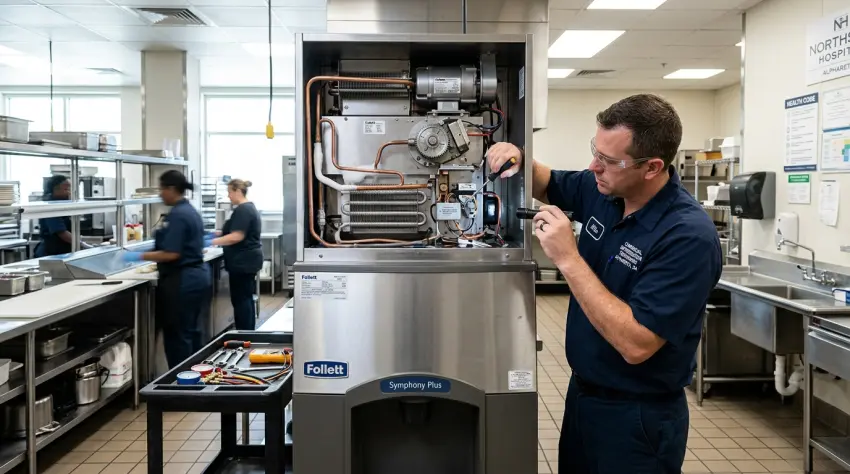
Introduction: The High Cost of Unchecked Ice Machine Auger Squeal
In healthcare institutions, corporate executive dining facilities, athletic training centers, and fast-paced commercial kitchens across North Fulton County, ice is not merely a refreshing beverage accessory; it is a critical clinical tool and a heavily regulated food product. Among commercial ice manufacturers, Follett Ice stands out as an engineering pioneer, providing chewable nugget Chewblet ice dispensers across models such as the Symphony Plus 12, 25, and 110 series, the compact 7 and 15 series countertop units, and the remote Horizon Elite 710 and 1010 ice machines. However, the continuous harvesting mechanism that creates chewable nugget ice operates under extreme mechanical pressure. When an employee or facility manager begins hearing a high-pitched, metallic shrieking or intermittent grinding noise emanating from the dispenser, the unit is experiencing severe mechanical friction. Scheduling timely appliance repair in Alpharetta, GA is vital to prevent an annoying noise from escalating into a ruptured evaporator cylinder.
Unlike conventional cuber ice machines that use a batch freezing cycle over an open nickel-plated evaporator grid and a hot gas harvest valve to drop cubes via gravity, Follett nugget ice machines utilize a flooded vertical or horizontal cylindrical evaporator barrel. A precision-machined 304 or 316 stainless steel auger rotates continuously inside this refrigerated cylinder at approximately 9 to 11 revolutions per minute. As liquid water enters the bottom of the cylinder, the surrounding refrigerant boils at approximately -5°F to 0°F, creating a thin slurry of ice crystals on the inner cylinder wall. The sharp spiral flighting of the rotating auger scrapes this ice continuously from the barrel wall and pushes it upward toward an extrusion head. At the extrusion head, the slush is forced through compression channels that squeeze out excess water before breaking off into uniform Chewblet nuggets.
The mechanical stress required to compress slushy ice slurry into dense nuggets creates substantial radial and axial thrust loads on the drive components. To withstand these forces, the auger is supported by a lower bronze journal sleeve bearing, an upper stainless compression head bearing assembly, and a ceramic-faced mechanical water seal that prevents water inside the evaporator from infiltrating the heavy-duty planetary gearmotor beneath. When lime and calcium scale adhere to the evaporator walls or when the bronze sleeve bearing runs dry due to water intrusion washing away lubricants, the auger begins to oscillate and deflect. The resulting sound is a piercing squeal that signals immediate, irreversible mechanical destruction if the unit is allowed to continue running. When mechanical systems falter, accessing dependable same-day appliance repair ensures that essential foodservice operations resume with minimal downtime.
Acoustic & Mechanical Symptoms: Decoding Follett Ice Machine Distress
A failing Follett continuous extrusion drive train rarely dies silently. Instead, the assembly broadcasts a clear progression of acoustic and tactile warning signs that alert attentive kitchen managers and facility engineers to impending failure. Recognizing these symptoms early allows commercial operators to halt operation and save the thousands of dollars required to replace a completely destroyed evaporator barrel.
| Acoustic Symptom | Root Cause Location | Mechanical Severity | Immediate Recommended Action |
|---|---|---|---|
| High-Pitched Squeal (Continuous) | Dry bronze sleeve bearing or ceramic water seal rubbing without lubrication | Critical (Immediate Seizure Risk) | Power down unit immediately; inspect lower bearing and mechanical seal face |
| Rhythmic Chirping / Squeak (1 Rev/Sec) | Auger shaft runout deflection rubbing against evaporator freeze wall | High (Barrel Scoring Imminent) | Measure shaft deflection; check upper compression head brass bushing wear |
| Heavy Grinding / Chattering | Stripped planetary gears in Grove gearmotor or heavy mineral scale packing | Severe (Gearbox Failure) | Check gearmotor amp draw; perform descaling and gear backlash inspection |
| Clicking Followed by Motor Silence | Thermal overload protector tripping on gearmotor winding | High (Electrical Overheat) | Allow motor to cool; measure operating current against 1.8 FLA nameplate rating |
| Grey Flecks or Metallic Shavings in Ice | Physical metal galling between auger flight edges and cylinder wall | Dangerous Health Hazard | Lock out machine; discard all ice; sanitize reservoir and replace auger assembly |
Beyond acoustics, tactile symptoms offer critical diagnostic clues. When an auger bearing begins to fail, the exterior shell of the gearmotor housing will radiate intense heat, frequently exceeding 165°F to the touch. Furthermore, the quality of the ice produced will noticeably degrade. Instead of crisp, bite-sized, dry Chewblets, the machine will dispense mushy, watery ice slurry. This occurs because the excessive friction inside the evaporator barrel generates heat that melts the slush faster than the refrigeration system can solidify it, while the compromised auger flights fail to achieve the compressive force necessary to pack the ice through the extrusion nozzles. When complex commercial appliances experience simultaneous mechanical and cooling faults, requesting emergency appliance repair prevents secondary damage across your commercial infrastructure.
Visual Before & After: Follett Auger Shaft & Bearing Restoration
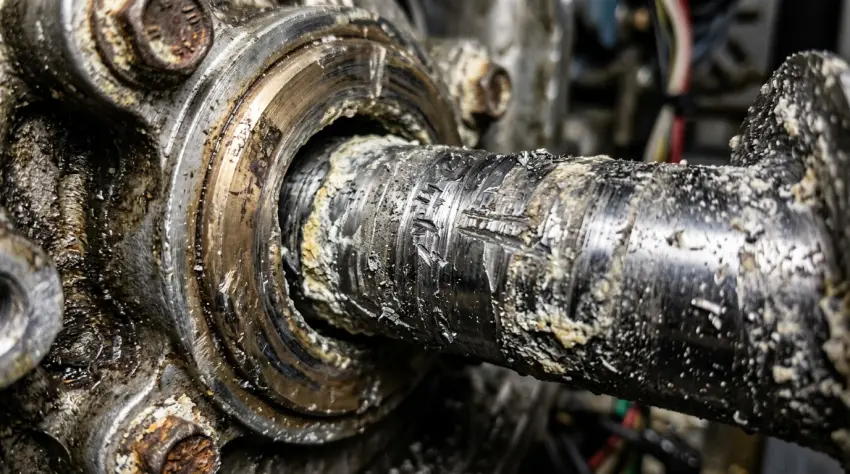
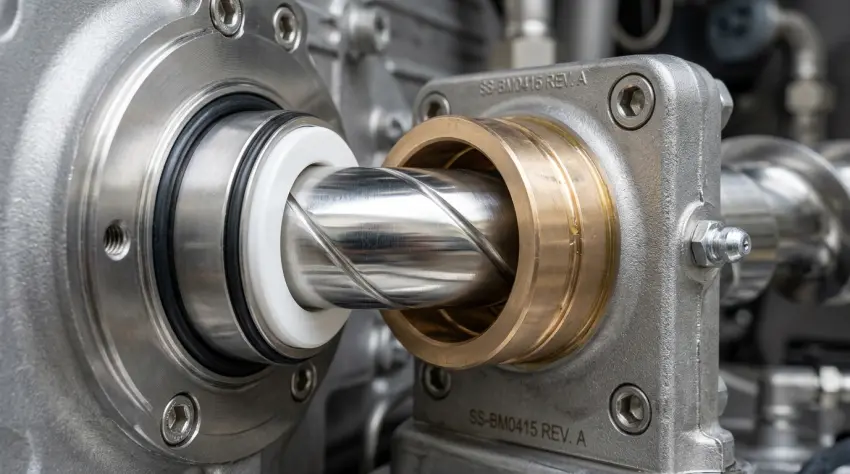
Field Case Review (Alpharetta, GA): Notice the deep gouges and metallic scoring on the left image where unlubricated contact ground the auger shaft against the sleeve bushing, generating an ear-splitting 92 dB screech. On the right, the restored assembly features a gleaming 316 stainless OEM auger shaft, pristine oil-impregnated bronze journal bearing, and fresh ceramic mechanical seal lubricated with high-purity NSF food-grade grease.
Primary Causes of Auger Squealing, Chattering, and Motor Overload
Understanding why a Follett auger drive fails requires examining the delicate thermodynamic and mechanical equilibrium inside a continuous ice maker. Several interrelated mechanical and environmental factors contribute to the deterioration of the drive assembly:
1. Severe Mineral Scale Calcification on the Evaporator Wall
Although municipal tap water across North Fulton County generally measures moderate in total hardness, the thermodynamic process of ice making dramatically concentrates minerals. In a continuous flake or nugget machine, water constantly enters the evaporator reservoir. As pure water molecules freeze onto the barrel wall, dissolved calcium carbonate, magnesium, and silica are left behind in the residual liquid. If the automated purge cycle is improperly programmed or water filtration fails, these minerals precipitate out onto the cold stainless steel or copper barrel walls as rock-hard calcified scale. As the auger rotates, its precision-machined flights physically grind against this rough mineral sandpaper. The frictional resistance spikes exponentially, causing the auger flights to chatter and emit an ear-piercing squeal. Similar scale-induced mechanical stress can also disrupt complex commercial refrigeration systems, requiring professional refrigerator repair services to diagnose compressor and evaporator health.
2. Water Infiltration Past the Ceramic Mechanical Seal
Directly below the freezing cylinder, Follett employs a precision mechanical water seal consisting of a stationary polished ceramic seat and a spring-loaded carbon-graphite rotating ring. This seal maintains an impermeable barrier between the pressurized water inside the evaporator and the lower gearbox drive shaft. Over years of operation, grit and fine sand particles can lodge between the ceramic faces, cutting microscopic grooves. Once water bypasses this seal, it drips directly onto the lower bronze journal sleeve bearing. The water washes away the microscopic oil film impregnated into the porous bronze, leaving the metal surfaces unlubricated. The resulting dry friction causes rapid galling and high-frequency acoustic screeching. If water penetrates further into the planetary gearbox, it contaminates the synthetic gear oil, creating a milky emulsion that leads to stripped gear teeth.
3. Auger Shaft Runout & Radial Deflection
A factory-new Follett auger shaft is machined to exacting tolerances, with allowable radial runout typically under 0.003 inches. Over thousands of operating hours under immense upward compression thrust, uneven ice density or sudden freeze-ups can induce minor shaft bowing. Once runout exceeds 0.008 inches, the rotating flighting no longer maintains a uniform 0.010-inch air gap with the cylinder wall. Instead, the outer edges of the flighting make direct physical contact with the cylinder wall once every revolution. This creates a distinctive, rhythmic chirping or squeaking sound that progressively wears deep gouges into the evaporator barrel.
4. Planetary Gearbox Bearing Deterioration & Worn Thrust Washers
The gearmotor utilized on Follett Symphony and Horizon series units (frequently manufactured by Grove Gear) incorporates hardened steel sun and planetary gears enclosed within an aluminum housing. The continuous downward reaction force of the auger pushing ice upward places immense load on the internal thrust washer and needle roller bearings. If the thrust washer wears thin, the entire drive shaft drops by several thousandths of an inch. This misaligns the internal gear mesh, causing a low-frequency grinding roar that amplifies through the stainless steel cabinet panels. Commercial kitchens in neighboring areas facing similar drive gear issues rely on our expert appliance repair in Milton, GA for prompt commercial support.
Step-by-Step Operator Troubleshooting: Safe Checks Before Calling Service
Before dispatching an emergency technician, kitchen managers and maintenance staff in Alpharetta can perform several safe, non-invasive troubleshooting steps to isolate whether the noise originates from water supply starvation, scale buildup, or mechanical bearing failure:
Step 1: Check Water Inflow Pressure & Filter Condition
A starved evaporator cylinder freezes dry, creating an ice dam that squeals against the auger. Inspect the incoming potable water pressure gauge. Follett requires a minimum dynamic operating water pressure of 20 to 25 PSI during the fill cycle. If sediment pre-filters are clogged, water cannot refill the reservoir quickly enough to match ice extrusion rates. Replace clogged filter cartridges and verify that shutoff valves are fully open.
Step 2: Inspect the Reservoir Float Switch & Water Level
Remove the front maintenance cover and locate the clear plastic water reservoir. Verify that the water level reaches approximately 1/2 inch below the reservoir overflow lip. If the float switch is stuck in the raised position due to mineral scale, the control board assumes the tank is full and refuses to open the water solenoid valve, leaving the evaporator dry while the refrigeration compressor continues to freeze.
Step 3: Run the Safe Chemical Descaling Cycle
If the squeal is light and intermittent, lime scale buildup is the probable culprit. Turn the machine control switch to the “CLEAN” position. Add 8 to 16 ounces of Follett SafeCLEAN Plus or food-grade nickel-safe ice machine cleaner into the reservoir. Allow the solution to circulate through the evaporator barrel for 20 to 30 minutes without freezing. If the squeal diminishes as scale dissolves, an intensive chemical clean may temporarily resolve the symptom. Facilities in adjacent communities experiencing similar refrigeration scaling often consult our appliance repair in Roswell, GA for comprehensive commercial descaling services.
Step 4: Perform the “Auger-Only” Motor Test
Many Follett dispensers have an electrical maintenance switch that allows the gearmotor to rotate while keeping the refrigeration compressor turned off. Flip the switch so only the gearmotor runs with water in the barrel. If the squealing vanishes completely during this test, the noise is related to ice compaction and freeze-wall friction. If the squeal persists at full intensity even with zero ice production, the failure is purely mechanical: either the gearmotor bearings or the lower bronze sleeve bearing have failed.
When to Stop DIY: Critical Indicators of Catastrophic Evaporator Seizure
While basic chemical cleaning and water pressure checks are within the scope of in-house facility engineering, attempting to disassemble a Follett evaporator drive without specialized pulling tools and training carries immense financial risk. Cease troubleshooting and immediately disconnect electrical power under the following conditions:
- Sustained High-Pitched Metal Screeching: If the squeal sounds like a lathe cutting steel, metal galling is actively taking place. Continuing to run the machine will score the interior cylinder wall beyond repair within minutes, transforming a $450 bearing repair into a $3,200 evaporator replacement.
- Water Leaking into the Gearmotor Drip Pan: If you observe water dripping from the bottom of the evaporator mounting plate into the drain pan or pooling atop the gearmotor housing, the mechanical water seal has suffered catastrophic failure. Running the unit will cause water to enter the electrical windings, risking dead shorts and fire hazards.
- Control Board Tripping Gearmotor Torque Error (Code 7 / Red LED): Follett electronic control boards monitor gearmotor electrical current. If current exceeds 2.2 amps for more than 3 seconds, the board initiates a safety lockout. Resetting the power repeatedly without resolving the mechanical bind will burn out the motor windings or crack the gear case.
- Metal Dust or Shavings Visible Around Extrusion Head: If you spot fine brass or stainless steel glitter around the ice chute or inside the dispense bin, mechanical components are disintegrating. Discontinue use immediately to prevent contamination of the ice supply. For fast commercial support across Fulton County, our dedicated technicians in Johns Creek, GA are equipped with genuine OEM replacement assemblies.
Repair vs. Replace Decision Matrix: Follett Continuous Ice Extrusion Systems
When faced with an auger or gearbox breakdown, facility directors and executive chefs must determine whether rebuilding the existing sub-assembly or investing in a brand-new commercial dispenser makes the best financial sense. Follett commercial ice dispensers are premium, institutional-grade machines designed for a 12- to 15-year service life when properly maintained. Below is an engineering decision framework based on the industry-standard 50% Rule and evaporator structural integrity:
| Component Diagnostic Status | Machine Age | Estimated Repair Cost | Recommended Action | Financial Rationale |
|---|---|---|---|---|
| Worn Bronze Sleeve Bearing & Water Seal Only | 1–7 Years | $380 – $620 | Rebuild Drive Train (Repair) | Evaporator barrel and auger intact; OEM bearing press-in restores full 100% factory reliability. |
| Complete Auger & Gearmotor Replacement | 4–9 Years | $1,100 – $1,550 | Rebuild Assembly (Repair) | A new commercial Follett dispenser costs $6,500–$9,500. Rebuilding the drive train costs under 20% of new unit cost. |
| Scored Evaporator Barrel Wall + Seized Gearbox | 8–12 Years | $2,800 – $3,600 | Evaluate Replacement vs Rebuild | If refrigeration compressor and R404A circuit are strong, replacement evaporator module may still be economical. |
| Refrigeration System Leak + Rotted Cabinet + Seized Auger | 12+ Years | $4,200+ | Full Unit Replacement | Multiple catastrophic system failures exceed the 50% replacement threshold; transition to a modern energy-efficient model. |
In high-end healthcare settings where sanitation regulations are stringent, repairing the existing unit with OEM parts ensures that the factory plumbing certifications and NSF listings remain fully intact. Premium refrigeration equipment like Sub-Zero units share similar precision engineering principles, and facility managers frequently leverage our specialized Sub-Zero appliance repair when servicing multi-unit commercial and estate kitchen equipment.
Cost Factors Influencing Commercial Ice Machine Rebuilds in Alpharetta
When commercial operators in Alpharetta receive an estimate for a Follett auger rebuild, several technical variables dictate the total investment. Understanding these cost drivers ensures financial transparency:
- Accessibility & Machine Configuration: A self-contained countertop Symphony Plus unit located in a hospital breakroom provides quick 360-degree access once the exterior cowling is removed. Conversely, a remote Horizon Elite ice machine mounted on a beverage dispenser with overhead refrigeration conduit or installed within a cramped under-counter cavity requires significantly more technician labor hours to extract and disassemble.
- Extent of Evaporator Wall Galling: If service is requested at the first onset of a mild squeal, replacing the lower bronze sleeve bearing and mechanical seal costs a fraction of an overhaul. However, if the machine was run for days while shrieking, the auger flighting will have gouged the inner stainless wall. If gouges exceed 0.005 inches, ice can no longer be scraped cleanly, necessitating a complete new evaporator barrel module.
- OEM Parts Sourcing vs. Aftermarket Knockoffs: Follett commercial ice systems operate under tight NSF potable water and structural tolerances. Master technicians strictly utilize genuine Follett OEM parts—including factory-matched ceramic mechanical seals, precision-machined oilite bronze bearings, and hardened Grove gearbox gears. Aftermarket knockoffs frequently leak within weeks, leading to catastrophic repeat gear failures.
- Sanitization & Biofilm Decontamination: In healthcare facilities, disassembling an ice machine drive train legally requires a full sanitization protocol in accordance with Joint Commission (TJC) standards. Technicians must chemically flush the water lines, descale the evaporator barrel, and sanitize the storage bin before returning the machine to patient service. For facilities operating commercial refrigeration and prep systems alongside ice dispensers, our Atosa commercial refrigerator repair provides an authoritative look at microprocessor controls and cooling diagnostics.
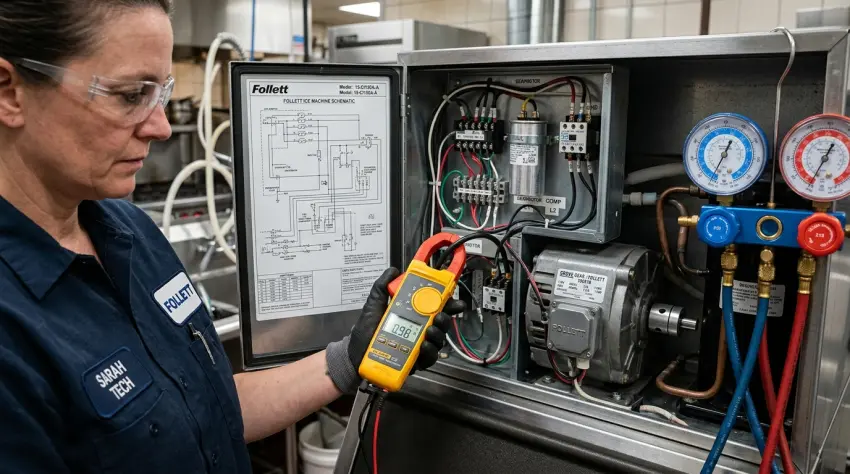
How Master Technicians Diagnose Auger Drive Trains (Telemetry & Tolerances)
When our master certified technicians arrive on-site at your Alpharetta facility, we avoid guesswork. Commercial ice extrusion systems require precision electrical telemetry and mechanical metrology to pinpoint the exact failure point. Below is the systematic diagnostic procedure executed by our factory-trained specialists:
First, the technician connects a true-RMS digital clamp multimeter around the gearmotor electrical feed wire (typically terminal L1 or the motor run winding lead). With the machine operating under full ice-making load, the operating amperage is measured. A healthy Follett gearmotor draws between 1.4 and 1.8 full-load amperes (FLA). If the meter reads 2.4 to 3.1 amps, excessive mechanical friction is occurring inside the evaporator barrel, confirming that either mineral scale is binding the flights or the journal sleeve bearings have galled. Similar electrical current testing is standard across commercial foodservice equipment, as demonstrated in our diagnostic guide for Frymaster commercial fryer troubleshooting.
Next, the technician removes the upper compression head and mounts a magnetic-base dial indicator to inspect auger shaft radial runout. The indicator tip is positioned against the polished bearing journal. As the auger is rotated manually by hand through 360 degrees, total indicator reading (TIR) must not exceed 0.003 inches. If runout measures 0.007 inches or greater, the shaft has bowed under compressive thrust and must be replaced to prevent barrel wall destruction.
| Component / Test Point | Measurement Parameter | Normal Factory Specification | Fault Condition / Squeal Trigger |
|---|---|---|---|
| Gearmotor Operating Current | AC Amperage (Clamp Meter) | 1.4 to 1.8 Full Load Amps (FLA) | > 2.2 Amps (Mechanical Overload / Binding) |
| Gearmotor Winding Resistance | Ohms Resistance (Ω) | 14.5 Ω to 18.2 Ω (Phase to Phase) | < 5 Ω (Short) or ∞ OL (Open Thermal Protector) |
| Auger Shaft Radial Runout | Dial Indicator Deflection (TIR) | < 0.003 Inches (3 mils) | > 0.006 Inches (Shaft Bowed, Rubbing Wall) |
| Bronze Journal Bearing Clearance | Inside Micrometer vs Shaft OD | 0.0015 to 0.0025 Inch Oil Gap | > 0.006 Inch (Egg-shaped wear, screeching) |
| Water Seal Ceramic Face Mating | Visual & Leak Pressure Test | 100% Mirror Polish, 0 Drops/Hour | Micro-cracked, Chipped, or Scale Infiltration |
| Gearbox Output Shaft Endplay | Axial Dial Indicator Travel | 0.005 to 0.012 Inches | > 0.035 Inches (Worn Thrust Washer, Chattering) |
Commercial convection ovens and heavy cooking equipment rely on similar electric motor run capacitors and centrifugal switches, as detailed in our analysis of Blodgett commercial convection oven blower motor repair. The systematic testing of motor windings and mechanical bearings protects kitchen owners from misdiagnoses and wasteful component swaps.
Critical OEM Parts Involved in Follett Evaporator Drive Overhauls
When rebuilding a squealing or galled Follett auger drive, commercial technicians utilize a dedicated suite of factory OEM components. Installing certified original parts guarantees sanitary compliance, structural durability, and quiet operation:
- Precision Machined Stainless Steel Auger (Follett Part #00135806 / #00938449): The central continuous extrusion auger machined from solid stainless steel bar stock with precision ground helical flights and hardened bearing journals.
- Oil-Impregnated Bronze Journal Sleeve Bearing (Follett Part #00135814): A porous, oilite bronze bushing pressed into the lower evaporator base. Microscopic pores release lubricating oil under mechanical friction and reabsorb it when cold.
- Ceramic-to-Carbon Mechanical Water Seal Assembly (Follett Part #00135822): A two-piece spring-loaded seal providing an absolute hydrodynamic barrier preventing pressurized potable water from breaching the gearbox drive housing.
- Upper Extrusion Head & Compression Nozzle Assembly (Follett Part #00938456): The hardened stainless extrusion ring containing compression channels that compress slurry into solid Chewblet ice nuggets.
- Grove Heavy-Duty Planetary Gearmotor (Follett Part #00135830 / #00938464): The fractional-horsepower, high-torque 115V or 230V drive motor with precision planetary reduction gears yielding 9–11 RPM output speed.
- NSF-H1 Food Grade High-Load Grease: Specialized synthetic lubricant rated for accidental food contact, used exclusively on O-rings and bearing sleeves during reassembly. Commercial freezers in commercial dining require similar specialized hardware and lubricants, supported by our local commercial freezer repair team.
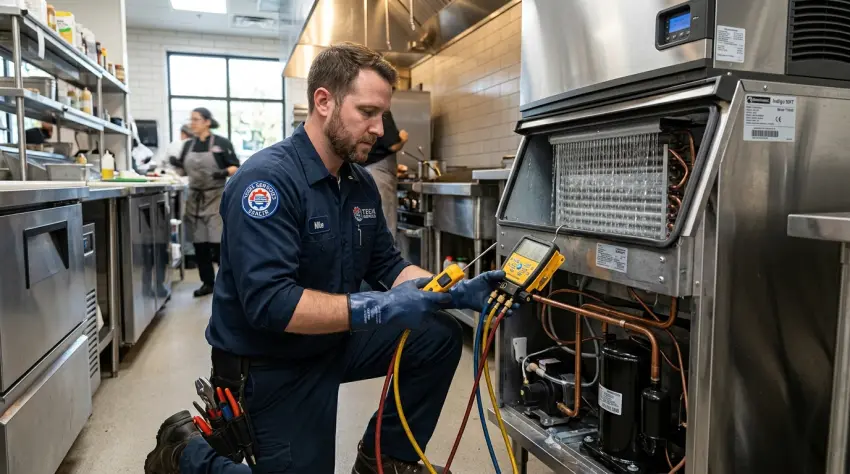
Preventive Maintenance & Sanitization Protocols to Eliminate Scale
Preventing auger squealing and bearing destruction in Follett commercial ice dispensers requires proactive, scheduled preventive maintenance. Kitchen and facility managers should institute the following quarterly and bi-annual maintenance protocols:
- Implement Multi-Stage Water Filtration with Scale Inhibition: Municipal water should pass through a 5-micron sediment pre-filter, an activated catalytic carbon block for chlorine removal, and a polyphosphate scale-inhibitor cartridge. Polyphosphate sequesters dissolved calcium ions, preventing them from bonding to the freezing cylinder wall.
- Perform Quarterly Chemical Descaling with Follett SafeCLEAN: Never allow more than 90 days to elapse between chemical cleaning cycles. In high-volume healthcare settings, schedule monthly descaling to dissolve micro-scale deposits before they achieve frictional mass.
- Inspect the Water Drain Pan & Mechanical Seal Drip Port: Inspect the clear drain tubing connected to the bottom of the evaporator housing monthly. If you detect even a single drop of water exiting the mechanical seal cavity, schedule water seal replacement immediately before bearing damage occurs. Commercial dishwashing systems also face severe water seal and pump impeller stress, as addressed by our technicians specializing in commercial dishwasher repair.
- Conduct Annual Motor Amperage Telemetry Audits: During scheduled preventive service visits, have your technician clamp the gearmotor power wire and record operating current. Tracking current over time provides an early warning indicator: if amp draw climbs from 1.5 amps to 1.9 amps over six months, a bearing is beginning to bind.
- Clean and Vacuum the Refrigeration Condenser Coil: A dusty or grease-clogged condenser coil causes condensing temperatures and head pressures to skyrocket. This causes the liquid refrigerant entering the evaporator to flash erratically, resulting in irregular freeze patterns that induce uneven auger thrust loads. Commercial laundry and dryer equipment in hospitality facilities similarly require clear airflow paths, managed by our certified commercial dryer repair division.
Electrical, Refrigeration & Potable Water Sanitation Safety Standards
Commercial ice dispensers incorporate 115V or 208/230V electrical systems, pressurized chemical refrigerants (such as R404A or R452A), and potable water supplies intended for direct human ingestion. When inspecting or servicing these machines, rigorous safety standards must be adhered to:
- Lockout/Tagout (LOTO) Compliance: Always disconnect the primary circuit breaker and secure it with an approved lockout device before removing maintenance panels. Follett gearmotors have high rotational torque; accidental cycling while hands are near the auger or drive coupling can cause severe crushing injuries.
- Chemical Protective Gear During Acid Descaling: Nickel-safe ice machine descaling solutions contain phosphoric and citric acids that can cause skin burns and eye irritation. Personnel must wear chemical splash goggles, neoprene gloves, and protective aprons during chemical flush procedures.
- EPA Section 608 Refrigerant Containment: The flooded evaporator on a Follett ice maker is an integral part of the sealed refrigeration circuit. Only EPA Universal-certified technicians are permitted to connect diagnostic gauges or perform refrigerant leak detection. Never puncture or use heat torches near the aluminum/copper evaporator wrap. Commercial washing machine systems also require strict adherence to utility isolation, detailed in our washing machine repair protocols.
- NSF Food Safety & Potable Water Backflow Prevention: The water supply line feeding the ice dispenser must be equipped with a dual-check backflow preventer compliant with ASSE 1022. Technicians must strictly use NSF-H1 registered lubricants on any component inside the water envelope to eliminate toxic chemical contamination risks.
Frequently Asked Questions (Interactive Technical Accordions)
Below are 16 in-depth, expert answers to the most common questions regarding Follett commercial ice dispenser auger squealing, bearing wear, and gearmotor troubleshooting in Alpharetta, GA:
Q1: Why is my Follett ice dispenser making a loud, high-pitched squealing noise?
A loud squeal from a Follett ice dispenser is typically caused by severe mineral scale accumulation inside the evaporator cylinder, a dry or worn lower bronze sleeve bearing, or water leaking past the ceramic mechanical seal into the gearmotor coupling. As lime scale roughens the evaporator freeze surface, the rotating stainless steel auger flights grind against the mineral buildup under intense compression pressure, producing high-frequency acoustic friction.
Q2: Can I continue running the ice dispenser while it is squealing?
No. Continuing to operate a squealing Follett dispenser will cause catastrophic metal-on-metal galling. The stainless auger flights will gouge deep grooves into the inner evaporator barrel wall, destroying the cylinder’s structural integrity. This transforms a routine $400 bearing or seal rebuild into an expensive $3,000+ complete evaporator replacement. Turn the machine off immediately upon hearing metal screeching.
Q3: What causes grey specks or black flakes in my Follett dispenser ice?
Grey specks or metallic flakes in dispensed Chewblet ice indicate physical metal shavings generated by severe friction between the rotating auger flights and the inner cylinder wall, or disintegrating bronze particles from a failed upper journal bearing. Discontinue use immediately, lock out the unit, and discard all ice in the bin. The entire auger and bearing assembly must be inspected and replaced, followed by thorough NSF sanitization.
Q4: How does a commercial ice machine technician test the Follett gearmotor?
A certified technician measures operating AC current using a true-RMS clamp multimeter around the motor power lead during active ice extrusion. Normal operating current ranges from 1.4 to 1.8 Full Load Amps (FLA). If the reading exceeds 2.2 amps, mechanical binding is confirmed. The technician also disconnects power to test winding resistance (14.5 to 18.2 ohms) and inspects the planetary gearbox for gear teeth backlash or oil emulsion.
Q5: What is the purpose of the water seal in a Follett ice maker?
The mechanical water seal consists of a precision polished ceramic seat and a spring-loaded carbon mating ring that creates an impermeable hydrodynamic barrier at the base of the freezing cylinder. It prevents the pressurized potable water inside the evaporator barrel from leaking downward into the planetary gearmotor housing and lower bearing cavity.
Q6: How often should a commercial Follett ice dispenser be descaled?
In standard commercial foodservice environments, chemical descaling must be performed at least every 90 days using an approved food-grade cleaner like Follett SafeCLEAN Plus. In healthcare settings, high-demand dining rooms, or areas with elevated water hardness, monthly descaling is strongly recommended to prevent scale crystals from forming frictional sandpaper on the evaporator wall.
Q7: What does Follett error code 7 or red LED gearmotor flash indicate?
Follett’s electronic control board monitors gearmotor current. When current exceeds 2.2 amps for more than 3 consecutive seconds, the board initiates an automatic safety lockout (Code 7 or rapid red LED flashing) to prevent burning out the motor windings or cracking the gearbox. This lockout is almost always caused by an ice freeze-up, heavy mineral scale, or galled bearings.
Q8: Can regular grease be used to lubricate Follett auger bearings?
Never. Only specialized NSF-H1 registered food-grade synthetic grease rated for incidental food contact may be used on Follett ice machines. Standard automotive or industrial greases contain toxic heavy metals and petroleum distillates that will contaminate the potable ice supply and violate federal health sanitation codes.
Q9: Why does my Follett dispenser produce wet, mushy ice instead of Chewblets?
Wet, slushy ice occurs when the refrigeration system is undercharged, the air condenser coil is clogged with lint, or the auger flighting has worn down so severely that it cannot develop sufficient compressive pressure at the extrusion head. Without sufficient compression, excess water is not squeezed out of the slurry before dispensing.
Q10: What is the expected lifespan of a Follett commercial ice dispenser?
With scheduled quarterly chemical descaling, proper water filtration, and timely bearing/seal maintenance, a Follett commercial ice dispenser routinely achieves 12 to 15+ years of dependable service in healthcare and commercial foodservice applications. Neglecting water treatment can shorten evaporator life to under 3 years.
Q11: Can a galled Follett auger shaft be repaired or re-machined?
No. Re-machining an auger shaft reduces its outer diameter, which creates excessive clearance within the bronze sleeve bushing and the extrusion nozzle. This leads to severe shaft deflection, vibration, water leaks, and catastrophic failure. A scored or bowed auger shaft must always be replaced with a factory OEM component.
Q12: How does incoming water temperature affect Follett ice production?
Incoming water temperatures above 70°F drastically reduce daily ice harvesting capacity. Warmer water requires more refrigeration BTU removal before freezing can commence, extending freeze times and placing continuous thermal strain on the refrigeration compressor and gearmotor drive train.
Q13: What is the typical turn-around time for an emergency auger rebuild?
Our service vehicles in Alpharetta carry common Follett OEM mechanical seals, bronze journal bearings, and descaling supplies. Most on-site bearing and seal rebuilds are completed within 2 to 3.5 hours on the same day. If a complete replacement evaporator cylinder or specialized gearmotor is required, overnight OEM logistics ensure rapid restoration.
Q14: How does scale inhibitor filtration protect continuous extrusion ice makers?
Polyphosphate scale inhibitor cartridges slowly release food-grade polyphosphate molecules into the incoming water stream. These molecules coat calcium and magnesium carbonate crystals at the molecular level, preventing them from nucleating and adhering to the freezing cylinder wall as hard scale.
Q15: Does hard water void the Follett factory equipment warranty?
Yes. Follett’s manufacturer warranty explicitly excludes damages resulting from lime scale buildup, corrosion, or lack of proper water filtration and scheduled chemical maintenance. Proof of regular professional preventive maintenance and water filter replacement is required to maintain warranty protection.
Q16: Why should I choose a certified commercial technician instead of general handyman services?
Follett commercial continuous extrusion systems operate under tight mechanical clearances and complex refrigeration parameters. A certified commercial technician possesses specialized hydraulic bearing pullers, precision dial indicators, true-RMS telemetry equipment, EPA Section 608 certifications, and direct access to genuine OEM parts catalogues, guaranteeing an accurate and sanitary repair.
Related Commercial Refrigeration & Cooking Equipment Services
Our commercial technical team provides comprehensive repair, maintenance, and emergency service across all major institutional kitchen appliances in Alpharetta and North Fulton County:
Key Takeaways for Alpharetta Facility & Kitchen Managers
- Acoustic Warning: An auger squeal from a Follett ice machine is a critical mechanical distress signal indicating severe mineral scale calcification or failed bronze journal bearings.
- Immediate Action Required: Never allow a squealing ice dispenser to continue running; sustained friction will gouge the inner evaporator wall, ruining the entire cylinder barrel.
- Electrical Telemetry: Normal Follett gearmotor amp draw measures 1.4 to 1.8 FLA. Amperage exceeding 2.2 amps triggers automatic safety lockouts.
- Water Seal Vulnerability: A leaking ceramic mechanical water seal allows water to breach the lower bearing cavity and wash away lubricant, accelerating bearing destruction.
- Sanitation Mandate: In healthcare and foodservice facilities, only NSF-H1 registered food-grade synthetic grease may be used during assembly.
- Proactive Prevention: Multi-stage water filtration with polyphosphate scale inhibitors combined with quarterly chemical descaling eliminates 90% of auger failures.
- Local Master Tech Support: Same-day priority commercial dispatch is available across Alpharetta, Milton, Roswell, and Johns Creek with genuine factory OEM parts.
Call to Action: Emergency Commercial Technician Dispatch in Alpharetta
Priority Commercial Service Dispatch
Silence Your Squealing Follett Ice Machine Today
Don’t let a failing auger bearing destroy your commercial ice dispenser’s evaporator barrel. Our master certified technicians provide same-day emergency diagnostics, OEM bearing press restoration, and food-grade sanitization across Alpharetta, GA.
EPA Section 608 Certified • Licensed & Insured Commercial Technicians • 90-Day OEM Warranty
Need Certified Appliance Repair Today?
Skip the phone line — book direct local priority dispatch across Alpharetta, Milton, Roswell & Johns Creek.