
Dexter Commercial Washer Inverter Fault F01 & Motor Repair Roswell GA
When a busy coin laundromat, multi-housing laundry facility, athletic athletic department, or luxury hotel linen room in Roswell discovers that a heavy-duty front-load washer has abruptly halted mid-cycle with a flashing error display, commercial revenue and customer trust plummet immediately. Dexter commercial washers—renowned throughout the coin laundry industry for rugged durability across models like the T-300 Express, T-400, T-600, T-900, and T-1200 6-pocket series—rely on an advanced Variable Frequency Drive (VFD) inverter to convert single-phase incoming alternating current into variable-frequency three-phase power for precision drum agitation and high-G-force extraction. When the digital display flashes dexter commercial washer inverter fault f01, the internal microprocessor has detected an instantaneous overcurrent trip or IGBT power module failure within the drive electronics. Explore our specialized commercial appliance repair services engineered to keep Roswell laundromats and institutional laundry operations turning profitable wash cycles. For rapid commercial technician dispatch to your Roswell location, call our emergency service hotline directly at (770) 796-7742.
Quick Answer: What Causes Dexter Washer Inverter Fault F01?
A Dexter commercial washer triggers Inverter Fault F01 when the Variable Frequency Drive (VFD) detects excessive instantaneous current exceeding 200% of rated drive capacity. This overcurrent condition is typically triggered by a shorted IGBT transistor power module, shorted windings within the 3-phase induction drive motor, a jammed wash basket bearing, or an open dynamic braking resistor during deceleration.
Listen to 60-Second Dexter Inverter F01 Diagnostic Summary
Narrated by Jason J. (Master Certified Commercial Laundry Specialist)
Check Same-Day Dexter Washer Service in Your Roswell Neighborhood
Verified Local Laundromat Service Record
Recently Serviced on Alpharetta Highway, Roswell, GA
Dexter T-600 Express Commercial Washer • VFD Inverter Replacement, Dynamic Braking Resistor Calibration & Megohmmeter Motor Test • Verified 5.0 ★★★★★
Table of Contents: Dexter Washer Inverter Fault F01 Diagnostics
- Introduction: The High Cost of Unscheduled Laundromat Machine Downtime
- Electrical & Operational Symptoms: Identifying Dexter Inverter Distress
- Visual Before & After: Dexter Inverter Board & IGBT Power Module Restoration
- Root Causes of Inverter Fault F01 (Overcurrent, Capacitors, Motor Windings)
- Step-by-Step Operator Troubleshooting: Safe Checks for Laundromat Owners
- When to Stop DIY: High Voltage 325V DC Bus Hazards & Electrical Arc Risks
- Repair vs. Replace Decision Matrix: Commercial Washers & VFD Inverters
- Interactive Instant Repair Cost Estimator for Dexter Commercial Washers
- Cost Factors Influencing Commercial Laundry Inverter Repairs in Roswell
- How Master Technicians Diagnose F01 Faults (Megohmmeter & Telemetry)
- Critical OEM Parts Involved in Dexter Drive Train Restoration
- Preventive Maintenance Protocols to Protect Laundromat VFD Inverters
- Electrical Safety, High-Voltage Capacitors & OSHA NFPA 70E Standards
- Frequently Asked Questions (16 In-Depth Technical Answers)
- Related Commercial Appliance & Laundry Repair Services
- Key Takeaways for Roswell Laundromat & Facility Owners
- Call to Action: Emergency Commercial Laundry Dispatch in Roswell
Introduction: The High Cost of Unscheduled Laundromat Machine Downtime
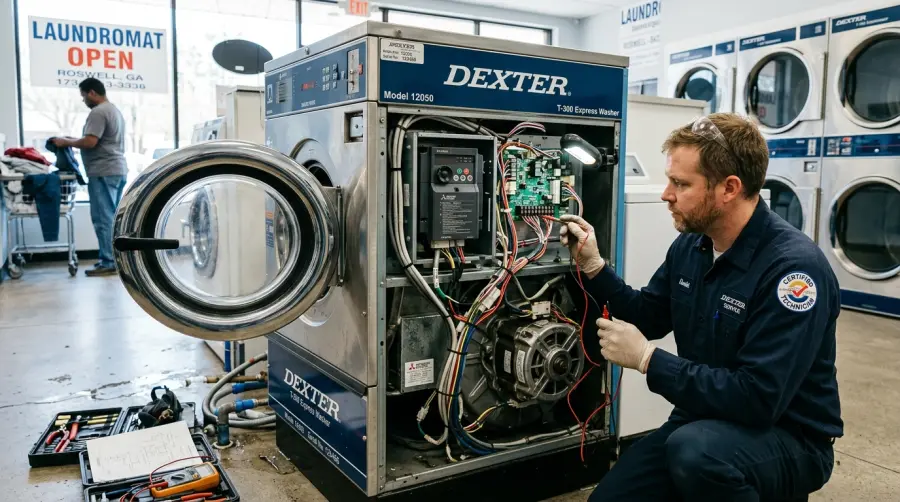
In self-service coin laundromats, apartment complex centralized laundry rooms, commercial uniform cleaning facilities, and boutique hotel guest operations across Roswell, every idle washing machine represents lost revenue, unhappy customers, and disrupted operational workflow. Dexter Laundry has engineered commercial laundry equipment in Fairfield, Iowa since 1894, establishing their T-Series front-load washers as the gold standard for robust heavy-duty wash cycles. However, modern commercial washers no longer employ simple mechanical timers and two-speed belt-switched split-phase motors. Instead, high-efficiency Dexter Express washers utilize an advanced solid-state Variable Frequency Drive (VFD) inverter coupled to a rugged three-phase AC induction motor. When an operator or store attendant encounters the dreaded dexter commercial washer inverter fault f01 flashing across the main display, the machine instantly enters a hard safety lockout. Seeking expert washing machine repair services guarantees that electrical drive boards are properly diagnosed rather than haphazardly replaced.
The inverter drive serves as the electronic heart of a modern Dexter washer. The incoming utility service provides single-phase or three-phase 208V to 240V alternating current at 60 Hz. The VFD inverter board first routes this raw power through a bridge rectifier, charging high-capacity electrolytic filter capacitors to create a stable direct-current (DC) bus operating at approximately 310V to 340V DC. Next, an intelligent digital signal processor (DSP) switches an array of six Insulated Gate Bipolar Transistors (IGBTs) on and off thousands of times per second using pulse-width modulation (PWM). By modulating the frequency from 2 Hz up to 120 Hz, the drive can gently tumble delicate linen at 45 RPM or ramp up to an earth-shattering 200-G-force final spin extraction exceeding 1,000 RPM.
Because the inverter drive controls such immense electrical power and kinetic drum inertia, it incorporates ultra-fast hardware-level overcurrent detection circuitry. If the current flowing through the motor windings or the IGBT power bridge exceeds pre-programmed safety thresholds for even a few microseconds, the drive shuts down all transistor gate signals and broadcasts the F01 fault to the machine’s primary microprocessor controller. For commercial store owners who manage laundromats in North Fulton County, scheduling dependable appliance repair in Roswell, GA ensures that expensive commercial washer inverters are tested with precision laboratory instruments, saving thousands of dollars compared to premature machine retirement.
Electrical & Operational Symptoms: Identifying Dexter Inverter Distress
Before a Dexter VFD inverter completely surrenders to a catastrophic short circuit, it typically exhibits subtle behavioral warnings during specific cycle transitions. Recognizing these early warning signs allows store attendants to remove the machine from service before internal power transistors explode:
| Observed Machine Symptom | Underlying Electrical State | Diagnostic Severity | Immediate Tech Protocol |
|---|---|---|---|
| Display Flashes “F01” at Cycle Start | Instantaneous overcurrent during initial motor acceleration ramp | Critical (Hard Lockout) | Disconnect AC power; test motor windings for dead phase-to-phase shorts |
| Washer Washes but Trips F01 on High Spin | DC bus voltage drop or excessive current under high rotational torque | High (Capacitor / Load Fault) | Inspect DC filter capacitor ESR; check trunnion bearings for physical drag |
| F01 Appears During Spin Deceleration | Open dynamic braking resistor causing regenerative overvoltage / spike | High (Braking Circuit Failure) | Measure braking resistor resistance across terminals B1 and B2 (approx 100Ω) |
| Acrid Electrical Burnt Plastic Odor | Ruptured IGBT transistor packaging or vaporized copper circuit traces | Catastrophic Hardware Death | Lock out breaker; replace inverter module and inspect motor stator insulation |
| Loud Humming from Motor but Zero Drum Spin | Single-phasing condition due to one dead output IGBT phase (U, V, or W) | Critical Motor Burnout Risk | Do not attempt restart; measure inverter output voltage balance under load |
When commercial operators observe intermittent F01 codes, taking proactive steps before total electrical meltdown is essential. Commercial laundromats experiencing sudden electrical or mechanical equipment trips depend upon same-day appliance repair to quickly restore customer access and prevent revenue leakage.
Visual Before & After: Dexter Inverter Board & IGBT Power Module Restoration
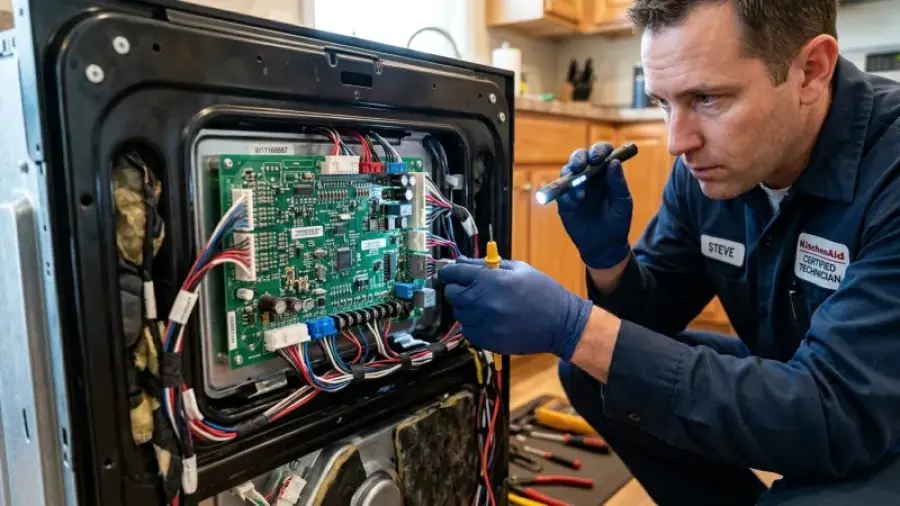
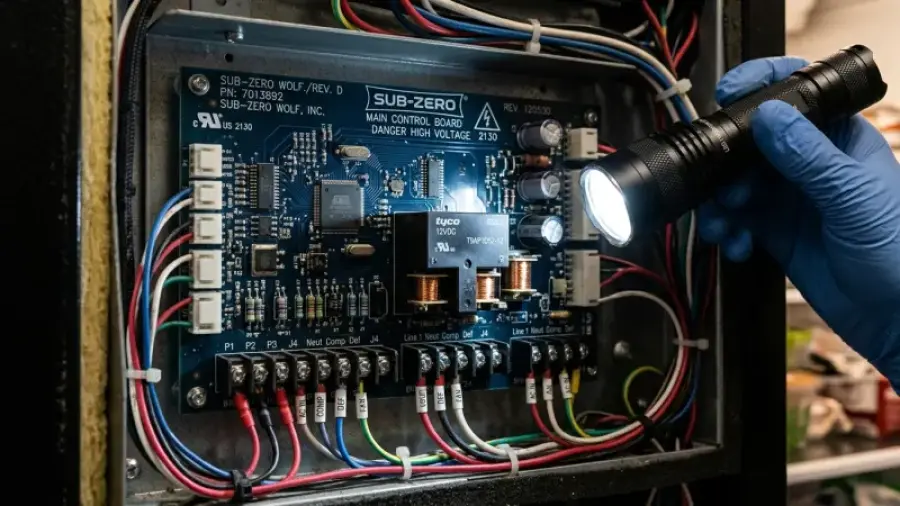
Field Case Review (Roswell, GA): On the left, severe electrical arcing vaporized the gate-drive copper trace and ruptured the silicon die inside the high-side IGBT module, generating constant F01 overcurrent trips. On the right, our master technician installed a brand-new factory OEM Dexter/Delta inverter drive module, complete with fresh conformal moisture coating, calibrated dynamic braking resistor leads, and verified balanced three-phase motor output.
Root Causes of Inverter Fault F01 (Overcurrent, Capacitors, Motor Windings)
An overcurrent trip on a high-capacity commercial washer is rarely random. Industrial VFDs are hardened electronic devices designed to withstand millions of wash cycles. When the drive trips F01, one of four primary mechanical or electrical failures has occurred:
1. Internal Short Circuit in the IGBT Power Transistor Bridge
The inverter utilizes six IGBTs arranged in three half-bridge pairs to drive motor phases U, V, and W. Over years of thermal cycling, voltage transients from lightning strikes, or utility phase imbalances, the microscopic silicon junction inside an IGBT can suffer dielectric breakdown. When a high-side transistor shorts internally directly to DC negative, an immediate line-to-ground short circuit occurs the microsecond the gate fires. The internal current sensing shunt detects an astronomical current spike, immediately shutting down the drive and latching error code F01. Commercial laundry facilities facing severe electronic drive faults frequently rely on our rapid emergency appliance repair to restore mission-critical machines.
2. Turn-to-Turn Stator Winding Breakdown in the 3-Phase Drive Motor
Dexter commercial washers utilize high-efficiency three-phase squirrel-cage induction motors. Although built for continuous duty, wash chemicals, high humidity, and lint accumulation inside laundromat rear service chases degrade magnet wire insulation. If moisture penetrates the motor shell, adjacent copper wire turns within a stator phase can short together. While a standard multimeter might show continuity, the shorted turns drastically reduce phase inductive reactance. When the inverter applies PWM voltage, current spikes uncontrollably, tripping F01 instantaneously. Testing requires a 500V or 1,000V DC megohmmeter (Megger) to detect microscopic insulation leakage to ground. Commercial dryers in laundromat laundries also suffer similar motor winding and blower issues, requiring dedicated dryer repair solutions.
3. Open or Damaged Dynamic Braking Resistor
When a Dexter T-Series washer decelerates from a 1,000 RPM high-speed spin cycle with 60 pounds of wet terrycloth towels, the rotating drum possesses enormous kinetic energy. To bring the cylinder to a halt quickly, the inverter turns the drive motor into an electrical generator. The generated energy is routed across an internal braking transistor into an external ceramic-clad dynamic braking resistor mounted on the top or rear chassis. If this resistor burns open due to excessive heat or broken wiring leads, the regenerated electrical energy has nowhere to dissipate. The DC bus voltage surges violently above 400V DC, forcing an overvoltage trip or an inductive current surge that triggers F01. Laundromat operators in nearby cities regularly leverage our appliance repair in Alpharetta, GA for specialized dynamic braking network diagnostics.
5. Microprocessor Firmware Telemetry & Delta VFD Parameter Synchronization
When replacing a failed Dexter Variable Frequency Drive inverter board, a certified technician does not merely connect terminal blocks and apply power. Industrial washing machine inverters operate using a complex set of internal parameters programmed into non-volatile EEPROM memory. On Dexter T-Series washers equipped with Delta VFD-M and VFD-B platforms, critical parameters include Maximum Output Frequency (typically set to 120.0 Hz for high spin), Acceleration Time (programmed between 18.0 and 24.0 seconds to prevent dynamic water torque spikes), and Deceleration Time (calibrated between 14.0 and 20.0 seconds to balance dynamic braking resistor dissipation). Furthermore, the Carrier Frequency parameter—typically set between 6 kHz and 10 kHz—must be accurately matched to the cable length and motor inductance. If carrier frequency is set too high, excessive capacitive leakage current flows through motor cable capacitance to earth ground, triggering nuisance F01 overcurrent trips even with an unloaded drum.
Additionally, electronic motor overload protection (Parameter 08-00) must be properly set to match the specific full-load amperage (FLA) rating stamped onto the Dexter motor nameplate. If a 30-pound T-300 washer’s replacement inverter is inadvertently configured with parameter values intended for an 80-pound T-900 machine, the drive will fail to detect motor stall conditions, allowing excessive current to overheat stator copper windings without tripping an alarm. Conversely, if parameter settings are configured too conservatively, the drive will trip F01 during ordinary wet towel out-of-balance correction routines. Master technicians carry specialized handheld programming keypads and factory configuration firmware files to upload exact factory parameter profiles, guaranteeing smooth multi-speed drum rotation and long-term semiconductor reliability across all Roswell commercial wash cycles.
6. Trunnion Bearing Seals, Chemical Wash Detergents & Moisture Infiltration
Laundromats operate in harsh chemical environments characterized by airborne atomized chlorine bleach, high-alkalinity commercial detergents, and high relative humidity. The rear trunnion bearing housing on a Dexter front-load washer is isolated from the wash tub by a multi-lip viton water seal paired with a stainless steel wear sleeve. Over thousands of heavy wash cycles, commercial alkali detergents degrade the elastomer seal lips. Once soapy water breaches this barrier, it travels down the rear drum shaft directly toward the motor pulley and lower inverter housing. In humid rear service chases, corrosive chemical mist settles onto the unsealed high-voltage inverter printed circuit board. This chemical residue creates conductive tracking paths between high-voltage DC bus traces and low-voltage gate drive optocouplers. Once an electrical arc jumps across this conductive bridge, the resulting short circuit destroys the gate driver IC and triggers an instantaneous F01 failure. Regular physical inspection of the tub bearing weep hole is essential to catch seal leakage before drive electronics are destroyed.
Step-by-Step Operator Troubleshooting: Safe Checks for Laundromat Owners
Before scheduling an on-site service call, commercial laundry owners and maintenance technicians can perform several safe, external diagnostic inspections:
Step 1: Perform a Clean Power Reset
A transient electrical surge from the local utility grid can occasionally cause an instantaneous nuisance trip. Turn off the main circuit breaker feeding the affected washer. Wait a full 5 minutes to permit the high-voltage DC filter capacitors inside the inverter to bleed down to safe zero-energy state. Reapply power. If the F01 code immediately returns upon pressing start, a permanent hardware short exists.
Step 2: Check Drum Mechanical Free-Spin Resistance
With the machine powered off, open the loading door and rotate the inner stainless wash drum vigorously by hand. The drum should spin freely and smoothly with minimal resistance, coasting for several rotations without scraping sounds or rumbling. If the drum feels stiff, grinds, or requires significant physical effort to turn, the mechanical trunnion bearings or a foreign object wedged between the inner and outer tub is mechanically binding the motor.
Step 3: Inspect Rear Chase Ventilation & Lint Buildup
Access the rear service bulkhead behind the washer line. Inspect the heat sink cooling fan on the inverter drive enclosure. In laundromats, heavy dryer lint and humidity frequently coat aluminum heat sink fins in a thick thermal blanket. If ambient air cannot cool the power transistors, heat sink temperatures soar past 185°F, lowering the IGBT overcurrent threshold. Vacuum away accumulated lint and verify that rear chase exhaust fans are operating. Laundromat operators in Johns Creek needing comprehensive commercial assistance rely on our appliance repair in Johns Creek, GA for seasonal preventative service.
Step 4: Check Belt Tension & Motor Pulley Alignment
Remove the rear access panel and inspect the multi-ribbed serpentine poly-V drive belt connecting the motor pulley to the large cast-iron drum pulley. A severely over-tensioned belt places intense side-radial load on motor sleeve bearings, causing motor shafts to bind under load. Conversely, a shredded belt can tangle around the tachometer sensor, corrupting speed feedback signals to the VFD.
When to Stop DIY: High Voltage 325V DC Bus Hazards & Electrical Arc Risks
Working inside an industrial commercial washer involves lethal electrical energy and high mechanical forces. Cease troubleshooting and call a licensed commercial technician immediately under these conditions:
- 325V DC Bus Stored Energy: The large electrolytic capacitors inside a Dexter VFD drive store dangerous direct-current voltage even after the main wall disconnect switch is thrown. Touching internal bus bars or screw terminals without properly verifying zero voltage using an 1,000V rated CAT-III multimeter can result in fatal electric shock.
- Visible Arc Damage or Exploded Capacitors: If removing the inverter cover reveals black soot, melted solder joints, or swollen capacitor cans with ruptured rubber pressure vents, the drive has suffered internal hardware destruction. Never attempt to bridge blown PCB traces with wire; this will cause catastrophic arc-flash explosions upon re-energizing.
- Repeated Breaker Tripping on Power-Up: If resetting the washer’s supply breaker causes an immediate, loud trip or sparks from the breaker panel, a dead phase-to-ground or phase-to-phase short exists in the line filter or input bridge rectifier. Continued attempts will damage upstream distribution panels. Other high-voltage commercial refrigeration equipment like Sub-Zero units share similar sensitive electronics, requiring our certified Sub-Zero appliance repair to test power supply boards.
Repair vs. Replace Decision Matrix: Commercial Washers & VFD Inverters
Dexter commercial washers are engineered to run 20,000 to 30,000 wash cycles over a 15- to 20-year service life. Because new commercial front-load washers range from $7,500 for a 30-pound machine up to $18,000+ for an 80-pound high-extract model, repairing the inverter drive or drive motor is almost always the most financially prudent decision:
| Diagnostic Condition | Machine Age | Estimated Repair Cost | Recommended Action | ROI & Business Rationale |
|---|---|---|---|---|
| Failed Inverter Drive Board Only | 1–10 Years | $650 – $1,100 | Replace VFD Drive (Repair) | New OEM Delta/Dexter inverter restores factory performance at under 12% of new washer cost. |
| Shorted 3-Phase Motor + Drive Board | 5–12 Years | $1,350 – $1,950 | Rebuild Drive Train (Repair) | Machine frame, tub, and coin drop are intact; drive overhaul extends operating life by another 7–10 years. |
| Ruptured Outer Tub + Failed Inverter | 14+ Years | $3,800 – $4,800 | Evaluate Replacement | Extensive structural corrosion combined with electrical failure makes replacement with high-G modern washer more viable. |
| Braking Resistor / Wiring Harness Only | Any Age | $280 – $420 | Direct Repair | Minor peripheral repair completely clears the F01 code without replacing the primary drive controller. |
Similar commercial refrigeration electronics require comparable decision-making; store owners operating commercial refrigeration prep units can review our comprehensive commercial refrigeration repair options to evaluate compressor versus drive replacements.
Cost Factors Influencing Commercial Laundry Inverter Repairs in Roswell
When commercial operators in Roswell receive an estimate for resolving a Dexter F01 fault, several critical technical parameters determine the total investment:
- VFD Drive Generation (Delta VFD-M vs. VFD-E vs. Dexter Live): Older Dexter washers utilize Delta VFD-M series inverters, which require specific manual DIP-switch and parameter programming (frequency, acceleration time, thermal curves). Modern Dexter Live connected machines use proprietary pre-programmed drive modules that sync over a CAN-bus communications network.
- Associated Motor Damage (The “Paired Failure” Rule): In approximately 25% of cases where an inverter blows an IGBT module, a shorted motor stator was the primary root cause that destroyed the drive. If a technician installs a brand-new $800 inverter onto a damaged motor, the new drive will blow instantly upon power-up. Performing a comprehensive 1,000V megohmmeter insulation test protects the owner’s investment.
- Genuine Dexter Factory OEM vs. Generic Inverters: Dexter-branded VFD drives feature custom firmware acceleration ramps and conformal moisture-resistant coatings designed specifically for humid laundromat environments. Installing generic industrial drives without factory acceleration profiles leads to balance faults, water extraction failures, and premature belt snapping. Commercial dishwashing systems face similar chemical and moisture exposure, as explored in our commercial dishwasher repair guide.
How Master Technicians Diagnose F01 Faults (Megohmmeter & Telemetry)
Master certified commercial laundry technicians follow a rigorous electrical telemetry protocol to diagnose Dexter F01 codes with absolute precision. We never guess; every circuit is verified using calibrated true-RMS instruments:
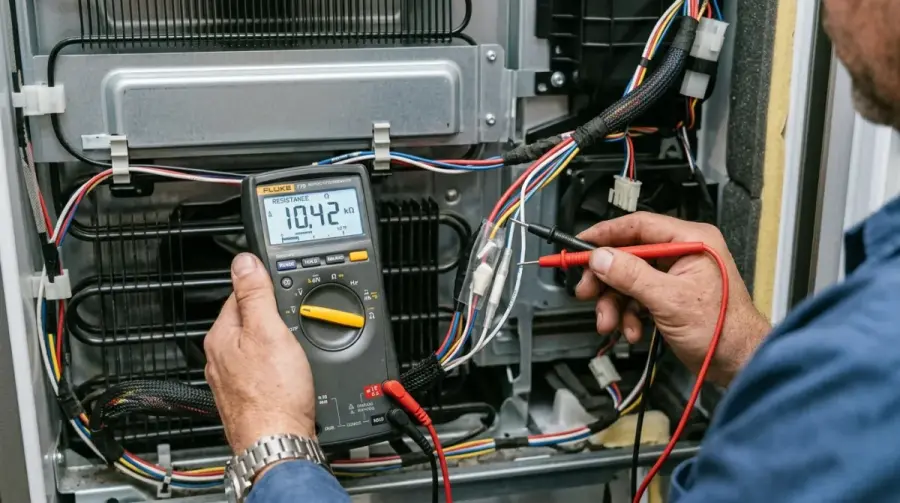
First, the technician disconnects AC mains power and verifies that the DC bus capacitor voltage has safely decayed to under 10V DC using a Fluke 87V multimeter across terminals + (P) and – (N). Next, the technician tests the six internal IGBT power diodes using the meter’s diode-check function. Placing the positive lead on terminal – (N) and probing motor output terminals U, V, and W should yield a uniform forward voltage drop of approximately 0.35V to 0.52V. Reversing leads should show open line (OL). If any terminal reads 0.00V (dead short) or OL in both directions, the IGBT module is blown. Commercial refrigeration systems utilize similar microprocessor and start relay diagnostics, as detailed in our guide on Atosa commercial refrigerator Carel controller repair.
Second, the technician disconnects the motor harness plug from the inverter and tests the three-phase motor windings. Using a micro-ohmmeter, phase-to-phase resistance is measured between U-V, V-W, and W-U. All three readings must be balanced within 2% to 3% of each other (typically between 1.8 Ω and 4.2 Ω depending on motor horsepower). Next, a high-voltage insulation tester (Megger) applies 500V DC between each motor phase and chassis earth ground. Insulation resistance must exceed 50 Megohms (50 MΩ); any reading below 10 MΩ indicates moisture or insulation breakdown that will instantly trip F01.
| Test Point / Component | Measurement Parameter | Factory Specification | Fault / F01 Trigger Condition |
|---|---|---|---|
| DC Bus Voltage (Terminals + / -) | DC Volts (Multimeter) | 310V to 340V DC (at 240V AC Input) | < 260V DC (Sag) or > 410V DC (Overvoltage) |
| Motor Phase-to-Phase Resistance | Ohms (Ω) across U-V, V-W, W-U | 1.8 Ω to 4.2 Ω (Balanced within 3%) | > 5% Imbalance or < 0.5 Ω (Shorted Winding) |
| Motor Insulation Resistance to Ground | Megohms (MΩ) at 500V DC Megger | > 50 MΩ (Minimum acceptable: 10 MΩ) | < 5 MΩ (Dielectric Breakdown to Chassis) |
| IGBT Freewheeling Diodes | Diode Voltage Drop (V) | 0.35V to 0.52V Forward / OL Reverse | 0.00V Short or OL in Both Directions |
| Dynamic Braking Resistor (B1 / B2) | Ohms Resistance (Ω) | 80 Ω to 120 Ω (Model specific) | ∞ OL (Open Resistor / Blown Element) |
| Tachometer Sensor Pulse Output | Frequency (Hz) / AC Volts | Smooth square-wave proportional to RPM | 0 Hz or Erratic Spikes (No Speed Feedback) |
Commercial gas deep fryers and kitchen cooking units also rely on millivolt telemetry testing, as documented in our diagnostic study on Frymaster commercial fryer pilot troubleshooting. Accurate instrument-based diagnostics ensure rapid resolution on the first truck dispatch.
Critical OEM Parts Involved in Dexter Drive Train Restoration
When restoring a commercial Dexter washer locked out on F01, commercial technicians install only certified factory OEM parts engineered to withstand continuous laundromat duty:
- Dexter OEM Variable Frequency Drive (VFD) Inverter Module (Part #9643-428-001 / #9643-428-003): The factory-programmed variable speed motor drive with calibrated torque-limiting algorithms and anti-moisture potting.
- Dexter 3-Phase Heavy-Duty Induction Drive Motor (Part #9376-295-001): Industrial TEFC (Totally Enclosed Fan Cooled) 3-phase induction motor with Class H insulation rated to withstand 180°C internal stator temperatures.
- Dynamic Ceramic Braking Resistor Bank (Part #9532-054-001): High-wattage wirewound ceramic resistor designed to safely burn off regenerative electrical energy during spin braking.
- Optical / Magnetic Tachometer Speed Sensor: Precision Hall-effect pulse sensor delivering real-time drum RPM telemetry to the main processor.
- Multi-Ribbed EPDM Heavy-Duty Serpentine Drive Belt: High-grip synthetic rubber belt engineered for high-torque acceleration without slippage. Commercial ovens and bakery equipment utilize similar specialized motor drive components, outlined in our coverage of Blodgett commercial convection oven blower motor repair.
Preventive Maintenance Protocols to Protect Laundromat VFD Inverters
Implementing scheduled preventive maintenance across your laundromat or institutional laundry room dramatically reduces the frequency of unexpected inverter breakdowns:
- Monthly Rear Chase Lint Decontamination: Use industrial HEPA vacuums and compressed dry nitrogen to clean heat sink fins and cooling fans on all inverter drive enclosures. Maintaining clear airflow prevents semiconductor over-temperature trips.
- Quarterly Terminal Torque Inspections: Thermal expansion and mechanical vibration loosen terminal screws over time. A loose motor lead terminal creates micro-arcing that instantly destroys sensitive IGBT transistors. Retorque all power terminals to 12 in-lbs.
- Bi-Annual Supply Voltage & Phase Balance Audits: Measure incoming line-to-line voltage across all phases. A phase voltage imbalance exceeding 2% causes a disproportionate 15% current imbalance in the inverter bridge, severely overheating the input diodes.
- Tachometer Sensor Telemetry Calibration: Clean magnetic pick-up teeth on the motor pulley and verify clearance with the sensor bracket. Continuous extrusion ice equipment and refrigeration units also require scheduled motor telemetry audits, as shown in our Follett commercial ice dispenser auger repair.
Electrical Safety, High-Voltage Capacitors & OSHA NFPA 70E Standards
Servicing industrial laundry equipment involves high electrical potentials, high rotational forces, and hot components. Always follow these vital safety standards:
- NFPA 70E Lockout/Tagout (LOTO): Always open the main electrical disconnect switch and apply an OSHA-approved lock and tag before touching rear panels or wiring harnesses.
- Stored Energy Verification: Wait a minimum of 5 minutes after power disconnection, then verify with a digital voltmeter that the DC bus capacitor voltage has dropped to absolute zero before servicing.
- Avoid Touching Dynamic Braking Resistors: Resistors can reach surface temperatures exceeding 300°F during heavy spin braking. Allow components to cool completely before tactile inspection. Commercial walk-in freezers also require strict electrical safety around high-amperage defrost heaters, documented in our guide for commercial walk-in freezer defrost timer repair in Roswell.
Frequently Asked Questions (Interactive Technical Accordions)
Below are 16 in-depth, expert answers to the most common questions regarding Dexter commercial washer Inverter Fault F01, motor testing, and drive repairs in Roswell, GA:
Q1: What does Inverter Fault F01 mean on a Dexter commercial washer?
Error F01 indicates an instantaneous overcurrent trip inside the Variable Frequency Drive (VFD) inverter. The drive’s internal micro-controller detected motor output current exceeding 200% of maximum rated capacity. This is triggered by a shorted IGBT power transistor module, shorted windings in the 3-phase drive motor, a seized tub bearing, or a failed dynamic braking resistor.
Q2: Can I clear the F01 code by simply resetting the circuit breaker?
If the fault was caused by a temporary power spike or utility glitch, power cycling the breaker for 5 minutes might temporarily reset the display. However, if the code reappears as soon as the motor begins to tumble, a permanent hardware short exists. Repeatedly resetting power on a shorted inverter risks blowing the input rectifier or catching fire.
Q3: How do I know if the fault is caused by the motor or the inverter?
A certified technician disconnects the motor cable from the inverter terminals and performs two tests: first, measuring phase-to-phase resistance across terminals U, V, and W with a digital ohmmeter (must balance within 3%), and second, applying 500V DC with a megohmmeter between each phase and chassis ground (must read over 10 MΩ). If the motor passes both tests, the inverter drive board has failed.
Q4: What role does the dynamic braking resistor play in F01 errors?
During spin deceleration, the motor generates electrical power that must be burned off as heat through the dynamic braking resistor. If this resistor burns open or its wiring breaks, the regenerated voltage surges onto the internal DC bus. This causes severe electrical instability that often manifests as an instantaneous F01 trip during spin stop.
Q5: Can an overloaded wash basket cause an F01 error?
Yes. If a customer severely overstuffs a 30-pound washer with heavy wet blankets or dense rugs, the rotational inertia during the transition from wash tumble to high-speed extraction can exceed the inverter’s instantaneous current limit. If the machine works normally after removing half the load, mechanical overloading was the trigger.
Q6: How long do Dexter washer VFD inverters typically last?
Under clean, well-ventilated laundromat operating conditions, a factory OEM Dexter inverter routinely operates for 8 to 12 years (handling 15,000 to 25,000 wash cycles). Excessive lint buildup, high rear chase ambient heat above 105°F, and high humidity can reduce inverter lifespan to under 4 years.
Q7: Can a generic off-the-shelf VFD be substituted for a Dexter inverter?
While generic Delta VFD drives can physically run an induction motor, they lack Dexter’s proprietary acceleration/deceleration profiles, out-of-balance detection logic, and communication interface with the Dexter control computer. Installing a non-OEM drive typically results in constant balance errors and improper G-force extraction.
Q8: What is the normal DC bus voltage on a Dexter commercial washer?
When supplied with standard 240V AC power, the rectified and filtered direct-current bus inside the inverter operates between 310V and 340V DC. If incoming utility voltage sags below 208V AC under heavy facility load, the DC bus drops below 260V DC, triggering overcurrent trips as the drive attempts to maintain motor horsepower.
Q9: Why does the washer drum rotate easily by hand but still throw F01?
Smooth manual drum rotation confirms that the mechanical bearings and wash basket are not seized. If the F01 code persists despite free mechanical rotation, the issue is purely electrical—typically a blown IGBT power transistor within the inverter or shorted internal motor windings.
Q10: What happens if I install a new inverter on a shorted motor?
The new inverter will be destroyed instantaneously upon the first motor start command. The shorted motor winding creates a near zero-ohm path that pulls massive current through the new IGBT transistors, blowing them within milliseconds. A master technician always verifies motor health with a 500V megohmmeter before installing a new drive.
Q11: How does line voltage imbalance damage commercial washer inverters?
In three-phase commercial buildings, an incoming voltage imbalance of just 3% between phases can force up to 25% current imbalance through the inverter’s input bridge diodes. This localized heating causes input diode failure, excessive DC bus ripple voltage, and premature capacitor rupture.
Q12: What is the turnaround time for an on-site Dexter inverter replacement?
Our service vehicles in Roswell carry genuine OEM Dexter/Delta inverter modules and diagnostic telemetry equipment. An on-site diagnostic, motor megger test, and inverter swap is typically completed within 1.5 to 2.5 hours on the same day.
Q13: Does Dexter offer remanufactured or repaired inverter boards?
Factory-authorized remanufactured exchange drives are often available through commercial parts distributors. However, we prioritize brand-new OEM drives that carry full manufacturer warranties and the latest generation firmware updates.
Q14: How does lint buildup inside the rear service chase cause inverter trips?
Inverter heat sinks depend upon continuous forced-air cooling. When dryer exhaust lint coats the cooling fan blades and aluminum cooling fins, heat cannot dissipate. As internal IGBT junction temperatures exceed 100°C, thermal protection circuits lower current thresholds, making the drive far more prone to tripping F01.
Q15: Can a loose electrical wire terminal trigger an F01 overcurrent error?
Yes. A loose screw terminal on motor phase leads U, V, or W creates microscopic electrical arcing under high-frequency PWM switching. This rapid arcing generates high-voltage inductive voltage spikes that the VFD’s current sensors interpret as a dead short, tripping F01.
Q16: Why should I choose certified commercial technicians over general handymen?
Commercial laundromat equipment combines three-phase high voltage, electronic VFD drives, and high rotational mass. Our certified technicians carry high-voltage CAT-III testing meters, 1,000V insulation testers, genuine OEM Dexter parts, and deep factory programming expertise, ensuring safe, permanent restoration.
Related Commercial Appliance & Laundry Repair Services
Our commercial technical division provides full diagnostic, maintenance, and repair coverage across all coin laundromat, hospitality, and institutional foodservice appliances throughout Roswell:
Key Takeaways for Roswell Laundromat & Facility Owners
- F01 Meaning: Inverter Fault F01 signals an instantaneous hardware overcurrent event exceeding 200% of the VFD drive’s safe operating limits.
- Primary Culprits: Blown IGBT transistor power modules, shorted 3-phase motor windings, or open dynamic braking resistors are the leading root causes.
- Paired Testing Mandate: Never install a replacement inverter without performing a 500V DC megohmmeter insulation test on the drive motor to prevent repeat drive failure.
- High Voltage Hazard: The internal DC bus maintains 310V to 340V DC stored energy; always verify zero volts with a CAT-III meter before servicing.
- Ventilation Importance: Keeping the rear service chase clear of lint and maintaining rear chase cooling fans prevents heat sink thermal overload trips.
- Rapid ROI: Replacing an inverter drive restores a $10,000+ commercial washer for under 15% of replacement cost.
- Local Master Techs: Priority emergency commercial dispatch is available across Roswell, Alpharetta, Milton, and Johns Creek with genuine factory OEM parts.
Call to Action: Emergency Commercial Laundry Dispatch in Roswell
Priority Commercial Laundry Dispatch
Clear Your Dexter F01 Fault & Restore Wash Revenue Today
Don’t let a locked-out commercial washer reduce your laundromat’s daily turns. Our master certified technicians provide same-day emergency diagnostics, high-voltage megohmmeter testing, and genuine OEM inverter drive replacements across Roswell, GA.
Licensed & Insured Commercial Technicians • Genuine Dexter OEM Parts • 90-Day Comprehensive Warranty
Need Certified Appliance Repair Today?
Skip the phone line — book direct local priority dispatch across Alpharetta, Milton, Roswell & Johns Creek.